Douglas Todd: Trudeau’s defiance of India ‘killing two birds with one stone’

Some interesting insights regarding the different positions within the Sikh and South Asian communities:

The callers lined up like almost never before on Harjit Singh Gill’s radio talk show this week after Prime Minister Justin Trudeau declared there were “credible allegations” that Indian agents were involved in the June murder of a Sikh activist outside a Surrey gurdwara.

“Things are very hot in the community,” said Gill, who has a morning talk show on Sher E Punjab, 600 AM. Trudeau took a chance on going public about the bloody end of the Khalistan independence fighter, Gill said, and many of B.C.’s 300,000 Sikhs felt affirmed by it.

Sikhs, who make up B.C.’s second-largest religious group after Christianity, have complained to Ottawa for months that India’s government, led by Prime Minister Narendra Modi, who many call a Hindu nationalist, must have had a hand in the slaying of Hardeep Singh Nijjar.

A plumber whom Indian authorities have accused of murdering a Hindu priest and killing six in a Punjabi cinema bombing, Nijjar was shot in his truck in the parking lot of the giant Guru Nanak gurdwara, of which he was president.

Since Gill believes no politician makes such a big move without considering its electoral implications, he said Trudeau “killed two birds with one stone” in his high-impact claim, which Indian government officials have angrily denounced as “absurd and motivated.” They are now asking Indian nationals to be cautious about visiting Canada because of its “growing anti-India activities and politically condoned hate-crimes.”

Trudeau’s thunderbolt declaration, Gill said, was satisfying to many Canadian Sikhs, particularly advocates of a separate Sikh homeland called Khalistan, in the way it protected Canadians’ sovereignty and right of free expression.

The prime minister, Gill said, also brilliantly distracted voters from issues that were killing him in the polls.

They include the housing affordability crisis, China’s subversion of Canadian elections and Trudeau’s poorly rated performance at this month’s G20 summit in India, where Modi accused Trudeau of protecting Sikh militants who employ violence in their battle for the ethno-religious vision of Khalistan.

Trudeau’s attack on possible interference by India’s government will resonate not only among Sikhs, but among immigrants from all sorts of countries, says Andres Machalski, president of Mirems, which monitors more than 800 foreign-language media outlets in Canada.

Since millions of immigrants have come to Canada to escape discrimination and persecution in their homelands, Machalski said, “Trudeau’s unassailable message to all immigrants is, ‘We will stand up for you.’”

That message can hit home for people who have left behind all sorts of conflict-ridden nations, whether China, Ukraine or Sri Lanka, said Machalski. It reverberates for Machalski himself, since he came to Canada as a refugee from Argentina in 1976, when elected leaders were replaced in a ruthless military coup.

Specifically, Machalski said Trudeau’s declaration on the opening day of parliament, which “gained maximum attention” and divert from issues working against his popularity, was mostly aimed at garnering support from the roughly 800,000 Sikhs in Canada.

Even though the number of Hindus in Canada is about the same, and many will be upset by Trudeau’s attack on the Hindu-majority country of India, Machalski said Punjabi Sikhs in Canada have a stronger group identity and are more politically organized and influential than Hindus, particularly in crucial federal and provincial ridings in Greater Toronto, Metro Vancouver and Calgary.

That’s the case, Machalski said, despite Punjabi Canadians disagreeing on just how much support there is for a separate Khalistan in this country.

“Many Sikhs kind of just tolerate the Khalistanis and their vociferous rallies,” he said.

Despite the wide distribution of vivid photos of Canadian Sikh protesters outraged at India, Gill agrees the Sikh population is “not monolithic.”

It’s hard to get numbers on how many Canadian Sikhs share the vision of Khalistan, said Gill, who looks forward to the results of the non-binding referendum that a secessionist group, Sikhs for Justice, has organized.

Last week vote organizers claimed 135,000 India-born Canadians in the Lower Mainland showed up to vote in the referendum that Nijjar, whom India accused of terrorism, had helped organize.

Earlier referenda were held among the large Sikh populations in Britain and suburban Toronto, which has contributed to Modi’s accusation that offshore agitators are stirring up division in his nation.

Prominent Punjabi Canadian Barj Dhahan, who has spent the past 30 years conducting business and philanthropy between B.C. and India, doesn’t trust the Metro Vancouver referendum. He says it’s not clear, for instance, who is eligible to vote in it.

And since Dhahan frequently travels to northern India, he says he knows the idea of Khalistan is virtually dead there. Sikhs in India “are much more worried about getting jobs and having a future.”

Gill, the talk-show host, also acknowledges the Khalistan movement is weak in India, in part because of changing demographics. In Canada, Gill said, views on Khalistan can differ sharply between Sikh fundamentalists and Sikh moderates, who often end up fighting for control of the province’s many gurdwaras.

Machalski, who monitors the discourse in dozens of Punjabi print and broadcast outlets across Canada, said there is no more uniformity among Canadian Sikhs on Khalistan than there is among Canadian Catholics on the pope.

Despite their wide range of views, Machalski said Sikhs in Canada are a powerful political force in electoral politics, including as MPs and MLAs, in part because of their ability to get assistance from the leadership of gurdwaras, which fill the role of community centres even for non-religious Punjabis.

Shinder Purewal, a Kwantlen Polytechnic University political scientist, and Dhahan have described how the Sikh population “punches above its weight” in politics for many reasons, particularly because of its ability to impact partisan nomination battles, including that of lawyer and NDP leader Jagmeet Singh, who was an early critic of India and defender of Khalistan supporters.

Source: Douglas Todd: Trudeau’s defiance of India ‘killing two birds with one stone’
Douglas Todd: Warnings of today’s foreign-student exploitation began a decade ago

Ignored then and no sign yet of meaningful action today:

North America’s foreign-student system is no longer a humanitarian endeavour to lift up the planet’s best and brightest, and support the developing world.

Instead, it’s become a commercial competition full of marketing rhetoric, which is creating chaos in higher education.

That’s what the West’s leading experts in international education told me 10 years ago.

They were describing how governments and post-secondary institutions were adopting an increasingly cynical attitude toward foreign students.

Philip Altbach, Hanneke Teekens and Jane Knight were ahead of their time in lamenting how international education was turning into a “cash cow” for public and private universities and colleges in the U.S. and especially Canada, where there are at least eight times more per capita than in the U.S.

While the concept of international education continues to have upsides, it’s now becoming obvious to many in Canada that the foreign-student system is creating hard times, especially for students from abroad. Even the Liberal government, long in denial, is starting to admit it.

Prime Minister Justin Trudeau’s government acknowledges it has pumped up the number of foreign students in Canada to, officially, 900,000. That compares to 225,000 in 2013. And experts say Ottawa’s number is a serious undercount.

The Liberals are still not necessarily admitting the obvious: That governments and post-secondary institutions are addicted to foreign-student spending and fees, which are four times higher than those of domestic students. Ten years ago, foreign students brought $8 billion into Canada, now Ottawa estimates it’s up to $30 billion.

The main problem, however, that has suddenly drawn more attention to foreign students is the out-of-control cost of housing, particularly renting.

International students, say housing analysts, are hiking competition for places to live. The average rent for a one-bedroom in Canada has jumped to a worrying $1,800, according to Rentals.ca. Vancouver is the most extreme in the country, at a devastating average of $3,013. A one-bedroom in Toronto is $2,592.

Foreign students are an expanding factor in such expensive housing — and it’s hurting the study visa holders themselves, who, according to both social media and the mainstream media, are increasingly feeling taken advantage of.

Even Canada’s housing minister, Sean Fraser, last month used the word exploited. And he finally admitted universities and colleges are bringing in far more students than they could possibly provide housing for.

That was before Benjamin Tal, chief economist for the CIBC Capital Markets, told Liberal cabinet ministers the government is dangerously undercounting the number of temporary residents, particularly foreign students, in Canada.

While the government, and Statistics Canada, state there are more than one million non-permanent residents in Canada, Tal’s calculations show there are at least one million more missing from the count. “Housing demand is stronger than what official numbers are telling you and that’s why we’re approaching a zero vacancy rate.”

The government’s calculations, Tal said, have ignored that many foreign workers and students don’t leave the country when their visas expire. They stay on in hopes of applying to become immigrants. Census methods for surveying foreign students, he added, are misleading.

Giacomo Ladas of Rentals.ca says, “International students do add pressure to the rental market,” even while he emphasized it’s not their fault.

“There’s such a supply and demand issue in the rental market right now and they add to this imbalance. The study permits for international students have increased by 75 per cent in the last five years. So, that’s a huge influx of people coming in and nowhere to put them.”

Delegates at a recent Union of B.C. Municipalities’ housing summit heard how rapidly foreign students and other non-permanent residents are adding to demand for housing.

The number of non-permanent residents and newcomers to Metro Vancouver has in five years almost doubled, delegates were told. Foreign students and other recent arrivals own eight per cent of all homes in Metro Vancouver, and account for 25 per cent of renters.

Canada’s housing minister received a lot of media attention in August when he responded to a reporter’s direct question by saying he wouldn’t rule out a cap on international students.

But since then both he and Immigration Minister Marc Miller have backtracked, and Trudeau has warned not to “blame” foreign students.

Miller admitted Canada’s “very lucrative” foreign student system “comes with some perverse effects, some fraud in the system, some people taking advantage of what is seen to be a backdoor entry into Canada.”

Whatever the Liberal cabinet is starting to admit in the past month, however, the public would be naive to expect any real reforms.

In addition to anxiety over the housing crisis, many economists also worry international students are being taken advantage of by employers to keep wages down. An earlier StatCan study showed up to one out of three foreign students aren’t attending school.

While some representatives of universities and college, especially private ones, are trying to shut down debate by accusing critics of blaming study visa holders for high housing costs and low wages, the reality is those raising concerns can be seen as standing up for people on study visas.

Many people are aware of a high suicide rate among international students, including alarms raised by funeral homes. The largest cohort of foreign students, by far, now comes from India, and it is often South Asian voices in Canada who are pointing to their victimization, including employer abuse and sexual harassment by landlords.

And Vancouver immigration lawyers such as Richard Kurland and George Lee add the federal government’s decision to allow unlimited international students is setting up many for future immigration disappointment.

Canada is building far too big a pool of people who will be highly qualified for permanent resident status, they say. Not everyone can win the immigration points-system competition, which has an annual cutoff.

The trouble is a lot of vested interests are eager for the foreign-student gravy train to keep chugging along, regardless of the unintended suffering it causes — including for students desperate for a place to live.

Source: Douglas Todd: Warnings of today’s foreign-student exploitation began a decade ago

Douglas Todd: Canadian Indigenous spirituality anything but monolithic 

Another good reminder:

“All First Nations believed their values and traditions were gifts from the Creator. One of the most important and common teachings was that people should live in harmony with the natural world and all it contained.”

That’s what the Canadian government’s educational resource for young people says every Indigenous person believed before settlers arrived. And today many continue to believe there is uniformity in contemporary Indigenous spiritual practice.

But the recent Canadian census reveals that Canada’s 1.8 million Indigenous people are anything but monolithic in regard to religion and spiritual practice. The range is extraordinary.

To begin with, the census, which every decade asks about religion, found a fast-rising number of Indigenous people, about 47 per cent, are checking off the box: “No religion, and secular perspectives.” That compares to only 20 per cent in 2011.

At the other end of the spectrum, a declining number of Indigenous people, also about 47 per cent, says they’re Christians.

And only four per cent of Canadian Indigenous people put themselves in the category of “traditional (North American Indigenous) spirituality.” This small group would be closest to the historic form of spirituality described in Ottawa’s educational resource for young people.

Indigenous religious diversity stretches surprisingly wide in 2023, flowing into unfamiliar streams.

The census, for instance, found 1,840 Indigenous Canadians who say they’re Muslim, while another 1,615 Canadians are Jewish.

I reached out to some Indigenous, Muslim and Jewish organizations to interview a First Nations, Inuit or Metis who is Jewish or Muslim, whereupon the Centre for Israel and Jewish Affairs introduced me to Cheyenne Neszo.

A status member of the Lheidli T’enneh First Nation based in and around Prince George, Neszo is deep into the process of converting to Judaism, the proud religion of her fiancé, Zach Berinstein.

Neszo, a 32-year-old lawyer, grew up in North Delta, where her extended family occasionally attended church and had in many ways lost touch with their Indigenous roots. That changed in recent years, as Neszo, her mother and grandmother applied for First Nations status and reconnected to those cultural origins.

Now, Neszo is three years into studying Judaism with Rabbi Dan Moscovitz at Vancouver’s Temple Sholom, where she and Berinstein will be married in September. “It’s just one of the most welcoming places I’ve come across,” said Neszo, who specializes in Indigenous law. Their wedding will be Jewish, with Lheidli T’enneh elements.

To understand the evolution in Indigenous religiosity over the years, I have frequently interviewed First Nations, Metis and Inuit elders and others who are Christians, who belong to one of the three denominations that ran Canada’s defunct federally funded residential schools.

Although the proportion of Indigenous people who belong to those denominations is declining, it remains that 485,000 Indigenous people today (27 per cent) still say they’re Catholic, 110,000 affiliate with the Anglicans and 42,000 are United Church members.

In addition, 28,000 Indigenous people belong to the Pentecostal Church, which did not operate a residential school. And what of the 6,515 who are Jehovah’s Witnesses and 5,035 who belong to the Church of Jesus Christ of Latter Day Saints (Mormons)?

Although he was not available for an interview, John Borrows, who is of Anishinaabe heritage and a committed Latter-day Saint, was recently profiled by Cardus, a Canadian think tank. Borrows is a professor specializing in Indigenous law, as well as head of the Victoria Multifaith Society.

Like other Anishinaabe people, Borrows went on a Vision Quest as a young man, fasting and being alone in the forest. Although he joined the Latter Day Saints when he was 19, he believes those experiences of encountering God’s presence in nature still inform his faith.

Ray Aldred, a member of the Cree Nation who directs the Indigenous studies program at Vancouver School of Theology, is not surprised more Canadian First Nations are classifying themselves under “no religion, and secular perspectives.”

They are essentially saying, Alder believes, that they don’t want to be associated with “one of those,” by which he means the Christians who are increasingly being condemned for their role in operating about 125 residential schools, which were almost all closed by the 1970s.

There was “no such thing as secular” in traditional Indigenous culture, said Aldred. “The category didn’t exist in the Indigenous mindset.”

He said Indigenous people are picking up the concept from attending college and university, where faculty tend to vilify Christianity and academic papers about the faith seem to only get published if the author can show they hate the religion.

“All that has an impact.”

At the same time, Aldred said many Indigenous people don’t see a contradiction between Christianity and their peoples’ ancient spiritual ways. “Their families have been part of the church for a couple of hundred years.”

For his part, Aldred, who is an Anglican priest, said he believes settler culture and religion has brought both positives and negatives.

Rather than Indigenous people zeroing in on their specific religious or non-religious identities, Aldred suggests they “try to focus on a communal identity,” which connects them to the land and to each other.

He talked about how Metis people, as well as the Nisga’a of northern B.C., follow many different denominations and religious traditions without fighting about it. He admires the Nisga’a creed: “One nation, one heart.”

And in an era when social media incites groups to feel contempt for the other, Aldred rightly encourages people of different faiths and no faith to engage in authentic dialogue.

“The important thing is people learn to speak heart to heart, so we hear one another.”

Source: Douglas Todd: Canadian Indigenous spirituality anything but monolithic 

Douglas Todd: B.C. desperately needs Ottawa to tie immigration levels to housing

More on housing and immigration levels:

Last week, hundreds of B.C. mayors and municipal councillors heard exactly why Ottawa’s failure to do so is causing them grief when it comes to providing adequate infrastructure, particularly affordable housing, but also schools, health-care facilities and daycares.

Delegates to the Union of B.C. Municipalities convention heard the country’s record population growth last year of one million was 96 per cent from offshore arrivals. Forty per cent of those newcomers were permanent residents and 60 per cent were temporary residents, especially foreign students.

The flood of foreign nationals is creating unprecedented demand for homes, which is pushing up rents and housing prices, which are among the highest in the world in cities like Vancouver and Toronto.

While people in Canada who already own homes, or serve as landlords, are benefiting, the rest are having to struggle with price-to-household income ratios that have soared since 2005 to among the worst in the Western world.

Chris Friesen, a national leader in providing settlement services for immigrants and refugees, told delegates it’s taking far too long for Ottawa to do the obvious and co-ordinate its migration policy with housing and other taxpayer-funded services.

Last year, British Columbia, which has almost no control over migration, took in 60,000 new permanent residents and 140,000 temporary residents, said Friesen, the longtime CEO of the Immigrant Services Society of B.C.

“And at the end of the day everybody is looking for a home,” said Friesen. Despite Kahlon’s recent efforts, Friesen criticized the way the NDP government in 2018 launched a 30-point housing strategy “and nowhere in that plan is there mention of immigrants, temporary residents or refugees.”

Friesen said service providers are increasingly talking about how the country’s “absorptive capacity” for newcomers is stretched. It’s not only affecting newcomers, he said, but Canadian-born residents, too.

A Statistics Canada report by Annik Gougeon and Oualid Moussouni showed immigrants bought 78 per cent of the homes purchased in Richmond in 2018, and more than 65 per cent of the dwellings bought in Surrey and Burnaby. Newcomers bought more than 40 per cent of homes in Vancouver, North Vancouver and New Westminster in 2018.

Dan Hiebert, professor emeritus of geography at the University of B.C., told the delegates that Canada would have to immediately build 1.36 million more houses and apartments just to reach the average homes-to-population ratios of the OECD, a club of well-off nations.

And to achieve “affordability” in the housing market, the Canada Mortgage and Housing Corporation has estimated the country would need to build 3.5 million extra housing units in the next seven years. Currently, only about 280,000 units are built each year.

The proportion of Metro Vancouver housing owned or rented by recent newcomers has doubled since 2016, according to census data. Growth rates are rocketing.

Permanent and non-permanent residents who arrived in the past five years alone now account for 14 per cent of Metro Vancouver’s population, eight per cent of all homeowners and 25 per cent of all renters.

Canada has not seen such high immigration rates since 1912, when 400,000 newcomers arrived, said Hiebert. Ottawa is now aiming for 500,000 new permanent residents each year. And that does not include hundreds of thousands of guest workers, plus the record 800,000 foreign nationals in the country on study visas.

Years ago, Hiebert referred to how Canada’s immigration policy is, in effect, Canada’s housing policy. Without knowing its origins, many UBCM attendees repeated the phrase frequently.

Hiebert suggested Canada’s dilemma is that arguably there might not be enough people to fill the country’s labour market, but there are too many for Canada’s housing market.

The vice-president of the Vancouver Board of Trade, David van Hemmen, said B.C. businesses are having difficulty attracting talent because of the alarming cost of housing. Some businesses, he said, are moving operations to Alberta or Washington state, to avoid B.C.’s daunting land costs.

While panelists and delegates consistently said the country should welcome newcomers, some civic officials who went to the microphones remarked on how Ottawa’s migration targets are “aggressive.”

Carling Helander, a provincial government immigration policy specialist who sat on the panel in lieu of Municipal Affairs Minister Anne Kang, acknowledged B.C.’s quest for new workers to address labour shortages creates a “circular loop” that tends to hike housing costs.=

A recent Gallup poll revealed 75 million people around the world want to move to Canada, the delegates heard. In addition, an Angus Reid Institute poll found newcomers are enthusiastic about getting into the housing market.

While 59 per cent of Canadian-born residents said “it’s important to own a home to feel like a real Canadian,” that figure jumps to 75 per cent among recent immigrants. While the individual earnings of recent immigrants are below average, Hiebert said household incomes are higher than most because more people tend to inhabit the same dwelling.

Friesen cited how the Liberal government’s humanitarian approach to asylum seekers from war-ravaged Ukraine exemplifies the absence of co-ordination between federal migration policy and local housing needs.

More than 175,000 asylum seekers from Ukraine have already landed in Canada, said Friesen. But 850,000 more have applied for refugee status. It’s just been announced they will have to forfeit their refugee application if they don’t get to Canada by March, 2024. All this, Friesen said, is being done without housing co-ordination.

The ISS of B.C. already has 13 full-time staff devoted to finding houses for asylum seekers and other newcomers, said Friesen. “Over 60 per cent of them land in Surrey in basement suites.”

Similar to B.C.’s housing minister, Friesen said this country badly needs a 10-year population growth strategy that matches arrivals with housing.

Source: Douglas Todd: B.C. desperately needs Ottawa to tie immigration levels to housing

Douglas Todd: 10 ways Ottawa diminishes Canadian citizenship [my comments embedded]

Not all of these are on the same level and have embedded comments. Needless to say, agree on the oath:

Last week, the House of Commons debated the Liberal move to play down the in-person citizenship ceremony and allow more newcomers to become Canadians by the click of a laptop key.

This technological technique for fulfilling a solemn oath is startling to many, even past governor general Adrienne Clarkson, who is long associated with liberal-left values. She is among those saying the ceremony is essential to building healthy pride in Canada.

We shouldn’t, though, be surprised by Ottawa’s latest diminishment of citizenship.

Even while many joke about Prime Minister Justin Trudeau’s 2016 musings to the New York Times that Canada is the world’s first “post-national state,” he keeps finding ways to convince the world he actually means it.

Trudeau and his backers often reveal their support for almost an open-border policy, as would fit with someone who believes, as he does, that there truly is ‘‘no core identity, no mainstream in Canada.’’

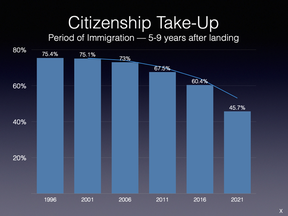
By his fruits shall you know him. The most recent sign is the 15-percentage point drop, since Trudeau was elected, in new arrivals taking Canada’s oath of citizenship.

More people in the immigration process are not bothering with Canadian passports. They’re hanging in on work or study visas or going no further than permanent resident status, which provides full social services and economic advantages.

Fewer are choosing to take the oath of Canadian citizenship

It was announced Thursday that Canada accepted a record one million new immigrants in 2022, the kind of milestone that can bring out Trudeau’s often-confusing rhetoric about pride in being Canadian. But what values does he expect Canadians, native-born and naturalized, to uphold?

As a former immigration department director, Andrew Griffith, notes, one quarter of young adults who immigrated tell pollsters they will probably leave Canada in two years. Like Canadian-born people, they’re frustrated by the cost of living and home ownership, which Liberal policies have worsened.

In addition to the Liberal effort to make optional Canada’s identity-affirming citizenship ceremony, here are nine further developments that, in different ways, undermine the value of citizenship:

Urging non-residents to vote

[Agree, although important to note while the number tripled once the change was implemented, only a total of about 30,000 expatriates voted in 2019 and 2021]

: few did so in One early indicator the Liberals were reducing the meaning of citizenship occurred in 2018, when Bill C-76 allowed any passport holder who doesn’t live in the country to vote federally. While most countries that accept immigrants expect them to maintain a meaningful relationship to their new nation, Senator Linda Frum criticizes the push for non-resident citizens to vote regardless of how long they’ve been away or whether they ever intend to return.

Buying citizenship

[Don’t have the sense that the Quebec program is that active recently.]

The Conservatives in 2014 cancelled the national immigrant investor program, by which rich offshore nationals could, in effect, buy Canadian citizenship. But the Liberals basically allow it to continue, including through provinces’ nominee programs and especially Quebec’s investor scheme, which former Quebec immigration director Anne Michèle Meggs said last year admitted 5,000 multimillionaires.

Foreign nationals can vote for political candidates

[Two schools of thought here, one that it is part of the integration process, the other that it provides more opportunities for foreign interference.]

is ripe for abuseIt’s telling the Liberals and NDP allow not only non-citizens — but non-permanent residents — to become party members and vote in nomination battles. Sources told Global News recently that CSIS investigators alleged international students from China, who are on study visas, were bused in to support one Liberal candidates’ nomination.

Pushing for permanent residents to vote

[Agree, given that Canadian citizenship relatively easy (if costly) to acquire.]

Many Liberal and NDP politicians, as well as Vancouver city council in 2018, have pushed to give permanent residents the privilege to vote in elections, especially municipal. That is arguably the only significant right permanent residents do not have.

Reduced immigration requirements

[Largely just a reversal of Conservative changes in 2014 and reversion to previous requirements.]

The Liberals have lowered the bar for citizenship, by cutting expectations on how much time would-be immigrants need to spend in the country, and by reducing requirements for skills in an official language.

Don’t have to pay foreign-buyers tax

[Haven’t seen evidence of that being a major factor.]

Mortgage brokers are quick to tell newcomers to Canada they only need to be permanent residents to avoid paying provincial and federal taxes on foreign buyers of Canadian land. Immigration specialists say it’s leading to shrinking interest in citizenship.

Dual citizenship remains

[Largely a practical measure, as some countries require immigrants to use their country of origin passport when visiting. The dual citizenship ban of China affects Canadian naturalization more than that of India.]

Ottawa continues to celebrate dual (or multiple) citizenship. Despite few Canadians calling for the policy to be changed, it’s the opposite of China and India, which do not recognize dual citizenship. One reason arrivals from those countries are shunning Canadian citizenship, say specialists, is to avoid giving up their original passports.

Permanent residents can become Canadian soldiers

[This change essentially adopted a long-standing USA policy.]

Last year, says Meggs, the Liberals made it OK for those with only permanent resident status to serve in the Canadian military.

CBC plays down Canadian identity

[Sigh…]

It should be no surprise that the CBC, the public broadcaster led by Liberal-friendly Catherine Tait, is behind a strange campaign pronouncing: “It’s not about how Canadian you are, it’s about who you are in Canada.”

The slogan sends a “mixed message” about whether to commit to hard-won common Canadian values or to highlight differences, says Meggs. It mostly seems like in-vogue identity politics, which declares the most crucial thing about any Canadian is their gender, ethnicity, religion or sexual orientation.

While some can claim there are benefits to these 10 actions, it’s more than fair to also question whether they diminish citizenship.

Source: Douglas Todd: 10 ways Ottawa diminishes Canadian citizenship

Douglas Todd: The cure for religious extremism

Not sure how to achieve this “cure:”

What do the World Cup in Qatar, the Russian invasion of Ukraine, American gay, lesbian and transgendered people, Quebec’s government, Canada’s Indigenous residential schools, and India and China have in common?

They have all been embroiled in recent battles over religious freedom, a subject that can make a lot of eyes glaze over in secularized societies. That is unfortunate, because religious freedom is the remedy to extremism.

The ideal of religious freedom has taken on an especially sour taste in North America because it has been weaponized by some conservative Christians and others to defend their “freedom” to discriminate against gays, lesbians and transgendered people.

While this is a one-sided misuse of the concept, it shouldn’t take away from the value of religious freedom, which many maintain is the foundation of all human rights. That is even while it’s largely misunderstood in the West.

There is no ambiguity, however, in regard to the brutal way tens of millions of Muslims, Christians, Falun Gong members and Baha’i are subjected to harassment, imprisonment, forced labour and worse in Hindu-majority India, Buddhist Myanmar, Shia Iran, and atheist China.

Indeed, six of 10 of the world’s most populous countries — China, India, Brazil, Indonesia, Pakistan and Nigeria — are home to severe religious extremism, says Brett Scharffs, director of the International Center for Law and Religion Studies and a renowned specialist on religious freedom.

The four countries that round out the world’s 10 largest — the U.S., Brazil, Bangladesh and Mexico — are also on downward trajectories, says Scharffs. The U.S., for instance, has been battered by more massacres at churches, synagogues and mosques, which are also often targeted for vandalism and arson.

In Canada, a gunman killed six people at a Quebec mosque in 2017. And in 2021, scores of Catholic and other churches in Canada were vandalized or burnt to the ground. These attacks occurred following misleading media reports of the discovery of “mass graves” of children next to the sites of former Indigenous residential schools, which were federally funded and church-run.

It’s not too hard to point to where religious freedom is threatened — including via Russia’s invasion of Ukraine. The patriarch of the Russian Orthodox Church is dangerously backing Vladimir Putin’s attempt to erase the preferences of Ukrainian Orthodox people, who want to be independent of Moscow’s oppressive Orthodox leaders.

The concept of religious freedom was also central to a more nuanced issue: Western complaints about anti-homosexual laws in Qatar during the World Cup soccer spectacle.

While it is entirely legitimate to criticize the leaders of countries hosting major global events, Scharffs wonders whether the army of Western critics of Qatar were harder on the Muslim-majority country than on homophobic Putin when he hosted the World Cup in 2018. And when China held last year’s Winter Olympics, Scharffs believes it got off lightly for persecuting Uyghur Muslims and Christians.

Normally, in Canada, religious freedom also tends to play out subtly, since the nation is not yet as polarized as many others, even while some seem to want to make it so.

Many English-speaking Canadians accuse Quebec’s popular governing party of bigotry, Islamophobia and even racism for its 2019 religious neutrality law, Bill 21, which bans public employees in positions of authority from wearing visible religious symbols on the job. But do many fail to understand the French concept of “laicite”?

This week, politicians in Quebec’s Assembly called for the dismissal of Prime Minister Justin Trudeau’s new appointee, Amira Elghawaby, as Canada’s representative on combatting Islamophobia, since she had earlier claimed “the majority of Quebecers appear to be swayed not by the rule of law but by anti-Muslim sentiment.” She apologized late Wednesday.

Quebec points to how laicite attempts to keep religion out of public affairs, while enshrining the right to believe or not believe. It’s restrictions apply to not only the Muslim hijab, but also the Jewish kippa, Christian cross, and Sikh turban.

Laicite does not tend to get a tolerant hearing in Anglo-American cultures such as Canada, which, as Scharffs says, are arguably the most “permissive” in regard to public religious symbols. Scharffs took note at a conference when French intellectuals unanimously defended laicite in the name of women’s rights. “They had a strong sense that women wearing a hijab was not a sincere expression of autonomy, but was the result of coercion on the part of husbands, fathers and brothers.”

And while Scharffs, a law professor at Brigham Young University, says it is true that women are generally compelled to wear headscarves in many Muslim-majority countries, such as Saudi Arabia, he says in North America the hijab is more an expression of choice. While Scharffs understands Quebec’s attempt to make secularism the over-riding public system, he prefers a more pluralistic position, which allows space for the expression of multiple religious worldviews.

When it comes to the over-heated U.S., Scharffs worries the populist religious right and populist secular left are becoming more extremist, showing little concern for each others’ freedoms. Conservative Christian nationalists, for instance, don’t care about the freedom of minority faiths. And many proponents of identity politics, whether on gender or sexual orientation, are determined to shut down the speech of religious people. That is even while both sides claim they support the principle of non-discrimination.

“The trouble is LGBQT people are scared. And religious people are scared,” said Scharffs. “I see much of today’s polarization driven by fear.”

No wonder the ideal of religious freedom is threatened.

Source: Douglas Todd: The cure for religious extremism

Douglas Todd: China’s thrashing of ‘racist’ West disguises its own sins

Of note:

A UBC professor recently told me that when his family members flew back to work in China after the Christmas holidays they had to get a PCR test to prove to border officials that they did not have COVID.

He was taken aback, because he follows multiple Canadian and international media sources. The reports he had seen had tended to sympathize with Chinese officials who claimed Western nations that instituted test requirements for incoming Chinese citizens were “discriminating”.

The professor hadn’t realized Communist Party officials were simply displaying chutzpah, if not hypocrisy. It was not adequately reported that China, which has experienced an outbreak of COVID after lifting restrictions recently, demands anyone entering the country of 1.4 billion people provide a negative COVID test taken 48 hours before arrival.

Much media coverage had either totally failed to report China’s test requirement, or hardly noted it. Instead, many journalists behaved as if China had an important moral complaint: Western politicians were displaying anti-Chinese prejudice.

It’s a small example of a phenomenon common in the West. Many Canadian politicians, media outlets and activists often fall for China’s strategy of putting the West on the defensive with accusations of anti-Chinese racism. Among other things, it covers up China’s own disturbing reality.

While polls suggest about three in 10 Chinese-Canadians experienced insults during the first year of the pandemic (largely because of reports that the coronavirus began in Wuhan), there are countless examples of Canadians going along with China’s political tactic of amplifying and exaggerating incidents in the West, to avoid criticism of themselves.

One example is Prime Minister Justin Trudeau. Repeating a theme, Trudeau tried to shut down Opposition complaints about how he covered up Ottawa’s engagement with China’s military at an infectious-disease laboratory in Winnipeg, where two scientists were arrested. Trudeau claimed Conservatives feared Asians, accusing party supporters of “intolerance toward Canadians of diverse origins.”

Liberal cabinet minister Patty Hajdu and Sen. Yuen Pau Woo also stand out as Beijing sycophants — for the way they have repeatedly charged Canadians who want to know more about the origins of COVID, and China’s infiltration into Canadian politics, of resorting to nasty “witchhunts” and “conspiracy theories” against people of Chinese background.

In B.C., the list of examples is long. It includes former Conservative MP Kenny Chiu (Richmond-Steveston East), who lost re-election after a torrent of abusive claims of being anti-Chinese after calling for a foreign-influence registry; Richmond lawyer Hong Guo, who has advised China’s state bodies, charging the B.C. Law Society with being anti-Chinese for disciplining her; B.C. scholars enduring the racist label for researching foreign investment in Vancouver housing; Chinese-language media branding former Vancouver mayor Kennedy Stewart a divisive ideologue for saying Canada’s spy agency is monitoring foreign political intrusion; and scores of Chinese-Canadian advocates for democracy in Hong Kong and Tibet routinely being cited for hating people from China.

China’s authoritarian leaders especially pull out the race card to crush people who point to the incarceration, mass surveillance and draconian clampdown on China’s 10 million Muslim Uyghurs.

The Chinese state-controlled Global Times has tried to stop Canadian criticism of the treatment of Uyghurs by pointing fingers at this country’s residential school system for Indigenous children.

This is not to overlook how accusations of anti-China prejudice are among the milder things thrown at Chinese-Canadians and others who fight for the rights of Uyghurs, Tibetans or Falun Gong members. China also intimidates through threats to health and livelihoods, including of family members in the motherland.

If anyone should doubt that race-baiting is a concerted strategy of China’s (as it is in Russia), check out last year’s statement from China’s embassy in the U.S. in response to the Democrat’s outlining their position on China. In a lengthy diatribe, the embassy accused Americans of white supremacy, flagrant hatred toward Asian-Americans, modern-day slavery, torturing immigrants, bullying and despising Muslims, forced labour, and slaughtering Indigenous people.

Bill Chu, a Vancouver anti-racism advocate, worries many in the West are being fooled by the propaganda spread in Chinese-language media and through pro-Beijing organizations that anti-Chinese hatred is widespread.

“A favourite PRC tactic is to use the terms ‘China,’ ‘Chinese’ and ‘Chinese Communist Party’ interchangeably. The PRC has mixed them all up so often and for so long that criticism of the CCP is now interpreted by China as a criticism of the people, and thus a racist act. The purpose of labelling such criticism as racism is to silence Western critics and politicians,” said Chu, who has been honoured for his work in Indigenous reconciliation.

“Canadians are so used to political pluralism that many assume Chinese citizens in the People’s Republic of China are enjoying the same,” Chu said. But while critics of the West have freedom of expression, the one-party dictatorship practices draconian censorship, lacks the West’s ethnic diversity, and allows almost no permanent immigration.

China’s record is shocking on racism, even while the Communist Party’s goal is to portray it as largely a Western phenomenon. In addition to brutal treatment of Muslims and Tibetan Buddhists, many reports have monitored abuse of Black people. In largely homogeneous China, where citizens are 90 per cent of Han ethnicity, Filipinos also complain of brazen discrimination.

While repressive China denies its own racist reality, Chu reminds North Americans to go in the opposite direction: “To be fair and acknowledge mistakes by the West.”

How are Chinese-Canadians responding? It’s tricky to capture the views of the 1.7 million people of Chinese origin in Canada, of which 831,000 were born in China, 487,000 in Canada, 228,000 in Hong Kong, and 72,000 in Taiwan.

An Angus Reid Institute poll of Canadians during the pandemic suggested about one-third of residents born in China “feel like an outsider in Canada,” a higher rate than for other ethnic Chinese.

However, a hefty 88 per cent of all Chinese-Canadians also said “I love Canada and what it stands for.” That was virtually the same proportion who agreed, “I feel a strong sense of belonging to Canada.” StatsCan reports many are doing well in education and careers.

Combining such polling results with recent reports about how Chinese nationals’ interest in emigrating to Canada had spiked 28-fold during the country’s lockdown, it would seem not many are truly buying Communist leaders’ accusations this country is a vipers’ pit of hate.

Source: Douglas Todd: China’s thrashing of ‘racist’ West disguises its own sins

ICYMI – Douglas Todd: Canada’s thirst for foreign-trained doctors leads to brain drain from poorer countries

Important consideration and a reminder of our largely self-interested immigration program:

It’s frustrating for many Canadians to lack access to a family physician.

And politicians understand the discontent.

That’s why B.C. Premier David Eby, Ontario Premier Doug Ford and others have been announcing they want to address the national health-care “crisis” by smoothing the way for potentially thousands of foreign-trained physicians to work in Canada.

However, while such a push will create some winners in Canada, there will be some losers: The people in countries that the physicians leave behind. Those who end up having to saying goodbye to the homegrown physicians their tax dollars paid to train tend to be in low- and moderate-income countries.

It’s an ethical dilemma, inherent in globalization, that virtually never gets mentioned in Canada.

The self-interest shown by Canadian politicians, and much of the public, in wooing offshore-trained physicians overrides the needs of the citizens of countries that produce them, which tend to have a far lower supply of doctors.

Of course, many internationally trained physicians are hungry for the chance to practise in Canada. One study showed 60 per cent of physicians taught in Pakistan, for instance, want to use their skills in another nation, with most citing how it would be more satisfying and lucrative.

The World Health Organization is trying to address the “geographic maldistribution” of health care workers.

It has developed a global protocol for the international recruiting of health personnel, which attempts to limit the often-detrimental effects of the brain drain. But while the WHO “strongly encourages” all nations to follow the code, it’s voluntary.

In effect, say some, needy countries that lose their health-care workers to places like Canada are providing an inadvertent aid program to richer nations.

It’s a poignant problem, including at a personal level. One of my friends, raised in Zimbabwe, trained as a physician in Africa, immigrated to Canada and had his abilities validated here. He rose high in medical ranks, offering his exceptional care to thousands of Canadians.

Recognizing his good fortune, he frequently returned to Africa to temporarily provide medical aid. Despite that, he was painfully aware he had, in effect, won the immigration lottery, which countless other Africans without adequate health care had not.

A major Canadian study of hundreds of foreign-trained physicians bluntly concludes: The “brain drain has obvious negative consequences” on low-income and middle-income countries.

The often-struggling nations not only lose crucial health-care workers, many of the migrating physicians themselves end up victims of so-called “brain waste,” according to the report led by the University of Toronto’s Aisha Lofters and others.

Since many foreign-trained doctors have run into far more barriers to actually practising medicine in Canada than they expected, they began to lose their skills and, when they returned to their homelands, were not as effective in providing health care.

While the survey was conducted before B.C. and Ontario promised this year to streamline the approval protocol, they authors of it warned “high-income countries like Canada need to ensure that the immigration process clearly outlines the relatively low likelihood of obtaining a career in medicine after immigration.”

The ideal, according to the World Health Organization, would be for all countries, rich and poor, to educate their own physicians and medical workers to meet their nation’s own needs. While the WHO doesn’t call for a ban on recruiting foreign-trained doctors, at the least it wants the process to be less misleading.

The issue of foreign-trained physicians ties into the larger challenge of the brain drain, which University of Oxford economist Paul Collier spells out in his book, Exodus: How Migration is Changing Our World.

A specialist on Africa and other developing regions, Collier understands the complexities involved when rich nations welcome the most-educated inhabitants of poorer countries.

He starts with some upsides. One is that people who emigrate to a richer country often send money back home. Their remittances can be a huge benefit to left-behind families. That’s the case despite studies showing the wealthiest emigrants send home the least money.

In addition, says Collier, successful emigrants “become role models to emulate.” They encourage more people in their country of origin to aspire to an education. Since some of those newly educated people don’t end up departing their homelands, it can improve local economies.

A disturbing side-effect, however, is that when too many trained people leave poorer countries, it can cause governments to put less money into public schooling, Collier says. In an extreme case, Haiti, 85 per cent of the educated class have already departed, many for Quebec and Ontario.

Overall, the brain drain from poorer countries causes Collier to conclude the global case for compassion does not lean so much to Canadian citizens ending up, in large part because of population growth, without a family physician

The strongest moral onus, in many cases, is on rich countries to do more to educate people in poor countries who will stay home.

There are ways that could be done, separate from countries restricting how many people can leave. Delanyo Dovlo, the WHO’s representative to Rwanda, suggests all countries contribute to incentives, such as improved working conditions, to encourage health-care workers to practise in their home countries.

The WHO also emphasizes training more people to provide health care in rural areas, because they are less likely to migrate away. Lisa Nguyen, of the University of Washington’s medical school, maintains financial encouragement should be offered to expatriate physicians to return home.

In general, WHO offers the common sense advice that nations, including the likes of Canada, should “strive to meet their health personnel needs with their own human resources, as far as possible.”

Such national self-reliance might not be the cheapest route for governments, which will have to educate more doctors, but it points to a long-term solution.

Source: Douglas Todd: Canada’s thirst for foreign-trained doctors leads to brain drain from poorer countries

Douglas Todd: Chinese interest in emigrating to Canada jumps 28 times

Kurland has it right that there is a big difference in interest, based upon web stats, and acting on those interests in terms of applications, as the US interest after Trump’s election demonstrated. 
IRCC web stats “immigrate to Canada” show a comparable increase in Chinese interest in Canada, but only about 21 percent (January-November 2019 compared to 2021). However, applications from China were essentially flat from 2019,  January-October for the same period in 2021 (2022 numbers have a time lag due to data entry delays). Admissions have also remained flat for the same period.
And of course, the share of China as a source of immigrants has fallen over past years for a variety of factors:
I have been following IRCC web stats for four years now and am not finding any significant correlation with applications and admissions:
China’s most popular internet search engine experienced a 28-times surge in residents looking up the terms “conditions to immigrate to Canada” during the populous country’s severe COVID-19 pandemic lockdowns.
According to an internal Canadian immigration department report obtained under access to information requests by a Vancouver immigration lawyer, the search engine Baidu saw soaring interest in “immigration to Canada” and “immigration” before it suspended use of the terms in April.

Source: Douglas Todd: Chinese interest in emigrating to Canada jumps 28 times

Douglas Todd: B.C. and Ontario need more say on immigration, says Quebec specialist [Anne Michèle Meggs]

Good article featuring commentary by the former Director of Strategic Planning, Ministère de l’Immigration, de la Diversité et de l’Inclusion du Quebec:
One of the country’s foremost immigration experts believes the provinces, especially B.C. and Ontario, need more control over where permanent and temporary newcomers arrive in the country.
Quebec is the sole province with significant powers over immigration, but in any given year it accepts only about one-eighth of all arrivals. Meanwhile, Ontario and B.C., which have meagre influence over migration, together absorb more than two thirds of newcomers.The federal Liberals have orchestrated “a massive shift” to temporary migration in the past six years “with no open consultation whatsoever,” Meggs said. Ottawa’s top-down changes — which now bring in more guest employees and working foreign students per year than permanent residents — have the strongest impact on services provided by provinces and municipalities.

“Is there a method in this madness? The short answer is: I can’t see one,” Meggs says of Ottawa’s migration policy.It’s creating chaos for the provinces. As well as for would-be permanent immigrants, who face long wait times, and temporary migrants, who often live precariously and are exploited by bosses. That includes, she says, tens of thousands of recent arrivals from Afghanistan and Ukraine.

Meggs’ views will have special resonance for British Columbians, since she is the sister of Geoff Meggs, former premier John Horgan’s chief of staff, Vision Vancouver city councillor and longtime NDP insider, who also publicly shares his views on immigration.

Geoff Meggs has endorsed giving permanent residents a vote in civic elections and making Vancouver an “access-without-fear” city where people can use services without disclosing immigration status. Geoff has also, like B.C. premier David Eby, lamented the lack of a federal plan to increase the supply of housing in the face of Ottawa’s increasingly higher immigration targets, which now aim for 465,000 new permanent residents in 2023.

While acknowledging that criticism of Ottawa’s immigration program can play into the hands of those opposed to any immigration, Anne Meggs joins many in settlement services in saying, “A national debate is essential. Immigration is a fact of life that the anti-immigrant spokespeople will have to get over.”

It is absurd, Meggs said in an interview, to suggest “we close the borders while poverty, conflict and climate change push people to move. The objective of such a Canadian debate would be to ensure that immigrants are welcomed and integrated properly at a rate that doesn’t put an extra strain on local communities.”

Although Meggs recognizes Immigration Minister Sean Fraser’s announcement last week to offer work permits to spouses and children of temporary foreign workers was done in the name of keeping families together, she’s concerned it’s another one of Ottawa’s “ad hoc measures” to bring in low-skilled workers to fill low-paid jobs.“This policy is simply reinforcing an immigration system built on temporary foreign workers largely in low-paid permanent jobs. It unfortunately opens the door to exploitation and furthermore, according to many studies by leading labour economists, is not a good strategy for the Canadian economy, since it discourages higher productivity and innovation.”

In addition, extra guest workers (who now arrive mostly through the International Mobility Program) “need housing, daycare, public transit, schools, health and social services, and all of these matters are provincial or municipal responsibilities.”

Provinces “should have a say in how many new people will be arriving, where they’ll be settling, how many are of school age and what languages they speak.” Although provinces have modest nominee programs for migrants, Meggs said provinces for the most part don’t even know whether the skills of guest workers line up with their region’s labour shortages.Contrary to conventional wisdom, Meggs said both the federal and provincial governments can legally legislate on immigration. And she is aware most provinces, including Ontario and B.C., have recently been asking for more influence over issuing visas.

Writing for French-language newspapers and extensively in Inroads, a left-wing journal of social policy, Meggs has said Canada’s vaunted skills-based approach to immigration is basically a thing of the past.

“Even among those selected by the points system, more than half are family members of a principal applicant.” Of all admissions only one in 10 are explicitly selected through the points system.The points system does not apply to foreign students, of which there are more than 600,000 in the country at one time, and their spouses, who are cleared to work in Canada (unlike in most nations). Meggs worries international students are taken advantage of for their high tuition fees and as low-cost labour.

Given an already long backlog for permanent resident status, Meggs questions allowing in more guest workers and foreign students, since a large portion will apply to become citizens. But many won’t get accepted, which will further pressure the Liberal government that she says is buying the agenda of the Century Initiative, which advocates increasing Canada’s population to 100 million by 2100.

“It would be political suicide to refuse to process these applications. It would mean that the temporary permits of people who have been integrated into the country for years, studied here, worked, paid their taxes and started to raise their families would expire, and they would have to leave.” In the past, she said, many have refused. Indeed, this year backlogged migrants launched more than 700 legal challenges against Ottawa.

As a director of Quebec’s immigration ministry Meggs found staff believed they were doing good. But they had little contact with the people over whom they were making often opaque decisions. Meggs believes in more consistent, transparent migration policy, to benefit both those already here and new arrivals.

Raised in southern Ontario by “very progressive parents,” Meggs said she and her brothers learned to “believe in collective responsibility.” As a result, given today’s long waiting lists, one of her top concerns centres on not giving so many low-skilled guest workers false hope of becoming Canadians.

“Since a lot of them won’t succeed, I think we need to treat people better. These are people’s lives. These are families making huge life-changing decisions.”

Source: Douglas Todd: B.C. and Ontario need more say on immigration, says Quebec specialist