Hong Kong press scorn Canada’s backdoor wealthy immigrant scheme

More on the abuse of the immigrant investor program. Nothing new (see Martin Collacott: The citizenship fire sale – National PostUnder new rules, rich Chinese should learn French if they want to move to Canada | South China Morning Post) but confirmation of bad and naive program design, led more by the political level of previous governments rather than evidence-based from the bureaucracy:

Most of the 30,000 rich Chinese who have recently moved to British Columbia told authorities they would settle elsewhere in Canada, with the deception costing the province access to billions of dollars in loans.

An investigation by the South China Morning Post revealed the widespread illicit practice, which is demonstrated in a huge discrepancy between approval and arrival numbers of Chinese in BC under the Immigrant Investor Programme IIP. The Post’s revelations come as Ottawa prepares to unveil a wealth migration scheme to replace the federal IIP, which was axed in June.

The huge influx of rich Chinese is already a hotly debated issue in Vancouver, which has seen property prices soar.From 2005 to 2012, a total of 29,764 rich Chinese, mostly from the mainland but also from Taiwan and Hong Kong, are known to have moved to BC under the program, which required applicants to loan Canada C$800,000 HK$5.54 million per family and have minimum assets of C$1.6 million.

Yet in the same period, only 13,872 certificates of permanent residency were issued to applicants from greater China who nominated BC as their intended destination.

Ian Young found that 53 per cent of the 29,764 investor immigrants from the mainland, Hong Kong or Taiwan who activated their permanent residency in British Columbia from 2005 to 2012 did so after telling authorities they would live in a different province.

This suggests at least 53 per cent of all Chinese known to have settled in BC under the IIP said they planned to live elsewhere.

Hong Kong press scorn Canada’s backdoor wealthy immigrant scheme | Vancouver Sun.

Douglas Todd: Ameri-Canadians point fury at Uncle Sam

Good column by Douglas Todd on American Canadians and the impact of FATCA:

But, except for writing this column, I basically never think of myself as having American origins. If someone asks about my ethnic background, I tend to emphasize my roots in England, Ireland and Wales. As a result of all these cultural forces downplaying what The Canadian Encyclopedia calls “overt displays of American consciousness,” many don’t realize some of the most influential Canadians were born in the United States.

They include economist C.D. Howe, CP Rail tycoon William Van Horne, White Spot founder Nat Bailey, fiction writers William Gibson, Robert Munsch and Jane Rule, journalists Barbara Frum, Jack Todd and Jeffrey Simpson, politicians Diane Ablonczy, Jim Green, Stanley Knowles and Elizabeth May, political commentator Tom Flanagan, scholar Jane Jacobs, athletes Donald Brashear and Jarome Iginla and actors Lauren Holly, Robin Thicke, Matt Frewer and Colm Feore.

Now — with FATCA causing investigators to scour the globe to hunt down more than seven million broadly defined “U.S. persons” it claims should be paying taxes to Uncle Sam — even more people in Canada with U.S. connections are finding another reason to bury their American identities.

Instead of just trying to be sensitive to fellow Canadians’ “vague hostility” towards the U.S., many Ameri-Canadians are experiencing an increase in their fury toward Uncle Sam.

Douglas Todd: Ameri-Canadians point fury at Uncle Sam.

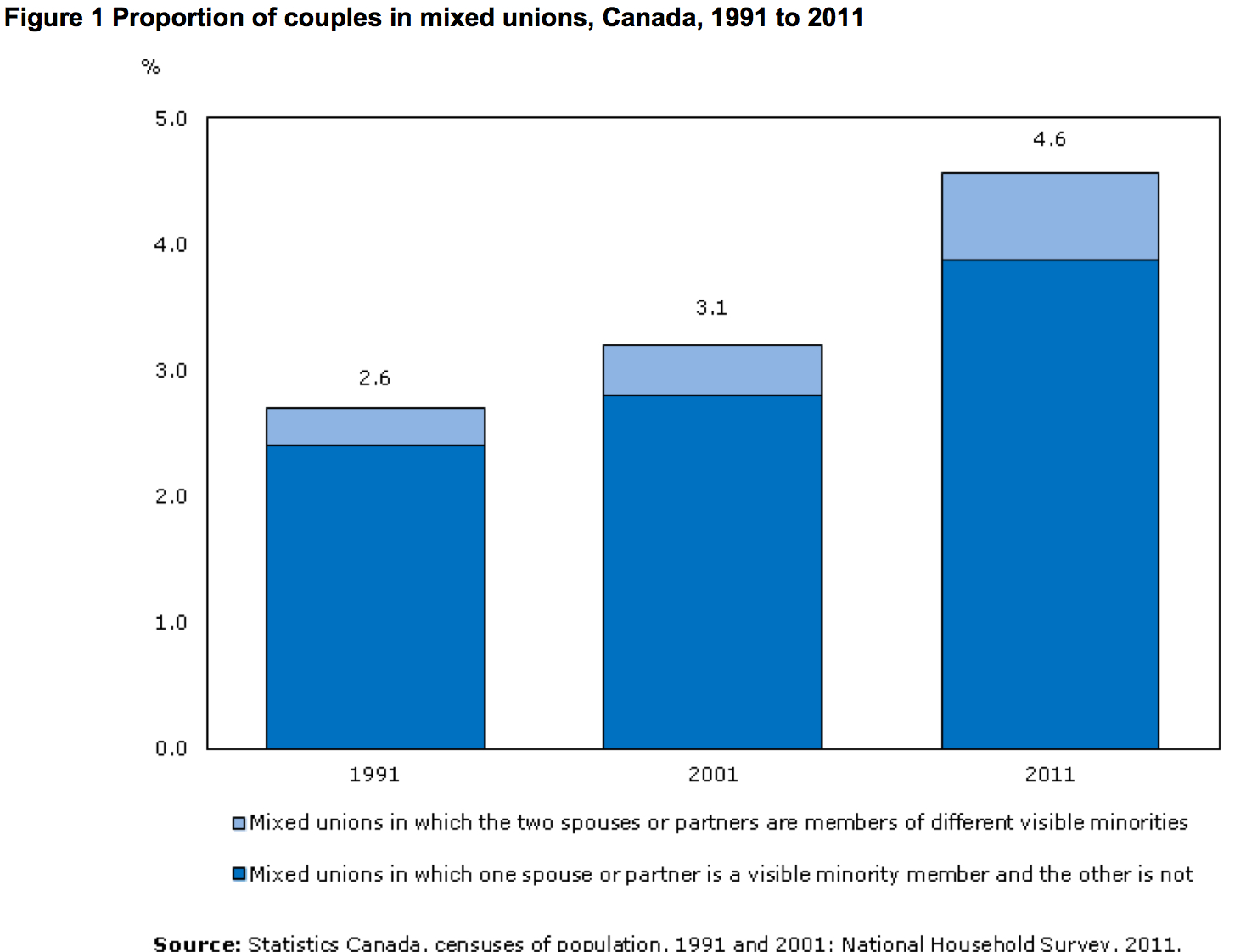
Metro Vancouver has highest ratio of mixed couples in Canada

StatsCan_Mixed_Unions_Graph
Good summary report from the recent Statistics Canada study by Douglas Todd:

Faizal Sahukhan, a Fijian therapist who specializes in counselling “inter-cultural” couples, says he’s found far more people in Metro Vancouver engage in inter-ethnic dating than actually “make the leap into marriage.”

Despite the high proportion of visible minority immigrants and their offspring in Metro Vancouver, Sahukhan said the “biggest barrier to mixed unions is parental influence.”

Asked why the proportion of visible minorities entering mixed unions tends to go down when the size of their ethno-cultural group goes up in a city, Sahukhan said, “Many people who are immigrants to Canada want to preserve homogeneity when their children begin to marry.”

North Shore-raised Kate Worthy, who is married to Paul Chu, was a bit taken aback that multicultural Metro Vancouver doesn’t have a larger proportion of people in mixed unions. She knows quite a few such couples….

Despite high immigration rates to Canada, marriage habits are changing slowly. The Statistics Canada report said “couples in mixed unions in Canada accounted for 2.6 per cent of all couples in 1991, 3.1 per cent of couples in 2001 and 3.9 per cent in 2006.”

The visible minority group members most likely to be in mixed unions in Canada are those of Japanese descent (79 per cent), followed by Latin Americans (48 per cent), blacks (40 per cent) and Filipinos (30 per cent).

The two visible minority groups least likely to enter into mixed unions are the largest ones in Canada and Metro Vancouver.

Of the 352,000 couples involving Chinese people in Canada, 19 per cent were in mixed unions, and of the 407,000 involving South Asians, 13 per cent were in mixed unions.

The Statistics Canada study does not directly report on how many whites are in mixed unions, but it says 85 per cent of mixed couples in Canada include a white person.

Metro Vancouver has highest ratio of mixed couples in Canada.

Link to full study:

Mixed Unions in Canada

Douglas Todd: ‘Best and brightest’ slogan popular with leaders who don’t get its satirical edge

Good critique of the indiscriminate use of the term the “best and brightest” in relation to immigration and Canadian values. Obviously, we do not want the “worst and dumbest” but the definition of what is the “best and brightest” in real world terms is hard to measure :

Most Canadian are aware that students who score the highest marks are not necessarily the “best.” How many times have you heard about doctors, academics, MBAs or psychiatrists who have no people skills, vision, collegiality or insight?

And what about the central value of the world’s major religions? Christianity, Islam and Sikhism, to name three, do not teach that society should focus on privileging “the best and the brightest.” Instead, along with most secular philosophies, they stand for upholding the dignity and value of all.

Instead of Canadian officials in government and public education using the language of universal worth, they are reverting to buzzwords to tell us to bestow even more status on the “best and brightest.”

There will always be a need for talent spotting to keep the wheels of society churning, but the growing proclivity in Canada for “best and brightest” sloganeering runs the danger of careering into elitism.

Let’s not forget the Vietnam era, when the phrase was most often used to expose pretense, deception and a lack of common sense.

Douglas Todd: ‘Best and brightest’ slogan popular with leaders who don’t get its satirical edge.

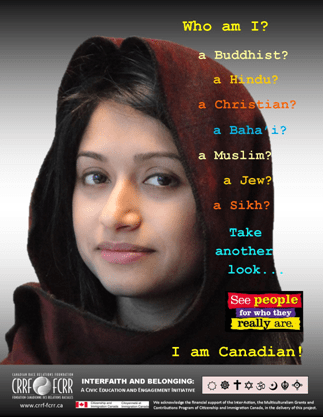
What’s wrong with this Canadian anti-racism poster?

While I agree with Todd’s views that we are a mix of identities, I think he goes too far in over interpreting the Canadian Race Relations Foundation poster.

After all, the poster is simply trying to say look at the person first, treat them equally and fairly, it doesn’t preclude further curiosity and discussion or ignore the various identities we have. And that no group is monolithic; one has to look at the individual and get to know them as a person, not a stereotype:

The poster is promoting confusing ideas about racism by telling viewers the only thing anyone should be concerned about regarding anyone is that they are “Canadian!”

But everyone in Canada has multiple identities.

They are shaped in part by being Canadian. But they are also shaped by their ethno-cultural background. They are shaped by being members of a religion (or not), by being female, by having roots in certain countries, by their economic status, by their familiarity with certain languages, by their family status and a host of other things.

Many factors make up who we are.

Multiculturalism should not be about assuming everyone is the same, ie. “Canadian.” That is not the end of our identities. But anti-racism groups like this act as if we should think and believe everyone is the same.

It’s dangerous teaching. They’re stifling curiousity. And what they are doing has potential to poison relations in Canada between people from different ethno-cultural-religious groups.

What’s wrong with this Canadian anti-racism poster? | Vancouver Sun.

Disclosure: I was an ex officio Board Member of the CRRF as part of my duties as DG – Citizenship and Multiculturalism

British Columbians grow more wary of other religions, interfaith marriages

The respective rates of “comfort” with interfaith marriage are not surprising:

  • 66% comfortable with Christians
  • 53% comfortable with Buddhists
  • 40% comfortable with Jews
  • 36% comfortable with Hindus
  • 28% comfortable with Sikhs
  • 17% comfortable with Muslims

The article would have benefitted from actual intermarriage rates compared to attitudes, as overall intermarriage rates have generally increased, albeit from a small base.

Attitudes are not limited to the “mainstream;” as the article notes, many within communities also want their children to marry from within the community, either to preserve their faith, pass it on to children, or at least theoretically have fewer compatibility issues.

Douglas Todd: British Columbians grow more wary of other religions, interfaith marriages.