Douglas Todd: Immigration fraud on a grand scale

Douglas Todd on the recent immigration fraud trial and verdict (while fraud and misrepresentation need to be countered, the overall number in percentage terms is small – see earlier “Protecting Canadian Citizenship” – Citizenship Fraud Update – Numbers Still Small):

[Judge] Harris could not find another Canadian immigration scam that matched “the scale of that perpetrated by Mr. Wang,” a former insurance agent and father of two who previously had no criminal record.

In determining Wang’s sentence, the judge took into account the punishments meted out in a range of earlier migration scams.

One case involved a man who imported 6,000 fake Alberta drivers’ licences. Another Ontario man filed 150 tax returns falsely claiming his clients lived in Canada, so they could obtain child-tax credits.

A woman in another case counselled au pairs on more than 100 occasions to lie to work in Canada. A B.C. woman was convicted of 16 counts of “arranging sham marriages between Chinese nationals and Canadians.” An Ontario duo arranged impostors to take English-proficiency tests for would-be immigrants with no ability in the language.

But how could Wang have pulled off a covert scheme involving more than 1,000 illicit would-be immigrants for eight years?

Barry Cartwright, senior lecturer in Simon Fraser University’s criminology department, said immigration fraud is “hard to catch. It’s expensive. It’s time consuming. And it’s resource-consuming.”

Even though Cartwright is not aware of a criminal case as extensive as Wang’s, the immigration specialist said he knows of larger questionable schemes involving loopholes in the immigration policies of Ottawa and Quebec, especially those to do with investor-class immigrants.

While Cartwright doesn’t want to take away from the value of Canada welcoming what he estimated to be the “nine out of 10” immigrants who end up contributing to the country, he said it’s difficult for officials to carefully screen applicants when “you’re bringing in almost 300,000 immigrants a year, or 25,000 refugees in two months.”

At his sentencing hearing, Wang’s lawyer argued his client’s punishment should be lenient since there was no “breach of trust.” The lawyer said the people who enlisted Wang’s services did so with “their eyes wide open.”

The judge, however, countered that Wang did not mastermind “victimless” crimes. The innocent children of his clients, he noted, could now be deported.

The judge also suggested the country’s entire immigration and taxation systems were victims of Wang’s elaborate cheating.

Wang’s subterfuge, Harris said, undermines whatever confidence Canadians have in the immigration process and is keenly relevant to “today’s age of international terrorism” and people smuggling.

In weighing Wang’s contributions to mass tax avoidance, Harris quoted Supreme Court Justice Peter Cory, who maintained the vast majority of Canadians who pay income tax by way of payroll deduction have little or no opportunity for evasion.

“Those who do evade the payment of income tax not only cheat the state of what is owing to it, but inevitably increase the burden placed upon the honest taxpayers. It is ironic that those who evade payment of taxes think nothing of availing themselves of the innumerable services which the state provides by means of taxes collected from others.”

In further justifying Wang’s seven-year sentence, Harris quoted B.C. Appeal Court Justice Sunni Stromberg-Stein, who said those who facilitate illegal migrants into Canada put an “astronomical cost” on the Canadian taxpayer, “fuel racial prejudice and racial tension” and “adversely impact all aspects of Canadian society.”

Even though Wang pleaded guilty, he has launched an appeal of his jail sentence.

Source: Douglas Todd: Immigration fraud on a grand scale

Douglas Todd: Mixed unions applauded by some, but dismissed by others as brownwashing

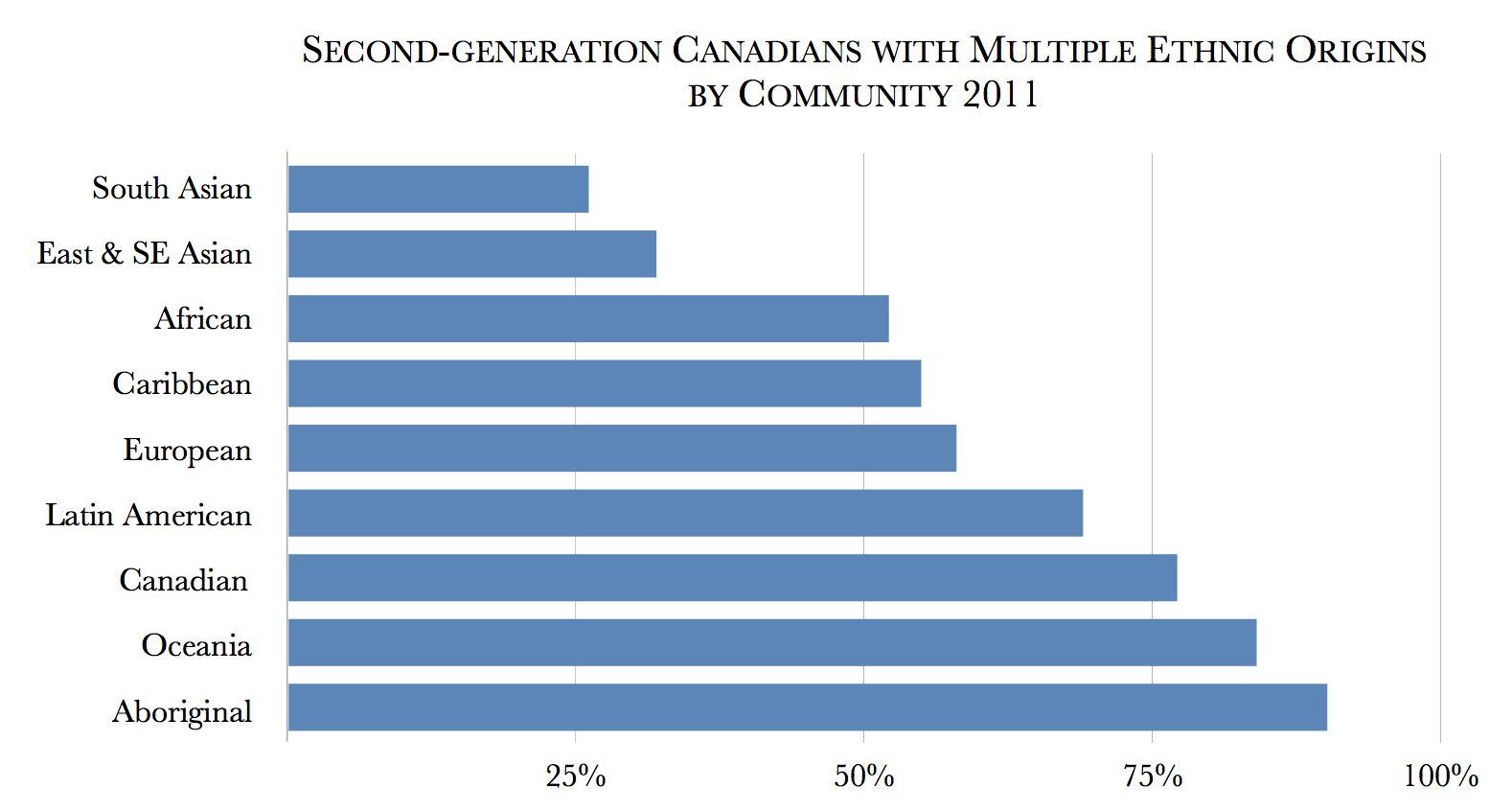
Canadians G2 Multiple origensTodd reports on the study by Feng Hou, Zheng Wu and Christoph Schimmele showing that community size and availability matter (“Group Size and Social Interaction: a Canada-US Comparison of Interracial Marriage”).

The overall StatsCan ethnic origin data shows the longer the community has been in Canada, the greater the number of Canadians with mixed ethnic origins, the result of more mixed unions. The above chart highlights second-generation immigrants who indicate also having Canadian ancestry (the third generation for most of the newer communities are not large enough, and old enough, to analyze):

But three cultural trends are shaking up this utopian dream, which places inter-ethnic couples at the vanguard of cultural fusion.

The first shift is demographic. Canadian statisticians have documented how the growth of ethnic groups in the Western world is actually making inter-ethnic couples less likely in major cities.

Secondly, many of the countries with traditional cultures that produce immigrants to the West remain resistant to ethnic intermarriage, often because of concerns about offsprings’ religious identities.

Thirdly, some race activists and social scientists are criticizing what they call the “brownwashing” of the population, arguing a mixed-union revolution is mostly sought by white liberals.

… A study published this year by Hou, Zheng Wu and Christoph Schimmele found the intermarriage rate among members of an ethnic group goes down in regions that house a large cohort of that group. No one is quite sure why.

The intermarriage rate in mid-sized Canadian cities such as Kelowna, Victoria and Trois-Rivières, where there are relatively few visible minorities, is reaching almost 40 per cent. People there appear motivated to go outside their ethno-cultural group for friends, dates and, importantly, marriage partners.

On the other hand, in Canadian metropolises where visible minorities, mostly Asians, account for almost half the population, the intermarriage rate is much lower. In Metro Vancouver it’s just 9.6 per cent. In multi-racial Toronto it’s only 8.2 per cent.

People seem to feel little need to find a partner outside their ethno-cultural group when living among hundreds of thousands of people with familiar backgrounds.

For instance, South Asians and ethnic Chinese make up the largest immigrant groups to Canada. But Statistics Canada reports they’re among the least likely to intermarry. Only 19 per cent of Chinese-Canadians in a couple, and 13 per cent of South Asian-Canadians, are in a mixed union.

Hou admits researchers can’t explain the complicated causes of intermarriage. But he cautioned against “blindly treating the prevalence of intermarriage as the litmus test of inter-group relations.” Hou says, “The prevalence can be low or go down simply for demographic reasons.”

Douglas Todd: Mixed unions applauded by some, but dismissed by others as brownwashing.

Douglas Todd: MP’s church comments not out of the ordinary

More on background and issues behind her remarks:

Vancouver South Conservative MP Wai Young’s contentious political remarks about Jesus and the Air India bombing are not out of the ordinary in some Canadian churches, says a specialist on evangelicals and Chinese Christians.

“They’re remarkably fascinating comments, but they’re not sensational,” said Justin Tse, a post-doctoral student at the University of Washington who earned his UBC PhD studying religion and trans-national migrants.

The evangelical pastors who head Harvest City Church in East Vancouver, where Wai spoke in late June, “felt her talk was so uncontroversial that they posted it on their website,” said Tse.

The national media is buzzing over comments Wai made during the service, in which she linked the federal Conservative party’s decision to launch anti-terrorist Bill C51 to the courage of Jesus Christ, “who served and acted to always do the right thing, not the most popular thing.”

Young, one of about 100,000 Chinese evangelical Christians in Metro Vancouver, also defended Bill C-51 by telling the Pentecostal congregation that Canada’s spy agency knew there was a bomb on the Air India flight that exploded over the coast of Ireland in 1985, killing 329 people, mostly Canadians. Young has retracted that statement. Her constituency office sent out a statement in which Young says she “misspoke,” adding “I regret this error.”

Tse said Young’s talk, one of others that she has made at Vancouver churches in recent months, was designed to appeal to evangelicals by portraying Jesus as a leader who “built community” — particularly one who did so within the framework of a “Conservative party ideology.”

Young’s talk at the church, Tse said, equated community and nationhood “with strong security.” The MP, a former provider of services to immigrants, stressed the importance of anti-terrorist legislation, firm borders, fighting crime and lowering taxes.

… Debra Bowman, the minister of Vancouver’s Ryerson United Church, echoed the views of many of Young’s critics when she urged the federal Conservatives to put as much effort into probing the charitable tax status of Tory-friendly churches as it does to auditing environmental and other non-profit groups.

“The thing I find really upsetting isn’t so much (Young’s) dreadful Christological claims for Harper’s Conservatives,” said Bowman. She was more concerned about the way the backbench MP appears to be flouting Canada Revenue rules on politically partisan activity by religious groups.

“I really hope someone will track whether (such churches) come under the same financial scrutiny that many justice-environment-church groups have been experiencing,” said Bowman.

Harvest City Church released a statement late Wednesday saying Young’s “comments were her own and Harvest City Church does not endorse her comments, nor any political party, nor does it endorse the use of its facility as a political platform.”

…Former federal Liberal cabinet minister Ujjal Dosanjh, who lost the predominantly Asian-immigrant riding to Young in 2011, said the Hong-Kong-born politician is a “well-meaning” backbench MP who would not have access to high-level information about Canada’s spy service or the Air India bombing.

While commenting that Young’s comparison of Jesus to the federal Tories amounts to “political pandering” that is “pretty far out,” Dosanjh focused on how he believes the Vancouver South MP made key mistakes in her analysis of the 1985 bombing of Air India Flight 182.

… Dosanjh said he cannot imagine any way that CSIS knew there was a bomb on the Air India plane. He also said the laws that existed in the mid-1980s did not bar CSIS from sharing such crucial security information.

With the rise of Sikh extremism in the 1980s, in which “Sikh temples in B.C. were used as bully pulpits by politicians and others,” Dosanjh said he became more and more convinced that no religious organization should be used for partisan political speeches.

Dosanjh said that period of time, in which he was severely beaten by Sikh extremists, “taught me that the separation of religion and state is very important. One should never make politically partisan statements in a religious institution. From my perspective she (Young) crossed the line. But I’m not picking on her. She’s not the only one. It happens frequently.”

Douglas Todd: MP’s church comments not out of the ordinary.

Douglas Todd: If academia is becoming less relevant, blame bad writing

These apply to all writing, not just academic:

What are the signs of bad writing?

• Jargon: Sometimes it’s necessary to use technical words, but words like “apperception” become unhelpful jargon when they’re used mostly to keep out outsiders. Other bits of jargon, like “outsourcing,” hide offensive realities.

• Verbs as nouns: Billig dislikes academic “nouniness,” the tendency to turn virtually every idea into an abstract noun. Billig names scores of over-used nouns, like mediatization, re-ethnicification, deindividuation and, especially, reification. He argues against making verbs into nouns with suffixes such as “ization,” “ication” or “ism.”

Billig is correct when he says such nouns turn vague concepts into concrete things, when they’re not.

An over-reliance on abstract nouns helps academics avoid dealing with real people and actual processes, Billig says.

For what it’s worth, one of my pet-peeve abstract nouns is the increasingly common “essentialism.”

• Passive language: Academics, like everyone else, need to avoid passive sentences when possible, because they include less information than sentences with active verbs, which require (often human) actors as subjects.

• Not much to say: In academic circles, the pressure “to publish or perish” is not an empty threat. Billig maintains somewhat ruthlessly that a cause of bad writing is that many academics don’t have much worthwhile to say. Academics, he says, often use jargon, nouns and passive sentences because they’re hiding that they’re just repeating platitudes.

• Self-censorship: This is another danger in academia. It’s not just politicians and business leaders who cover their butts with euphemisms; academics also default to bureaucratic language. Bureaucratese is designed to say less, not more.

Douglas Todd: If academia is becoming less relevant, blame bad writing.

And always a good idea to re-read Orwell’s Politics and the English Language essay from time to time.

Douglas Todd: Canada a blank slate, with no culture?

More on the ongoing (existential) debate on whether Canada has a unique culture. My favourite comments cited by Douglas Todd are below:

Eric Kaufmann, a Vancouver-raised political scientist at the University of London, said while there is no single Canadian identity, “as long as each resident of the country identifies with Canada in some way, the whole remains united.”

Somewhat like John Ralston Saul, Kaufmann emphasizes the “Métis,” or “mixed,” nature of Canadian culture — that many residents are a blend of such things as Anglo-American, Protestant, aboriginal, French-Canadian, Catholic and, increasingly, Asian origins.

The “northern landscape” is also a significant connector among Canadians, said Kaufmann. So is the way Canada is a more “ordered, equal society than the U.S. Then there are everyday things like maple syrup, hockey and the moose, which of course, matter, too.”

Kaufmann suggests governments not push too hard on promoting a single view of Canadian culture, but instead highlight “core values around respect for liberty, law and celebrating major historical episodes.”

All of this acknowledges that Canada is not an easy-to-define country. And there are semantic challenges around the word, “culture,” which some academics enjoy de-constructing.

But even highlighting core values, and the interpretation that can be attached to each core value, is never quite as easy or as neutral as it sounds.

Douglas Todd: A blank slate, with no culture?.

Douglas Todd: Spiritual narcissism inflates ego

Douglas Todd on the writings and thoughts of Gerald May on spiritual narcisism:

We can all succumb to narcissism when we have a spiritual growth spurt or philosophical insight. It happens when we begin thinking we are pretty great because we have achieved a level of development others have not.

How it creeps in

Here are six examples of how spiritual narcissism can creep in:

Feeling Chosen: Spiritual seekers who believe they have been “chosen” can become narcissistic. Like being on the playground and getting picked early for a team, nothing boosts self-importance more than feeling one is among the Select.

Striving to be a master: Gerald May distrusts seekers who want to become God-like. Whether they’re Christians, neo-pagans or atheist existentialists, he cites how fearful people often struggle to “amass personal power and control over destiny,” rather than learn to let go and sacrifice.

Working to be good: While many indulge in vices, others strive to be highly moral. Sometimes they go too far. May says some people “so achingly long to be helpful that they are blinded.” The Tao Te Ching advises, “Give up sainthood … and it will be a 100 times better for everyone.”

Over-emphasizing spiritual levels: American ethicist James Fowler created a famous ladder showing how people ascend through stages of spiritual maturity. While May found some validity in it, he cautioned against making spiritual levels so concrete. May would have also critiqued the colour-coded developmental memes of Don Beck’s spiral dynamics. With ladders, it’s too easy to rank yourself on a higher rung.

Lacking forgiveness: It is right to yearn for justice. It is another thing to be unable to get over an injustice, particularly to oneself. The unforgiving, May says, separate themselves from others, and become captives of resentment and superiority. Psychologist Nancy McWilliams refers to people who can’t let go of an injustice as “hyper-vigilant narcissists.”

Brotherly and sisterly love: In discussing active “filial love,” May says there is a danger of doing so to bolster self-regard. Aiding others because of guilt can be spiritually narcissistic. Even though Christianity and Buddhism call for acts of compassion, May says over-helpful people can “lose their experiential connectedness with the divine mystery of life.”

Avoiding the trap

…. he taught the most direct way to discern whether we are surrendering to unconditional love, rather than to self-aggrandizement, is to check to see if our spiritual journey is “deepening our compassion and service to the world.”

Can happen in all fields.

Douglas Todd: Spiritual narcissism inflates ego.

Douglas Todd: Defending the right to offend

Douglas Todd’s reflections on Charlie Hebdo and the ensuring debates over freedom of speech and religion:

The process of secularization is now thoroughly ensconced in the West; in effect, it declares there is no consensus over what is sacred.

As philosophers such as Canada’s Charles Taylor have pointed out, secularization has elevated the value of doubt so that it’s at least equal to values about what is sacred.

Taylor believes secularism is imperfect, but that it’s a cultural advance.

Not all religious leaders agree.

Even the most staunch defenders of Canadian multiculturalism, such as scholar Will Kymlicka, recognize that’s a problem.

Kymlicka admits religion provides the toughest test of multiculturalism. Canadians, Kymlicka says, have become accustomed to tolerating, and even welcoming, people of diverse ethnic backgrounds.

But religion is not about skin colour; it’s about belief systems. And belief systems make decisions about what is of ultimate value, which can sometimes form into rigid ideology.

That can lead to beliefs that some things are absolutely taboo, such as visual images of Muhammad.

Taking the secularization argument further, some religion scholars say the modern emphasis on doubt, paradoxically, creates healthier religions.

That’s because secularization, at its best, respects the past, but is willing to question it.

In that way, the Protestant Reformation and Enlightenment were secularizing movements.

Some go so far to say Jesus and Buddha were secularizers: Reformers who upset the religious status quo, sometimes joking about it.

I’ve never heard anyone maintain Muhammad was a secularizer, but the case could be made, since he was also a reformer, who challenged the degrading tribal customs of seventh-century Arabia.

One Charlie Hebdo cartoon that appeared in recent years featured Muhammad crying, lamenting how he had come to be loved by violent and “idiotic” fundamentalists.

I have no need to publicly mock someone’s religious (or atheistic) beliefs. But that doesn’t mean I won’t be accused of it: Some people are extremely easy to offend.

Do we walk on eggshells around such people, religious and otherwise, who believe they have a kind of sacred right to be hyper-sensitive? Or do we engage in honest exchange to defend the values of a democratic society?

Even though I dislike some of the cruder forms of satire, I dearly hope the genre has a robust future.

Douglas Todd: Defending the right to offend.

Douglas Todd: Let’s feel free to be religious at Christmas

Douglas Todd on the annual ‘War on Christmas’ ritual, and the need for greater public recognition of faith:

Instead of inadvertently silencing Christian and other religious people, then, let’s truly recognize this is a pluralistic country, with many faiths and secular world views.

That means encouraging the expression of virtually all world views, religious and secular, in the public square. (And also being open to criticism of them.)

When it comes to publicly recognizing Christmas along with other festivals, however, the trickiest part is pragmatic.

Statistics Canada says two-thirds of Canadians consider themselves Christian, a one-quarter consider themselves non-religious and the rest following other faiths.

It would be more than awkward to have vacation days to mark the festivals of every faith, no matter how small their membership. Chaos could reign, especially in workplaces. But other gestures can make possible diverse expressions.

Given the ethno-cultural and religious fragmentation in Canada, it’s conceivable a decorated Christmas tree display could have a unifying influence in this country.

After all, I could name countless atheists who merrily put up Christmas trees. Sikhs often do the same thing. And Muslims tell me they love Christmas lights and the focus on Jesus and Mary, since they’re important to Muslim tradition. Hindus and Buddhists, too, are pretty relaxed about spiritual diversity.

Indeed, even though B.C. has one of the world’s highest ratios of religious eclecticism and foreign-born residents, an Insights West poll last year found that British Columbians prefer to say “Merry Christmas” by a 10-to-one margin over “Happy Holidays.”

These British Columbians appear aware that, when a North American travels to a predominantly Hindu, Buddhist, Shinto or Muslim country, the citizens are not going to be apologizing for public expressions of their long-held customs.

Similarly, if we take the spirituality and tradition out of Canadian Christmas, we’ll just end up with commercialism and Jingle Bells triteness.

Douglas Todd: Let’s feel free to be religious at Christmas.

Douglas Todd: Lessons from U.K. migration debate

One take on the UK’s immigration and related debates in a lengthy discussion between Douglas Todd and Eric Kaufmann, professor of politics at Birkbeck College, University of London:

Where is successful integration occurring in Britain?

The proportion of mixed-ethnicity households doubled between 2001 and 2011, Kaufmann says. “The fastest-growing group in England are those of mixed race who share English descent with the majority.”

Many second-generation immigrants are also integrating. “A significant share of the children of European immigrants and some of mixed-race background come to identify as white British, melting into the majority.”

Also, opposition to immigration is lower in neighbourhoods where a large share of minorities has been present for over a decade, giving people time to habituate to each other.

It is the rapid pace of change, rather than diversity itself, Kaufman says, that is causing most Britons to want to reduce immigration levels.

Douglas Todd: Lessons from U.K. migration debate.

Douglas Todd: The dangers of scapegoating religion: Karen Armstrong

Good interview with Karen Armstrong on her latest book, Fields of Blood:

Armstrong would not be content with the platitude that such and such a faith is strictly “a religion of peace.” She defends the need for countries to have responsible militaries and reveals how religious people have often been far from innocent, allowing their faith to be co-opted for destruction.

For instance, she notes that while Jesus was a near-pacifist, Mohammed was a powerful leader. When Mohammed was locked in open war with Jewish tribes, Armstrong judges his decision to slaughter 700 Jewish men and put their wives and children into slavery as “an atrocity that marked the lowest point in the Prophet’s career.”

Otherwise, she believes, Mohammed was a consensus builder and deal maker who respected Jews and Christians as “the people of the Book Bible,” adding, “Mohammed must be one of the few leaders in history to build an empire largely by negotiation.”

In discussing religion, in other words, we have to avoid stereotyping, but we also have to be realistic.

That requires acknowledging that religion around the planet, as many immigrants to North America will attest, is not all sweetness. It can be used to persecute minorities — and it frequently comes with scriptural literalism, patriarchy, intolerance of homosexuality and opposition to individual freedom.

Yet, with all the accusations flying around blaming religion for virtually all conflict and oppression, it’s more than valid to recall how religion has also long been an inspiration for peace and reconciliation.

“It is simply not true that ‘religion’ is always aggressive. Sometimes it has actually put the brakes on violence,” says Armstrong in Fields of Blood.

Douglas Todd: The dangers of scapegoating religion.