Douglas Todd: Here’s how to end migration scams by the global rich in Canada

Todd continues his series of articles on immigration scams involving wealthy immigrants, including the issue of taxation, particularly those who ‘park’ their family in Canada while continuing to live and work in their country of origin.

I am currently analyzing citizenship take-up by immigration category and business immigrants (entrepreneurs, investors) have the largest gap between relatively low principal applicant naturalization (mainly men) and secondary applicants (their families):

Canada could crack down in many ways on the scams performed by “ghost immigrants” who avoid paying their share of Canadian taxes while driving up housing prices in Vancouver and Toronto.

Immigration and tax specialists are pressing Ottawa to adopt numerous proposals they believe would put an end to widespread illegitimate migration schemes, such as those employed by two rich families from China, whose tactics were exposed this month in B.C. Supreme Court.

The case of Fu versus Zhu revealed how the wealthy families, who had together bought three expensive homes on the west side of Vancouver, had been engaging in illicit plots involving Canadian real estate, tax avoidance and lying about their immigration status.

“The problem is that there is large-scale immigration of relatively wealthy people to Canada who are not contributing significantly, if at all, to the Canadian tax base,” said David Lesperance, a specialist in Canadian tax and immigration law.

“They have bid up the housing markets in Vancouver and Toronto. They are also receiving the benefits of Canadian permanent resident status, including excellent schooling, free medical care, security and (eventually, as citizens) an excellent visa-free passport.”

Noted Vancouver immigration lawyer Richard Kurland shares much of the unease of Lesperance – including frustration that Canadian authorities are not enforcing the country’s rules when would-be immigrants fail to declare their worldwide income, pretend to spend time in Canada and obscure the real owners of their properties.

The two specialists have appeared before politicians in Ottawa to offer their ideas on fighting such scams. They agree problems have been created by Canada welcoming so many investor families, in which the breadwinners often become “ghosts immigrants” with little connection to Canada other than engaging in property speculation.

A recent investigation by the South China Morning Post, for instance, found that more than 40 per cent of the breadwinners for recent millionaire migrant households in Canada appear to have left Canada, although some left family members behind. It’s a widespread phenomenon, said the newspaper, among rich Hong Kong and Mainland Chinese migrants.

Lesperance and Kurland maintain their proposals would be especially helpful in dealing with the increasing number of trans-national “astronaut” migrants who use Canadian real-estate primarily as a place to park their capital and sometimes their offspring.

The specialists would especially target the rapidly growing number of would-be Canadians who are renouncing their permanent resident status, which some are using as a way to avoid paying taxes in Canada while still visiting often on 10-year visas.

“Unfortunately, the perception of too many (wealthy) immigrants is that cheats are not sought after or detected” by Canadian tax or border officials, said Lesperance. To eliminate the problem of ‘ghost immigrants,’ the Canadian Revenue Agency must change this perception.”

Both experts emphasize how important it is for the CRA to do far more tax audits of investors, domestic and offshore, who buy up numerous properties. Authorities should particularly focus, they say, on the dubious techniques accountants have cooked up for avoiding paying taxes on their capital gains.

In the complex world of immigration law, perhaps the most radical idea for reform comes from Lesperance, who says it would reduce foreign speculation in Canadian real estate and curtail the tax evasion illustrated by clothing manufacturing mogul Quoqing Fu in the B.C. Supreme Court case.

The judge mocked Fu’s testimony after learning he had told the CRA his worldwide income, which is subject to taxes in Canada, was just $97.11.

Instead of authorities trying in vain to determine whether would-be immigrants are physically present in Canada, Lesperance recommends rating them mostly on whether they pay significant income taxes in Canada — regardless of which country in which they spend most of their time.

There is not much wrong with rich people travelling the world to work, invest and run businesses, argues Lesperance, who is based in Europe. Many would be satisfied, he says, to hold two passports while still paying their share of taxes on their global incomes to Canada, in return for “a stable and safe place for their global operations” and their children.

Canada is losing out on these entrepreneurial newcomers, he says, because its immigration policy focuses on migrants having a sustained “physical presence” in the country. The major resistance to this idea, Lesperance said, comes from those who believe newcomers “must rub elbows at Tim Horton’s to become Canadianized.”

The trouble with Canada’s current residency-based approach to immigration, said Lesperance, is that it often doesn’t work and “we get people like the Fu family abusing the tax system, but we scare away the Mark Zuckerbergs of the world.”

Even though Kurland strongly believes Canada needs to stop exploitation of the country by high-net-worth tax-avoiding newcomers who speculate in real estate, the Vancouver immigration lawyer continues to believe there is value in immigrants integrating into the country by “rubbing shoulders” with Canadians.

Kurland, author of the Lexbase newsletter, also worries that, unless wealthy would-be immigrants who are not often present in the country simply write Canada a big cheque in exchange for citizenship, too many would have their accountants find ways to hide their riches in a trust fund.

Alternatively, one of Kurland’s more innovative recommendations is for the federal government “to very visibly invite Chinese tax collectors to Vancouver,” a move which would dramatically remind cheaters to submit to the rigours of Canada’s tax and security treaties with China, which is launching its own crackdown.

Kurland also believes that, in this new era “in which global computer systems can carefully track individuals’ travel,” it is fast becoming easier and less costly for Canadian authorities to catch people who are not following the country’s immigration and tax rules.

Ultimately, however, like Lesperance, Kurland believes the following is the most important thing that will lead to a clampdown on migration scams in Canada involving false tax claims and real-estate speculation:

“It’s a pure question of political will.”

Source: Douglas Todd: Here’s how to end migration scams by the global rich in Canada

Douglas Todd: Explosive B.C. court case details seven migration scams

Another good article by Todd, covering the different scams uncovered by this case:

A shocking B.C. Supreme Court case that pitted two rich families from China against each other provides grim revelations about the kind of migration, tax, and real-estate scams regularly occurring in Metro Vancouver and beyond.

Immigration and tax lawyers are stunned that the Fu and Zhu families became embroiled in a lengthy civil suit over three multi-million dollar houses they purchased together in Vancouver, since their case provides evidence of their illicit schemes around real estate, tax avoidance and immigration.

“This case provides unusually candid insight into what those who would abuse our immigration and real-estate systems really think in their own words about their true motives for seeking access to Canada and our real estate,” said Vancouver immigration lawyer Sam Hyman.

David Lesperance, a Toronto-based immigration and tax lawyer, said: “The fact that two different parties … would choose to fully expose their transgressions in a public forum shows either blinding ignorance, or complacency about the ramifications of that exposure, given the longtime lack of enforcement of immigration and tax laws in Canada.”

While both specialists believe the Fu versus Zhu case justifies investigation by the Canadian Revenue Agency, the Canada Border Services Agency and other enforcement bodies, they say the dispute between the families indirectly illustrates the range of common, mostly unpunished migration and real-estate scams occurring in Canada.

Here are seven migration-related subterfuges the case exposes:

1. Not declaring full worldwide income to Canadian tax officials

Judge Susan Griffin scoffed at one family’s breadwinner, Guoqing Fu, for declaring to the Canadian Revenue Agency he had a worldwide income of only $97.11.

“This was an incredible assertion, given the fact he owns one of the top 10 textile manufacturing and distribution companies” in China’s biggest production zone, said Griffin.

The immigration specialists say it’s commonplace for wealthy foreign real-estate investors to falsely claim to tax authorities they earn much less than they do. It’s typically done in an attempt, they say, to avoid income taxes in Canada, and to make one’s family eligible for welfare and other taxpayer-financed subsidies.

But the Fu family may have gone too far, says Lesperance. “I think that clearly an investigation by Canada Revenue Agency is in order. (Depending on the results) the CRA could definitely ask the Crown to proceed with a criminal tax evasion charge, which could result in a 200-per-cent-of-tax-evaded penalty, plus up to five years imprisonment.”

2. Pretending to spend time in Canada to meet residency requirements

Chunquin Zhou referred to one of her Vancouver luxury houses as “immigration jail,” a term often adopted by well-off would-be migrants.

She used the phrase in reference to what she considered the hardship inherent in Ottawa’s requirement that would-be immigrants physically spend two years out of five in Canada before obtaining citizenship.

The judge also found her son, Xiao Feng Fu, was “sophisticated in lying, including in scheming to deceive Canadians immigration authorities that he could maintain permanent residency status without spending the necessary days residing in Canada.”

The family members’ attempts to pretend they were living in Canada while spending time offshore echo a technique used in a widespread scam orchestrated up until 2015 by Richmond resident Xun Wang, who hauled in $10 million over eight years by producing altered Chinese passports and fraudulent identities for up to 1,200 clients.

3. Hiding real real-estate ownership

The Fu and Zhu families were well versed in how to avoid taxes on the sale of their houses by making false claims about the actual owners.

One common technique that wealthy foreign nationals use to avoid or evade paying capital gains tax in Canada is by putting dwellings in the names of children or spouses who appear to be permanent residents of Canada, and who appear, at least on paper, to occupy the houses.

4. Lack of regulation of real-estate agents

The son’s phoney claims about spending time in Canada were coordinated by the families’ realtor, identified only as “Mr. Gu.” The realtor assisted the son by helping provide false pay cheques, false employment records and false verbal claims about losing his permanent-resident card while in China.

“The new B.C. real estate regulator may want to invite Mr. Gu to a session over his behaviour,” said Hyman, referring to the way B.C.’s real-estate regulation was recently reformed following persistent complaints it was failing to discipline rogue realtors.

5. Illicitly laundering money out of China

The Fu versus Zhu case baldly highlights the two families’ efforts to break the laws of China, which is increasingly placing tighter restrictions on the amount of money it allows to leave the economic powerhouse.

The Fu family, to avoid detection, used their employees on 21 occasions to transfer lump sums just under China’s restriction against removing more than $50,000 US a year from the country.

The judge noted the parties acknowledged the steps were taken to evade China’s currency controls, as well as its restrictions on how many dwellings they could own.

The Fu and Zhu families’ efforts to illegally remove at least $1 million US from China corresponds to similar attempts made by Anita Wang and other families from China, who the B.C. Supreme Court found in early January illicitly laundered $750,000 to buy a property in Port Coquitlam.

6. Misusing provincial migration programs

The two families from China initially started their application process to move to and invest in Canada by going through the provincial nominee programs of Prince Edward Island and Manitoba, jurisdictions which lack the popularity of Metro Vancouver and Toronto for migrants.

Neither family showed any intention of settling in those provinces, since they immediately put all their efforts into investing in residential real estate on the west side of Vancouver.

7. Exploiting Canadian courts, with costly trials

Postmedia reporter Sam Cooper is among the journalists who are increasingly covering lengthy cases involving foreign nationals who use Canadian civil courts to solve their own trans-national legal wrangles.

But, as Hyman says, it costs Canadian taxpayers a great deal to provide the judges, buildings and legal staff to run the court system, even when the losing side sometimes has to contribute to opponents’ lawyers’ fees.

“The bitterest irony in all this is that those who would so brazenly thwart our laws with such perceived impunity, for personal gain, would turn to our taxpayer-funded legal system for recourse. Chutzpah doesn’t begin to describe the parties’ conduct,” said Hyman.

Despite the conclusion of the Fu versus Zhu civil case, Hyman noted the family members involved “appear to continue to have access to Canada.”

via Douglas Todd: Explosive B.C. court case details seven migration scams | Vancouver Sun

When ‘harmony’ is not good enough: James Hoggan

James Hoggan, author of I’m Right and You’re an Idiot, on the balance between confrontation and collaboration and the need for dialogue.

The challenge is how to have vigorous yet respectful conversations:

When I was chair of the David Suzuki Foundation I asked Canadian problem solving guru Adam Kahane to speak at our board retreat when it met at the Brew Creek Centre in Whistler.

I invited him because of his work as a facilitator in hot spots around the world.  Like many of the thought leaders I interviewed for my book, I’m Right and You’re an Idiot, Adam encouraged me to consider the role warlike rhetoric plays in creating gridlock and inaction on environmental problems such as climate change.

I found his methodology for dialogue, called transformative scenario planning, a hopeful alternative to the growing political polarization.

During his talk to our board, Adam got into a brief but heated disagreement with David Suzuki who argued that in some cases dialogue is a waste of time. David spoke about the CEO of a consortium of companies who wanted to discuss international criticism of the Alberta oil sands regarding its environmental performance.

David said he would be willing to engage with the CEO if he would first agree to certain basic principles: that we are all animals and that we need clean air, clean water, clean soil, clean energy and biodiversity. The CEO declined. Adam challenged Suzuki on this, saying that seeking such an agreement in advance was unreasonable and unproductive.

Adam recently told me this exchange had a big impact on him. “It shook me up a lot.” Initially, he couldn’t make this new idea fit into his frame of collaboration so it stayed with him “as an unresolved tension.” He didn’t dismiss the argument because he holds David in such high esteem.

And gradually this principle seemed more important and altered Adam’s thinking about how to approach advocacy, conflict and dialogue, and this exchange became an important section of his new book, Collaborating with the Enemy: How to Work with People You Don’t Agree with or Like or Trust.

Adam writes: “I could now see that engaging and asserting were complementary rather than opposing ways to make progress on complex challenges, and that both were legitimate and necessary.”

If we suppress assertion and advocacy in an effort to engage with an opponent, “we will suffocate the social system we are working with,” and end up with feeble collaboration. He is now convinced that healthy collaboration needs to include “vigorous fighting.”

Rather than focusing on finding harmony when dealing with people who hold radically conflicting opinions, we can embrace both conflict and connection:

“If we stretch beyond our conventional, comfortable, habitual approach to collaboration we can be more successful more often, and don’t have to default to polarization, and worsen the situation.”

He recently told me it’s wrong to think we can only collaborate successfully by first forging harmonious teams that have reached agreement on where they’re going, how to get there, or who needs to do what.

Author Adam Kahane was shaken by a conversation with David Suzuki about activism.

This discussion got me thinking about how my own attitudes have evolved while searching for better ways to deal with antagonists of all kinds, including climate science deniers. Adam’s new book reinforces my experience that changing public opinion and public policy requires both advocacy and collaboration — although I’ve learned that both have their limits.

Advocates tend to overplay their hands and may unintentionally strengthen the resistance they work so hard to overcome. Collaboration on the other hand can create a false equivalence that undermines science when opposing viewpoints are both presented as legitimate, when clearly they are not.

A perfect example of this is the decades’ old debate between genuine climate scientists and climate change deniers working for industry-funded, right-wing think tanks. Any advocacy to counteract alarming environmental problems such as climate change, ocean acidification or species extinction is by its nature difficult and adversarial.

I told Adam it’s hard to collaborate with someone who says climate change is a hoax perpetrated by the Chinese, because engaging in such a specious argument only drags the conversation down to a ludicrous level. I also said when it comes to climate change, dialogue often fails, but lessons from the civil rights movement give us hope. They tell us that people who meet with resistance can eventually see results if they keep demanding it and never give up.

On the other hand, our social capacity for pluralism will either empower or prevent us from emerging from the climate crisis. Being right on the science is not enough. That’s why this book is so important. We need to develop our ability to work with the enemy, or as Thich Nhat Hanh put it, “speak the truth but not to punish.”

via When ‘harmony’ is not good enough | Vancouver Sun

Douglas Todd: The misused concept of racism, refined

Doug Todd’s summary of the debates between Cornel West, Ta-Nehisis Coates and John McWhorter.

His distinction between unconscious racism (or implicit bias) vs active discrimination is overstated, as implicit bias or discrimination is not as innocuous as he presents. Just as not every action or attitude cannot be attributed to implicit bias or discrimination, neither can every case of implicit bias being dismissed.

On the other hand, looking at the issues from a narrow, one community perspective, as Holly Anderson does with the word “clan” undermines the more serious issues related to implicit bias and discrimination (much as the removal of the word ‘chief’ in Toronto District School Board job titles):

Are we starting to refine our concept of racism, arguably the most explosive word in North America today?

Three powerful African-American public intellectuals are in a high-level debate over racism. All three agree racism can be a serious problem, especially in the U.S., where black-white tensions for some still run deep.

But the eloquent authors — Cornel West, Ta-Nehisi Coates and John McWhorter — have extraordinarily different perspectives on the extent of racism. Their debate, as well as discussion in Canada, may be requiring cultural warriors on all sides to become clearer about what they mean when they use, and in many cases misuse, the term racism.

In pluralistic Canada, the anti-racism movement is not quite as aggressive as in the U.S., especially in regards to blacks, who make up only two per cent of this country’s population. Still many Canadian activists and academics try to give it top prominence.

One reason it’s important for Canadians to be clear about the meaning of racism is that cities such as Vancouver and Toronto now have among the world’s highest proportions of foreign-born residents, with ethnically hyper-diverse populations.

Discussions of housing, welfare, jobs, renting, land claims and neighbourhood enclaves sometimes touch on race and nationality. And we have to talk about these issues without fear of being silenced by trumped-up claims of racism, which has occurred over the decades.

One revealing manifestation of Canada’s anti-racism movement emerged from Simon Fraser University in 2017. Philosophy prof. Holly Andersen launched a petition to have the Scottish-rooted word “Clan” removed from the names of the university’s sports team. She argued it is potentially offensive to blacks, since they might associate it with the Ku Klux Klan.

What can a debate among America’s leading black intellectuals tell us about the value of Andersen’s petition, and, most importantly, about how to engage thorny issues that often become muddled over misunderstandings of racism?

To answer we need to know why Harvard’s Cornel West, a veteran left-wing civil rights activist, so strongly disagree with Coates, who may be the most celebrated black writer in the U.S. today.

Coates, raised in a violence-filled neighbourhood of Baltimore, is the author of many books, including last year’s We Were Eight Years in Power: An American Tragedy, which celebrates Barack Obama’s era in the White House and amounts to a concerted attack on “white supremacy.”

Coates believes racism is the U.S.’s worst catastrophe and pessimistically believes it will never change. “The problem with the police is not that they are fascist pigs, but that our country is ruled by majoritarian pigs,” Coates says.

Coates, in effect, encourages activists to dramatically broaden the definition of prejudice to include what some call unconscious racism. “Racism is not merely a simplistic hatred. It is, more often, broad sympathy toward some and broader skepticism toward others,” he says.

On Dec. 17, however, Cornel West pushed back in an opinion piece in The Guardian. It has led to a titanic dispute, an intense debate going back to disagreements between Martin Luther King and Malcolm X.

“Coates fetishizes white supremacy. He makes it almighty, magical and un-removable,” West says.

“Unfortunately, he hardly keeps track of our fight back, and never connects this ugly legacy to predatory capitalist practices, imperial policies (of war, occupation, detention, assassination) or the black elite’s refusal to confront poverty, patriarchy or transphobia.”

Coates’ “perception of white people is tribal and his conception of freedom is neo-liberal,” West said, defining “neo-liberal” as individualistic and embedded in Wall Street.

In response to the debate, Coates soon deleted his Twitter account, which had 1.25 million followers, saying, “I didn’t get in it for this.”

Which leads us to McWhorter, who writes about race and language as a professor at Columbia University and may be the most insightful of all three.

Antiracism “encourages an idea that racism in its various guises must be behind anything bad for black people,” says Columbia University Prof. John McWhorter.

“Coates is celebrated as the writer who most aptly expresses the scripture that America’s past was built on racism and that racism still permeates the national fabric,” says McWhorter.

While acknowledging racism against blacks is a grave issue, McWhorter worries Coates has become a high “priest” of what he calls the new “religion of Antiracism.” It’s not entirely bad that “Antiracism” has become a religion, says McWhorter. It’s been effective in reducing the prejudice of the 1960s, when some whites dismissed Martin Luther King as a “rabble-rouser.”

Yet in his essay, “Antiracism: Our Flawed New Religion,” McWhorter says the downside of Antiracism is that it has become an absolutistic orthodoxy that can’t be questioned, humiliates skeptics and doesn’t hold up to scrutiny.

“(Antiracism) encourages an idea that racism in its various guises must be behind anything bad for black people,” says McWhorter. “The fact is that Antiracism, as a religion, pollutes our race dialogue as much as any lack of understanding by white people of their Privilege.”

What does this grand debate in the U.S. have to do with the internationally publicized effort by SFU’s Andersen to ban the word “Clan” from sports teams?

For one, it suggests Anderson is bringing American vigilance about racism to Canada. She was raised in Montana and obtained her PhD at the University of Pittsburgh, a city where one-quarter of the population is black.

Andersen’s petition was also included in Tristin Hopper’s widely read Dec. 28 piece in The National Post, “Here are all the innocuous things that suddenly became racist in 2017,”which explored the year’s more “overblown” accusations.

Philosophy professor Holly Anderson’s petition to remove the name “Clan” from SFU’s sports teams was rejected by nine out of 10 in an online poll.

Anderson did not return messages, so I didn’t get to ask her opinion of Canadian aboriginals referring to themselves as belonging to the Raven Clan, Wolf Clan, etc. And SFU media’s relation department would only say this week that her anti-Clan petition, which the public rejected in a poll, remains “under review.”

One thing we can learn from Andersen’s petition, though, is it gained attention in part because the professor, Coates and others are increasingly popularizing the concept of unconscious racism, which has little to do with the conventional definition of racism, which focuses on active discrimination based on a sense of superiority.

Even Mahzarin Banaji, the psychology professor who invented the term, cautions that “unconscious racism” should never have quasi-legal standing and has nothing to do with real discrimination. Still, the new concept, embraced by liberals, condemns all sorts of momentary feelings that were not considered racist in the past. The concept makes it appear the problem of racism has expanded, when it is more likely contracting in North America.

Overall, though, I think West might have one of the simplest arguments against exaggerating racism. West is of the “old left,” which emphasizes economics, whereas Coates is an icon of the “cultural left,” which stresses identity politics. West (and McWhorter) think racism is a big issue, but that it’s dangerous to make it the only one.

A raft of other harms needs to be confronted that are not defined by race. West’s essay starts by naming the scourge of corporate greed, government corruption and unnecessary violence. We could add unaffordable housing, unequal access to education, et cetera. The list goes on.

Source: Douglas Todd: The misused concept of racism, refined

Douglas Todd: How religion cuts into politics in B.C.

Tend to agree that more studies needed with respect to visible minorities and religion (some obvious links, Canadian Sikhs, evangelical or more fundamentalist Christians among Chinese Canadians), and the political impacts:

Did Christy Clark increase her popularity by 10 percentage points when she stopped attending Vancouver’s giant Pride parade?

That’s one of the more spicy possibilities raised in a new book that delves into how religion makes a big difference in politics in Canada, even in unusually secular B.C.

The authors of Religion and Canadian Party Politics, from UBC Press, devote a chapter to the ways conservative Christians have been a crucial factor in B.C.’s political dogfights, with a glance also at Sikh influences.

The University of Toronto’s David Rayside and Carleton’s Jerald Sabin and Paul Thomas explain how Clark, who had been happily attending Pride parades, abruptly stopped doing so in 2012.

With Clark painting herself as more socially conservative, her polling numbers went up and those of the then-robust B.C. Conservative party plummeted by 10 percentage points.

The ex-premier did more than snub Vancouver’s Pride parade to cement the “religious vote” in the pivotal 2013 B.C. election, however.

Clark’s advisers obtained an endorsement from Stockwell Day, a preacher and former Conservative cabinet minister. Clark also appeared on the evangelical TV show of David Mainse, host of 100 Huntley St. In addition, the book cites my report on her speech to the Christian organization, City in Focus, in which she said it’s “tragic” more people don’t worship God.

Perhaps most importantly, Clark aggressively propped up private religious schools, and not only because her son attended Vancouver’s St. George’s, an upper-class, nominally Anglican institution.

Religion and Canadian Party Politics cites how B.C.’s private schools, which are mostly conservative Christian, with some Sikh and Muslim, are growing to the point they now educate 13 per cent of all the province’s young students.

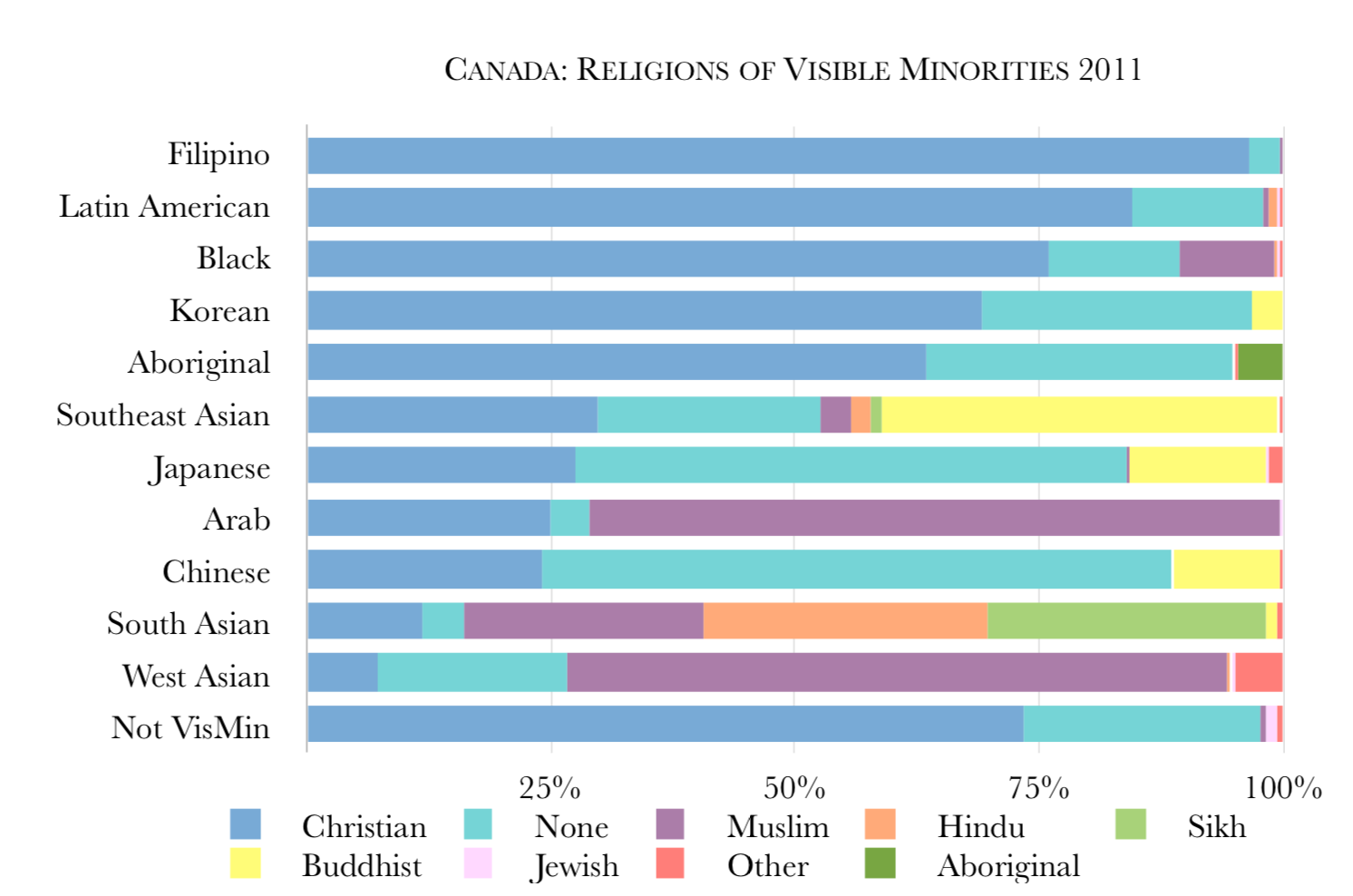
The tactics of Clark, an Anglican, were not only aimed at white Christians, but also B.C. Filipinos (95 per cent of whom are Christian), Koreans (64 per cent Christian) and ethnic Chinese (22 per cent Christian, 59 per cent not religious).

As for the B.C. NDP, Religion and Canadian Party Politics points to polls suggesting they appear to disproportionally rely on non-religious voters.

That is significant since the portion of British Columbians who are atheists, or unaffiliated, is arguably the highest of anywhere in North America, at 44 per cent.

It should be noted, though, that despite the tendency of B.C. Liberals to attract religious voters and the NDP to do the opposite, polls suggest all the province’s parties are capable at different times of drawing support from across the ethnic and faith spectrum.

It’s too bad, in an era when almost all politicians are going out of their way to court minority religious and ethnic groups, the book touches only briefly on Clark’s early success with Sikhs.

It quotes a source saying 30 per cent of the B.C. Liberal party’s membership was made up of Sikhs, even though they comprise just five per cent of the B.C. population. Metro Vancouver’s Sikhs number almost 200,000 and their large gurdwaras often host political gatherings.

Unfortunately, since Religion and Canadian Party Politics was published in 2017, it was not able to report on the way many Sikhs seemed to feel betrayed by Clark during this year’s B.C. election.

The NDP this May won all eight Metro Vancouver ridings with significant Sikh/South Asian populations.

An even more recent overlap of Sikhism and politics in B.C. occurred with the October election of Jagmeet Singh, an orthodox Sikh, as leader of the federal NDP. Singh won in part because he signed up 10,000 new members in B.C., many of them Sikhs.

It’s paradoxical that Singh is now leading a progressive, morally liberal party, even while he’s a baptized Sikh loyal to a faith devoted to conservative sexual ethics.

Even though Singh, 38, is unmarried, the Sikh religion emphasizes orthodox males are expected to be married, emphasizing they should not have sex until then.

Homosexuality is also not accepted in Sikh teaching, and abortion is seen as generally wrong.  Nevertheless, Singh appears to express the kind of tolerance promoted by Sikh teachings about not hating anyone based on their race or sexuality.

How do Canadian Muslims vote?

That question may not be quite as significant in Metro Vancouver, where the Muslim population is three per cent, as it is in places such as Montreal and Toronto, where Muslims make up eight per cent of the population.

Even though Religion and Canadian Party Politics doesn’t delve into it, polls suggest many Canadian Muslims support patriarchy, reject homosexuality and discourage mixed unions.

So it initially appears contradictory that 65 per cent of Canadian Muslims supported Prime Minister Justin Trudeau, (a Catholic) who frequently shows solidarity with feminists and LGBQT people.

The paradox is partly explained by Stephen Harper’s campaign, however. The federal Conservative party took a stand against the face-covering niqab worn by some Muslim women and, as Rayside said in an interview, showed “very one-sided support for Israel.”

Such is the complicated world of religion and politics in Canada.

While Religion and Canadian Party Politics is strong in critically assessing the influence of conservative white Christians on politics, sometimes by stealth, it’s not as useful on the impact of minority ethnic and religious groups.

Rayside acknowledged many scholars are reluctant to appear to criticize ethnic-based faiths.

But whites are now a minority in Metro Toronto and Vancouver. And about 17 per cent of Metro Vancouver residents, and 22 per cent of Torontonians, follow a non-Christian religion.

As scholar Reginald Bibby points out in his new book, Resilient Gods (UBC Press), in the decade leading up to 2011 more than 478,000 immigrants arrived who were Catholic (mostly Filipino and Chinese), 442,000 had no religion (mostly Chinese and Europeans), 388,000 were Muslims (mostly Iranians and Pakistanis), 154,000 were Hindus (from India) and 107,000 were Sikhs (India).

Scholars may have to overcome their cautiousness and more seriously study the impact of such fast-growing ethnic and religious groups.

It’s not just conservative Christians who have been quietly changing the face of Canadian partisan politics. So have Sikhs and Muslims: Many would expect they would be the hot new thing in political research.

via Douglas Todd: How religion cuts into politics in B.C. | Vancouver Sun

Douglas Todd: Who decides the land is ‘sacred’?

Todd on the Ktunaxa/Jumbo Glacier case:

Ktunaxa elder Chris Luke Sr. lives in B.C.’s Purcell Mountains, about 1,000 kilometres east of Vancouver. He doesn’t speak English and he knows how to keep his silence.

Still, Luke is a powerful man.

For eight years, the elder’s religious vision has seized the attention of Canada’s top courts, demanding the focus of hundreds of lawyers, judges, civil servants and politicians.

Their work became necessary because Luke said he had an epiphany in 2004 — which he did not reveal to his people until 2009 ­— that the grizzly bears that inhabit a large chunk of public land in the Purcells are sacred, divine protectors.

As a result, Luke’s small tribal group entered into years of hard political negotiations with the B.C. government, which turned into a precedent-setting court case against developers of a ski resort called Jumbo Glacier.

The case, which Luke and his people lost this month in the Supreme Court of Canada, not only raised profound questions about Canada’s commitment to protect religious freedom, it opened a bigger cans of worms. It highlighted philosophical, ethical, anthropological and religious issues.

Four of the broad questions from Luke’s case are: Who decides what is “sacred?” Are religious beliefs static? Is Indigenous spirituality monolithic? Do aboriginals consistently respect the land?

In the case, known as “Ktunaxa Nation versus British Columbia,” the elder was put forward as the sole source of religious truth.

“The record is clear that the Ktunaxa (believe) only certain members of the community, knowledge-keepers, possess information about spiritual values, and that only Mr. Luke could speak to these matters,” wrote the judges.

The Supreme Court of Canada agreed the Ktunaxa were “sincere” in following Luke’s vision of the “Grizzly Bear Spirit.” But the judges noted the Ktunaxa had believed for less than a decade that the grizzly territory they call Qat’muk was of utmost spiritual significance.

The judges concluded timing didn’t matter, though. “Whether this belief is ancient or recent plays no part in our analysis. The Charter protects all sincere religious beliefs and practices, old or new.”

In other words, Canadian courts are obliged to take seriously almost anybody who convinces their followers that land in B.C., or anywhere, is absolutely sacred.

Theoretically, Luke could have been a New Age guru from, say, Los Angeles, who persuaded a group to “sincerely” believe parts of Saskatchewan, or Mississauga, were untouchable. The potential is high for arbitrariness.

Even though the Ktunaxa lost their case, two of nine Supreme Court judges (and many aboriginals and their supporters) believe the majority made a mistake in one of the reasons they refused to stop the ski development for religious reasons.

In general, I tend not to champion giant ski resorts, nor shopping malls nor casinos, whether on public, private or Aboriginal land. Like many Canadians, I also strongly support reconciliation with Canada’s Indigenous populations, along with the treaty process.

The Supreme Court of Canada agreed the Ktunaxa were ‘sincere’ in following their elder’s vision of the ‘Grizzly Bear Spirit.’ But the judges noted the Ktunaxa had believed for less than a decade that the grizzly territory in the Purcell Mountains was of utmost spiritual significance. Determining ‘sacredness’ is subjective, and the courts justifiably don’t want to take a stand on it.

But, with the Ktunaxa case, it’s hard not to think the majority of judges were more reality-based than the dissenters.

One of the flaws in the Ktunaxa lawyers’ arguments was in the definition of sacred. Who decides what is sacred? And what rights does that give those who claim it?

The court concluded understandings of “sacred” are subjective. In a pluralistic society, one person’s sacred is another person’s profane.

So, instead of legally protecting a physical place or object that some claim sacred, the only thing Canada’s courts rightly felt justified in guarding is religious expression (which includes giving Sikhs the right to carry kirpans, or ceremonial knives).

Beyond the legal angles, which are many, the Ktunaxa case also brings up many broad religious issues, including about whether faiths are static.

Though many think religions such as Christianity or Islam are set in stone when they’re founded, many other believe they change over time. The Ktunaxa case inadvertently confirmed how a group’s theology can dramatically evolve, since the court found no evidence they believed in the “Grizzly Bear Spirit” before contact with Europeans.

The case also touches on the question: Are Canadian Indigenous beliefs monolithic?

The two dissenting judges seemed to assume so, with Judge Michael Moldaver saying things such as, “There is an inextricable link between spirituality and land in Indigenous religious traditions.”

But no judge mentioned the wide religious diversity among Canada’s 1.7 million Indigenous people, including that two of three are Christian. That includes many Ktunaxa.

Dream Catchers: How Mainstream America Discovered Native Spirituality, by Philip Jenkins, is one of many books describing how eclectic and syncretistic Indigenous spirituality has been, including in the way such things as smudging rituals have been loosely borrowed and adapted.

We cannot assume religious uniformity among Indigenous people or anyone else, even though the dissenting judge appeared to do so — somewhat naively, romantically.

Canadian scholar Rod Preece’s Animals and Nature has detailed hundreds of ways North American Indigenous people have through the centuries mistreated the land and animals.

That includes the way Prairie natives killed thousands of buffalo at a time, wasting their meat, sometimes just taking their tongues. It also entails recent events, such as the Inuit hunter on his snowmobile who chased 162 wolves to their deaths and B.C. aboriginals joining non-Aboriginals in overfishing.

North American aboriginals often ambivalent approach to nature also suggests itself when tribal groups erect unsightly billboards and casinos on what is supposedly “sacred” land, along with huge commercial developments, such as the new Tsawwassen mall.

Such troublesome realities, however, didn’t stop Judge Moldaver from playing the role of a religion expert when he insisted Aboriginals are unique in their firm belief physical things are sacred.

That’s unlike those who follow “Judeo-Christian faiths,” Moldaver claimed, “where the divine is considered to be supernatural.”

Thousands of religion scholars would disagree with the judge’s generalization. They might cite the Christian theology of “incarnation,” which teaches God is embedded in every natural thing, not to mention the commitment of Jews and Muslims to their holy lands.

Moldaver’s awkward attempts at theology serve as a reminder of why Canadian courts have decided never to rule on what is religiously “orthodox.”

To be fair, the dissenting judge was trying in his way to further the valuable process of reconciliation with Canada’s aboriginals.

But the majority of judges went ahead and actually did so: By clarifying that ostensibly political claims about who controls public land cannot be made on religious grounds.

via Douglas Todd: Who decides the land is ‘sacred’? | Vancouver Sun

Can Canadians learn from world’s largest Muslim country? Douglas Todd

Todd reflects on his recent visit to Indonesia and possible implications for Canada (one could argue that there may be similar risks with regard to more fundamentalist Christians, whether immigrants or not):

When Canadians think about the Islamic world, they tend to focus on quasi-dictatorships in the Middle East, like Saudi Arabia, Egypt and Iran.

But the world’s most populous Muslim nation is actually Indonesia.

This equatorial Southeast Asian country is home to 260 million people, 87 per cent of whom are Sunni Muslims.

It’s been a democracy for two decades, a rarity among Muslim-majority countries.

Canada is a much different country, obviously. Our nation is predominantly Christian, increasingly non-religious, and has been a democracy for at least 150 years.

Indonesia, nevertheless, has surprising similarities to Canada, particularly in the way its moderate Muslim community leaders express commitment to values such as pluralism.

Surprisingly, the Muslim-majority country’s centuries-old motto is: “Unity in diversity,” which sounds a lot like Prime Minister Justin Trudeau’s go-to slogan: “Diversity is our strength.”

I recently attended a conference of the International Association of Religion Journalists (IARJ) in Jakarta, the world’s second-largest metropolitan region.

I was struck by how many times journalists, professors, top Muslim leaders and politicians used words like tolerance, diversity, multiculturalism and interfaith dialogue.

They do so for a reason: Indonesia is at a crossroads.

Its young democracy is increasingly fragile, threatened by rising intolerance and Muslim extremists, particularly those from the authoritarian Middle East.

I lost count of how many times speakers at the conference referred, in an almost casual way, to Indonesian “riots,” largely organized by Muslim radicals, some of which led to killings.

Indonesian journalists who write about religion repeatedly talked about being harassed, threatened, ostracized and having to deal with Muslim-led boycotts.

Journalists from other Muslim-majority countries, like Pakistan and Malaysia, also described backlashes when they tried to write stories about their countries’ laws, which forbid criticizing Islam and treat sodomy as a crime.

The most recent case of mushrooming extremism in Indonesia centres on the once-popular former governor of Jakarta, Basuki Tjahaja Purnama, a Chinese Christian.

Purnama is now in jail after his political opponents’ trumped-up a charge that he blasphemed Islam, merely by saying the Qur’an allows people to vote for non-Muslims.

With moderate politicians living in trepidation of such illiberal Islamists, the latter are taking advantage of democratic freedoms to magnify their power.

Islamists have successfully brought in sharia law in regions of Indonesia, influenced in part by ultra-conservative Muslims from the Middle East.

Scores of drug dealers are being shot on sight. Hardliners in some regions have totally prohibited alcohol, restricted women’s dress, and are punishing homosexuals, adulterers and those who date outside marriage, with whippings.

As these grim examples illustrate, compared to Canada, the stakes are much higher for moderates in countries like Indonesia when they profess a commitment to such things as diversity and pluralism.

Canadians could learn from the courageous Indonesians willing to defend such values, including democracy and cultural sovereignty, from outside religious forces.

Most Canadians take democratic freedoms for granted — in contrast to moderates in Indonesia, like Foreign Minister Retno LP Marsudi.

She told the IARJ conference: “For a diverse country like Indonesia, harmony is a must, otherwise it cannot survive.”

The increasing power of extremists, external and internal, has also led the leader of the moderate Muslim socio-religious group, Muhammadiyah, which has 30 million members, to call on Indonesians to wake up.

“Moderate Muslims are too quiet. We have to become radical moderates,” Abdul Mu’ti, Muhammadiyah’s secretary-general, told conference delegates. “Moderate Muslims have been sleeping. We have kept silent. We have become lazy tolerant.”

Likewise, a founder of The Wahid Institute for democracy, Yenny Wahid (daughter of Indonesia’s former president), urged Muslims to stop ignoring religious extremists, since acquiescence has given them a bigger platform.

“You have to fight back. You have to defend your own boundaries,” Wahid said.

The immense political power held by religious organizations in Indonesia is largely unfamiliar to Canadians.

English-speaking Canada’s once-predominant mainline Protestants have given up a lot of their influence, particularly in the past 50 years.

Noted religion historian Mark Noll says when Canada’s Protestants, and to some extent Catholics, welcomed multiculturalism and pluralism in the 1970s, they eroded their own influence. These denominations are now minor players on the national scene.

And even though Canadian evangelicals tried, mostly through stealth, to shape federal policy during the heyday of Conservative Prime Minister Stephen Harper, they largely didn’t succeed.

Minority religions in Canada — Muslims, Sikhs, Buddhists and Hindus — are now growing faster than Christian denominations.

But they are still relatively small. Muslims make up eight per cent, for instance, of Toronto residents, while Sikhs comprise a roughly equal portion of Metro Vancouver’s population.

As SFU political scientist Sanjay Jeram makes clear, Canadian politicians constantly woo such urban religious groups. But, because they are not majorities, they don’t have the same broad power to sway politics as Muslim groups do in Indonesia.

There is a frank discussion to be had some day over whether hard-line religious organizations, strengthened by their separate schools, may ever really pose a risk to Canada’s democratic values.

There is little doubt many immigrants arrive with more patriarchal practices than domestic Canadians. Polls show religious immigrants generally have a higher aversion to intermarriage and are more critical of abortion and homosexuality.

But the more immediate threat to Canadian democracy, and Canadian values such as equality and fairness, currently has less to do with religion and much more to do with economics.

Witness the housing affordability crises in Metro Vancouver and Toronto. As a result of the globalization of capital and labour, and the anything-goes attitudes of Canadian politicians, locals in these major cities have been priced out of their own housing markets.

Are Canadians prepared to defend their democratic values, including the principle of economic justice? Are Canadians willing to take a stand to protect citizens from trans-national capital and property speculators, domestic and foreign?

Or, as Abdul Mu’ti warns Indonesians, are Canadians instead going to be passive in the face of such threats, the ultimate practitioners of “lazy tolerance”?

Source: Can Canadians learn from world’s largest Muslim country? | Vancouver Sun

Douglas Todd: Vancouver’s ethnic Chinese irked by inequality, tax avoidance

More good reporting on under-reporting of income in Vancouver. Not surprising that Chinese Canadians, likely particularly second generation, are as concerned as any one:

When urban planner Andy Yan spent an hour last week on a Fairchild radio talk show, every Cantonese- and Mandarin-speaking person who called was irate about growing housing inequality and tax avoidance.

“It really surprised me. The biggest lesson out of it was that Chinese-speaking people are as concerned as everyone about fairness and transparency and accountability,” Yan said.

The housing researcher said Chinese-Canadians appear as worked up as others about the growing gap between the house-rich and the rent-poor in this metropolis of 2.4 million people, in which one in five people have Chinese origins.

Yan, director of Simon Fraser University’s City Program, found in a study of the 2016 census that Metro Vancouver led the 10 most-populous cities in Canada in having the highest percentage (16.5 per cent) of residents living in low-income households.

Yan’s study, in addition confirming there are genuinely low-income city neighbourhoods, also added evidence to rising worries about Lower Mainland households that appear to under-report income.

“It’s a total mind-spin,” Yan said. “In Richmond, it seems to be a special concern,” he said, explaining how residents of the municipality, who are 50 per cent ethnic Chinese, are concerned many households may be under-reporting incomes to avoid taxes.

In a large swath of northwest Richmond, centred around Westminster Highway and Gilpin Road, which is replete with new high-end condos, 33 to 50 per cent of residents report living in low-income households. The Canadian average is 14 per cent.

Yan said his study revealed parts of West Vancouver and the west side of Vancouver are also sharp anomalies, with 25 to 33 per cent of individuals in households declaring poverty-like incomes, despite the stratospheric housing prices in those areas.

Yan’s study echoes two reports by veteran real-estate researcher Richard Wozny and UBC geographer Dan Hiebert, which show that residents of core Metro municipalities, where housing is extremely expensive, are often paying less taxes than people in the suburbs, where real-estate values are more modest.

In light of the study by Yan and others, three major factors appear to be contributing to why Metro Vancouver outstripped other major Canadian cities in having the most low-income households.

One factor is the region’s unusually large cohort of poor and working poor, a result in part of tepid wages compared to other Canadian cities.

A second cause relates to neighbourhoods with high-end housing in which some families appear to not be declaring their full worldwide incomes.

A third reason came to light this week, when immigration lawyer Richard Kurland released a Statistics Canada report showing contrasting financial outcomes among foreign-born residents — who make up 45 per cent of Metro’s population.

The report by Garnett Picot and Yuqian Lu showed that immigrants from Asia, who are predominant in Metro, are much more likely to report “chronic low incomes” than the Canadian-born and immigrants from elsewhere.

The disparity was most pronounced among immigrant seniors, who were 15 times more likely than Canadian-born seniors to declare poverty-like conditions.

After Yan pored over the results of his study, he was not surprised to see that more than half the residents of Vancouver’s Downtown Eastside are on low incomes. It is a struggling zone notorious for high rages of drug addiction and mental illness. It is the most extreme example of several low-income zones dotted through Metro, where old rental apartments are the norm.

The unsettling neighbourhoods to Yan, and others, are those dominated by costly houses and highrise condos, but have 25 to 50 per of households claiming low incomes.

In addition to northwest Richmond, such tony neighbourhoods include Ambleside, Sentinel Hill and Cedar Dale in West Vancouver, and Kerrisdale, Arbutus Ridge and Oakridge on the west side of Vancouver.

Detached homes in these neighbourhoods typically sell for $2 million to $6 million, with condos going for $500,000 to $1.3 million.

“It used to be that income was a driver of real-estate values,” said Yan.

But a phenomenon is occurring in which the riches of many rely on heavy borrowing and are buried in assets such as real estate that are not taxed like income. Yan said President Donald Trump, an international real-estate mogul, is a prime example.

Although Yan said “under-reporting of income is hard to measure,” the fact many Metro neighbourhoods with expensive housing are reporting low incomes may relate to “the perils of wealth-based immigration.”

Immigration lawyers and scholars concur. They emphasize it is too easy for many trans-nationals to buy stylish condos or mansions in Metro Vancouver and Toronto, often in the names of their spouses or children, while reporting tiny or non-existent global incomes to the Canada Revenue Agency.

Yan was heartened by Chinese-speaking callers’ reactions to his report on income and housing disparity.

“Many Chinese people are aware of how income inequity has shown up in China through 3,000 years of history. They understand the instability that goes with it,” he said.

“Some Chinese people are not doing that well in Metro Vancouver. And many are concerned about having a real community. So they want to see fairness.”

Source: Douglas Todd: Vancouver’s ethnic Chinese irked by inequality, tax avoidance | Vancouver Sun

Todd: Debating immigration wisely means not vilifying opponents

Douglas Todd’s piece on my IRPP article “How to debate immigration policy in Canada”:

Canada is one of the few advanced countries that can’t seem to hold an authentic public discussion about immigration policy.

Canadian boosters of high immigration and those who oppose it are mutually contemptuous. Their verbal boxing matches are dominated by sloganeering and name-calling.

If Ottawa is ever going to take seriously public opinion to fine-tune its immigration policies, the combatants need to follow a few rules. They may need a referee, who acts fairly when others are losing their heads.

Andrew Griffith may not realize it, but he has just stepped forward to be the mediator between those who advocate more open borders and those who seek greater restrictions.

The high-level Immigration Department official, who has helped draw up the country’s citizenship policies, is on medical leave to undergo cancer treatment.

But his time away from the bureaucracy has inspired him to write books and a compelling essay just published by the journal Policy Options, titled, “How to debate immigration policy in Canada.”

I’ve experienced Griffith’s diplomat-like poise. Occasionally, I’ve tried to get him to air stronger opinions, yet he doesn’t take the bait. He’s committed to even-handedness.

But he’s also realistic. To use an edgier phrase than he might, Griffith realizes Canadians are pretty pitiful at openly discussing immigration issues.

Like others, Griffith suggests fear of being labelled xenophobic is the over-riding contributor to Canadians’ unusual silence on mass migration, which has arguably defined this country more than any other.

It doesn’t help the cause of dialogue that almost no politician, and few academics, will critique how Canada’s approach to the complexities of immigration affects the host society.

Source: Todd: Debating immigration wisely means not vilifying opponents | Vancouver Sun

Todd: Tax avoidance behind Metro’s disconnect between housing, income

Another good piece on Vancouver’s housing prices and the underpaying of tax:

After census figures this week revealed alarming gaps between housing costs and average incomes in Metro Vancouver, veteran real-estate analyst Richard Wozny is preparing a speech for B.C. politicians that blames the disparity is in part on tax avoidance.

A reason why residents of Metro Vancouver municipalities with expensive housing tend to report lower incomes than people in less-costly municipalities is that many of the former avoid declaring their total wealth, said Wozny, whose company has produced 1,200 studies on real-estate trends in Canada and the U.S.

“Canada has become a freeloader society” in which some mansion owners have found ways to avoid reporting their total incomes to the Canada Revenue Agency, said Wozny, who will speak on Sept. 25 at the convention of the Union of B.C. Municipalities in Vancouver.

Census figures released this week show Metro Vancouver, which has one of the world’s most expensive housing markets, lags behind 14 other Canadian cities on average wages.

The census also exposed an apparent contradiction: Residents of Richmond, Burnaby, the city of Vancouver and West Vancouver — which have the most expensive housing costs in Metro — also have on average the highest rates of poverty.

The census data highlights “inappropriate reporting of family incomes” by many property owners in Metro Vancouver’s well-off neighbourhoods, says Wozny, head of Site Economics Ltd., who said governments need to crack down on residential property speculators.

Inadequate Canadian tax laws have allowed owners of houses that sell for more than $2 million or $3 million “to report unusually low taxable median family incomes,” Wozny said in a detailed report titled Low Incomes and High House Prices in Metro Vancouver.

“It is not logical that so many low-income residents buy expensive houses. The analogous situation would be people reporting minimum wage routinely buying Rolex watches and luxury limousines,” Wozny said.

It’s also not fair, Wozny said, that the burden of paying for Metro Vancouver’s transit systems and schools is largely borne by residents of the suburbs, such as Port Moody, where house prices are only average, yet residents have the highest taxable incomes in Metro Vancouver.

“Irrationally high-priced real estate is not harmless,” Wozny said. “There are plenty of victims, from the environment to the middle class. Simply stated, Metro Vancouver is worth more than it charges in property taxes and fees.”

When Wozny speaks to politicians at the UBCM, he will urge better regulations to target real-estate speculators, both domestic and offshore, many of whom shield their wealth from Canada’s tax officials.

“The Americans would never tolerate such free riders. Canada has become a money-launderer’s paradise,” Wozny said in an interview.

“Seattle’s incomes are far higher than those in Metro Vancouver, and its economy is many times larger, yet its housing prices are far lower than they are in Metro Vancouver. The difference is that Seattle is governed by laws that tax worldwide incomes, and which don’t allow un-monitored capital flows.”

Wozny disagrees with real-estate lobbyists who attempt to explain the radical gap between housing prices and wages by saying many mansion owners in Richmond, Vancouver, Burnaby and West Vancouver are seniors getting by on low incomes.

That rationalization doesn’t make sense, Wozny said, because most neighbourhoods in North America have similar levels of what he called “old Mrs. MacKenzie who has lived in her house since the Second World War. There are old Mrs. MacKenzies in every city.”

Wozny’s analysis also doesn’t support remarks made Wednesday by economist Iglika Ivanova of the Canadian Centre for Policy Alternatives, who speculated the reason municipalities with soaring housing prices also have unusually high percentages of people living below the poverty line ­is the latter want to live near transit lines.

Instead, Wozny’s report supports former Richmond mayor Greg Halsey-Brandt, who was the first to publicly flag how some of his city’s pricier neighbourhoods had almost as many people reporting poverty-level incomes as in Vancouver’s destitute Downtown Eastside.

University of B.C. geographer Dan Hiebert has also discovered a correlation between neighbourhoods with largw foreign-born populations and neighbourhoods that appear to have unusually low taxable incomes, despite their inflated housing prices, such as Richmond and Vancouver’s west side.

Wozny, a real-estate business insider, appreciates the analyses of immigration lawyers Sam Hyman and Richard Kurland, and SFU professor Josh Gordon, who have pointed to loopholes in tax and real-estate laws.

They say unenforced laws allow wealthy speculators to avoid taxes by using trusts or companies to purchase real estate, by falsely claiming they are not “residents of Canada” for tax purposes and by buying residential property in the name of “proxies,” such as low-income spouses or children.

Even though Wozny considers himself a fiscal conservative, he said B.C. and Canada desperately need tax-code updates so that investors who buy multiple residential proprieties contribute more to their communities.

“The public has been cynically abandoned by governments. Real-estate is an essential building block of the middle classes,” Wozny said. But hard-working people are being squeezed out of ownership, he said, by speculators who put too much demand on Metro’s real-estate market and who aren’t carrying their social weight.

“Everybody should be paying taxes,” Wozny said. “Taxes should be a privilege. We should enjoy paying them.”

Source: Todd: Tax avoidance behind Metro’s disconnect between housing, income | Vancouver Sun