Diversity in the Bundestag

Dramatic change:

When it comes to diversity in the Bundestag, last year’s federal elections in Germany produced the most diverse parliament in the country’s history. The 2021-2025 Bundestag contains a record number (83) of parliamentarians from migrant communities – legislators who are not, or have at least one parent who is not, a German citizen. Moreover, over a third (35%) of legislators are now women, including the legislature’s two first openly transgender lawmakers.

Meanwhile, and for only the third time in its history, the presidency of the Bundestag is also filled by a woman – the Social Democratic Party of Germany’s (SPD) Bärbel Bas, assisted by four female Vice-Presidents from across the political spectrum. Newly inducted Chancellor Olaf Scholz will also preside over Germany’s first gender-balanced cabinet.

This increase in diversity is largely due to a jump in votes for the SPD and the Greens, two of Germany’s most diverse parliamentary parties. Both have gender quotas for candidate selection, with over half of the Greens’ parliamentary party, and over 40% of SPD legislators, being women. The SPD (9.8%) and the Greens (14.9%) also have a greater proportion of candidates from migrant backgrounds than the CDU/CSU (2.9%).

Following the successful coalition talks between the SPD, the Greens and the Liberals, it appears that a more diverse set of legislators will wield power than ever before.

Intuitively, the Bundestag’s greater diversity is to be welcomed. A parliament which better reflects the society it purports to represent fulfils the criteria of descriptive representation: the country’s population is more accurately reflected in the makeup of its legislature.

This symbolic representation can not only engender legitimacy but can also reduce feelings of alienation amongst otherwise marginalised groups.

Given increased rates of misogynist violence, crimes against LGBTQ+ people, and ethnic discrimination in Germany, the greater visibility of minorities in mainstream politics may provide reassurance to those communities that feel vulnerable.

But what about the implications of greater descriptive representation for parliament’s substantive work? Symbolic representation certainly does have its benefits but alone is insufficient.

To be well represented, marginalized and vulnerable groups need parliamentarians to advocate for their interests, transform political agendas, and influence political debate.

There is clear evidence that minority legislators feel a sense of responsibility to do so, be that by asking parliamentary questions, scrutinising legislation, or proposing bills. In Germany, there is certainly legislation which could better reflect the needs and lived experience of minority groups.

Angela Merkel’s National Action Plan, designed to facilitate the integration of refugees and asylum seekers into German society after 2015, focused heavily on language classes and employment as a means of assimilation, and has beencriticised for its failure to combat negative perceptions of, and attitudes towards, immigrant communities.

Similarly, calls for reform to the German law on Self-ID, which currently subjects individuals to large fees and invasive psychological assessment, have to date failed to catch legislators’ attention. The election of two trans representatives may, at a minimum, raise awareness of the issue, and even inform the thinking of governing parties.

Indeed, preliminary evidence seems promising. The Government’s newly minted coalition agreement proposes fundamental change to self-ID laws, and compensation for trans people forced to undergo sterilization in order to legally change their gender identity. Sven Lehmann, a Green MdB, has also been appointed as a government commissioner on gender and sexual diversity, working on LGBTQ+ issues across government departments.

The Government has also committed to introducing a comprehensive strategy (and additional funding) to combat violence against women, and to reforming the asylum process to be more simple, fair, and protective of vulnerable populations.

However, though coalition ministers are supportive, there may still be some limits to the extent to which legislators are able to amend legislation, and actively represent minority groups.

For one thing, although the diversity of the Bundestag increased in 2021, the bar was relatively low to begin with. The share of female legislators is up by just three percent from 2017, and the number of representatives who are female, LGBTQ+, or belong to migrant communities is still low in comparison to the wider population.

For example, only 11.3% of legislators hail from migrant communities, with the largest – Germany’s Turkish community – still vastly underrepresented.

Second, wider societal attitudes are not necessarily conducive to change. As in many other European countries, whilst German attitudes towards LGBTQ+ communities and gender equality are relatively liberal, debate around issues such as gender identity, race, multiculturalism and discrimination is increasingly polarised.

This had led to an increasingly hostile political environment for minority candidates, which is unlikely to encourage political engagement.

Tareq Alaows, a Syrian refugee, campaigned for the Greens in September’s elections on a platform of immigration reform in the hope of becoming the first Syrian immigrant in the Bundestag. However, he was forced to step down after facing a torrent of racial abuse.

A recent study has also found that the 2021 German election campaign was rife with disinformation and conspiracy campaigns which specifically targeted female candidates. Nine in ten female MPs have received correspondence containing misogynistic hate speech and threats.

Third is the question of party politics. Not only are the public increasingly at odds on social issues, but parties are too.

Germany’s three coalition parties may be in step on social issues, but polling ahead of the 2021 election showed a large partisan divide between CDU/CSU candidates and their colleagues from other parties on issues such as migration, or the need to take explicit action to tackle racism and discrimination.

Consequently, although the CDU’s dominance may have faltered in this election, there will still be a substantial bloc of legislators ready to block substantive action on diversity from Government or fellow legislators. In the absence of support from conservatives, parliamentarians’ ability to bring about real legislative change, or shift the attitudes of the wider electorate, may be constrained.

The 2021 session of the Bundestag will be one of its most inclusive. A change in the makeup of parliament, and a more diverse, supportive governing coalition, could mean substantive action on issues such as immigration, self-ID, and misogyny. Such action, however, may be limited.

Illiberal public attitudes, inter-party disputes, and the continued relative lack of lawmakers from minority backgrounds pose formidable hurdles to establishing a distinctive legislative agenda.

There’s a real danger, therefore, that the impact of the Bundestag’s increased diversity may end up being largely symbolic, rather than inspiring tangible change.

Source: Diversity in the Bundestag
Most support workplace diversity but not if it’s a job qualification: national survey

Not that surprising as there is often a difference between what people support in principle compared to when it has the potential to affect them:

Most people in a new Canada-wide survey say equal representation in government is important, but they don’t support employers taking demographic characteristics into account in hiring and promotion decisions. 

The survey by the Canadian Hub for Applied and Social Research at the University of Saskatchewan was done by phone between Dec. 1 and Dec. 24. It asked 1,000 people about equality, diversity and inclusion in workplaces and government. 

The majority of respondents said they support various minority groups being in government, including women (89 per cent), Indigenous people (86 per cent), persons with disabilities (83 per cent), visible minorities (81 per cent) and members of the LGBTQ community (68 per cent).

The survey also asked if employers should only consider qualified candidates or if they should also take into account demographic characteristics when hiring. 

About 60 per cent of those surveyed said employers should only consider how qualified a candidate is, even if it results in less diversity. 

“It’s the inverse of what folks were saying in the previous battery of questions, saying it’s important that these groups be represented,” research director Jason Disano told The Canadian Press in a phone interview from Saskatoon. 

“Folks like the idea in theory, but when it comes to real-world implications or potential ramifications on them as an individual, that’s when they say, ‘Wait a minute, maybe let’s take a step back from this. I support the idea, but I don’t support specific actions to do it.'”

About one-quarter of those surveyed, and most between the ages of 35 and 54, also said they missed a career opportunity or they know someone who missed a career opportunity because of a decision to increase workplace diversity.

“It’s surprising but also makes a lot of sense from the perspective that (equity, diversity and inclusion) initiatives really only started coming into being in the last 10 to 20 years,” Disano said. 

“Those who are 55 years of age and up are settled in their career, and the younger individuals — especially with these COVID-19 times — may have had fewer opportunities to actually be potentially impacted by some of these initiatives.” 

Disano said the survey also indicated, across the board, that women were more likely than men to support diversity in workplaces.

Those surveyed were also asked about the importance of elected officials speaking French. 

Most respondents said politicians should be fluent in both official languages. About 83 per cent said it’s important for the prime minister to speak French, while 65 per cent said it’s important for members of provincial governments and 64 per cent said it’s important for premiers.

Those in Quebec, more than in other jurisdictions, said elected officials should be fluent in both official languages. 

Disano said it’s important to ask questions about diversity, representation and language because it shows there’s a need to have a broader conversation about workplace diversity among governments, workplaces and other organizations.

“The issue is really in terms of convincing people why it’s important and how they make an overall difference,” Disano said.

The survey was reliable to within plus or minus 3.1 per cent, with a 95 per cent confidence level. 

Source: https://www.nationalnewswatch.com/2022/01/10/most-support-workplace-diversity-but-not-if-its-a-job-qualification-national-survey/#.YdwSCMnMKUl

Contrasting pre- and post-pandemic public service survey results

For the data nerds among you, you might this analysis of the Public Service Employee Survey organizational and harassment/discrimination indicators, broken down by visible minority and Indigenous group of interest, comparing the pre- and post-pandemic periods.

Conclusion:

There has been comparatively little change between the pre- and post-pandemic period but noteworthy that Black satisfaction with resolution of harassment and discrimination complaints is less than other visible minority groups.

While it appears that the experience of visible minorities is worse than Indigenous peoples, PSES data supports the view that the government has considerable work to improve the workplace organizational culture to reduce harassment and discrimination for both visible minority and Indigenous groups. This needs to take place at the general and the specific group levels by each department given the variances between the individual groups.

As in the case of disaggregated data with respect to employment equity groups, the increased granularity of the PSES provides a richer evidence base for managers and human resources to develop measures to improve inclusion in the public service at the departmental and organizational levels.

Full article:

Charts colour coded to show variations:

Quebec’s population is changing, but the makeup of the province’s police forces is not, data shows

Lag in most police forces across the country last time I checked, as institutions change more slowly than the population:

In Repentigny, a suburban community east of Montreal, it’s rare to see a person of colour in a police uniform. In fact, there are only two.

Pierre Richard Thomas, a local advocate, said Black residents often feel like they aren’t treated equally.

“For an adult or a young teen, seeing a police officer is worrying. It’s frustrating,” said Thomas, a spokesperson for Lakay Média, a Haitian community organization.

The situation in Repentigny is among the most extreme examples of the gap in representation between Quebec police and the general population, an analysis by CBC News shows.

Only two per cent of the police service in Repentigny identifies as a visible minority, and none as Indigenous, compared with 12 per cent of the general population.

CBC requested the latest figures on staffing from 12 police services across the province and compared them to the latest census data from 2016 for the areas they serve.

Suburbs becoming more diverse

The results show police officers across the province remain overwhelmingly white, even as visible minorities (the term used by Statistics Canada and police to describe people of colour) account for a growing percentage of those living in Montreal and municipalities farther afield.

The fast-expanding suburbs outside the city, in particular, are becoming more racially diverse.

But the police services remain mostly white, even though recruiting officers from a wider variety of backgrounds is a stated goal of the provincial government.

The chart below illustrates the divide between police services and the populations they serve, with the RCMP’s Quebec division coming closest to being representative of the population.

Quebec police forces don’t reflect population they serve

Representation of Indigenous and visible minorities among police is far lower than in the general population.

pastedGraphic.png

The issue of racial inequity in policing was thrust to the forefront again this week, after a video captured Quebec City police officers dragging, hitting and pinning down Black youths in the snow.

Five officers were suspended in connection with the incident. The Quebec City police service, which has come under scrutiny in the past for a lack of diversity and allegations of racial profiling, is investigating.

Quebec City police did not provide up-to-date statistics this week, but as of June 2020, it had no Black officers out of a total of 853. According to the most recent census figures, there were more than 12,300 Black residents in Quebec City, accounting for 2.4 per cent of the city’s population.

Findings from CBC’s analysis include:

  • Thérèse-De Blainville and Deux-Montagnes have only one officer each who identify as visible minorities.
  • Châteauguay has the most representation of visible minorities and Indigenous people of any of the 12 police services.
  • Laval and Montreal have the widest discrepancy between their populations and police services.
  • There has been little change since CBC’s last analysis of police data in 2016, although the number of visible minorities in Montreal police is up by two percentage points.

Troubling, but not surprising, expert says

Akwasi Owusu-Bempah, an expert in policing and an assistant professor in sociology at the University of Toronto, reviewed the data.

He said the findings are troubling but not surprising — given similar gaps in representation have been documented across Canada.

Research has found that a greater diversity in police departments improves trust in those institutions.

But there’s also no clear indication it leads to more equitable policing.

“I don’t think that the diversification of police agencies is necessarily a panacea to dealing with all of the issues of racial and other forms of bias that we have. But I do think that representation is important,” said Owusu-Bempah, an adviser on anti-Black racism to the Canadian Civil Liberties Association.

“It’s something that we should be striving for.”

Improved oversight of police and better training are also crucial, said Rashawn Ray, a senior fellow at the Brookings Institution and a sociology professor at the University of Maryland.

“Police officers, regardless of their race or their gender, their background, they’re trained in a similar way. They’re socialized to police people in a similar way,” said Ray, who oversees a training program that uses virtual reality simulations to improve equity in policing.

He added, though, that the mere optics of more people of colour in uniform can build a stronger relationship with the communities police serve.

Hiring a challenge, police say

Repentigny typifies the struggles seen in smaller municipalities outside Montreal. A report released by academic researchers in September found Black residents were 2.5 to three times more likely to be stopped by local police than their white counterparts.

In the wake of those findings and the shooting death of a Black man last August, the Repentigny police service announced a five-year plan that includes a commitment to “inclusive” hiring practices.

But the police service said it will take time to make changes, given they rarely have full-time jobs available and don’t offer the potential for career advancement as a job in a bigger city.

“As a smaller police service with limited possibilities of advancement, hiring in itself is a challenge for us,” said Éric Racette, assistant director of the police service.

“This being said, we acknowledge that we must do better to increase those numbers.”

Quebec police services have tried to address the problem with programs aimed at encouraging people of colour and Indigenous people to become officers.

The Montreal police and the Quebec provincial police are among those taking part in a fast-track program through the provincial police academy in Nicolet aimed at bringing in a more diverse range of hires, including women.

In separate statements, both police services said they were committed to improving the diversity of their ranks.

Nine per cent of Montreal police identify as visible minorities, compared with 33 per cent of the city’s general population. The provincial police are nearly entirely white, with only three per cent identifying as visible minorities.

A spokesperson for Montreal police said the service is “increasing its resources and efforts to interest young people in police careers, particularly those from ethnocultural and Indigenous communities” in order to “be like the population it serves.”

Montreal police launched a recruitment campaign last May urging Montrealers, including women and people of colour, to “become an agent of change.”

Change in approach needed, advocate says

If police want to improve trust and help citizens feel less fearful, they’ll have to change the way they operate, said Margaret Wilheim, an anti-racism advocate in Châteauguay, on Montreal’s South Shore.

Wilheim recently helped a Black community consultation group look at systemic racism in Châteauguay. The consultation group heard about instances of racial profiling, allegations of excessive service and increased scrutiny during traffic stops.

While Wilheim is encouraged that Châteauguay has a higher percentage of Indigenous people and people of colour than other municipal police services, she said better representation isn’t enough on its own.

“Then you have to look at retention and better policing practices so people don’t feel like they are being questioned arbitrarily,” she said.

Although police services often lament the difficulty in attracting people of colour, Wilheim said they need to be proactive and remove barriers to inclusion.

“It’s easy to say we have the problem, but maybe [they] should look at some of [their] practices, hiring retention, training programs,” said Wilheim.

In Repentigny, hiring more Black officers needs to be paired with real change from the public administration on down so the Black community feels like it’s being treated fairly, said Thomas.

“It has to come from above,” said Thomas, who is looking for a clear signal from the newly elected mayor and counsellors that it is committed to rebuilding trust between the Black community and the police.

“We need a new approach,” he said. “This is 2021 and society is changing. Everything is changing. We can’t stay stuck in the policing of the 1950s.”

Source: Quebec’s population is changing, but the makeup of the province’s police forces is not, data shows

New Parliament has some fresh, diverse faces, but is it enough?

Some good commentary by Erin Tolley. Agree with her that it would be preferable for the Library of Parliament to collect and maintain this data, as they do for women, Indigenous and those born outside Canada:

The number of visible minority MPs and of other historically marginalized communities in Canada’s 44th Parliament, which resumes Monday, Nov. 22, has notably increased, but some analysts question the depth of the changes. 

The number of Indigenous MPs went from 10 in 2019 to 12. There will be a total of eight Black MPs, including the five incumbent from the 2019 Parliament and three new additions.

Based on the validated and judicial recount results posted on Elections Canada website, the Liberals have 160 seats (up by three from 2019), the Conservatives 119 (down two), the NDP 25 (up one), the Bloc Québécois an unchanged 32, and the Greens two.  

Despite seemingly little change on the surface, the election yielded a relatively high turnover — bringing a total of 52 new MPs from all parties who will take their seats in the House of Commons for the first time. 

Critical twists

In at least six ridings where visible minorities were either incumbents or contenders, there were critical twists and turnarounds. 

Liberal Parm Bians unseated the Conservative Kenny Chiu in the riding of Richmond East. Paul Chiang unseated the Conservative Bob Saroya in Markham-Unionville. George Chahal defeated Jagdeep Kaur Sahota in Calgary Skyview, thus swaying an important seat for Liberals in the province of Alberta. Conservative Nelly Shin lost to the NDP candidate in Port Moody-Coquitlam, and the Conservative Michelle Ferreri defeated Maryam Monsef in Peterborough. 

The sixth important riding where visible minorities lost out to a third candidate was Kitchener-Centre, where the dropping out of the race of Raj Saini led to an easier win for the Green party candidate Mike Morris.      

Election 44 reflected the greatest diverse pool of candidates in any election thus far, and as a result, the new Parliament will have greater representation for many historically neglected communities. 

The new Parliament will have 103 female MPs, three more than the previous one, and women MPs in total now make up 30.5 per cent of the House of Commons, a slight increase from 29 per cent. 

For comparison, in 2015, there were 88 women MPs. The Liberal Party has increased its number of female MPs since then from 52 to 57. The NDPs have gone from nine to 11. For the Conservatives, the number of women remained steady at 22, as did the number for the Bloc Québécois at 12 and for the Greens at one. The 44th Parliament likewise marks an increase in LGBTQ2S+ MPs, with eight openly LGBTQ2S+ MPs elected, double the number from 2019.  

In the runup to the September election, a team of Carleton University researchers led by Erin Tolley, Canada research chair in gender, race and inclusive politics, launched a project to track candidate’s diversity. 

The dataset collected includes information about their gender, race, Indigenous background, age, occupation, and prior electoral experience, as well as riding, party, and province. 

Slow and incremental

But while there is visibly increased diversity, Tolley says the progress has been slow and incremental.  

“The snap election and short campaign likely had some impact on who ran for office this time around,” she told New Canadian Media. 

“We know that it takes longer to find and convince women, racialized and Indigenous candidates to run, not because they don’t want to but because politics historically has been inhospitable to them.”

Without being proactive, she says, another election might come sooner than we think. 

“If parties are serious about diversifying politics, they should already be laying out the groundwork, identifying promising candidates, encouraging them to run, and giving them the support they need to do so,” she says. 

Tolley also points out that, based on the observation of successive election cycles, racialized and Indigenous candidates remain somewhat pigeon-holed in a select number of ridings, mostly those with large racialized or Indigenous populations. This, according to her, creates a ceiling in terms of how many can be elected to Parliament. 

“We know that racialized and Indigenous candidates can win in a number of ridings, regardless of the riding’s demographic composition. Parties should think more broadly about the contexts in which they recruit diverse candidates so as not to limit their opportunities,” Tolley suggests. 

Reflecting on the makeup of the new Parliament, Andrew Griffith, a media commentator, policy analyst and the fellow of the Canadian Global Affairs Institute, likewise sees it as a “slow and steady progress,” both in terms of the number of visible minority candidates and elected MPs.  

He also considers that growing diversity is reflected in the new Cabinet that was announced on Oct. 26, and expects this to extend into Parliamentary secretaries. 

Not enough data 

Of the 338 candidates during the election, Liberals had 147 women running for office, 25 Indigenous,18 Black and another 50 visible minority candidates and 17 who identify as LGBTQ2S+.  

The Conservatives, out of 338 candidates in total, had 114 female candidates, their largest number so far. Of those, eight were Indigenous and Metis candidates. The Conservatives also had four LGBTQ2S+ candidates in this election. 

There were also 14 Black and 60 visible minority candidates, bringing the total of the non-white candidates to 74. The NDP had 177 women, 29 of them Indigenous. It had 104 visible minority candidates and 69 LGBTQ2S+ candidates. The Bloc Québécois had a total of 78 candidates, including 37 women, and 13 visible minority candidates, which albeit small, in comparison to others, was the most in the Party’s history. 

Based on the final tally of the candidates, the Liberals once again have the highest number and percentage of MPs, with 43 elected to serve. The Conservatives have six visible minority MPs. The NDP has three. One visible minority MP, a former Liberal candidate, won as an independent. 

Such figures, however, are not readily available as neither the Parliamentary Library nor the political parties put them out. 

Tolley is especially critical of the lack of institutionalized collection of demographic data on candidates or the racial backgrounds of MPs.  

“The Library of Parliament does publish information on women and Indigenous MPs, but nothing related to race. This leaves journalists and researchers without reliable and systematic data on diversity in parliament. That makes it difficult to track progress or hold parties accountable”, she says. 

The first item of business when Parliament resumes will be the election of the Speaker.

Source: https://newcanadianmedia.ca/new-parliament-has-some-fresh-diverse-faces-but-is-it-enough/

Australian comms agencies perceive diversity as not urgent

Of note. Any views on how this compares with Canada?:

A new study by the Framework for Agency Inclusion and Representation (FAIR) and comms agency Think HQ showed that Australian comms agencies are falling behind on diversity practices. While awareness appeared to be high, qualitative findings showed that there were inconsistencies on knowledge and implementation in the workplace as well as in client work and advisory.

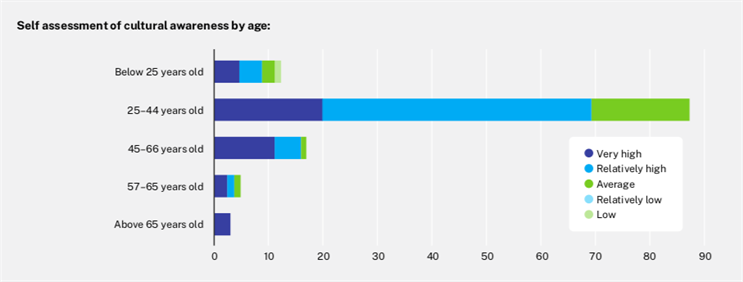
The survey, which used 131 responses from the country’s comms industry, found that while all respondents are quite aware of broader diversity and inclusion principles that initially focused on gender, many have limited understanding, much less a focus on cultural diversity. Most of them were aware of the cultural diversity of the Australian population, but do not see the urgency or importance of integrating it in their business operations enough to equate it with business success.

For example, one respondent suggested that they do not see integrating cultural diversity matters in their business as essential because “people are succeeding without it”. The respondent added: “We still seem to be progressing well adapting and being so people don’t see the urgency of the need.”

Another respondent said that diversity in the workplace is not a priority for them because it isn’t tied to their KPIs. Yet another respondent said that multiculturalism in comms work is ‘niche’ whether communicating to Australian-born audiences or residents with migrant backgrounds. “I don’t think it is so much about making your communication sharper for… culturally diverse audiences because they are too niche,” this person said.

In terms of hiring, the interviewees acknowledged the lack of communication practitioners with culturally diverse backgrounds. A few of them who recruited from England had the propensity to count those hires as part of the ‘culturally diverse’ cohort. A majority of respondents quoted that some 20% of their staff have a culturally diverse background but when further probed, they indicated that the number could have included British, who are not considered culturally and linguistically diverse.

One respondent said: “If I think about my career today, it’s predominantly been in agencies with privileged white people, private school-educated, tertiary education.”

While ‘positive discrimination’ was quoted as a way to recruit more culturally diverse talent, many respondents also mentioned that second- and third-generation Australians do not necessarily want to be identified based on their ethnicity or ancestry. This appears to be a conundrum that many recruiters or leaders still face in Australia.

Here are a few charts that reflect findings from the study:

Source: Australian comms agencies perceive diversity as not urgent

These Numbers Show How More Diversity on TV Leads to Increased Viewership

Of note:

Television that reflects the growing racial and ethnic diversity in the U.S.resonates with audiences and industry stakeholders, a study from the University of California, Los Angeles (UCLA) released on Tuesday shows.

In UCLA’s Hollywood Diversity Report for 2021, which covered the 2019-2020 TV season, researchers found that there was a general increase in hiring diverse talent for people of color and women, both for on-screen and behind-the-scenes roles, despite the challenges many productions faced during the pandemic. To collect the data, researchers tracked racial and ethnic diversity across multiple job categories for 461 scripted television shows across six broadcast networks, 29 cable networks and 15 digital platforms; they also tracked ratings and social media engagement.
[time-brightcove not-tgx=”true”]

The study found that ratings and social media engagement for most groups, including white audiences, peaked for shows that featured casts that were at least 31% minority, while viewership among adults between the ages of 18 and 49 often peaked when a show had a majority minority cast. And for the first time in the study’s history, the percentage of scripted broadcast TV acting roles for people of color, which clocked in this year at 43.4%, surpassed the overall percentage of people of color in the U.S at 42.7% for ethnic and racial groups.

Darnell Hunt, dean of the Division of Social Sciences at UCLA, who co-wrote the report with his colleague Ana-Christina Ramón, says these significant shifts are indicative of the rise in streaming technology, which, through a non-traditional business model, has resulted in more shows by people of color and women being greenlit, which has paid off well. Increasing diversity in the U.S. also means that audiences are hungry to see themselves on-screen—a factor that will only become more important in the future; currently, 53% of all Americans under the age of 18 are people of color, putting the country on track to be majority non-white within two decades.

“People basically want to see the TV shows that look like America, that have characters they can relate to and have experiences that resonate with them,” Hunt told the Associated Press, pointing to the critical and commercial successes of shows like Insecure, which was created by and stars Issa Rae, and the Emmy award-winning Watchmen, which starred Regina King.

But there’s still plenty of work to be done in Hollywood when it comes to furthering diversity and inclusion, per the study. While numbers for representation on-screen have improved, this change can largely be attributed to increased roles for Black or multiracial talent. Asian Americans, who are the fastest-growing racial group in the U.S., Latinx and Indigenous people still remain mostly underrepresented in all acting categories. Both Hunt and Ramón attribute this to executive decisions that see diversity within a Black-white binary.

Behind the scenes, people of color face also face a large parity gap; in TV writing rooms across all platforms, while numbers were up for writers of color, they still made up less than 30% of the writers. This lack of representation was also evident for top roles like directors, show creators, and industry execs.

Source: These Numbers Show How More Diversity on TV Leads to Increased Viewership

‘It’s really unconscionable’: Here are the cabinet contenders Justin Trudeau snubbed

The reality of cabinet-making and the various factors – regional, gender, ethnic/racial etc – and how that invariably leads some to not make it.

Visible minority representation in Cabinet was 16.1 percent in 2015, rising to 21.6 percent in 2019 and falling slightly to 20.5 percent in 2021:

While the shuffling of key ministers and the ousting of others dominated cabinet chatter on Tuesday, there were also questions about MPs thought to be cabinet shoo-ins who were nowhere to be seen.

Prime Minister Justin Trudeau’s front bench shakeup saw the creation of a slightly expanded cabinet, with seven ministers remaining in their old posts, nine newcomers, and three members shown the door.

As for those left without a seat at the table, Quebec MP Greg Fergus is one of the names topping that list.

Fergus is set to start his third term representing the riding of Hull-Aylmer, and most recently served as parliamentary secretary to the prime minister, the president of the Treasury Board and the minister of digital government, among other positions.

“You get a guy like Greg who’s done everything right within his party, serving the country — and he gets overlooked,” said NDP MP Matthew Green, a member of the Parliamentary Black Caucus alongside Fergus.

“I just don’t understand it. It’s really unconscionable.”

Fergus, who declined to comment on this story, has done much more than partaking in a never-ending list of parliamentary roles, committees and associations: he also stood by the prime minister’s side during the 2019 election campaign after old photos emerged of Trudeau in blackface.

And even as Trudeau’s past actions loomed over his commitment to combating anti-Black racism the following summer, Fergus took a knee alongside the prime minister during a Black Lives Matter protest on Parliament Hill.

Fergus is one of several MPs from across the National Capital Region who were left without cabinet gigs on Tuesday.

Gatineau MP Steven MacKinnon, also a former Liberal party national director, was another contender who missed out on a spot. In Ottawa, former Ontario ministers Marie-France Lalonde and Yasir Naqvi, who each fit in Trudeau’s vision of a diverse cabinet, also failed to level up.

The region might have done with one more minister, said one government source who spoke on the condition they not be named, given that Catherine McKenna’s departure left only Ottawa-Vanier’s Mona Fortier representing the area.

Fergus and others might have filled that void, the source said, but Trudeau’s commitment to gender parity made that difficult.

The NDP’s Green, meanwhile, says the Liberal government will need to move past “this notion that they can only have a handful of Black people in cabinet.”

Ahmed Hussen was returned to cabinet Tuesday, while Toronto Centre’s Marci Ien became the first Black woman on the front bench in nearly two decades.

But Bardish Chagger’s ejection from cabinet left a potential opening for other picks from southwestern Ontario, like London West’s Arielle Kayabaga, the source said.

And while Atlantic Canada was well-represented among the 38 faces sent to cabinet this week, there are still those who were bypassed, said Lori Turnbull, director of the school of public administration at Dalhousie University.

Halifax MP Andy Fillmore was one of those options, Turnbull said, although one of the top contenders was Halifax West’s Lena Metlege Diab, a former Nova Scotia minister long speculated to fill the void left by former fisheries minister Bernadette Jordan.

Jordan’s Nova Scotia spot on the front bench was instead plugged by Central Nova’s Sean Fraser, a longtime MP who was handed the immigration file Tuesday.

“Every prime minister will have their own math … around how they’re going to put the pieces together and who they want to bring in,” Turnbull said.

“And one thing is that (Diab) represents Halifax West, which is a very safe Liberal riding. So it’s possible that if (Trudeau) is … sort of trying to solidify a seat, he doesn’t need to solidify that one with a cabinet post.”

Source: ‘It’s really unconscionable’: Here are the cabinet contenders Justin Trudeau snubbed

And this piece by Erica Ifill complaining about Greg Fergus’ absence from cabinet is silent about how Black representation in Cabinet has increased from 0 in 2015 to 2 out of 39 in 2021 (Ministers Hussen and Ien):

Fergus’ snub shows that for Black faces, the work is never enough

New Zealand: Tertiary institutions given 10 years to end minority pass rate disparity

Of note (and the difficulty of change):

It’s the third time in the past decade the commission has set a deadline for achieving parity.

In 2012 the commission wanted to eradicate disparities in polytechnics by 2015 and in universities by 2018. But that didn’t happen. In 2018-19 the commission aimed to achieve parity within five years and fined institutions that failed to improve. But it quietly dropped that deadline and last year introduced the 10-year target.

Tertiary Education Commission deputy chief executive, Learner Success Ōritetanga Directorate, Paora Ammunson, said past attempts at tackling the disparities had failed because they were based on isolated interventions.

“One of the frustrations I guess is that our approach to equity has tended to be really well-intentioned but quite bespoke and disconnected piecemeal interventions and we’re at a stage in the TEC now where we realise that’s not going to close the gap, that’s not going to serve the learners well that we want to succeed,” he said.

Ammunson said the commission had been trialling a different approach requiring large-scale whole-of-institution changes.

“The solution is going to be about a whole-of-ecosystem approach in those institutions towards tackling the problem of attrition, really taking a holistic approach to that. Using your data intelligence, using your guidance systems, making sure that your leaders are setting the direction, making sure you’re doing it in partnership with the community groups and organisations that are important in your context,” he said.

He said the commission was confident its approach would work.

“We’ve been testing this model with tertiary partners. It will require us to work with them and it will require us to have sometimes hard conversations about parts of their delivery that aren’t achieving what they and the TEC would be expecting.”

Last year universities had a qualification completion rate of 52 percent and course completion rate of 82 percent for Māori students. For Pacific students the figures were 48 and 75 percent, while for non-Māori and non-Pacific students the figures were 66 and 90 percent.

In polytechnics Māori students had a 48 percent qualification completion rate and 70 percent course completion rate. For Pacific students the rates were 46 and 71 percent, and for non-Māori and non-Pacific students the figures were 57 and 84 percent.

The Tauira Pasifika National President of the Union of Students’ Associations, Jaistone Finau, said the time was right to tackle the disparities.

He said tertiary institutions were taking student wellbeing more seriously and were also moving to introduce a new code for pastoral care.

Finau said institutions should treat students as partners and use their insights to improve completion and retention rates.

Te Mana Akonga tumukai takirua (co-president of the Māori students’ association), Nkhaya Paulsen-More, said universities had not been doing enough to help Māori students achieve.

“University strategies seem to be aligning with Tiriti-led policies but on the ground we’re still getting complaints from students that they don’t see much of a change,” she said.

“Things like ‘my lecturer doesn’t understand me because I’m Māori and they don’t respect the fact that I’m not the person to go to automatically if they don’t understand anything that’s Māori’, so being referred to as the cultural trainer in formal settings or utilising their knowledge without reimbursing them for that knowledge.”

The organisation’s other tumuaki takirua, Renāta White, said if the commission used financial penalties against institutions that failed to make progress, it should require the institutions to spend the money on improvements.

“I would rather the funds go back into supporting the students. So if there is a fine they are fined needing to employ maybe more support and mental health or more support and peer mentorship rather than the funds going back to government,” he said.

Huhāna Wātene from the Tertiary Education Union said universities and polytechnics could make a big difference for Māori students by hiring more Māori academics and tutors.

She said students also needed more culturally-appropriate support.

“In institutes whether it be in schools, polytechnics, kohanga, kura, it’s the services that are wrapped round them [students] that really assist and allow them to flourish. If you put any students, not just Māori and Pasifika, in that kind of environment they can’t do anything but do well,” she said.

“We know for a fact that Māori students do exceedingly well when they have that support services around them or people who value and appreciate their cultural aspirations and the tikanga.”

Wātene said the commission should use incentives rather than penalties to encourage change.

Source: https://www.rnz.co.nz/news/national/453303/tertiary-institutions-given-10-years-to-end-minority-pass-rate-disparity

Diversity and Division in Advanced Economies

Another informative survey by Pew. Canada tends to have lower perceptions of conflict than the median (as one would expect) except for urban/rural:

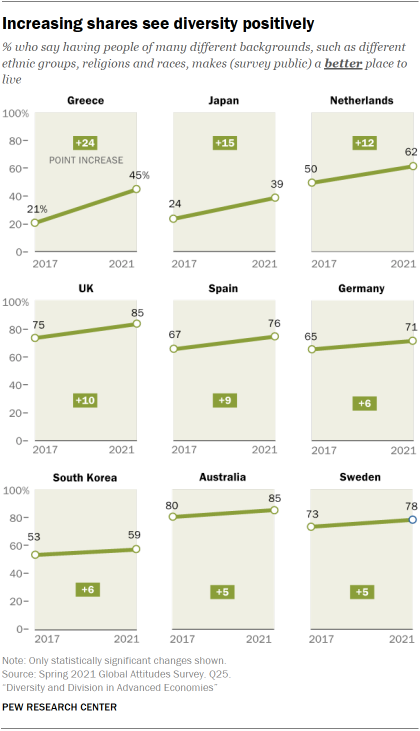
Wide majorities in most of the 17 advanced economies surveyed by Pew Research Center say having people of many different backgrounds improves their society. Outside of Japan and Greece, around six-in-ten or more hold this view, and in many places – including Singapore, New Zealand, the United States, Canada, the United Kingdom, Australia and Taiwan – at least eight-in-ten describe where they live as benefiting from people of different ethnic groups, religions and races.

Chart showing increasing shares see diversity positively

Even in Japan and Greece, the share who think diversity makes their country better has increased by double digits since the question was last asked four years ago, and significant increases have also taken place in most other nations where trends are available.

Alongside this growing openness to diversity, however, is a recognition that societies may not be living up to these ideals: In fact, most people say racial or ethnic discrimination is a problem in their society. Half or more in almost every place surveyed describe discrimination as at least a somewhat serious problem – including around three-quarters or more who have this view in Italy, France, Sweden, the U.S. and Germany. And, in eight surveyed publics, at least half describe their society as one with conflicts between people of different racial or ethnic groups. The U.S. is the country with the largest share of the public saying there is racial or ethnic conflict.

Chart showing perceptions of conflict between groups much higher in South Korea and U.S., especially between those who support different political parties

Notably, however, in most societies racial and ethnic divisions are not seen as the most salient cleavage. Rather, in the majority of places surveyed, more people identify conflicts between people who support different political parties than conflicts between people with different ethnic or racial backgrounds. Political divisions are also seen as greater than the other two dimensions tested: between those with different religions and between urban and rural residents. (For more on the actual composition of each public surveyed on each of these dimensions, see Appendix A.)

In the U.S. and South Korea, 90% say there are at least strong conflicts between those who support different parties – including around half or more in each country who say these conflicts are very strong. In Taiwan, France and Italy, around two-thirds say the political conflicts in their society are strong. Still, in around half of the surveyed publics, fewer than 50% say the same.

Chart showing around half or more in several publics say people do not agree on basic facts

In some places, this acrimony has risen to the level that people think their fellow citizens no longer disagree simply over policies, but also over basic facts. In France, the U.S., Italy, Spain and Belgium, half or more think that most people in their country disagree on basic facts more than they agree. Across most societies surveyed, those who see conflict among partisans are more likely to say people disagree on the basic facts than those who do not see such conflicts.

Views on the topic are also closely related to views of the governing party or parties in nearly every society (for more on how governing party is defined, see Appendix B). In every place but the U.S. and Italy, those with unfavorable views of the governing coalition are more likely to say most people disagree on the basic facts than those with favorable views of the government.

Chart showing views of COVID-19’s effect on unity factor into views of political conflict

Although divisions between racial and ethnic groups as well as between partisans are palpable for many, other types of conflicts are less commonly perceived. For example, in no place surveyed does a majority think there are strong conflicts between people who live in cities and people who live in rural areas. Similarly, only a minority in most countries say there are divisions between people who practice different religions – though around half or more do sense such conflicts in South Korea, France and the U.S.

Beyond divisions between specific groups, there is also a widespread – and growing – sense that societies are more divided now than they were before the COVID-19 pandemic. A median of 61% across the 17 advanced economies say they are now more divided than before the outbreak, and in all but one of the 13 countries also polled in summer 2020, the sense that societies are more divided than united has risen significantly since last year. Those who describe their society as more divided than before the global health emergency are also significantly more likely to see conflicts between different groups in society and to say their fellow citizens disagree over basic facts.

Source: Diversity and Division in Advanced Economies