Express entry economic immigration timelines a ‘joke,’ say lawyers as processing times increase

Further to the IRCC departmental results report and its failure to meet its service standards (see https://multiculturalmeanderings.com/2021/01/21/immigration-program-ircc-results-highlights/ :

Canada’s “express entry” approach to key economic immigration programs isn’t working, immigration lawyers say, following a recent report showing that none of them are meeting the six-month service standard.

That failed grade was among 17 missed performance targets the Immigration, Refugees, and Citizenship Canada (IRCC) reported for the 2019-20 fiscal year, or 31 per cent of the 54 total targets. It said none of the government’s business lines for permanent residents adhere to service standards during a time period that had yet to feel the pandemic’s full impact. 

Launched in 2015, the express entry process is described by Canada as its “flagship” system for various federal skilled worker programs, and a portion of the provincial nominee program, as a pathway to permanent residence for skilled workers in Canada and overseas. IRCC has said it plans to increase permanent-resident admissions, setting a target of 341,000 for 2020 and 350,000 for 2021, with most of the uptick expected from economic immigration streams.

Evelyn Ackah, founder of Ackah Business Immigration Law in Calgary, laughed when she repeated the program’s name.

“Express entry, that’s a joke. When they first launched that program a few years ago, it was incredible. It was three months, four months,” she said, but now she warns clients it can take more than a year.

She said it’s disappointing the government hasn’t been able to keep up with the high volume of applications. To her, it’s a clear resourcing and staffing problem that doesn’t line up with Canada’s stated goals to increase immigration levels. 

“It’s not working as an express process, absolutely not. It’s the same as the old process, as far as I’m concerned, and it’s lost its credibility with people,” she said. “The trend is getting slower and slower.”

Over the last three years, and before COVID-19 interruptions, processing times have increased, and in some cases, doubled the time it takes to deal with 80 per cent of applicants. The federal skills trade stream jumped from six months in 2017 to one year for the majority of applicants, while the federal-skilled worker and provincial-nominee programs increased from six to nine months in that same time frame. The Canadian Experience Class increased from four to seven months. Across all programs, only 60 per cent of the applications met the standard by the end of 2019.

According to the department’s latest plan, its overall spending is set to increase from $1.92-billion in 2017-18 to the peak last fiscal year at $3.46-billion, before going back down this fiscal year to $2.84-billion, $2.6-billion in 2021-22, and $2.56-billion in 2022-23.

The stretching timelines reflect an increase in applications to express entry, with the 332,331 submissions in 2019 amounting to a 20 per cent jump from the number of applications in 2018. Among the 2019 profiles submitted in 2019, 72 per cent were eligible for at least one of the business programs, according to the program’s year-end report.

https://flo.uri.sh/visualisation/5180771/embed

Still, the government promises to those searching for information online about the express entry system that it “will result in fast processing times of six months or less.

“I can’t even bring up that number [to clients],” said B.C.-based  immigration lawyer Will Tao of Heron Law, saying more transparency is needed. 

It’s “misleading” and can “give the wrong impression” to applicants, he said, especially now with the pandemic posing even more of a challenge to processing times.

“I think they pretty much internally abandoned it, so from my perspective, if you’ve done that, then you probably should … let clients know,” he said, calling for better transparency so that people can get more certainty about their situations. 

Even though it’s supposed to be an automated system, based on points, both lawyers said the process gets bogged down during the authentication stage, as officials check over and verify the many documents submitted. Eligible candidates in the pool are given a score based on their skills and experience, with top-ranking candidates invited to submit an application for permanent residence. As of June 2017, IRCC added extra points to candidates with strong French-speaking skills.

Both Mr. Tao and Ms. Ackah acknowledged it can be a complicated process, but Ms. Ackah said that’s all the more reason to match up resourcing.

In IRCC’s report on performance targets, the department said “substantial efforts” have been made to reduce applications that took longer than six months to process in the express entry system.

“While service standards are being met for a higher number of applications compared to previous years, this was offset by an increase in applications and the processing of older applications,” the report said.

The department noted early results show “progression towards higher admission targets” and efforts to increase the intake are having an impact on service standards, in this case, the promise to have the majority completed within six months. The department doesn’t control intake for provincial nominee program’s paper applications and Quebec-selected skilled workers.

By email, IRCC spokesperson Lauren Sankey said the government remains committed to reducing application processing times and improving the department’s service delivery. 

IRCC misses a third of 2019-20 targets

In 2019-20, the department met 37 of 54 performance targets, and missed 17, or 31 per cent. The express-entry delay was the worst among several performance targets the department didn’t reach. Canada’s backlogged asylum system again failed to make the cut, with the department reporting only 32 per cent of asylum claims were referred to the Immigration and Refugee Board of Canada within service standards, compared to target of 97 per cent.

A couple of targets found language-development delays for people settling in Canada. In one case, only 37 per cent of IRCC’s settlement clients reported improved official language skills compared to the target of 60 per cent, while 19 per cent of people reported receiving language-training services compared to target of 25 per cent.

Ms. Sankey said every newcomer’s experience is unique, including their participation in settlement services, which is managed by IRCC and delivered by more than 500 service provider organizations across the country, outside of Quebec. Federally funded language training is “a key component” said Ms. Sankey, who noted there’s been a proportionate increase in newcomers with limited knowledge of English or French over the past few years.

In 2019-20, IRCC also reported 2.82 per cent of permanent residents outside Quebec identified as French speaking, compared to the target of 4.4 per cent. Ms. Sankey said under the Francophone Immigration Strategy, IRCC is “pursuing year-round targeted promotion and recruitment” to attract more qualified French-speaking candidates, and noted under the express entry program, the government increased invitations to French-tested candidates from 4.5 per cent in 2018 to 5.6 per cent in 2019.

These results suggest issues with respect to service standards, language training, and refugee claims, said Andrew Griffith, a fellow of the Canadian Global Affairs Institute who was once a director general at the department’s Citizenship and Multiculturalism Branch.

While many reflect perennial problems and backlogs, given these markers IRCC seems to be “systematically” missing the standards it sets to monitor how well it’s delivering its services, he said.

“So if they’re consistently their targets it says there’s either a management problem, an operational problem, a resource problem, or some combination of those,” he said. 

Even so, he noted a contrasting target the department met: a 91 per cent satisfaction rate from visitor, international students, and temporary worker applicants who reported they were satisfied overall with the services they received. While he doesn’t advocate for lowering targets, Mr. Griffith questioned why the government reports on aspirational or unrealistic goals. 

“Personally, I favour realistic standards for public departmental reports, with aspirational more appropriate for internal use,” he said. 

IRCC’s targets are based on factors like historic trends, program objectives, resourcing levels, client service goals, and evolving influences such as the impact of increasing temporary resident and permanent resident immigration levels, said Ms. Sankey.

“Targets are reviewed regularly, and in some cases, the department establishes ambitious targets that serve to stretch program vision and encourage innovation. In other cases, they are based on baselines and historic trends where achievement is more certain,” said Ms. Sankey, noting following a 2020 departmental review how IRCC tracks performance will change.

Distilling service performance down into two tracks—one for permanent residents (PR) and one for temporary residents (TR)—is not a true representation of the department’s performance, she said, given the disparate programs under the two umbrellas. Instead, IRCC will report on the service standard for each individual program, which Mr. Griffith called a “significant change” given the “overly simple” approach before.

“This change will capture more accurate service standard performance for the many lines of business which make up the temporary and permanent resident programs,” Ms. Sankey said. 
Source: https://hilltimes.us10.list-manage.com/track/click?u=a90bfb63c26a30f02131a677b&id=4ac92e0ed3&e=685e94e554

IRCC Departmental Plan 2018-19: Citizenship

The new framing of citizenship places citizenship outside of integration in the 2018-19 Departmental plan, viewing citizenship as more operational in nature rather than key to integration.

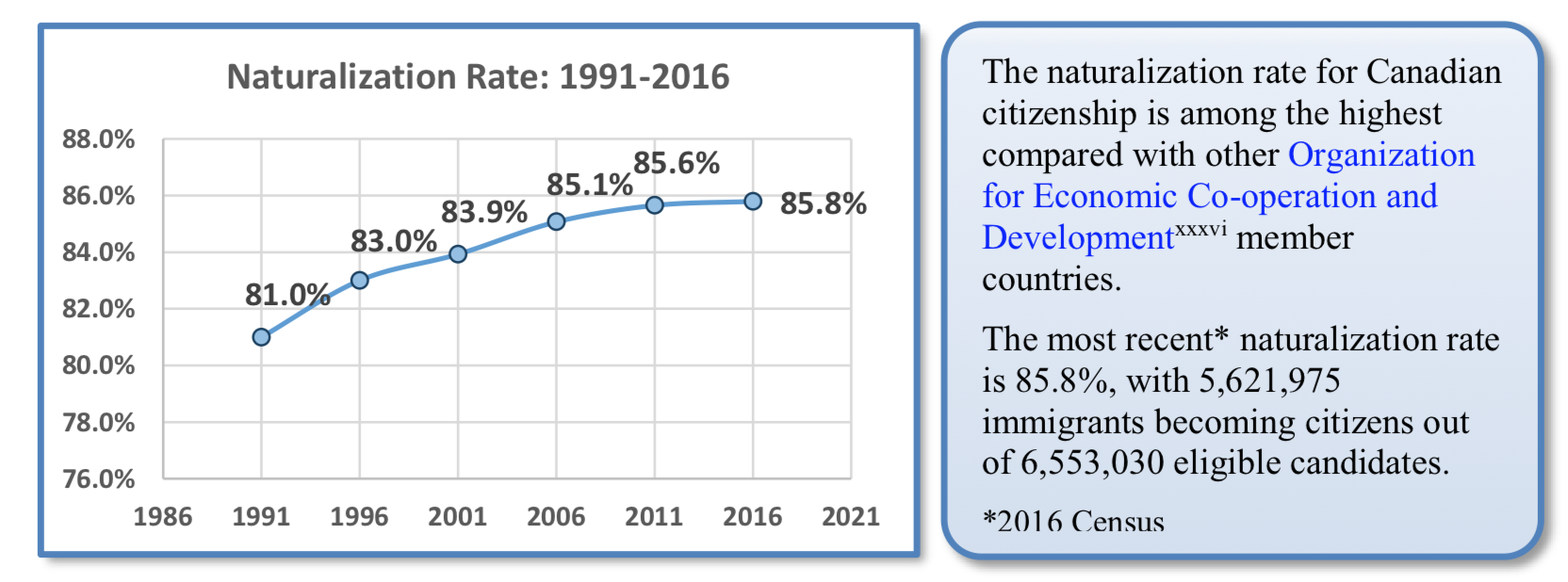
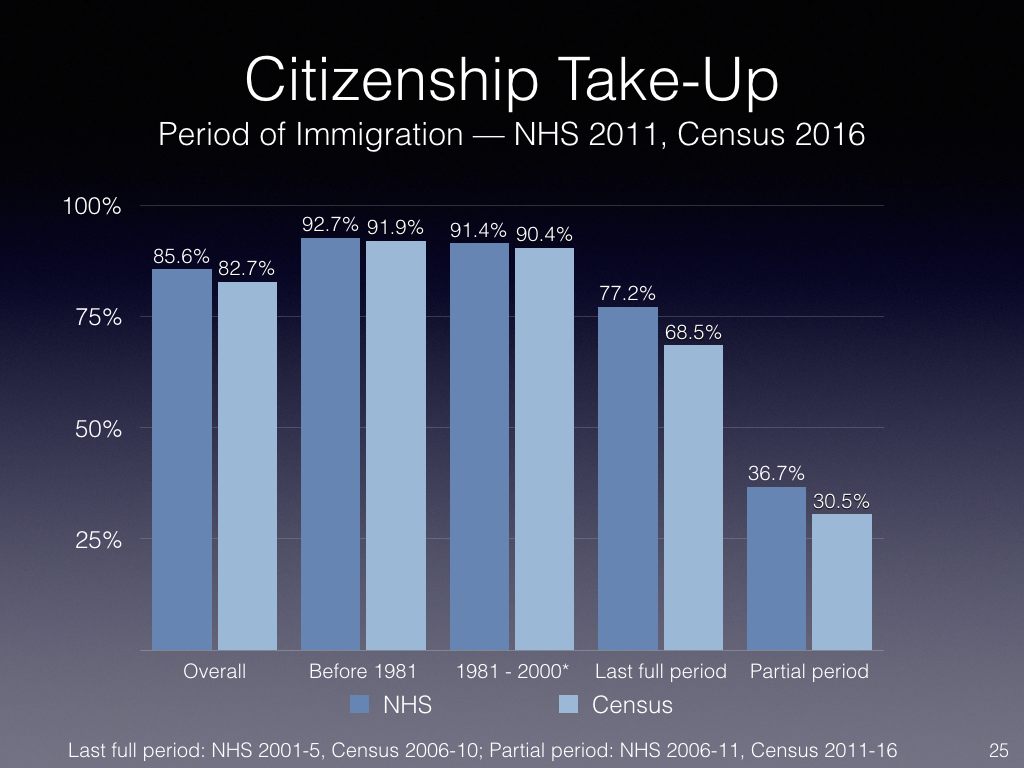
Moreover, the plan includes an incorrect naturalization rate of 85.8 percent for the 2016 Census rather than a more accurate rate of 30.5 percent, given their methodology using the four-year residency requirement for the full 2011-16 period without accounting for the fact that the three-year residency requirement was in effect  until May 28, 2015 (my detailed analysis in my article, What the census tells us about citizenship).

This will likely come back to haunt IRCC and StatsCan in 2021 as using the same methodology would mean assuming a three-year residency period for the entire 2016-20 period, despite the four-year period being in effect for 649 days, or about 35 percent of the time.

And of course by overstating naturalization rate now, and understating in 2021 (assuming they are consistent in their methodology), the decline will appear larger.

I look forward to doing the analysis then!

Summary chart below:

Metropolis 2018 - Citizenship.025.png

Core Responsibility 3: Citizenship and Passports

IRCC promotes the rights and responsibilities of Canadian citizenship, and issues secure and internationally recognized Canadian citizenship and travel documents so that Canadians can participate fully in civic society and so that travel is facilitated across borders while contributing to international and domestic security.

 The Department is consulting with Indigenous organizations and Crown-Indigenous Relations and Northern Affairs Canada to update in 2018–2019, through a legislative amendment, the Oath of Citizenship to include reference to respecting treaties with Canada’s Indigenouspeoples. This is also in response to the Truth and Reconciliation Commission’s Calls to Action.

To improve the client experience, the Department is also working in collaboration with the Canadian Digital Service to improve flexibility in accessing citizenship tests and ceremonies. Furthermore, the Department is considering additional enhancements in 2018–2019 which could allow more electronic accessibility options.

Planned result: Eligible permanent residents become Canadian citizens

Departmental Result Indicators

Targets

Date to achieve targets

2014–15 Actual results

2015–16 Actual results

2016–17 Actual results

Percentage of permanent residents who become Canadian citizens

≥ 85%

2021 (every five years)

85.6% (2011)

85.6% (2011)

85.8% (2016)

Percentage of citizenship applications that are processed within service standards18

≥ 80%

End of each FY

N/A

N/A

90%

Percentage of citizenship applicants who report they were satisfied overall with the services they received19

≥ 90%

page23image2913264

End of each CY

page23image2908672

IRCC Departmental Plan 2017-18 – Citizenship section ignores the main issue of declining naturalization

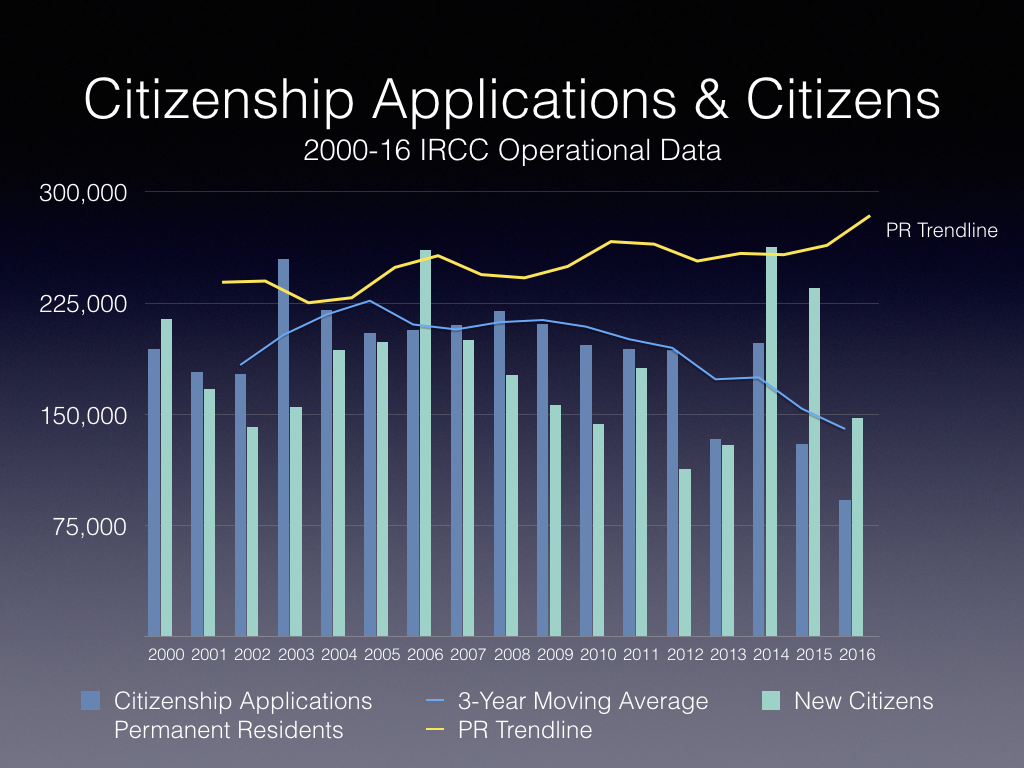
I have been holding off these comments on the IRCC Departmental Plan until the final 2016 citizenship statistics were released. The above chart now includes these showing a steady decline in applications:  198,000 in 2014 (about the historical norm), 130,000 in 2015 and 92,000 in 2016. The number of new citizens, reflecting the additional funding to clear up the backlog of some 300,000 applications, rose to 263,000 in 2014, then dropped somewhat to 235,000 in 2015, with a sharper drop to 148,000 in 2016.

With the number of permanent residents close to 300,000, over time this will mean fewer immigrants taking up citizenship, a major break with the immigrant-to-citizen model.

This “elephant in the room” is mentioned nowhere in the IRCC Departmental Plan (or Performance Report), nor is there any discussion of the societal risks of fewer immigrants taking up Canadian citizenship.

IRCC maintains a meaningless performance management standard: IRCC uses the benchmark of  the overall naturalization rate of all immigrants, no matter how long ago they came to Canada, rather than the more relevant number who have become citizens in the last 6 to 8 years.

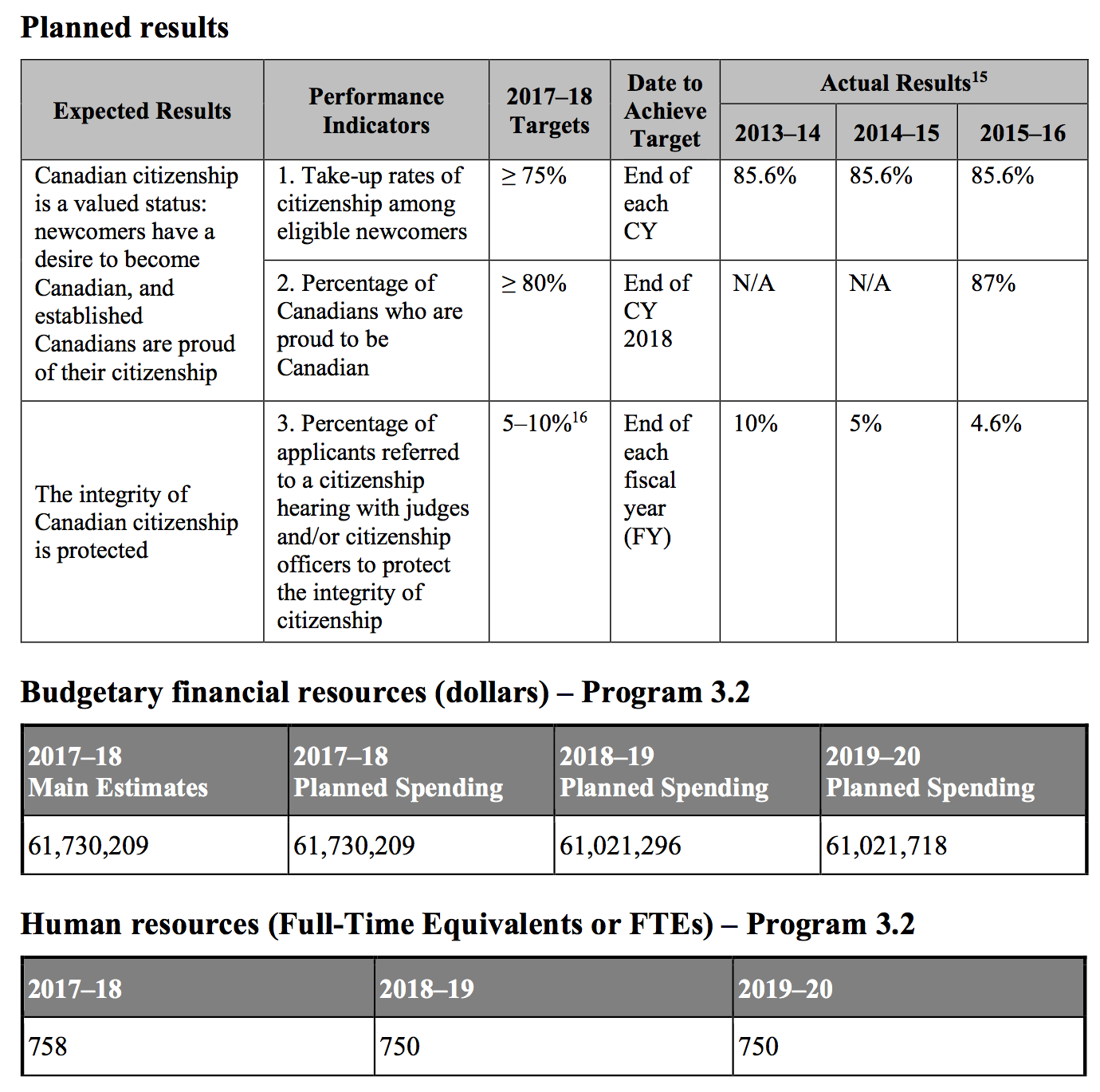
Planned spending is $62 million, projected to remain flat for the next three years (three percent of departmental spending).

Priority: Diversity and attachment

The Department provides newcomers with access to Canadian citizenship and promotes the rights and responsibilities associated with Canadian citizenship, thus fostering a sense of belonging for newcomers and Canadians.

  • Provide support for proposed legislative changes to the Citizenship Act (Bill C-6) which seek modifications to provisions such as revocation as well as residency and language requirements for citizenship applicants.
  • Continue to promote citizenship awareness, including through Canada 150 celebrations, and update the citizenship study guide, Discover Canada: The Rights and Responsibilities of Citizenship to be more reflective of Canada’s diversity.

Priority: Efficient processing

The Department aims to ensure that its screening processes are faster for clients and more effective for Canadians.

  • Expand the eligibility for the new Electronic Travel Authorization (eTA) with proposed expansion for certain travellers from Brazil, Bulgaria and Romania. As well, explore further opportunities to facilitate travel to Canada by lower-risk foreign nationals, such as the increased use of automation to make visitor screening faster, more secure and effective for both travellers and Canadians.
  • Implement innovative approaches to increase efficiencies and reduce processing times, including reducing the processing time for spousal applications by half, to 12 months. Improve the citizenship application process, enabling qualified permanent residents to obtain citizenship more quickly. The Department will also target citizenship application backlogs and develop tools to improve how work is distributed and handled across its service delivery network.

Program 3.2: Citizenship for Newcomers and All Canadians

The purpose of the Citizenship Program is to administer citizenship legislation and promote the rights and responsibilities of Canadian citizenship. IRCC administers the acquisition of Canadian citizenship by developing, implementing and applying legislation, regulations and policies that protect the integrity of Canadian citizenship and allow eligible applicants to be granted citizenship or be provided with a proof of citizenship. In addition, the program promotes citizenship, to both newcomers and the Canadian-born, through various events, materials and projects. Promotional activities focus on enhancing knowledge of Canada’s history, institutions and values, as well as fostering an understanding of the rights and responsibilities of Canadian citizenship.

Planning highlights

  • Implement changes to the Citizenship Act following Royal Assent of Bill C-6, including corresponding updates to the Citizenship Regulations.
  • Update the citizenship study guide, Discover Canada: The Rights and Responsibilities of Citizenship, in support of Canada 150 celebrations.
  • Continue to collaborate with federal partners and national Indigenous organizations to explore options to respond to the Truth and Reconciliation Commission recommendations.

2017–2018 Departmental Plan

The 2015-16 IRCC Departmental Performance Report does not provide any meaningful reporting on citizenship but states:

The Department, through its regular performance reporting processes, has developed specific performance indicators to cover the Citizenship Program’s key outcome areas, including awareness of the responsibilities and privileges associated with Canadian citizenship; desire and successful uptake of Canadian citizenship by newcomers; the integrity of the Citizenship Program; and the value attached to Canadian citizenship. As data are not available at this time, results will be reported in the future.

Canadian Heritage Departmental Plan 2017-18 – Multiculturalism

Multiculturalism-related excerpts from the latest PCH departmental plan, starting with where it fits in the overall departmental strategy and then progressing to the “sub-program” level.

To date, no change in the Conservative government priorities, although these have been updated with respect to the grants and contributions element, where the new priorities are:

  • work toward the elimination of discrimination, racism and prejudice;
  • provide opportunities for youth community engagement; and
  • bring people together through art, culture and/or sport.

The re-integration into Canadian Heritage has not yet raised the profile or influence of multiculturalism. The reduced resources, the dispersion across different branches, and Ministerial focus on more important priorities are likely the main reasons.

Promote diversity and inclusion to enhance Canadians sense of belonging and pride and to promote inclusive economic growth.

  • Deliver a successful year-long celebration of the 150th anniversary of Confederation through a wide range of national and local community events and initiatives.
  • Implement a new and modernized Court Challenges Program, in collaboration with the Minister of Justice and Attorney General of Canada.
  • Support and enhance our approach to diversity and inclusion through the Multiculturalism Program and other initiatives.

Operating context: conditions affecting our work

“The more people engage with the breadth of our country’s diversity, the more Canadian they become.”

The Right Honourable Justin Trudeau, Prime Minister of Canada

The work of Canadian Heritage will continue to play an important role in the lives of Canadians in a dynamic and evolving context. Globalization is creating new domestic and international markets that provide significant opportunities to promote and invest in Canadian creative industries and Canadian creators. The rise of new technologies and digital platforms are changing the way Canadians create, access and experience culture. As the Canadian population becomes increasingly diverse there is an opportunity to build on Canada’s strength in achieving inclusive diversity. In international surveys, Canadians are amongst the most likely to say they are “very proud” of their country. Canada can play an influential role in promoting diversity globally and to share the lessons of its unique historical experience as a multicultural, bilingual, treaty nation with the shared values of human rights. Given the mandate and responsibilities of the Department, Canadian Heritage will continue to play a key role in promoting and celebrating an inclusive society that strengthens and sustains the Canadian social contract and promotes innovation and economic prosperity.

Sub-program 2.2.5: Multiculturalism Program

The objectives of the Multiculturalism Program are to build an integrated, socially cohesive society; to improve the responsiveness of institutions to the needs of a diverse population; and to engage in discussions on multiculturalism, integration and diversity at the international level. The Program provides grants and contributions to organizations for projects and events that enhance intercultural/interfaith understanding, civic memory and pride, respect for core democratic values, and participation in society and the economy. It undertakes public outreach and promotion activities that are designed and delivered to engage Canadians on multiculturalism issues. The Program’s ongoing public outreach and promotional activities include Asian Heritage Month, Black History Month, various web-based resources, and other initiatives. The Program is designed to implement requirements set out in the Canadian Multiculturalism Act, including the development of the Annual Report on the Operation of the Canadian Multiculturalism Act, which is tabled in Parliament. The Program’s international engagement supports Canada’s participation in agreements such as the International Convention on the Elimination of all Forms of Racial Discrimination, and in institutions that address multicultural issues globally. This sub-program uses funding from the following transfer payments: Grants in support of the Multiculturalism Program and Contributions in support of the Multiculturalism Program.

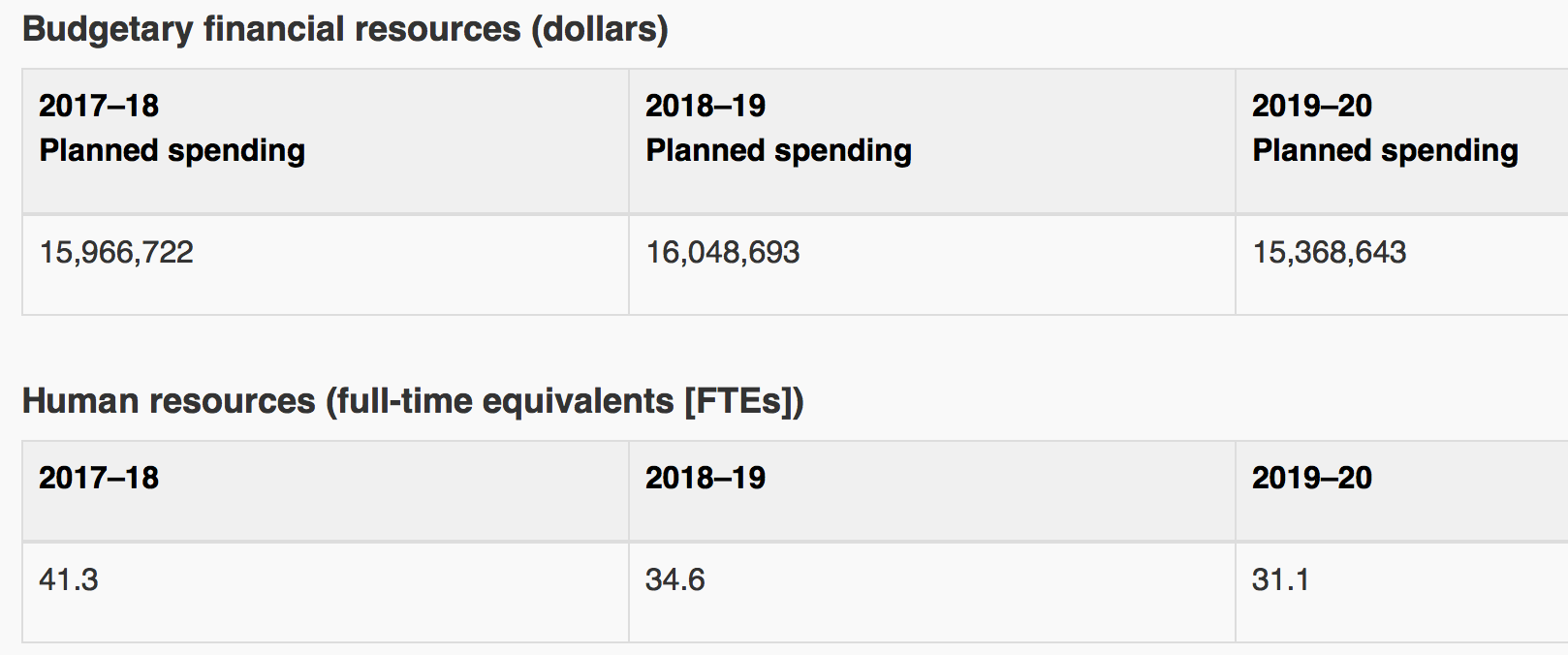
Note: This represented a decline from the amount originally transferred from PCH to then CIC in 2008: $8.7 million for salaries, $5.9 million for operating, and $22.8 million for grants and contributions (G&Cs also included funds for the Canadian Historical Recognition Program, which sun-setted shortly thereafter). The Multiculturalism Program had about 80 FTEs at the time of the transfer.