Ontario’s Education Minister Stephen Lecce says he has asked his staff to review the circumstances surrounding a series of anti-racism training sessions held by the Toronto District School Board in the spring of 2021 following the recent suicide of a former principal who said he was bullied and harassed during the sessions.
“These are serious and disturbing allegations,” Lecce said in a written statement. “No staff member should ever be subject to harassment while in their place of work.”
Richard Bilkszto, a 60-year-old retired principal, sued the TDSB earlier this year, alleging that his reputation was “systemically demolished” during two anti-Black racism training sessions in the spring of 2021 when, after he had challenged some of the speaker’s comments, he was singled out and accused of supporting white supremacy.
The Workplace Safety and Insurance Board allowed Bilkszto’s claim for a “mental stress injury” in 2021 and awarded him compensation for two months of lost earnings. The adjudicator of his case found that the facilitator of the training sessions was “abusive, egregious and vexatious” in their conduct and that it rose “to the level of workplace harassment and bullying.”
Bilkszto, who alleged in his lawsuit that he suffered “severe emotional distress” as a result of what happened in the sessions, died by suicide earlier this month, according to a statement his lawyer posted to Twitter last week.
A member of Bilkszto’s family confirmed his death to the Star, but declined further comment.
In his statement, Lecce offered condolences to Bilkszto’s family and friends, adding that the tragedy “underscores the need for greater accountability of school boards and the necessity to ensure professional training is free from harassment and intimidation.”
He said he has asked his staff “to review what happened in this instance in the TDSB and bring me options to reform professional training and strengthen accountability on school boards so this never happens again.”
The school board released its own statement, jointly signed by Director of Education Colleen Russell-Rawlins and associate directors Audley Salmon and Louise Sirisko, saying they “share the Ministry of Education’s desire to learn what happened” and they will work with the ministry as part of any review.
“We recognize that many are grieving the loss of Richard, who was a colleague, mentor and friend,” the statement reads. “TDSB is in the process of gathering information to better understand the events that occurred.”
KOJO Institute, the company that facilitated the training sessions, said Tuesday that it also “welcomes” a ministry review into the matter and “will co-operate fully” with ministry officials.
The Toronto School Administrators Association said Bilkszto had contacted the association in the aftermath of the sessions saying he had been “bullied, intimidated and harassed” by the facilitators. The association says it asked the school board at that point to investigate Bilkszto’s concerns. “To our knowledge, an investigation was never undertaken.”
According to Bilkszto’s lawsuit, the conflict arose when, during the second of four virtual training sessions, the facilitator, Kike Ojo-Thompson, suggested Canada was more racist than the U.S., in part because it had not reckoned with its racist history in the same way the U.S. had.
When Bilkszto disagreed it led to a brief, but tense exchange. Later in the session and in the following week’s session, Ojo-Thompson is alleged to have implicitly referred to the exchange as an example of “resistance” in support of white supremacy.
The allegations in Bilkszto’s lawsuit have not been proven. The TDSB has not filed a statement of defence.
In a statement provided to the Star prior to Bilkszto’s death, the KOJO institute said it disputes many of the allegations in Bilkszto’s lawsuit against the TDSB, “including the descriptions of interactions with KOJO Institute staff which paint an inaccurate and incomplete picture” of what happened in the sessions.
The company, which has provided anti-racism training to dozens of organizations in the public, private and charitable sectors (including the Toronto Star), is not a party to Bilkszto’s lawsuit. They said it would be “inappropriate” to comment further since the matter was before the courts.
Following Bilkszto’s death, the company provided an additional statement offering condolences to Bilkszto’s loved ones. They added that any interaction with individual TDSB employees during the sessions was “brief” and that they had “no involvement” in any investigation by the school board or the WSIB following the sessions.
In recent months, Bilkszto had become outspoken in his opposition to various school board initiatives aimed at reducing inequity in education. The statement announcing his death, released by his lawyer, says that after his “troubling experience with the (TDSB)’s equity agenda, Richard began advocating to bring people together through a more equality-focused, pro-human approach.”
While I wouldn’t make the same generalizations about all DEI courses and programs, this case highlights the risk of an overly aggressive and ideological approach, one that the Board and administrators failed to address. No need to “throw the baby out with the bathwater” but clear need to vet and monitor consultants to ensure respectful and balanced approaches:
By now, you have probably heard the tragic story of former Toronto District School Board (TDSB) principal Richard Bilkszto, an esteemed educator with 24 years’ experience. In 2021, he attended two TDSB-mandated diversity, equity and inclusion (DEI) sessions, led by the KOJO Institute, during which the facilitator, Kike Ojo-Thompson, berated him for challenging her statement that Canada was a more racist place than the United States.
“We are here to talk about anti-Black racism, but you in your whiteness think that you can tell me what’s really going on for Black people,” she allegedly said, and then reportedly proceeded to berate him in a second session as a “real life” example of someone supporting white supremacy.
Bilkszto, who himself had spoken out against racism during his career, was devastated. Bilkszto went on stress leave and sought support from Ontario’s Workplace Safety and Insurance Board, which found he had been subject to workplace harassment. When he got back from leave, the board refused to reinstate his contract. He then filed a civil suit against the TDSB, seeking additional damages and an apology.
But Bilkszto never fully recovered from the pain caused by the damage to his reputation and his soul. On July 13, he ended his life. According to a statement authorized by his family, “The stress and effects of these incidents continued to plague Richard. Last week he succumbed to this distress.”
Bilkszto’s heart-rending story made headlines across Canada and around the globe. A petition has been started, demanding an inquiry into his death. The Toronto School Administrators’ Association also requested a review. And on Monday night, Ontario Education Minister Stephen Lecce asked officials to “bring me options to reform professional training and strengthen accountability on school boards so this never happens again.”
Bilkszto’s story resonates so deeply because it is an indictment of the failure of DEI training to achieve one of its stated goals: inclusion. Instead of making space for all voices, Bilkszto was shut down because of his race. Worse yet, in our schools, this type of “training” is now competing for scarce resources with priorities such as safety and academic performance.
Recently in Winnipeg, a school administrator defended his district’s annual spending of nearly $850,000 on DEI programs , saying, “We want our children to be anti-racist because you’re either a racist, or you’re an anti-racist.” In British Columbia, a government official stated that the province’s anti-racism plan for K-12 “is an important part of our work to decolonize our institutions and build a better B.C. for everyone.”
But is this “decolonization” and anti-racism education improving interpersonal relations between teachers and students? In B.C., nine in 10 teachers report experiencing violence or bullying on the job. The aforementioned school district in Manitoba, Louis Riel, saw a 263 per cent increase in unsafe behaviour by students last year.
In Nova Scotia, 87 per cent of teachers say that school violence has increased since 2018 and over half have been victims of violence or threats. And in Toronto, the TDSB is projected to have its most violent year since it started collecting data in 2000.
Meanwhile, student performance is declining. While Canada continues to perform well compared to other OECD countries, between 2000 and 2018, Canada recorded a 14-point decline in standardized reading scores, as well as declines in math and science scores classified as “steadily negative.”
Inequity is rooted in poverty, which has many factors, including race. But correcting for it comes down to resources, not words, applied in the right places.
Instead of hosting DEI sessions to berate their staff, school boards should redirect funds to tutoring low-income students who need extra help. They should fund food programs for kids who are hungry so they can concentrate and learn. Physical education, which has been directly correlated with improving educational scores, should increase. Self-esteem is rooted in achievement, and that should be the goal for every student.
Telling a principal that his whiteness is the problem does not help a single Black kid graduate. What it does do is divide, bully and shame. And sometimes, worse.
Of note, an egregious example of DEI training run amok and a cautionary tale regarding engaging American DEI consultants:
In late April, 2021, a Diversity, Equity, and Inclusion (DEI) trainer named Kike Ojo-Thompson presented a lecture to senior Toronto public-school administrators, instructing them on the virulent racism that (Ojo-Thompson believes) afflicts Canadian society. Canada, she said, is a bastion of “white supremacy and colonialism,” in which the horrors unleashed by capitalism and sexism regularly lay waste to the lives of non-white and female Canadians.
Anyone who lives in Canada knows this to be a preposterous claim. But in the wake of the George Floyd protests, which opportunistic DEI entrepreneurs in Canada treated as a gold rush, such lies have been treated as unfalsifiable. The same is true of the (equally preposterous) claim that Canada’s experience with anti-black racism directly mirrors that of the United States. And so it was expected that Ojo-Thompson’s audience would simply nod politely and keep their mouths shut until her jeremiad had concluded.
But one audience member refused to submit: Richard Bilkszto, a long-time principal at the Toronto District School Board who’d also once taught at an inner-city school in upstate New York. Having worked on both sides of the Canada-U.S. border, he told Ojo-Thompson that her generalizations about the two countries seemed misguided; and that denouncing Canada in such a vicious manner would do “an incredible disservice to our learners.”
Bilkszto’s descriptions of Ojo-Thompson’s presentation (a recording of which was verified by at least one Canadian journalist) suggest that she is indeed quite ignorant of both American and Canadian history. Her claim that Canada’s monarchist tradition marks it as more racist than the United States is particularly absurd, given that the British outlawed slavery decades before both Canada’s creation and the U.S. Civil War.
National Post columnist Jamie Sarkonak describes what happened after Bilkszto began speaking up:
“Ojo-Thompson is described to have reacted with vitriol: ‘We are here to talk about anti-Black racism, but you in your whiteness think that you can tell me what’s really going on for Black people?’ Bilkszto replied that racism is very real, and that there’s plenty of room for improvement—but that the facts still show Canada is a fairer place. Another KOJO training facilitator [KOJO Institute is the name of Ojo-Thompson’s company] jumped in, telling Bilkszto that ‘if you want to be an apologist for the U.S. or Canada, this is really not the forum for that.’ Ojo-Thompson concluded the exchange by telling the class that ‘your job in this work as white people is to believe’—not to question—claims of racism.”
This is not a unique story. I have reported for Quillette on other instances in which audience members have been smacked down for raising their voices when confronted with this kind of diatribe. It is part of the pattern of hypocrisy that surrounds the DEI industry more generally: While these consciousness-raising sessions are typically conducted on the conceit of teaching participants to be “brave” and ”disruptive,” the well-paid corporate trainers who lead them often demand a climate of craven subservience.
Ojo-Thompson didn’t confine herself to rebuking Bilkszto in that moment. She also allegedly attacked Bilkszto in a subsequent lecture as exemplifying the forces of white supremacist “resistance.” In Ojo-Thompson’s view, her original treatment of Bilkszto had presented everyone with a valuable template for how they should respond when “accosted by white supremacy.”
For his part, Bilkszto responded by suing the Toronto District School Board (TDSB) for harassment. He also sought a TDSB investigation of Ojo-Thompson’s actions, which the school board refused to conduct. But Ontario’s Workplace Safety and Insurance Board (WSIB) took the incident more seriously, determining that Bilkszto was owed seven weeks of lost pay due to the mental stress he’d endured.
The WSIB judgment, later obtained by the National Post, concluded that Ojo-Thompson’s behaviour “was abusive, egregious and vexatious, and rises to the level of workplace harassment and bullying,” and that she’d intended to “cause reputational damage and to ‘make an example’” of Bilkszto.
I spoke with Bilkszto several times over the last two years, and he would often email me stories about other Canadians who’d been targeted as heretics. He took a leading role in a group of Toronto educators looking to address the problem of ideological extremism, and brought me in once as a guest speaker in late 2021.
Although Bilkszto and I never met (this was still the COVID era, when almost every meet-up was done over Zoom), we quickly bonded over our shared principles, both of us being traditional urban liberals who’d become concerned by the social-justice fanaticism that now suffused the TDSB.
Yet nothing in my own experience allowed me to fully comprehend the pain that Bilkszto was experiencing. A political progressive who’d devoted more than two decades of his life to the TDSB, Bilkszto never fully recovered from being falsely smeared as a supporter of white supremacy in front of his peers.
This month, Bilkszto, aged 60, committed suicide. I don’t know if he left a note. But according to his family, his suicide related to the false accusations of racism he’d endured in April 2021.
Bilkszto was particularly devastated by the fact that some of his TDSB bosses, whom he’d naively expected to defend him (or at least have the courtesy to say nothing at all), eagerly piled on with the public shaming meted out by their external DEI consultant.
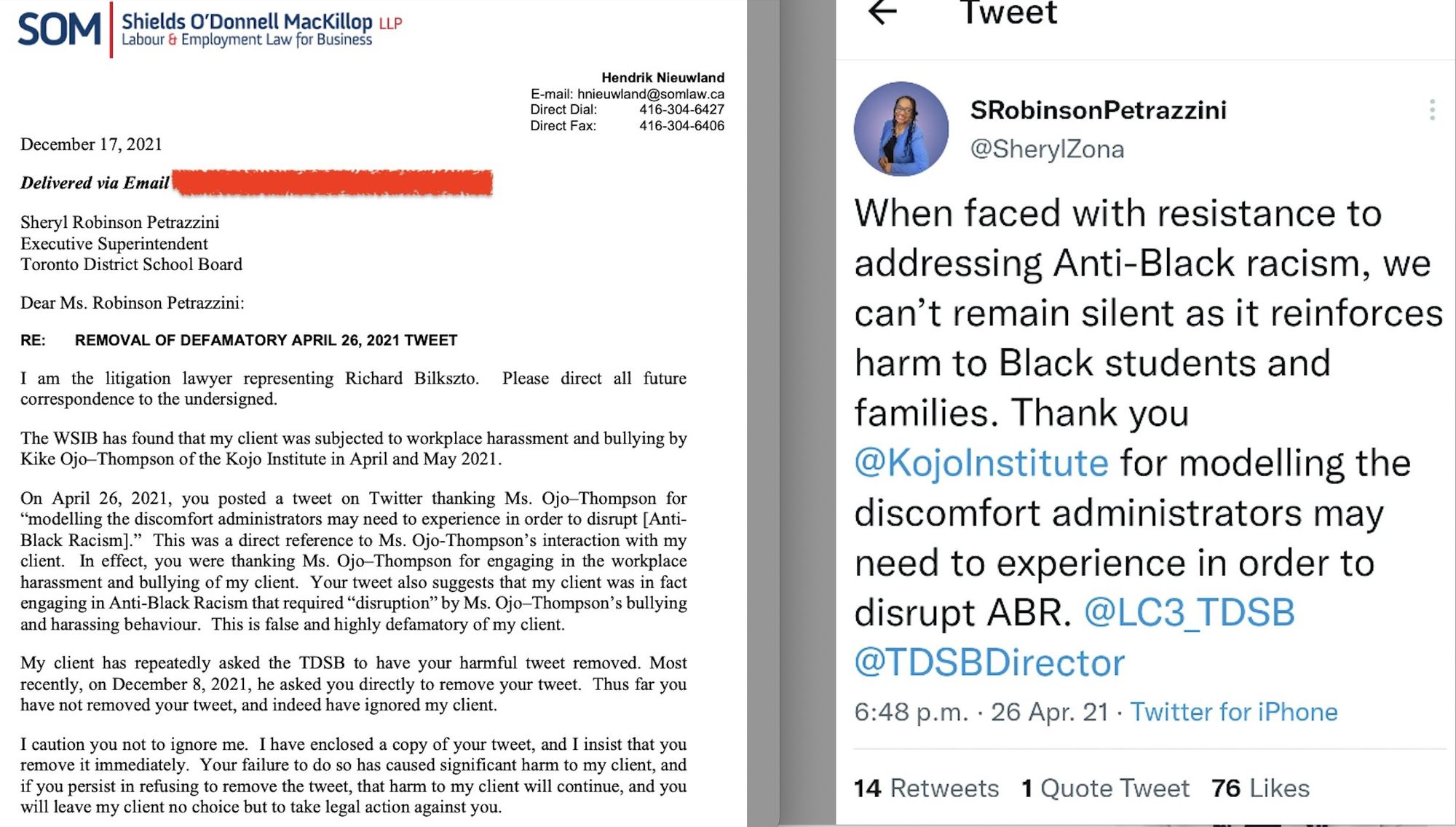
On Twitter, Sheryl Robinson Petrazzini, then the TDSB’s Executive Superintendent, thanked Ojo-Thompson and her KOJO colleague for “modelling the discomfort [that] administrators”—i.e., Bilkszto—“may need to experience in order to disrupt ABR [anti-Black racism].”
For good measure, Robinson Petrazzini also suggested that Bilkszto (whom she did not name, but was the obvious subject of her Tweet) was allied with the forces of “resistance” to anti-racism, and so was abetting “harm to Black students and families.”
Bilkszto personally asked Robinson Petrazzini to delete the Tweet. She did so only eight months later, and only after receiving a letter from Bilkszto’s lawyer warning her that she’d be sued unless she did so.
According to Bilkszto, his other bosses also refused to support him, instead attacking him for his “male white privilege.” And yet, once Bilkszto filed a lawsuit against the TDSB, seeking $785,000 damages for the emotional and reputational harm he’d endured, those same administrators now began claiming that it was Ojo-Thompson who’d gone rogue.
While they’d been perfectly happy to throw Bilkszto under the bus when the stakes were confined to emotional “discomfort,” the TDSB suddenly decided to sue Ojo-Thompson for negligence and breach of contract, demanding that she effectively indemnify the school board for any payout that might become due to Bilkszto. (The TDSB later claimed that it planned to discontinue this suit. But Sakornak reported that it was still a going concern as of June 6.)
I live in Toronto, where my own children have all passed through TDSB schools. Their experience has been a positive one, and I’m happy with the education they’ve received, notwithstanding the sometimes excessive pedagogical focus on race and genderwang. In fact, I have come to sympathize with the teachers—most of them smart hard-working people who find themselves being pressured by their own unions and administrators to adopt militant social-justice postures in their classrooms.
In some school boards, moreover, professional advancement is limited to those who explicitly embrace “anti-racist, high anti-oppressive” leadership principles. So while social-justice puritans comprise a small minority at most schools, they are able to exert disproportionate power in their bid to censure, humiliate, or even oust colleagues, such as Bilkszto, who speak up for the silent majority. In some cases, these ideological enforcers work closely with local race activists and their media allies, so as to harass or censor educators and parents accused of wrongthink.
While the work of anti-racism careerists such as Ojo-Thompson and TDSB Director of Education Colleen Russell-Rawlins is often justified as a righteous crusade against the forces of privilege, it would be difficult to find a more privileged clique of professionals in the field of Canadian public education.
Prior to getting her $300K-per-year TDSB gig, for instance, Russell-Rawlins served as the anti-racism czar at the (even more dysfunctional) neighboring Peel District School Board. Since coming to the TDSB, she’s presided over a series of embarrassing scandals, including an aborted student census that was discovered to be full of overt social-justice propaganda, a revamping of specialty schooling that was found to have been based on a plagiarized research report, and the cancellation of a speaking event by a Nobel-winning ISIS survivor on the grounds that it might be seen as Islamophobic. She’s blithely sailed through all of this without suffering any career repercussions.
The same is true of Robinson Petrazzini, the former $200K/year TDSB superintendent who went on Twitter to spike the football when Bilkszto was humiliated by Ojo-Thompson. Shortly after Bilkszto lawyered up, Robinson Petrazzini became Director of Education at the neighbouring Hamilton-Wentworth District School Board.
As for Ojo-Thompson, she continues to be feted by numerous Canadian organizations and media outlets. In 2022, she served on the board of directors of Parents of Black Children, a Toronto-area lobby group that’s made a name for itself largely by urging school boards to implement the same anti-racism instructional modules that constitute Ojo-Thompson’s own stock-in-trade. (Her partner Rohan served until recently as Workplace Equity Manager with the Peel District School Board, and the two would appear together on stage to talk about “the Impact of Systemic Racism on K-12 Workplace Well-Being.”) The market for the sort of militant anti-racist diatribes that Ojo-Thompson peddles seems inexhaustible within Canada’s corner offices, and I seriously doubt whether even the negative attention resulting from Bilkszto’s death will dent her income.
And in any case, she’s been through this before—for this was not the first time that Ojo-Thompson has encountered “resistance”: A 2021 diversity training session that she delivered to councilors of Sarnia, a small Ontario city on the shores of Lake Huron, reportedly sparked a revolt among some audience members, causing Ojo-Thompson to quit that gig in a huff.
“The undisputed, uncorrected, and unabated hostility demonstrated by some members of Council toward our Principal Consultant Kike Ojo-Thompson was wholly inappropriate,” declaimed the KOJO Institute’s director of client services, Craig Peters. “There were things that were said in that meeting—that we won’t divulge—that led us to believe that it wasn’t in the organization’s best interest to continue.”
When contacted by The Sarnia Journal, Ojo-Thompson added that the comments she’d heard had made her feel unsafe.
“Safety isn’t always physical,” said Ojo-Thompson. “There is emotional and mental harm that can be done.”
No doubt, Richard Bilkszto (1963-2023) would agree.
Diversity, equity and inclusion leaders, who were hired in waves to help companies achieve an ethnically balanced workforce after George Floyd’s murder in 2020, are being phased out, surveys indicate, leaving experts in the field concerned that corporations’ talk of affecting change was just empty words.
DEI roles increased by 55% following demands for broader racial equity and justice after Floyd’s murder, the Society for Human Resource Management reported in 2020. But instead of creating fair opportunities and a comfortable work culture for Black employees, a pair of recent reports indicate, DEI professionals are losing their jobs, as layoffs across the economy have gained momentum.
The attrition rate for DEI roles was 33% at the end of 2022, compared to 21% for non-DEI roles. Amazon, Applebees and Twitter lead the waywith DEI layoffs since July 2022, according to , a New York-based company that uses data to analyze workforce dynamics and trends.
Another survey showed that Black employees represent only 3.8% of chief diversity officers overall, with white people making up 76.1% of the roles. Those of Hispanic or Latino ethnicity make up 7.8% and those of Asian ethnicity make up 7.7%
Reyhan Ayas, a senior economist at Revelio Labs, which surveyed DEI layoffs, said the data shows the pledge to impact change was not followed by genuine effort.
“I always say that it is so easy to make public statements and commitments because no one will eventually check if you’re committed to the things that you committed to,” she said. “I can say: ‘I will be fully vegan by 2025’ because no one will ever call me in 2025 and ask me if I’m actually fully vegan. And that’s really what is going on here. In 2020, a lot of companies made big commitments, big statements around the DEI roles and goals. And as we are observing a turning of that tide, I think it’s very timely that we actually look into companies to see if they have kept up with those big statements they made.”
DEI professional Nika White, author of the book, “Inclusion Uncomplicated,” said the studies also reveal “the harsh reality” of many companies’ commitments to diversity. “This is very disheartening, especially after so many of us were hopeful after George Floyd’s murder that organization leaders would be sensitized and committed to equity and inclusion.
But the opposite has happened. Revelio Labs’ 2023 report on the state of DEI and the impact of last year’s layoffs, found that DEI-focused roles “experienced a nearly 40% churn rate at companies engaged in layoffs, as compared to about 24% for non-DEI roles.”
The stunning absence of Black people in chief diversity officer roles in companies makes DEI professionals cringe.
“This is a role that is essential to advocating and advancing the progress for underrepresented talent at these organizations,” said Wade Hinton, founder of Hinton and Co., a DEI firm in Chattanooga, Tennessee. “And so, you want to make sure that it reflects the diversity of our communities and this country, and it’s clear that we’ve got work to do on this.”
Together, the studies mean something more to Chris Metzler, senior vice president, corporate DEI and environmental, social and governance strategies at the National Urban League. The influx of DEI officer hires in 2020, he said, was disingenuous and the positions have largely been weakened to the point of being toothless.
“Most of your diversity professionals at these companies report to human resources, which are headed by white women and in some cases, white men,” he said. “So, it doesn’t surprise me that Black diversity officers . . . are being moved out. It’s increasingly becoming a dead-end job. Corporations are saying one thing and demonstrating something else. It’s going back to checking the box versus hiring and keeping qualified workers who can impact change in the company.”
Tai Robinson, a human resources professional in Houston, said the value of Black DEI officers can be significant, if given in-house support because they are specifically trained for the role. “When a white human resources person listens to African Americans voice their concerns,” she said, “they can end up sounding like complaints, although they are just concerns. And that’s a problem.”
Some in the field say two other concerns helped make DEI positions expendable: a lack of support from higher-ups and the hiring of workers who have little or no experience in executing this specialized job.
“So many of these individuals were receiving these great salaries,” Robinson said. “But in reality, they were wearing golden handcuffs, unable to do but so much because the organization leaders didn’t want much done.”
Metzler agreed, adding that without support, the DEI officers are set up to fail.
“They have the title; they don’t have the authority. In some cases, they don’t have the budgets, so it’s difficult to navigate that terrain,” he said.
“There is a value proposition to this work. It’s an important job that requires trained professionals,” Metzler added. “It is time for organizations to retool the description and to hire the right people for these positions and not just fill a position with someone who has no idea where to even begin.”
Metzler insists the focus should shift from DEI to environmental, social and governance strategy, which has three pillars: how a company’s practices impact the environment; the social consequences of a company’s performance; and governance over an organization’s decisions and ramifications of those decisions.
“ESG is the way forward,” he said. “We’re still in that old, affirmative action, equal employment opportunity definition of diversity, which is part of the reason why we’re not moving in any significant way.”
Still, while bothered by the drop-off of DEI officers, Hinton said he remains encouraged that the trend can be reversed.
“I’m optimistic because I consult with clients every day,” he said. “I know first-hand that there are organizations that truly want to see progress made. But collectively we’ve got to make sure that we’re encouraging those organizations to encourage their peers to work with them to advance this work.”
But the opposite has happened. Revelio Labs’ 2023 report on the state of DEI and the impact of last year’s layoffs, found that DEI-focused roles “experienced a nearly 40% churn rate at companies engaged in layoffs, as compared to about 24% for non-DEI roles.” The stunning absence of Black people in chief diversity officer roles in companies makes DEI professionals cringe.
The federal government will examine the effectiveness of federal diversity, equity and inclusion strategies in the public service, as part of a multicultural framework review announced on Friday night.
The review will, more broadly, look at whether existing Commonwealth institutional arrangements and policy settings support an inclusive multicultural society, and make recommendations.
Australian Multicultural Foundation executive director and company secretary Dr Bulent Hass Dellal AO will serve as chair.
Speaking at the launch event in Sydney, Minister for Immigration, Citizenship and Multicultural Affairs Andrew Giles said the review was about “enhancing the capacity of government agencies and service providers to respond to the needs of our multicultural communities”.
Mr Giles said that work had already begun in the Department of Home Affairs to better respond to the needs of multicultural communities, noting that the Multicultural Affairs team had moved from the Countering Foreign Interference division and into the Immigration section.
“The change, though it may seem bureaucratic to some, is symbolic of the role of Multicultural Affairs under an Albanese Labor Government,” he said.
“A portfolio that, at its core, should be about embracing those who have settled in Australia, rather than focusing on who we want to keep out.”
Human rights advocate and former refugee Nyadol Nyuon OAM and Multicultural Australia chief executive officer Christine Castley will also co-author the review.
Panellist Ms Castley said she looked forward to taking part in the review, which falls 50 years after the first multiculturalism policy paper was published under the Whitlam government.
“I am genuinely excited to be a part in this once-in-a-generation opportunity to take an open and honest look at how we ensure genuine inclusion, tackle systemic barriers and engage in the robust conversations we need to have if we are to move forward as a stronger, better, fairer and more inclusive nation,” Ms Castley said.
The panel will be supported by a reference group, which includes former Australian rules footballer Bachar Houli, Multicultural Youth Advocacy national manager Rana Ebrahimi, and Tasmania Australian of the Year John Kamara.
Mr Giles accused the former Coalition government of promoting “fearmongering and division surrounding multicultural Australians”, and said the review was a “concrete step towards an inclusive country”.
“Under their watch, a fragmented and inconsistent approach to engaging with CALD communities saw failures to translate vital health information during the pandemic, and government support and grant programs inaccessible to emerging migrant groups,” he said, in a statement leading up to the review’s launch.
The review is due to deliver its final report with recommendations to the minister by March 2024.
Agree with the concerns regarding the risks to scientific research:
Is a gay Republican Latino more capable of conducting a physics experiment than a white progressive heterosexual woman? Would they come to different conclusions based on the same data because of their different backgrounds?
For most people, the suggestion isn’t just ludicrous, it’s offensive.
Yet this belief — that science is somehow subjective and should be practiced and judged accordingly — has recently taken hold in academic, governmental and medical settings. A paper published last week, “In Defense of Merit in Science,” documents the disquieting ways in which research is increasingly informed by a politicized agenda, one that often characterizes science as fundamentallyracist and in need of “decolonizing.” The authors argue that science should instead be independent, evidence-based and focused on advancing knowledge.
This sounds entirely reasonable.
Yet the paper was rejected by several prominent mainstream journals, including the Proceedings of the National Academy of Sciences. Another publication that passed on the paper, the authors report, described some of its conclusions as “downright hurtful.” The Proceedings of the National Academy of Sciences took issuewith the word “merit” in the title, writing that “the problem is that this concept of merit, as the authors surely know, has been widely and legitimately attacked as hollow as currently implemented.”
Instead, the paper has been published in a new journal called — you can’t make this up — The Journal of Controversial Ideas. The journal, which welcomes papers that “discuss well-known controversial topics from diverse cultural, philosophical, moral, political and religious perspectives,” was co-founded in 2021 by the philosopher Peter Singer and is entirely serious. This particular paper was rewritten multiple times and peer-reviewed before publication. However controversial one judges the paper’s claims, they deserve consideration.
According to its 29 authors, who are primarily scientists (including two Nobel laureates) in fields as varied as theoretical physics, psychology and pharmacokinetics, ideological concerns are threatening independence and rigor in science, technology, engineering, mathematics and medicine. Though the goal of expanding opportunity for more diverse researchers in the sciences is laudable, the authors write, it should not be pursued at the expense of foundational scientific concepts like objective truth, merit and evidence, which they claim are being jeopardized by efforts to account for differing perspectives.
Consider the increasingly widespread practice of appending a “positionality statement” to one’s research. This is an explicit acknowledgment by the author of an academic paper of his or her identity (e.g., “nondisabled,” “continuing generation”). Positionality statements were first popular in the social sciences and are now spreading to the hard sciences and medicine. The idea is that one’s race, sex, relative privilege and “experiences of oppression” inherently inform one’s research, especially in ways that perpetuate or alleviate bias.
But whatever validity “alternative ways of knowing,” “multiple narratives” and “lived experience” may have in the humanities, they are of questionable utility when it comes to the sciences. Some defenders of positionality statements maintain that these acknowledgments promote objectivity by drawing attention to a researcher’s potential blind spots, but in practice they can have the opposite effect, implying that scientific research isn’t universally valid or applicable — that there are different kinds of knowledge for different groups of people.
Another concern is the rise of “citation justice” — the attempt to achieve racial or gender balance in scholarly references. The purpose of a citation in an academic publication is to substantiate claims and offer the most relevant supporting research. Advocates of citation justice say these citations too often prioritize the work of white men. But in a field like chemistry, in which fewer than 30 percent of papers are written by women, according to data from the American Chemical Society, and where the foundational texts are almost entirely written by men, “justice” means disproportionately favoring studies by women, regardless of relevance. Many prominent science journals now recommend that before submission, authors run their papers through software programs that detect any citation bias.
A third worrisome development is the statements that researchers are often required to write in order to apply for faculty jobs (and to advance in those positions) describing their commitment to diversity, equity and inclusion, something my colleague John McWhorter, one of the paper’s authors, has written about in The Times. These are noble goals that in practice, however, can amount to discrimination, and such statements strike many as a kind of political litmus test. At the University of California, Berkeley, for example, in the hiring cycle from 2018 to 2019, three-quarters of applicants for faculty positions in the life sciences were eliminated on the basis of these statements alone. (Grant programs also often require applications for funding in the sciences to include D.E.I. goals.)
Of course, nobody wants to hire a racist. But that’s not what we’re talking about. For a prospective faculty member to say he is determined to treat all students equally rather than to advance diversity initiatives can be enough to count someone out of a job.
Marisol Quintanilla, an assistant professor of nematology at Michigan State University, was required to take a multiple choice D.E.I. test for continued employment, along with all faculty members; she was also asked to write a D.E.I. statement as part of her annual performance evaluations, which weigh heavily in the tenure process. Several designated answers in the test didn’t align with her religious or scientific beliefs, she said. The statement requirement was abandoned in March, but not without a protracted battle. “I’ve heard colleagues of mine saying they need to get rid of white men in academia,” Quintanilla, a Chilean immigrant of mixed ethnicity, told me. “It amounted to clear discrimination. I feel very uncomfortable with this because I think hiring the best qualified candidates would be best for the advancement of science.”
Those are just three troubling practices detailed in the new paper. Sadly, they are part of a much larger set of developments.
“What’s being advocated are philosophies that are explicitly anti-scientific,” Anna Krylov, a chemistry professor at the University of Southern California and one of the paper’s authors, told me. “They deny that objective truth exists.” Having grown up in the Soviet Union, where science was infused with Marxist-Leninist ideology, Krylov is particularly attuned to such threats. And while she has advocated on behalf of equal treatment for women in science, she prefers to be judged on the basis of her achievements, not on her sex. “The merit of scientific theories and findings do not depend on the identity of the scientist,” she said in a phone interview.
It should go without saying — but in today’s polarized world, unfortunately, it doesn’t — that the authors of this paper do not deny the existence of historical racism or sexism or dispute that inequalities of opportunity persist. Nor do they deny that scientists have personal views, which are in turn informed by culture and society. They acknowledge biases and blind spots.
Where they depart from the prevailing ideological winds is in arguing that however imperfect, meritocracy is still the most effective way to ensure high quality science and greater equity. (A major study published last week shows that despite decades of sexism, claims of gender bias in academic science are now grossly overstated.) The focus, the authors write, should be on improving meritocratic systems rather than dismantling them.
At a time when faith in institutions is plummeting and scientific challenges such as climate change remain enduringly large, the last thing we want is to give the public reason to lose faith in science. A study published last month, “Even When Ideologies Align, People Distrust Politicized Institutions,” shows that what we need is more impartiality, not less.
If you believe bias is crucial to evaluating scientific work, you may object to the fact that several of the authors of the study are politically conservative, as are some of the researchers they cite. One author, Dorian Abbot, a geophysicist at the University of Chicago and a critic of some affirmative action and diversity programs, inspired outcry in 2021 when he was invited to speak at the Massachusetts Institute of Technology. But to deny the validity of this paper on that basis would mean succumbing to the very fallacies the authors so persuasively dismantle.
One needn’t agree with every aspect of the authors’ politics or with all of their solutions. But to ignore or dismiss their research rather than impartially weigh the evidence would be a mistake. We need, in other words, to judge the paper on the merits. That, after all, is how science works.
Of note. Wonder whether same trend present in Canada:
We would like to think that as business gets more complex, that as new forces influence decision-making and the pace of change accelerates, leadership teams are evolving and getting smarter. And then we see this: U.S. corporations are quietly eliminating diversity, equity and inclusion roles faster than any other positions.
DEI positions declined 33 per cent at the end of 2022 from their peak after the George Floyd killing in 2020, according to Revelio Labs, a New York work force research firm. That compares with a decline of 21 per cent for non-DEI roles.
Among the companies that have cut deepest into the DEI muscle are Amazon, Applebee’s and Twitter, which has reduced its team to two people from 30.
Beyond the complicated politics around diversity, the business implications of this decline are significant – and material. It is one more metric reflecting the widening gulf between the societal IQ of modern leadership teams – their knowledge of how they are affected by wider social and cultural contexts – and the changing expectations of stakeholders. What we end up with is a valley of death for leaders who can’t or won’t evolve.
It goes well beyond diversity. Internal and external constituencies are demanding that company leaders incorporate into their strategies the social trends that are influencing their decisions, from DEI to ESG to political interference in the markets they serve. Increasingly, a company’s societal IQ has an impact on the choices made by customers, investors and employees – and ultimately the company’s bottom line.
Many leaders are ill-prepared for the change, since this impact often has little or nothing to do with the products or services they sell. The traditional expertise they learned in business school – finance, operations, valuation, market forces, competitive analysis and the like – is no longer enough to succeed.
The decline in diversity roles is a stark example. Too many companies saw diversity as an issue to be dealt with rather than a strategic imperative for success, despite all sorts of data showing successful companies look like the customers and communities they serve.
They rushed into a hiring spree they believed sent a clear message: We get it. In the three months following Mr. Floyd’s death, DEI roles rose 55 per cent, according to the Society for Human Resource Management.
Clearly, many didn’t get it at all. Now that the noise around the issue has subsided somewhat, companies are cutting the positions they created – and publicized – to demonstrate their commitment to change without having made meaningful improvements within their organizations. Many are using broad layoffs to cover their tracks; newly minted DEI jobs are often the first to go in the “last in, first out” formula for work force reductions.
Critics such as the National Urban League are rightly calling out companies for being disingenuous, suggesting they created dead-end jobs as part of a check-all-the-boxes exercise to appear responsive to the social justice movement.
Many point to DEI programs as window dressing, tucked under human resources for a degree of separation from the C-suites. While many companies adopted recruitment mandates requiring slates of racialized candidates for all jobs, many did not change the internal mechanisms that drive the success of new hires – training, development and cultural immersion.
To be sure, there are plenty of examples of the need for higher societal IQ that predate Mr. Floyd’s death. And it is an imperative that affects not just a company’s reputation.
To protest U.S. immigration policy, workers at Wayfair.com, the online home décor company, staged a walkout in the summer of 2019 because the company was selling goods to a government contractor hired to furnish detention centres along the U.S.-Mexico border.
Chick-fil-A, the U.S. fast-food chain, saw its U.K. expansion plans stymied in 2019 when LGBTQ+ groups protested what they saw as the intolerant Christian conservative views of the company’s owners. Its first foreign store closed after just six weeks.
Institutional investors pulled billions of dollars from Fisher Investments after its founder, Ken Fisher, allegedly made sexist comments at a 2019 conference. And Goya Foods and MyPillow faced boycotts for openly supporting President Donald Trump’s re-election bid in 2020.
Ask the leaders of any of these companies and they will probably tell you they were blindsided by the power of what they considered to be non-business influences.
There’s one more remarkable finding in new research from online recruiting firm Zippia: Only 3.8 per cent of chief diversity officers at U.S. companies are Black. More than 76 per cent are white, 7.8 per cent are Hispanic/Latino, and 7.7 per cent are Asian.
You don’t need an MBA to know that doesn’t add up.
In recent years, we’ve seen tremendous growth in diversity, equity, and inclusion initiatives. Many people have eagerly embraced these efforts, but some have criticized and resisted them, including Florida’s governor, Ron DeSantis, who recently announced plans to block state colleges from having DEI programs at all.
This sort of external resistance to DEI initiatives tends to dominate the headlines — but at many organizations, there’s also significant internal resistance to DEI initiatives that leaders need to overcome.
We’ve done extensive research on why people resist social-change efforts and on strategies to overcome that resistance. If you want to make your efforts more effective, we’ve found, the key is to understand why people resist them. This applies to DEI initiatives, which engender several different forms of resistance, each of which demands a different strategic response.
In this article, drawing on some of our recent psychological research, we’ll identify those different forms of resistance and explain what psychological threats drive these modes of resistance. We’ll also offer guidance for framing your efforts in ways that will help you overcome that resistance.
Psychological Threats
DEI initiatives often involve significant organizational changes and thus can elicit threat and concern, particularly from members of majority groups, who have traditionally benefitted from being in the majority and may feel that their organizational status or resources are threatened. This is what’s known as “status threat,” and the people who experience it often perceive diversity initiatives in zero-sum terms. They assume that if members of minority groups make any gains — in opportunities, hires, the potential for promotion — members of the majority group will necessarily incur losses.
Some group members may also fear that DEI initiatives imply that their achievements are not the result of their skills and qualities but rather their group membership. We call this “merit threat,” in which advantaged-group members feel that recognizing the existence of bias, discrimination, and inequality “explains away” their own successes. Merit threat is especially common among majority group members who are strongly committed to value systems that prize hard work and individual merit. It’s also common when a DEI initiative has strong implications for decisions that are usually seen as recognitions of merit, such as promotion.
Finally, majority group members can sometimes experience “moral threat.” This is the sense that if you acknowledge your privilege, you tarnish your moral image by linking yourself to an unfair system. This is most common when majority group members are generally committed to the moral ideal of equality. Because people are fundamentally motivated to see themselves as good and moral, those committed to the ideal of equality may experience threat when a DEI initiative highlights how their group has violated this moral principle.
When majority group members experience one or more of these threats, they respond with three primary forms of resistance.
Defending
When members of majority groups feel that their status is threatened, they may try to defend (or justify) the current status quo by seeking to legitimize it. Defending the status quo can prevent changes that might be perceived as harmful to their group. For example, at Google, an employee reacted to a DEI training by writing a memo in which he argued that gender gaps in the tech sector were not the result of discrimination but rather “non-bias causes.” Among the reasons he specified were gender differences in prenatal exposure to testosterone, differing interest in people versus things, and levels of extraversion and neuroticism. The memo is a classic example of defending, in that it argues that existing inequalities are legitimate because they are based in supposed biological differences.
Organizational leaders should work to reduce status threat before trying to counter defending with evidence of inequity; otherwise, such evidence will likely be met with further resistance. To address status threat, it’s important to draw attention to the “win-win” aspects of DEI initiatives, particularly how increased diversity can drive long-term growth in the business and increase opportunities for everyone (often referred to as the “business case” for diversity). While some research suggests that business justifications can have problematic effects when incorporated into normative organizational statements, they can nonetheless be useful specifically in addressing status threat by helping shift people out of a zero-sum mindset. In addition, some DEI policies can be framed as working to value the perspectives and experiences of all groups. These inclusive multiculturalism policies, which include the majority group, can help majority-group members feel that their group’s values and interests are not being neglected.
Denying
Some people resist DEI initiatives by downplaying inequality or bias, or even denying that they exist at all. “I don’t understand why we need to attend these sessions,” one employee wrote in a feedback survey after a diversity training at L’Oreal, “because we’re not discriminating against any employees to begin with.” Denying is usually elicited when members of majority groups experience both status threat and merit threat.
Because denying is driven both by status threat and merit threat, it is important to address both. For status threat, as we noted above, the key is to reduce perceptions of DEI as a zero-sum game. Addressing merit threat, however, calls for an additional strategy: self-affirmation, in which people are invited to reflect on a personally important trait, value, or achievement, why it is important to them, and how it is expressed in their life. For example, someone who especially values loyalty and friendship might think about a time when they made a personal sacrifice to help a friend.
Self-affirmation has been shown to bolster positive self-esteem, allowing people to accept information they might otherwise find threatening. In the DEI context, self-affirmation can make it easier for deniers to accept evidence of ongoing discrimination. When we encounter someone who denies, our initial impulse might be to present them with overwhelming evidence of inequality, but engaging in affirmation first can help open people up to this information. So instead of beginning a meeting about the need for diversity training by providing statistics about the severity of the problem, consider first engaging people in an exercise allowing them to reflect and affirm themselves, or highlighting positives about the organization and its employees that provide this sense of affirmation. Only then move to discussing the problem that needs to be addressed.
Distancing
In some cases, members of advantaged groups are willing to acknowledge that there is discrimination and inequality, but they distance themselves from it personally, by arguing that they themselves are unbiased and have never benefited from discrimination. People who engaging in distancing, which is driven by both merit threat and moral threat, often prefer to think in individual terms and work to disconnect themselves from groups, thus insulating themselves from accusations that they have benefitted from bias or privilege. For example, Spencer Owens & Co. thought they had made progress on diversity issues, because majority-group members at the organization increasingly made remarks such as “I don’t see people in color” and “We are all human beings here.” However, an inciting incident and subsequent company-wide survey revealed significant racial tensions, driven in part by frustration from minority-group members about majority-group members’ refusal to acknowledge how race affected their views and work.
Because distancing is driven in part by merit threat, the self-affirmation strategy can be useful when trying to overcome it. The best strategy to use to counter moral threat, however, is to redirect it, by reframing DEI initiatives as a way for people to express their moral ideals and thus repair their moral standing. For example, researchers have found that when DEI initiatives are framed as a way to express universal ideals (fairness, equality, and so on) rather than as an obligation that majority-group members must live up to, this increases support for DEI programs. So consider highlighting how DEI efforts present an opportunity for majority-group members to demonstrate their commitment to universal moral principles, and in doing so ensure that they are not automatically associated with discrimination and privilege.
. . .
Majority-group members who resist DEI efforts typically do so because they experience those efforts as threatening. To overcome their resistance, you first need to determine what kinds of threat they’re experiencing (the most common forms being status threat, merit threat, and moral threat), and then what kinds of resistance they’re putting up in response (the most common forms being denying, defending, and distancing). By understanding these dynamics, and by employing the targeted strategies we’ve described for overcoming these different kinds of resistance, you’ll have an easier time advancing DEI efforts in your organization.
Yet another analysis questioning the value of some diversity training and a reminder to focus on actions and behaviours, not “hearts and minds”:
Diversity trainings have been around for decades, long before the country’s latest round of racial reckoning. But after George Floyd’s murder — as companies faced pressure to demonstrate a commitment to racial justice — interest in the diversity, equity and inclusion (D.E.I.) industry exploded. The American market reached an estimated $3.4 billion in 2020.
D.E.I. trainings are designed to help organizations become more welcoming to members of traditionally marginalized groups. Advocates make bold promises: Diversity workshops can foster better intergroup relations, improve the retention of minority employees, close recruitment gaps and so on. The only problem? There’s little evidence that many of these initiatives work. And the specific type of diversity training that is currently in vogue — mandatory trainings that blame dominant groups for D.E.I. problems — may well have a net-negative effect on the outcomes managers claim to care about.
Over the years, social scientists who have conducted careful reviews of the evidence base for diversity trainings have frequently come to discouraging conclusions. Though diversity trainings have been around in one form or another since at least the 1960s, few of them are ever subjected to rigorous evaluation, and those that are mostly appear to have little or no positive long-term effects. The lack of evidence is “disappointing,” wrote Elizabeth Levy Paluck of Princeton and her co-authors in a 2021 Annual Review of Psychology article, “considering the frequency with which calls for diversity training emerge in the wake of widely publicized instances of discriminatory conduct.”
Dr. Paluck’s team found just two large experimental studies in the previous decade that attempted to evaluate the effects of diversity trainings and met basic quality benchmarks. Other researchers have been similarly unimpressed. “We have been speaking to employers about this research for more than a decade,” wrote the sociologists Frank Dobbin and Alexandra Kalev in 2018, “with the message that diversity training is likely the most expensive, and least effective, diversity program around.” (To be fair, not all of these critiques apply as sharply to voluntary diversity trainings.)
If diversity trainings have no impact whatsoever, that would mean that perhaps billions of dollars are being wasted annually in the United States on these efforts. But there’s a darker possibility: Some diversity initiatives might actually worsen the D.E.I. climates of the organizations that pay for them.
That’s partly because any psychological intervention may turn out to do more harm than good. The late psychologist Scott Lilienfeld made this point in an influential 2007 article where he argued that certain interventions — including ones geared at fighting youth substance use, youth delinquency and PTSD — likely fell into that category. In the case of D.E.I., Dr. Dobbin and Dr. Kalev warn that diversity trainings that are mandatory, or that threaten dominant groups’ sense of belonging or make them feel blamed, may elicit negative backlash or exacerbate pre-existing biases.
Many popular contemporary D.E.I. approaches meet these criteria. They often seem geared more toward sparking a revolutionary re-understanding of race relations than solving organizations’ specific problems. And they often blame white people — or their culture — for harming people of color. For example, the activist Tema Okun’s work cites concepts like “objectivity” and “worship of the written word” as characteristics of “white supremacy culture.” Robin DiAngelo’s “white fragility” trainings are intentionally designed to make white participants uncomfortable. And microaggression trainings are based on an area of academic literature that claims, without quality evidence, that common utterances like “America is a melting pot” harm the mental health of people of color. Many of these trainings run counter to the views of most Americans — of any color — on race and equality. And they’re generating exactly the sort of backlash that research predicts.
Just ask employees at the Smithsonian’s National Museum of African American History and Culture, which had to issue an apology after it posted an Okunesque graphic that presented rational thought, hard work and “emphasis on scientific method” as attributes of “white culture.”
Then there are the lawsuits. As The New York Times Magazine noted in 2020, at least half a dozen people who had been employed by the New York City Department of Education filed lawsuits or won settlements in cases relating to mandatory D.E.I. trainings. Racial affinity groups, a popular intervention in which participants are temporarily separated by race so they can talk about, well, race, have perhaps proved even more problematic. They’ve sparked complaints in places like Jacksonville, Fla. (where a principal was temporarily reassigned after she attempted to separate white students from students of color to discuss “cultural issues”), and Wellesley, Mass. (where the creation of racial affinity groups for students provoked a now-settled lawsuit from a conservative group).
Not every complaint is valid, not every lawsuit has merit and backlash to conversations about racial justice is nothing new. Martin Luther King Jr. had an unfavorable rating of 63 percent before his assassination. If common diversity trainings definitively made institutions fairer or more inclusive in measurable ways, then one could argue they are worth it, backlash and mounting legal fees notwithstanding. But there’s little evidence that they do.
So what does work? Robert Livingston, a lecturer at the Harvard Kennedy School who works as both a bias researcher and a diversity consultant, has a simple proposal: “Focus on actions and behaviors rather than hearts and minds.”
Dr. Livingston suggests that it’s more important to accurately diagnose an organization’s specific problems with D.E.I. and to come up with concrete strategies for solving them than it is to attempt to change the attitudes of individual employees. And D.E.I. challenges vary widely from organization to organization: Sometimes the problem has to do with the relationship between white and nonwhite employees, sometimes it has to do with the recruitment or retention of new employees and sometimes it has to do with disparate treatment of customers (think of Black patients prescribed less pain medication than white ones).
The legwork it takes to actually understand and solve these problems isn’t necessarily glamorous. If you want more Black and Latino people in management roles at your large company, that might require gathering data on what percentage of applicants come from these groups, interviewing current Black and Latino managers on whether there are climate issues that could be contributing to the problem and possibly beefing up recruitment efforts at, say, business schools with high percentages of Black and Latino graduates. Even solving this one problem — and it’s a fairly common one — could take hundreds of hours of labor.
The truth, as Dr. Livingston pointed out, is that not every organization is up to this sort of task. Ticking a box and moving on can be the more attractive option. “Some organizations want to do window dressing,” he said. “And if so, then, OK, bring in a white fragility workshop and know you’ve accomplished your goal.”
The history of diversity trainings is, in a sense, a history of fads. Maybe the current crop will wither over time, new ones will sprout that are stunted by the same lack of evidence, and a decade from now someone else will write a version of this article. But it’s also possible that organizations will grow tired of throwing time and money at trainings where the upside is mostly theoretical and the potential downsides include unhappy employees, public embarrassment and even lawsuits. It’s possible they will realize that a true commitment to D.E.I. does not lend itself to easy solutions.
The 1960s heralded all kinds of innovations—lava lamps, bubble wrap, the birth control pill, and the BASIC programming language, just to name a few.
Today, most of us use more modern versions of the inventions the 1960s produced.
With one notable exception: corporate antibias and diversity training. “There are dozens, if not hundreds, of studies [of these programs], most of them showing that diversity training has no effects,” says Alexandra Kalev, an associate professor of sociology and anthropology at Tel Aviv University, and coauthor with Harvard sociology professor Frank Dobbin of the new book Getting to Diversity.
And yet, despite the stack of evidence, “it is hard to find a Fortune 500 company without a diversity and harassment training these days,” they write.
When antibias trainings first emerged, they were rooted in mainstream psychological beliefs at the time: that attitudinal change precludes behavior change. In other words, you need to change what you think before you can change what you do.
Many corporate trainings were a by-product of President John F. Kennedy’s 1961 legislation to stop racial discrimination, Dobbin and Kalev explain. Eager to prove that they were on the right side of history, organizations swiftly developed recruitment and training programs for Black employees and “race relations training” for others on staff, despite there being no federal mandate to do so. When the Civil Rights Act of 1964 made sex discrimination illegal, organizations expanded these trainings to cover sex discrimination.
In their new book, Dobbin and Kalev explore not only why these trainings have endured despite the evidence, but also what works to make progress on diversity, equity, and inclusion inside organizations. Their book is informed by two big questions: “What goes on within companies to prevent women and people of color from flourishing in the way that white men with the very same qualifications flourish?” And, “How can firms tear those barriers down and work toward true inclusion?” To answer them, Dobbin and Kalev use data from over 800 companies captured between 1971 and 2015, as well as interviews with managers from another 100 companies conducted after 2007. The result is a book that is tailored for anyone who is craving actionable, evidence-based advice about how to create effective programs.
The week they published their book, I spoke with Dobbin and Kalev about why we continue to rely on unconscious bias training, the most impactful interventions for diversity, equity, and inclusion (DEI) progress, a DEI “stealth program,” and why organizations tend to lay off more women and people of color during recessions. Our conversation, edited for clarity and length, is below.
What have we learned from the past few decades of studying the effectiveness of diversity trainings?
Kalev: For decades, there has been so much research, and most of it shows that diversity training has no effect. Usually, the effects examined are short term changes—understanding of certain concepts, or plans for future behavior or, attitudes. Some studies find positive short-term effects, and some of them find negative effects.
What we’ve learned is that it’s very hard for people to be forced to change their attitudes. They act with reactance, needing to take control over their decisions and regain autonomy. We’ve learned that trying to suppress stereotypes makes those stereotypes more accessible. We’ve learned that the message of multiculturalism makes white men feel excluded. And when it comes to attitudes, we gain them through the life course, so no single afternoon session will undo that.
The barriers to diversity are diverse. Different companies, departments, groups, and industries have different barriers. If you bring on an over-the-counter diversity training, what are the chances you’ll be spot on with what’s going in your organization?
Nothing I told you is a secret. That research is not the innovation of our book. It’s out there and ignored.
Why do so many organizations opt for trainings that aren’t supported by evidence?
Dobbin: Part of it is that it’s easy to do. It’s an easy way to show that you’re trying to do the right thing, and it’s conspicuous because every person in the organization is exposed to it. Part of the reason it remains popular is that it doesn’t change what executives and managers have to do from day to day. Business can go on as usual.
“Part of the reason trainings remains popular is that it doesn’t change what executives and managers have to do from day to day. Business can go on as usual.”
We also tend to think, erroneously, that our behavior is driven entirely by our values and our ways of thinking about the world. So, if you can change people’s values and ways of thinking about the world, you can change their behavior. But often it goes the other way. If you change their behavior, you can often change how they think about the world.
The main indicator you look at to understand whether a program is working, or not, is how it impacts the numbers of women and people of color in management. Why is this so important?
Kalev: Our data looks at several decades, and we look at the change in the number of managers from each demographic group over time. Getting to management means that you succeeded in getting promotions, that you get opportunities, you feel included, your talent is visible, you’re able to show your skill. We think that looking at the numbers actually includes all other dimensions of diversity and inclusion, because the number of people of color, or women or whatever underrepresented group in management is the bottom-line outcome of all other dimensions.
You find the two most impactful programs are formal, democratized mentoring systems and having a diversity manager or task force. Let’s talk about mentoring systems first. Why do they work?
Dobbin: We think mentoring systems work so well because they do several things at once. They help managers to see the obstacles that people of color and white women face in moving up the ladder. They make managers aware that there are fixable structural problems that they could begin to address, or at least they could look out for. Part of it is just making one person higher up in the organization aware of you, aware of your strengths and your aspirations. People mostly get superior jobs in an organization because somebody’s noticed them—they need mentors and sponsors to move up.
What are the most important components of a mentoring program?
Kalev: You want to have a formal program. Mentoring does occur informally, but it excludes women, people of color, other underrepresented groups that don’t have those natural networks. You want to have someone in charge of the program to make sure it is actually happening. You want to match based on interest. People might think for cultural comfort you would want to match based on demographic identities, but there are not enough potential mentors, like Black female mentors or Asian American women that can serve as mentors. So there’s simply not enough senior people from underrepresented groups to mentor. And those who are underrepresented senior leaders are usually overloaded with diversity related tasks.
Probably the most important reason to match by interest is that you want the relationships to break down the segregation, those glass walls between people like white men, for example, and women or people of color. You want to create matches that are actually cross-cultural, but based on interests, because that’s what we do in organizations: we work in functions like finance or AI, based on disciplines or interests.
Finally, you want to make sure that mentoring is open to everybody, not only to the potential stars, because those who you think are stars have already succeeded. Those that you don’t recognize as stars are exactly the ones who need the chance. Not everyone can be promoted, but you want to give everybody the opportunity to show their skill.
You also talk about an intervention I wasn’t familiar with, perhaps because it’s not typically seen as a tool to enhance DEI: self-managed teams. This is a group of employees inside an organization charged with managing and executing on their work without being guided by a manager. You call them a “stealth diversity program.” Why can they have such a positive impact?
Kalev: Usually work in modern organizations is divided by color and gender lines. For example, men and women can work side-by-side, but the woman is the assistant, which reproduces stereotypes, because we don’t see women outside of supporting roles.
Self-managed teams were designed to increase productivity from workers. But an unexpected consequence of them, or maybe expected if you think about it, is that they put together people that never worked together to collaborate, to be dependent on each other to design a product that will have the best consumer interface, or the best technology. They have to solve problems together.
That’s one of the best ways to reduce stereotypes, to propel awareness. It’s a different type of awareness, right? Because now I see you as a person. And because I’m dependent on you, in this task, I also devote more cognitive resources to evaluate you and cannot treat you as a category.
During recessions, firms are more likely to lay off women and people of color, and also less likely to hire them. I’m curious if you could talk a little bit about why you think that is the case.
Kalev: There’s a structural bias component and an individual bias component. For the individual bias component, basically, when the ship is going down, you want to have the ones you trust most to manage the ship. Even when women and people of color reach management, they are still suspect. In times of stress, we rely more on our biases.
We think mentoring systems work so well because they do several things at once. They help managers to see the obstacles that people of color and white women face in moving up the ladder.
And then there is a structural bias component. Women and minorities are usually the later comers. So I would have a lower tenure in management than my white male colleague. And many of the layoffs and downsizings are “last to come first to go.”
Women and minorities are also still in marginalized jobs, such as in human resources, public relations, even in management. So women and minorities are more likely to be in units that are more likely to be axed.
One of the things that I was surprised by in the book was that having a diversity task force or diversity manager was such an impactful intervention. That’s because I’ve seen so many companies appoint someone a diversity manager, or create a task force, but then give that person or group virtually no budget or power to do anything. I’d love to hear why I’m wrong and why these interventions can be powerful.
Dobbin: We interviewed hundreds of diversity managers who would often say, “I have no power, I have no budget. I feel like I’m not doing anything.” But a number said there are a few things they can do, and one of the things that’s most effective is “I just ask a line manager why they made that decision.” Essentially what diversity managers do is they activate social accountability in people, and the knowledge that someone might ask you about your decisions.
Diversity managers usually have access to the human relation information system, and they’re looking at the numbers, and they’re looking at them by department, and they’re looking at hiring slates. One thing they frequently do is talk to managers after, say, a seasonal round of hiring or promotions. And they’ll ask, “So it seemed like half the applicants were women, but you didn’t find any women that you wanted to hire. Should we be searching somewhere else? Is there something wrong with the candidates we’re getting?”
There’s this sociological idea of the looking-glass self, which is when you put yourself in the perspective of somebody who’s observing you. You’re looking in the mirror at your own behavior and asking, How does this look to someone observing my behavior? How does it look if I interviewed 15 men and 15 women and hired seven men and one woman? It’s not the same as a grievance procedure where you’re being threatened through a formal complaint process. This is just social influence—what are the norms, and how is this going to look to someone else?



 Multicultural Meanderings