Immigrants back regularization for undocumented people

More accurate header would be “immigrant organizations” as unclear, absent good polling, the degree to which immigrants themselves, who have gone through the hoops, would support. And the usual arguments in favour of impact on overall GDP, not the more important GDP per capita.

Sense of impending panic over a likely conservative government with their “the time is now” reference:

As leaders of immigrant and diaspora organizations across Canada, we want to address recent statements from Immigration Minister Marc Miller about the supposed lack of consensus on the regularization of undocumented people. This hesitancy ignores the moral and economic imperatives at stake. Canada has a responsibility to offer protection and stability to those who have long contributed to our society from the shadows. Contrary to concerns expressed by some about “queue jumping,” many Canadians—especially within immigrant communities—support regularization. Here’s why.

A matter of justice and solidarity

Many immigrants—like other Canadian citizens—personally know non-status people. Undocumented people are our friends, partners, neighbours, family, and coworkers. They care for our children, build our homes, and deliver our food. Their lack of status makes them vulnerable to exploitation, from unfair wages to denial of health care.

Many have fled war, persecution, or severe economic hardship, only to face a precarious existence due to barriers to legal status. Immigrant communities overwhelmingly support regularization because we understand these hardships, and empathize with those trapped by the unforgiving web of the immigration system.

Understanding the path to becoming undocumented

It’s crucial to dispel the myth that undocumented immigrants are “queue jumpers.” Becoming undocumented is not a choice but often a consequence of an opaque and unfair immigration system. Many arrived legally as refugees or migrant workers, but faced insurmountable obstacles in renewing their status or obtaining permanent residency.

Immigrants know—through personal experience or those of our parents and grandparents—that access to permanent residency is fraught with high fees, long waits, and complex requirements that many cannot meet. Thousands fall through the cracks not because they are trying to subvert the system, but because the system fails to provide fair options. When immigrants see undocumented people, they know it could be them. Regularization is not about rewarding lawbreakers; it’s about rectifying systemic failings that leave many vulnerable and uncertain.

Regularization: a pathway, not a shortcut

The idea that regularizing undocumented people amounts to “jumping the queue” is a misconception. Regularization does not mean granting immediate permanent residency without scrutiny. It means allowing individuals to apply for permanent resident status, subject to the same assessments as any other applicant. This would place them in the queue where they belong, acknowledging their long-term contributions and connections to Canada.

Regularization programs can ensure fairness and integrity, offering a transparent process where individuals must meet specific criteria, such as proving residence in Canada. This is not about creating shortcuts but about integrating those already part of our communities into the legal framework, enabling them to contribute more fully to society.

Economic and social benefits

Regularizing undocumented immigrants is not just a humanitarian gesture; it’s an economic boon. These individuals are already contributing significantly to our economy, often in sectors facing severe shortages. By bringing them out of the shadows, we can enhance their wages, productivity, purchasing power, and tax contributions. According to research done on France applied to Canada, regularization would grow the economy by more than $28-billion, and as Miller said, that’s more than the economic growth from multiple oil and gas pipelines. This growth will fund public infrastructure and services, which will result in improving the working and living conditions of all Canadians including recent immigrants.

Regularization promotes social cohesion and stability, and reduces exploitative labour practices. When people live without fear of deportation, they are more likely to invest in their communities, seek education for their children, and pursue opportunities. This leads to stronger, more integrated communities where everyone has a stake in our collective success. Undocumented people already live here, regularization is about including them in the family of rights.

The time is now

Canada has welcomed diverse communities of newcomers over the years. This has strengthened us. We cannot let fears and misconceptions dictate policies that leave hundreds of thousands in a perpetual state of limbo and fear. The decision to regularize undocumented immigrants aligns with our values of fairness, compassion, and inclusivity. The time for change is now. Immigrants are ready to support this initiative.

Debbie Douglas is executive director of OCASI – Ontario Council of Agencies Serving Immigrants. Amy Go is president of Chinese Canadian National Council for Social Justice. Samina Sami is executive director of COSTI Immigrant Services. Samya Hasan is executive director of Council of Agencies Serving South Asians. This is the shared opinion of multiple immigrant groups we are in touch with in the country.

Source: Immigrants back regularization for undocumented people

Douglas: Cash Cows And Scapegoats: The Plight Of International Students

Indeed, a nuanced and balanced account of the issues and responsibilities, along with the honesty to state no easy answers:

“We will have to be nuanced in our response.” I wrote to my Board of Directors, as a follow up to their discussion on the almost daily announcements of changes to the International Students Program from the federal Minister of Immigration. But after hitting send, I wondered how do you nuance the lives of individuals that are being impacted by these changes? 

In the last year or so, Canada’s housing crisis has unfairly landed on the shoulders of International Students, here in Ontario and across the country. In some quarters, the increasing cost of living, the damped down wages and rising youth unemployment numbers, all laid at their blameless feet. Some ‘charities’ in the Greater Toronto Area has even gone as far as barring them from accessing food to feed their hungry stomachs. 

Students – young people courageous enough to cross oceans in search of education and yes, hopefully an opportunity to stay here in this land of plenty (for some) where they can build a life for themselves and those who sacrificed to afford them this opportunity. We know their stories. During the recent health pandemic, they were praised (along with migrant workers) for filling the labour gaps of food delivery, cleaners, drivers, shelf-stockers and cashiers in our grocery stores and other jobs that employers were only too glad to fill with their underpaid labour. 

But now, as rental housing prices soar in cities and towns and grocery barons are allowed to gouge us as consumers with impunity, we lay the blame at their feet. We do not ask, why were universities and especially community colleges (including the private ones) allowed to significantly increased enrollment of international students without providing affordable dormitories or other housing for them? Why didn’t provinces, who bankrolled the costs of post-secondary education on the backs of international students, ensure that enough affordable rental units were being built to accommodate the growth in population? What about the federal government who exponentially increased the number of student visas issued each year- tripling the number in the last decade or so – did they stop to think about infrastructure as they responded to provinces and educational institutions insatiable appetite for international student dollars? 

The vitriol in the comments sections of newspaper covering the Immigration Minister’s announcement is unbelievable at times- the xenophobia, the racism, the misinformation, all forming a perfect storm of hate towards this very heterogenous group of people. 

But there are issues here that must be addressed, I remind myself. Are the changes the Minister has made, all wrong? Of course not. Students are here to study, but must also work to support their daily needs. The change back to twenty-four hours (three eight hour shifts per week) during the school year and uncapped number of hours during vacation or school break seems reasonable to me. The increase in funds they must have available on annual basis was more than doubled. Some increase surely was required, but more than doubling? On top of the astronomical tuition fees? Maybe not so reasonable. 

The significant reduction in the number of visas issued per province and the Ontario government’s decision to ensure that the vast majority of these visas go to publicly funded (and not private colleges) tertiary education institutions- absolutely the right decision. 

And what about the unintended consequences? Who or what else is impacted by these changes? During our regional meetings with member agencies last month, we heard about the negative fall out for smaller and rural communities. Especially northern Ontario. International students are an important bread and butter line for those communities. There will be much negative fall out there. 

On the other hand, we are hoping that these drastic changes would mean a lessening of exploitation of students not yet here – from unscrupulous recruiters peddling false dreams. Landlords who invested in housing, driving up housing costs and fleecing these unfortunate students, who at times were reduced to renting time in a bed- so crowded were some of these spaces. Or the employers who steal the labour of students refusing to pay them for the actual time they have worked. 

There are no easy answers here. I still remember the stories from our community health centres who speak of the pain of having to inform families of the suicide of their child (at least 91 international students from India reportedly died in Canada in the past five years). 

For the students already here and who are navigating these changes, we call for their institutions to step up to ensure that they have adequate shelter and access to basic needs. We call on the federal government to leverage their existing funded settlement services programs so that these students have the supports they require to make their way through their studies and eventual success as permanent residents of our communities. 

A nuanced response? Maybe not. But certainly, the reality at this moment. More to come on this. 

Source: Cash Cows And Scapegoats: The Plight Of International Students

Canada is getting bigger. Are we setting the country and its newest citizens up for success?

Good overview of some of the issues:

Debbie Douglas was 10 when she came from Grenada to join her parents in Canada.

On her first day of school in 1973, her family had to fight with the principal, who wanted to put her back a year and have her take ESL because she spoke English with a Grenadian accent. In the end, she was allowed to attend Grade 5.

“But by the end of the first week on the playground, I got called the N-word, and it shook me to my core,” Douglas recalls. “And I looked around to see if anybody had heard and nobody said anything … In a school of 500, there were three Black kids and I don’t recall any other kids of colour.”

Despite a degree in economics from York University, her stepfather could only find a job as a financial planner. Her mother, a teacher back home, ended up working in a nursing home. 

But if you were to ask Douglas’s mother what her migration experience has been, Douglas says, she would say Canada has been very good to her family.

“My parents worked hard. We went to school. We now have a middle-class life. It’s a great migration story,” Douglas, executive director of the Ontario Council of Agencies Serving Immigrants, told a forum about Canada’s immigration narrative this past May.

“Great” has never meant “easy” for newcomers arriving in this country. Douglas says the stories of immigrants’ struggles and sacrifice were just often not heard.

Yet Canada has long maintained its status as a destination to which newcomers aspire. The immigration story that’s told has, for decades, been one of perceived success — both from the perspective of those forging new lives here, and from the viewpoint of a country eager to grow.

Today, that national narrative appears to be under new strains that are threatening the social contract between Canada and its newcomers.

Canada’s population has just passed the 40-million mark, and it’s growing thanks to immigration. 

Immigration accounts for almost 100 per cent of the country’s labour-force growth and is projected to account for our entire population growth by 2032.

Governments and employers from coast to coast have been clamouring for more immigrants to fill jobs, expand the economy and revitalize an aging population. The more, the merrier, it seemed, even during economic recession of recent years.

Post-pandemic, Ottawa is set to bring in 465,000 new permanent residents this year, 485,000 in 2024 and 500,000 in 2025 to boost Canada’s economic recovery after COVID.

Amid this push, there have been critiques that immigrants are too often being reduced to numbers — to units meant to balance the equations of our economy. While it is clear our economy needs immigration, what is it that newcomers need of Canada to ensure they can settle and thrive here? Are those needs being met?

Meanwhile, the federal government’s plan to bring in a historic level of immigrants has been met with some reservations domestically, as Canadians struggle with stubbornly high inflation amid global economic uncertainty resulting from Russia’s invasion of Ukraine and volatile geopolitics.

There is a sense of scarcity emerging in Canada, despite the country’s seemingly great wealth — whether it manifests in the housing crisis, a strained health-care system, or in the lack of salary increases that keep up to inflation. 

While a national dialogue about Canada’s immigration strategy is overdue, some fear anti-immigrant or xenophobic backlash amid news, op-eds and social-media conversation that ties immigration to the strains already being felt.

One poll by Leger and the Association of Canadian Studies last November found almost half of the 1,537 respondents said they believe the current immigration plan would let in too many immigrants. Three out of four were concerned the levels would strain housing, health and social services.

“Canada is at a crossroads in terms of being able to continue to be a leader in immigration. It’s at a crossroads in its ability to provide the Canadian dream to those who move to the country,” says University of Western Ontario political sociologist Howard Ramos. 

“It’s at a crossroads in terms of the infrastructure that’s needed to support this population, and it’s at a crossroads potentially at having widespread support for immigration.”

How Canada got to 40 million

Canada’s immigration strategy has long been about nation-building to meet both the demographic and economic aspirations of the country.

In 1967, Canada introduced the “points system,” based on criteria such as education achievements and work experience, to select economic immigrants. It was one of a series of measures that have gradually moved the immigration system away from a past draped in racism and discrimination.

The point system shifted a system that favoured European immigrants and instead helped open the door to those from the Global South for permanent residence in this country. The 2021 Census found the share of recent immigrants from Europe continued to decline, falling from 61.6 per cent to just 10 per cent over the past five decades. 

Ottawa had turned the immigration tap on and off depending on the economic conditions, reducing intake during recession, until the late 1980s, when then prime minister Brian Mulroney decided to not only maintain but to increase Canada’s immigration level amid high inflation, high interest rates and high unemployment. 

“There are real people behind those numbers — people with real stories, real hopes and dreams, people who have chosen Canada as their new home,” Mulroney’s immigration minister, Barbara McDougall, said back in 1990 of a five-year plan to welcome more than 1.2 million immigrants.

The plan, too, was met with what today sound like familiar criticisms of the country’s ability to absorb the influx of people.

“We don’t think the federal government is taking its own financial responsibility seriously. The federal government is cutting back. They’re capping programs,” Bob Rae, then Ontario’s NDP premier, commented.

“They’re not transferring dollars to match the real cost, whether it’s training, whether it’s (teaching) English as a second language, whether it’s social services.”

Another big shift under Mulroney’s government was the focus on drafting well-heeled economic and skilled immigrants to Canada, which saw the ratio of permanent residents in family and refugee classes drop significantly from about 65 per cent in the mid-1980s to about 43 per cent in 1990s, and about 40 per cent now.

Mulroney’s measures severed Canada’s immigration intake from the boom-and-bust cycle of the economy. Successive governments have stuck to the same high-immigrant intake, regardless of how good or bad the economy was performing.

It has set Canada apart from other western countries, where immigration issues are often politicized. Coupled with the official multiculturalism policy introduced by the government of Pierre Trudeau in 1971 in response to Quebec’s growing nationalist movement, it has contributed to Canada’s image as a welcoming country to immigrants.

Public support for immigration has remained fairly high and Canada seemed to have fared well despite such economic challenges as the burst of the dot-com bubble from the late 1990s to mid-2000s, the global financial crisis in 2008 and 2009, and the economic downturn driven by the oil-price slump in the mid-2010s.

Observers, however, note the challenges and circumstances of those economic fluctuations were different than what we see today: there was enough housing stock in the 1990s and the impacts of the crashes in the financial, tech and oil markets since were sectoral, regional and temporary.

Canada’s infrastructure problem

Except in Quebec, which has full control over its newcomer targets and selection, immigration is a federal jurisdiction in Canada, planned in silo from other levels of governments that actually deliver health, education, transportation and other services. Yet the impacts of immigration are felt locally in schools, transits and hospitals. 

A lack of infrastructure investments and the rapid immigration growth have finally caught up with the country’s growth. “We spent decades not s upporting our communities,” says Douglas.

“We were not paying attention to building infrastructure. We were all under-resourcing things like community development and community amenities. We haven’t built adequate affordable housing.

“It’s now become a perfect storm. We have all these people and not enough of what is needed for everybody.”

While the majority of newcomers have historically settled in the big cities such as Toronto, Vancouver and Montreal, a growing number are moving to smaller cities and towns that in some cases are not ready for the influx. The share of recent immigrants settling in the Big Three dropped from 62.5 per cent in 2011 to 53.4 per cent in 2021, with second-tier cities such as Ottawa-Gatineau, Kitchener-Cambridge-Waterloo, London and Halifax seeing significant growth.

“I don’t think it occurred to them that they need to build infrastructure to be able to welcome people in. It’s a lack of planning. It is a lack of funding,” Douglas says.

“We’ve raised these immigration numbers without paying attention to what it means, what it is that we didn’t have. We are already facing a crisis and we are bringing in more people without addressing the crisis.”

Canadian employers are champions for more economic immigrants. Half of employers surveyed told the Business Council of Canada they were in favour of raising the annual immigration targets — provided there are greater investments in the domestic workforce, as well as in child care, housing and public transportation.

Goldy Hyder, the council’s president and CEO, says many of the day-to-day challenges Canadians and immigrants face are in fact driven largely by labour shortages, whether it’s in health care, housing, or restaurants and retail.

Around the world, he says, countries build infrastructure to spur population — and economic — growth, but in Canada, he contends, it’s been vice-versa.

Hyder sees this moment as a crucial one for raising immigration targets and maintaining public support. “We are at a seminal moment in the life of this country, because we’re at a seminal moment in the life of the world right now,” he says.

Hyder says the country’s immigration policy shouldn’t be just about bringing in people, it should be part of a bigger workforce and industrial strategy to ensure skills of all Canadians and immigrants are fully utilized in the economy in order to maintain the public support for immigration.

“We need to plan better. We need to be more strategic in that plan. And we need to work together to do that: federal, provincial, municipal governments, regulatory bodies, professional bodies, business groups,” he says.

“Let’s address the anxieties that Canadians are facing. You don’t sweep them aside or under a rug. We must have honest discourse with Canadians, fact-based about what we’re trying to do to make their lives better.”

The tradeoffs that come with population growth

The case made for increased immigration is often an economic one. That said, research has generally found the economic benefits of immigration are close to neutral. That’s because when it comes to population growth, there are always tradeoffs.

While bringing in a large number of immigrants can spur population growth and drive demand for goods and services, it will also push up prices even as the government is trying to rein in out-of-control costs of living, warn some economists. 

When more workers are available, employers don’t have to compete and can offer lower wages. Further, just adding more people without investing into social and physical infrastructure such as housing and health care is going to strain the society’s resources and be counterproductive, economists say.

“For housing and health care, it takes a long time to catch up with the increased demand,” says Casey Warman, a professor in economics at Dalhousie University in Halifax, whose own family doctor is retiring. (He is now on a wait list seeking a new one, with 130,000 ahead of him.)

One of the main metrics of economic success has traditionally been a country’s overall GDP. Immigration and population growth can fuel the pool of labour and consumers and boost the overall GDP.

But there’s an emerging chorus of economists arguing that there is a better reflection of the standard of living and economic health in a country. That’s GDP per capita — productivity per person. The growth of Canada’s GDP per capita has been quite flat over the recent years, growing marginally from $50,750.48 in 2015 to $52,127.87 last year. Despite the recovery and high inflation amid the pandemic, it’s still below the $52,262.70 recorded in 2018.

Uncertainty about rapidly changing economic conditions, as well as the fast pace of technological adjustments, have also created uncertainty about what skills and labour will be in demand as the country moves forward.

“One big unknown now is how automation and especially AI is going to change the landscape for labour demand in the next five, 10 years … Is it going to decrease demand for labour?” Warman asks. 

How to adapt in the face of this uncertainty, and how immigration should be approached in light of it, is a conversation Canada needs to have, experts say.

Ivey Business School economics Prof. Mike Moffatt says that who Canada is bringing in matters as much as immigration levels, and what’s happening with the economy is nuanced.

Economic, family and humanitarian classes are the three main streams of permanent residents coming to Canada, and each group has different impacts on the economy, generally with those who come as skilled immigrants having the highest earnings and weathering economic downturns best.

The profiles of the incoming immigrants and their ability to integrate into the economy matter, says Moffatt. Bringing in foreign-trained doctors and nurses who can’t get licensed from stringent regulators, for example, won’t help address the health-care crisis.

Still, Moffatt says his critique of Canada’s immigration plan is less about the ambitious targeted numbers than the pace of the increases, as well as the short notice for provinces and cities in planning for the influx.

“Whether it be on education, immigration support programs, labour market programs, all of these things, there’s no time to adjust,” says Moffatt, senior director of policy and innovation at the Smart Prosperity Institute, a think tank with a stated goal of advancing solutions for a stronger, cleaner economy.

“I do think we can have robust increases in the targets. I don’t think that’s necessarily a problem, but let the provinces and cities know what you’re doing.

“There’s no collaboration. There’s no co-ordination. They are not working with the provinces and municipalities and the higher-education sector in order to come up with any kind of long-term thinking. It’s very short-term in nature.”

Should Canada cap international students and migrant workers?

Aside from questions about the immigration plan Canada has, there are also questions about the plan it doesn’t have.

The national immigration plan sets targets for the number of permanent residents accepted yearly, but leaves the door wide open for temporary residents. 

That has become a bigger issue over the years as Canada has increasingly shifted to a two-step system to select skilled immigrants who have studied and worked in Canada, bringing in more international students and temporary foreign workers than permanent residents.

According to Statistics Canada, there were close to a million (924,850) temporary residents in Canada in 2021, making up 2.5 per cent of the population.

The majority of them, including asylum-seekers, can legally work here; the remaining 8.7 per cent who don’t have work permits includes visitors such as parents and grandparents with the so-called super visa, who can stay for up to five years.

Temporary residents, who don’t have credit history for loans and mortgages in Canada, are more likely to be renters and public transit users (but eligible for some provincial health care), says Anne Michèle Meggs, who was the Quebec Immigration Ministry’s director of planning and accountability before her 2019 retirement.

“In the past, it wasn’t an issue, because we had a relatively small temporary migrant population, so we managed, even though we took the approach that we just bring them in and we don’t look after what happened to them afterwards,” says Meggs, whose book “Immigration to Quebec: How Can We Do Better” was recently published.

“That’s fine. That population wasn’t out of control. So that’s why we still successfully managed and it didn’t become a crisis.”

However, under tremendous pressure from post-secondary institutions to recruit international students, and from employers to quickly bring in foreign workers, she said the balance has tipped. To not set targets for temporary immigration is to get into trouble, Meggs warns.

“We want people to come and we want people to stay. You want things to be good for everybody, including immigrants and including children. And I think the objective has to be to make sure that everyone gets treated with dignity,” she says.

“Immigrants are not just sources of labour or sources of financing of institutions or spending money to increase our national GDP. These are people. We have to get back to talking about the immigrants and not just immigration.”

Canada ‘cannot afford to allow for polarization’

Canada immigration overall has been a success in terms of forging positive public attitudes toward immigration and the political participation by immigrants, says Andrew Griffith, a retired director general of the federal immigration department.

He feels Canada now has the maturity to have an honest and informed conversation about immigration without the fear of being labelled as racist and xenophobic. The focus of the discussion, he says, should be on Canada’s capacity to ensure a good quality of life for those who are already here and those who will be coming.

“It’s not about keeping the immigrants out. It’s more that if we’re going to do this, we have to do it right,” says Griffith. “We have to make sure we have the right infrastructure, the right housing policies and everything like that.”

Any immigration plan, Griffith says, should go beyond the intake levels but study the potential socio-economic impacts and include inputs from provincial and municipal governments.

Canada has grown to become a country of 40 million, and it has not always been smooth sailing.

But Canadians have worked hard to make immigration work for everyone and the success has come down to how the growth has been managed and how the public support for immigration has been maintained.

“We cannot afford to allow for polarization, populism and xenophobia to kick in here because it’s a very slippery slope,” says Hyder, whose family arrived in Calgary from India in 1974 when he was seven. “Other countries have seen it. It can go downhill very fast.

“Immigration is part of the arteries of our soul. It is who we are as a people.”

Source: Canada is getting bigger. Are we setting the country and its newest citizens up for success?

Douglas: Walking the Talk: Embedding Anti-Racism in Immigration Policies and Practices

A good example of the perspective of the more activist end of the spectrum (overly so IMO), Debbie Douglas of OCASI addressing the Canadian Council of Refugees:

Good morning and thank you CCR for allowing me this space to address you this morning. It’s very difficult to say no to Janet as many of you know.

Take a look around you.

It is wonderful to be here with you all – with people who are interested in – and I am certain – are committed to “the rights and protection of refugees and other vulnerable migrants in Canada and around the world and to the settlement of refugees and immigrants in Canada.” I hope that sounded familiar to you because that is the CCR self-declaration of who we are.

That is our commitment. That statement is us.

I want to start my remarks by sharing a  very short video clip

When I have the privilege to acknowledge the land on which I am present as a guest, I wonder if others struggle as I do to create meaning and make connections, so that my acknowledgement of the land is not by rote; it is not a performance; but instead it is an expression of respect to the first peoples of the land and it comes from my centre and speaks my truth. This search for words to express my relationship to this land and its first stewards, is informed by my people’s complicated relationship with these lands called Turtle Island and our complex 400 year shared histories with its first peoples. My short hand is often ‘stolen people on stolen land’, but that is too glib and runs the risk of the erasure of millennia of First Peoples presence in what we now call the Americas. So I continue to search for ways to acknowledge my ancestors’ histories on these lands. While committing to walk in solidarity with First Nations, Inuit and Metis on these lands where I have been granted the privilege to live.

The late Arthur Manuel wrote in, “Unsettling Canada: A National Wake-up Call” his book with Grand Chief Ronald M. Derrickson,

“There is room on this land for all of us and there must also be, after centuries of struggle, room for justice for Indigenous peoples.”

What better way to begin a Canadian Council for Refugees consultation on the theme of “Towards equity and anti-racism in Canada’s immigration system”, than by reflecting more deeply on the land acknowledgement.

That by acknowledging the land and the treaties, we also acknowledge that the first peoples have collective ownership and stewardship to the land – not the crown, not the federal or provincial governments, but Indigenous peoples.

The CCR has seven resolutions under the subject heading, Indigenous peoples – including a resolution from 2013 – almost ten years ago – that the CCR honour all the Treaties upon which this country is founded and which bind all of us living in the territories where treaties exist. And there are lands where treaties do not exist that too are stolen.

In affirming our commitment as Treaty Peoples, we must also affirm a commitment to truth, because there can be no reconciliation without truth.

If we are to affirm our commitment as treaty peoples we must also affirm a commitment to land back.

As Arthur Manuel reminded us, “there is room on this land for all of us … and there must also be room for justice for Indigenous peoples”.

He wrote:

“We simply understand that the cause of our poverty, and of the enormous distress that comes with it, is the usurpation of our land. The only real remedy is for Canada to enter into true negotiations with us about how our two peoples can live together in a harmonious way that respects each other’s rights and needs. We are looking for a partnership with Canada, while Canada is trying to hold on to a harmful and outdated colonial relationship.” 

“Unsettling Canada” – that is the book and I urge you to read it. If you are not able to get your own, there are copies in public libraries across this land. Check it out and read it.

And you will learn why there cannot be reconciliation without truth.

Why we cannot simply stop at land acknowledgements.

And Why we cannot disrupt settler-colonization without land back.

I’m sure there are many more messages and insights. I’m still reading.

Where would we be today as a people, had the entity that calls itself Canada fully and completely honoured the treaties and the underlying land rights of Indigenous peoples?

What would an immigration system look like, if Canada wasn’t a settler-colonial state?

What will our borders look like? Would we even have borders?

Were you to look at our planet from space you would not see countries. You would not see borders.

Borders, citizenship.

Human constructs that divide and rule.

That structure inequities and inflict trauma on generations.

I have another book recommendation for you – and I promise this talk is not going to be all about my recommended reading list. Well mostly not. And I’m just starting this book.

“Border and Rule: Global Migration, Capitalism, and the Rise of Racist Nationalism by Harsha Walia explains how the so-called refugee and migrant crises are the “inevitable outcomes of conquest, capitalist globalization, and climate change.

We cannot begin to talk about equity and anti-racism in Canada’s immigration system without first acknowledging its roots in settler-colonialism, racism, patriarchy and capitalism.

Quite simply, Canada has weaponized the immigration program against Black and brown people.

The disparities we see in how different peoples are treated.

The disproportionate disadvantages faced by certain refugees and migrants – particularly those of African origin.

The family separation endured by refugees and migrants – longer and more prevalent in racialized communities.

These are not accidents. 

These are not co-incidences.

They are the inevitable outcomes of program design, policy decisions, and operational directives. And of course human behaviour and practice.

Ketty Nivyabandi, Secretary General of Amnesty International Canada has described it as “policy inflicted refugee trauma”.

—–

How would you respond to this statement – let’s see a show of hands if you disagree with the following statement:

“Overall, there is too much immigration to Canada.”

If you disagree, put your hand up.

It seems the rest of Canada agrees with you.

Environics asked this question in a survey conducted in September 2022. 

The majority of Canadians disagreed there is too much immigration.

It was the highest level response to this question since 1977, when Focus Canada first began asking this question of the Canadian public.

In the same survey, the majority of respondents also agreed that, “Canada needs more immigration to increase its population”; and with this statement, “Overall, immigration has a positive impact on the economy of Canada.”

There is a high level of public support for immigration in this moment, and it presents an opportunity.

This is our moment to advocate more strongly for an equitable, fair and just immigration system that does not entrench structural disadvantage, does not perpetuate systemic racism, and is free of bias.

—–

Now I have dropped some terms like structural disadvantage, systemic discrimination and bias.

I am sure you all have your own definitions. Let me share mine.

Systemic racism consists of the organizational culture, policies, directives, practices or procedures that exclude, displace or marginalize racialized groups or create unfair barriers for them. They routinely produce inequitable outcomes for racialized people, and often produce advantages for white people.

Structural disadvantage or racism is racial bias among institutions and across society. It consists of the cumulative and compounding effects of a range of societal factors, including the history, culture, ideology and interactions of institutions and policies that systematically privilege white people and disadvantage people of color- people who are racialized.

The CCR resolutions database is a superb source of examples for all of the above.

This CCR consultation is a conversation on moving towards “Equity and anti-racism in Canada’s immigration system”. But I hope we will also have conversations about racial justice.

What is the difference?

Racial equity is a process of eliminating racial disparities and improving outcomes for everyone. It is the intentional and continual practice of changing policies, practices, to make systems, and structures more responsive to and prioritizing measurable change in the lives of people of color.

Racial Justice is a vision and transformation of society to eliminate racial hierarchies and advance collective liberation, where Indigenous, Black and racialized people in particular have the dignity, resources, power, and self-determination to fully thrive. It is a tearing down and a reimagining of existing systems and structures to the benefit of all.

Racial equity is the process for moving towards the vision of racial justice. Racial equity seeks measurable milestones and outcomes that can be achieved on the road to racial justice. Racial equity is necessary, but not sufficient, for racial justice. 

I thank “Race Forward” for these definitions. Race Forward is a US-based non-profit that brings systemic analysis and an innovative approach to complex race issues to help people take effective action toward racial equity.

Our current public narrative is peppered with reference to Diversity, Equity and Inclusion – or DEI as some people like to say.

Diversity is an acknowledgement of difference, but it is not an acknowledgement of racism. It does not recognize that some are given more power and privilege while it is taken away from others.

Diversity without inclusion is just tokenism.

Inclusion is the measure of the quality of representation and participation. But inclusion alone is not enough. We need to ask inclusion in what?

Inclusion in Canada’s ongoing settler-colonial project? Inclusion in systems that continue to oppress many?

That is not what we want. 

DEI is the road – or part of it – but racial justice and “Unsettling Canada” must be the goal.

—–

We have more than enough evidence of systemic racism in the immigration system and in legislation, policies and practices right across government.

The Federal government adopted an Anti-Racism Strategy in 2019, but stopped short of giving anti-racism a legislative foundation in Canada. We need a federal Anti-Racism Act.

Federal government departments have made a commitment to address systemic racism, issued statements and come up with action plans. Federal Ministries and other orders of government in the country have made a commitment to collect disaggregated data, as means to identify and remedy systemic inequities.

Immigration, Refugees and Citizenship Canada (IRCC) acknowledged the presence of racism – but not systemic racism – within the Department – in an anti-racism value statement, and in its response to a Standing Committee on Citizenship and Immigration report on “Differential Treatment in Recruitment and Acceptance Rates of Foreign Students in Quebec and in the Rest of Canada”.

IRCC does however make a commitment to address systemic racism, and proposes several remedies in its Action Plan, including the collection of disaggregated data. These are promising steps and ones we hope will bring about positive and long-lasting change.

But are they enough? Will they end the blatant systemic discrimination in the immigration system that the CCR and many others have been fighting for so long?
Will they eliminate deeply-embedded structural racism?

—–

Black children are taken into foster care in Ontario at a rate 2.2 times higher than the percentage of Black children in the province. That’s what the Ontario Human Rights Commission found in 2018

There is ample evidence that contact with the child welfare system increases the likelihood of criminal justice contact later in life.

It is no surprise then that Black children are disproportionately affected by the association between child welfare and criminal justice systems. 

If those children don’t have Canadian citizenship, they might find themselves targeted for deportation – thanks to the criminal inadmissibility provisions of the Immigration and Refugee Protection Act (IRPA).

We have this double-standard in Canada, that anyone other than a Canadian citizen is marked out for double punishment – first in the criminal justice system, and again through the immigration system which could see their permanent residence status taken away and then they are deported, most often to countries they have no connections to having grown up here in Canada. 

It is outrageous.

In 2018 the Canadian government was set to deport Abdoul Abdi upon his release from prison. Mr. Abdi came to Canada as a refugee at age six; taken into State care at age 7; lived in 31 different foster homes; and became involved with the criminal justice system as a teenager.

The State, which was legally responsible for his care, never applied for citizenship on his behalf. On his release from prison, Canada Border Services Agency targeted him for removal. He went to federal court to fight to stay in Canada.

This case led to a policy change that now allows provincial child welfare workers to apply for citizenship on behalf of children in care. Not many child welfare offices have taken up this offer. Nova Scotia is the only province as far as I know that have moved forward with this. Ontario is moving on it.

Our System, Our Children, Our Responsibility: A Campaign against the Deportation of Child Welfare Survivors” has called for a public policy to avoid the deportation of any foreign national in Canada who came to Canada as a child and spent any period of their childhood in the child welfare system.

I urge you to support their call. I do. We do as OCASI. You can find more information on the Black Legal Action Centre website, blacklegalactioncentre.ca 
Let’s also push for a broader demand for racial justice for everyone, in addition to child welfare survivors.

Let’s call for an end to the criminal inadmissibility provision in immigration law so that people without citizenship are not punished twice – once through serving a criminal sentence, and then again through loss of permanent resident status and deportation.

We need to get rid of it, without reservations and without conditions.

Why?

Because double-punishment is morally repugnant.

Because it is racist.

Because Black and Indigenous people in particular, and racialized people in general are over-policed, over-criminalized and over-represented in the criminal justice system.

And if they don’t have Canadian citizenship they are highly likely to be targeted for CBSA attention – eventually leading to deportation.

Let’s get rid of crimmigration.

—–

Let’s not stop there.

IRCC has weaponized Section 91 of the Immigration and Refugee Protection Act and it’s having a differential impact on Black and brown people – denying them free help from community agencies for immigration matters. Black and brown people are more likely to be low-income in Canada despite having higher levels of education compared to white people. They are more likely to rely on community agencies for help. But IRCC actively denies them that help.

Long family reunification delays are felt disproportionately by racialized refugees and immigrants, particularly people from the Global South who don’t have the privilege of freely crossing borders, unlike most people of the Global North – and unlike capital/money.

Canada’s immigration system privileges spousal relationships over parents and grandparents. While there are hiccups including long delays for applicants particularly from the global south, on the whole, the sponsorship process is easier, shorter, there is a shorter sponsorship undertaking period and every spousal application is processed. But even within spousal sponsorships which the government has deemed a priority we see differential treatment of applicants based on country of origin. Data shows that there are far more refusals of spousal sponsorship applications from South Asia for example, than Europe. 

The metrics used to determine the genuineness of spousal relationships centres Euro-Canadian practices as the norm and any behaviour deviating from this “norm” becomes suspect resulting in increasingly high refusal rates from global south couples. This practice is further exacerbated for same gender couples, particularly those who hail from one of the 169 or so countries where same sex love is criminalized. 

IRCC plans to collect disaggregated data across all its practices. We must ensure that we are consulted and our input informs the areas for study and the tools used to collect this data. We must also insist that findings are reported out transparently and consistently. 

—–

Let’s not forget migrant workers.

IRCC’s own report from July 2021 (Racism, Discrimination and Migrant Workers in Canada: Evidence from the Literature), confirmed the Seasonal Agricultural Workers Program – SAWP – traces its roots to racism. The program has not changed in design since it was created in 1966 – other than an expansion to include more countries.

A quote from the report:

“The program originated because there was a shortage of labour to fill seasonal jobs in Ontario in the mid-1960s. Some government officials believed that black workers were racially suited for backbreaking labour under the hot sun and so justified the program in part on the basis of racist beliefs about the innate capacities of black people. Further, government officials thought that while black workers were useful as sources of temporary labour, they were not good as potential Canadian citizens because their presence in Canada would cause the emergence of a “race relations” problem. Although these racist ideas no longer explicitly sustain or justify the program, it is arguably a continuing example of institutional racism in Canada because it had its origins in racism.”

SAWP has been part of the immigration system for almost 56 years. For more than fifty years Black and brown workers have been coming here year after year to work on Canadian farms, spending most of their lives away from their families, without any chance of permanent residence, working for low wages, in harsh and degrading conditions, tied to a single employer, with little practical access to the rights they are supposed to have as workers.

Let’s not forget migrant care workers – a program that came out of the Domestic Worker scheme of the 1960’s – another program rooted in anti-Black racism and patriarchy. The changes since then have further restricted the program, and there is no longer an assured pathway to permanent residence.

—–

International students are now the largest category of temporary or permanent immigrants to Canada. They pay higher tuition, work for minimum wage or less.
In 2021 they made universities rich, contributing at least 12.2% of total university earnings. Pre-pandemic, in 2018, they contributed almost $22 billion to the Canadian economy.

The majority are racialized. The majority are from the geopolitical Global South. They all pay tuition at a rate that is several times more than that paid by domestic students. With the unequal exchange rates – rooted in colonization, systemic racism and the ongoing plunder of resources from the Global South – they put far more into the Canadian economy than they will ever get out.

The whole system is simply a new way of plundering the Global south for resources, with universities and colleges increasingly dependent on these fees to fill gaps left by provincial government underfunding. 

Meanwhile, international students are still denied access to IRCC-funded settlement services; many live and work in horrendous conditions; and the rate of suicide among students is high and continues to climb.

And yet, despite this reality, potential students continue to apply to Canada, sold the hope of a pathway to citizenship after graduation. The majority who apply from Africa or Caribbean – primarily Black students, are refused a student visa even though their acceptance rates by post secondary institutions are comparable to other international students (“Submission on Nigerian Study Permit Declining Approval Rates, 2015- 2020”. CAPIC. February 2021) 

There is much more. More examples of differential treatment in our immigration system based on racial identity and country of origin.

When IRCC eventually rolls out its plan for regularization of immigration status, we expect it to be accessible and open to everyone (although there is loud chatter that Seasonal Agricultural Workers will be excluded, along with refugee claimants already in the system) and we must push back against this because we expect it to also be free of bias and prejudice; that it will be free of systemic racism. That it will be free of social and economic class biases. That it will be inclusive. 

—–

A recent CBSA survey showed one in four border agents said they directly witnessed a colleague discriminate against a traveller in the last two years. 71 percent of respondents suggested the discrimination was based, in full or in part, on the traveller’s race. More than three-quarters of respondents cited the traveller’s national or ethnic origin.

Bill C-20 to establish independent oversight of CBSA is making its way through the Parliamentary process. That will certainly help, but a Public Complaints and Review Commission, if established, may not be enough.

IRCC is considering setting up an Ombudsperson office – something we have all called for, for many years. An independent Ombudsperson office, appropriately resourced, can certainly help. But it will not be enough. 

Even with the best of intentions, IRCC’s Anti-Racism Action Plan is simply not enough.

To conclude, I believe that what we need and I hope you’ll join me in this call – for an independent commission on systemic racism in the immigration and refugee system, properly resourced, a broad enough mandate, using a GBA plus framework. This commission will hear from the public. Hear from people in this room and other advocates and activists from around the country. Hear from IRCC employees, especially those who are Black and racialized – so that Canada can go forward with an immigration program that is proactively antiracist and inclusive of all wanting to call Canada home.

—–

I cannot end without saying thank you to Janet Dench and wish her well on the next stage of her life’s path.

About Twenty-four years ago, I joined OCASI and the sector and my first national sector event a few weeks later was the CCR consultation in Halifax. Nervous, unsure of what to expect, I left my dorm room (I took comfort in that familiar experience having attended many a feminist/women’s rights/lesbian rights gathering where we bunked in dorms often with strangers who quickly became friends) and entered the plenary space. Hundreds of faces, mostly white, most friendly, keeping close to my then OCASI Board chair Miranda Pinto, who was making her way to the front of the room to introduce to the one and only Janet Dench.

A warm, welcoming, no BS greeting and Janet was off gathering all involved in the opening plenary ensuring the plenary started almost on time. Lesson one. Make newcomers feel as if they belong- a member of the family and not a guest. Over the years there were many other lessons that Janet gave to me. Solid policy analysis. Creating opportunities for membership to lead. Being a servant-leader or leading from behind. Clear, consistent, transparent values and principles that were never to be compromised. Walking into every room and sitting at every table as an equal, never forgetting that her goal was the changing of systems, policies and practices so that those made most vulnerable, those who are most marginalized locally, nationally and internationally are provided opportunities and pathways to better lives where they can thrive. Janet, I thank you for these lessons. 

Thank you my colleagues for your ongoing commitment to this important work that we do. Merci et Asante Sana.

Source: Walking the Talk: Embedding Anti-Racism in Immigration Policies and Practices 
Federal government must allow for immigrants and refugees to receive Canada Child Benefits

Would be helpful to their case if they would provide some estimates of the number of “refugee claimants and other individuals with precarious immigrant status” affected. The total number of refugee claimants as of December 2020 is about 80,000 (IRB data) with no reliable numbers for others, a relatively small number. However, there is merit to their arguments for those who are working and paying income tax:

Given that As COVID-19 rages on, the federal government has rightly extended several emergency benefits, including the Canada Recovery Benefits (CRB) — though not to all in need.

This is welcome news for many Canadians, particularly women and racialized community members, who are among the hardest hit by the pandemic triggered economic downturn. The January 2021 Statistics Canada Labour Force Survey showed unemployment rate has increased to the highest level since August 2020, with core-age women posting the largest employment declines in the month and many racialized groups continuing to experience disproportionately higher job loss rates.

The CRB and its predecessor CERB have kept many struggling families afloat, including many migrant workers and people with precarious status, who could access these benefits with a valid work permit.

During the pandemic, the government has also made an additional one-time payment of $300 per child for families who are receiving the Canada Child Benefits (CCB) and a promise of an additional $1,200 for eligible families with children under six in 2021.

However, not every child in Canada, and not every family in need, is able to enjoy this quasi-universal benefit.

To qualify for the CCB, an applicant parent must be a Canadian citizen, permanent resident, protected person, or a visitor who has lived in Canada for at least 18 months. 

Excluded from accessing CCB are refugee claimants and other individuals with precarious immigrant status, even though many are working legally and filing personal income tax return. In some cases, these families have Canadian-born children, but are still denied CCB because of the parents’ immigration status.

The denial of CCB has a disproportionate impact on women who are still the primary caregivers for children in most Canadian families. Given that the vast majority of people with precarious immigration status are people from the Global South, the denial of CCB adversely affects individuals from racialized communities, who have long been overrepresented among the low income population in Canada.

The federal government has been promising since 1989 to end child poverty. Most recently, the government reprioritized this issue with the release of its national poverty reduction strategy in 2018, followed by poverty reduction legislation that received royal assent in 2019. This strategy calls for a “human rights-based approach to poverty reduction, [one that] reflect[s] principles that include universality, non-discrimination and equality, participation of those living in poverty, accountability and working together.”

Despite this, 1.3 million children, or 18.2 per cent of children, live in poverty in Canada today. Before the pandemic, in many parts of the country, that rate was on the rise.

Child poverty is more prevalent for communities marginalized by race, gender, and their immigration status. 

The exclusions of CCB based on immigration status have been in our law books for many years. Former bureaucrats involved in the design of the child benefits scheme could not explain why these exclusions were introduced in the first place, other than noting that the government of the day did not anticipate that refugee claimants and others in similar situations would be working legally and filing income tax. 

The CCB is a proven tool to reducing child poverty. Access to this benefit for families with precarious status is a matter of equity and justice.

As the federal government prepares for its 2021 budget, there is no better time than right now for the federal government to move swiftly. Deputy Prime Minister Chrystia Freeland has set forth an economic vision of an intersectional feminist and green recovery in the last fall fiscal update. Prime Minister Justin Trudeau has said that no one will be left behind in pandemic response and recovery efforts to build back better. 

But without investments to support families who are falling through the cracks, these words are empty.

People with precarious immigration status are important members of our communities. They are doing the essential work to keep us safe and the economy going.

The federal government should honour its human right obligations and stop discriminating against low-income children and families with precarious status by providing them with immediate access to the Canada Child Benefit.

Source: https://www.thestar.com/opinion/contributors/2021/02/25/federal-government-must-allow-for-immigrants-and-refugees-to-receive-canada-child-benefits.html

Canada’s fiscal update may be feminist in its approach, but it’s not so intersectional

A bit of a tortured piece as the authors struggle between finding fault and faint praise. The government has made significant investments in anti-racism initiatives (even if more could be done) but these are targeted initiatives. The various benefit programs have been relatively generous in terms of their coverage, with the main inequalities being between front-line service workers (disproportionately women and visible minorities) and those being able to work remotely. And most of these are residence-based, not on being a citizen or permanent resident, contrary to their assertions:

On Monday, Canada’s first female Finance Minister delivered the fall economic statement (FES), and appropriately, she declared that Canada’s pandemic recovery “must be feminist and intersectional.” But while Chrystia Freeland’s proposed mini-budget arguably meets the former aspiration, it does not seem to meet the latter.

The FES provides a modest increase in child-care investments, additional dollars for the child-care work force, and a promise to make these increases permanent. The Liberal government deserves praise for making child care a priority for economic recovery.

But a feminist budget must also be anti-racist, or else the government would end up privileging a certain segment of the population while leaving groups that already experience pre-existing structural inequities in worse shape.

The government gave an encouraging nod to supporting anti-racism initiatives with $50-million over two years to expand the anti-racism action program and multiculturalism program. It also allocated funding to expand the anti-racism secretariat, restated a previously announced pilot program to build opportunities for Black-owned businesses, and promised to review the Employment Equity Act as it is applied to the federal public sector.

However, it lacks an overall anti-racist framework for budgeting, or targeted investments for communities of colour. The FES does not state how the government plans to redress long-standing racial gaps in the labour market, which have significantly widened during the pandemic.

Statistics Canada’s most recent labour-force survey confirms that Canadians in Arabic, Black, Chinese and South Asian communities experienced much higher unemployment rates and much higher increases in unemployment rates over the past year compared with white Canadians. The government promised to create more jobs through massive infrastructure investments, but it did not guarantee these jobs will be made equitably accessible to those under-represented in the labour market due to structural racism and other forms of discrimination.

It’s also worth noting that the government earmarked $238.5-million to be spent on body cameras for RCMP officers to “respond to concerns about policing from racialized communities.” That money could have been used to strengthen programs for racialized youth, or more directly combat systemic racism within Canada’s national police force.

The government rightly decided to boost the Canada Child Benefit (CCB) for low-income families, but has again failed to repeal the discriminatory provision under the Income Tax Act that links CCB eligibility to immigration status. Low-income racialized women with precarious status who dutifully file income tax still cannot access the CCB, even for their Canadian-born children.

They are the same mothers, along with others, who are denied access to almost all COVID-19 emergency benefits, including the CRB and CERB, because they lack permanent status in Canada – despite disproportionately being the ones who put their and their families’ lives at risk by doing essential work.

The FES promises long-overdue investment in long-term care to improve their infection control, but does nothing to enhance the sorely needed culturally appropriate long-term care facilities for racialized seniors.

The pandemic has amplified major racial inequalities in employment, health care, access to senior care, housing, justice and education.

While the government works on a “feminist and intersectional” pandemic recovery plan, we must also reimagine what a society founded on justice, equity and dignity should look like.

Let’s not revert to the common refrain of austerity and deficit fighting that will only benefit the privileged few at the expense of everyone else. We have here a once-in-a-lifetime opportunity to make government spending count.

The government can start by making anti-racism more than just the “plus sign” of its gender-based analysis and elevating it to equal footing with its stated feminist agenda. Specifically, it should create a national action plan against racism, with concrete strategies, actionable goals, measurable targets, timetables and necessary resource allocation to address all forms of racism including anti-Indigenous, anti-Black and anti-Asian racism, as well as Islamophobia.

The government claims to want to proceed with a recovery for all. Strengthening employment equity for the federal public sector, attaching employment equity measures to all federal investment and recovery programs through mandated Community Benefits Agreements (which would give racialized and other under-represented groups equitable access to any new jobs created and equal benefit from all investment), and eliminating immigration status as a gateway requirement to accessing federal benefits would be the place to start.

Avvy Go is the clinic director at the Chinese & Southeast Asian Legal Clinic. Debbie Douglas is the executive director of Ontario Council of Agencies Serving Immigrants. Shalini Konanur is the executive director of South Asian Legal Clinic of Ontario.

Source: https://www.theglobeandmail.com/opinion/article-canadas-fiscal-update-may-be-feminist-in-its-approach-but-its-not/

NGOs tell UN panel Canada is failing on racism: Paradkar

Shree Paradkar reports on the NGO critique of Canada’s record in combatting racism (Debbie Douglas of OCASI, Avvy Go of the Chinese & Southeast Asian Legal Clinic, Shalini Konanur, of the South Asian Legal Clinic of Ontario).

While their points are largely valid, they portray a completely bleak picture when surely the reality is more nuanced. This may be the nature of the process when their role is to prevent an alternative view to the more positive portrayal of the government response.

But it is surprising, given that all three are Ontario based, that they do not mention the province’s anti-racism strategy as an example that the federal government should emulate.

And surely, is the change of federal language towards diversity and inclusion, the increased diversity of appointments, and other policy initiatives of the current government not worthy of note, while allowing for criticism where needed?

Every day when I read news from around the world, I have occasion to feel thankful to be in Canada.

Yet, I was surprised this weekend to hear many Canadians, revolted by the events unfolding in Charlottesville, Va., say: At least we’re not as bad. In reality, our history, too, involves slavery, indentured labour, brutal oppression and colonization. Our country, too, has thriving right-wing extremism.

It’s not Canadian to be flashy and to shout out our deeds from the rooftops. The flip side of this modesty is, when history judges those actions to be misdeeds, we are able to dismiss them as trivial because they were not as glorified as they were down south.

The dismissal allows us to masks the past and ease our collective conscience.

It’s precisely a recognition of those past misdeeds, their present consequences and a reckoning of current laws that a group of prominent Canadian NGOs are seeking in Geneva Monday, when they ask a UN body to hold Canada’s feet to the fire for failing to keep its promises to end discrimination.

The Colour of Poverty — Colour of Change and its members are asking the United Nations Committee on the Elimination of Racial Discrimination (CERD) to recognize how Canada has “failed to comply with its international human rights obligations . . . and domestic human rights laws.”

“Racism is a matter of life and death,” for Indigenous peoples, their joint statement says, citing dismal socio-economic health indicators, suicides, murders and disappearances of thousands of people.

Both Indigenous and Black people are disproportionately poor and disproportionately represented in the criminal justice system.

“This is not the first time we brought this concern to the CERD committee, and yet very little has changed in more than a decade of our submitting shadow reports,” said Debbie Douglas, executive director of the Ontario Council of Agencies Serving Immigrants (OCASI).

The NGOs are calling for a national action plan on racism for Canada that would commit to combating discrimination in hiring, and funding anti-racist organizations.

Chiefly, it is seeking the collection of “disaggregated” data across all government departments.

This kind of data collection that specifies identities such as race, gender or disability is the minimum Canada needs so it can measure the impact of its policies whether in health or housing or jobs.

How do you try to solve a problem when you can’t quantify it?

“For instance,” says Avvy Yao-Yao Go, clinic director at the Chinese & Southeast Asian Legal Clinic, “Under the Federal Employment Equity Act, the federal government has data on the representation of women, ‘visible minority,’ Indigenous peoples and people with disabilities in the federal public service.

“However, we do not know, for instance, of the “visible minority” categories, what are the percentages for people of African descent versus people of Chinese descent versus people of South Asian descent. Or under (the category of) women, how many are women of colour and from which communities.” [Comment: Actually we do from census data – see my Federal Employment Equity and Religious Minorities in the Public Service)]

Or, take Canada’s immigration law that allows people detained for immigration purposes to be detained indefinitely. More than 6,000 people were held in 2016-17, the agencies say, although more than 90 per cent of them were not considered a security threat.

“We recently participated in a case in federal court that sought to challenge indefinite detention,” says Shalini Konanur, executive director of the South Asian Legal Clinic of Ontario.

“During that case we spoke with several detainees, and the vast majority were racialized. Currently, there is no race-based data being collected about detainees but we know anecdotally that racialized persons in Canada are disproportionately impacted by indefinite detention.”

The NGOs also want the federal and provincial government to remove barriers to the recognition of international training, and to amend the Ontario Human Rights Code to stop discrimination based on police data.

They are drawing attention to domestic laws that discriminate against specific groups.

In addition to immigrant detainees affected by law, migrant farm workers and caregivers such as nannies — the majority of whom are people of colour — are also vulnerable.

Migrant agricultural workers do not have access to permanent resident status. As for caregivers, their once guaranteed pathway to permanent residence was revoked in 2014.

Both groups have their work permit tied to a specific employer leaving them vulnerable to exploitation.

“While migrant workers contribute to social entitlement programs in Canada, their temporary status largely precludes them from accessing these programs,” said Amy Casipullai, an OCASI staffer.

The UN committee is expected to release its review on Aug. 25.

Source: NGOs tell UN panel Canada is failing on racism: Paradkar | Toronto Star

Ottawa pilots ‘name-blind’ recruitment to reduce ‘unconscious bias’ in hiring

This pilot will provide some real world data to the existing blind cv studies that have been conducted by Oreopoulos and Reitz.

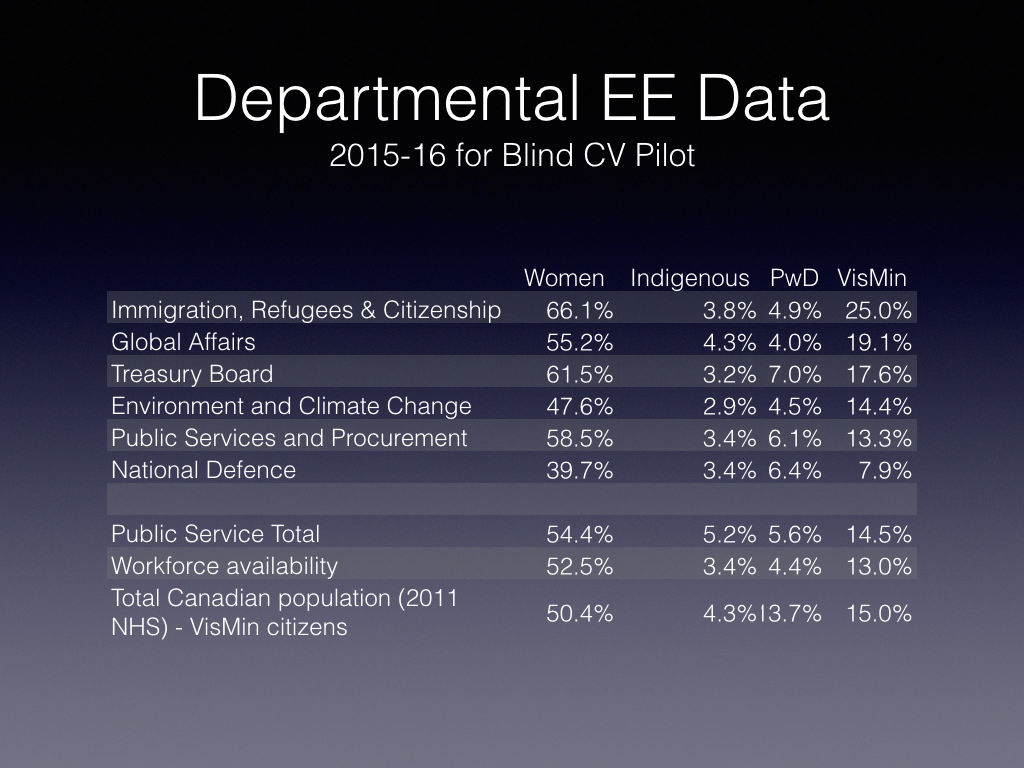
Wisely, the government has chosen to pilot this in a number of departments with different representation challenges, as shown in the table below:

As the government has largely met the goal of being representative of the population it serves, implicit bias may be less of a factor in the government sector. Representation is somewhat less at more senior levels, where implicit bias is likely less of an issue given that candidates are known.

It would be ironic indeed if the pilot, intended to test for bias against visible minorities, would show a bias for visible minorities, given some of the “over-representation” in some departments. In any case, a valuable exercise.

Ottawa has launched a pilot project to reduce biases in the hiring of federal civil services through what is billed “name-blind” recruitment, a practice long urged by employment equity advocates.

The Liberal government’s move came on the heels of a joint study by University of Toronto and Ryerson University earlier this year that found job candidates with Asian names and Canadian qualifications are less likely to be called for interviews than counterparts with Anglo-Canadian names even if they have a better education.

“It’s not just an issue of concern for me but for a lot of people. A number of people have conducted research in Canada, the U.K., Australia and the U.S. that showed there is a subliminal bias in people reading too much into names,” said Immigration Minister Ahmed Hussen, who first delivered the idea to Parliament last year as a rookie MP from Toronto.

“Name-blind recruitment could help ensure the public service reflects the people it serves by helping to reduce unconscious bias in the hiring process.”

Some companies in the private sector, including banks and accounting firms, have already adopted the practice, which removes names from application forms in order to stop “unconscious bias” against potential recruits from minority backgrounds.

In the United Kingdom, the government now requires name-blind applications for university admissions service and other applications for organizations such as the civil service, British Broadcasting Company and local government.

U of T sociology professor Jeffrey Reitz said the initiative is an important step forward but cautioned officials they must consult independent experts in developing the process and reviewing the results to make sure it is done correctly.

To conduct name-blind screening, he said, recruiters must remove any information on a resumé that would reveal the ethnicity of the person, such as name, birth place and membership in an association before coding the candidates in the talent pool.

“If the government is serious about it, they need to make the process transparent and allow researchers to look at the new procedures and the results,” said Reitz, a co-author of the Canadian study on name discrimination against Asians.

Debbie Douglas of the Ontario Council of Agencies Serving Immigrants said she hopes the pilot could benefit other minority groups, given studies have shown that white English- and French-speaking able-bodied women have been the primary beneficiaries of current employment equity programs.

“We hope as the government moves proactively to ensure diversity in hiring it will review the existing program and strengthen it to ensure the intentional inclusion of racialized and indigenous job seekers,” said Douglas.

Treasury Board President Scott Brison, who championed Hussen’s initial idea, said he welcomed the opportunity to explore new ways of recruiting talent for the public service.

“A person’s name should never be a barrier to employment. Diversity and inclusion in the workplace is critical to building an energized, innovative and effective public service that is better able to meet the demands of an ever-changing world,” said Brison at the launch of the pilot at Ryerson Thursday.

The six departments participating in the pilot include Department of National Defence; Global Affairs Canada; Immigration, Refugees and Citizenship Canada; Public Services and Procurement Canada; Environment and Climate Change Canada; and the Treasury Board Secretariat. A report on the pilot is expected in October.

Using data from a recent large-scale Canadian employment study that examined interview callback rates for resumés with Asian and Anglo names, U of T and Ryerson researchers found Asian-named applicants consistently received fewer calls regardless of the size of the companies involved.

Although a master’s degree can improve Asian candidates’ chances of being called, it does not close the gap and their prospects don’t even measure up to those of Anglo applicants with undergraduate qualifications.

Compared to applicants with Anglos names, Asian-named applicants with all-Canadian qualifications had 20.1 per cent fewer calls from organizations with 500 or more employees, and 39.4 per cent and 37.1 per cent fewer calls, respectively, from medium-sized and small employers.

Source: Ottawa pilots ‘name-blind’ recruitment to reduce ‘unconscious bias’ in hiring | Toronto Star

Shaping the future of Canada’s immigration system

A number of opinions on the issues set out in the current immigration consultations (see earlier Collacott: Immigration ‘conversation” is public relations exerciseIRCC Discussion guide on immigration: What about citizenship?).

In addition to my comments below, views of Debbie Douglas (faster processing of family reunification), Harald Bauder (more funding for settlement, pathways from temporary to permanent residency), Jeff Reitz (greater efforts on employment) and the Conference Board (increased immigration levels, spread across the country):

Having inherited an immigration system plagued with backlogs and heavy-handed enforcement, the Liberal government says it’s keen to hear what you think needs to be done about Canada’s immigration future.

Since the beginning of the summer, Immigration Minister John McCallum and his parliamentary secretary, Arif Virani, have held more than two dozen roundtable meetings across Canada with settlement services organizations, businesses and community groups to get their thoughts.

Although the meetings are by invitation only — more are coming in August — the public can submit ideas by email to the minister. Since early July, more than 2,500 online submissions have been received. Submissions end Aug. 5.

“Immigration, Refugees and Citizenship Canada will be reviewing the feedback from Canadians to help guide decisions on how many people we will welcome in the coming years and the future of immigration in Canada,” said a department spokesperson.

While the final report won’t be ready till at least the fall, the Star interviewed a group of immigration experts to weigh in on the national dialogue by identifying gaps in the system and offering solutions.

Meaningful and accessible citizenship:

Andrew Griffith, a former director general at the immigration department, said Canada largely has its immigration policies and programs right, but an independent review by a royal commission would be helpful.

He said the consultation questions are biased towards economic class immigrants and miss out on important areas such as citizenship.

“Most immigrants choose to become citizens as part of their integration into Canadian society. If we believe in immigration integration, we should support political integration, in addition to economic, social and cultural,” said Griffith.

“The main instrument for doing so is citizenship, given that allows for full participation in the political process.”

Canada’s naturalization rate has been declining, from the peak of 93.3 per cent for immigrants who came before 1971, to just 36.7 per cent among those who arrived between 2006 and 2007.

Griffith said Ottawa must set targets for naturalization as a benchmark, to assess whether its policies strike the right balance in making citizenship accessible and meaningful.

Officials must also regularly review citizenship requirements to ensure that different ethnic groups and immigration classes (economic, family and refugees) have comparable outcomes. Reducing the hefty application fee from the current $530 would make citizenship more financially accessible.

Source: Shaping the future of Canada’s immigration system | Toronto Star

The Hill Times has the political reaction to the (trial balloon?) of differential immigration fees:

The federal government is seeking public feedback on letting some immigration applicants pay more for faster processing.

That idea is one of many put forward in an online consultation document the government is asking members of the public to fill out as it gears up for an overhaul of the immigration processing system.

The NDP’s immigration critic and a pair of Liberal and NDP MPs say bringing in a two-tiered Canadian immigration system is out of the question.

“I wouldn’t support it,” said NDP immigration critic Jenny Kwan (Vancouver East, B.C.). “By doing that, effectively you’re saying you can buy your way into the system and bypass everybody.”

“They’re absolutely creating a two-tiered system if that were to proceed,” she said.

However, Liberal MP Peter Fonseca (Mississauga East-Cooksville, Ont.) and a Toronto immigration lawyer say such a system could help to improve immigration processing.

The issue is one close to MPs’ hearts as much of their constituency work is tied up in helping constituents with immigration questions, including application processing.

Many MPs have two staffers in their riding offices and at least one attends to constituents’ immigration needs. The most common complaints of constituents about immigration issues are related to long delays in the processing times of applications for family reunification, refugees, spousal sponsorship, temporary foreign workers, visitor visas, and Canadian citizenship applications.

Immigration reform

Gloomier future seen for Canadian immigration

IRCC analysts are asking many of the right questions:

With 35 per cent of male newcomers returning home and a growing middle class in developing countries less inclined to migrate, an internal government review is calling the future of Canadian immigration into question.

The report by Immigration Refugees and Citizenship Canada also points to the challenge of reconfiguring an immigrant-selection system in a rapidly changing labour market where a growing number of jobs are temporary and there’s “increasing mismatch” of available skills and the skills in demand.

“What changes, if any, does Canada want to make to its current ‘managed migration,’ ” asked the 23-page study, titled Medium-Term Policy: Balanced Immigration and stamped “for internal discussion only.” “To what extent is the current overall immigration level appropriate and/or necessary?”

With major changes made in the last decade under the former Conservative government, legal and immigration experts are calling on Immigration Minister John McCallum to have a “national conversation” on the future of Canadian immigration.

“Ottawa must take a step back to do a review of the whole immigration program and reach a national consensus in moving our country forward as a nation-building exercise rather than as an economic imperative,” said Debbie Douglas of the Ontario Council of Agencies Serving Immigrants.

“The Liberals have good political instincts and like to be seen as doing more on the immigration front. It’s the right time to take a look at what is working and what is not working in the system.”

The new government has already announced reviews of certain immigration programs involving temporary foreign workers and the Express Entry processing system, but critics say such reviews must be done in a holistic manner rather than a piecemeal fashion.

“This is the most thoughtful brief (on Canada immigration) I’ve seen in 10 years,” said Queen’s University immigration law professor Sharry Aiken. “It’s asking all the right questions that are useful starting points for a wide-ranging discussion of the future of our immigration system.”

The internal report, obtained by the Star, also devotes attention to the estimated 2.8 million Canadian citizens — 9 per cent of the population — who live abroad, including a million people in the United States, 300,000 in Hong Kong and 75,000 in the United Kingdom.

Some 35 per cent of male immigrants to Canada return home, many within the first year. Between 1996 and 2006, the annual exit rate for citizens born in Canada was 1.33 per cent compared to 4.5 per cent for naturalized citizens.

“There has been a rather negative view of these expatriate Canadians, as they have been regarded as evidence of ‘brain drain,’ Canada’s lack of competitiveness in retaining high-skilled professionals and business leaders, and our insufficient success in integrating new arrivals,” the report noted. “Canada could choose to take a more proactive stance with expatriates.”

Measures implemented by other countries include: extending voting right to expats, providing non-resident representation in the national legislature, facilitating business and research networks, doing outreach to communities abroad to promote ties as well as creating tax treaties with other countries to facilitate work abroad.

The report also points to the greater emphasis the former Tory government put on selecting economic immigrants based on in-demand occupations in a so-called “project economy” marked by limited length of employment based on the duration of a contract or project.

“This environment makes it a significant challenge to target occupations and industries that are priorities for addressing through immigration,” it said.

While the report forecast does mean potentially lower immigration to Canada in the longer term, University of Toronto professor Jeffrey Reitz said global migration is still driven by “inequality” from poor to rich countries.

Although Ottawa introduced the Express Entry system in 2015 to let employers pick prospective immigrants from a pool of candidates to ensure newcomers are quickly employed, Reitz said the uptake of candidates outside the country has been small.

“Anything that improves the employment situation contributes to immigrant retention, but there is an aspect of retention in the family class. When you lose your job and you have no family, you move. A support group gives people a reason to stay,” explained Reitz, the director of ethnic, immigration and pluralism studies at U of T.

Hence, the immigration report raised the question over the strict differentiation of “economic” and “social” immigration in the current system, which channels applicants into the skilled and nonskilled streams.

“Regardless of how their application was accepted, immigrants make many contributions to Canadian society; economic migrants make social contributions; social immigrants make economic contributions,” it said.

“Given the somewhat artificial distinction between social and economic immigration, there may be grounds for giving greater weight to ‘non-economic’ criteria and on criteria related to the success of subsequent generations.”

Ryerson University professor John Shields said recent immigrants are caught up in the same “new economy” faced by young Canadians entering the workforce.

“All immigrants including the refugee class contribute to the society economically. They pay dividends economically in five, ten years as integration is a long-term process that can take a lifetime,” said Shields, whose research focuses on labour markets and immigrants.

“Recent immigrants and young Canadians face a different kind of roadblock from those who are already established in Canada. The issue we need to deal with is creating higher quality employment in Canada and educate Canadian employers of the values of one’s work experience from somewhere else.”

Source: Gloomier future seen for Canadian immigration | Toronto Star