Canada’s population sees biggest one-year increase on record, StatCan reports

Quoted on need for annual levels plan to include temporary residents and political will to curb growth:

Canada’s population is growing at its fastest pace since the distant days of the baby boom.

According to the latest Statistics Canada report, the population last year grew by more than a million — a 2.9 per cent rate, the highest since the late 1950s and one that outstrips, by a wide margin, every other G7 country.

At that rate, observed StatCan’s Patrick Charbonneau, the population, now at slightly over 40 million, would double in just 25 years.

The question those figures and that projection raise is this: Is Canada — famously in the midst of both a housing crisis and a health-care crisis — ready to deal with that many more people?

The growth — 98 per cent of it — has been driven by immigration, both permanent and temporary, and particularly by the numbers of non-permanent residents coming to Canada. Those include refugees, temporary foreign workers and international students.

In 2022-23, Canada took in some 1.13 million immigrants, the highest such figure on record, and almost half a million more than the previous year. Over the same period, the number of non-permanent residents increased by 697,701.

As of June 2023, the number of non-permanent residents stood at nearly 2.2 million, about 5.5 per cent of Canada’s population.

“Temporary immigration has surpassed permanent immigration for the first time last year in a context where permanent immigration was already close to a record high,” said Charbonneau.

Andrew Griffith, a former director general at the federal Immigration Department, said Ottawa has a well-managed immigration system of permanent residents, but the exponential growth of the temporary resident admission has made the population growth unsustainable.

Ottawa has an annual plan that sets admission targets for different classes of permanent resident, but the entry of temporary residents is uncapped.

“We have to have an integrated immigration plan that actually looks at both the permanent residents and the temporary residents, given that the temporary residence is largely uncontrolled and has been increasing at a very high rate,” Griffith said.

“If you look at its explosive growth over the past few years, the past 20 years, that obviously contributes to all the pressures on housing, health care, infrastructure and the like.”

He said the government’s immigration plan is developed in silos and doesn’t address infrastructure capacity issues when it comes to health care, housing, education and transportation.

Although public sentiment still largely favours the continued immigration boost and its economic and workforce benefits, many regions are already struggling to manage housing and health-care shortages.

Across Canada, rising prices and limited supply create difficulties for those seeking home rental and ownership. The Canada Mortgage and Housing Corp. said in a Sept. 13 report that Canada needs 3.5 million more units, on top of those already being built, to restore affordability. Sixty per cent of the demand for housing is in Ontario and B.C., largely due to supply lagging behind demand for 20 years.

On the health side, about six million people across Canada lack access to a family doctor, according to Canadian Medical Association data. Of those who have a family doctor, about a third experience overly long wait times to access them.

It’s a system already under strain, with doctors and nurses increasingly reporting stress and burnout, and some quitting.

An increasing population doesn’t necessarily dictate a health-care calamity, said Ruth Lavergne, a Canada Research Chair in Primary Care at Dalhousie University.

But she said the segment of the population supporting and working in health care needs to grow proportionately to the population. And we need to “rethink the organization of health care, to make it more efficient and better use the capacity that we have.”

Some of that capacity exists within the ranks of the newcomers, in the guise of foreign-trained health professionals. The problem is Canada doesn’t have a great record in helping them work here.

But streamlining the credentialing process can’t be the only fix, said Canadian Medical Association president Kathleen Ross.

She said the country will have to reconsider health-care delivery.

And that, to her mind, means reconsidering who’s doing what, where and when in the health system, and how to plug gaps without opening up new ones.

It also means changing how primary care works, reducing the administrative burdens on health professionals and better retaining them.

“We’re in a really unique time. Our emergency rooms, which are sort of the backstop, if you will, for a primary care system that’s not functioning well, are already over capacity and struggling with closures relating to our human health resource challenges.”

“These are all things we need to take into consideration, whether or not our population increases by a half a million or one-and-a-half million this year. It still behooves us to get back to the big discussion about how we are going to deliver access to care for all residents in Canada, whether they’re temporary or permanent.”

On the housing shortage side, the responsibility falls on provincial and federal governments to ensure Canada can withstand rising demand, said John Pasalis, president of Toronto brokerage Realosophy Realty. Over the past decade, he feels that has broken down as governments failed to scale investments in vital services in line with population growth.

Although immigrants often feel the brunt of the blame for these pressures, Pasalis said culpability lies with leaders who set ambitious immigration targets and allow universities to accept significant numbers of international students without investing in upgrading capacity.

“The people who are moving here are the ones that are kind of paying the biggest price in many, many cases.”

If governments don’t step up, all Canadians will eventually feel the squeeze, said Mike Moffatt, assistant professor in business and economics at Western University.

“We certainly either need to increase the amount of infrastructure built and housing built or slow down population growth,” Moffatt said. “If we continue to have this disconnect, we’re just going to have more housing shortages, less affordability and more homelessness.”

Instead of looking at newcomers as the source of housing strain, Moffatt says leaders should impose stronger restrictions on investors taking advantage of scarcity to drive up prices.

But it’s not just the supply of houses; it’s the type of supply. Those stronger regulations will need to be aimed at developers, too, said Marc Lee, a senior economist for the Canadian Centre for Policy Alternatives. The housing in highest demand — for low- and middle-income families — is not as profitable to build.

David Hulchanski, a University of Toronto professor of housing and community development, noted that Airbnb has also taken up available housing across the country, something he said could be curbed through stronger regulation.

“There’s this effort to blame our housing problem on an increase in population,” said Hulchanski. “It isn’t just supply, it’s the type of supply.”

Against this backdrop, Immigration Minister Marc Miller has talked about the need to rein in admissions of international students — around 900,000 this year — by developing a “trusted system” to enhance the integrity of the international student program.

Griffith said that’s not enough — Canada needs to impose a hard cap, though that will take a strong political nerve.

“The business sector will squawk about the fewer temporary workers. Education institutions will go bankrupt if they don’t have their international students. The provincial governments will get in the way because they have to actually pay for university (education) rather than allowing the universities to be subsidized by foreign students.”

Shutting down the international student program and the temporary foreign worker program, or making major reductions to those programs, seems unlikely, he said, but freezing at current levels and gradually reducing those numbers might be viable.

“It would be very contentious,” he said. “It boils down to a lot of political will.”

Source: Canada’s population sees biggest one-year increase on record, StatCan reports
Those who toil in low-wage jobs in the GTA more likely to be visible minorities

Of note:

The swelling ranks of Greater Toronto workers who pour coffee, clean offices and toil in other low-wage jobs are more likely to be visible minorities, according to a new report.

Although visible minorities make up just 46 per cent of the Toronto region’s workforce, they account for more than 63 per cent of the working poor, says the report being released Tuesday by the Metcalf Foundation.

Within each of the area’s four largest visible minority groups — Chinese, Black, South Asian and Filipino — the Black community has the highest percentage of working poor, at 10.5 per cent, says the report written by social policy expert John Stapleton, who used the latest census and Statistics Canada income data.

Second- and third-generation Black Canadians are especially vulnerable and often earn less than recent Black immigrants, according to the report.

Working poverty is lowest in the Filipino community, at 5.3 per cent, just above white residents at 4.8 per cent.

“It is striking and concerning that the Black population has the highest percentage of working poverty among both the immigrant population and those born in Canada,” says the report.

The growth in working poverty among and second- and third-generation Black Canadians is “particulary pronounced” among Black Canadian-born females, who saw an increase from 9.7 per cent in 2006 to 12.2 per cent in 2016, the report says.

As highlighted in a recent United Way report, the Toronto region is “coming to the uncomfortable realization that our increasing economic inequality is also highly racialized,” says University of Toronto professor David Hulchanski.

“We knew this, but now we have solid data and evidence,” says Hulchanski, who has been tracking disappearing middle-class neighbourhoods in the GTA and other Canadian cities for almost 50 years.

The report reflects “facts and trends that cannot continue if we want a productive, prosperous and harmonious Toronto region,” he adds.

The report is the second update of Stapleton’s groundbreaking 2012 analysis, which found working poverty in the Toronto region spiked by an alarming 46 per cent between 2001 and 2006, largely due to the demand for entry-level service workers to support the burgeoning high-paid knowledge sector. This includes lawyers, business and finance professionals.

Over the past decade, working poverty grew by another 27 per cent, Tuesday’s report shows.

“Although this slower growth is a welcome trend, the continued growth is troubling,” Stapleton says.

High rates of working poverty along with data that points to “the racialization” of working poverty is a serious public policy concern, he says.

“These trends ought to be considered unacceptable anywhere, and definitely in the wealthiest and most diverse metropolitan area of an affluent nation,” Stapleton says. “We all lose out when a significant part of our labour force cannot make ends meet.”

Black community scholars Carl James and Kofi Hope, who independently analyzed the report’s race-based data, say the findings have to be seen in the context of “the reality of anti-Black racism, and the reluctance of Canadians to acknowledge that this phenomenon has existed in our nation for hundreds of years.”

“This report shows why it is important to collect disaggregated data,” says James, who holds the Jean Augustine chair in education, community and diaspora at York University’s faculty of education. “And it also shows why it is important to disaggregate the visible minority category.”

Soha Mohamed, 29, a decent work project facilitator at the Victoria Park Hub in Scarborough, says the Metcalf report paints a “disappointing” portrait of the experience of Black workers.

“But it doesn’t come as a shock, especially for me, personally, and my own relationship to precarious work,” adds Mohamed, a Black woman whose part-time contract, with no benefits, expires next March.

“Even though my work is to promote stable employment and opportunities for job advancement, health and pension benefits, equality and rights at work for women, it’s also something that I aspire to achieve,” she says.

Mohamed, who has two young daughters, immigrated to Canada with her parents from Sudan when she was 5. Combined with child benefits and her partner’s meagre income as an upholsterer, their household income falls below Canada’s Low-Income Measure of about $47,000 after taxes for a family of four in 2017.

“I am already looking for work because I know my current contract won’t be extended,” she said. “There is always that level of uncertainty. What happens next? How will I pay the rent?”

The report defines the working poor as people between the ages of 18 and 64 who are not students, are living independently and have an annual after-tax income between $3,000 and the Low-Income Measure of $22,133 in 2015, the year the most recent census was taken.

By this measure, 7 per cent of Toronto workers — almost 170,000 — are “working poor.”

The working poor tend to be younger and less educated than the overall working population. And they are more likely to be men, a reflection of the loss of manufacturing jobs in the area that tended to be dominated by male workers.

Although the data doesn’t show why the growth in working poverty has slowed in the past decade, increases to the minimum wage and new and increased income supplements for people living in poverty likely helped, Stapleton says.

“These interventions, which continue to moderate the incidence of working poverty, illustrate that governments have a crucial role to play in assuring adequate incomes for residents,” says the report by the Metcalf Foundation, which is dedicated to equity, sustainability and the arts.

Strategies to reduce working poverty also need to address systemic and structural issues that continue to marginalize the Black community, the report adds.

Society needs to value work done by those in lower-paying jobs and find a way to turn them into full-time, less precarious employment.

“We believe that through higher wages, better job stability, anti-racism strategies, and more effective support programs, Toronto could reduce and even eradicate working poverty,” Stapleton says in the report.

Many of the factors driving working poverty among all GTA residents — including being a young worker, having no post-secondary education, and living outside the downtown core — are common among Black Canadians, say York University’s James and Hope, a senior policy adviser at the Wellesley Institute.

A February 2019 Statistics Canada report says 26.6 per cent of the Black population was under age 15, while only 16.7 per cent of the overall Canadian population was in that age group.

According to the Toronto District School Board, Black students — particularly males — are more likely than other students to be suspended or expelled from school and have a higher dropout rate.

And Black people in Toronto are also disproportionately watched, stopped and “carded” by police, leading to higher rates of criminalization, they add.

As far as intergenerational working poverty, James and Hope say it appears the longer Black families live in Canada and interact with Canadian institutions, “the more difficult it becomes for them to overcome entrenched barriers.”

“Further research is needed to look more closely at the ways anti-Black racism manifests to produce barriers to Black people’s success in the labour market,” they say. “This research is critical to moving forward if we are to get a full picture of what is happening within Black communities, and what policy and community responses are necessary to change this situation.”

Source: Those who toil in low-wage jobs in the GTA more likely to be visible minorities

Toronto is segregated by race and income. And the numbers are ugly

More good detailed analysis at the census tract level by David Hulchanski that highlights the disparities that more aggregated analysis misses.


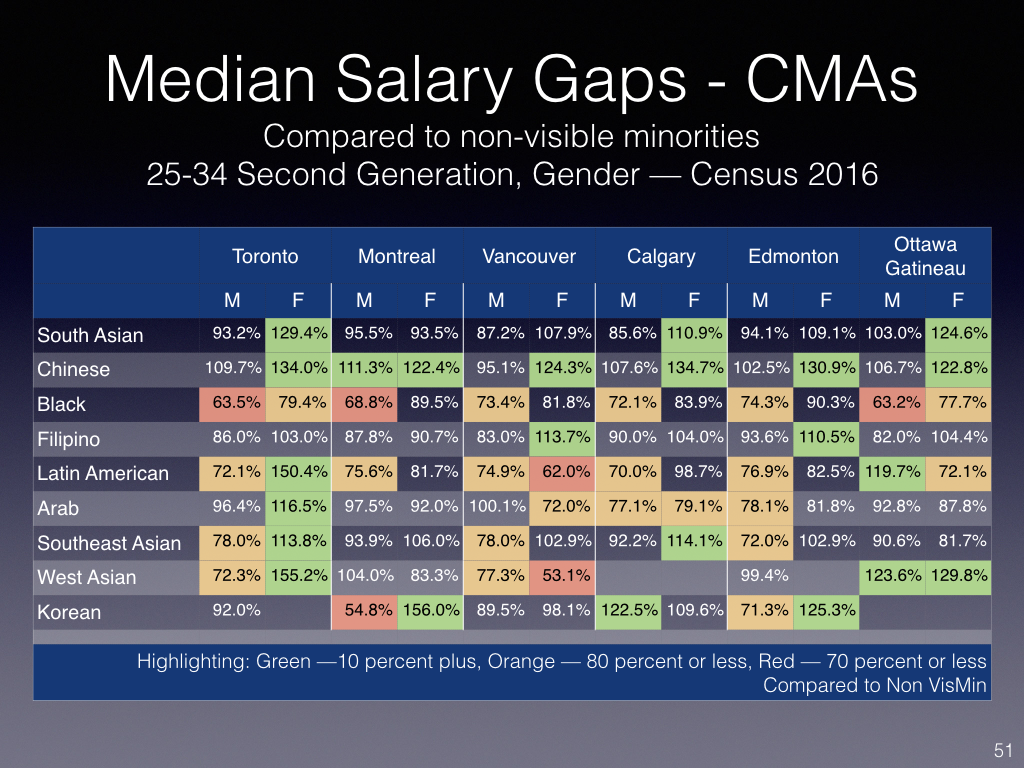
My analysis, focussing on outcomes of second generation visible minorities 25-34 years old shows largely comparable outcomes for most groups, with the exception of Blacks, Latin Americans, Arabs and West Asians. Discrimination certainly plays a part in these disparities but other factors (e.g., time in Canada, area of study etc) also play a part:

In Toronto, the colour of money is mainly white.

New demographic charts show a strikingly segregated city, with visible minorities concentrated in low-income neighbourhoods and white residents dominating affluent areas in numbers far higher than their share of the population.

The new charts come from University of Toronto Prof. David Hulchanski and his research team, known for using census data to illustrate growing income inequality in the city. Their latest effort flags the role of discrimination in that inequality, with lopsided racial breakdowns that surprised the researchers.

“It’s starker than we would expect,” Hulchanski said in an interview.

Hulchanski revealed the new charts last week in the Netherlands at a conference called “Urban poverty and segregation in a globalized world.”

Using the 2016 census, his team calculated that 48 per cent of Toronto’s census tracts are low-income neighbourhoods, where the average individual income is $32,000 before taxes.Fully 68 per cent of residents in these neighbourhoods are visible minorities while 31 per cent are white. (Whites make up 49 per cent of Toronto’s population.)

The main ethno-cultural communities in these low-income neighbourhoods are all overrepresented compared to their share of the city’s population. Black residents, for example, are 9 per cent of the population but make up 13 per cent of residents of low-income neighbourhoods.

High-income neighbourhoods are almost a reverse image. They make up 23 per cent of Toronto’s census tracts, with average individual incomes of $102,000 before tax. Fully 73 per cent of residents in these neighbourhoods are white, far higher than their share of the city’s population. The rest are visible minorities, of whom only 3 per cent are Black.

Whites are also overrepresented in middle-income neighbourhoods, where the average income is $49,000.

“Money buys choice. And people with the most choice are choosing to live in certain areas,” Hulchanski says, explaining the disproportionately high concentration of white residents in high- and middle-income communities.

Choice also partly explains the makeup of low-income neighbourhoods. Some members of ethnic groups prefer to live where their communities are most numerous, giving them easy access to the shops and cultural or religious services that facilitate integration or simply make life more enjoyable.

York University Prof. Carl James, who reviewed Hulchanski’s charts, questions how free the choice actually is for visible minorities.

“We have to think about how the system might have enabled and co-operated in making it possible for some people to access high income neighbourhoods and to stay in those neighbourhoods, or operated to keep others out of those neighbourhoods. It’s not just individual choice. Many other structural things work in relation to choice.”

Studies indicate that discriminatory barriers to good jobs and housing play a determining role.

“Discrimination is not at the same level as in the United States,” Hulchanski says, “but that doesn’t make it any better for those who face that problem here.”

The researchers split the city into high-. and low-income categories by comparing neighbourhoods that were 20 per cent above or below the Toronto Census Metropolitan Area average. Middle-income was within 20 per cent. The team then used census data to see the makeup of those communities.

Evidence of discrimination is reinforced by another chart produced by Hulchanski’s team, showing relatively high levels of education in low-income neighbourhoods. Half of all residents in those areas have a post-secondary degree: 25 per cent from a university and 25 per cent from a community college.

Hulchanski questioned why half the city has average gross incomes of only $32,000 when so many people in those low-income neighbourhoods have relatively high levels of education. “That doesn’t make sense, except for discrimination,” he said.

Another worrying sign for Hulchanski is that 57 per cent of residents in Toronto’s low-income neighbourhoods are immigrants, including established ones who arrived before 2006. Only 31 per cent of residents in high-income areas are immigrants, including 23 per cent who arrived prior to 2006.

The racial segregation of Toronto neighbourhoods is in the context of research, also from Hulchanski’s team, illustrating the growth of low- and high-income neighbourhoods in Toronto, while middle ones steadily disappear.

The polarized income trend dates back to the 1990s, caused by federal and provincial cuts in transfer payments and social assistance, along with tax cuts, rising housing costs and the disappearance of well-paid manufacturing jobs, Hulchanski says.

Government policies caused the income polarization, and only government policies can reverse it, he argues. Hulchanski warns that in Europe, where the trend is less severe, income polarization and ethnic segregation has contributed to the rise of far-right populist movements and outbreaks of violence.

“How long can this continue?” Hulchanski asks. “There is no sign of the trend reversing yet.

“Will there be riots in Toronto? Who knows?”

Source: Toronto is segregated by race and income. And the numbers are ugly

Toronto’s income gap continues to widen, finds U of T expert

Not new, but better documented by David Hulchanski than done earlier:

Between 1970 and 1990, average incomes jumped significantly in only about 13 per cent of Toronto’s 500-plus “census tract” neighbourhoods.

Slightly more, 19 per cent, saw incomes drop significantly, while most Torontonians, in 67 per cent of the census tracts, saw earnings change only modestly.

Expanding the time frame to 1970 to 2012 exposes a dramatic shift.

Middle-income communities across the city began to evaporate. Neighbourhoods with relatively stable average income shrank by more than half, to 32 per cent of the census tracts.

The percentage of neighbourhoods where residents’ average incomes skyrocketed more than doubled. At the same time, the percentage of neighbourhoods where people were getting much poorer also doubled.

Yorkville, which transformed from downtown hippie haven to posh shopping district favoured by the jet set, saw the biggest surge in average incomes. Part of Thorncliffe Park, which became a landing pad for newly arrived immigrants, saw the biggest income drop.

When the city snapshot is narrowed to only 2012, just under half of Toronto is considered low-income — well under the $46,666-per-year average — while 21 per cent is high-income and only 30 per cent is middle.

“What I call City No. 2 — the middle-income city — is simply disappearing,” Hulchanski says.

Gentrification is only one of the root causes, he says, listing provincial and federal policy changes since 1990 that he believes were intended to further enrich society’s top earners.

This can also be mapped against visible minorities, many of whom are low-income in Toronto.

Of course, this is not just a Toronto issue as part of worldwide trend towards greater inequality.

Toronto’s income gap continues to widen, finds U of T expert | Toronto Star.