‘It is a battle for hearts and minds’: Trudeau’s $35 million gamble to counter radicalization

No easy solutions but these approaches are part of the toolkit. Small change compared to security expenditures:

A growing number of experts are advocating for a more holistic approach to countering violent extremism — one that attempts to address community grievances and feelings of social exclusion, he said.

Still, some say the terrorist propaganda and violent narratives on the Internet and social media sites — often infused with glorious references to past and valiant warriors — cannot be ignored and efforts must be made to squarely refute  their often misleading claims.

“It is a battle for hearts and minds,” Shaikh said.

Some of this is already happening in Canada. In 2015, Public Safety Canada threw its support behind a video project, Extreme Dialogue, that highlighted the stories of individuals who had walked away from extreme Islamist groups or far-right groups, as well as family members impacted by extremism.

Last year, Montreal’s Centre for the Prevention of Radicalization Leading to Violence created a comic book that used humour to try to address some of the underlying causes of radicalization.

But do these counter-narrative campaigns ring hollow for their intended audiences? And how do you gauge success? By clicks and web visits?

Phil Gurski, a former CSIS strategic analyst, said trying to deconstruct and counter every piece of propaganda ends up being a never-ending game of “whack-a-mole.” He suggested putting more emphasis on alternative narratives, for example, emphasizing Muslim empowerment and success stories.

But that still leaves the question of how to deal with individuals who are more deeply entrenched in their radicalization, such as foreign fighters who have returned to Canada. About 180 Canadians are known to have participated in terrorist activities overseas — mostly in Turkey, Iraq and Syria — and about 60 have returned.

If police fear someone may commit a terrorism offence, but don’t have enough evidence to charge them, they have sometimes gone to court to apply for peace bonds, which temporarily restrict an individual’s movements. But as the case of Aaron Driver showed, these bonds cannot always be relied upon to prevent violence.

Driver had been the subject of a peace bond that restricted access to his computer and cellphone and barred him from possessing firearms or explosives. Yet, last August, the Islamic State sympathizer was able to shoot a martyrdom video and get into a taxi with a homemade bomb before being shot and killed by police in Strathroy, Ont.

For those not quite as far down the path of radicalization, police in Toronto last year announced they had been experimenting with an early intervention model, not dissimilar to the one in Britain. Individuals deemed at-risk for violence are steered to “hubs” of community representatives who assess whether they might benefit from spiritual guidance, family counselling or mental-health support. Calgary police have a similar program in place.

Yet this approach creates other conundrums: Should such voluntary programs be mandatory? And should the goal be “de-radicalization” — the suppression of extreme ideology? Or is it more realistic to settle for “disengagement” — allowing a person to continue to harbour radical ideas so long as they do not resort to or support violence?

“The dangers to democracy are obvious here and not at all easy to reconcile,” Littlewood said. And, “success in one year may be undone two or three years later,” he added.

Whoever takes the helm of Canada’s new counter-radicalization office is in for a “mind-boggling” ride to try to create a coherent national framework for best practices, Gurski said.

“I don’t know if we’ll ever know what works,” he said. “But that doesn’t mean we shouldn’t do it.”
Toronto lifts curtain on extremism prevention plan, quietly operating for more than 2 years

Part of the arsenal in combatting extremism and increasing resilience:

Police in Toronto are lifting the curtain on an extremism prevention program that has been quietly operating in the city for more than two years — but experts in the field say getting young people at risk of radicalization to use it will come down to a question of trust.

The project, which first sprouted in 2013, has been purposely kept from public view until this week.

“At this point in time we feel that we have a good service in place and we’re ready for people to participate in it,” Deputy Chief James Ramer told CBC News. Together with the City of Toronto, Ramer said, the force hoped to fine-tune the program behind the scenes through direct involvement from community groups, rather than simply present a made-by-police project.

Here’s how it works.

A person deemed at risk for extremism is referred by a police officer or a participating agency to one of four hubs, each consisting of 15 to 20 bodies, including medical professionals, faith groups, the school board and community housing.

Referrals require the consent of the person at risk and are based on a list of some 103 risk factors. Participation, said police, is entirely voluntary.

Cases are assessed at the hub, and depending on the most pressing concerns, two participating organizations are chosen to lead an intervention, which can range from spiritual counselling to mental health assistance.

Referrals anonymous

“All of this is done in complete anonymity,” said Ramer, adding that the hub process meets the privacy commissioner’s “gold standard” in terms of protection of personal information. Only cases that involve a criminal element or pose risks to public safety are formally investigated.

As for what kinds of extremism the program addresses, Sgt. Kelly Gallant said it runs the gamut from Islamist-inspired, to white supremacist to environmental extremism, to name a few. “We talk about all different kinds of extremism.… Not just what we mostly see on TV.”

It’s not the first time a deradicalization program has been floated in Toronto, but it is the city’s first police-led initiative.

Toronto police

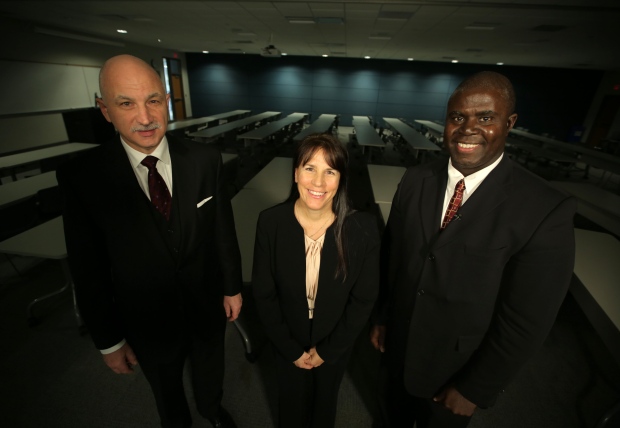
Deputy Police Chief James Ramer, Sgt. Kelly Gallant and Staff Sgt. Donovan Locke say the extremism prevention program has been quietly operating in the city for more than two years. (CBC)

Six months ago, the Canadian Council of Imams announced plans to open two to three deradicalization clinics in Toronto that would take a “holistic” approach, as early as this fall. Those clinics, Toronto imam Hamid Slimi told CBC Toronto, have not yet taken off owing to a lack of community support.

Toronto’s program is housed under the police’s existing community safety program, which also tackles gangs and drugs. Montreal also has an anti-radicalization centre, but not one led by police.

Trust ‘in shambles’ in some communities

But whether young people will consent to being involved in the program will ultimately depend on whether they feel safe engaging with police, says University of Waterloo religious studies post-doctoral fellow Amarnath Amarasingam.

“It depends much on how the police are able to gain the trust of communities. In some communities, this trust is in shambles, but in others, there is a history of working together. So, it really depends if the cops can shed some of this baggage,” Amarasingam said.

Source: Toronto lifts curtain on extremism prevention plan, quietly operating for more than 2 years – Toronto – CBC News

Doing Countering Violent Extremism (CVE) right: Gurski

Phil Gurski’s sensible advice:

Which brings me back to the new government and its CVE plans (see article here).  For what it is worth, here are my suggestions, based on 32 years as an intelligence analyst and 18 months as an outreach advisor/participant”

  1. Keep the government role low-key.  “I’m from the government and I’m here to help” does not work on this file.

  2. Leverage community leaders.  They know their communities best

  3. Use Muslim youth. They have a wealth of energy and good ideas

  4. Make sure CVE covers the entire ideological spectrum, even if the single greatest national security threat today is from violent Islamists

  5. I know this one is nigh impossible but here it is anyway: do whatever you to ensure that senior public officials do not say anything really stupid (like equating wearing the hijab with terrorism – yes it was done!).

Source: Borealis Threat & Risk Consulting

Islamic Scholars Convene an Anti-ISIS Summit in Mecca – The Atlantic

Good piece contrasting the US-led CVE summit and the Muslim World League, a Saudi-backed alliance of Islamic NGOs, led summit in Mecca on “Islam and Counterterrorism:”

According to Will McCants, director of the Project on U.S. Relations with the Islamic World at the Brookings Institution, there’s a logic behind the divergence in messaging from Washington and Mecca. “This conversation can’t really happen in the U.S., or in the West, because the [Obama] administration is determined not to frame this [conflict] or have it be interpreted as a religious war,” he told me. “It wants to take that talking point away from its enemies.” McCants added that Muslim leaders may also feel more comfortable speaking openly about an issue that is afflicting their own community. When the U.S. tries to adjudicate theological issues, he said, “it can discredit the people who reach the same conclusions we do. If Muslims and the U.S. government say these guys don’t represent Islam, it makes the Muslims look like pawns of the United States.”

The priorities of the CVE and Muslim World League summits were also distinct. The impetus for the conference in Mecca appears to have been the Saudi government’s belief that Islamist terrorism represents not only a threat to the security of the region, but also an existential threat to Islam itself. It would therefore have been impossible for the speakers to ignore ISIS’s Islamic roots. The conference’s organizers cast their mission as developing a coordinated campaign to promote a moderate, peaceful vision of Islam that disavows the violence and apostasy that ISIS thrives on. The program, above all, emphasized that this is a specifically Muslim issue, and placed the onus on the Muslim community to craft a narrative that overpowers the Islamic State’s.

In comparison, the CVE summit was more concerned with addressing radicalization in all its forms, and emphasized the economic and social conditions in which people tend to become radicalized. The agenda also had a largely domestic focus despite the United States being low on the list of countries contributing foreign fighters to jihadist groups in Syria and Iraq.

But whether ISIS’s deeds are labeled “violent extremism” or “Islamized terrorism,” the conversations in Washington and Mecca had at least one thing in common: They deepened the debate over whether ISIS and its fellow travelers are “Islamic,” and whether the answer matters in the first place. That debate is not just academic. It has real consequences for how the Islamic State’s opponents mount their counteroffensive.

Given the somewhat uncomfortable role that Saudi Arabia has played in encouraging the spread of Salafism (albeit non-violent forms), somewhat ironic that they now have to focus on some of the indirect consequences.

Islamic Scholars Convene an Anti-ISIS Summit in Mecca – The Atlantic.

Roach and Forcese: The government’s new speech crime could undermine its anti-terror strategy

A different and valid take:

Here’s why: the data suggests that our most promising means of combating radicalization is with on-the-ground programs that anticipate threats and steer people away from violence. Thus the RCMP has launched its new counter-violent extremism (CVE) program, an all-of-civil-society initiative designed to navigate people away from trouble in the “pre-criminal space” — that is, before they violate the law.

This is an uncertain and challenging undertaking. However, it may be the most rational response to a social problem that no prosecutor or penitentiary will ever solve, and may actually make worse. And the government’s new speech crime could undermine it. Let us illustrate why, with a very plausible hypothetical situation.

The new CVE program reaches out to a mosque, wishing to involve it and its membership. It wants people to assess honestly the merits of, and confront squarely, the Al-Qaeda-inspired world view that says Islam is under attack by “Western crusaders,” and that it is the duty of good Muslims to act in defence, even with violence. This airing of views will require, at minimum, a venue in which people can speak freely, and the mosque is asked to provide it.

The imam is aware of the new speech offence, and is worried that some of his members, though they show no propensity for violence, nevertheless hold radical views. He fears what will happen if the RCMP hear statements such as, “the use of violence in defence of Islam is just and religiously sanctified and should be supported.” Some community members are also keen to send money to groups overseas whose conduct may include acts of violence.

And so, wisely, the imam decides to consult with a local lawyer, who concludes that statements like the one above might well be seen as knowing and active encouragement of the concept of “terrorism offences in general.” And he concludes that in making these statements at the CVE meeting, the speaker may be aware that some of his fellows may commit some terrorist offence, including perhaps sending money to group listed as, or associated with, a terrorist group.

Reasonably, the lawyer concludes there is a risk that the meeting could violate the new speech crime. The RCMP’s “pre-criminal” CVE space then turns into a “criminal space.” The imam has no choice but to cancel the meeting.

Roach & Forcese: The government’s new speech crime could undermine its anti-terror strategy

U.S. Is Trying to Counter ISIS’ Efforts to Lure Alienated Young Muslims – NYTimes.com

Good piece in the NY Times about US Government efforts to engage American Muslims in countering extremism, with some of the same issues that likely arise in Canada. The last line captures the conundrum:

American officials have been able to identify Americans fighting for the Islamic State or other Syrian rebel groups based on intelligence gathered from travel records, family members, intercepted electronic communications, social media postings and surveillance of Americans overseas who had expressed interest in going to Syria, counterterrorism officials said.

But efforts at countering violent extremism, especially at home, “have lagged badly behind other counterterrorism pillars,” said Michael Leiter, a former director of the National Counterterrorism Center. “It is heartening to see the administration attempt to invigorate those efforts, but it is unfortunate that it has, despite the efforts of many, been so long in coming.”

Government supporters question whether funds will be available to sustain these programs. “The administration has the right framework for doing this, but long-term success will depend on sustainable resourcing to help local government, communities and law enforcement build initiatives that can have impact,” said Quintan Wiktorowicz, a former senior White House aide who was one of the principal architects of the current strategy.

That strategy here at home, called countering violent extremism, has proved much more difficult for American officials to master than the ability of the Pentagon and spy agencies to identify, track, capture and, if necessary, kill terrorists overseas.

Among its efforts, the Department of Homeland Security provides training to help state and local law enforcement officials in identifying and countering the threat, including indicators of violent extremism and “lone wolf” attacks.

The department awarded the International Association of Chiefs of Police a $700,000 grant last year to develop training on how to prevent, respond to and recover from acts of terrorism.

The department has also sponsored exercises in seven cities, including Houston, Seattle, and Durham, N.C., to improve communication between local law enforcement and communities and to share ideas on how best to build community resilience against violent extremism. “We’re raising awareness,” said David Gersten, who was recently named the department’s coordinator for the overall effort.

Carter M. Stewart, the United States attorney in the Columbus area, said he and his staff meet regularly with Somali-American and other community leaders.

But Muslim advocates say there is deep suspicion that, despite all the meetings and the talk of outreach, the government’s main goal is to recruit informants to root out suspected terrorists.

“I don’t know how we can have a partnership with the same government that spies on you,” said Linda Sarsour, advocacy director for the National Network for Arab American Communities.

Indeed, those who met with Mr. Johnson were conflicted, some saying they were pleasantly surprised he had traveled here to put a face on the federal effort, but clearly embittered by their past experiences with the government.

Dr. Iyad Azrak, 37, a Syrian-American ophthalmologist, recounted how he and his family had been forced on numerous trips to Canada to wait for hours at border crossings while inspectors reviewed his records.

“Not once when we’re coming home do they say to me, ‘Welcome home,’ ” said Dr. Azrak, who said he has been a naturalized citizen for six years.

U.S. Is Trying to Counter ISIS’ Efforts to Lure Alienated Young Muslims – NYTimes.com.