Opinion: There’s no link between terrorism and multiculturalism – Jedwab

Jack Jedwab of ACS notes the many fallacies in Farid Rohani’s piece on multiculturalism and radicalization (Opinion: Multiculturalism should not be misused to justify divisions: Farid Rohani):

Yet Rohani makes a pernicious link between these heinous acts and Canadian multiculturalism. He establishes this false association by suggesting that the Canadian multicultural framework has seen “activists promote group traditions as having more importance than individual freedoms,” and suggests it creates an environment that enables terrorists to propagate their views. He further states that multiculturalism “is being used to create different groups that contest our tolerant democracy.”

It has been increasingly common for detractors of multiculturalism to make such claims without identifying the culprits. Rohani does precisely this and, regrettably, contributes to the spread of what he describes as “quiet intolerance,” the very thing about which he expresses concern. His observation will end up inviting unfair generalizations about minority religious groups that will fuel the divisions that he suggests he seeks to remedy.

Rohani implies that such things as forced and arranged marriages, honour killings and teaching of hate toward other religions or toward homosexuals or death warrants against apostates are also to be attributed to flawed communications about what pluralism and multiculturalism entail. In general, such things are far more prevalent in non-democratic societies that reject diversity and multiculturalism. The individuals who engage in such egregious acts for the most part wish to erode multiculturalism and replace it with a model of society that would limit individual freedoms and undermine intercultural harmony.

Rohani specifically singles out newcomers to Canada as being particularly exposed to distortion about our national identity and values. So what would he make of the fact that the killings in Ottawa and St-Jean-sur-Richelieu were carried out by individuals born and raised in Canada? Indeed, newcomers value the opportunity to live in our democracy and there is no evidence that they are more likely than non-immigrants to want to undermine it.

Opinion: There’s no link between terrorism and multiculturalism | Montreal Gazette.

Clear case of ‘multicultiphobia,’ to use Phil Ryan’s phrase.

Jedwab also cites the recent polling done for the Canadian Race Relations Foundation as supporting this view (report-on-canadian-values), as do most polls that I have seen.
Canadian Race Relations Foundation | Awards of Excellence Call for Nominations

Call for nominations for the Canadian Race Relations Foundation Awards of Excellence:

Nominations are open for this years Canadian Race Relations Foundation Awards of Excellence for Best Practices in promoting harmonious race relations – but the deadline is fast approaching!

Canadian organizations from the voluntary, private or public sector may nominate themselves, or be nominated by others, and submit their applications no later than 9 a.m. on Mon., Sept. 22, 2014 via the CRRF website at www.crrf-fcrr.ca.

The prestigious Awards of Excellence recognize initiatives that build an awareness and understanding of Canadian values and identity that are reflective of Canadian diversity and respectful race relations.

“Our award winners represent organizations that have taken the ideals of harmonious race relations and social cohesion, and transformed them into successful, sustainable programs that can be reproduced,” said Albert Lo, chairperson, Canadian Race Relations Foundation.

“Winning this prestigious award, and being published by the CRRF, shines a spotlight on these thought-leaders, elevates their public profile and raises awareness of their important initiatives.  These exceptional organizations and agencies become part of a pantheon of other forward thinkers whose work has contributed to our international knowledge base of cutting-edge anti-racism research and practice.”

One award will be given for Best Practices in each of the following six categories: Aboriginal Peoples, community, corporate, education, government/public sector and youth initiatives.

Canadian Race Relations Foundation | Canadian Race Relations Foundation Awards of Excellence.

Younger Canadians hold more negative views about religious groups – CRRF

Further to an earlier release of the CRRF and ACS Survey on Religion, Racism and Intergroup Relations in Canada Shows Differences in Attitudes Among Anglophones, Francophones and Other Groups, a further release pertaining to attitudes to religious diversity by age group. Remarkably consistent across religions, except for Muslims:

Table 1: Negative attitudes towards certain groups, according to age groups
 Negative Opinion

Total

18-24

25-34

35-44

45-54

55-64

 Muslims 44% 43% 45% 40% 43% 40%
 Jews 19% 24% 25% 20% 15% 15%
 Protestants 15% 24% 23% 14% 15% 8%
 Catholics 19% 25% 25% 22% 18% 13%
 Atheists/Agnostics 21% 14% 18% 21% 21% 22%
 Religious 31% 36% 33% 31% 31% 27%
 Immigrants 24% 24% 27% 24% 30% 16%
 Aboriginals 26% 26% 26% 25% 29% 22%

Younger Canadians hold more negative views about religious groups

Whereas on diversity in general, young people are more supportive than older age groups, as another relatively recent study by ACS shows:

Do you have a very positive, somewhat positive, somewhat negative or very negative opinion of Canadian Multicultural Policy
Total 18-24 25-34 35-44 45-54 55-64 65 + French English Other
TOTAL positive 58% 74% 61% 61% 56% 54% 47% 48% 60% 67%
Very positive 15% 34% 18% 15% 10% 12% 8% 8% 14% 26%
Somewhat positive 43% 40% 43% 46% 46% 42% 39% 40% 46% 41%
TOTAL negative 35% 14% 29% 33% 35% 39% 50% 45% 32% 28%
Somewhat negative 23% 7% 19% 24% 25% 25% 33% 29% 22% 18%
Very negative 12% 8% 10% 9% 11% 14% 17% 16% 10% 11%
I prefer not answering 7% 11% 10% 6% 9% 7% 3% 7% 8% 5%

Younger Canadians Believe Multiculturalism Works; Older Canadians, Not So Sure 

I expect a further breakdown by region (urban vs rural, QC vs ROC), cross-referenced to more broad-based attitude polling, may cast more light, or it may simply reflect that younger people, in general, may be less religious.

No surprise, and consistent with other surveys, distrust of Muslims is higher than other religions (they did not ask about Sikhs which generally “rate” between Muslims and other religions). There may be a link between the categories “religious” and Muslims, given perceptions of more religious fundamentalism or conservatism.

Like all polling, one question leads to another …

Survey on Religion, Racism and Intergroup Relations in Canada Shows Differences in Attitudes Among Anglophones, Francophones and Other Groups

January 2014 survey on religious diversity, racism and intergroup relations by ACS and Canadian Race Relations Foundation. Not much surprising, communities tend to focus on their issues (and socialize more from within) and Québec attitudes towards religious diversity more negative. Racism highlights below:

Almost two in three Canadians (62%) report they are “worried” about a rise in racism. Concerns about racism and discrimination against particular groups such as Muslims, Aboriginal Peoples, immigrants and Jews vary greatly from one group to another.  Members of a particular group appear more concerned about a rise in racism and discrimination directed against their own group. Jews show a relatively high level of concern about racism directed against other groups as well. Francophones also show a higher level of concern except as it relates to anti-Aboriginal sentiment.

Survey on Religion, Racism and Intergroup Relations in Canada Shows Differences in Attitudes Among Anglophones, Francophones and Other Groups – Press Release – Digital Journal.

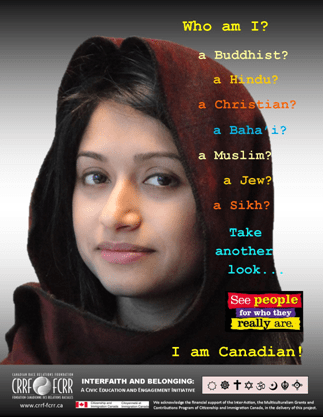
What’s wrong with this Canadian anti-racism poster?

While I agree with Todd’s views that we are a mix of identities, I think he goes too far in over interpreting the Canadian Race Relations Foundation poster.

After all, the poster is simply trying to say look at the person first, treat them equally and fairly, it doesn’t preclude further curiosity and discussion or ignore the various identities we have. And that no group is monolithic; one has to look at the individual and get to know them as a person, not a stereotype:

The poster is promoting confusing ideas about racism by telling viewers the only thing anyone should be concerned about regarding anyone is that they are “Canadian!”

But everyone in Canada has multiple identities.

They are shaped in part by being Canadian. But they are also shaped by their ethno-cultural background. They are shaped by being members of a religion (or not), by being female, by having roots in certain countries, by their economic status, by their familiarity with certain languages, by their family status and a host of other things.

Many factors make up who we are.

Multiculturalism should not be about assuming everyone is the same, ie. “Canadian.” That is not the end of our identities. But anti-racism groups like this act as if we should think and believe everyone is the same.

It’s dangerous teaching. They’re stifling curiousity. And what they are doing has potential to poison relations in Canada between people from different ethno-cultural-religious groups.

What’s wrong with this Canadian anti-racism poster? | Vancouver Sun.

Disclosure: I was an ex officio Board Member of the CRRF as part of my duties as DG – Citizenship and Multiculturalism