Antisemitic rhetoric continues to be used by some opponents of COVID-19 measures

Unfortunately, not all that surprising:

Belle Jarniewski leaned back from her computer, seething with anger after she finished watching a video on Reddit showing a Winnipeg restaurateur accosting public health enforcement officers.

“I’m still shaking after listening to that rant. That was unbelievable,” she said.

The video shows Shea Ritchie, the owner of Chaise Lounge locations on Corydon Avenue and Provencher Boulevard, speaking with officers giving him tickets on Sept. 24 for allowing diners who choose not to be vaccinated to dine inside his restaurant.

Source: Antisemitic rhetoric continues to be used by some opponents of COVID-19 measures

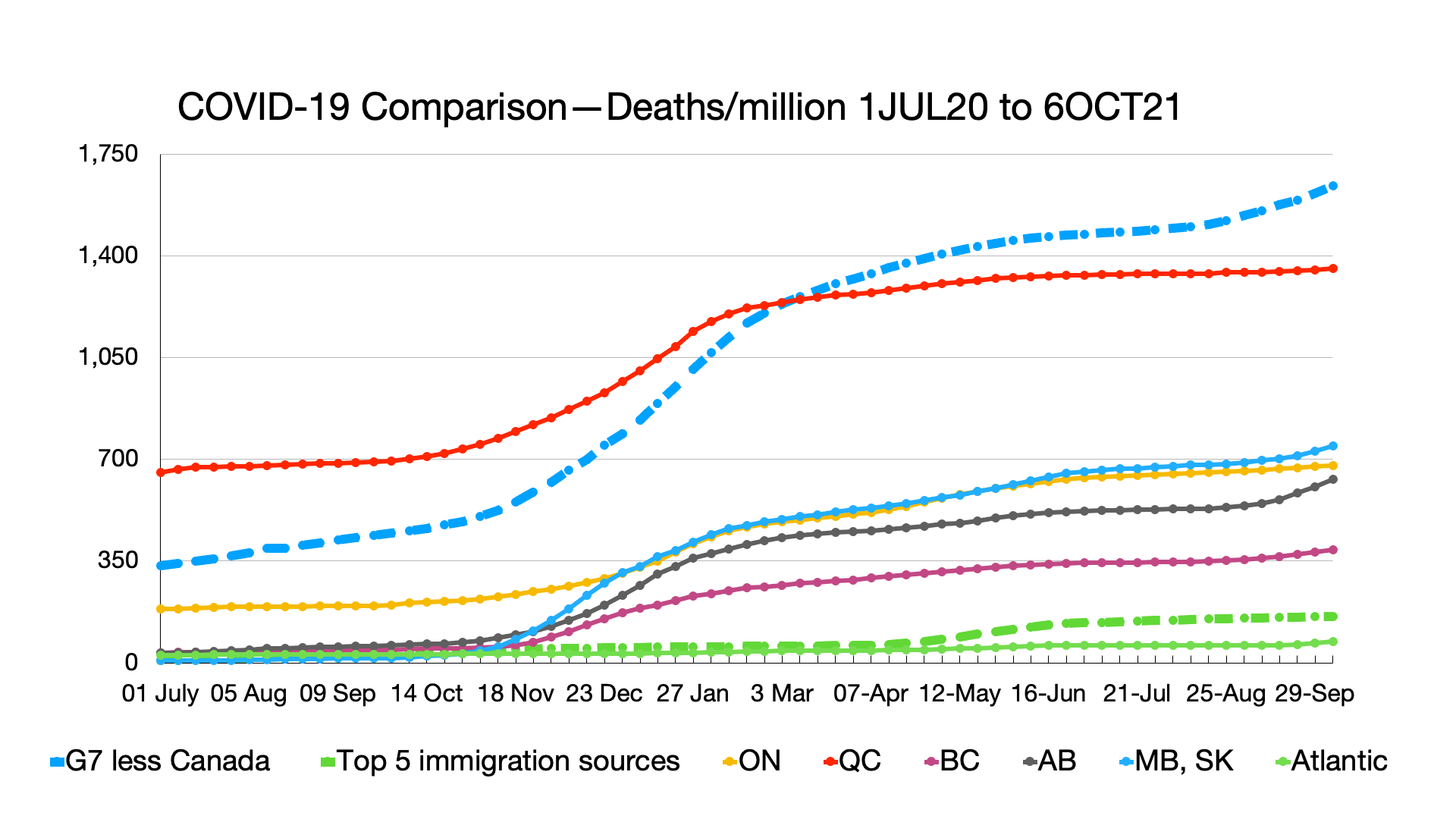
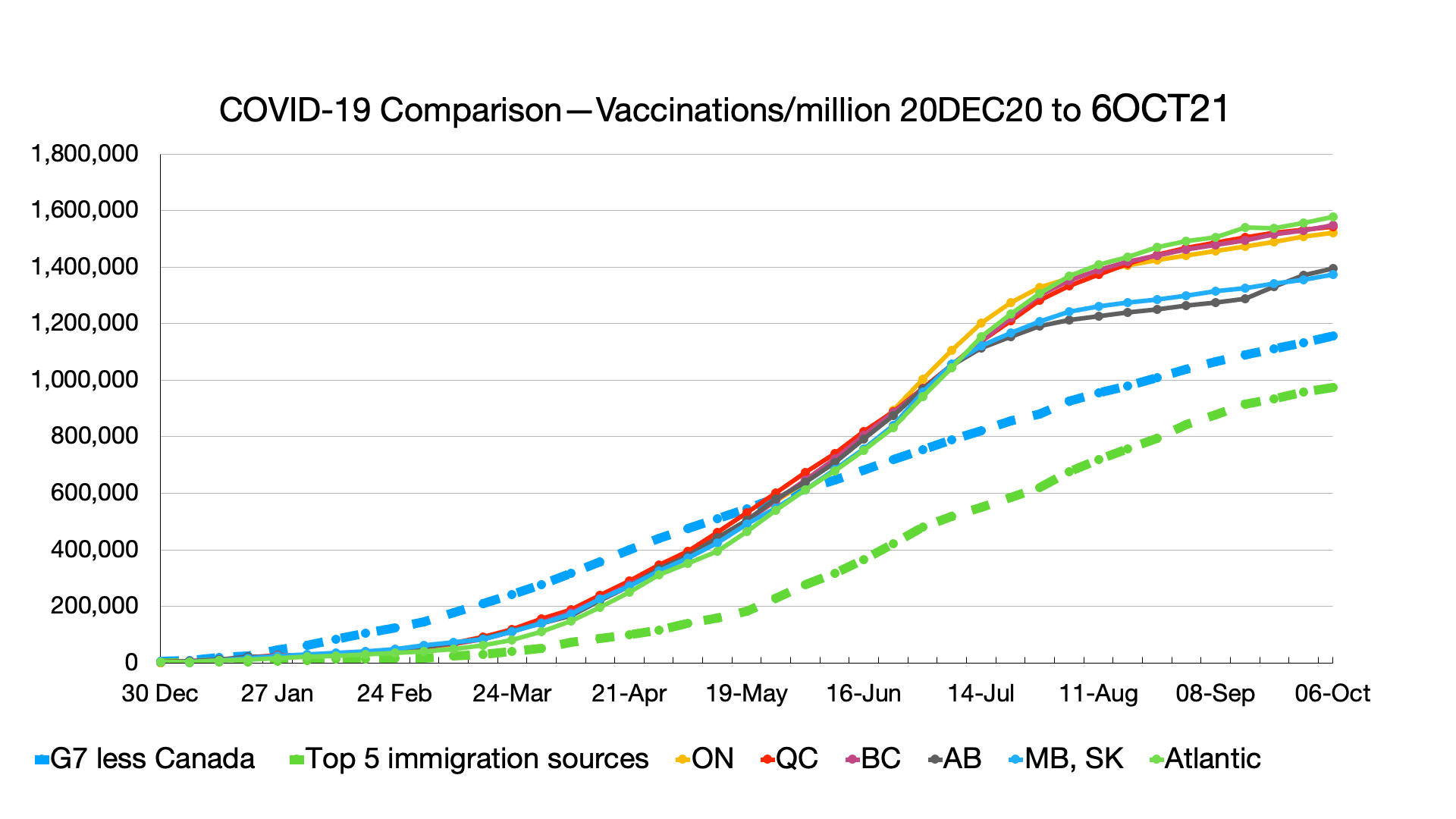
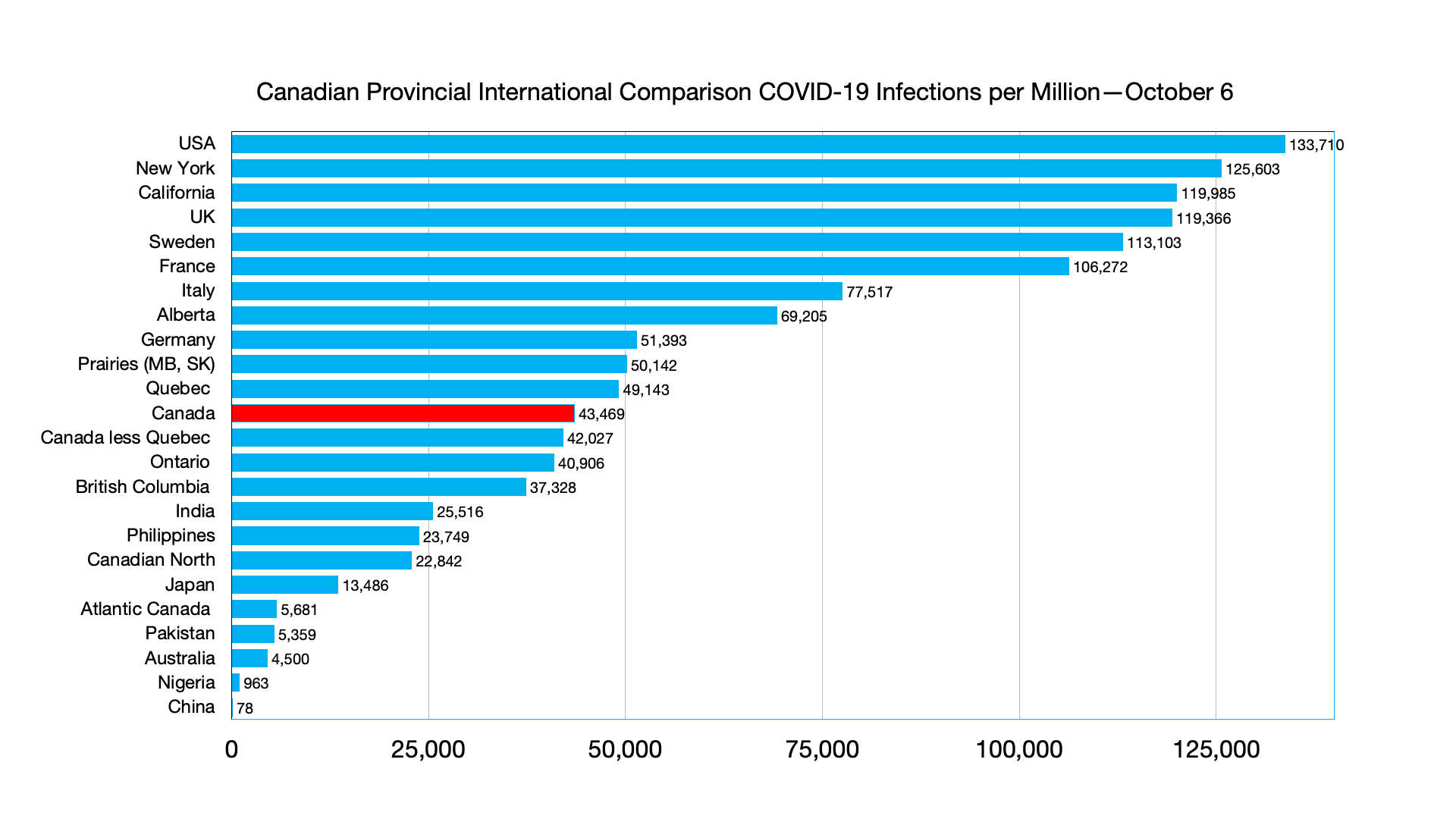
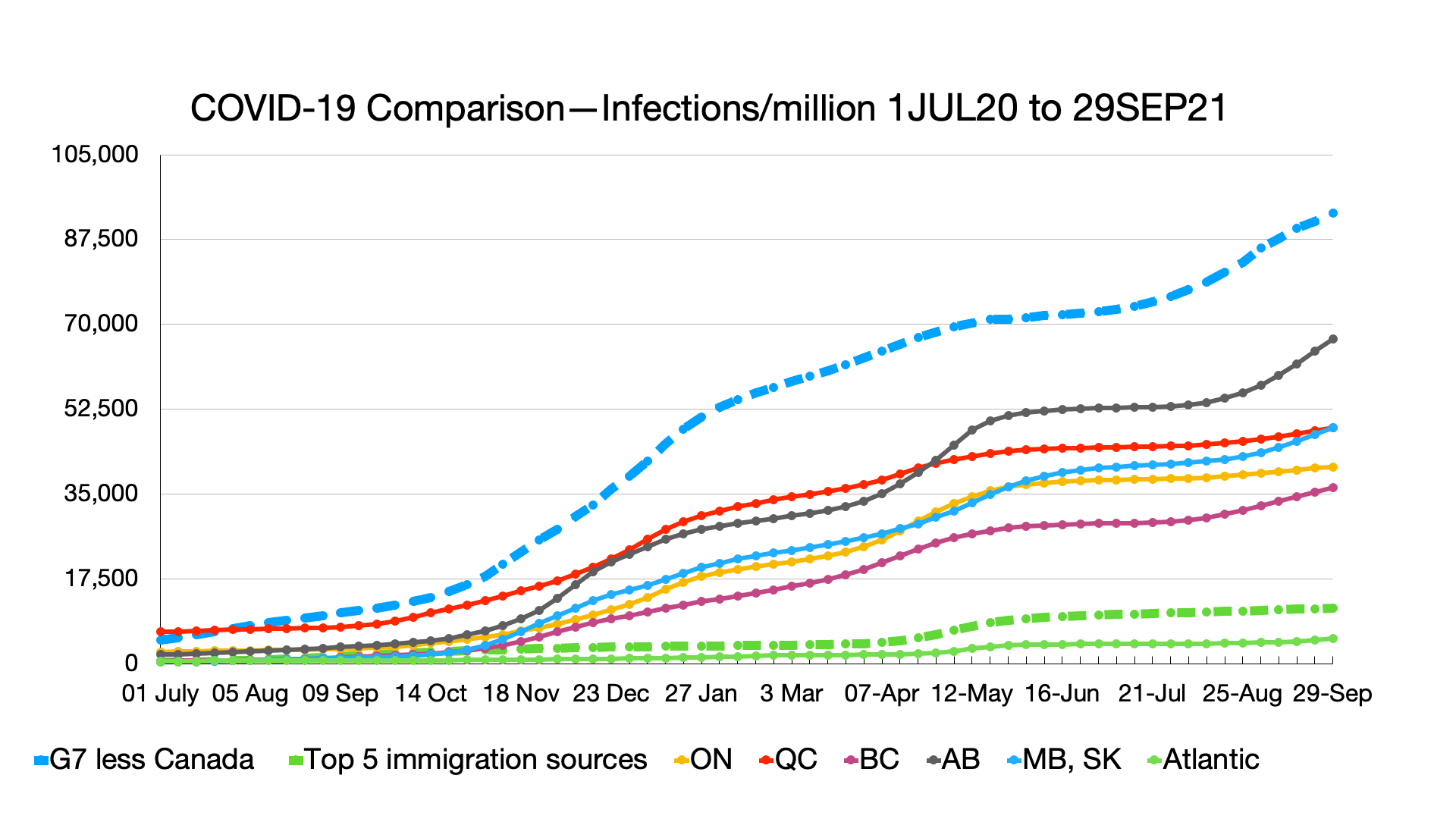
#COVID-19: Comparing provinces with other countries 6 October Update

The latest charts, compiled 6 Octoober as overall rates in Canada increase slightly due to the variant. Canadians fully vaccinated 72.4 percent, higher than USA 56.7 percent and the UK 67.4 percent).

Vaccinations: Minor changes in Canada, Japan now ahead of New York and Germany. China fully vaccinated 75 percent (unchanged), India 18.4 percent.

Trendline Charts:

Infections: Continued trend of pronounced uptick in G7 less Canada (driven largely by USA). Continued sharp rise in Alberta particularly notable as has been extensively covered in the media. British Columbia has overtaken Quebec.

Deaths: Canadian North ahead of Japan, Alberta approaching Ontario deaths.

Vaccinations: No significant change from last week. New Brunswick recent increase less apparent in Atlantic as a whole.

Weekly

Infections: Canada ahead of Canada less Quebec, Atlantic Canada ahead of Pakistan:

Deaths per million: Prairies ahead of Canada, Philippines ahead of India, Canadian North ahead of Japan:

Unvaccinated Conservative MPs should ‘stay home’ from Parliament: Bloc leader

Valid given vaccine mandates elsewhere even if this will only affect Conservative MPs:

Bloc Québécois Leader Yves-François Blanchet said Wednesday the next session of Parliament should happen in person with any members who are not fully vaccinated against COVID-19 staying home.

Questions remain about what the return to Parliament will look like for Canada’s 338 elected representatives after the recent federal election saw the Liberals re-elected with a minority government.

Prime Minister Justin Trudeau says he will name his cabinet next month and Parliament will resume sometime in the fall.

Since the pandemic hit in March 2020, the House of Commons and committees had been functioning with some MPs working from Ottawa, but many others appearing virtually, including, later on, to vote, before the election was called.

Blanchet said he wants to see Parliament resume quickly with MPs having to be fully vaccinated in order to be there in person because now vaccines against the novel coronavirus are more widely available.

His party, along with the New Democrats and Liberals, made it a rule that candidates had to be fully vaccinated in order to hit the doorsteps, but the Conservatives did not.

“They get fully vaccinated or they stay home,” Blanchet said of Conservative MPs who might not have had their shots.

“Parliament should not come back under any kind of hybrid formation … now we know that we can go on with the way this building is supposed to work, and we should not refrain from doing so because a few persons don’t believe that the vaccine works. This belongs to another century.”

NDP MP Peter Julian said in a statement that because Canada is battling a fourth wave of the virus, the party wants to talk to others about continuing some of the hybrid practices when Parliament resumes.

“All of our NDP MPs are vaccinated and we’ve been very clear that federal government employees must be vaccinated too. Getting vaccinated is the right thing to do and elected leaders have a responsibility to set a good example by following public health advice,” Julian said.

The Liberals and Conservatives did not immediately respond to requests for comment Wednesday.

The Conservatives saw 119 MPs, including incumbents and new candidates, elected on Sept. 20, after the party spent the race dogged by questions about its opposition to making vaccines mandatory as a tool to defeat COVID-19.

Conservative Leader Erin O’Toole refused to say on the campaign trail whether he knew how many of those running for the Tories had been fully vaccinated, saying he told campaign teams that those who are not immunized against COVID-19 should take daily rapid tests.

O’Toole is himself vaccinated and has been encouraging others to get their shot, but the Conservative leader says he also respects the personal health choices of Canadians and attacked Trudeau for using the issue to sow division in the country.

Conservative MPs will make their way to Ottawa next week to have their first caucus meeting since the election, where they will have to decide whether they want to review O’Toole’s leadership.

The call for MPs to be vaccinated comes as Trudeau works on bringing in a mandate requiring the federal civil service, along with those working in its federally regulated industries, to be fully vaccinated.

His government has promised to make it a rule by the end of October that travellers flying or taking a train in Canada have to be immunized in order to board.

Many provinces have already introduced a vaccine passport system requiring consumers to provide proof of immunization to access non-essential businesses like restaurants and sports and entertainment venues.

“For the safety of House of Commons staff, translators, pages, security, other MPs and their staff, all parliamentarians should show proof that they are fully vaccinated in order to take their seats in the House,” tweeted former Liberal cabinet minister Catherine McKenna, who didn’t seek re-election, but served for six years in government.

As of Friday, Health Canada reported that around 79 per cent of people 12 and older as having being fully vaccinated, with about 85 per cent receiving at least one dose.

Source: Unvaccinated Conservative MPs should ‘stay home’ from Parliament: Bloc leader

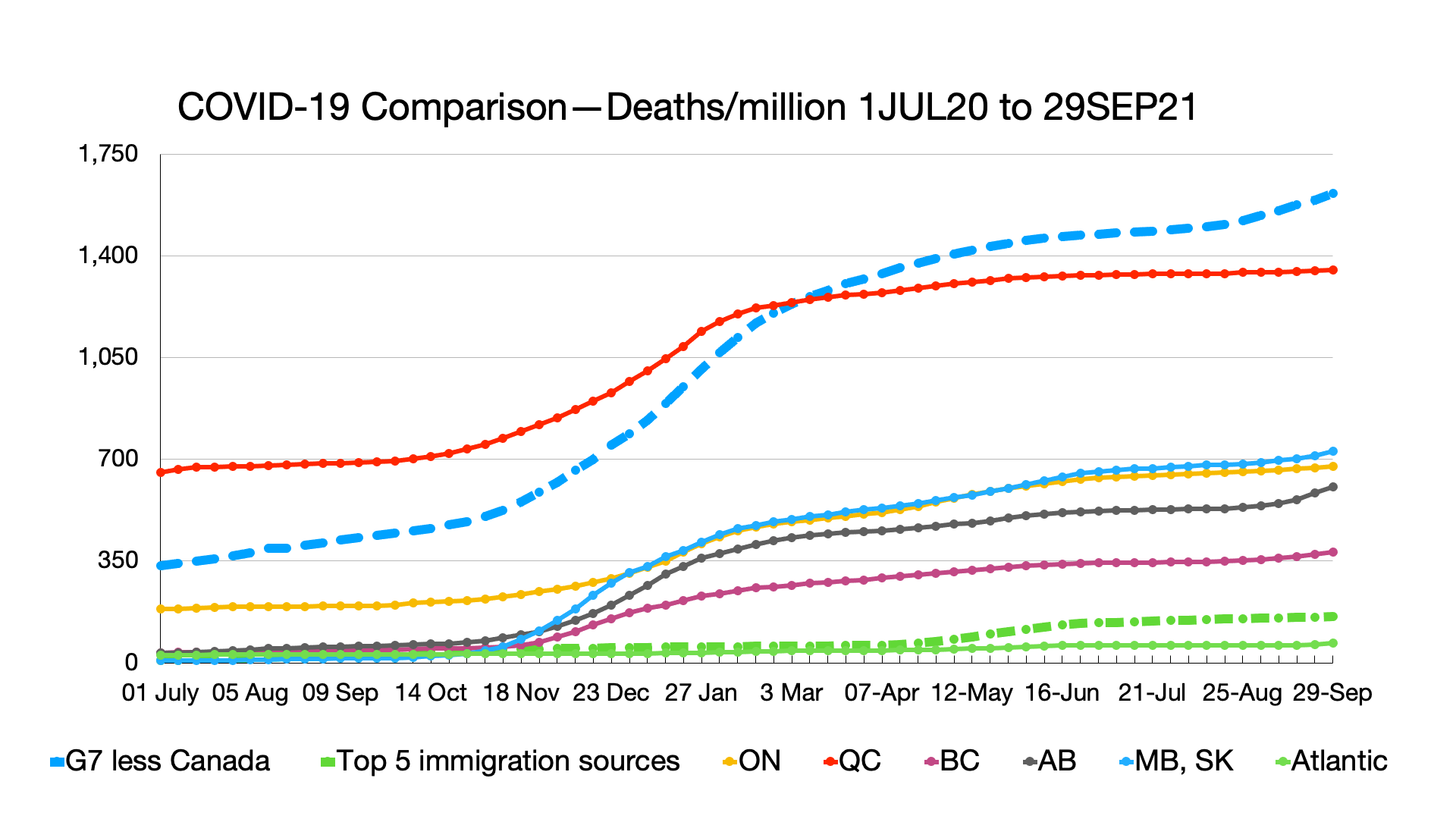
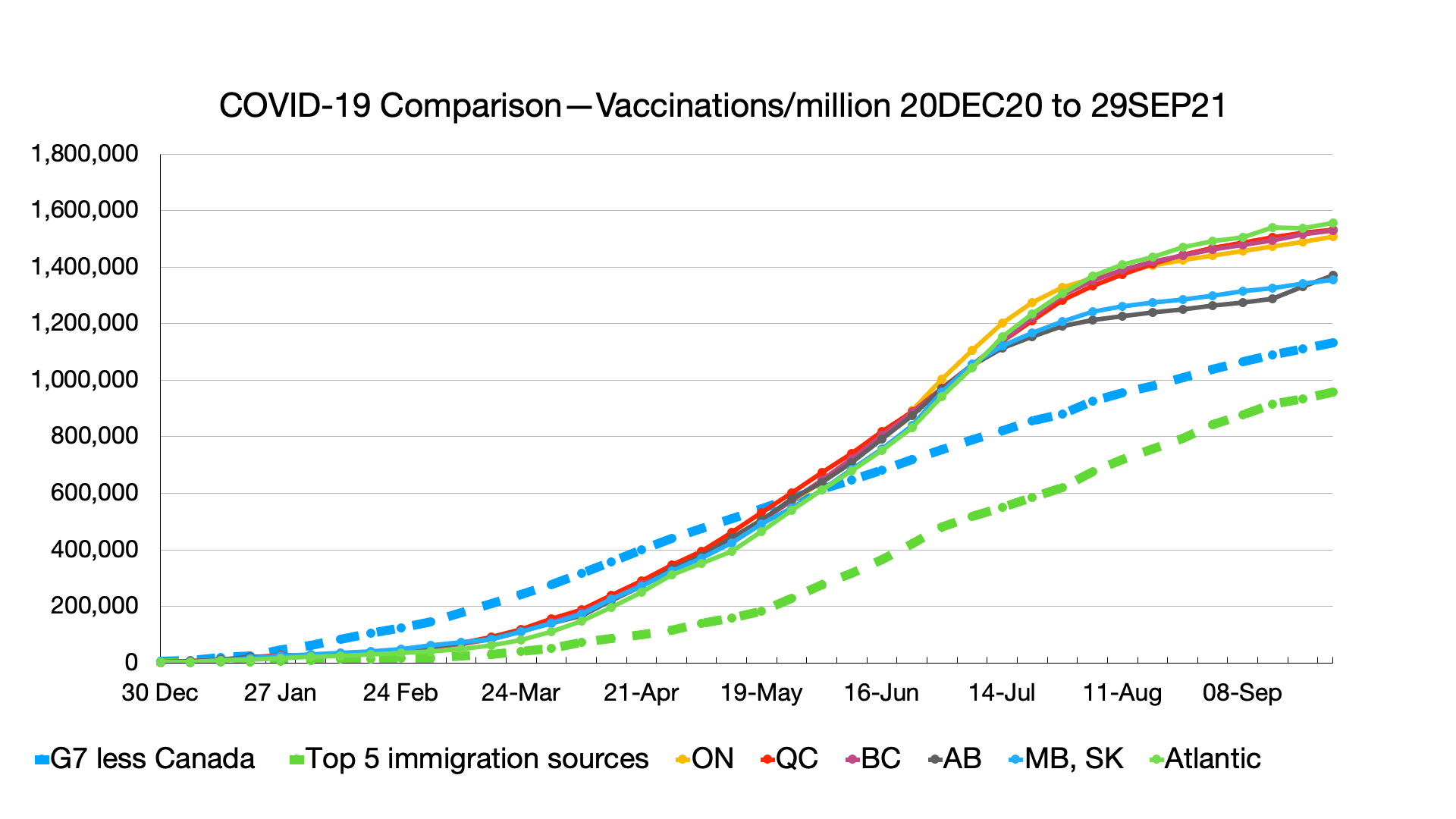
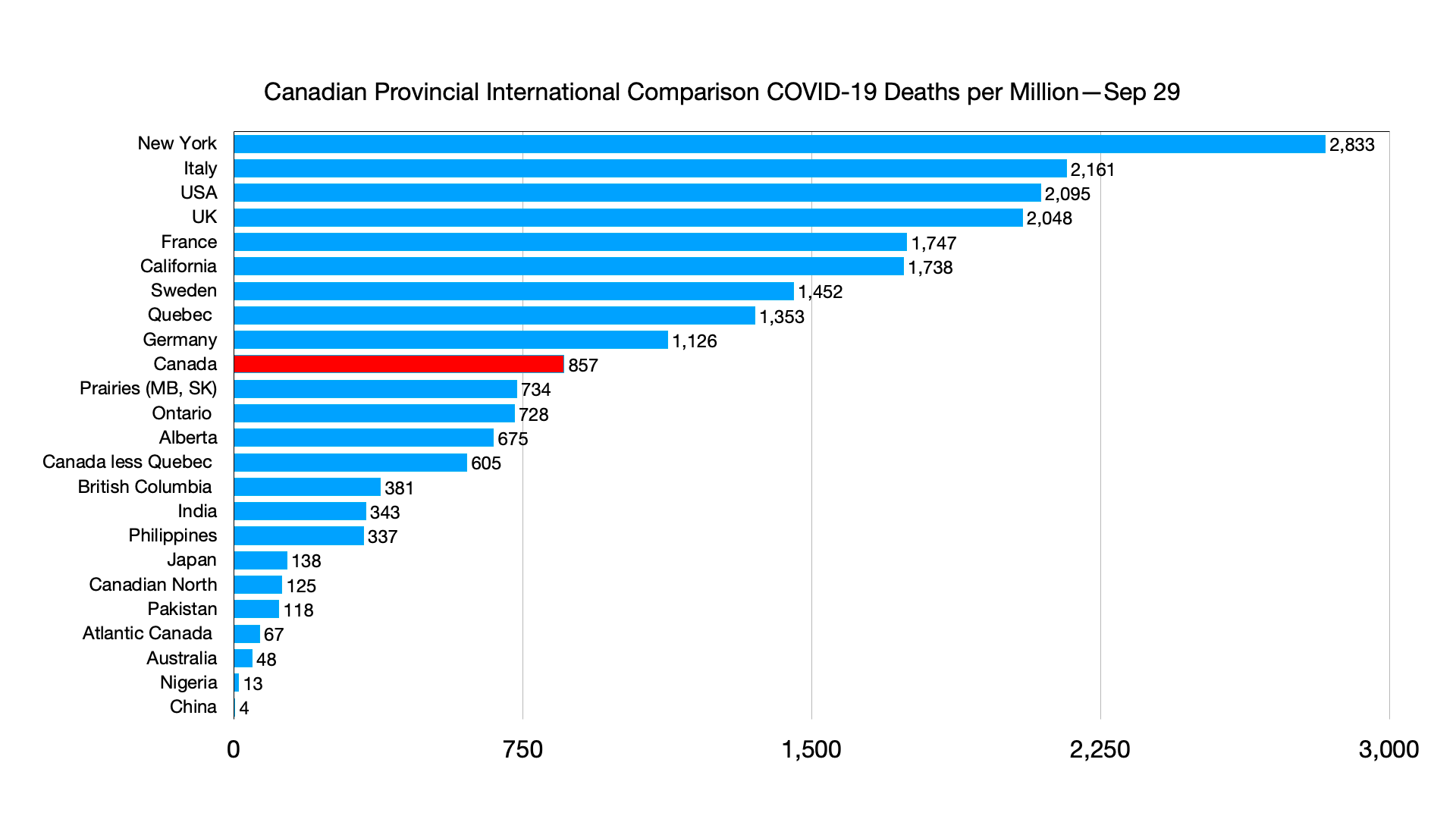
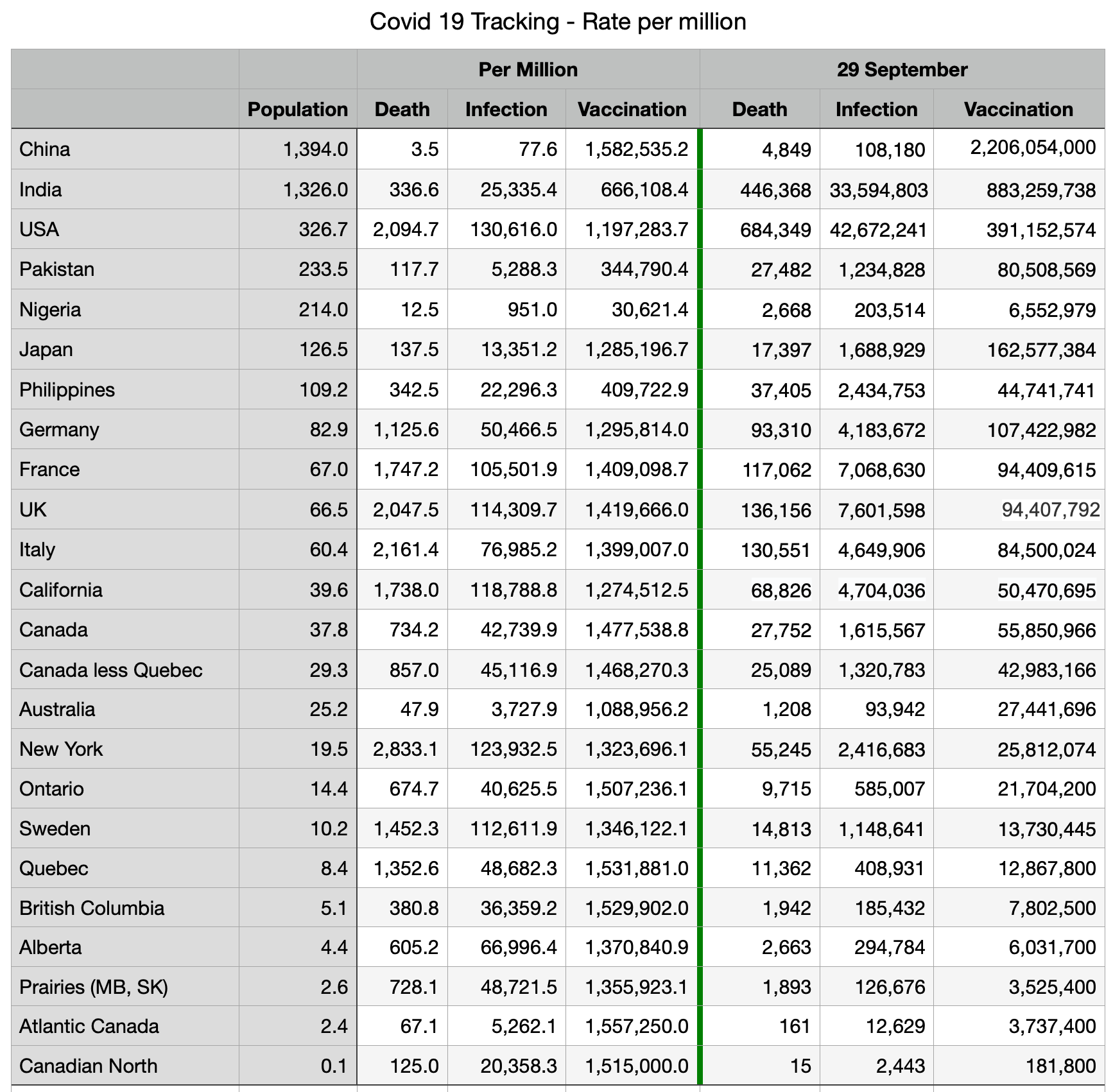
#COVID-19: Comparing provinces with other countries 29 September Update

The latest charts, compiled 29 September as overall rates in Canada increase slightly due to the variant. Canadians fully vaccinated 71.5 percent, higher than USA 56.4 percent and the UK 67 percent).

Vaccinations: Alberta ahead Prairies, Japan ahead of California and USA. China fully vaccinated 73.1 percent (unchanged), India 16.9 percent.

Trendline Charts:

Infections: Continued trend of pronounced uptick in G7 less Canada (driven largely by USA). Continued sharp rise in Alberta particularly notable as has been extensively covered in the media.

Deaths: Canada less Quebec now ahead of Canada (reflecting rise in Alberta and Prairies), Philippines ahead of India.

Vaccinations: Impact of Alberta backtracking and imposing a vaccine mandate continues to show increase, now slightly better than Prairies but still significantly lower than other provinces.

Weekly

Infections: UK ahead of Sweden, Prairies ahead of Quebec, Canada less Quebec ahead of Canada:

Deaths per million: Canada less Quebec ahead of Canada, and all provinces save Quebec, Philippines ahead of India:

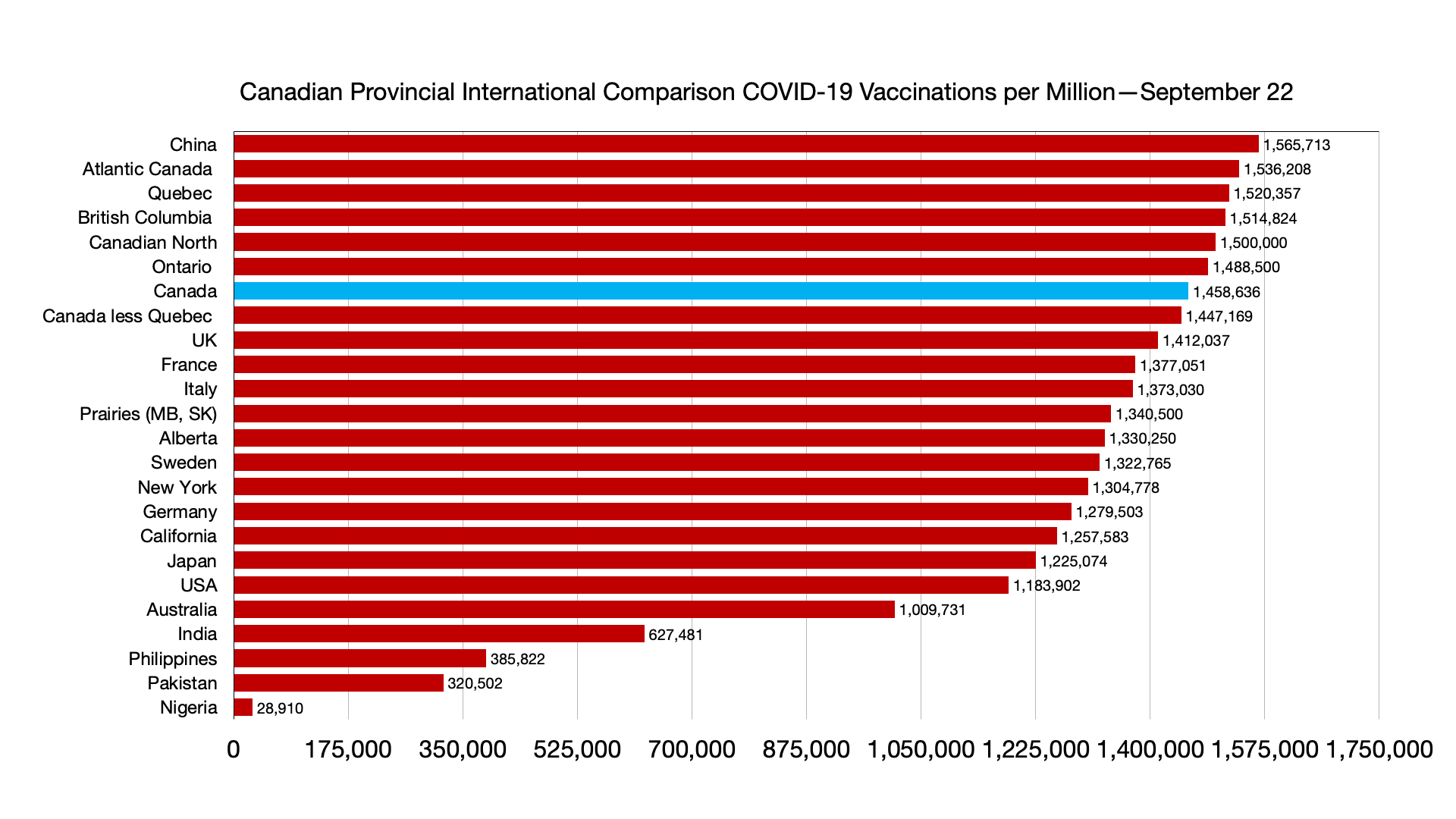
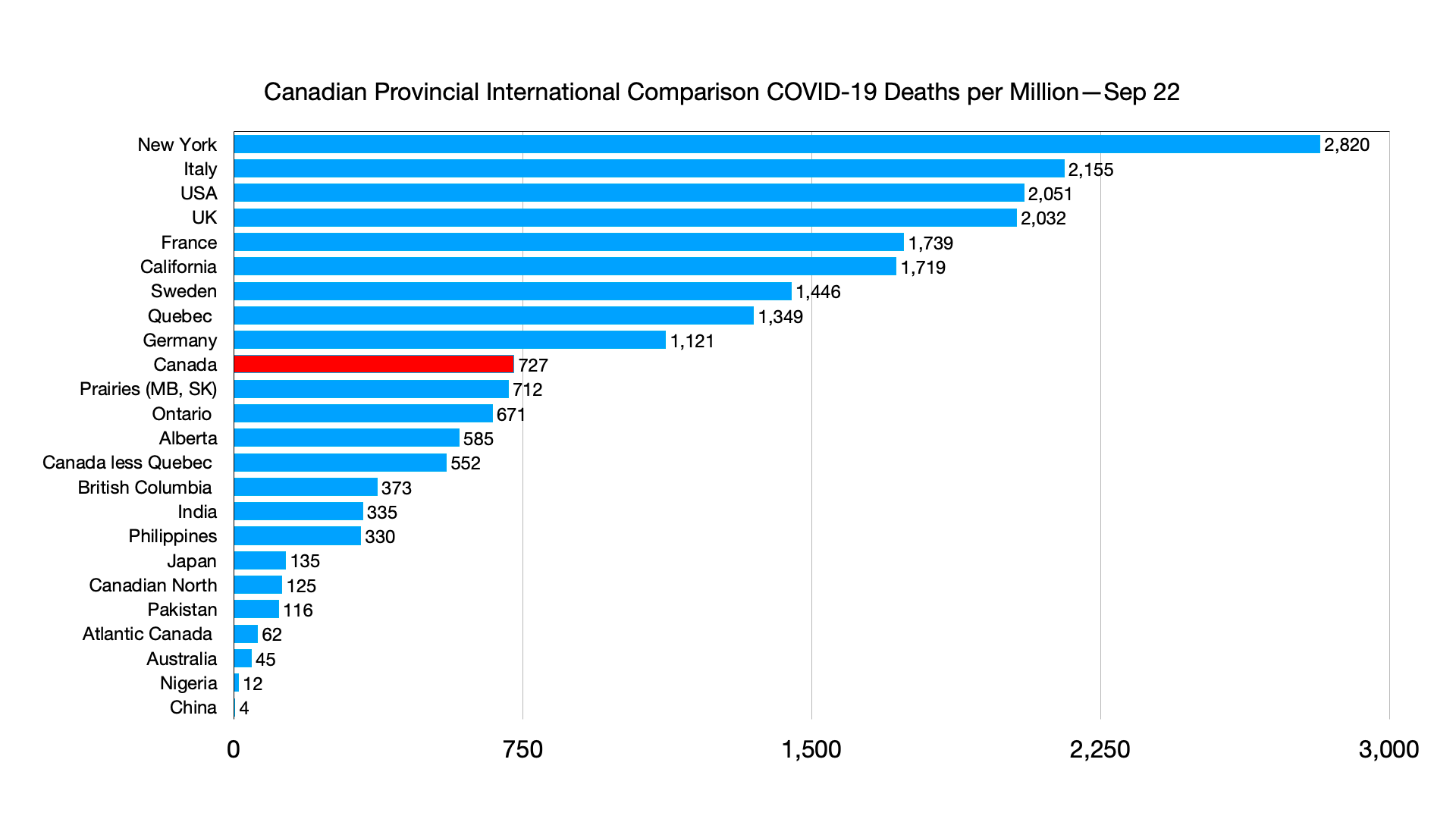
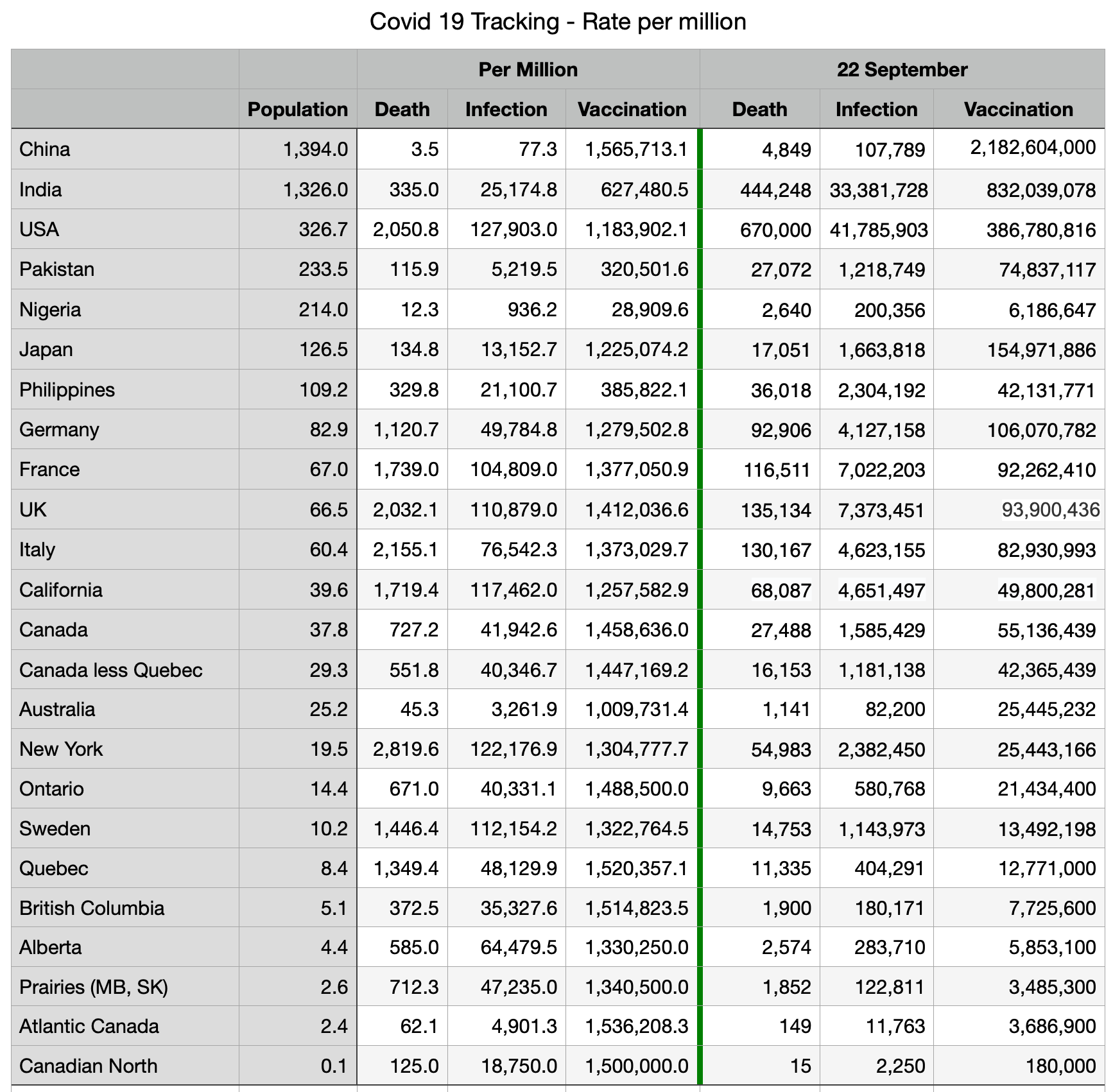
#COVID-19: Comparing provinces with other countries 22 September Update

The latest charts, compiled 22 September as overall rates in Canada increase slightly due to the variant. Canadians fully vaccinated 70.5 percent, higher than USA 55.5 percent and the UK 66.6 percent) but all three countries are hitting a wall, with only minimal increases in the past week.

Vaccinations: Alberta ahead of Sweden, Japan ahead of USA, and India ahead of Philippines. China fully vaccinated 73.1 percent, India 15.3 percent.

Trendline Charts:

Infections: Continued trend of pronounced uptick in G7 less Canada (driven largely by USA). While all provinces showing increased infections, Alberta and Prairies showing the highest, followed by British Columbia.

Deaths: No major change but continued uptick G7 less Canada and in Alberta.

Vaccinations: Ongoing steady gap between Alberta and Prairies with lower vaccination rates than elsewhere in Canada but impact of Alberta backtracking and imposing a vaccine mandate shows increase over past week.

Weekly

Infections: Canada less Quebec now ahead of Ontario (thanks to Alberta and Prairies):

Deaths per million: USA now ahead of UK.

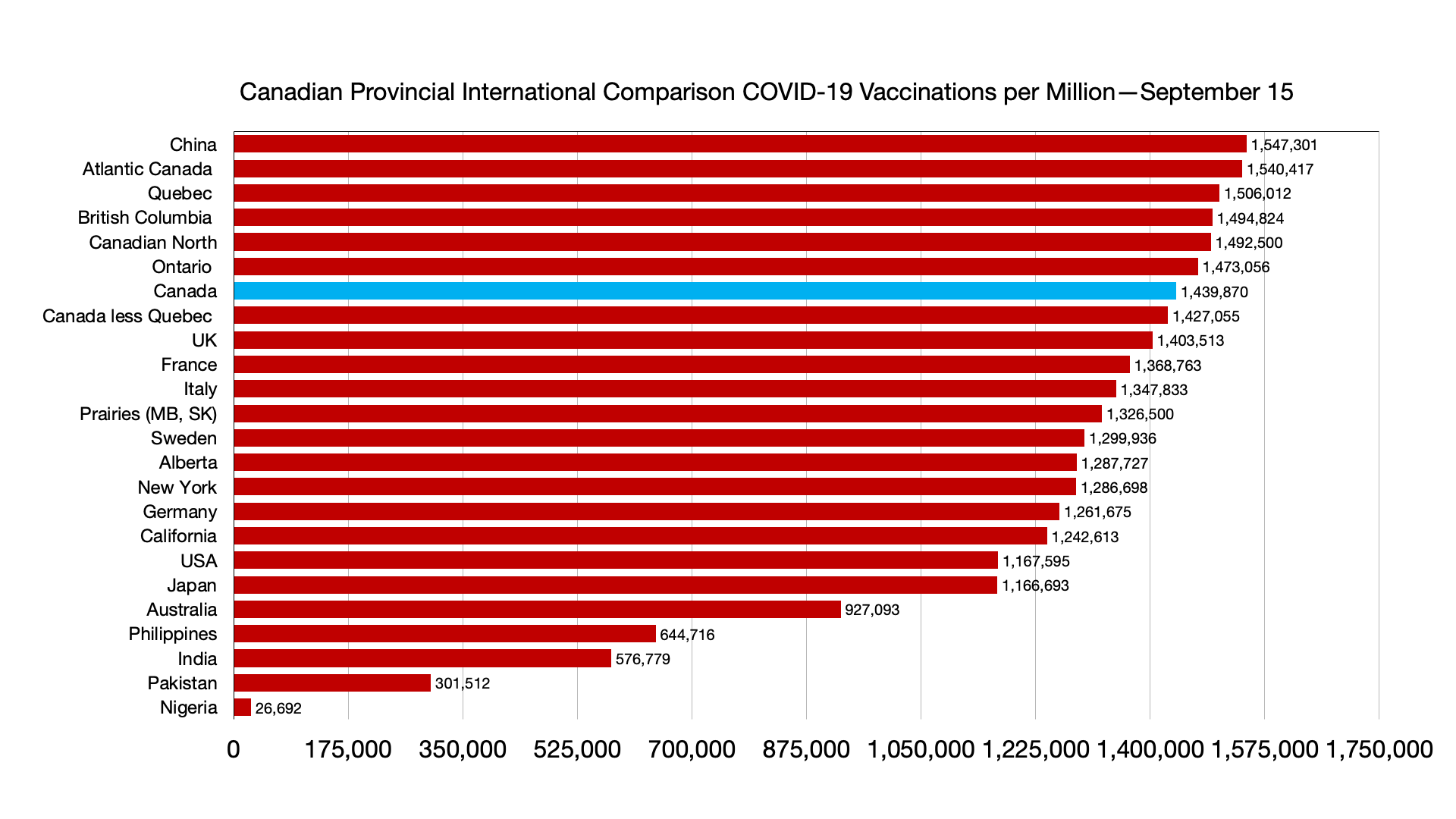
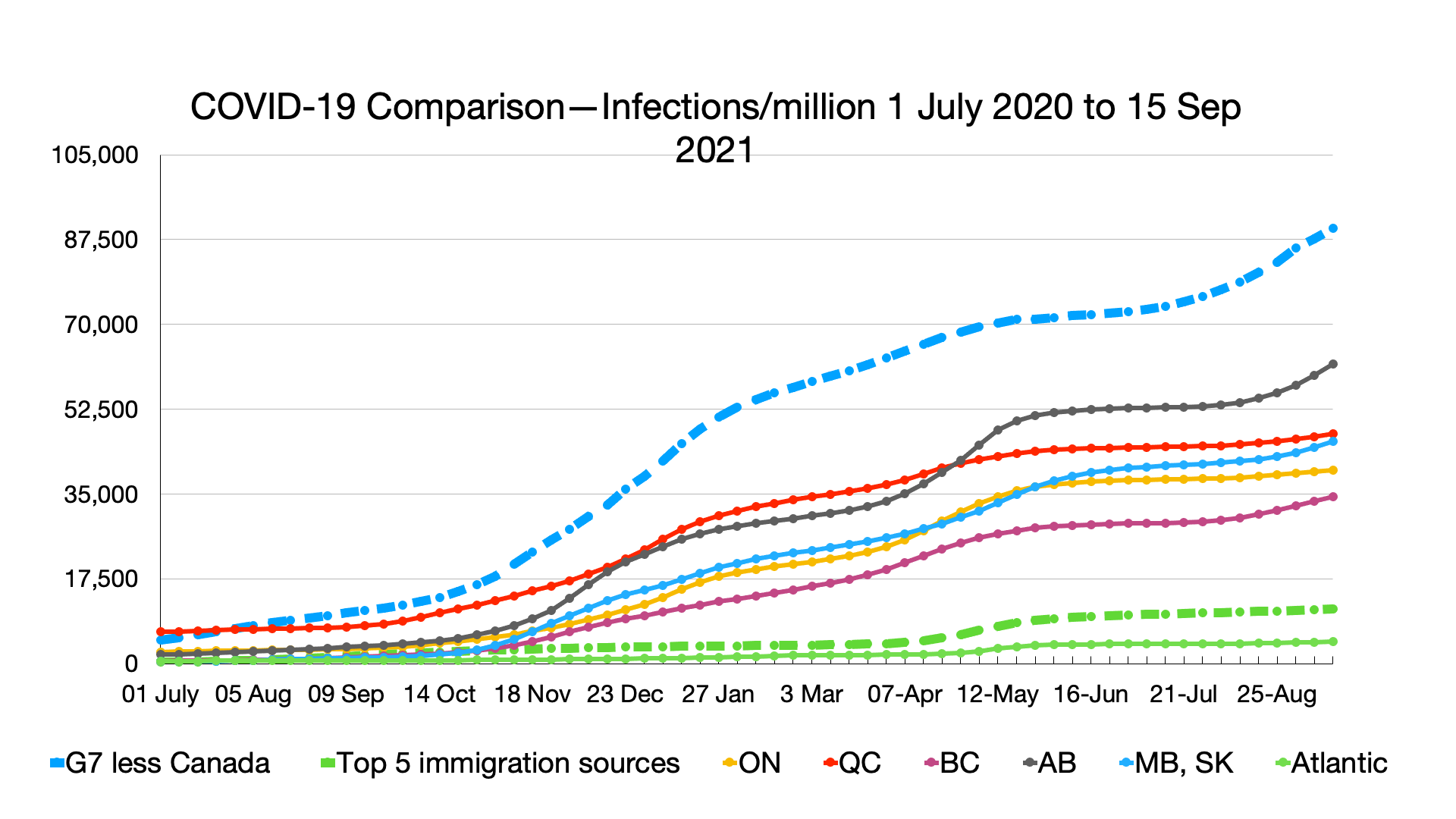
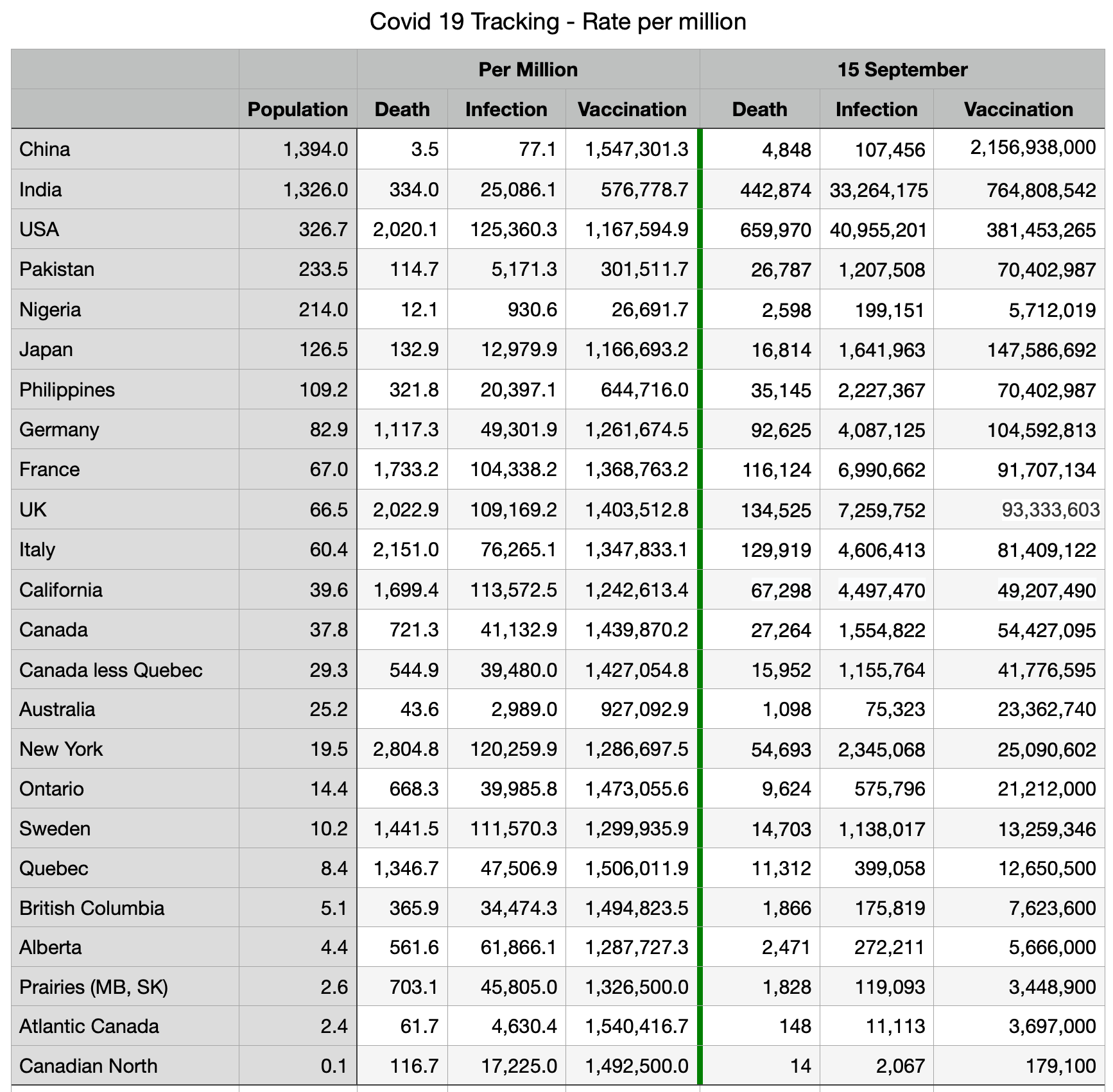
#COVID-19: Comparing provinces with other countries 15 September Update

The latest charts, compiled 15 September as overall rates in Canada increase slightly due to the variant. Canadians fully vaccinated 69.3 percent, higher than USA 54.6 percent and the UK 66 percent) but all three countries are hitting a wall, with only minimal increases in the past week.

Trendline charts

Vaccinations: Philippines ahead of India. China fully vaccinated 69.4 percent, India 13.3 percent.

Infections: Continued trend of pronounced uptick in G7 less Canada (driven largely by USA). While all provinces showing increased infections, Alberta and Prairies showing the highest, followed by British Columbia.

Deaths: No major change but uptick G7 less Canada and in Alberta.

Vaccinations: Ongoing steady gap between Alberta and Prairies with lower vaccination rates than elsewhere in Canada. More rapid increase of immigration sources countries continues to be driven by China and to a lesser extent, India.

Weekly

Infections: No relative change.

Deaths per million: Canadian North ahead of Pakistan.

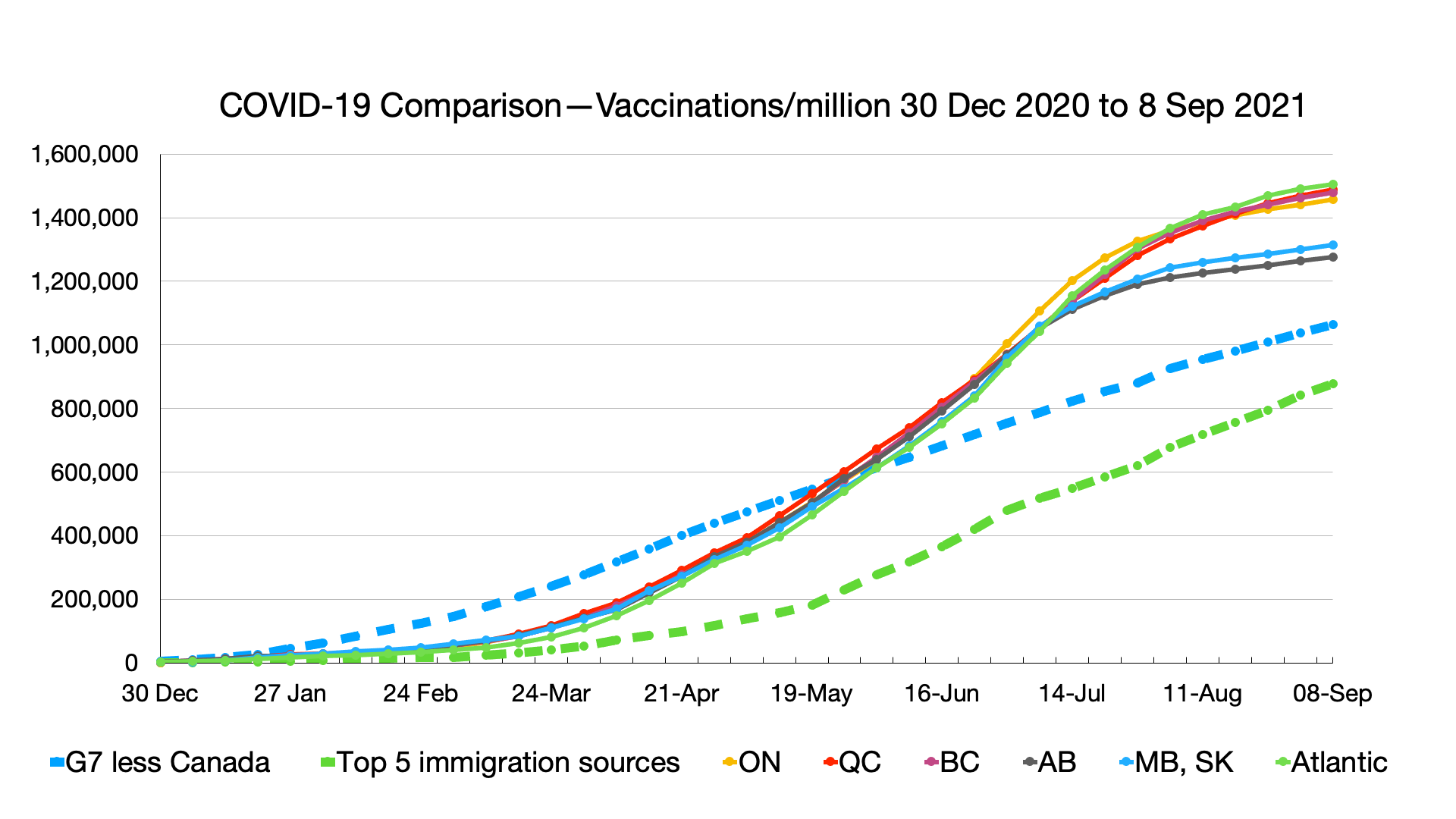
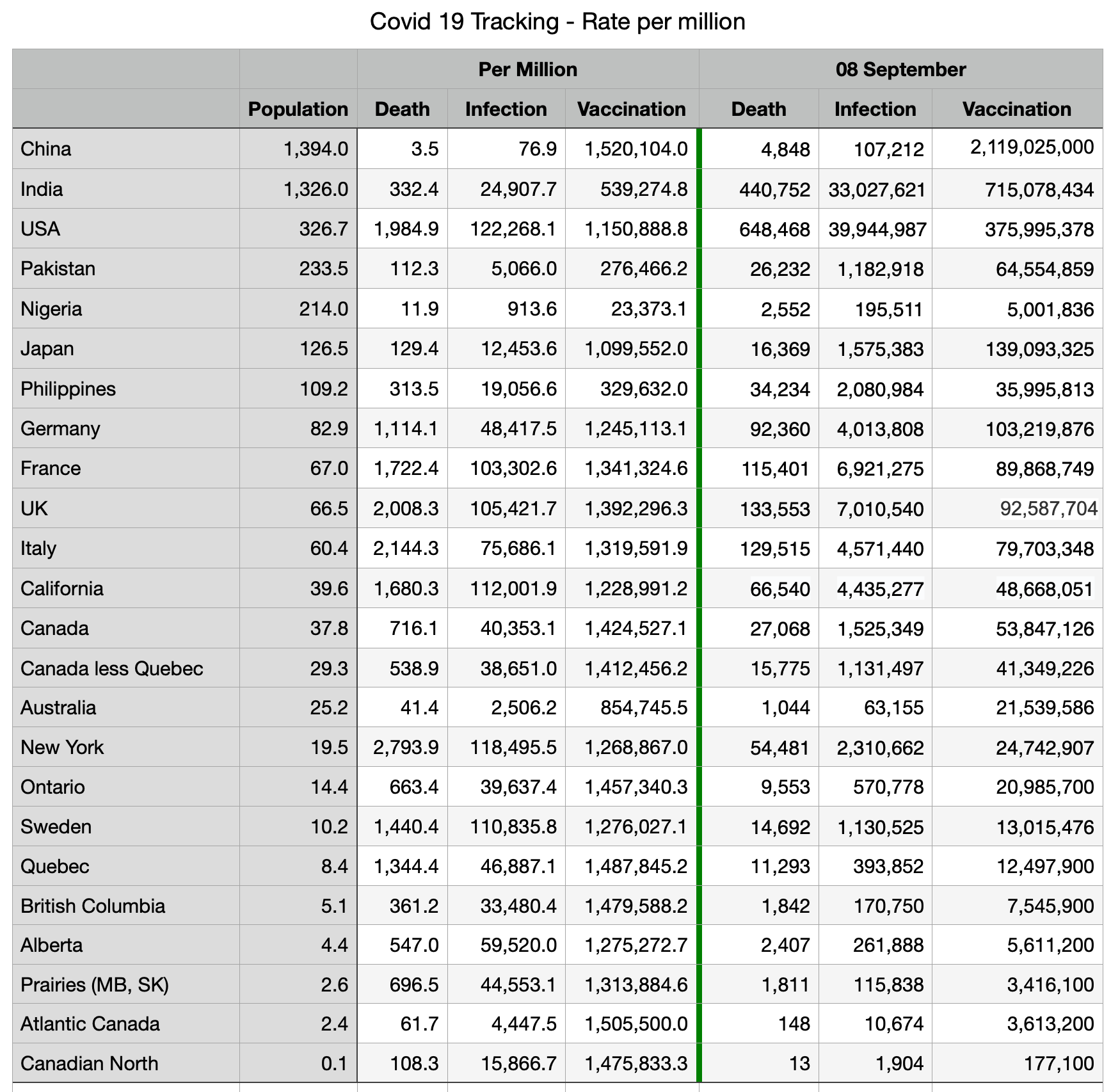
#COVID-19: Comparing provinces with other countries 8 September Update

The latest charts, compiled 8 September as overall rates in Canada increase slightly due to the variant. Canadians fully vaccinated 68.6 percent, higher than USA 53.8 percent and the UK 65.1 percent) but all three countries are hitting a wall, with only minimal increases in the past week.

Vaccinations: China now has highest vaccination rate, British Columbia ahead of Canadian North, Italy ahead of Prairies, Sweden ahead of Alberta.  Chinese fully vaccinated, 63.3 percent (unchanged from last week).

Trendline charts

Infections: Same ongoing trend of pronounced uptick in G7 less Canada (driven largely by USA). While all provinces showing increased infections, Alberta and Prairies showing the highest.

Deaths: No major change but uptick G7 less Canada.

Vaccinations: Ongoing steady gap between Alberta and Prairies with lower vaccination rates than elsewhere in Canada. More rapid increase of immigration sources countries continues to be driven by China and to a lesser extent, India.

Weekly

Infections: No relative change except California slightly ahead of Sweden.

Deaths per million: No significant change.

Vaccine passports pose an equity problem

The equity problems are related to the barriers some groups face in obtaining vaccines. But we do know that vaccine passports result in an increase in vaccination rates given it increases the “cost” of not being vaccinated. And what about the legitimate concerns of the more vulnerable (age, immunocompromised) which exist in all communities:

Recently, New York City became the first American city to declare that workers and customers alike will require proof of having received at least one vaccine dose, before being allowed to partake in routine activities such as dining at restaurants and exercising at gyms. Since then, Québec, British Columbia, and now Ontario have chosen to implement “vaccine passports” – digital or physical proof of full immunization – to categorize which residents should and should not be able to conduct nonessential activities.

Canadians are understandably anxious to see as many of their neighbors vaccinated as possible. COVID-19 cases are spiking in Canada, driven by the Delta variant, with most – but not all – occurring among the unvaccinated. But current initiatives to require vaccine passports ignore the reality of vaccine segregation, and how they could reinforce inequities in society – and how they might not actually encourage vaccination nor stop the spread of the disease.

One of Dr. Berger’s patients in his Baltimore clinic – a 35-year-old – was recently asked whether he’d been vaccinated against COVID-19. “I do food prep at a restaurant, 14 hour days, six days a week,” he replied. “I’m not sure when I’m supposed to get time off.” He cracked a tired smile. “And then I worry about going out, these days.” He explained that was because of COVID-19, but also because of the U.S. Immigration and Customs Enforcement agency, which has not stopped its efforts to deport the undocumented even during a global pandemic.

In Canada, fear of compromising privacy has already fueled vaccine hesitancy among the undocumented, and digital vaccine passports (which require users to download an app to their phone, and to scan a QR code provided by the venue which they are visiting) has only added to their fears.

Additionally, in British Columbia, the vaccine passport requirement has been applied so stringently that even people who cannot be vaccinated for medical reasons will have their freedom of movement restricted. Gabrielle Peters, a disability rights advocate in British Columbia, is among them. “[People with disabilities] were completely ignored and now we’re completely thrown under the bus because of concerns about other people,” she said in a recent interview. “How is it that you can make an age-based exemption, but you can’t make a medical exemption?”

These people are not ideologically opposed to vaccination; they are constrained by circumstances and undermined by lack of support. How should we best respond, to support public health while also relieving the desperate circumstances of Dr. Berger’s patients and those like them?

Beyond medical and legal reasons, there are widespread barriers to getting vaccinated. If you can’t get off work because you lack protections or just need the money, say. Or if you have to take care of kids, the bus isn’t running, you’re not feeling well, or you simply can’t find the time to figure out how or where to get the vaccine, given everything else life has thrown at you.

Then, there’s also the matter of understandable mistrust in governments. A person thinking about getting vaccinated also has to trust that those organizing vaccinations have their best interest at heart. But many governments have victimized various people at various times, both in the past and to this very day. How can Black Americans place full trust in vaccinations when they’re being promoted by a government with a profoundly cruel history of medical experimentation on Black communities throughout the country’s history? Which Puerto Rican would not think twice about the shot, given the memory of forced sterilizations on that part of the U.S.? Who among the Indigenous people in Canada would uncritically accept any announcement from a federal government with its own history of forced sterilization and residential school programs?

Technical barriers also underlie the failures that have plagued vaccine passport rollouts in Europe, as well as New York and California. In particular, the U.S. has seen technical hiccups that could have been predicted and avoided. Additionally, IBM – the developers of New York’s Excelsior passport app – have already been musing about adding even more private information to the passport, including health insurance and driver’s licenses. Yet, there has been no parallel effort by legislators to safeguard users’ privacy with legal protections against information-sharing among third parties, or penalties for misuse.

If we must have COVID-19 passports, we must also make them supportive, not punitive. They need to open doors to all the social supports that make life during a pandemic possible, and which so many have been denied: reliable, humane work; food; housing; shelter; childcare; and healthcare. The state needs to provide, not punish – and that would actually help hasten the end of COVID-19.

Zackary Berger is a primary care physician and bioethicist at Johns Hopkins School of Medicine and the Esperanza Center, both in Baltimore. Andray Domise is a Toronto-based writer.

Source: https://www.theglobeandmail.com/opinion/article-vaccine-passports-pose-an-equity-problem/

Immigration and natives’ exposure to COVID-related risks in the EU | VOX, CEPR Policy Portal

Interesting assessment that immigrant workers in EU countries helped non-migrants avoid COVID-related risks given that immigrant workers filled the more difficult and dangerous jobs and that native workers were more able to shift to jobs that could be filled from home:

In recent years, immigration policy has been at the forefront of political debates in high-income destination countries. The UK completed its withdrawal from the EU on 31 January 2020, due in part to the desire to have more control over its immigration policies and to limit migrant flows. Intense political debates and polarisation on immigration helped fuel the rise of right-wing parties in Europe and political controversies over the border wall and the Dream Act in the US.

Despite these high-profile examples of the popular and political backlash against immigration, the academic literature provides evidence that immigrant workers often fill difficult and dangerous jobs that locals are not willing to undertake (Orrenius and Zavodny 2009 and 2013, Sparber and Zavodny 2020).

The recent COVID-19 shock exerted unforeseen and sudden pressures on labour markets across the world. While the negative effects of the pandemic were widespread, some categories of workers were hit much harder than others due to their occupations (Adams-Prassl et al. 2020a and 2020b, Dingel and Neiman 2020, Garrote-Sanchez et al. 2020, Gottlieb et al. 2021). Migrant workers, in particular, have been more exposed to the negative impacts of COVID-19 (Basso et al. 2020, Borjas and Casidi 2020, Fasani and Mazza 2020 and 2021). Another strand of the migration literature shows that in response to immigration, native workers reallocate to different occupations in which they have a comparative advantage (Peri and Sparber 2009).

Against this backdrop, a question of interest is whether immigration contributed to reducing locals’ exposure to the COVID-19 pandemic. In a recent paper (Bossavie et al. 2020), we explore how the prevalence of immigration in a labour market affects different types of workers’ exposure to COVID-19 related risks. We provide evidence that not only were immigrant workers more exposed to the economic and health-related shocks of the pandemic; they also served as a protective shield for native workers. By selecting into higher-risk occupations prior to the pandemic, immigrants enabled native workers to move into jobs that could be undertaken from the safety of their homes or with lower face-to-face interaction with customers and co-workers during the pandemic.

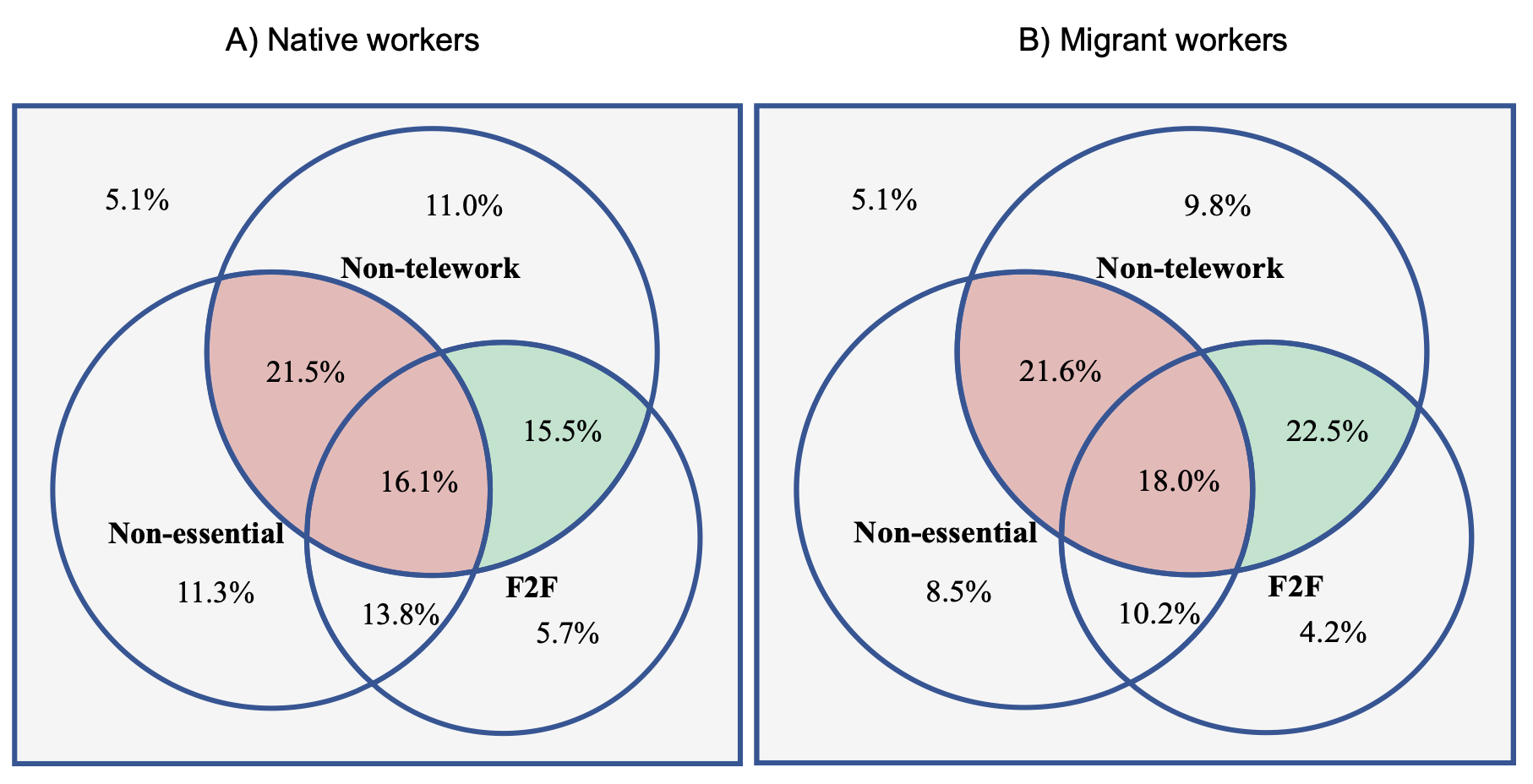
To assess the exposure of immigrant and native workers to the economic and health risks posed by the pandemic, we construct various measures of vulnerability. We look at three main dimensions of occupational vulnerability in the context of COVID-19: whether an occupation can be carried out from home, whether it has been categorised as essential by governments in the context of COVID-19, and whether it is exposed to COVID-19 health risks. In general, lower-skilled occupations such as machine operators, waiters, and day laborers tend to be less amenable to work from home than professional and managerial occupations. Essential jobs are concentrated in key sectors such as healthcare or agriculture. The higher health risks are found in essential occupations that require intensive face-to-face interactions such as doctors, personal care workers, or bus drivers.

We focus on destination countries in Western Europe, including the 15 countries that were the initial members of the EU (prior to the 2004 enlargement), Norway, and Switzerland. This region is the destination for an estimated 60 million of some 272 million immigrants worldwide. The analysis is based on a harmonised labour force dataset (EU Labor Force Survey) that contains detailed information on personal characteristics (such as age, education, occupation, and sector) of native workers and labour migrants in hundreds of local labour markets in subregions within European countries.1 The distribution of occupations by type of exposure to COVID-19 and by migrant status in the EU is reported in Figure 1.
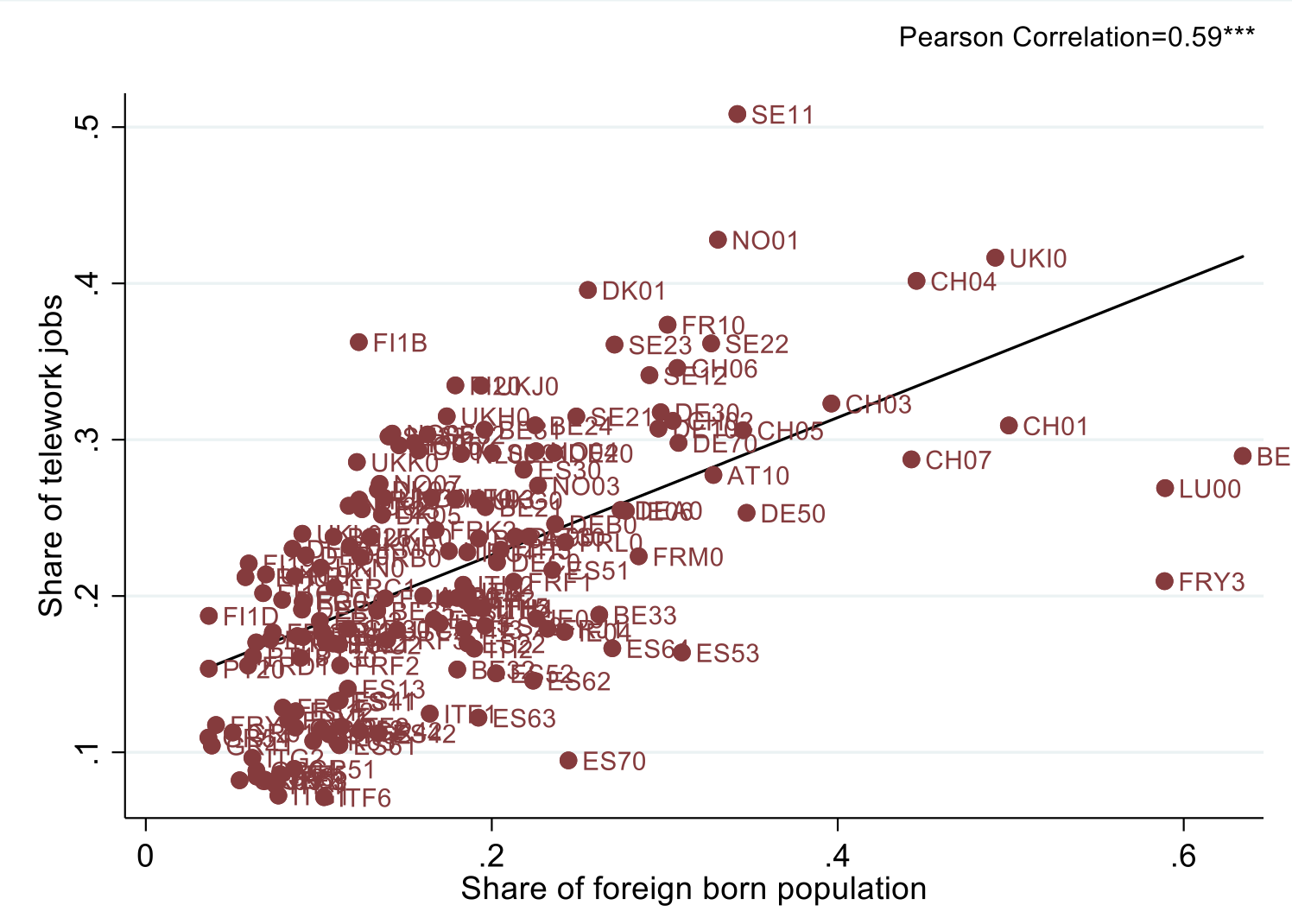
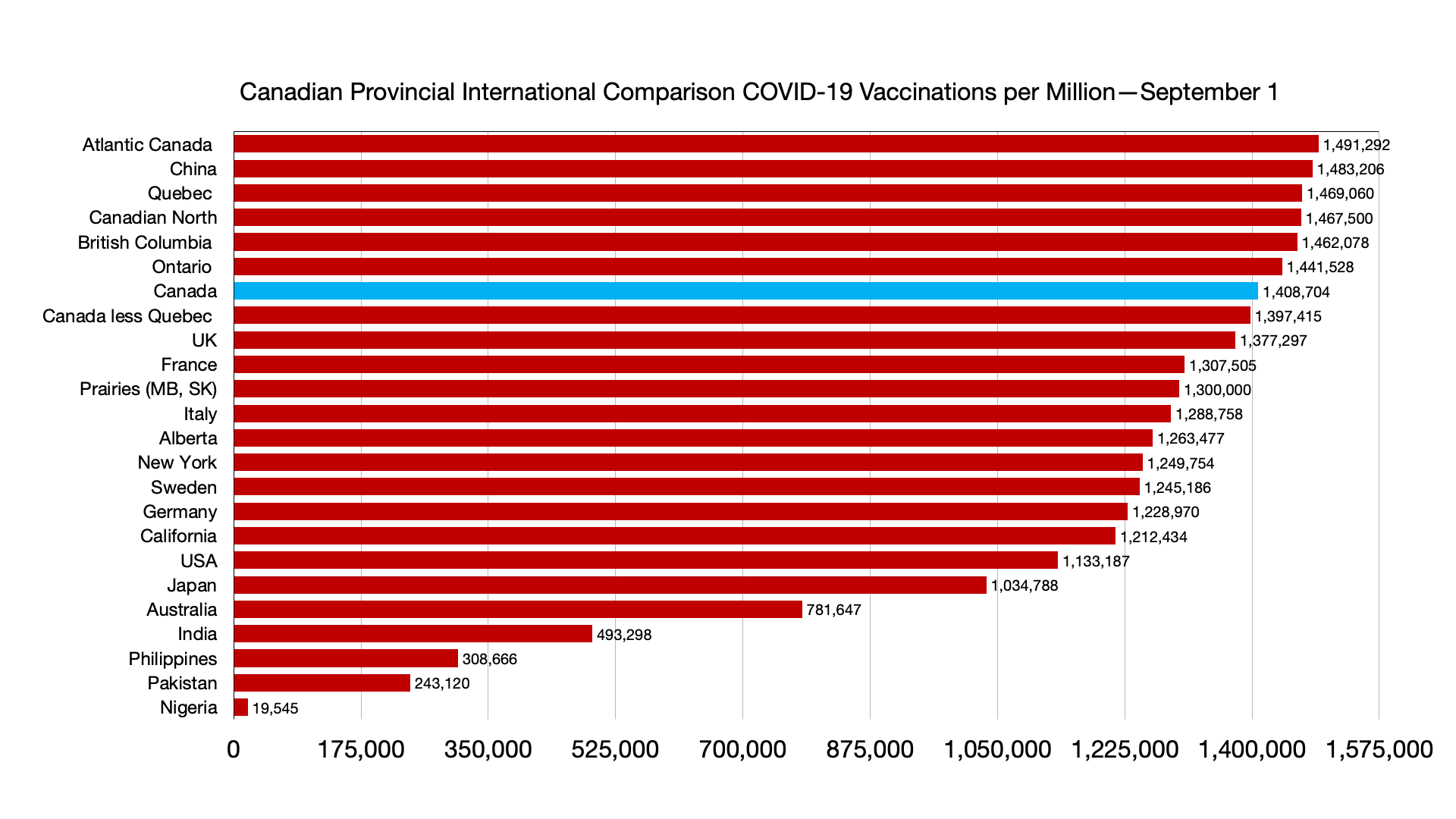
Figure 1 Relative size of telework, essential, and non-face-to-face jobs in the EU

Source: Own calculation based on EU-LFS 2018 data, following EC directive (2020) and Fasani and Mazza (2020).

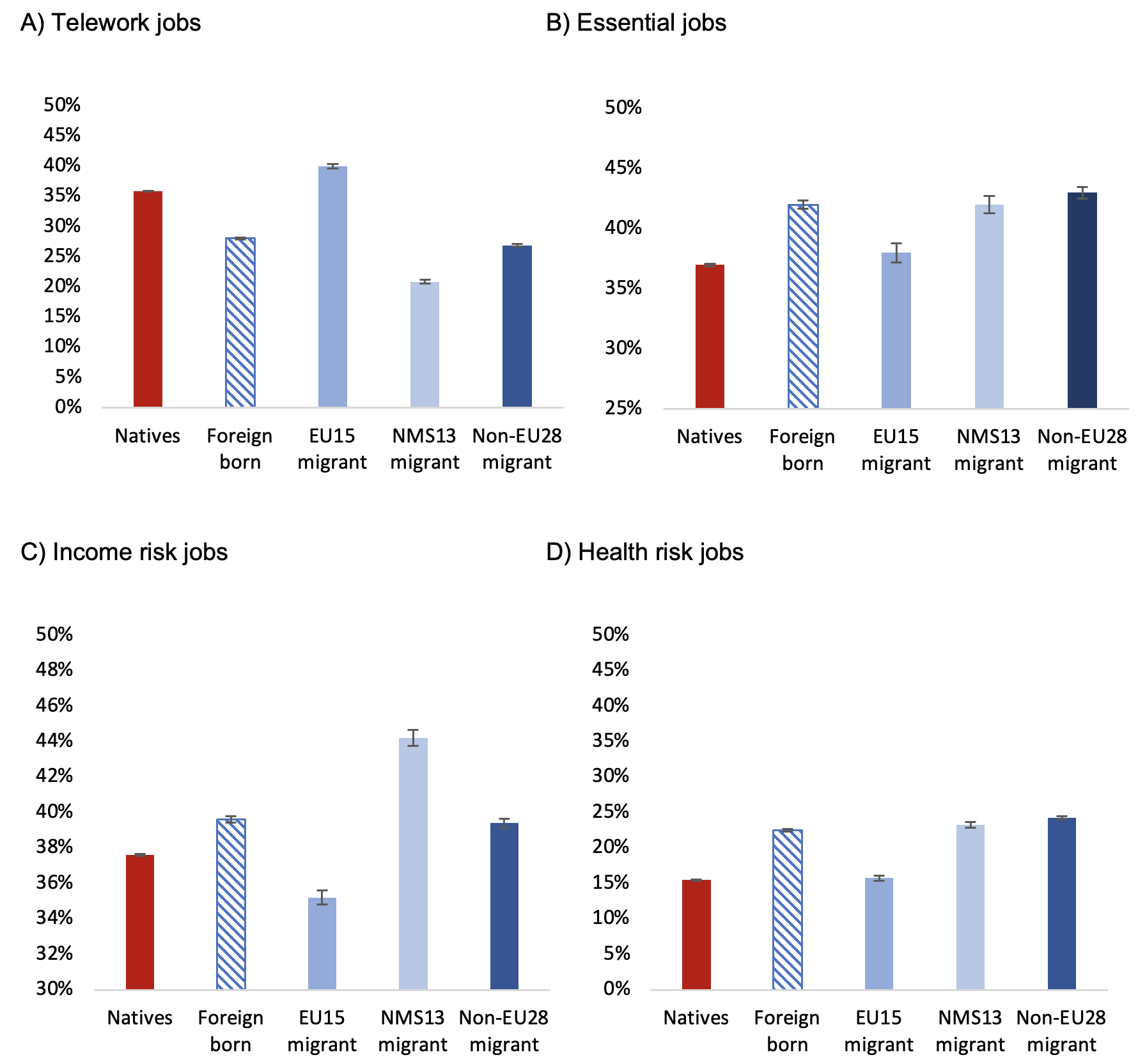
We first find that immigrants are generally employed in occupations that are more vulnerable to COVID-19-related risks (Fasani and Mazza 2021 report similar findings). Our estimates show that only 27% of employed migrants in the EU15 have a job amenable to telework, compared to 41% of native workers (Figure 2). On the other hand, migrants are slightly more likely to be in essential occupations. Combining those two categorisations of job vulnerabilities, migrants are more than 10% less likely than natives to hold jobs that are shielded from negative income shocks associated with the COVID-19 pandemic. Furthermore, migrants are also more likely to have jobs that are exposed to health risks, though we report significant heterogeneity in exposure among immigrant groups. The higher vulnerability of migrants is common across skill levels but varies depending on country of origin, with Eastern European migrants being the most exposed to income risks while migrants from Western Europe or North America have a similar risk profile to natives. Recent Eurostat statistics show that the higher vulnerability of migrants to the COVID-19 shock in Western Europe resulted in higher employment losses in 2020 (4% drop vis-à-vis 2019, compared to 0.8% fall for natives during the same period).

Figure 2 Share of workers by region of origin and risk type

Source: Own calculation based on EU-LFS 2018 data, following EC directive (2020) and Fasani and Mazza (2020).

We then examine whether the presence of immigrants in local labour markets has a causal impact on the vulnerability of native workers in the same geographic areas. Our empirical analysis is motivated by a general equilibrium model of comparative advantages in task performance between immigrant and native workers (Peri and Sparber 2009). In the model, native workers reallocate to other occupations in response to an influx of immigrant workers. In the empirical analysis, we use an instrumental variable approach to account for the non-random location choices of migrant responses to local job opportunities, which is based on past migration presence in the same region. Because of information, networks, and preferences, there is a strong positive association between current and past immigrant presence across European regions, as immigrants tend to move to the same locations where previous immigrants from the same country already live.

We find that native-born workers in those European subregions with a higher share of immigrants are significantly less likely to be exposed to various dimensions of occupational vulnerability associated with COVID-19. This association is especially strong when looking at the likelihood of being employed in teleworkable occupations (Figure 3), and the results get stronger once the endogeneity of immigrants’ location choices is taken into account. Immigration thus had a causal impact in reducing the exposure of native workers to some labour markets risks associated with the COVID-19 pandemic.

Figure 3 The relationship between share of immigrants in the working-age population and share of natives employed in jobs amenable to work from home in European regions

Source: Authors’ calculations using the EU Labor Force Survey 2018.
Note: The sample includes NUTS-2 regions from the EU-15 as well as Switzerland and Norway.

We also find heterogeneous effects depending on the characteristics of native workers. The effects of immigration on job safety are stronger for highly (i.e. tertiary) educated native workers, who benefit from the presence of both high-skilled and low-skilled migrants. By contrast, the effects are smaller and statistically insignificant for less (i.e. non-tertiary) educated native workers. We also assess whether these compositional effects on employment of certain types of native workers are accompanied by overall changes in total employment and wages. We find no evidence of wage or employment impacts among native workers, suggesting that the increase in job safety among native workers is driven purely by their reallocation from vulnerable jobs to safer jobs.

In short, we find that immigration to Western Europe reduced the economic exposure of natives to COVID-19 related labour market shocks by pushing them towards occupations that are more amenable to work from home. Our paper thus provides another example of immigrant workers in effect ‘protecting’ native workers by taking on the riskiest jobs during the pandemic.

Source: Immigration and natives’ exposure to COVID-related risks in the EU | VOX, CEPR Policy Portal

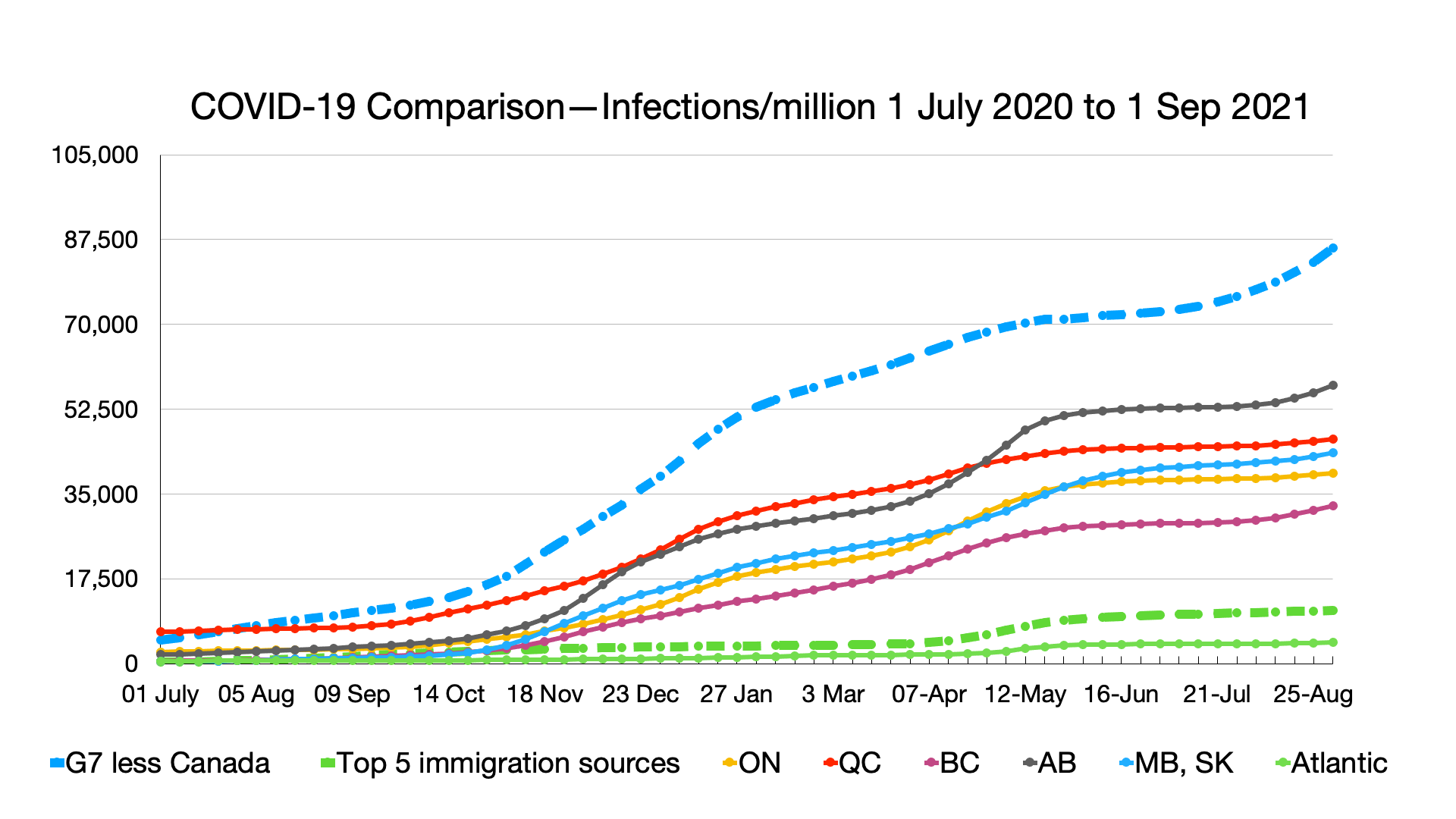
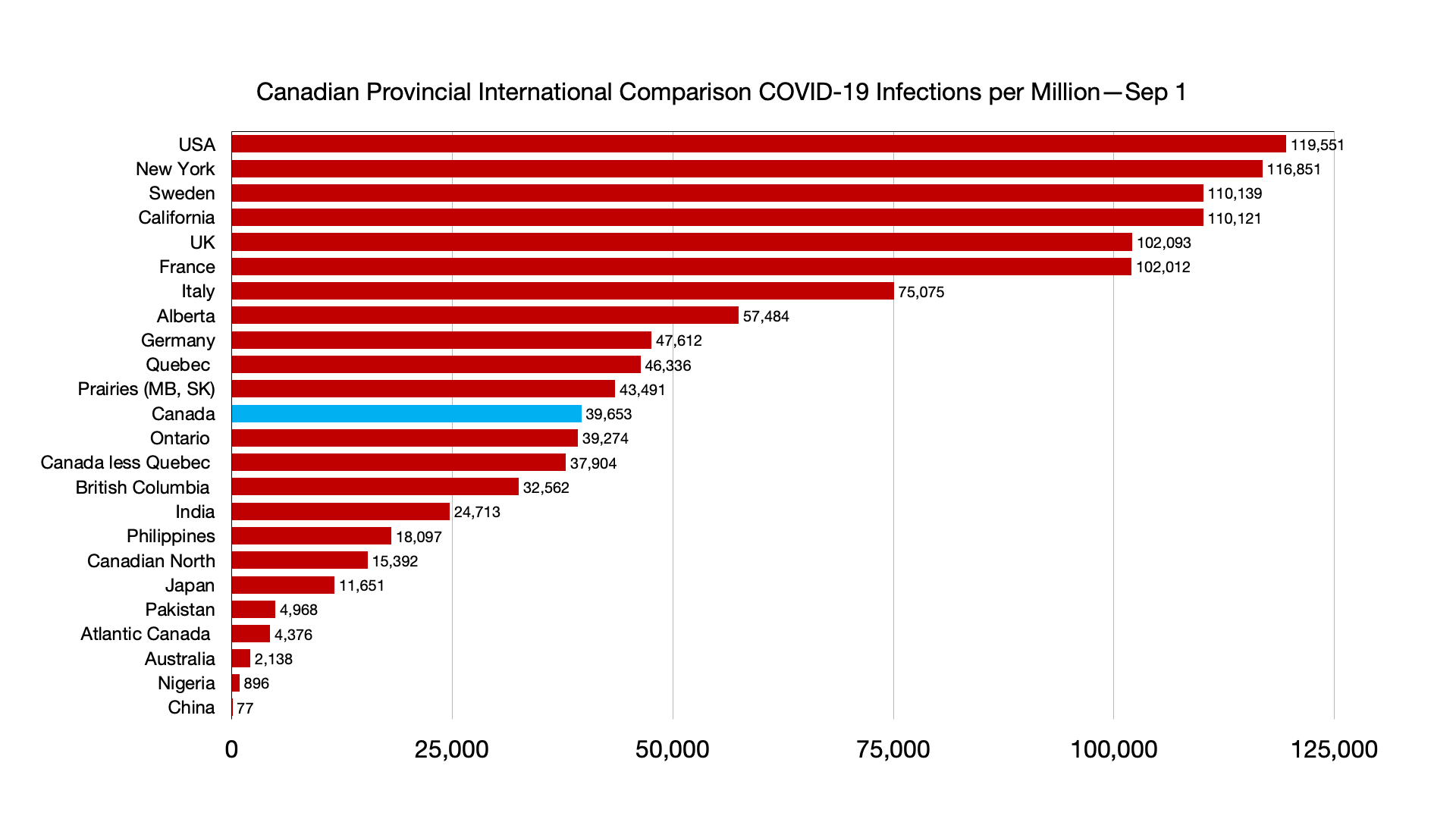
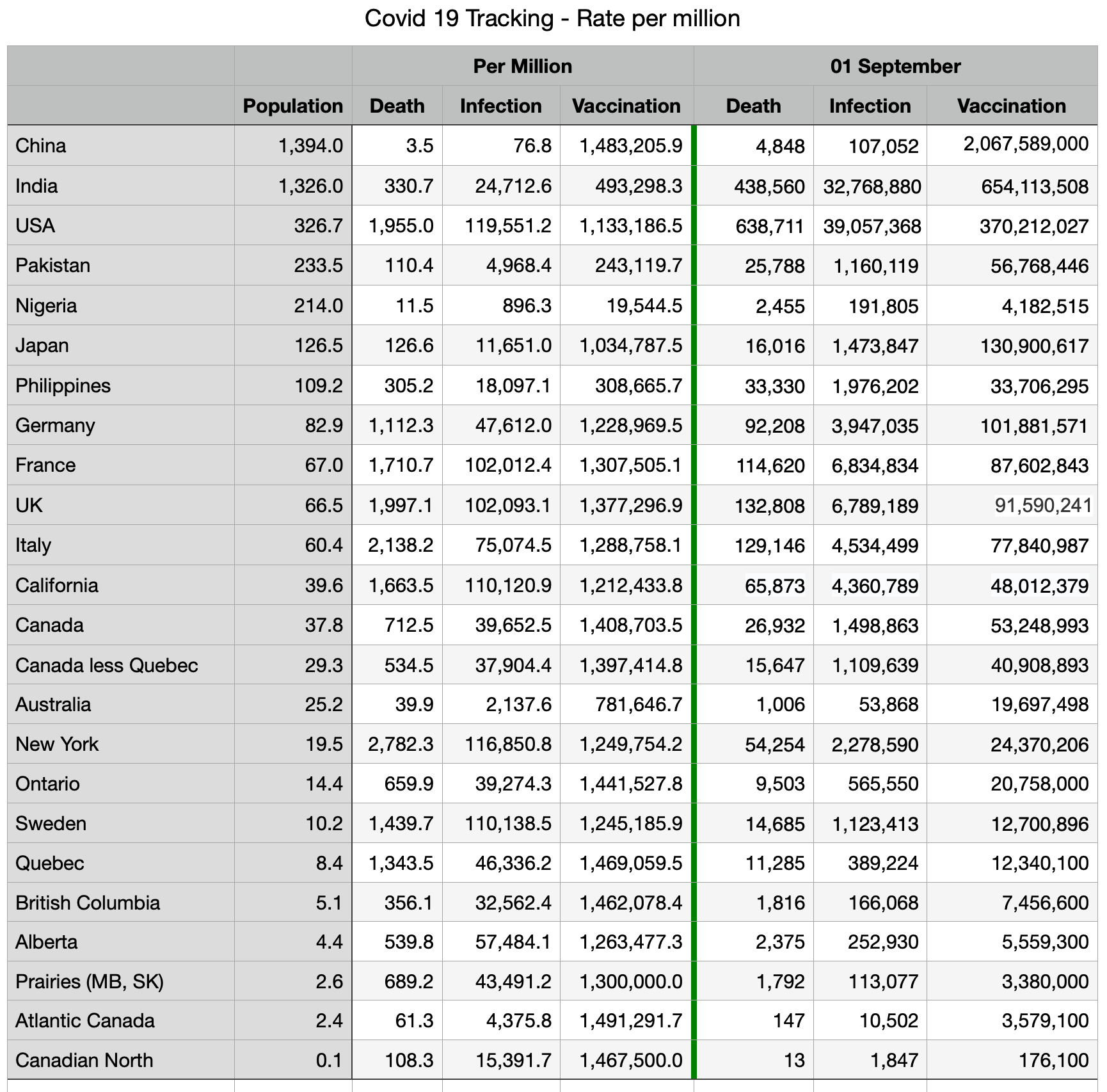
#COVID-19: Comparing provinces with other countries 1 September Update

The latest charts, compiled 1 Septe mberas overall rates in Canada increase slightly due to the variant. Canadians fully vaccinated 67.6 percent, higher than USA 53 percent and the UK 64 percent), although all three countries appear to be reaching a wall with respect to vaccination.

Vaccinations: China second after Atlantic Canada, Quebec ahead of Canadian North, France ahead of Prairies, and Germany ahead of Sweden. Chinese fully vaccinated, 63.3 percent, if numbers are accurate.

Trendline charts

Infections: Same ongoing trend: More pronounced uptick in G7 less Canada (driven largely by USA). While all provinces showing increased infections, greater upticks in Alberta, British Columbia.

Deaths: No significant change.

Vaccinations: Ongoing steady gap between Alberta and Prairies with lower vaccination rates than elsewhere in Canada. More rapid increase of immigration sources countries driven by China and to a lesser extent, India.

Weekly

Infections: No relative change except UK slightly ahead of France.

Deaths per million: No significant change.