#COVID-19: Comparing provinces with other countries 4 May Update and end of this series

As this note from the Globe notes:

“Due to changes in the prevalence of testing, case counts alone are no longer a reliable indicator of the spread of COVID-19. In part due to this, recovery data is no longer available from all provinces and territories. Some provinces have also shifted to weekly or irregular updates, which impacts the timeliness of data shown below.With some provinces and countries no longer reporting on the number of infections, comparisons between provinces and countries on the omicron variant are imprecise.”

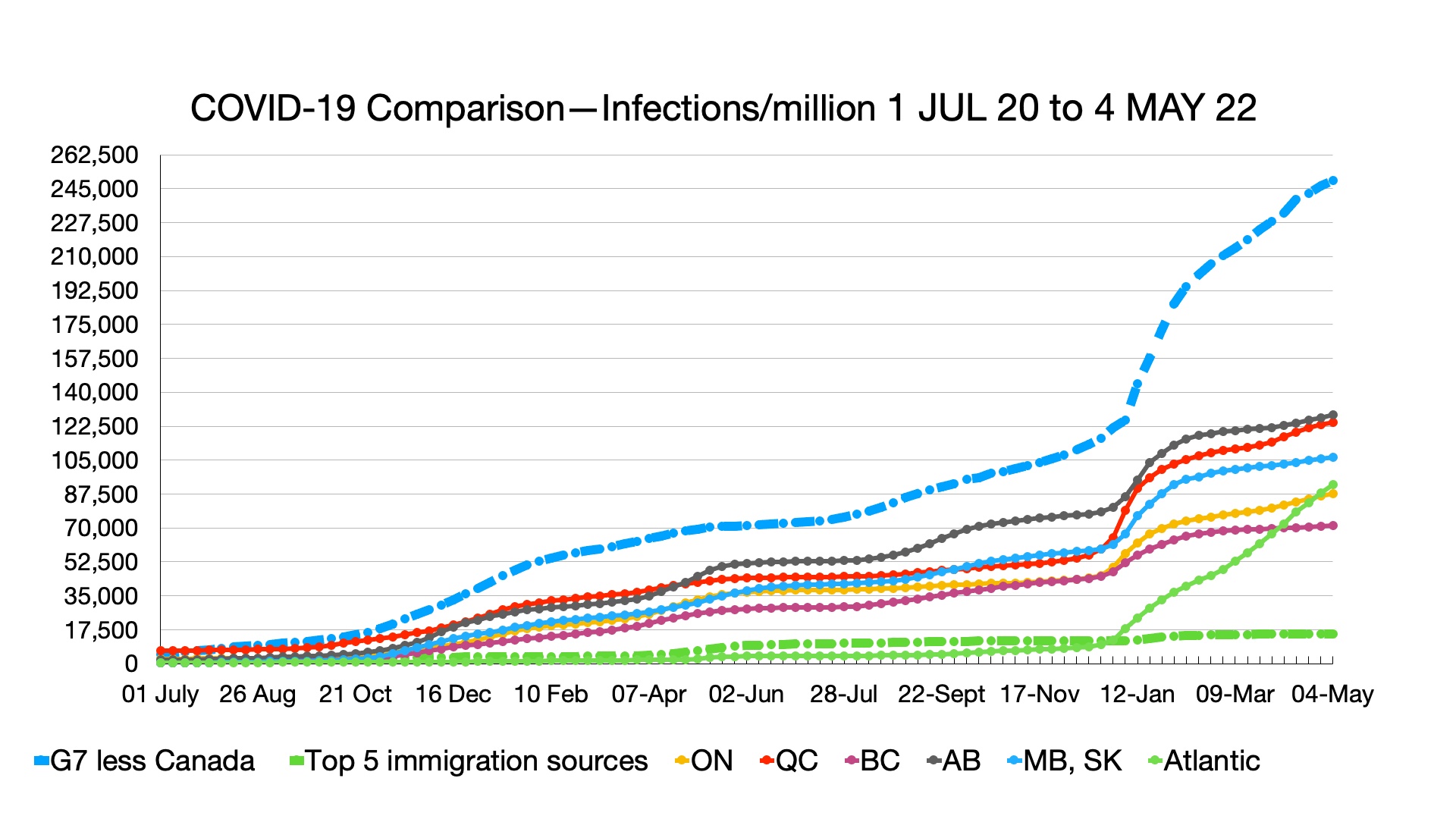
In addition, the data from many of the countries surveyed has remained largely static over the past month, with some revisions downwards. This data has served its purpose in in helping me analyze the effect of COVID on immigration (see my How the government used the pandemic to sharply increase immigration).

One other note, visiting Switzerland, Holland and Germany to visit friends and family, it was striking the differences in COVID restrictions, with Holland the most relaxed (no required masking on planes and transit) and Germany the most strict. Nice to have a sense of normality but disconcerting at the same time (we wore our masks).

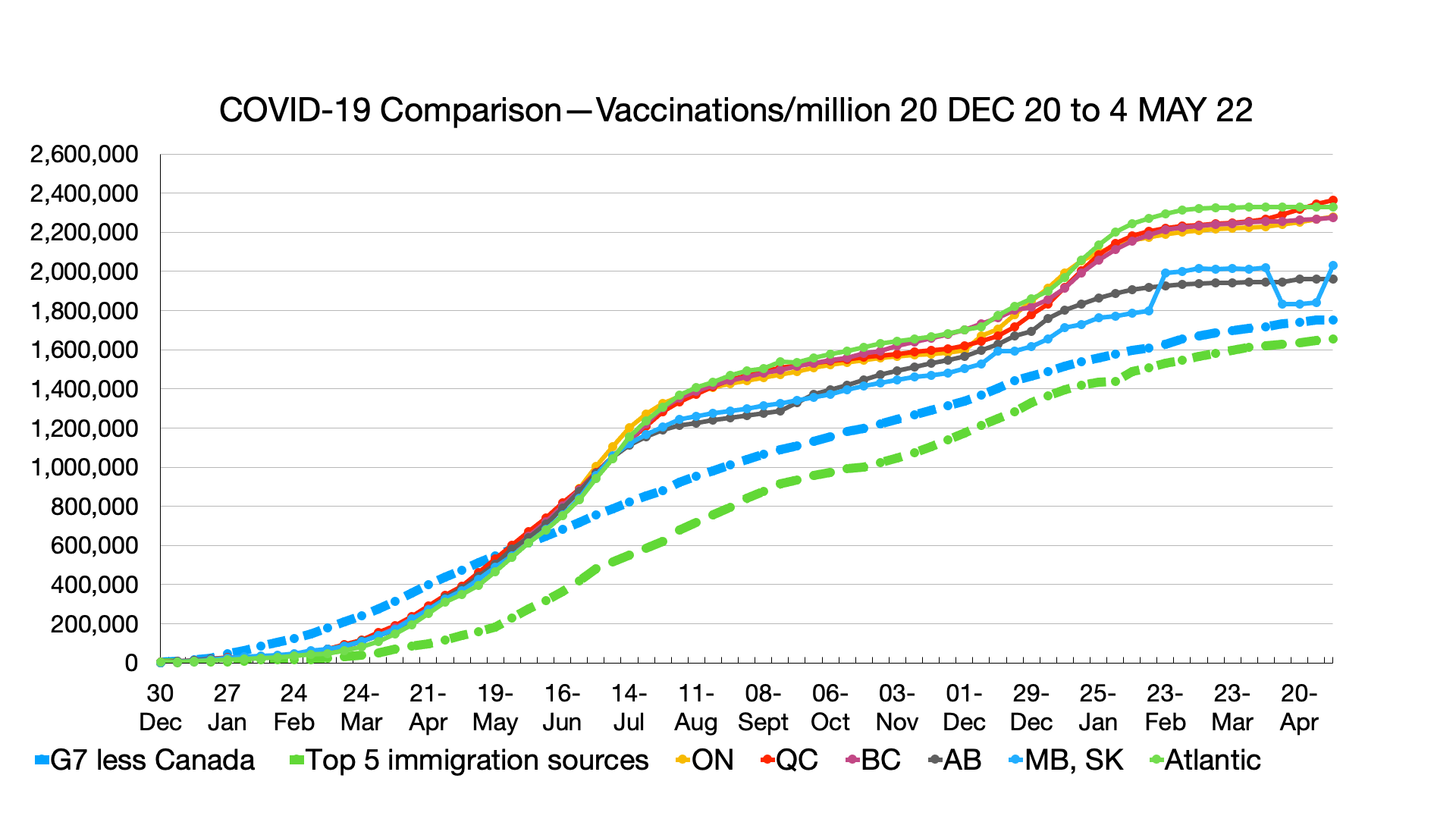
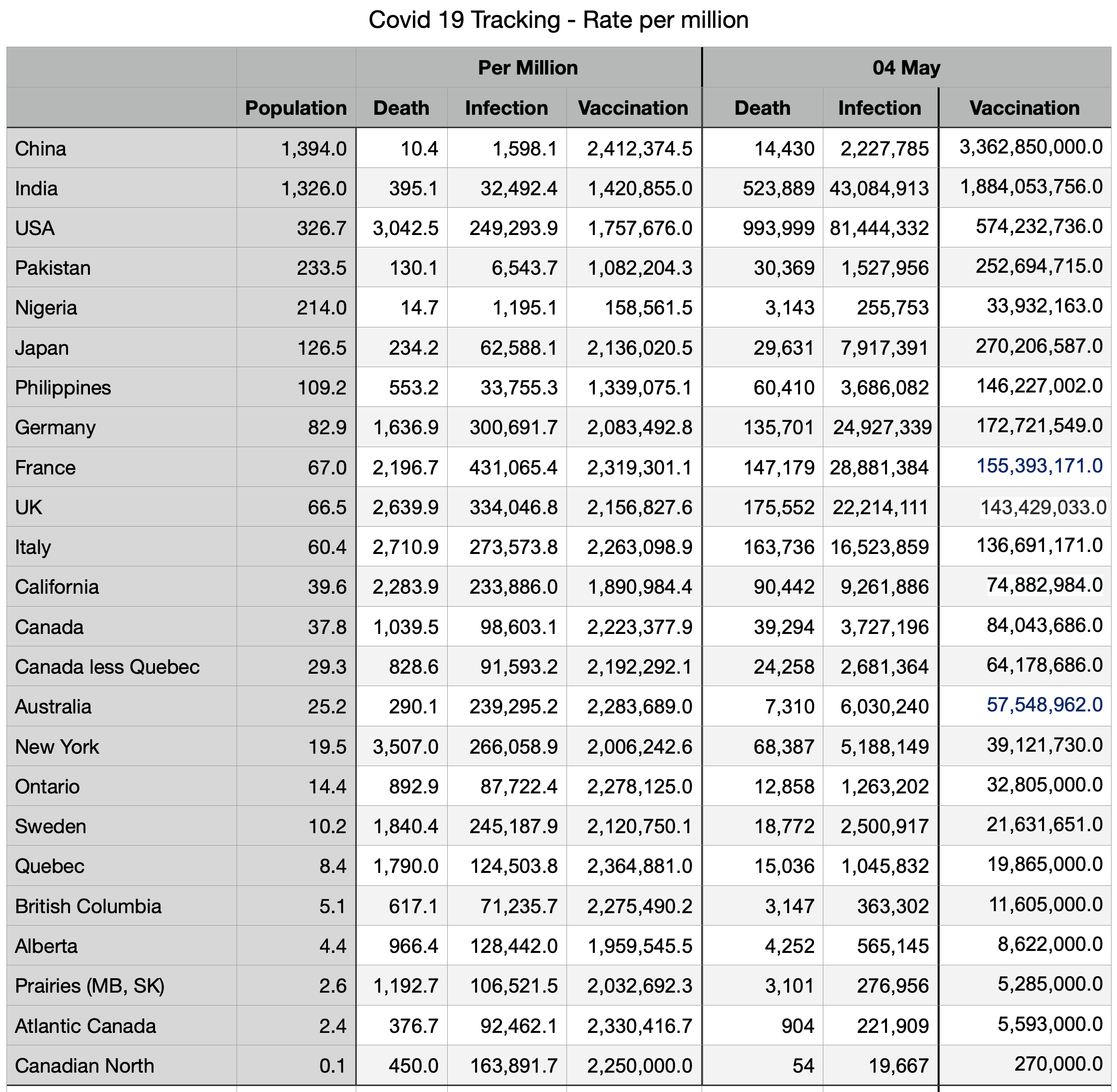
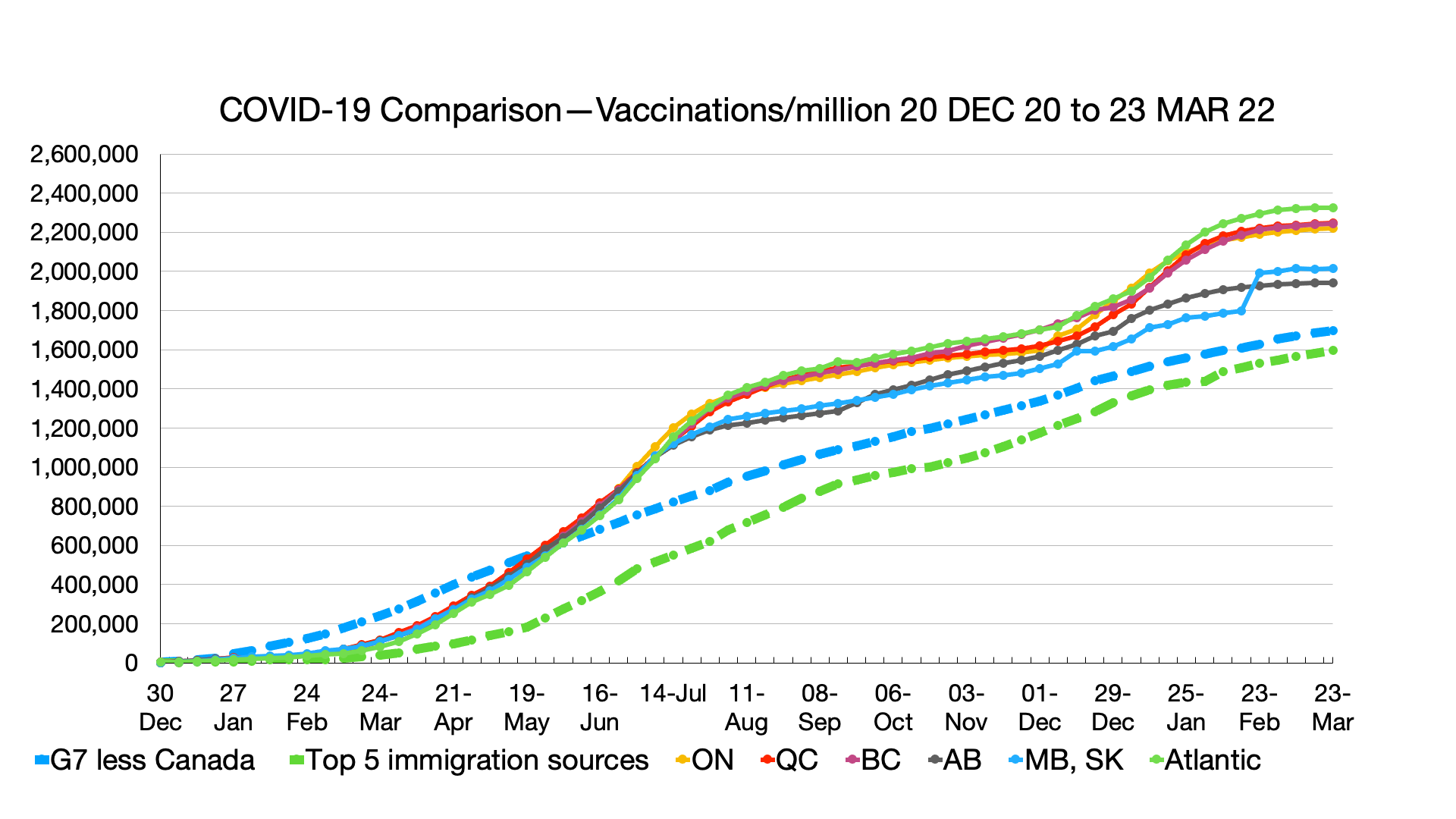
Vaccinations: Ongoing minor shifts and convergence among provinces and countries with plateauing of overall vaccination rates. Canadians fully vaccinated 81.8 percent, compared to Japan 80.2 percent, UK 73.2 percent and USA 66.6 percent.

Immigration source countries: China fully vaccinated 88.3 percent, India 61.8 percent, Nigeria 6.5 percent, Pakistan 55 percent, Philippines 61.7 percent.

Trendline Charts:

Infections: As noted, variations in reporting make comparisons difficult. Steep increase in Atlantic Canada may reflect more consistent reporting.

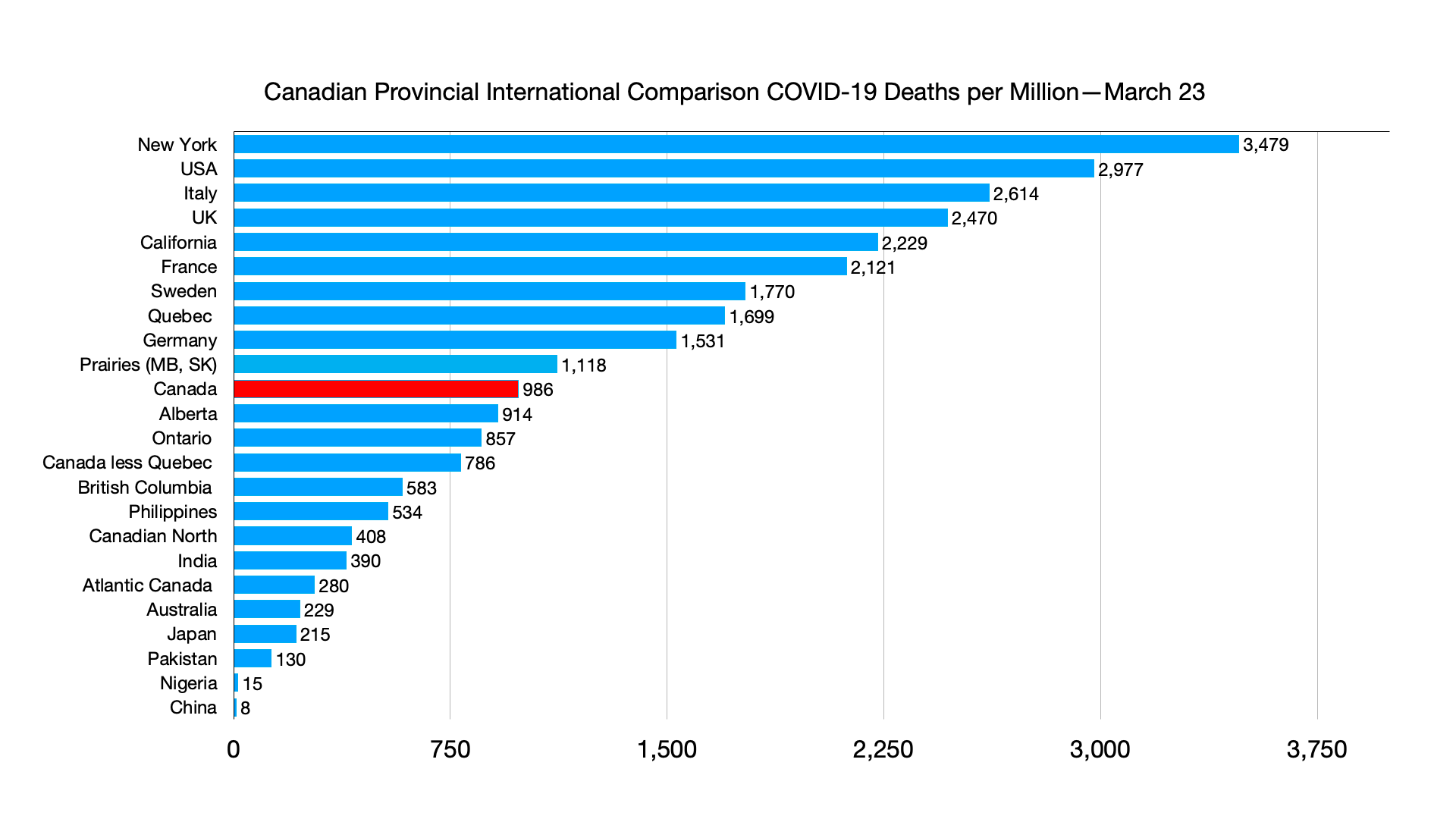
Deaths: No relative changes.

Vaccinations: Minor changes. All provinces have stalled in vaccinations, Saskatchewan reporting gaps account for Prairie fluctuations.

Weekly

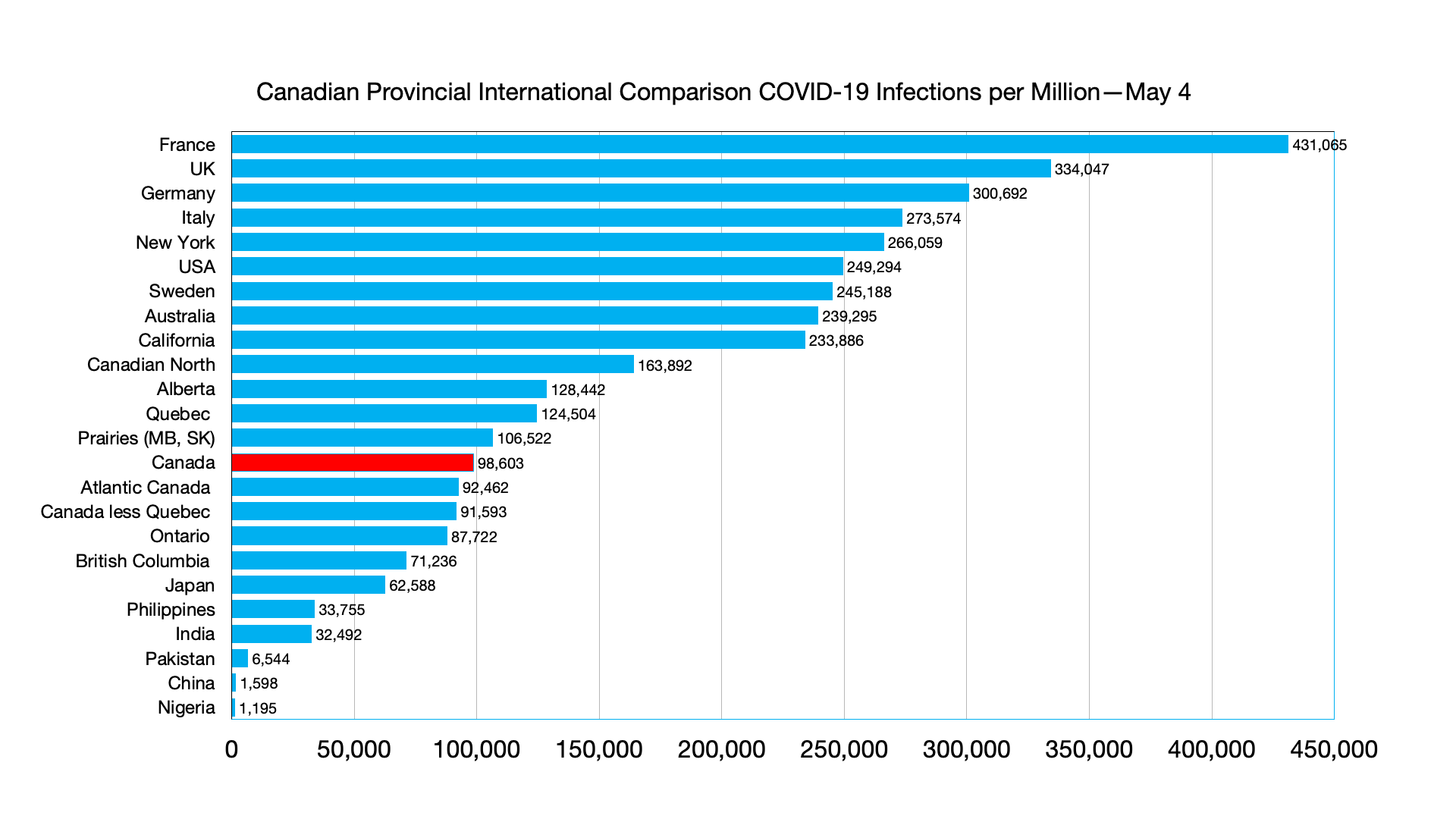
Infections: Italy ahead of New York, Australia ahead of California, Atlantic Canada ahead of Canada less Quebec, China ahead of Nigeria. 

Deaths: No relative change.

#COVID-19: Comparing provinces with other countries 6 April Update

With some provinces and countries no longer reporting on the number of infections, comparisons between provinces and countries on the omicron variant are imprecise.

Vaccinations: Some minor shifts but convergence among provinces and countries but minimal increases to overall vaccination rates. Canadians fully vaccinated 83 percent, compared to Japan 79.8 percent, UK 74 percent and USA 66.4 percent.

Immigration source countries: China fully vaccinated 88.9 percent, India 61 percent, Nigeria 4.8 percent, Pakistan 53.5 percent (significant jump), Philippines 61.4 percent.

Trendline Charts:

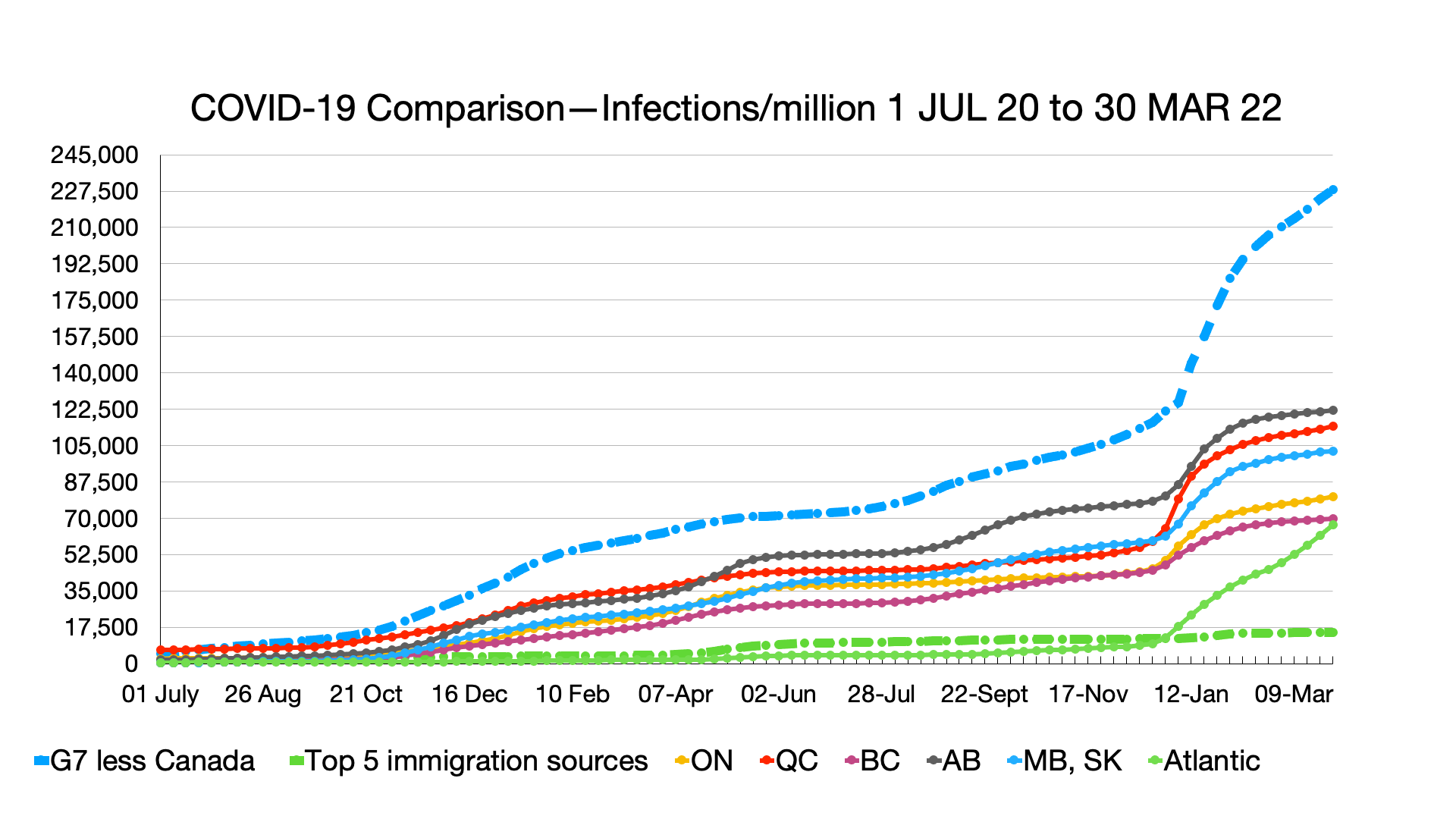
Infections: As noted, variations in reporting make comparisons difficult. Steep increase in Atlantic Canada may reflect more consistent reporting.

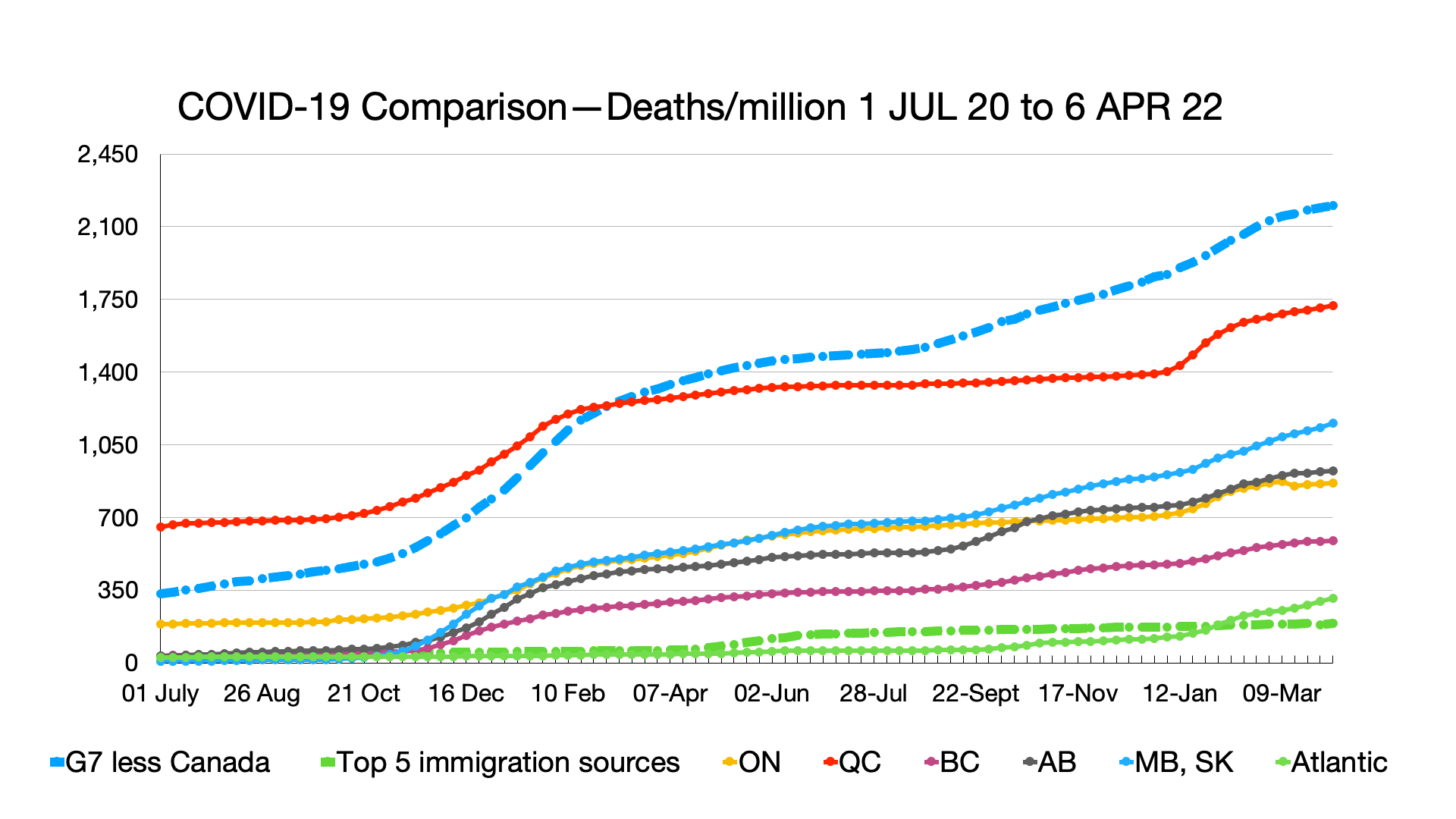
Deaths: No relative changes.

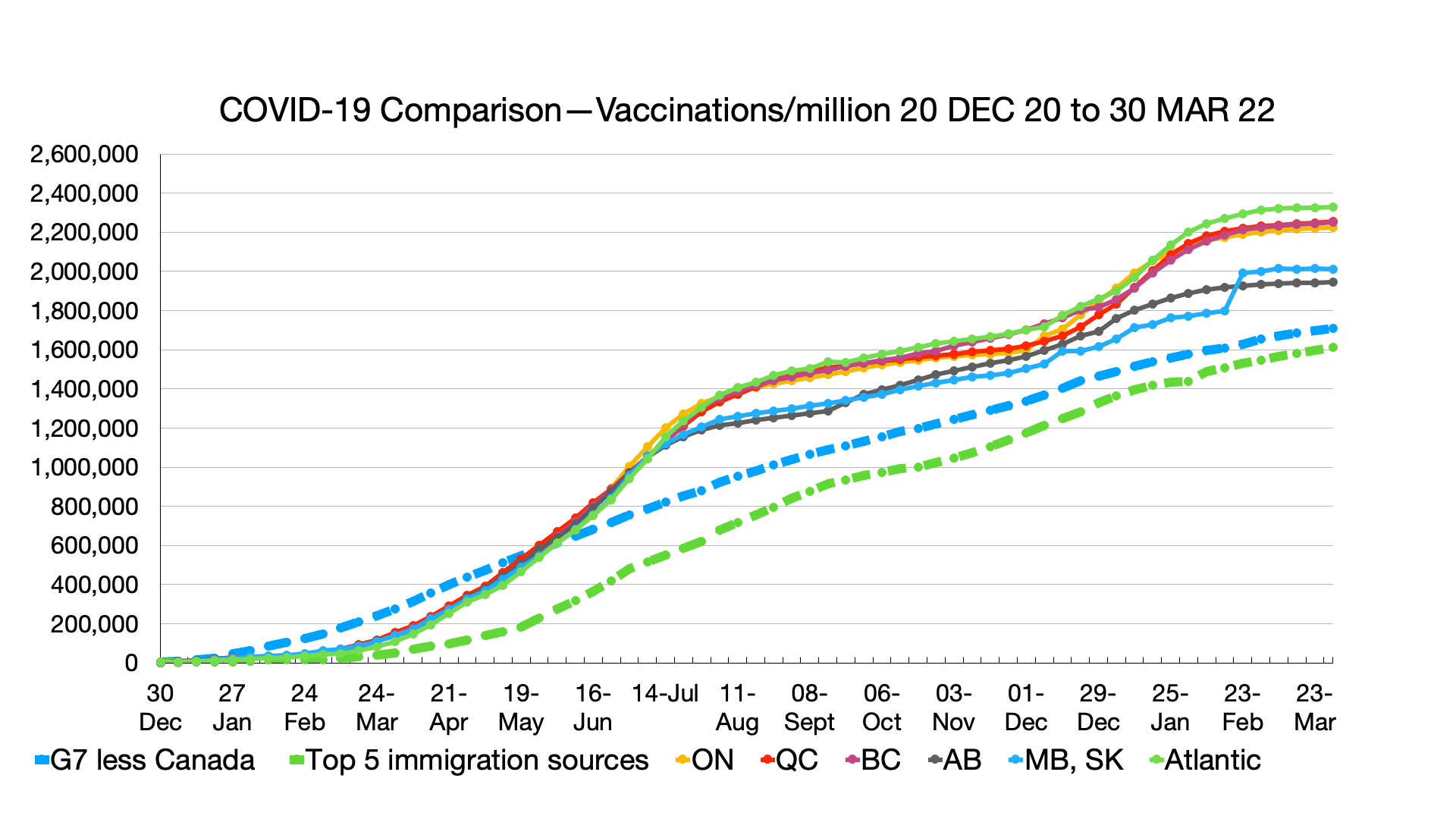
Vaccinations: Minor changes. All provinces have stalled in vaccinations, as have most countries.

Weekly

Infections: Germany ahead of New York, British Columbia ahead of Atlantic Canada.

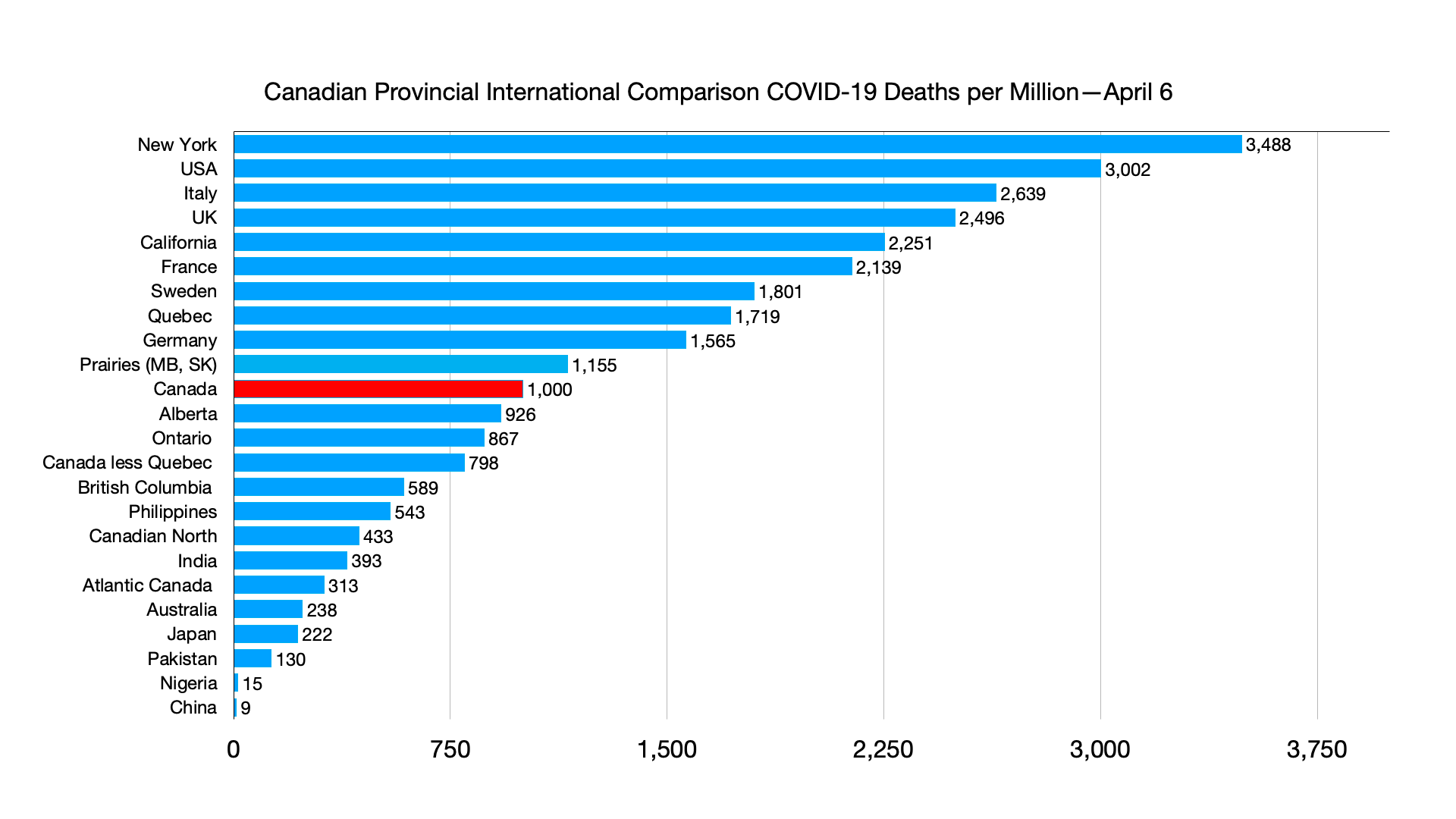
Deaths: No relative change.

Cuts in Britain Could Cause a Covid Data Drought

Unfortunately, many governments are short sighted.

Canada did the same when it disbanded the Global Public Health Intelligence Network (GPHIN) the year before the pandemic, many provinces are no longer carrying out regular testing and reducing the frequency of reporting etc.

Interesting example of South Africa and how it is able to maintain monitoring at a reasonable cost:

The British government on Friday shut down or scaled back a number of its Covid surveillance programs, curtailing the collection of data that the United States and many other countries had come to rely on to understand the threat posed by emerging variants and the effectiveness of vaccines. Denmark, too, renowned for insights from its comprehensive tests, has drastically cut back on its virus tracking efforts in recent months.

As more countries loosen their policies toward living with Covid rather than snuffing it out, health experts worry that monitoring systems will become weaker, making it more difficult to predict new surges and to make sense of emerging variants.

“Things are going to get harder now,” Samuel Scarpino, a managing director at the Rockefeller Foundation’s Pandemic Prevention Institute, said. “And right as things get hard, we’re dialing back the data systems.”

Since the Alpha variant emerged in the fall of 2020, Britain has served as a bellwether, tracking that variant as well as Delta and Omicron before they arrived in the United States. After a slow start, American genomic surveillance efforts have steadily improved with a modest increase in funding.

“This might actually put the U.S. in more of a leadership position,” said Kristian Andersen, a virologist at Scripps Research Institute in La Jolla, Calif.

At the start of the pandemic, Britain was especially well prepared to set up a world-class virus tracking program. The country was already home to many experts on virus evolution, it had large labs ready to sequence viral genes, and it could link that sequencing to electronic records from its National Health Service.

In March 2020, British researchers created a consortium to sequence as many viral genomes as they could lay hands on. Some samples came from tests that people took when they felt ill, others came from hospitals, and still others came from national surveys.

That last category was especially important, experts said. By testing hundreds of thousands of people at random each month, the researchers could detect new variants and outbreaks among people who didn’t even know they were sick, rather than waiting for tests to come from clinics or hospitals.

“The community testing has been the most rapid indicator of changes to the epidemic, and it’s also been the most rapid indicator of the appearance of new variants,” said Christophe Fraser, an epidemiologist at the University of Oxford. “It’s really the key tool.”

By late 2020, Britain was performing genomic sequencing on thousands of virus samples a week from surveys and tests, supplying online databases with more than half of the world’s coronavirus genomes. That December, this data allowed researchers to identify Alpha, the first coronavirus variant, in an outbreak in southeastern England.

A few other countries stood out for their efforts to track the virus’s evolution. Denmark set up an ambitious system for sequencing most of its positive coronavirus tests. Israel combined viral tracking with aggressive vaccination, quickly producing evidence last summer that the vaccines were becoming less effective — data that other countries leaned on in their decision to approve boosters.

But Britain remained the exemplar in not only sequencing viral genomes, but combining that information with medical records and epidemiology to make sense of the variants.

“The U.K. really set itself up to give information to the whole world,” said Jeffrey Barrett, the former director of the Covid-19 Genomics Initiative at the Wellcome Sanger Institute in Britain.

Even in the past few weeks, Britain’s surveillance systems were giving the world crucial information about the BA.2 subvariant of Omicron. British researchers established that the variant does not pose a greater risk of hospitalization than other forms of Omicron but is more transmissible.

On Friday, two of the country’s routine virus surveys were shut down and a third was scaled back, baffling Dr. Fraser and many other researchers, particularly when those surveys now show that Britain’s Covid infection rates are estimated to have reached a record high: one in 13 people. The government also stopped paying for free tests, and either canceled or paused contact-tracing apps and sewage sampling programs.

“I don’t understand what the strategy is, to put together these very large instruments and then dismantle them,” Dr. Fraser said.

The cuts have come as Prime Minister Boris Johnson has called for Britain to “learn to live with this virus.” When the government released its plans in February, it pointed to the success of the country’s vaccination program and the high costs of various virus programs. Although it would be scaling back surveillance, it said, “the government will continue to monitor cases, in hospital settings in particular, including using genomic sequencing, which will allow some insights into the evolution of the virus.”

It’s true that life with Covid is different now than it was back in the spring of 2020. Vaccines drastically reduce the risk of hospitalization and death — at least in countries that have vaccinated enough people. Antiviral pills and other treatments can further blunt Covid’s devastation, although they’re still in short supply in much of the world.

Supplying free tests and running large-scale surveys is expensive, Dr. Barrett acknowledged, and after two years, it made sense that countries would look for ways to curb spending. “I do understand it’s a tricky position for governments,” he said.

But he expressed worry that cutting back too far on genomic surveillance would leave Britain unprepared for a new variant. “You don’t want to be blind on that,” he said

With a reduction in testing, Steven Paterson, a geneticist at the University of Liverpool, pointed out that Britain will have fewer viruses to sequence. He estimated the sequencing output could drop by 80 percent.

“Whichever way you look at it, it’s going to lead very much to a degradation of the insight that we can have, either into the numbers of infections, or our ability to spot new variants as they come through,” Dr. Paterson said.

Experts warned that it will be difficult to restart surveillance programs of the coronavirus, known formally as SARS-CoV-2, when a new variant emerges.

“If there’s one thing we know about SARS-CoV-2, it’s that it always surprises us,” said Paul Elliott, an epidemiologist at Imperial College London and a lead investigator on one of the community surveys being cut. “Things can change really, really quickly.”

Other countries are also applying a live-with-Covid philosophy to their surveillance. Denmark’s testing rate has dropped nearly 90 percent from its January peak. The Danish government announced on March 10 that tests would be required only for certain medical reasons, such as pregnancy.

Astrid Iversen, an Oxford virologist who has consulted for the Danish government, expressed worry that the country was trying to convince itself the pandemic was over. “The virus hasn’t gotten the email,” she said.

With the drop in testing, she said, the daily case count in Denmark doesn’t reflect the true state of the pandemic as well as before. But the country is ramping up widespread testing of wastewater, which might work well enough to monitor new variants. If the wastewater revealed an alarming spike, the country could start its testing again.

“I feel confident that Denmark will be able to scale up,” she said.

Israel has also seen a drastic drop in testing, but Ran Balicer, the director of the Clalit Research Institute, said the country’s health care systems will continue to track variants and monitor the effectiveness of vaccines. “For us, living with Covid does not mean ignoring Covid,” he said.

While Britain and Denmark have been cutting back on surveillance, one country offers a model of robust-yet-affordable virus monitoring: South Africa.

South Africa rose to prominence in November, when researchers there first discovered Omicron. The feat was all the more impressive given that the country sequences only a few hundred virus genomes a week.

Tulio de Oliveira, the director of South Africa’s Centre for Epidemic Response & Innovation, credited the design of the survey for its success. He and his colleagues randomly pick out test results from every province across the country to sequence. That method ensures that a bias in their survey doesn’t lead them to miss something important.

It also means that they run much leaner operations than those of richer countries. Since its start in early 2020, the survey has cost just $2.1 million. “It’s much more sustainable,” Dr. de Oliveira said.

In contrast, many countries in Africa and Asia have yet to start any substantial sequencing. “We are blind to many parts of the world,” said Elodie Ghedin, a viral genomics expert at the U.S. National Institute of Allergy and Infectious Diseases.

The United States has traveled a course of its own. In early 2021, when the Alpha variant swept across the country, American researchers were sequencing only a tiny fraction of positive Covid tests. “We were far behind Britain,” Dr. Ghedin said.

Since then, the Centers for Disease Control and Prevention has helped state and local public health departments start doing their own sequencing of virus genomes. While countries like Britain and Denmark pull back on surveillance, the United States is still ramping up its efforts. Last month, the C.D.C. announced a $185 million initiative to support sequencing centers at universities.

Still, budget fights in Washington are bringing uncertainty to the country’s long-term surveillance. And the United States faces obstacles that other wealthy countries don’t.

Without a national health care system, the country cannot link each virus sample with a person’s medical records. And the United States has not set up a regularly updated national survey of the sort that has served the United Kingdom and South Africa so well.

“All scientists would love it if we had something like that,” Dr. Ghedin said. “But we have to work with the confines of our system.”

Source: Cuts in Britain Could Cause a Covid Data Drought

#COVID-19: Comparing provinces with other countries 30 March Update

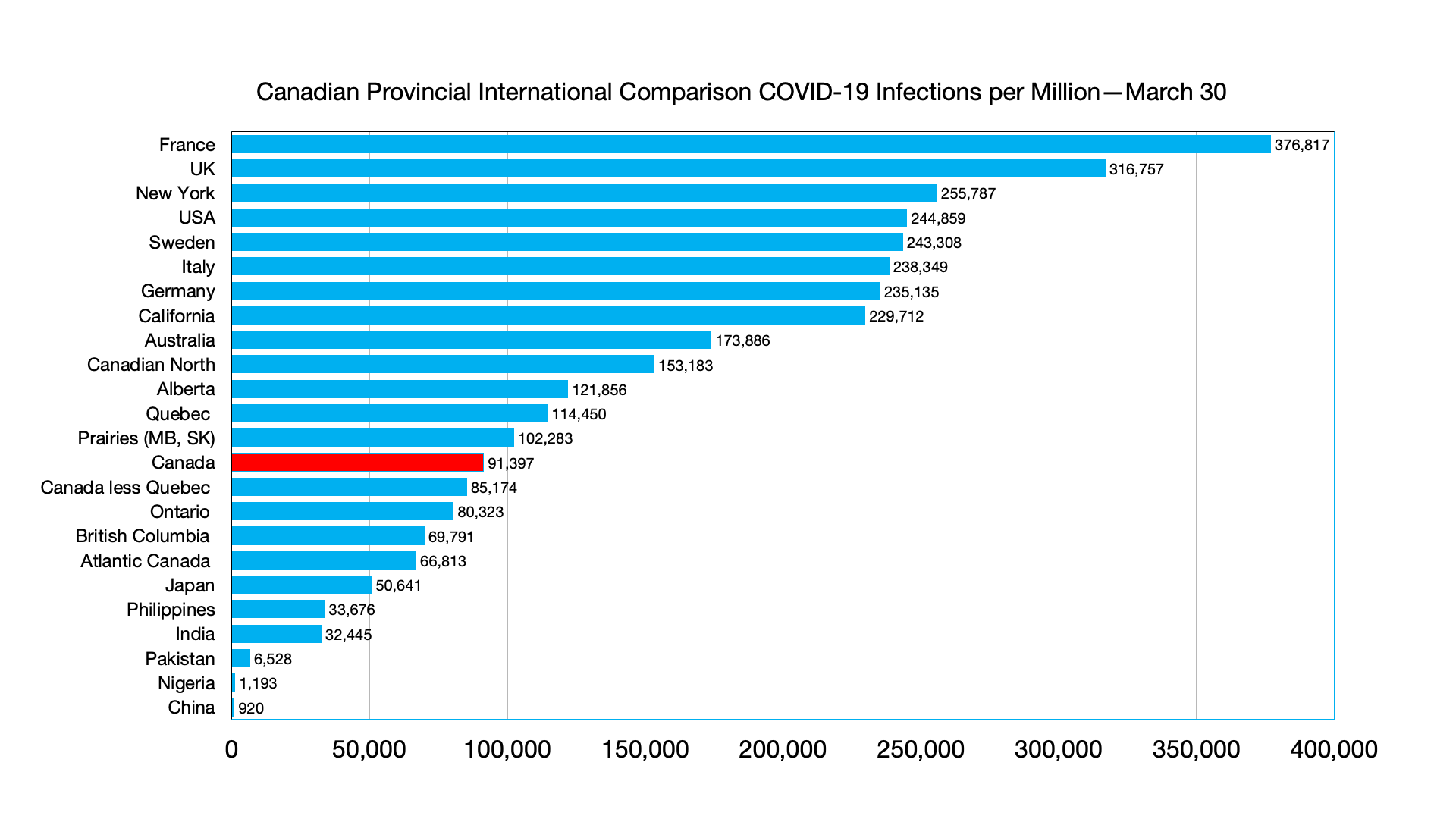
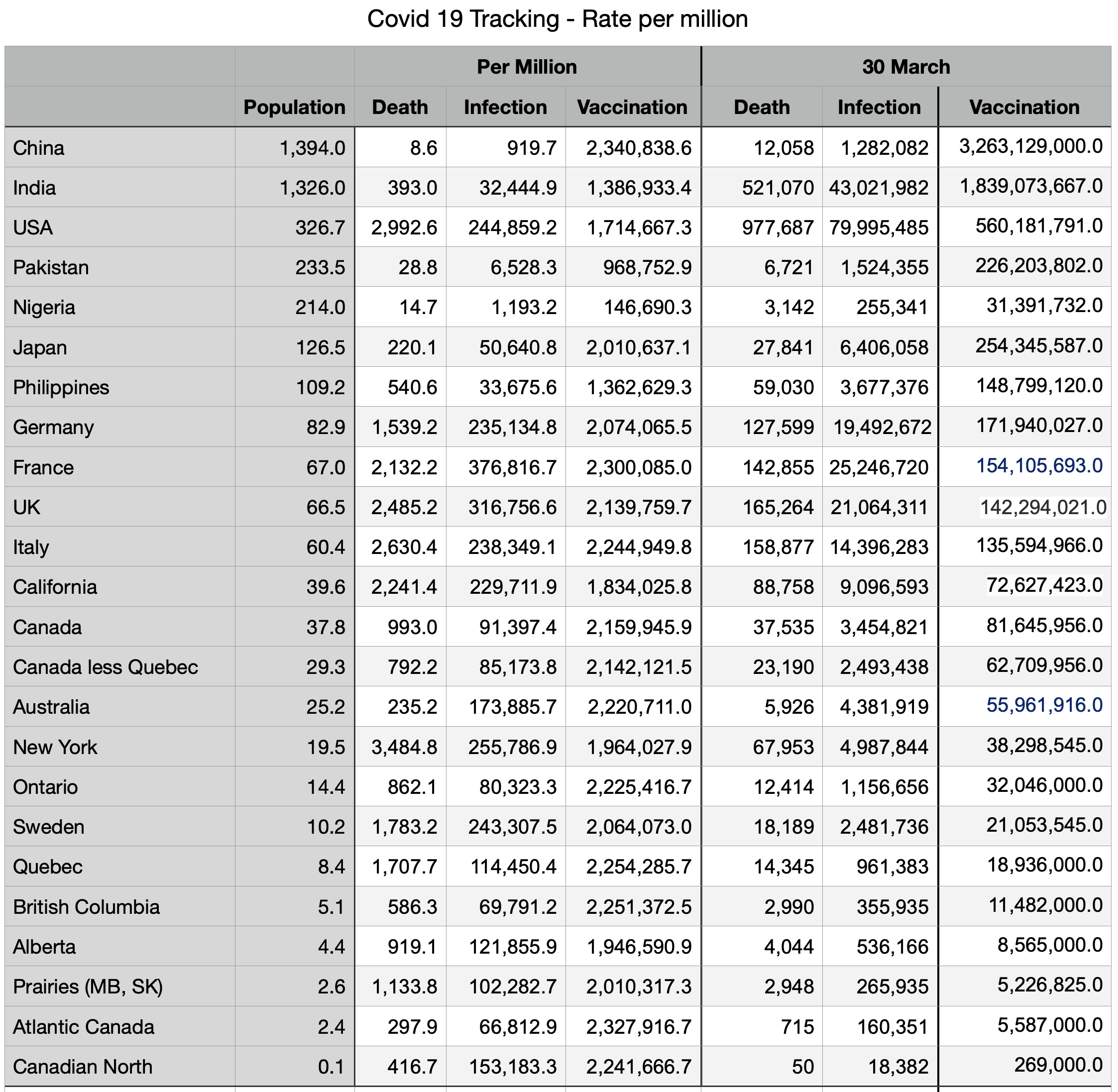
Numbers from China continue to climb. New omicron variant showing up in increased infections in G7 countries and in some provinces (uneven testing hides some of the change).

Vaccinations: Some minor shifts but convergence among provinces and countries but minimal increases to overall vaccination rates. Canadians fully vaccinated 82.9 percent, compared to Japan 79.7 percent, UK 73.9 percent and USA 66.3 percent.

Immigration source countries: China fully vaccinated 88.8 percent, India 60.6 percent, Nigeria 4.8 percent, Pakistan 47 percent, Philippines 609 percent.

Trendline Charts:

Infections: Increased number of infections due to omicron variant in G7 countries with most Canadian provinces having lower rates of increase save for Atlantic Canada.

Deaths: No relative changes.

Vaccinations: China ahead (again) of Atlantic Canada, Japan ahead of Prairies.

Weekly

Infections: Germany ahead of California.

Deaths: No relative change.

Should it stay or go? Ottawa weighs the vaccine mandate for the public service

Will be interesting to see what government decides and whether it is applied consistently across departments and organizations:

The timing and pace of return-to-office plans for Canada’s public servants will hinge on what the federal government decides to do with its vaccine mandate for employees.

The federal Office of the Chief Human Resources Officer is leading a review into the six-month-old mandate, seeking input from unions and other stakeholders, but a decision will be based on the advice of public-health officials. The results of the review will be given to Treasury Board President Mona Fortier.

While the review had to start by the six-month anniversary on April 6, it is not a deadline for a decision.

Dr. Theresa Tam, Canada’s chief public health officer, said public-health officials are at a “very important juncture” in reviewing COVID-19 policies such as mandates, which are shifting from “an emphasis on requirements to recommendations.”

But Opposition MPs repeatedly pressed Tam and Health Minister Jean-Yves Duclos at the Commons health committee this week on when mandates for travellers and public servants will be lifted. Tam said the situation is unstable because of surges caused by the latest Omicron variant. She said Canada is taking a phased approach with the lifting of mandates that must be closely watched.

“I think this is just waiting to see what happens with that situation, ensuring the provinces are still able to cope as they release measures. They are just doing that at the moment and (with) that observation, the federal government makes a decision,” Tam told the committee.

Dany Richard, co-chair of the National Joint Council, a joint union and management committee, said the review is a political “hot potato” for the government. The factors to consider are many, including the risk of lifting the mandate too soon or appearing to be capitulating to the pressure of the February convoy protests.

“They might play it by ear, extend for three months, but if they remove it, we’ll have people saying ‘Hey, I don’t feel comfortable returning to work’ knowing they’ll be working with someone who is not vaccinated,” said Richard.

Last October, the government introduced a vaccination policy requiring all public servants and RCMP employees to prove they’re fully vaccinated against COVID-19 or face unpaid leave. Today, more than 98 per cent of public servants are fully vaccinated. Vaccine mandates are also imposed on employees of federally regulated industries.

Benjamin Piper, an employment lawyer at Goldblatt Partners, said keeping the mandate has become more difficult as provinces drop COVID-19 restrictions with recent declines in serious illness and death.

“There’s no doubt that the law would say that at some point, if the situation has improved sufficiently, this will no longer be justifiable. The question is when you reach that point,” Piper said.

Health officials say the two-dose vaccine mandates that initially proved effective in increasing vaccine uptake and limiting spread aren’t offering much protection in reducing transmission of Omicron.

“We know is that, with the Omicron variant, having two doses – the protection against infection and further transmission goes really low,” Tam said during a recent news conference. “You really need a third dose to provide augmentation against transmission. All that should be taken into account as the federal government looks at the policies going forward.”

But Tam suggested expanding the mandates to three doses isn’t in the cards now. It would difficult because eligibility for a booster varies by age. Also, people who have Omicron infection are asked to wait up to three months before getting the third dose.

The mandate review also comes as the more contagious COVID Omicron variant called BA.2 is on the rise and expected to create another surge in cases. The BA.2 sub-variant is on its way to becoming dominant in Ontario and across Canada. Although more transmissible than the original Omicron, it does not appear to be as severe.

All these factors are converging as the government tries to ease the workforce it sent home to work during the pandemic back to the workplace after two years.

The government is moving to a hybrid workforce, a mix of working at home and remotely. Departments are returning at their own pace and the progress is slow. Many don’t expect a major return until the fall but a new variant could change all that.

Many argue scrapping the vaccine mandate could derail imminent return-to-office plans. Many public servants want to continue working from home. Employees could resist returning to the workplace without a vaccination policy or assurance the employee next them is vaccinated.

Richard said unions would press for workers to work from home if safety fears rise. They are particularly concerned about departments that issued blanket orders for all employees to return to the office two or three days a week.

It is an open question whether the government can justify imposing the mandate and proof of vaccination on remote workers who don’t come to the office. Since the pandemic started, the government has hired hundreds of remote workers who don’t have an office to go to.

Meredith Thatcher, co-founder and workplace strategist at Agile Work Evolutions, argues keeping the mandate for now, along with social distancing and other precautions will help get people back to the office sooner.

“I think having a mandate in place will make people feel more comfortable. If I am told I have to return to the office three days a week and there’s no vaccine mandate, I may say, ‘I’m sorry; I have an immunocompromised person in my house. I’m not coming.’”

Lifting the mandate could also fuel a wave of internal churn as employees pick up and move to departments that will allow them to work remotely.

“I’m telling you there’s going to be a kind of Darwinian natural selection. My members have mobility. They can go work where they want and if telework is a big deal for them, they’ll go and work somewhere else,” said Richard.

Whether the mandate stays or goes, unions argue it’s time to stop punishing the unvaccinated and let them go back to work.

Greg Phillips, president of the Canadian Association of Professional Employees (CAPE), argued the 702 unvaccinated employees should be provided with accommodations such as remote work or daily testing and personal protective equipment if they have to go to the workplace.

“We feel that those that remain unvaccinated should be allowed to start working again and start earning a living again, and that if people are going into the office, they should probably be vaccinated,” Phillips said.

Phillips said the mandate was introduced as a temporary measure and the 98-per-cent vaccination rate shows it was a success. If extended, CAPE wants a plan that explains the rationale and outlines milestones.

“We want to know the game plan for when they see an end to the policy,” said Phillips. “Every sporting event has a time limit or a score limit. You always know when the game is going to be over.”

Source: Should it stay or go? Ottawa weighs the vaccine mandate for the public service

#COVID-19 Immigration Effects: January 2022 Update

This presentation provides the latest operational data on permanent and temporary immigration to Canada, broken down by major programs and countries, along with citizenship and visitor visas.

The government’s focus remains largely on Permanent Residents and “feeder groups” such as international students and other temporary residents.

While minimal progress has been made on reducing backlogs, operational levels have largely recovered to pre-pandemic levels.

#COVID-19: Comparing provinces with other countries 23 March Update, Vaccinations in African countries

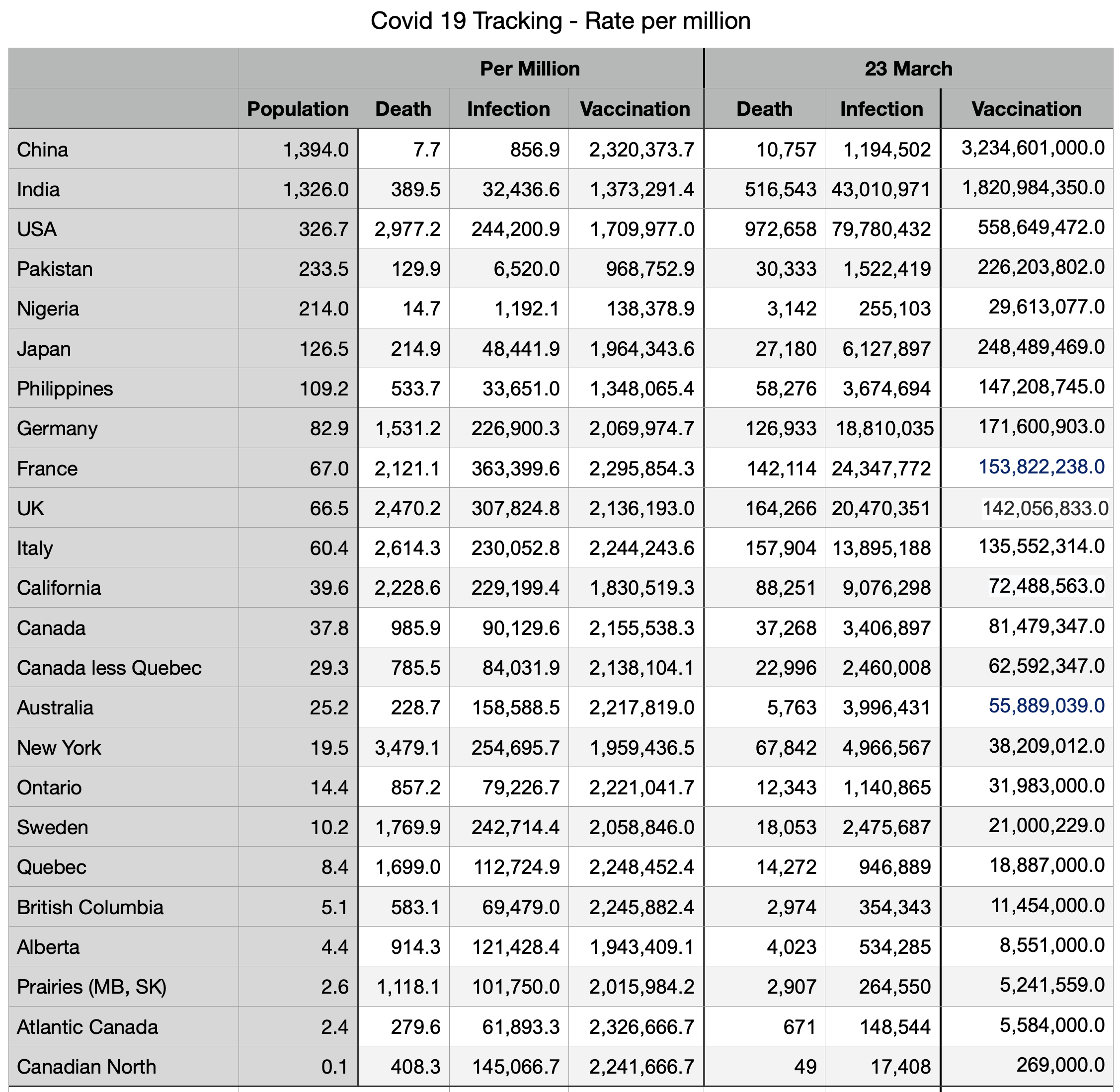
Numbers from China continue to climb with infections up 59 percent and deaths up 21 percent. New omicron variant showing up in increased infections in some countries.

Vaccinations: Some minor shifts but convergence among provinces and countries. Canadians fully vaccinated 82.7 percent, compared to Japan 79.6 percent, UK 73.8 percent and USA 66.1 percent.

Immigration source countries: China fully vaccinated 88.7 percent, India 60.1 percent, Nigeria 4.5 percent, Pakistan 47 percent, Philippines 60.3 percent.

Trendline Charts:

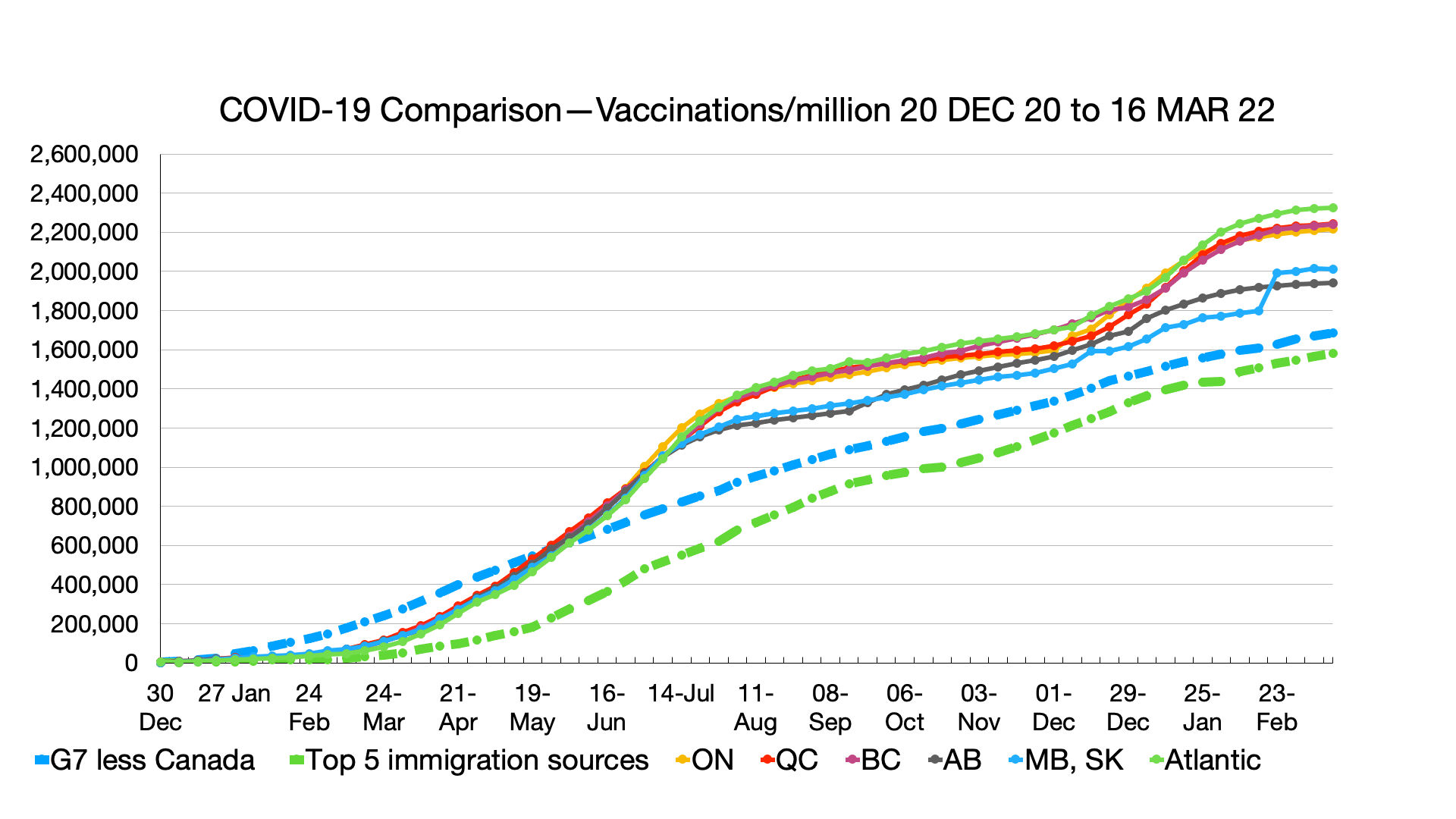
Infections: Limited signs of new omicron variant yet in Canada, with Atlantic Canada infection rates not yet slowing town.

Deaths: No major changes.

Vaccinations: No major relative changes, with Japan ahead of New York and Alberta.

Weekly

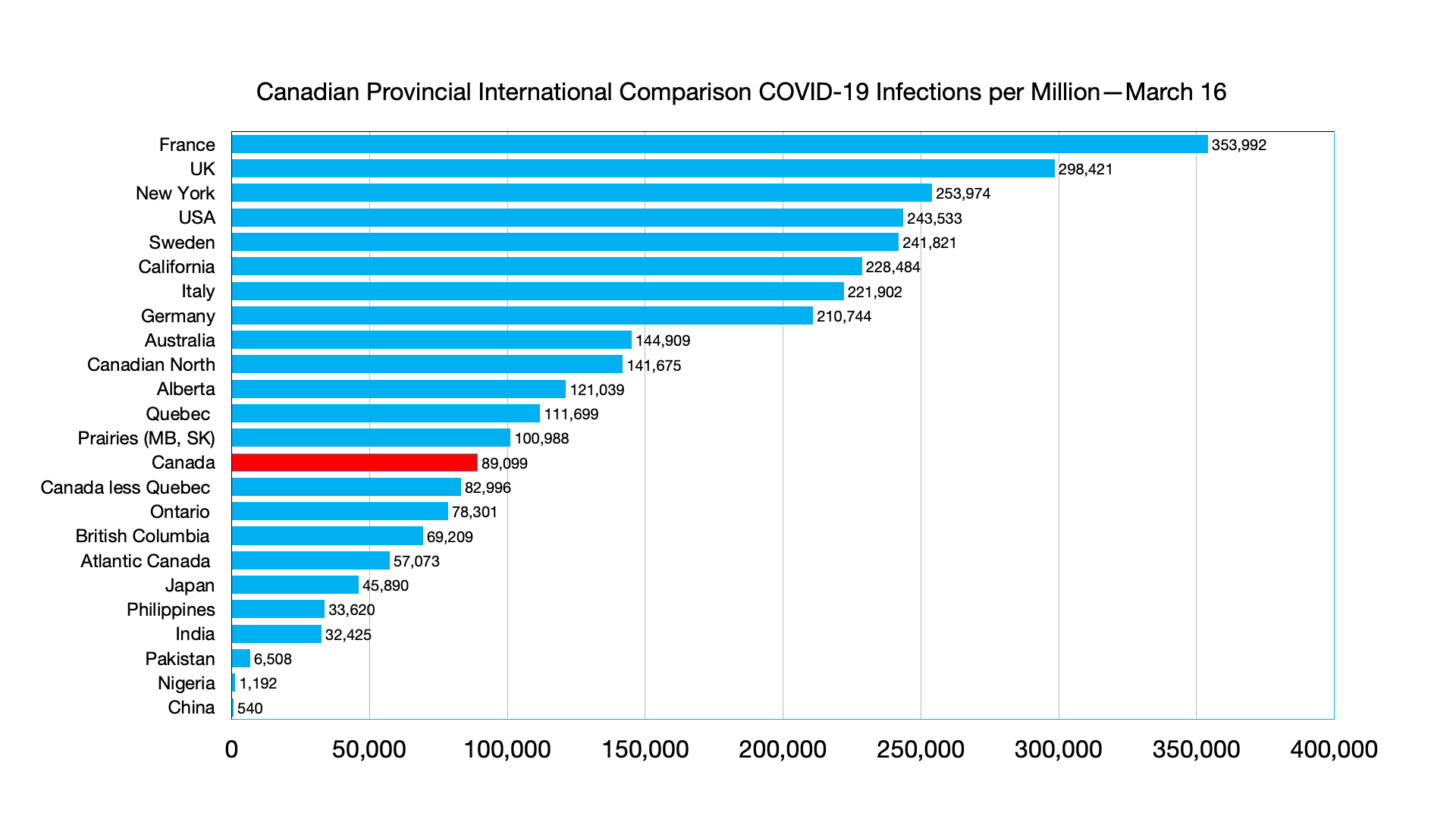
Infections: Italy ahead of California.

Deaths: No relative change.

Informative analysis in The Economist:

It is little over a year since the first doses of life-saving vaccines were delivered to Africa under the Covid-19 vaccines Global Access Facility (covax), a scheme aimed at helping poorer countries get inoculated. Yet what should have been a celebration of the region’s fastest-ever vaccine rollout—with 400m doses jabbed into waiting arms—was instead marred by disappointment at how much more could have been achieved.

Listen to this story.

Instead of complaining about not getting vaccines, some countries are now protesting that they are being drowned in a deluge of the stuff and are unable to use it all. Last month Africa cdc appealed to donors to stagger the supply of their shots. “We have not asked them to pause the donations, but to co-ordinate with us so that the new donations arrive in a way so that countries can use them,” said John Nkengasong, the director of Africa cdc.

Increased deliveries are exposing logistical defects in distribution within countries, while weak health-care systems have been unable to jab doses into arms as fast as they get them. Across Africa as a whole just 62% of delivered vaccines have been administered and 29 countries have used less than half of their supplies, says the who. Among the worst laggards are the Democratic Republic of Congo, which has used 15% of its consignments and jabbed less than 2% of its eligible population, and Burundi, which has used less than 2%.

Also hidden in the averages are big gaps in vaccination rates between cities and the countryside. Although continent-wide data are not available, Githinji Gitahi, the chief executive officer of Amref Health Africa, an ngo, says this trend is clear across many countries, including Ghana, Kenya, Rwanda and Tanzania. In Kenya 51% of adults in Nairobi, the capital, had been fully vaccinated by March 16th. But in Mandera county, a poor semi-arid region next to the border with Somalia, only 10% had been fully jabbed.

Part of the reason is logistical. Freezers for storing vaccines are in short supply. But this should be surmountable. Take Uganda. By November just 14% of its eligible population had received their first dose. But in a push supported by donors including the American government, it bumped that rate up to 47% in just six weeks. In Ivory Coast, where many people were nervous about the jab, the government bumped up the vaccination rate from 22% to 36% in the month of December by running radio campaigns to allay people’s fears. These speedy successes suggest that in many places the biggest shortage is not of freezers or nurses, but of zeal on the part of the authorities to go out and get injecting. 

Source: Africa has plenty of covid doses, but it lags in jabs

How vaccination status might predict views on the Russian invasion of Ukraine

Of note. Too much watching Fox News or sites like Rebel Media and “True” North?

Unvaccinated Canadians are about 12 times more likely than those who received three doses to believe Vladimir Putin’s invasion of Ukraine was justified, according to a new survey by national polling firm EKOS.

The poll found 26 per cent of those who identified as unvaccinated agreed the Russian invasion is justified, with another 35 per cent not offering an opinion. This compared to only two per cent of surveyed Canadians who said they had three doses of the COVID-19 vaccine and who supported the attack, and four per cent who offered no view.

EKOS president Frank Graves said vaccination status strongly predicts views on the war, from seizing the property of Russian oligarchs to providing non-military aid to Ukraine. In each case, a vast majority of vaccinated Canadians agreed with measures to help Ukraine and oppose Russia, a view held by only a small minority of unvaccinated people.

Torstar was granted access to results of the EKOS data that show a correlation between vaccination status and attitudes toward a host of political issues, including the war in Ukraine.

The EKOS survey — conducted from March 9 to March 13 and using a random sample of 1,035 Canadians — concludes that a “plurality of vaccine refusers are much more sympathetic to Russia.” The survey has a reported margin of error of plus or minus 3.1 percentage points, 19 times out of 20.

Ten per cent of those surveyed, or about 105 people, identified as being unvaccinated. National vaccination statistics show around 11 per cent of Canadians five and up have not received one dose of a COVID-19 vaccine.

Of those Canadians who received three doses of COVID-19 vaccine, the study found 82 per cent agreed with imposing tougher sanctions on Russia even if it meant higher fuel and food prices at home. Only 18 per cent of unvaccinated people concurred.

Eighty-five per cent of vaccinated people agree the country should take in Ukrainian refugees versus 30 per cent of unvaccinated Canadians.

While 88 per cent of vaccinated Canadians agree Russia is committing war crimes during the widely condemned invasion, 32 per cent of unvaccinated people do.

The study concludes the results point “to the highly corrosive influences of disinformation.”

“This is definitely a new and bluntly insidious force that’s contributing to polarization and disinformation and poor decision-making. And it doesn’t seem to be going away. Things are getting worse,” said Graves. “I don’t think this is because those people had an ingrained sympathy to the Russians. They’re reading this online, they’re consuming this from the same sources that were giving them the anti-vax stuff.”

The EKOS survey comes out at a time when some of the loudest anti-vaccine voicesthat supported the Ottawa occupation are pushing disinformation about the Ukraine war over social media channels that reach tens of thousands of people.

The Line Canada — its distinctive flag, depicting a red line through a black circle, visible during the Ottawa protest — tweeted unsubstantiated allegations Tuesday that Ukrainian president Volodymyr Zelenskyy is a “lunatic” courting a world war and Ukraine is producing illegal bioweapons. Awake Canada, a self-described “civil rights” group that opposes pandemic mandates and has more than 116,000 followers on Facebook and Twitter, compares NATO to Nazi Germany, while No More Lockdowns — the anti-COVID-mandate group associated with its de facto leader MPP Randy Hillier — pushed the conspiracy that the invasion is an attempt to stop a new world order.

“I saw it almost immediately, within days of the invasion, people supporting it and some quite stridently,” said Timothy Caulfield, a Canada Research Chair in health law and policy at the University of Alberta who has studied the rise and spread of conspiracy theories. “It was pro-Russia, pro-Putin, it was the same kind of dogmatic language you heard from the anti-vaxxers about the alleged harms associated with vaccines. And it was almost immediate and it was from the same crowd.”

Some of that amplification is also coming from Maxime Bernier, leader of the People’s Party of Canada, who has been a prominent figure at anti-lockdown and anti-vaccine rallies, as well as the Ottawa protest.

Bernier tweeted that he deplores the invasion but also shared on Twitter a March 3 video by Whitby PPC candidate Thomas Androvic, who said Putin was “doing us a favour” by invading Ukraine, and the country is a “money laundering industry” and “Trudeau is in on it.” Androvic did not respond by deadline.

Bernier told his 185,000 Twitter followers to watch the video, which he called “a very interesting analysis of the situation in Ukraine.”

The EKOS survey compares vaccination status with political attitudes on the pandemic, vaccines, government trust and the war to create what Graves called a “disinformation index” to better understand the influence of disinformation in Canada.

Graves said those with three vaccine doses rejected disinformation about vaccines, supported public health measures including vaccine passports, and expressed support for Ukraine.

He said the survey shows that with fewer doses, acceptance of disinformation grows, as does sympathy for the Russian invasion.

Unvaccinated Canadians are also more likely to have a profound distrust of government, science and professional health experts, Graves said, and are more likely to support the protest convoy that occupied Ottawa for nearly a month.

“So the pattern was really clear that disinformation was not just a curious feature. It was, I think, a causal ingredient of vaccine resistance.”

The population of unvaccinated Canadians is relatively small. Around 85 per cent of Canadians five years old and older have at least two doses of COVID-19 vaccine, according to federal data. Nearly half of Canadians 18 and older have received their booster.

But in recent years, the politically active elements of the anti-vaccine and anti-mandate community have proven to be adept at networking, organizing and fundraising through social media, said Stephanie Carvin, a national security expert from Carleton University. Millions of dollars were raised through crowdfunding for the Ottawa occupation, although much of that money is frozen as court cases and criminal investigations proceed.

“They aren’t going anywhere anytime soon,” said Carvin.

That organizational capacity may be attractive to mainstream politicians looking for support in tight election races, although wooing those sympathetic to Putin may carry its own political price.

“The convoy movement is going to have a long-term impact on Canadian political life, I think,” said Carvin.

Source: How vaccination status might predict views on the Russian invasion of Ukraine

#COVID-19: Comparing provinces with other countries 16 March Update

Numbers from China continue to climb 608,000 to 753,000 infections and from 6,923 to 8,915 deaths. New omicron variant showing up in increased infections in some countries.

Vaccinations: Some minor shifts but convergence among provinces and countries. Canadians fully vaccinated 82.5 percent, compared to Japan 80 percent, UK 74 percent and USA 66 percent.

Immigration source countries: China fully vaccinated 88.3 percent (numbers have not budged over past month, India 60 percent, Nigeria 4.4 percent, Pakistan 47 percent, Philippines 60 percent.

Trendline Charts:

Infections: Ongoing signs of omicron and other variants plateauing, with Atlantic Canada being the notable provincial exception.

Deaths: No major changes. Ontario appears to have revised its count, reflected in the chart.

Vaccinations: No major relative changes.

Weekly

Infections: Australia ahead of Canadian North.

Deaths: Canadian North ahead of India

#COVID-19: Comparing provinces with other countries 9 March Update; New Zealand changes its tack on surging COVID-19 cases

Overall decline in infections and deaths continues. Numbers from China have a further significant increase since last week, from 315,000 to 608,000 infections and from 5,380 to 6,923 deaths.

Vaccinations: Some minor shifts but convergence among provinces and countries. Canadians fully vaccinated 82.4 percent, compared to Japan 79.5 percent, UK 73.5 percent and USA 65.9 percent.

Immigration source countries are also converging: China fully vaccinated 88.3 percent (numbers have not budged over past four weeks), India 58.9 percent, Nigeria 4.2 percent, Pakistan 46.6 percent, Philippines 58.4 percent.

Trendline Charts:

Infections: Ongoing signs of omicron and other variants plateauing, more so in Canadian provinces than comparator groups.

Deaths: G7 still not plateauing.

Vaccinations: No major relative changes although Japan is now ahead of California.

Weekly

Infections: No relative changes. Infections per million in China have increased from 226 per million to 436 per million.

Deaths: Major change again is with respect to China with deaths per million increasing from 3.9 to 5 per million.

New Zealand changes its tack on surging COVID-19 cases

Back in August, New Zealand’s government put the entire nation on lockdown after a single community case of the coronavirus was detected.

On Tuesday, when new daily cases hit a record of nearly 24,000, officials told hospital workers they could help out on understaffed COVID-19 wards even if they were mildly sick themselves.

It was the latest sign of just how radically New Zealand’s approach to the virus has shifted, moving from elimination to suppression and now to something approaching acceptance as the omicron variant has taken hold.

Experts say New Zealand’s sometimes counterintuitive actions have likely saved thousands of lives by allowing the nation to mostly avoid earlier, more deadly variants and buying time to get people vaccinated. The nation of 5 million has reported just 65 virus deaths since the pandemic began.

But virus hospitalizations have been rapidly rising, hitting a record of more than 750 on Tuesday and putting strain on the system.

Across the country, the explosion in cases has left people stunned. Just a month ago, case numbers were around 200 per day. Now, the outbreak is affecting everyone from frontline workers to lawmakers.

Opposition Leader Christopher Luxon became the highest profile politician yet to announce he was infected on Monday, saying he felt fine and would continue working from home.

One factor that hastened the outbreak was the return of thousands of university students to campuses around the country last month.

Ralph Zambrano, the student president at Victoria University of Wellington, said the virus had spread rapidly through hundreds of students in residence halls, taking a toll on their mental health and well-being.

“The campus would usually be buzzing at this time of year but it has a very eerie feeling to it,” he said, adding that most students were opting to learn remotely. “There’s lots of anxiety and tension.”

He said the outbreak had strained the food supply system in the halls, with some students being offered only a protein drink for breakfast or a piece of cold meat and some peas for dinner.

The university said case numbers in the halls were now reducing as students recovered.

Professor Michael Baker, an epidemiologist at the University of Otago, said the variant had proved as ferociously infectious in New Zealand as it had in other countries.

He said cases appeared to be plateauing or even starting to dip in the largest city of Auckland, while still rising elsewhere.

While much of the world was breathing a sigh of relief after two years of terrible problems, Baker said, New Zealand was at its worst point yet in the pandemic and was coming to terms with the fact the virus would remain in the country permanently.

He said he was concerned health authorities had lost the ability to properly track the outbreak, as they struggled to shift from a system where they carefully monitored a few cases to dealing with thousands of self-reported results from rapid antigen tests.

Dr. Caroline McElnay, the director of public health at the Ministry of Health, told reporters the number of hospitalizations would grow, but that patients with omicron generally had less severe illnesses than previous patients had experienced with the delta variant.

She said the rising number of both patients and infected health workers had prompted the relaxation in the rules around when health workers could return to hospitals.

She said infected workers would only be allowed to work with patients who already had the virus, and if there were no other options.

“It’s an extra tool that enables our health system to keep running,” she said.

Source: New Zealand changes its tack on surging COVID-19 cases