Singapore Was A Shining Star In COVID-19 Control — Until It Wasn’t

Another example how socioeconomic and immigrant status affects COVID-19 infection rates:

Early on in the coronavirus pandemic, Singapore was praised as a shining example of how to handle the new virus. The World Health Organization pointed out that Singapore’s aggressive contact tracing allowed the city-state to quickly identify and isolate any new cases. It quickly shut down clusters of cases and kept most of its economy — and its schools — open. Through the beginning of April, Singapore had recorded fewer than 600 cases.

By the end of April, however, the case count exceeded 17,000. And not only is all of Singapore now under a strict lockdown, but it has the most coronavirus cases in Southeast Asia.

The vast majority of these cases are in the overcrowded dormitories that house more than 300,000 of Singapore’s roughly 1 million foreign workers — and the number of cases is expected to continue to rise in the coming weeks.

“We have started our testing with the dormitories where there were a high number of cases detected,” Singapore’s health minister, Gan Kim Yong, said in a virtual press briefing this week.

Singapore ordered a lockdown on April 7 in response to an uptick in cases in the general population — and then began to find a significant number of cases in the dorms.

Gan says Singapore is now testing more than 3,000 migrant workers a day but hopes to expand that number. The virus is spreading so rapidly in the dormitories, however, that the Health Ministry hasn’t been able to test all of the suspected cases.

“For dormitories where the assessed risk of infection is extremely high, our efforts are focused on isolating those who are symptomatic even without a confirmed COVID-19 test,” Gan says. “This allows us to quickly provide medical care to these patients.”

Singapore is a small city-state with a population of just under 6 million inhabitants. On a per capita basis, it’s the second-richest country in Asia.

But its economy relies heavily on young men from Bangladesh, India and other countries who work jobs in construction and manufacturing. Singapore has no minimum wage for foreign or domestic employees. The foreign workers’ salaries can be as low as US$250 per month, but a typical salary is $500 to $600 a month.

Speaking to the media, Gan credited extensive screening in the dorms with finding many workers who are infected with SARS-CoV-2, the coronavirus that causes COVID-19, but who didn’t appear sick.

“So far, the majority of the cases here have had relatively mild disease or no symptoms. And they do not require extensive medical intervention,” Gan said. “About 30% require closer medical observation due to the underlying health conditions or because of old age.”

As of this week, only a handful of the migrant workers — fewer than two dozen — were in intensive care units.

The city-state is setting up thousands of what it calls “community care beds” in convention centers and other public buildings to isolate and treat coronavirus patients. The hope is that most of the cases can be managed by medical staff in these temporary wards, rather than in hospitals. So far the city has 10,000 community care beds and plans to expand to 20,000 by mid-June.

It’s no surprise that the migrant workers are now being infected, says Mohan Dutta, a professor at Massey University in New Zealand who has done research on these migrant laborers. He says conditions in the dorms put the workers at significant risk of catching a respiratory disease like COVID-19. There are 12 to 20 bunk beds per room.

And even though some of the workers are deemed “essential,” most are no longer allowed to leave the dormitories. “There is little room to move around. They have little room to store their things, which really contributes to this sense of the rooms being unhygienic,” says Dutta.

Dutta, who founded CARE, the Center for Culture-Centered Approach to Research and Evaluation, at the National University of Singapore in 2012, with a focus on marginalized communities, has just published a paper on migrant workers in Singapore during this pandemic.

He says many of them told him they are concerned about whether they’ll get paid during the lockdown (Singapore’s Ministry of Manpower insists they will) and about the overcrowding and lack of sanitation facilities in the dormitories.

Dutta says that in many dormitories, 100 workers share a block of five toilets and five shower stalls.

“There is this sense of panic and fear, and part of that is related to this sense of not being able to move outside of the room,” he says. “Everyone is pretty much stuck in the room at such close proximity.”

Singapore’s Health Ministry has moved aggressively to try to address the coronavirus outbreaks in the housing blocks. The government is trying to find alternative accommodations for people in the hardest-hit dorms, but Dutta says it’s impossible to come up with safe, short-term lodging for more than 300,000 workers.

But he does believe there could be long-term changes that would help the workers. And Dutta hopes this outbreak will force Singapore to examine how it treats this often overlooked population, bringing major changes in how foreign workers are housed and treated.

Meanwhile, the explosion of cases in Singapore over the last three weeks has remained primarily among foreign workers. For example, on May 1 there were 11 new cases reported among Singapore’s permanent residents and 905 new infections among the workers residing in the dorms.

Michael Merson, the head of the SingHealth Duke-NUS Global Health Institute in Singapore, says it’s unlikely the outbreaks in the dormitories will spill over to the rest of the city.

“There’s very little mixing between the foreign workers and the rest of the population,” Merson says. He’s confident that Singapore’s health officials will be able to isolate the infected workers and give them, in his words, “the best medical care possible.”

Nonetheless, the Singaporean government has extended the lockdown for the entire city-state until at least June 1.
Canadians with foreign national spouses face obstacles at border

Seems a bit pig-headed and contrary to the intent of the measures:

When Canada closed its border mid-March due to the pandemic, John Alan Aucoin and other Canadians were unequivocally assured their spouses from abroad would be allowed into the country despite the travel bans.

Little did they know it would come with a catch. Canada Border Services Agency actually had its own rules when applying the government order.

Aucoin didn’t expect his American wife, Adrienne Berg Yorinks, to have trouble coming home to Cape Breton. The couple’s only concern returning from Florida was being able to drive through Maine and New York with those states in lockdown.

But like many foreigner nationals married to Canadians but yet to become permanent residents, Yorinks was refused entry at the border. The couple have been separated for weeks now, one in Florida, the other in Nova Scotia, not knowing when the border will reopen.

“Adrienne was not on a shopping trip. It was not an optional travel. She’s travelling to our primary home with me, a Canadian,” said Aucoin, who met his now wife in 2014. They wed in 2018.

“The fact is Canadian families are being separated notwithstanding of our prime minister’s assertions.”

On March 16, when Prime Minister Justin Trudeau announced the border would be closed to non-Canadians, he made exceptions for immediate family members of Canadian citizens and permanent residents. The travel ban, as stated in the government’s orders, was to curtail the spread of COVID-19.

However, since April, a growing number of foreign spouses and children of Canadians have been refused admission into Canada because their travels are deemed “non-essential and optional” by Canadian border agents at airports and land border crossings, said lawyers.

“The Order-in-Council is very clear that immediate family members of a Canadian citizen or permanent resident are exempted from the travel restrictions,” said Barbara Jo Caruso, a former chair of the Canadian Bar Association’s immigration division.

“It appeared the border was open for a period of time, and then they started tightening it in early April. And now nobody gets in except if (the travel) is of essential nature.”

On Good Friday, after being on the road for hours driving back from Juno Beach, Fla., Aucoin, a retired lawyer, and Yorinks, an artist and author, arrived at the border crossing between Calais, Maine and Saint Stephen, N.B. at 5:30 a.m. A border agent refused to let Yorinks in because her travel was deemed non-essential.

When the couple returned to the United States border entry, American officials refused to let Aucoin in because Washington’s COVID-19 travel ban doesn’t have provisions to exempt foreign spouses accompanying Americans.

“It’s been a roller-coaster for us, and we have tried to keep our spirits up,” said Aucoin, who had consulted a lawyer, obtained a notarized statement from the Justice of Peace who married them in Cape Breton and drafted a quarantine plan upon arrival. Yorinks ended up having to drive home to their winter home in Florida by herself.

Immigration lawyer Rafeena Rashid, who used to represent the federal Justice Department and now has her own practice, said her clients — a British and Canadian couple — boarded a government repatriation flight to Toronto Pearson airport April 13 after Global Affairs Canada cleared them.

However, the border agency seized the British husband’s passport and sent him back to the U.K. the next day. The couple are still separated.

“It is very clear that one thing is said to the public while something else is done behind the scenes by CBSA,” said Rashid. “CBSA absolutely has no oversight. Zero. Who’s CBSA to come up with its own criteria that’s not based on the law?”

In response to the Star’s inquiry, the border agency referred to a provision in the government’s COVID travel orders that says: A foreign national, including a Canadian’s immediate family member, is banned from entry if they seek to enter for an optional or discretionary purpose, such as tourism, recreation or entertainment.

However, an internal instruction for front-line border agents obtained by the Star revealed that Canada Border Services Agency actually has set criteria beyond that.

The guidelines include, among other criteria, a ban against a “foreign national coming to Canada to temporarily reside with spouse or immediate family during the pandemic.”

The immigration department last week also posted on its website examples of what are deemed discretionary: visit family on vacation; spend time at a secondary residence; attend a funeral; and birth of a grandchild.

What is not discretionary, it says, is for people to spend the pandemic period with their Canadian family member to ensure each other’s health, safety and well-being. “It would be beneficial to all parties, as the reunification of family members is a key point of the Order in Council,” it notes. “This allows for families to be together during this difficult time.”

Lawyers said the border agency’s own rules go against the spirit of the government order.

“There’s a consistent reference to essential travels, and they don’t see keeping a family together in crisis as essential,” said lawyer Erin Simpson, who has filed a court challenge against a border agency decision to deny one of her client’s entry to Canada.

Nadia Drost of Toronto said her Italian journalist husband, Bruno Federico, was denied entry at Pearson airport on April 22 and sent back to New York City, where he had travelled for an assignment for a documentary about COVID-19. The two had already booked an Airbnb for his 14-day quarantine.

“It’s wrong that border officers are following secret guidelines that are different from what the public is privy to,” said the 42-year-old Toronto woman, also a journalist. “We need oversight of CBSA in the way they interpret the government order. They’ve got to square up.”

Source: Canadians with foreign national spouses face obstacles at border

Australia’s dependence on immigration faces its biggest economic test

Canada will face a similar test with respect to its multi-immigration plan that planned on 340,000 new permanent residents in 2020 and further annual increases in subsequent years, with immigration being responsible for virtually all population growth and thus a major contributor to economic growth:

Australia’s dependence on immigration to grow the economy is about to be sorely tested.

One of the secret ingredients to Australia’s unparalleled run of economic growth since the country’s last recession has been strong population growth.

While local mums have played their part in swelling the number of locals, the heavy lifting has been done by people from nations such as China, India, Britain, New Zealand and the Philippines who have decided to call Australia home.

Over the past decade, the nation’s permanent population has grown by 3.7 million to more than 25 million. Of that increase, 60 per cent was due to net migration.

That extra 2.2 million people have been an economic powerhouse, requiring homes, cars, food and every day goods and services while also contributing fresh skills to the jobs market.

But it has come at a price, particularly in Sydney and Melbourne. Be it via higher house prices or over-crowded schools, all levels of government have struggled to keep up with the demands of a growing population while reaping the economic benefits of that population.

The Morrison government made much of its decision in last year’s budget to cap permanent migration at 160,000 for four consecutive years as dealing with the congestion pressures on our big cities.

That cap didn’t include the hundreds of thousands of temporary migrants – be it students or workers – who help run the economy and add to demand.

But with the borders shut, international students stuck in their home countries and immigration all-but impossible, the issues around migration and Australia’s dependence on it cannot be ignored.

The government is now expecting net overseas migration – which was forecast to reach 271,000 in 2019-20 – to be 30 per cent lower. Next year, the drop is tipped to be 85 per cent.

Combined, that’s close to 300,000 missing shoppers, students, family members and skilled workers from the economy.

With temporary workers leaving the country and others unable to get in, population growth is likely to stall. Sydney could shrink while Melbourne’s stellar growth of recent years will be muted, with serious economic repercussions.

Australia will, post-virus, remain a desirable destination for permanent migrants, temporary ones and international students.

The Morrison government’s economic rebuilding plan will have to include a discussion around the nation’s dependence of immigration.

Source: Australia’s dependence on immigration faces its biggest economic test

Internal debates in the Australian Labour Party:

Kristina Keneally’s call to give Australians “first go” at jobs by cutting temporary migration has won cautious support from unions but divided Labor MPs who are worried the home affairs spokeswoman was freelancing with policy aimed at more conservative voters.

Several of Senator Keneally’s colleagues privately voiced frustrations on Sunday about her decision to write an opinion piece arguing against the “lazy approach” used by governments to prop up economic growth through immigration and suggested that the overall migrant intake could be less under Labor. Other MPs publicly defended Senator Keneally, arguing that Australia’s use of temporary migrants was a debate that needed to happen as the nation recovered from the coronavirus crisis.

In an opinion piece for The Sun-Herald and The Sunday Age on Sunday, Senator Keneally said Australian workers must “get a fair go and a first go at jobs”, and the country had an unprecedented chance to overhaul the immigration system, particularly the temporary worker intake which was not capped. It was not the first time Senator Keneally has called for the government to look at temporary migration, but it was her strongest suggestion yet that the overall number of migrants would be lower under Labor.

“The post-COVID-19 question we must ask now is this: when we restart our migration program, do we want migrants to return to Australia in the same numbers and in the same composition as before the crisis? Our answer should be no,” she wrote.

Australian Council of Trade Unions secretary Sally McManus said on Twitter that too many employers had used the temporary visa system to avoid hiring local workers and were exploiting people whose visa status and security depended on their employer. Ms McManus argued this had led to systematic wage theft. Victorian Labor MP Ged Kearney, former president of the ACTU, told The Sydney Morning Herald and The Age she welcomed the debate on whether to overhaul the immigration system.

“I think we really do need to have the conversation and get the balance right – and it may need to be a lower overall intake, but the focus should be on temporary migration and increasing permanent migration,” she said.

Immigration is a vexed issue for Labor with the party occasionally being accused of over-compensating in response to Coalition attack campaigns over border security. Bill Shorten, when he was leader in 2016, caused controversy with an “Australia First” television advertisement which featured almost all white people and pledged that Labor would “build Australian first, buy Australian first and employ Australians first”.

Multiple senior Labor sources confirmed the issue of whether to restart a debate on the size and composition of Australia’s immigration program had been discussed at shadow cabinet level but no decision had been made on a change of policy. Opposition Leader Anthony Albanese did not respond to a request for comment.

“This is still just Kristina’s view at this stage, not the party’s,” one shadow cabinet source said.

Senator Keneally, who emigrated to Australia from the US, also caused frustration among senior Labor MPs because they were blindsided by her opinion piece. It wasn’t featured in the original talking points circulated by Mr Albanese’s office to MPs on Sunday morning. A second round of talking points – the party’s message on the topical issues of the day – was sent out later in the day which included Labor’s position on immigration.

One Labor MP from the Left faction, which tends to support a more-open approach to migrants and refugees, said they were concerned about being accused of “dog-whistling”.

“We don’t have a problem with the call to look at temporary migration, but we don’t have to sound like Peter Dutton while doing it,” he said.

Another Labor MP said: “This is a very sensitive issue. The ALP has torn itself apart over this issue in the past. This is an issue that needs to be handled very sensitively.”

Labor’s education spokeswoman, Tanya Plibersek, said immigration was an important part of Australia’s multicultural make-up, but Labor’s view had always been that the number and composition of the intake should be in the national interest.

“Immigration is a really important part of our economic success story. One of the reasons the Australian economy has been growing at all, frankly, in recent times is because of strong immigration numbers,” she said.

Victorian Labor MP Julian Hill said the COVID-19 crisis had exposed the Morrison government’s failure in migration policy, “and in particular the massive explosion in temporary migration”.

“Morrison has tried an enormous con job trumpeting a fake cut to migration, which is really just sleight of hand cutting valuable permanent migration while lower skilled permanent migration explodes,” he said.

Acting Immigration Minister Alan Tudge accused Senator Keneally of not having a consistent position on temporary migrants.

“She wants to give temporary migrants welfare payments so they can stay in Australia, but now says she doesn’t want temporary migrants,” he said.

Senator Keneally said in her piece that although migration would be a key element to the way the Australian economy recovered from the pandemic, changes had to be made to the current system which had resulted in an over-reliance on temporary workers.

The setting of limits on the migrant intake may be moot point for years with Australia’s immigration to take a serious hit coming out of the coronavirus pandemic.

Prime Minister Scott Morrison last week revealed Australia’s net overseas migration numbers would drop by 85 per cent in the 2020-21 financial year, compared to 2018-19 numbers.

Source: Labor internal angst at Kristina Keneally’s call to lower immigration

Why Have Britain’s Ethnic Minorities Been Hit Harder by COVID-19? It’s Hardly a Mystery

Another example of denial of the links between minority status and socioeconomic factors as a way to minimize the influence of systemic and other issues affecting socioeconomic outcomes and thus health. Not an either/or but an and:

COVID-19 is a disease that can strike anyone. A recent study of 5,700 sequentially hospitalized COVID-19 patients in a New York City health network, for instance, found that patients’ ages ranged from single digits to 90-plus. Roughly 60 percent were male. About 40 percent were white. Nine percent were Asian. And 23 percent were black.

As Coleman Hughes recently noted in Quillette, black people are overrepresented among American COVID-19 fatalities overall. In Chicago, for example, black people account for more than 70 percent of COVID-19 deaths, despite comprising just 30 percent of the local population. But this doesn’t necessarily tell us much about the disease itself, because “black people are more likely than white people to die of many diseases—not just this one. In other cases, the reverse is true. According to CDC mortality data, white people are more likely than black people to die of chronic lower respiratory disease, Alzheimer’s, Parkinson’s, liver disease, and eight different types of cancer.”

In the UK, too, COVID-19 has had a disproportionate effect on communities that get lumped in under the (somewhat dated) term “BAME”—black, Asian, and minority ethnic. The Intensive Care National Audit and Research Centre has reported that 34 percent of a studied group of 6,720 critically ill COVID-19 patients self-identified as black, Asian or minority ethnic. By way of comparison, the comparable figure for a group of 5,782 patients with non-COVID-19 viral pneumonia tracked between 2017 and 2019 was about 12 percent. Moreover, as the Telegraph reports, “despite only accounting for 13% of the population in England and Wales, 44% of all [National Health Service] doctors and 24% of nurses are from a BAME background. Of the 82 front-line health and social care workers in England and Wales [who] have died because of COVID-19, 61% of them were black or from an ethnic minority.”

The release of these numbers prompted an official inquiry. And last week, the Labour Party appointed civil-rights campaigner Doreen Lawrence to head up its own review of the issue. A BBC article entitled “Coronavirus: Why some racial groups are more vulnerable” informs readers that the issue might be rooted in the “physiological burden from the stresses caused by racism and race-related disadvantage, such as the frequent secretion of stress hormones.” London Mayor Sadiq Khan recently wrote an article in the Guardian, demanding that more data be collected. However, he didn’t wait for such data before suggesting that the issue is rooted in “the barriers of discrimination and structural racism that exist in our society.”

I’m a refugee from Afghanistan who came to England as a child in the back of a refrigerated truck. So I know a little bit about these issues. I also know that the above-described statistical disparities may well be related to factors that have nothing to do with racism. Firstly, as everyone in the country knows, BAME communities are disproportionately urban. Specifically, they tend to live in Britain’s larger cities, such as London, Birmingham, and Manchester—often within populous urban wards. Contagion rates are high in these areas, in part because it’s easier for an epidemic to spread in a big city than in the country’s sparsely populated (and disproportionately white) countryside.

Secondly, BAME groups in the UK tend to have more aggravating health conditions, known as comorbidities. Given the epidemiological data, this is of enormous importance. In the aforementioned study of 5,700 COVID-19 patients in New York City, for instance, the leading comorbidities were found to be hypertension (57 percent of all patients), obesity (42 percent), and diabetes (34 percent). Overall, a stunning 94 percent of patients in the study had at least one comorbidity. And 88 percent had more than one.

According to 2006 data, South Asians in the UK are up to six times more likely to develop type-2 diabetes as compared to white people, and black people were up to five times more likely. Similarly, as the BMJ has reported, people of South Asian and Black ethnicity “are known to have worse cardiovascular outcomes than those from the white British group”—in large part because of the “significant” effect of differences in average hypertension levels.

Thirdly, immigrant households are far more likely to contain more than two generations living under one roof. (The authors of a 2017 report found that 70 percent of surveyed white households in the UK containing people aged 70-plus didn’t contain younger individuals. The comparable figure for black households was about 50 percent. For South Asians, it was 20 percent.) In such circumstances, social isolation is more difficult, and grandparents are put at risk of catching infectious diseases from (possibly asymptomatic) younger relatives. From the beginning of this pandemic, intra-household contagion has been a leading form of COVID-19 transmission. The bigger the household, the more people get infected in each cluster.

Fourthly, the problem of getting public-health information to citizens is compounded in the case of those immigrants who have limited English abilities. There is much less official information in Somali, Hindi, Farsi, or Pashto, for instance. There is lots of “fake news” circulating on WhatsApp groups, which is especially problematic in the case of those who don’t understand information coming from official channels in English. Much of this fake-news information flow flies under the radar of public officials.

Finally, as noted above, BAME workers make up a disproportionate share of National Health Service medical staff. A fifth of nurses and midwives, and a third of doctors, are from BME backgrounds. In many cases, these actually represent employment success stories. But as one would expect, these cohorts also tend to be younger, and so are disproportionately employed in entry-level roles and front-line care, as opposed to working in specialized clinics or managerial positions.

An objective assessment of such issues is welcome. But the government’s fact-finding project should take into account the underlying factors, as opposed to simply echoing some of the unhelpful generalizations that now have become common currency in the media.

The public-health policies that are put in place in coming years will affect our ability to withstand the next pandemic. And we should be mindful of the manner by which they impact different communities in different ways. Such a discussion would not only help save lives, but also help spark a larger discussion about why such differences continue to exist, and, more generally, what factors have prevented BAME communities from sharing in the benefits that come with social integration.

Source: Why Have Britain’s Ethnic Minorities Been Hit Harder by COVID-19? It’s Hardly a Mystery

For background:

Kamrul Islam doesn’t dare visit his local supermarket. Over the last few weeks, he said three of his closest friends fell ill with the coronavirus shortly after shopping there. One friend’s mother became seriously unwell after contracting the virus and died.

The 40-year-old former cab driver says a day doesn’t go by when he isn’t aware of a death or infection of someone he knows. While the coronavirus has spread widely across the UK, the pandemic has taken a huge toll on the area where Islam lives, the east London borough of Newham, which has recorded the worst mortality rate in England and Wales.

The borough’s rate – 144.3 deaths per 100,000 people – is closely followed by Brent in north London (141.5), and Newham’s neighbour Hackney (127.4), according to figures published by the Office for National Statistics. The data confirms what Islam has suspected all along: people living in the poorest parts of the country are dying from Covid-19 at a much higher rate than those in the richest.

On Islam’s road and neighbouring street, 22 people have died after contracting coronavirus. “Every day I get a message from someone in my community telling me of people who have died. They are young and old. It’s been really tough,” Islam said. His wife, who wished to remain anonymous, said: “You hear sad stories of people dying and no one was with them. It does affect people mentally.”

The deaths from the coronavirus include Betty and Ken Hill, who were together for more than 40 years and died hours apart; Dr Yusuf Patel, who was the fifth GP to succumb to the virus in the UK; “exceptional” secondary school English teacher Dr Louisa Rajakumari; and Abdul Karim Sheikh, the former ceremonial mayor who founded one of the first mosques in the area.

Coronavirus has halted immigration to Australia and that could have dire consequences for our economic recovery

Will be interesting to watch Canadian numbers and plans over the coming few years, although Canada, unlike Australia, had been planning annual increases:

Australia’s migration intake this year is expected to plummet due to coronavirus-induced travel restrictions and shutdowns, creating a raft of economic and social headaches set to prolong its recovery from the pandemic.

Australia’s immigration program has played a key role in nearly three decades of essentially uninterrupted economic growth.

Due to border closures around the world, the total number of migrants who will make Australia home this financial year, both temporary and permanent, will be far lower than it has been in a long time.

Nearly 300,000 temporary visa holders have left Australia since the start of the year according to the federal government and there are predictions the country will miss out on another 240,000 would-be migrants by the end of the year.

Researchers say that could cause a “demographic ripple effect” to last for some time because Australia will be relying heavily on migrants to rebuild once the pandemic has passed.

“We need immigration to survive this next stage of our future,” Australian National University demographer Liz Allen told SBS News.

“We have an ageing population with more people retiring from the workforce than people entering the workforce. That means we have fewer people contributing to our tax base, which pays for our vital services: our roads, our infrastructure, our hospitals, our schools – everything.

“Our migrant intake will help fill the gaps.”

Intake ‘lower than envisaged’

Australia’s 2019-20 permanent migration program will now fall well short of the cap of 160,000 places set by the federal government.

Projections by sharemarket broker CommSec suggest around 240,000 fewer people could migrate to Australia over the next 12 months.

A spokesperson for acting immigration minister Alan Tudge said while COVID-19 will clearly have an impact on the 2019-20 program, it was still too early to say what the final outcome would be.

“It will be lower than we envisaged given our borders are closed to all but Australian citizens and permanent residents,” the spokesperson said.

Permanent residency visa invitations have fallen dramatically in the past month, Department of Home Affairs data shows.

Just 50 invitations for skilled independent subclass 189 visas – which allow holders to live anywhere in Australia – were issued in April, compared to 1,750 in March.

Invitations for the subclass 491 visa, which requires migrants to live in regional Australia, fell from 300 to 50.

There were 2.43 million temporary migrants in Australia in December 2019, a number which according to the federal government fell to 2.17 million – a drop of 260,000 – in early April.

That number is expected to fall even further, with many temporary visa holders excluded from the JobKeeper wage subsidy scheme.

Prime Minister Scott Morrison told them to instead return to their home countries if they were not able to support themselves in Australia.

With chief medical officer Brendan Murphy flagging last week that restrictions on international travel would not be lifted for at least three to four months, it could be at least that long until Australia starts welcoming migrants again.

University of Sydney migration expert Anna Boucher said the coronavirus crisis has laid bare how reliant Australia is on migrants, noting the 2019 federal budget papers showed the government’s much-touted surplus was predicated upon higher levels of net overseas migration.

“Without very high net overseas migration we would not have had a budget surplus,” associate professor Boucher said.

“There’s no way achieve that sort of net overseas migration this year with border closures and COVID-19.”

The pandemic-induced freeze on immigration comes after a record 298,200 migrants left Australia in the year to 30 June 2019 – seven months before Australia recorded its first coronavirus case on 25 January 2020.

Associate professor Boucher said the pandemic could trigger a rethink of how heavily Australia relies on its migrants to fill gaps in the workforce.

“We have caps on permanent migration, and they’ve become more stringent in recent years, but we don’t have caps on temporary migration. It’s possible in future years the government will look at that. A lot of it depends on how we redeploy Australians.”

“We are in competition with other countries for migration, so if other countries have closures for as long as we do and we are still seen as providing opportunities, we might be able to bounce back to pre-COVID-19 levels.”

Economy to bounce back slower

Economists say the drop in migration will have significant economic consequences for Australia’s coronavirus recovery.

Migrants are workers, taxpayers, consumers and big players in the housing market. Many economists believe they also play a role in driving long-term innovation and productivity.

Population growth and economic growth exist side-by-side and migrants have “historically played quite a big role” in both, Grattan Institute CEO John Daley said.

“Real economic growth in Australia over the last couple of years has been around 2 to 2.5 per cent. Of that, almost one per cent has simply been the effect of migration,” he said.

“Every year on average there’s one per cent more people born overseas living in Australia than there were last year, [causing] a one per cent increase in the total Australian population. When you have a one per cent increase in the population, you get a one per cent increase in GDP, more or less.

“In many quarters over the past couple of years Australia has had almost no economic growth apart from the growth in population, and of that growth, about two-thirds have been migrants.”

Mr Daley said economic recoveries were always slow and a shock “of this kind” means it’s likely to take the economy “several years” to completely bounce back.

“Absolutely that will be accentuated in Australia by the fact there will be fewer migrants,” he said.

Commsec senior economist Ryan Felsman said even just a 10 per cent reduction in overall migration numbers would remove a “significant tailwind” from the Australian economy.

“The longer our borders are closed, the more likely it is Australia will have a slower economic rebound than other countries,” Mr Felsman said.

Source: Coronavirus has halted immigration to Australia and that could have dire consequences for our economic recovery

The secret Covid-19 rate in Richmond, Canada’s most Chinese city, isn’t what racists might expect. It’s dwarfed by the rest of the nation

Worth noting with the results likely reflecting greater awareness among Chinese Canadians and their networks:

Amid a spike in anti-Asian incidents in British Columbia during the coronavirus pandemic – from slurs to the assault of a 92-year-old man – Canada’s most Chinese city is defying racist stereotypes conflating ethnicity with the illness.

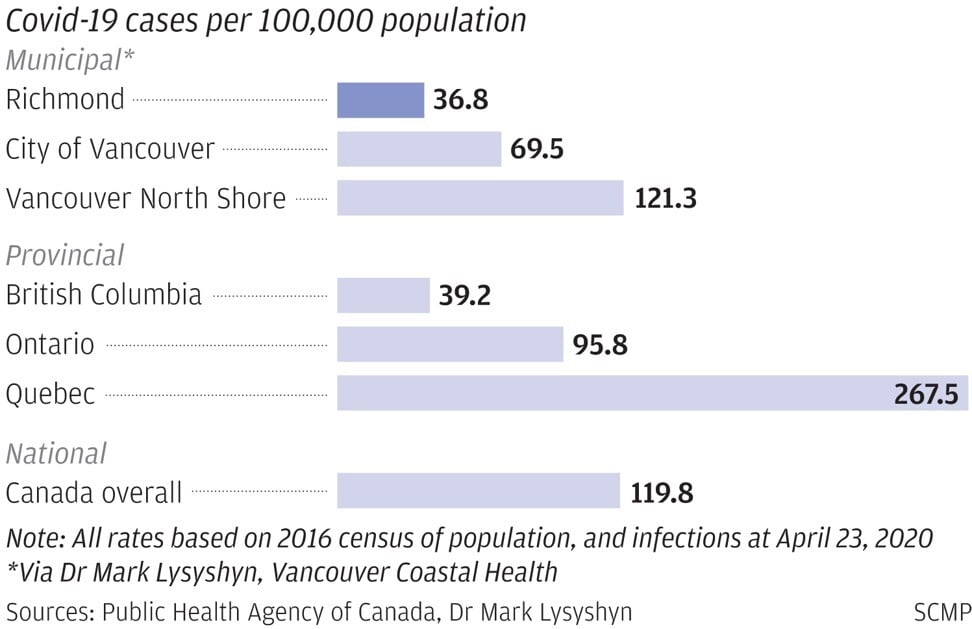
In Richmond, where 54 per cent of the population claims Chinese heritage, the rate of confirmed Covid-19 cases appears to be less than one-third the rate in the rest of Canada, and only about half that in neighbouring Vancouver.

BC health officials have tried to keep secret the Covid-19 prevalence in municipalities, citing the risk of stigmatisation in hard-hit places, or a false sense of security in others.

But in a Facebook Live appearance last Thursday, Dr Mark Lysyshyn of the Vancouver Coastal Health (VCH) authority revealed a partial breakdown of cases, saying that about 10 per cent of the 755 cases in the VCH catchment at that time had occurred in Richmond.

“The greatest number of cases are in the Vancouver area,” said Lysyshyn, deputy chief medical health officer with VCH, responding to a question from a viewer. “About 60 per cent of our cases are there. We’ve also seen a high number of cases on the North Shore, about 30 per cent of our cases there. And then about 10 per cent of our cases in Richmond.”

Photo: SCMP Graphics

He said a small number – about 3 per cent – were in rural locations outside the greater Vancouver area, although he did not explain this pushing the total above 100 per cent.

On a population basis, and taking that disparity into account, Lysyshyn’s assessment translates into a confirmed Covid-19 prevalence of about 37 per 100,000 people in Richmond (with a population of 198,000 according to the 2016 census).

By comparison, the city of Vancouver’s confirmed prevalence is about 70 per 100,000, while the Vancouver North Shore is by far the hardest hit area in the VCH catchment, with an estimated prevalence of 121 cases per 100,000. The North Shore, made up of three municipalities, has suffered the deadliest outbreak in BC, at the Lynn Valley Care Centre where at least 20 people died.

All of Canada, meanwhile, had a rate of 120 per 100,000, based on the 42,110 confirmed cases last Thursday. That rate has since risen to about 143, as of Wednesday.

British Columbia’s provincial health officer, Dr Bonnie Henry, has refused to give municipal figures for Covid-19 cases, instead providing breakdowns for BC’s large health regions.

The 2.5 million strong metro Vancouver area – which includes the city of Vancouver, Richmond and 21 other municipalities – is divided between two health regions, Vancouver Coastal Health and Fraser Health. Both health regions also encompass rural communities beyond Metro Vancouver.

Vancouver Coastal Health declined to elaborate on Lysyshyn’s assessment.

“Dr Lysyshyn was providing approximate numbers during his Q&A. To date, we have only provided case numbers for VCH as a whole, or in relation to specific declared outbreaks and have not released detailed statistics on a more local level, so we’re not able to clarify any further,” said Matt Kieltyka a public affairs officer with Vancouver Coastal Health.

Henry responded to persistent calls that she release municipal data on Covid-19 cases in an April 6 statement.

“Simply put, the risk is everywhere,” she said. “It would be irresponsible to mention only a few communities and give people outside those areas a false sense that they are not susceptible or at lower risk. Every health region in British Columbia has people with Covid-19. Every community and hometown – no matter how large or small – is at risk.

“As we notify the public about Covid-19 cases, we have been careful about how much we disclose [about] the specific location of confirmed cases … there is still very much of a stigma associated with infection.”

Richmond’s medical health officer Dr Meena Dawar has similarly declined to provide case counts since March 19, when she told city officials there were only 10 confirmed cases in the city, the Richmond News reported.

There were early fears that Richmond – the most ethnically Chinese city in the world outside Asia – could have been a potential hotspot for the disease because of a large population of frequent travellers to and from China. The city is also home to Vancouver International Airport.

But Richmond residents were also early to take Covid-19 seriously and adopted social distancing measures long before being advised by authorities to do so.

By late January, many residents were wearing face masks and many of Richmond’s Chinese shopping malls and restaurants were largely deserted, which even prompted a short-lived government campaign encouraging people to return. Some Lunar New Year events were cancelled and by February 11, Richmond’s Lingyen Mountain Buddhist Temple had closed its doors, citing coronavirus concerns.

It would not be until mid-March that BC authorities ordered residents to stay at home and socially distance themselves from others.

Virologist Dr Jason Kindrachuk, Canada research chair in new and re-emerging viruses at the University of Manitoba, said he “absolutely” believed the early adoption of social distancing by BC’s Chinese community could have helped suppress the disease in the province.

Such behaviour was “fantastic, it needs to be applauded and recognised”, he said.

About 27 per cent of people in the city of Vancouver have Chinese heritage, compared with about 11 per cent in BC and 4.6 per cent in all of Canada.

BC currently has 2,053 confirmed Covid-19 cases, at a rate of 44 per 100,000. That rate is far lower than the larger provinces of Ontario (117) and Quebec (315), while BC’s similar-sized neighbour Alberta has a rate of 119 per 100,000.

Vancouver police last week warned that a spate of hate crimes had been reported, including five anti-Asian incidents in March. In the only one involving violence, a 92-year-old man with dementia surnamed Kwong was thrown out of a convenience store by a much larger man shouting anti-Asian statements about Covid-19 on March 13.

“Xenophobia is on the rise and we hope that as a community we can stand together to help protect the next person this may happen to,” the Kwong family said in a statement. A suspect has been identified but no charges filed; police said they were still investigating.

Other incidents conflating Covid-19 with people of Asian appearance have involved abusive language, although the Vancouver Police Department declined to elaborate.

On Wednesday, Vancouver Mayor Kennedy Stewart said that “hate of any kind has no place in our city”.

According to a survey conducted on April 24 by Corbett Communications for a group called the Chinese Canadian National Council for Social Justice, 12 per cent of respondents in Vancouver agreed (4 per cent) or said they did not know (8 per cent) when asked whether “all Chinese or Asian people carry the Covid-19 virus”.

Canada’s chief public health officer Dr Theresa Tam said on Twitter on January 29 that she was “concerned about the growing number of reports of racism and stigmatising comments on social media directed to people of Chinese and Asian descent related to #2019nCOV #coronavirus.”

BC’s Bonnie Henry said on April 6 that the key to avoiding Covid-19 was not staying away from areas with high rates of infection but adopting personal practices like social distancing and good hand hygiene.

“So, while I understand the desire to know and understand what the Covid-19 situation is in your community, I need to emphasise that knowing where the positive cases are does not protect you, your family or your community,” said Henry. “The actions you take will do that.”

And the National Post analysis where travel-related COVID-19 cases came from: Canada’s early COVID-19 cases came from the U.S. not China

Contact tracing must not compound historical discrimination

Good discussion of some of the issues involved:

Governments seem likely to adopt tracing apps as a part of the new normal in the fight against infection during a pandemic. This week, Prime Minister Justin Trudeau said Ottawa had “a number of proposals and companies working on different models,” and that “there are possibilities around using voluntary measures.” Unfortunately, the use of these tracing aps will not be genuinely optional or voluntary for most users. Perhaps more importantly, the technical frameworks that are currently under development must be configured in such a way that the historical discrimination of minority groups is not compounded by governments’ implementation of tracing policy.

Research suggests that these apps will be installed on mobile phones and designed to work in concert with smartphone operating systems to alert the phone’s owner if they have been in close contact with someone diagnosed with COVID-19. The apps will probably rely on the opt-in COVID-19 tracing technical frameworks that were jointly announced by Apple and Google, and let individuals reveal their COVID-19 status as well as potentially inform them about people or places that carry higher risks of infections.

A significant amount of attention has been given to the privacy and security issues associated with these apps as well as whether the tracing apps will be sufficiently accurate to warrant using them in the first place. If governments approve their use, there may be strong legal or social pressures for individuals to use them and so it is critical for policymakers to start developing equitable policies and not justify the adoption of apps on the basis that individuals have opted-in to their use.

Opt-in mechanisms are intended to give individuals control over how their personal information is handled. Apple’s and Google’s operating systems already let individuals choose whether to share their information when they install a new game or productivity app on a device. These companies’ health surveillance functionalities will replicate this existing freedom of choice model. COVID-19 related proximity information will not be collected or shared without a smartphone user having first consented to the activity.

Meaningful consent to these companies’ health surveillance must involve giving individuals a certain level of understandable information about a tracing app’s data practices. However, policy-makers cannot be focused exclusively on a narrow understanding of consent. They must go further.

Government compulsions to opt in

Governments may decide that contact tracing apps can help to contain COVID-19’s spread once sufficient testing is available for both symptomatic and asymptomatic cases. If public safety officers are tasked with enforcing social distancing or self-quarantine orders they might demand that individuals reveal their COVID-19 status. The possibility of such an encounter with law enforcement officers, in particular, will implicitly encourage Canadians to use tracing apps. With an unlocked phone in hand, officers may go on fishing expeditions to search for potentially unlawful communications or activities.

Officers asking about individuals’ COVID-19 status may be particularly concerning to minority groups subjected to carding or to enhanced and often illegal searches. Members of over-policed groups may also feel particularly compelled to opt in to using COVID-19 apps due to concerns about how police will treat them if the apps are not installed.

Moreover, tracing apps may not be optional if individuals must reveal their COVID-19 status before entering government buildings or using public services or spaces. In such circumstances, it is conceivable that individuals would be compelled to use the apps to obtain licenses, use public transit or pass through public parks.

Private business and compulsions to opt in

Private organizations will likely have clients reveal their COVID-19 status before entering a store. If you must show your status to enter a grocery store, it is no longer optional. Sometimes clients may be unable to reveal their status – they may not own a phone or have lost it and be unable to purchase another – or they may not want to reveal their status on the basis of potentially negative consequences. For example, clients of food banks may be unwilling to reveal their COVID-19 status at all and be motivated to present fake information to avoid the chance that they will be prevented from accessing a food bank for food.

Employers may also want to know their employees’ COVID-19 status to protect or manage their workforce. Any employee who has been in contact with someone diagnosed with COVID-19 might be barred from the workplace until they undergo self-quarantine or receive negative test results. Where employers lack robust stay-at-home policies or if accessing a worksite is a condition of continuing to receive a salary, there is a risk that individuals will attempt to evade health surveillance.

Towards inclusive policy options

Canadians have demonstrated a relatively high-degree of trust in their political and health leaders throughout the pandemic. However, trust in law enforcement bodies and health bodies is considerably lower for some. The technological infrastructure being developed by Apple and Google will not resolve these historical tensions. If governments choose this path, then they must face these tensions directly.

First, governments should not empower police to view individuals’ COVID-19 status but, if they do, they must prevent officers from turning status checks into smartphone fishing expeditions. As well, public officials who review an individual’s tracing app should be required to record and publicly report the gender and ethnicity and provide an explicit rationale for assessing their COVID-19 status.

Second, policy-makers must work with organizations representing historically disenfranchised groups to develop policies which ensure members of the public can reliably access government buildings and services. Anti-poverty, homeless and addiction advocates should be consulted to determine how government services and infrastructure can continue being offered to persons who may lack access to smartphones or for cases when they may be COVID-19 positive or potentially infected.

Third, governments could subsidize the costs associated with an employee’s self-isolation or self-quarantine. Not all employees have paid sick leave that extends to self-isolation or benefits that cover the entirety of an employee’s sick leave over the course of recovering from COVID-19. Without generous sick leave policies, employees may be motivated to find ways to be at work even if their app indicates they are ill.

Fourth, any government-sanctioned tracing app must provide information for Canadians to meaningfully opt in to any health surveillance. Privacy commissioners and health officials could be tasked with ensuring that apps clearly and accurately explain an app’s anonymization measures, how COVID-19 risk assessments are generated and disclosed and the effectiveness of the app in tracing the spread of the disease.

It’s clear the apps that use Apple’s and Google’s technical frameworks are unlikely to be truly voluntary or opt-in. While neither company’s promised frameworks are presently available for developers to use, this does give policy-makers time to design ones that are inclusive. It is time they start their drafting and planning for this hypothetical tracing app future so that, if it does come to pass, any policies will avoid compounding historical discrimination.

Source: Contact tracing must not compound historical discrimination

Wealthy Move Their Money To Tax Havens

As always…:

Lockdown might impact peoples’ ability to move across borders, but it doesn’t stop money flowing into tax havens around the world.

The economic shocks of coronavirus have meant that offshore financial centres such as Switzerland are back to their old tricks: Banking peoples’ money away from their more risky homelands.

UBS, a Swiss bank and the world’s largest wealth manager, announced its profits were up by 40%. In the first three months of 2020, it saw $12 billion in net new money, nearly treble the amount banked in the previous quarter.

“We successfully managed March’s high volumes and activity across our trading and client platforms, including peaks of three times the normal levels,” Sergio Ermotti, the bank’s CEO, told investors on Tuesday (April 28).

This enabled the bank to gain a higher share of wallet from its clients, Ermotti added.

Pre-coronavirus, Switzerland’s popularity for offshore banking was fading as its banking sector could no longer guarantee client secrecy. However, the country’s notorious stability combined with low COVID-19 infection rates have renewed its appeal among the international wealthy who use its private banking services.

“There are some countries where the risk of your money and your wealth being more at risk than others does potentially also lead to inflows into safe and secure places like Switzerland,” says Anna Zakrzewski, who leads Boston Consulting Group’s Global Wealth Management division.

Source: Wealthy Move Their Money To Tax Havens

Wells: Let’s reopen Ontario and Quebec. You go first.

I am always impressed by the sophisticated understanding of Paul Wells when it comes to how governmental decision-making and his avoidance of overly simplistic arguments of many commentators (he calls out some). Just as he did in The doomed 30-year battle to stop a pandemic, a welcome dose of reality and constraints, where governments have accountability unlike those writing opinion columns:

At last the day came when the politely populist premiers of Ontario and Quebec—the provinces where four-fifths of Canada’s COVID-19 patients reside—announced their plans to roll away their stone and step into the post-pandemic light.

The plans were nearly empty and the premiers looked terrified.

The Ontario document, A Framework for Reopening Our Province, has timelines that mention no date after April 27, which was the day the document was released. It listed three phases: “Protect and Support,” which is what’s been happening; “Restart,” which theoretically comes next; and “Recover,” which in theory will happen someday. The “Restart” phase is described in conspicuously belts-and-suspenders terminology: a “careful, stage-by-stage approach” during which “public health and workplace safety will remain the top priority” and “public health officials will carefully monitor” whether there are new outbreaks “for two-to-four weeks.” The big question: “whether it is necessary to change course” and essentially revert to the current cave days.

This next phase will kick in when cases are durably declining, hospitals can handle any influx of new cases, and public-health tracing can follow any new cases. The second of those boxes, mercifully, has probably already been ticked. The third may never be, because this is such a sneaky virus. Where is Ontario on the first? A reporter asked. Premier Doug Ford couldn’t say.

Quebec, the epicenter of the Canadian outbreak, has a slightly more concrete plan about which Quebec officials seemed commensurately less confident. “If we see that the situation isn’t under control, we’ll push the timetable back,” premier François Legault said. “The watchword will be prudence.”

Another watchword will also be regionalism. Montreal is in the very early stages of a decline in active caseload following what was, and in many ways remains, one of the worst outbreaks in North America. The rest of the province looks more like the rest of the country. So Legault is re-opening elementary schools and public daycares outside greater Montreal in two weeks, on May 11. In the Montreal region they’ll open a week later. High schools stay closed until September.

And even that timetable exaggerates the imminence of a post-COVID social era. Schools will reopen “if and only if” the situation doesn’t deteriorate from now to May 11, Legault said. And school won’t even be mandatory: “Parents who want to keep their children at home won’t be penalized in any way.”

It’s pretty easy to anticipate 72 hours of large-scale game theory beginning on May 9, as tens of thousands of parents use Facebook, Zoom and text messages to ascertain whether they’re better off sending the kids to school or keeping them home. Class sizes will, in any event, be capped at 15, essentially requiring some number of parents to keep their children out.

And after that? When does your local barber shop, dry cleaner, skate sharpener or driver’s license office open? We’ll see. It’s a far cry from the easy certainty of commentators like the  shock jocks on Quebec City radio and the more nuanced impatience of columnists in the Sun papers, which essentially delivered their readership whole to the Ford Conservatives.

It’s an impatience all of us have heard in family conversations. It’s an impatience most of us feel. You know the songbook as well as I do: Look, this is ridiculous, nobody signed on for global economic euthanasia, nobody was told in March that we’d still be here in May and maybe July and maybe January, everybody has to die of something, suicide and obesity and delayed surgery kill people too, and we’re pushing those numbers up as we try to tamp this one down. (Suddenly everyone’s a public-health ninja who knows more about all this than Theresa Tam and Bonnie Henry.)

But it’s quite another matter to be the person in charge when the rubber hits the road. People are full of bravado for society and sometimes less so for their circle. Two weeks seems a reasonably manageable timeframe for a partial resumption of what was, after all, everyone’s everyday life until mid-March. But push it forward and make it personal: How do you feel about sending your own son or daughter back to school tomorrow? Are you ready for a family dinner this weekend? Everyone’s got to die of something, so how about Uncle Ned in late May by drowning in his own pulmonary fluids? That’s a harder call. It helps explain why the plans Legault and Ford released on Monday were, in Ford’s words, road maps and not timetables. And why it left some columnists, whose responsibility extends no further than their keyboards—I know, I live there too—righteously cranky.

The fact is, it’s hard to plan next steps because disaster continues despite the best efforts to contain it: 57 deaths in Ontario in one day, 84 in Quebec. Many more still to come. The closest parallel to this coronavirus in recent history was the 1918-19 flu outbreak, and that one was worse in the fall than it had been in the spring.

Legault and Ford aren’t even leading the process of deciding what happens next: like good populists, they’re being led by it, and if they looked worried on Monday it’s because they’re well aware there’s a shift change underway in the reopening debate. The debate was led until now by people who gain by sounding bold. They’re finding themselves outnumbered by people with everything to lose. Suddenly waiting doesn’t sound like such a bad idea.

COVID-19 Has Separated Those With Real Problems From Those With Mere ‘Snoblems’

Cute phrase, but one that accurately captures inequalities:

There are problems, and then there are “snoblems,” as social media like to call certain first-world personal issues during the pandemic. And almost anyone with a pen and a platform—myself included—has written about the latter, with harrowing tales of everything from long grocery lines during the lockdown to bad hair and awkward Zoom dates. But just as the privileged appear to be moving down the back side of the global coronavirus pandemic, it is those people in the margins, almost always ignored by society, that we need to be most worried about, not only for the sake of compassion, but for self-interest.

“The rigorously managed city-state of Singapore has suffered a recent spike in new cases simply because it wasn’t watching those who are easiest to ignore. ”

The curve has been flattening in most of the hardest hit areas of the global coronavirus crisis, from New York City to northern Italy, where  fewer than 500 deaths in a single day now feels oddly victorious. Wuhan is opening for business and Italy will slowly come out of its own coronavirus hibernation in early May.

But as Singapore has learned, premature celebrations of containment can easily backfire if success is only measured among those being counted. The rigorously managed city-state has suffered a recent spike in new cases simply because it wasn’t watching those who are easiest to ignore.

Migrant workers forced into lockdown in tight dorms are now emerging to help kickstart the Singapore economy, but during the height of the crisis, they were largely untested, and the virus ran wild among them. They now account for a huge increase in cases taxing the health care system and causing leaders to enforce a partial lockdown for the first time in the pandemic.

The same is likely to happen across Europe, where migrant workers and seasonal laborers are desperately needed to harvest winter crops. Special dispensation to cross closed borders is now being considered for Romanian harvest workers to come to Italy, where they will move into barrack-style lodgings and work side by side. In Great Britain, after calls for furloughed workers from non-agricultural sectors to step up and work in the farm industry were largely ignored, the government chartered flights to bring Romanian fruit and vegetable pickers in, despite travel bans.

Romania has had just over 11,000 positive cases, but as of the weekend had carried out only around 115,000 tests, meaning a large part of the population probably is infected without knowing. Italy does not have the capacity to test seasonal farm workers, who could introduce the virus in the southern regions of the country where winter agriculture is based, and which have largely escaped the brunt of the pandemic.

“On Greek islands, where thousands of refugees live in horrific conditions awaiting rulings on their asylum requests, testing is virtually nonexistent.”

The more than 71 million people displaced by war and conflict worldwide, as tallied by the United Nations High Commissioner for Refugees, have also been locked down without the sort of testing carried out on other populations. Human Rights Watch warns that as nations lift restrictions, many of the migrants will start moving again without any proper care during the critical early stages of the pandemic.

On Greek islands where thousands of refugees from the Middle East live in horrific conditions awaiting rulings on their asylum requests, testing is virtually nonexistent. A spokesperson for Doctors Without Borders told The Daily Beast that at the notorious Moria camp on the island of Lesbos, where 19,000 migrants and refugees live in a space meant for just 3,000, there is just one water tap for every 1,300 people and no soap at all.

“Families of five or six have to sleep in spaces of no more than three square meters [about 32 square feet],” Dr. Hilde Vochten, MSF’s Medical Coordinator in Greece, said recently. “This means that recommended measures such as frequent hand-washing and social distancing to prevent the spread of the virus are just impossible.”

As the world has learned from watching COVID-19 tear through cruise ships, aircraft carriers and New York  City, tight living arrangements are the perfect breeding ground for the virus. In so many parts of the marginalized world—from refugee camps to labor farms—social distancing cannot be enforced effectively and blanket testing for the virus is just not a priority.

These also are the environments where other health issues are rampant, from malnutrition to a lack of hygiene, which will complicate even mild cases of COVID-19, and where asymptomatic carriers could easily spread the disease to thousands of people before a single case is confirmed.

Moria, like other camps, is serviced by staff who live on the island and come and go from the camps, making it easy for them to spread the disease, and holes in the fences make it easy for many of the people there to move freely and return.

Writing in The Nation, author and human rights advocate Sasha Abramsky warns of a storm on the horizon. “So preoccupied are we by our own fears and by the U.S. pandemic calamity that we risk forgetting the misfortunes piled on misfortune of the 70 million people around the world currently displaced by war and social collapse,” he writes, warning that in the United States, Donald Trump’s policies on immigration have caused a bottleneck in facilities where those who may be carrying COVID-19 are neither treated nor released.

In the United States, where there are an estimated 11 million people Trump likes to call “illegal aliens,” many work in the sectors that solve the snoblems for the rest of us. A lack of access to health care could be deadly, not just for “them” but for “us,” too. Out of fear of deportation, these vulnerable undocumented workers are likely to avoid hospitals, and instead stay on the job, working in those businesses that are opening up in some states, like restaurants, massage parlors, and bowling alleys.

The stark degrees of suffering and vulnerability to COVID-19 have largely focused on the elderly and unwell in the developed world, the strain on normally well-developed health systems that should have been far better prepared, and the shocking lack of preparedness in the world’s richest economies. But, writing in The Economist, Bill Gates warns that as the pandemic slows in developed nations, it will accelerate in developing ones.

“Their experience, however, will be worse,” says Gates. “In poorer countries, where fewer jobs can be done remotely, distancing measures won’t work as well.” He notes that, “COVID-19 overwhelmed cities like New York, but the data suggest that even a single Manhattan hospital has more intensive-care beds than most African countries. Millions could die.”

Gates goes on to say he hopes wealthy nations include poorer ones as they move to a post-pandemic world. “Even the most self-interested person—or isolationist government—should agree with this by now,” he says. “This pandemic has shown us that viruses don’t obey border laws and that we are all connected biologically by a network of microscopic germs, whether we like it or not.”

But if nothing is done to integrate the needs of those vulnerable populations on the margins—whether at home in the “first world” or abroad in less affluent societies—experts warn they may contribute massively to the second wave of COVID-19. And they won’t be as easy to ignore the next time around.

Source: COVID-19 Has Separated Those With Real Problems From Those With Mere ‘Snoblems’