Canada provides exception for U.S. students planning to study north of border

That was fast (a few days after this article Canada’s travel rules unfair to first-year foreign students, U.S. parents say:

The federal government appears to have relaxed restrictions at the Canada-U.S. border that would have made it impossible for first-year university students from the United States to enter the country.

An update to the government’s guidance for international students, posted Friday, now says a student coming from the U.S. may no longer need a study permit that was issued on or before March 18, the day the border restrictions were first announced.

New York resident Anna Marti, whose daughter is planning to attend McGill University in Montreal this fall, said she was part of a “group effort” by parents across the U.S. who lobbied their senators, members of Congress and Richard Mills, the acting U.S. ambassador to Canada, to get the restrictions eased.

The rule would have made it all but impossible for U.S. freshmen to get into Canada, while other later-year students with pre-existing student permits could cross the border easily — even after having spent the summer south of the border, where the COVID-19 pandemic has been growing in severity for months.

Marti said she was told by Mills that the issue came up during ongoing discussions in Washington about the Canada-U.S. border restrictions — and that her entreaties, as well as media coverage of the plight of U.S. parents, “helped to put a ‘face’ to the issue.”

Citizenship, Refugees and Immigration Canada now says border officers will accept a “port of entry letter of introduction” that shows the student was approved for a study permit, in lieu of a permit approved before March 18. The exception, however, only applies to students from the United States.

“We celebrated, although we won’t fully celebrate until she is in Montreal,” Marti said, noting that the family — and many others — must now wait for those letters of introduction and study permits to come through.

She’s also well aware of the fact that students hoping to travel to Canada from countries outside the U.S. are still bound by the March 18 restriction.

“I just hope someone continues addressing the issue for all international freshmen,” she said. “International students who quarantine are not the real danger.”

Other parents in the U.S. remain wary of the border, since the rules require anyone seeking entry to Canada to be travelling for a “non-discretionary or non-optional purpose” — a description that could exclude students whose courses are being held entirely online.

The total number of COVID-19 cases in the U.S., growing by tens of thousands of cases a day, reached the 4.4 million mark Monday, with more than 150,000 deaths to date. Premature reopenings, an uneven and cavalier approach to physical distancing in parts of the country and a partisan divide over mask requirements have helped to fuel a surge in cases.

Canada, by comparison, has reported 114,000 total cases and nearly 8,900 fatalities so far.

“There are no measures in place to provide for expedited processing of study permit applications,” Canada’s immigration department said in an update earlier this month.

“Foreign nationals who had a study permit application approved after March 18, 2020 … may not be exempt from the travel restrictions (and) they should not make any plans to travel to Canada until the travel restrictions are lifted, as they will not be allowed to travel to or enter Canada.”

Immigration Minister Marco Mendicino announced last week the government would prioritize study permits for students who have submitted complete applications online. Students will also be able to apply time spent studying online toward their eligibility for work permits in Canada, provided at least 50 per cent of the program is completed in Canada.

Ottawa has also introduced a priority processing system and a two-stage process for students who are unable to obtain all the necessary documentation.

A spokesman for Mendicino did not respond to media inquiries Monday.

Source: Canada provides exception for U.S. students planning to study north of border

In Jerusalem’s Old City, The Devout Adjust To Worship In The Coronavirus Era

Of interest and in sharp contrast to some congregations elsewhere who have ignored or defied public health measures:

“The air over Jerusalem is saturated with prayers and dreams like the air over industrial cities,” wrote Yehuda Amichai, one of the city’s beloved poets, in 1980. “It’s hard to breathe.”

Now it’s hard to pray.

In the historic walled Old City, the beating heart of a place sacred to millions around the world, a second wave of the coronavirus has challenged devout communities to rethink how to pray safely. This spring, Jerusalem’s revered religious sites closed partially or fully as prayer gatherings were blamed for some infections. Now Israel permits houses of prayer to operate under restrictions.

New customs accompany old worship rituals: a grid of prayer quadrants at the Western Wall. Only clergy permitted at the Church of the Holy Sepulchre. “Place your carpet here” stickers on the floor of the Al-Aqsa Mosque grounds to keep worshipers distanced.

Here are some of the newest rituals surrounding Muslim, Christian and Jewish prayer in Jerusalem’s Old City.

Bring your own carpet

The Al-Aqsa Mosque, where tradition says the Prophet Muhammad journeyed to heaven, reopened in late May after Muslim authorities closed it to the public for more than two months — its first lengthy closure since the Crusaders captured it in 1099.

Worshipers are now asked to perform the wudu, the ritual washing of parts of the body, at home. Volunteers at the mosque provide hand sanitizer and masks. Participants are also asked to bring prayer carpets from home, to avoid touching the carpeted floor inside the mosque building.

“I have never used as many small carpets as nowadays,” said Mustafa Abu Sway, a member of the mosque advisory council, sitting next to his yellow carpet outside the mosque. “It just goes to the washing machine, because you don’t know what it has been contaminated with.”

Israel restricts prayer gatherings in Jerusalem — initially capped at 50 worshipers, then 19, and now 10 — but Al-Aqsa is hosting several thousand every Friday for the main prayers.

That’s partly to maintain a Palestinian presence at a compound also revered by Jews as the site where the Biblical temple once stood. Orthodox and right-wing Israeli Jewish activists are increasingly paying politically sensitive visits to the mosque grounds and lobbying to allow Jewish prayer there, which Palestinians see as hostile efforts to seize control at the site.

Muslim officials also believe they can hold prayers safely by spilling over into the mosque’s vast outdoor complex. Stickers on the floor show worshipers how to keep spaced at a healthy distance, with partial success.

“It would be a pity if everything is shut down. I mean, you need a place, a source of hope, a source of light, to invigorate people and give them a break,” said Abu Sway.

A recent sermon implored worshipers not to spread false rumors about the pandemic and to take it seriously. After prayers on a scorching Friday, thousands poured out of the Old City holding prayer carpets on their heads and refreshing frozen pops in their hands.

Celebrating Mass on Facebook Live

Nearby, the Church of the Holy Sepulchre, the traditional site of Jesus’ crucifixion, is closed due to the pandemic — except to the clergy who continue their daily rituals inside, behind its wooden doors.

A short walk away, St. Saviour’s Monastery hosts Jerusalem’s main Roman Catholic Mass, with a small women’s choir and no congregation onsite.

For months, Father Amjad Sabbara held a series of mini-Masses, with 19 participants each, so everyone in his Palestinian parish could attend a socially distanced Mass at least once a month. Now, with a second wave of infections afflicting Jerusalem’s Palestinian neighborhoods, congregants watch from home on Facebook Live.

“It’s better, you know, for the protection of the people and the families,” Sabbara says. “It’s better to stay in their homes. And in this way, we can pray together.”

It’s in their homes where his congregants need him most. Sabbara has set up a special counseling hotline and says he’s getting a lot of calls about family tensions from being cooped up at home during the pandemic.

On a recent Sunday, he offered his homily in Arabic and raised a golden goblet and round communion wafer, all in front of a web camera.

Somehow, two devoted churchgoers managed to slip into the closed, cavernous church. They were allowed to stay.

No kissing the Torah scroll

Jewish prayers continue at the Western Wall, a remnant of the ancient Biblical temple compound. But the outdoor prayer plaza is now divided into quadrants designed to keep worship groups small.

Nearby, at the Ramban Synagogue in the Old City’s Jewish quarter, longtime elementary school teacher Yehezkel Cahn, 71, oversees the morning prayers — for several dozen worshipers sitting six feet apart in designated seats — as if the synagogue were his classroom. He’s drawn cartoons with handwritten instructions: No wearing masks on your chin. No turning on the ceiling fan.

“Because the corona goes from his nose to my mouth,” Cahn says.

Another sign reads: “Don’t try to be a wise guy! You have no permission to use the prayer books of the synagogue.”

Cahn wears blue surgical gloves as he cradles the Torah scroll, turning his back as he passes a veteran white-haired worshiper. He says the man often forgets the synagogue’s new health rule against kissing the scroll, a traditional sign of respect performed by touching the scroll and then kissing one’s own hand as it is paraded around the congregation.

“I don’t want him to kiss,” Cahn says.

Cahn repeatedly looks at his watch, to usher in three shifts of morning worshipers in 45-minute slots. He’s keeping the prayer groups small. Inside the synagogue, he allows no more than 10 men. That’s the minimum quorum required by Orthodox Judaism for Torah readings and certain prayers — and the government’s latest restriction on indoor gatherings is 10 people. Whoever doesn’t get a seat indoors prays in the courtyard.

As with efforts by Jerusalem’s other major faiths, it’s an attempt to protect worshipers’ safety during the pandemic while permitting the uninterrupted rhythm of religious life.

Source: In Jerusalem’s Old City, The Devout Adjust To Worship In The Coronavirus Era

‘Without early warning you can’t have early response’: How Canada’s world-class pandemic alert system failed

This has to be considered a significant fail: disbanding the PHAC Global Public Health Intelligence Network, or GPHIN a few years before COVID-19.

Kudos to the Globe for good investigative reporting and analysis.

Given that resource reductions and reallocations are normally executed at the bureaucratic level (with political sign-off), one would hope that PHAC is revisiting this decision and the relative importance within PHAC of senior bureaucratic decision-makers vs scientific advice and expertise. Savoie’s comments on senior public servants as courtiers comes to mind when reading about these differences so well captured in the Globe report.

Some form of enquiry (preferably external) is needed  to assess how this short-sighted decision took place and the related accountabilities.

While there is no excuse for the ethical violations of the PM and Finance Minister regarding WE, it would be a far better use of Parliament to investigate this decision and its impact, given that it contributed to Canada’s missing the opportunity for an early and thus likely more effective response, with fewer deaths of Canadians:

On the morning of Dec. 31, as word of a troubling new outbreak in China began to reverberate around the world, in news reports and on social media, a group of analysts inside the federal government and their bosses were caught completely off guard.

The virus had been festering in China for weeks, possibly months, but the Public Health Agency of Canada appeared to know nothing about it – which was unusual because the government had a team of highly specialized doctors and epidemiologists whose job was to scour the world for advance warning of major health threats. And their track record was impressive.

Some of the earliest signs of past international outbreaks, including H1N1, MERS and Ebola, were detected by this Canadian early warning system, which helped countries around the world prepare.

Known as the Global Public Health Intelligence Network, or GPHIN, the unit was among Canada’s contributions to the World Health Organization, and it operated as a kind of medical Amber Alert system. Its job was to gather intelligence and spot pandemics early, before they began, giving the government and other countries a head start to respond and – hopefully – prevent a catastrophe. And the results often spoke for themselves.

Russia once accused Canada of spying, after GPHIN analysts determined that a rash of strange illnesses in Chechnya were the result of a chemical release the Kremlin tried to keep quiet. Impressed by GPHIN’s data-mining capabilities, Google offered to buy it from the federal government in 2008. And two years ago, the WHO praised the operation as “the foundation” of a global pandemic early warning system.

So, when it came to the outbreak in Wuhan, the Canadian government had a team of experts capable of spotting the hidden signs of a problem, even at its most nascent stages.

But last year, a key part of that function was effectively switched off.

In May, 2019, less than seven months before COVID-19 would begin wreaking havoc on the world, Canada’s pandemic alert system effectively went dark.

Amid shifting priorities inside Public Health, GPHIN’s analysts were assigned other tasks within the department, which pulled them away from their international surveillance duties.

With no pandemic scares in recent memory, the government felt GPHIN was too internationally focused, and therefore not a good use of funding. The doctors and epidemiologists were told to focus on domestic matters that were deemed a higher priority.

The analysts’ capacity to issue alerts about international health threats was halted. All such warnings now required approval from senior government officials. Soon, with no green light to sound an alarm, those alerts stopped altogether.

So, on May 24 last year, after issuing an international warning of an unexplained outbreak in Uganda that left two people dead, the system went silent.

And in the months leading up to the emergence of COVID-19, as one of the biggest pandemics in a century lurked, Canada’s early warning system was no longer watching closely.

When the novel coronavirus finally emerged on the international radar, amid evidence the Chinese government had been withholding information about the severity of the outbreak, Canada was conspicuously unaware and ultimately ill-prepared.

But according to current and former staff, it was just one of several problems brewing inside Public Health when the virus struck. Experienced scientists say their voices were no longer being heard within the bureaucracy as department priorities changed, while critical information gathered in the first few weeks of the outbreak never made it up the chain of command in Ottawa.

‘WE NEED EARLY DETECTION’

The Globe and Mail obtained 10 years of internal GPHIN records showing how abruptly Canada’s pandemic alert system went silent last spring.

Between 2009 and 2019, the team of roughly 12 doctors and epidemiologists, fluent in multiple languages, were a prolific operation. During that span, GPHIN issued 1,587 international alerts about potential outbreak threats around the world, from South America to Siberia.

Those alerts were sent to top officials in the Canadian government and throughout the international medical community, including the WHO. Countries across Europe, Latin America, Asia and Africa also relied on the system.

On average, GPHIN issued more than a dozen international alerts a month, according to the records. But its purpose wasn’t to cry wolf. Only special situations that required monitoring, closer inspection or frank discussions with a foreign government were flagged.

GPHIN’s role was reconnaissance – detect an outbreak early so that the government could prepare. Could the virus be contained before it got to Canada? Should hospitals brace for a crisis? Was there enough personal protective equipment on hand? Should surveillance at airports be increased, flights stopped, or borders closed?

This need for early detection sprang from a climate of distrust in the 1990s, when it was believed some countries were increasingly reluctant to disclose major health problems, fearing economic or reputational damage. This left everyone at a disadvantage.

For Canada, the wake-up call came in 1994 when a sudden outbreak of pneumonic plague in Surat, India, sparked panic. Official information was sparse, but rumours promulgated faster. As citizens fled the city of millions, many on foot, others boarded planes.

Public Health officials in Ottawa were soon alerted to an urgent problem: Staff at Toronto’s Pearson International Airport, fearing exposure to the plague, threatened to walk off the job if a plane arriving from India was allowed to land. The government scrambled to put quarantine measures in place.

“We were caught flat-footed,” said Ronald St. John, who headed up the federal Centre for Emergency Preparedness at the time. The panic demonstrated the need for advance warning and better planning.

“We said, we’ve got to have early alerts. So how do we get early alerts?”

Waiting for official word from governments was often slow – and unreliable. Dr. St. John and his team of epidemiologists didn’t want to wait. They began building computer systems that could scan the internet – still in its infancy back then – at lightning speed, aggregating local news, health data, discussion boards, independent blogs and whatever else they could find. They looked for anything unusual, which would then be investigated by trained doctors who were experts in spotting diseases.

It was a mix of science and detective work. A report of dead birds in one country, or a sudden outbreak of flu symptoms at the wrong time of year in another, could be clues to something worse – what the analysts call indirect signals.

Find those signals early enough, and you can contain the outbreak before it becomes a global pandemic.

“We wanted to detect an event, we didn’t want a full epidemiological analysis,” Dr. St. John said. “We just wanted to know if there was an outbreak.” …

Source for remainder: https://www.theglobeandmail.com/canada/article-without-early-warning-you-cant-have-early-response-how-canadas/

Canada tells most international students not to come until travel ban is lifted

Effect on economy will be significant:

International students have been told not to make travel plans to Canada until after Ottawa’s border restrictions are lifted.

In the latest update of its program guidelines, the federal immigration department said Tuesday that international students will not be allowed to enter Canada if they have received a student visa after the country’s border lockdown on March 18.

Even those who have a valid study permit from that date or earlier will be denied entry unless they can prove their travel is “non-discretionary or non-optional.”

“While many Canadian college and university campus locations are closed, classes are generally continuing online. Travel will be deemed discretionary or non-discretionary depending on individual circumstances,” said the advisory.

In 2019, more than 650,000 international students studied in Canada at the post-secondary level. The sector contributed more than $21 billion to the Canadian economy through students’ spending and tuition fees, which are two to three times higher than their domestic peers. The largest cohort of the students usually arrives in the fall.

To ensure Canada remains a competitive destination of choice for international education during the pandemic, the federal government is allowing students to count the time spent pursuing their studies online abroad toward their eligibility for a post-graduation work permit.

If they have submitted a study permit application and if at least half of their program is completed in Canada when the border reopens, they will be eligible for the work permit, which many international students count on as an ultimate pathway for permanent residence.

“The pandemic has had a significant impact on international students and the Canadian institutions and communities that host them. This is why we have implemented a series of measures to support them,” Immigration Minister Marco Mendicino said earlier.

“We value the contribution of young people seeking a high-quality education in Canada, and we’re making every effort to minimize how current challenges affect their plans and dreams for the future.”

Despite the special COVID-19 measures, international students have complained that schools still require the same hefty tuition fees for online programs, which present other challenges regarding time-zone differences. Some students may have to stay up for their class in the wee hours from their home countries.

Sarom Rho, a migrant student worker organizer, said Ottawa has been tone-deaf to the needs of international students, who have been asking for a tuition freeze and work permit extension, among other things that could help them through the pandemic.

“International students are disappointed with these announcements,” said Rho of Migrant Students United. “The government’s response is geared towards maintaining international enrolment and fees as a source of revenue to keep schools operating. It’s disavowing its responsibility to the quality of education for these students.”

According to the immigration department’s updated guidelines, border agents have the final say in admitting arriving students.

Students must prove their presence in Canada is necessary for their continued participation in their program, such as in labs and workshops, or prove that pursuing online studies is not an option for their school or program or not possible from their home country, for example, due to internet restrictions or bandwidth limitation.

Like all travellers, international students who enter Canada must undergo the necessary health checks and self-quarantine for 14 days upon arrival.

Some universities and colleges have issued support letters to incoming international students advising them to take extra precautions before travelling to Canada because students are responsible for the costs of returning to their home countries.

At the University of Saskatchewan, for example, students are recommended to provide border agents support letters from the administration saying that “your studies cannot be completed online and you are expected to to start on-site.”

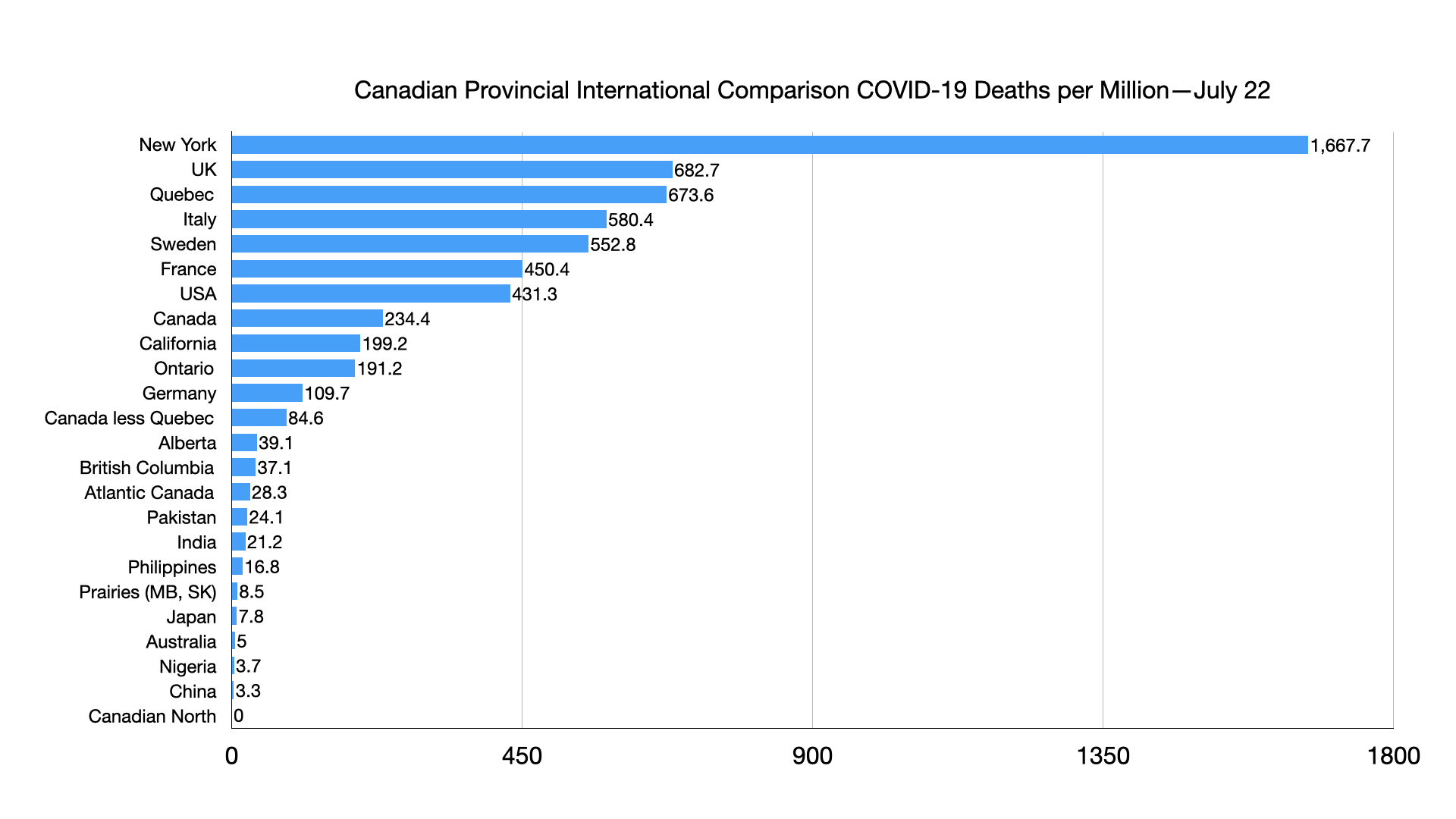
#COVID-19: Comparing provinces with other countries 22 July Update

The latest weekly stats showing no major changes from last week in terms of relative ranking, although the USA can be expected to surpass the harder hit European countries in deaths per million over the next few weeks given current trends. The recent spike in infections in British Columbia, Alberta and Quebec continues to become more apparent (but not, fortunately to date, in the death statistics).California edged over Ontario this week:

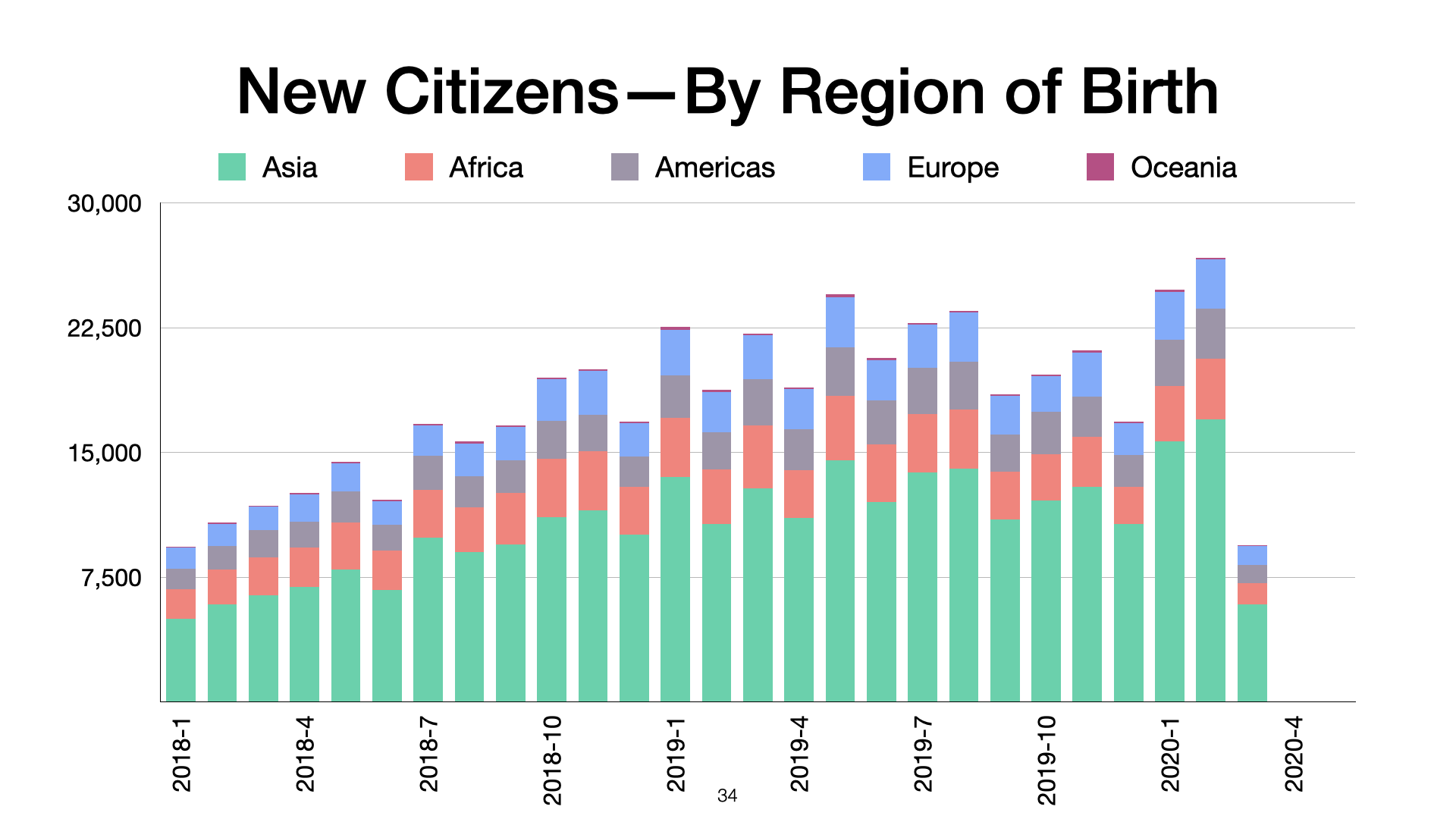
Citizenship statistics 2020: How the complete shutdown looks

With open data now having posted the 2020 numbers, we have comparable data across all IRCC programs regarding the impact of COVID-19. The data reflects the  complete shut down of citizenship ceremonies (save for a few online).

Having this baseline data will allow for analysis of how quickly the program recovers.

Unfortunately, open data does not publish citizenship applications (unlike virtually all other programs, so we only have a partial picture). Annoyingly, the IRCC country of birth listing is different from the other programs’ country of citizenship listing, making it harder to sort alphabetically across programs (i.e., citizenship country of birth Peoples Republic of China compared to other data tables, China, PRC, The Netherlands vs. Netherlands, The etc).

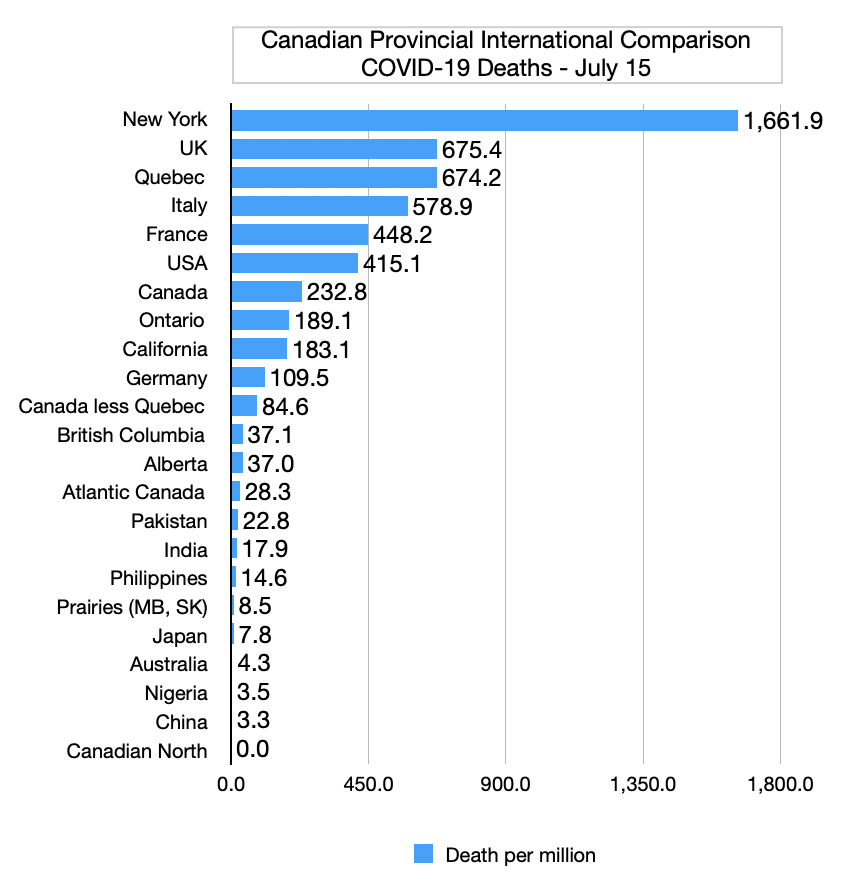
#COVID-19: Comparing provinces with other countries 15 July Update

The latest weekly stats showing no major changes from last week in terms of relative ranking, although the USA can be expected to surpass the harder hit European countries in deaths per million over the next few weeks given current trends:

Ottawa didn’t enforce rules for employers of migrant farm workers during pandemic

Appears to be a significant program implementation fail, particularly with respect to Ontario in contrast to British Columbia:

The federal government allowed some employers of migrant farm workers to submit three-year-old housing inspection reports in order to secure labour during the pandemic, instead of requiring up-to-date evidence of compliance with the temporary foreign worker program.

As well, for a six-week period at the outset of COVID-19, the government stopped conducting housing inspections under the TFW program altogether. When the audits resumed, they were done remotely.

While Employment and Social Development Canada (ESDC) has received 32 COVID-19-related complaints regarding the program in the agri-food sector since March, not a single farm has so far been found in violation of several key pandemic-related rules. For example, employer-provided accommodations must allow workers to keep a distance of two metres, and employees must be paid for their mandatory quarantine upon arrival in Canada.

The federal government is ultimately in charge of the TFW program. It has the power to conduct pro-active inspections of accommodations, which can include bunkhouses, trailers and sheds. The provinces and local public-health units also have a role to play in oversight, creating a jurisdictional quagmire that has proved detrimental to the well-being of some temporary foreign workers.

In Ontario alone, more than 1,000 migrant farm workers have tested positive for COVID-19, according to a Globe and Mail survey of local public-health units. Health officials have stressed that, for the most part, the workers arrived in Canada healthy and contracted the virus locally. Three men from Mexico have died.

A Globe investigation into the outbreaks published last month exposed the unsafe conditions endured by some migrant workers. Interviews, photos and videos portrayed overcrowded accommodations, broken toilets and cockroach and bed-bug infestations. As well, sheets and cardboard were used as dividers between bunk beds. Workers also recounted not being fully paid for their initial quarantine.

Federal guidance for employers of temporary foreign workers, updated in April, said that if an agri-food operation can’t submit a valid housing inspection report owing to COVID-19, “they must try to provide a satisfactory” report within the previous three years. The employer must later provide proof of compliance before the end of the permit term.

And even if an employer can’t produce a report from the previous three years, the company can still be approved to receive temporary foreign workers “if photos of the accommodation are provided and the employer agrees to submit an updated [report] to ESDC within the duration of the work permit.”

The department said in an e-mail that it would be rare for an employer to submit a three-year-old housing inspection report. In prepandemic times, employers had to provide, on an annual basis, a satisfactory report no older than eight months if they wanted to hire temporary foreign workers. This means that if a business employed migrant workers last year, for example, it would have had a recent report that it could submit.

In an interview with The Globe last month, Employment Minister Carla Qualtrough acknowledged shortcomings in the TFW program and said Ottawa will overhaul it. Ms. Qualtrough said “nothing is off the table,” including changes to the enforcement regime. She also said that the government may create national housing standards that would have to be met for employers to qualify for the program.

Santiago Escobar, a co-ordinator with the Agriculture Workers Alliance, said the group has long sought improvements to what he described as “so-called inspections.” The alliance operates under the United Food and Commercial Workers union and represents migrant employees. “[The oversight regime] is not doing enough,” he said. “All inspections must be done in person, before workers arrive, and again once they’ve moved in.”

Over the past few months, Mr. Escobar said, the alliance has helped process dozens of applications for federal open work permits. This type of authorization, launched last year for vulnerable migrant workers, allows foreign nationals to leave abusive employers and work elsewhere for up to one year. Mr. Escobar said many of the applications included pandemic-related concerns. All of the submissions were approved.

And yet no employers have faced penalties for breaches of federal COVID-19-related rules. The employment department noted, however, that approximately 11 per cent of employers have required “some correction to minor issues” before being deemed compliant.

Of the 32 COVID-19-related complaints regarding the TFW program, the department has launched 11 inspections. Three are complete, with the employer found compliant in all areas. The rest of the complaints are under review. The federal government has the authority to penalize employers found to be non-compliant, including through a fine of up to $1-million and a ban on accessing labour through the program.

From mid-March to the end of April, Ottawa halted its housing inspections; ESDC said this was done to protect the health and safety of migrant workers, employers and government staff. When the inspections resumed, they were done remotely.

York University professor Leah Vosko, a Canada research chair whose work focuses on enforcement of employment standards and the precarious immigration status of migrant workers, said remote inspections are problematic. They don’t always accurately establish whether employers are abiding by the rules, she said, and information can be easily fabricated and manipulated.

In addition to more in-person audits, Prof. Vosko said Ottawa should increase unannounced inspections. “[A worker] being seen as a ‘troublemaker’ can jeopardize current and future employment contracts and lead to repatriation,” she said in an e-mail. “Proactive inspections are therefore needed to address the well-documented exploitative and unsafe conditions migrant farm workers labour under.”

One migrant farm worker told The Globe that when employers are given advance notice of an inspection, they have time to make conditions appear better than they are. “They’re prepared for the inspection, and usually what they do is show the good lunch room or the part of the facilities that are in good shape,” the worker said. The Globe is not identifying the worker because of concerns about future employment.

Prof. Vosko said Ottawa must create a national housing standard for temporary foreign workers. She pointed to a 2018 federally commissioned study on employer-provided accommodations that found a lack of uniformity in housing conditions and oversight.

“Consequently, prior to the pandemic, there were no concrete federal directives around housing capacities, bed size, number of windows and doors, privacy measures, food preparation and storage, [and] sanitation facilities,” she said.

At the provincial level, Ontario Premier Doug Ford has repeatedly cited Ministry of Labour inspections and compliance orders as evidence that his government is taking action to protect migrant farm workers. But ministry inspections cover workplaces, not housing. The ministry said in an e-mail that it conducted 142 field visits in the agri-food sector related to COVID-19 between mid-March and early June. The inspections resulted in 34 COVID-19-related orders to improve conditions.

Scotlynn Group’s farm in Vittoria has been the subject of two formal COVID-19-related complaints to the Ministry of Labour. In May, there was a complaint with regard to “lack of COVID-19 measures,” and in June, there was a second one regarding “quarantine requirements,” according to ministry records provided to The Globe.

Investigations into the complaints are continuing; neither has so far resulted in a compliance order. The ministry is also investigating the June 21 death of Juan Lopez Chaparro, a 55-year-old Scotlynn worker from Mexico who had been admitted to hospital with COVID-19. The ministry declined to comment on the continuing fatality investigation.

Mr. Lopez Chaparro was one of 216 migrant workers at the Scotlynn farm; almost all of them have tested positive for the virus. Without a work force to speak of, the farm abandoned its asparagus harvest in early June.

The president and chief executive of Scotlynn Group – a North American transportation logistics and farming company with one of the largest vegetable operations in Ontario – told The Globe last week that all of the Vittoria workers have since tested negative and have been cleared to return to work. Scott Biddle said the Ministry of Labour told him they would likely be on site for two days to investigate Mr. Lopez Chaparro’s death, but ended up staying for two hours.

Mr. Biddle said officials interviewed him about the farm’s health and safety measures, including as it relates to accommodations for the initial mandatory quarantine. He said he rented hotel rooms for nearly 200 workers; 21 employees were isolated across seven bunkhouses, in line with a public-health occupancy directive that limited the number of workers per bunkhouse to three.

After four pro-active Ministry of Labour inspections and follow-up visits between January of 2010 and June of 2020, Scotlynn’s farming operation has been issued 13 compliance orders, according to ministry records. The orders require, among other measures, that the company prepare a policy for harassment and “assess the risks of workplace violence that may arise from the nature of the workplace, the type of work or the conditions of work.”

In five instances, the compliance order says vaguely, “the employer shall take every precaution reasonable in the circumstances for the protection of a worker.”

Three Scotlynn workers were among those interviewed for The Globe’s recent investigation. The men described overrun living conditions; ill workers living with healthy ones; and no PPE to guard against the virus.

Mr. Biddle said the two formal COVID-19-related complaints submitted to the Ministry of Labour are baseless and were brought by one “rogue” employee. “Every company has had complaints, but we’ve never had a fine,” he said. “We take every precautionary measure possible. We always go above and beyond.”
Source: https://www.theglobeandmail.com/canada/article-how-ottawas-enforcement-regime-failed-migrant-workers-during-the/

Dark skinned patients left out of COVID-19 studies, as minorities some of the hardest bit by the virus

Of note, another example of systemic bias and discrimination:

Clinical images of patients with hives, swollen lips, chickenpox-like rashes, and red or purple lesions on the feet known as “covid toes,” have been published in medical studies since the start of the pandemic, demonstrating how the virus can affect the skin.

These images can help doctors diagnose patients who are otherwise asymptomatic – if they have light skin.

But images of darker-skinned patients have largely not been included in medical studies showing how COVID-19 can present on the skin, even as the disease has disproportionately affected people of colour in Canada and the United States. Symptoms can appear very differently on dark skin tones, underscoring the need for inclusion in clinical studies.

“Black folks in Canada, specifically Toronto, are overrepresented in terms of the burden of COVID-19,” said Bolu Ogunyemi, a dermatologist and clinical assistant professor of medicine at Memorial University in Newfoundland.

“So it’s unfortunate that we’re actually underrepresented in records of the manifestation from skin for this disease.”

The COVID-19 studies reflect a pattern in which darker skinned patients are largely missing from medical literature, part of an issue of racism within the medical system.

A literature review in The British Journal of Dermatology found that out of 36 studies showing images of COVID-19 presentations on skin published between December, 2019, to May, 2020, there were zero images of dark skin tones.

Researchers evaluated each clinical image using the six-point Fitzpatrick scale, which categorizes skin tones from lightest to darkest, and found that 92 per cent of the 130 images were of skin in the first three categories, which range from the lightest coloured skin to a medium tone. There were zero images of skin in the two darkest Fitzpatrick categories.

While it is not yet clear how significant these skin lesions can be in diagnosing COVID-19, understanding what they look like could lead to earlier testing. Some provinces, such as Nova Scotia, have added symptoms of red or purple fingers or toes to a list of symptoms that indicate a person should get tested.

“We’re still trying to figure out what these manifestations actually mean,” said the main author of the study, Jenna Lester, who is an assistant professor of dermatology at the University of California, San Francisco.

“But if there is a rash that patients can identify themselves when they were perhaps asymptomatic and can use it as a way to know they need to get tested but we’re not showing it in dark skin – it is a huge disservice to patients.”

Including examples of what diseases can look like on dark skin is important because indicators such as redness may be difficult to spot on dark skin, said Lynn McKinley-Grant, associate professor of Dermatology at Howard University College of Medicine and president of the U.S.-based Skin of Color Society.

Redness on light skin can appear as a different shade on darker skin, she said, or not appear at all. Doctors may have to employ different diagnostic methods to determine the issue, such as using touch to see whether the skin is warm. Sometimes, darker skin can also react very differently.

“In the textbooks it’ll describe a rash as flat and not itchy, but in darker skin types, it’ll be raised and itchy, but still be in the same pattern,” Dr. McKinley-Grant said.

The Skin of Color Society has shared images on social media of darker skin showing symptoms that are similar in appearance to COVID-19 symptoms.

While most health care units in Canada do not yet collect race-based data on COVID-19 patients, statistics show that the most diverse geographic areas also have some of the highest rates COVID-19. In early June, after health care professionals across the country raised concerns about the lack of data on how COVID-19 has affected racialized populations, Ontario had granted some health units permission to begin collecting race-based data.

In the U.S., where race-based data are available, studies show that African-Americans are almost three times as likely to test positive for the virus than white people.

Some doctors in Canada have linked the lack of representation in COVID-19 studies to larger issues of representation in medical studies and textbooks, across all disciplines.

Edgar Akuffo-Addo, a first-year medical student at the University of Toronto, says he has experienced this first hand.

In a first-aid training course he recently completed, Mr. Akuffo-Addo said participants were instructed to check for signs of shock by pressing down on a patient’s fingernails and waiting to see how long it took to turn red again.

“I tried to do the test on myself, and I couldn’t see it on my own skin,” he said. In addition, he said all the patients featured in the video training materials were white.

Mr. Akuffo-Addo describes the lack of representation as “troubling and worrying” and has embarked on his own review of clinical images of skin conditions related to COVID-19, and has so far examined 1,000 images in studies from Spain, France, Italy, the U.S. and Canada. Mr. Akuffo-Addo said that he confirmed with the authors of those studies that all patients were white.

Dr. Ogunyemi said the study of dermatology has been historically white.

When the field was first developing in Britain, the U.S. and Canada, he said, there was a smaller proportion of people of colour, so the criteria for the diagnosis of skin issues was centred around people with lighter skin. But these criteria have not changed significantly since that time.

“The problem is our population in these countries is changing – but the definition of skin disease is not keeping up with the pace.”

Studies also show that a mistrust of the medical system is a major reason why people of colour may choose not to participate in medical studies, stemming from a history of mistreatment as well as discrimination within the medical system.

Dr. Ogunyemi said that because the information on treating dark skin may not be readily available, Canadian doctors may have to take additional steps to ensure they are comfortable and able to treat people with dark skin.

“I think like a lot of things, you have to take a conscious effort, you have to go out of your way.”

Covid 19 Canadian Immigration Effects: May 2020 Update

This deck examines monthly changes due to COVID-19 on permanent resident admissions, temporary resident work permit holders, and study permit holders, broken down by category and program, region and top countries and province (Provincial Nominee Program and study permits).