Survey Finds Asian Americans Are Racial Or Ethnic Group Most Willing To Get Vaccine

May have missed it but have not seen any comparable data for Canada:

A wide-ranging survey shows Americans’ willingness to receive a coronavirus vaccine when it becomes publicly available and confidence in its effectiveness are on the rise.

But when broken down by racial or ethnic group, Black respondents show the most reluctance, with less than half saying they will do so.

The survey by the Pew Research Center found that 60% of Americans overall say they would definitely or probably get a vaccine for the coronavirus if it were available today.

While that figure is 9% higher than it was in September, it still lags behind the 72% of Americans who said in May they would get the vaccine, when clinical trials for a vaccine were just getting underway.

Roughly four in 10 respondents overall (39%) say they would definitely not or probably not get a vaccine, according to Pew.

However, about half of that cohort did leave open the possibility they could change their mind once more information is available and once others get vaccinated. The other half said they are “pretty certain” more information will not change their decision.

Pew found quite a bit of variance when responses were broken down by racial or ethnic group on willingness to get a vaccine.

A whopping 83% of “English-speaking Asian Americans…say they would definitely or probably get vaccinated,” outpacing all other racial or ethnic groups, according to Pew.

White and Latinx respondents answered about the same, with 63% and 61% respectively saying they definitely or probably would get the vaccine.

“Black Americans continue to stand out as less inclined to get vaccinated than other racial and ethnic groups,” according to Pew, which found that just 42% of African Americans said they would get one when made publicly available.

This figure may be surprising to some, given that 71% of Black respondents told researchers they knew someone who has died or been hospitalized due to the virus, nearly 20 points higher than Americans overall (54%).

But there is a long history of mistrust on the part of Black Americans toward public health officials, much of it stemming from the notorious Tuskegee experiment of the 1930s, when researchers lied to hundreds of Black men, telling them they were conducting research on treatments for “bad blood.”

In reality the scientists were allowing the Black men to die of untreated syphilis. Those experiments were slated to go on for six months, but they lasted 40 years, according to the Centers for Disease Control and Prevention.

That is perhaps why Barack Obama, the nation’s first Black president, said in an interview this week with SiriusXM’s The Joe Madison Show that he’d be willing to get vaccinated in front of cameras when it becomes available.

“I promise you that when it’s been made for people who are less at risk, I will be taking it,” Obama said. “I may end up taking it on TV or having it filmed, just so that people know that I trust this science.”

Former presidents Bill Clinton and George W. Bush have also said they are willing to get the vaccine in front of a camera.

The Pew study was a national survey conducted between Nov. 18 and Nov. 29 surveying 12,648 U.S. adults.

The margin of sampling error for the survey is plus or minus 1.5 percentage points.

Source: Survey Finds Asian Americans Are Racial Or Ethnic Group Most Willing To Get Vaccine

‘There is no playbook in dealing with the pandemic’: how StatsCan has mobilized around urgent COVID-19 data collection

Of interest:

With the majority of people at Statistics Canada still working from home amid the COVID-19 pandemic, the agency has been working to become more agile in its collection of disaggregated data and the disproportionate effects of the crisis on vulnerable communities, according to Tina Chui, acting director of diversity and social statistics.

“There is no playbook in dealing with the pandemic,” said Ms. Chui. “I think we’ve become a lot more agile, and StatsCan has been undergoing modernization for a number of years, which allowed us to springboard into more innovative ways of doing things.”

The impact of the pandemic has been spread unevenly across the Canadian population, particularly pertaining to people from vulnerable communities and marginalized groups.

“Because of that, we have really mobilized to collect as much information as possible,” said Ms. Chui. “We have been investing our efforts in a number of modernization initiatives for a number of years already, which actually helped us to prepare for the pandemic response.”

Ms. Chui said that during the initial stages of the pandemic, senior management within Statistics Canada took “calculated risks and made some tough choices” to adapt the agency’s response to urgent data needs, including everything from information around mental health to the impact on businesses to enable people to better navigate the impact of the damage.

Crowdsourcing, web panels used for COVID-19 data collection

The agency has engaged in a number of crowdsourcing pushes throughout the pandemic, with first results on the impacts of COVID-19 on Canadians coming in between April 3 and April 24, followed by a focus on the impacts of the pandemic on postsecondary students from April 19 to May 1.

The focus then shifted to the collection of data surrounding the mental health of Canadians from April 24 to May 11; Canadians’ perceptions of personal safety from May 12 to May 25; trust in government, public health authorities and businesses from May 26 to June 8; as well as the impact of COVID-19 on Canadian families and children from June 9 to June 22.

Most recently, crowdsourcing was used to analyze the impacts of the pandemic on Canadians living with long-term conditions and disabilities from June 23 to July 6, finishing with a push to determine Canadians’ experiences of discrimination from August 4 to August 18.

Web panels have also been used from March 29 through to September 20 to collect data around the impacts of the pandemic, resuming economic and social activities, information sources consulted by Canadians, as well as technology use and cyber security.

From Jan. 25 to Feb. 1, the agency will be looking into substance use and stigmatization within the context of the pandemic as well.

“We really used those two sources in the last few months to collect very timely information,” said Ms. Chui. “Since the lockdown in mid-March, we worked very quickly to put some new surveys through crowdsource and web panel methods to collect data.”

‘We had to mobilize very quickly’

The federal government introduced its anti-racism strategy in June 2019, designed to unroll from 2019 to 2022 at the cost of $45-million.

Statistics Canada’s role within that strategy is to “support the data and evidence pillar,” said Ms. Chui. “Fast forward to the pandemic: we do need this real-time [data], we had to mobilize very quickly, so how can we leverage the existing work to monitor how Canadians are dealing with the pandemic?”

Calling the agency’s Labour Force Survey their “mission critical program,” Ms. Chui said new questions have been recently added to get a better sense for the impact on visible minority populations.

“That’s how we can find monthly data of COVID on employment,” said Ms. Chui. “Unfortunately we’re still deep in the second wave, but when we’re going through the recovery, certain communities will have a lot more to gain back, so with the monthly survey, we’ll be able to better monitor the situation.”

According to the most recent Labour Force Survey that reflects labour market conditions as of the week of Nov. 8 to 14, growth was “variable across demographic groups.”

Among Canadians aged 15 to 69, according to the report released on Dec. 4, the unemployment rate of those designated as a visible minority decreased 1.5 per cent to 10.2 per cent in November.

Beginning in July, the survey now includes a question asking respondents to report the population groups to which they belong. Possible responses, which are the same as in the 2016 census, include, White, South Asian (e.g., East Indian, Pakistani, Sri Lankan), Chinese, Black, Filipino, Arab, Latin American, Southeast Asian (e.g., Vietnamese, Cambodian, Laotian, Thai), West Asian (e.g., Iranian, Afghan), Korean, Japanese, or Other, according to Statistics Canada’s website.

Long-form census scheduled for 2021

In his mandate letter from Prime Minister Justin Trudeau’s (Papineau, Que.) office, Minister of Innovation, Science and Industry Navdeep Bains is responsible for preparing for the long-form census in 2021, including the collection and analysis of disaggregated data.

Ms. Chui said the census is the government’s “best source for disaggregated data.”

“For instance, when we look at socio-economic outcomes of women, we cannot just look at women, because socio-economic outcomes are tied very closely together with age, because age is a proxy for lifecycle,” said Ms. Chui. “So we have to look at the combinations of sex and age, and we can still drill further [into regions]. Then you can further drill into women in their prime working age, who are members of a visible minority.”

“The census is such a big data source that it will allow us to drill down into that level of detail, while also allowing us to protect the privacy and confidentiality of respondents,” said Ms. Chui.

According to the department, the census will contain new content to better identify individuals’ sex at birth, gender, veteran status, religion, registered members of Métis organization or settlements, as well as those enrolled under or a beneficiary of an Inuit lands claim agreement.

Pandemic has highlighted ‘pre-existing inequalities in our society,’ says expert

Malinda Smith, a professor at the University of Alberta who has also sat on Statistics Canada’s Expert Working Group on Black Communities in Canada, told The Hill Times that the pandemic has highlighted the pre-existing inequalities in our society, and “aggravated them for people who are on the front lines, people you see were marginalized, but now we recognize are essential.”

University of Alberta professor Malinda Smith says ‘what Statistics Canada can do from a national point of view is provide clear categories and a coherent strategy where we have data that is collected and comparable.’

There was a need for better race-based data prior to the pandemic in relation to policing, according to Prof. Smith—a need that has been amplified as result of the pandemic.

“What this has all shown is that across the country, across the provinces, is very uneven data collection, and what Statistics Canada can do from a national point of view is provide clear categories and a coherent strategy where we have data that is collected and comparable.”

“And this is as, if not more important—the information will be able to help evaluate initiatives and programs and policies to assess their differential impact, and then to design interventions that will properly address them,” said Prof. Smith.

“Right now, a once-size-fits-all strategy doesn’t allow you to do that, and the uneven data collection doesn’t allow you to even identify hotspots,” said Prof. Smith. “My view is that even though this is framed as an anti-racism strategy, it might just as well be framed in terms of a systematic commitment to what an equitable, inclusive society looks like.”

Source: ‘There is no playbook in dealing with the pandemic’: how StatsCan has mobilized around urgent COVID-19 data collection

‘Nothing we’ve done has helped’: In Toronto’s poor, racialized neighbourhoods, second-wave lockdowns are again failing to slow COVID cases

Good detailed analysis:

The data is clear, and has been for months: Ontarians who are poor, under-housed and racialized are disproportionately attacked by COVID-19.

And yet, deep into the second wave, this central feature of the pandemichas not been central to our pandemic response, health experts say. The current “one size fits all” restrictions have so far failed to protect the vast majority of people getting infected by COVID-19. As a result, lockdowns in hot spots like Toronto and Peel are on track to be longer, harder and more devastating for everyone. 

“If we don’t tackle this problem, we will continue to struggle through the winter. I can guarantee you that right now,” says Dr. Peter Juni, scientific director of the Ontario COVID-19 Science Advisory Table, which provides evidence to inform the province’s pandemic response.

In the first wave, lockdowns worked instantly in richer, whiter Toronto neighbourhoods but failed to flatten the curve in the poorest, most racialized ones, Star analyses showed. 

Experts fear the same thing is happening again. Over a recent four-week period, the 20 Toronto neighbourhoods with the highest proportions of visible minorities recorded more than 3,300 cases. The 20 whitest neighbourhoods reported just 360. This racialized tilt is not a function of race itself, research shows, rather of who performs essential but low-paying work and is more likely to live in sub-standard housing.

“This is really about the people who do all the work for us and who allow you and me to stay home,” says Juni.

“The restrictions work very nicely in my neighbourhood, Moore Park,” an affluent area in North Toronto, Juni adds. “In some other neighbourhoods, they don’t. Why? Because we do not support people to actually be able to decrease the amount of contact they have.”

Summer offered a reprieve from the virus — a chance to reflect on the first wave of the pandemic and prepare for the second. And perhaps the harshest lesson from the spring was that COVID-19 predominantly impacted poor and racialized Torontonians, especially from Black and South Asian communities.

According to Toronto Public Health data released in July, racialized residents accounted for 83 per cent of cases despite making up 52 per cent of the population. People in the poorest households accounted for the largest share of cases of any income group.

Many of the worst-hit neighbourhoods were in the city’s northwest and northeast. And while the rest of Toronto — particularly whiter, more affluent downtown neighbourhoods — enjoyed a relatively pandemic-free summer, residents in these areas continued to see transmission simmer along at low levels.

As the second wave took off, the same first-wave patterns quickly took hold: the downtown Waterfront neighbourhood initially emerged as a hot spot, then infections began to spike in neighbourhoods more densely populated by poor and racialized residents. 

The province and the city began a series of interventions over the fall that escalated in severity — all of which have been too lax, many epidemiologists have argued. In late September, capacity limits were imposed for indoor dining and bars. In early October, indoor dining was nixed entirely along with fitness classes, and gathering sizes reduced. 

These measures did have an impact — but most dramatically in downtown neighbourhoods like Little Portugal and the Waterfront. In the northwest and northeast corners especially, cases continued to climb.

“Rates in some of those downtown communities have dramatically decreased. You can see the direct effects of the intervention on those neighbourhoods, and you can hypothesize that (restaurants and indoor dining) were a very big driver for the cases in those neighbourhoods,” says Dr. Vinita Dubey, an associate medical officer of health with Toronto Public Health. 

Dubey acknowledges that the inequalities of the first wave are repeating. “We are still seeing some of the same patterns that have actually persisted,” she says. “We’re doing more, we’ve learned more, we’re working with the communities more. But some of those systemic inequalities or disparities haven’t (been) fixed between the first and second wave.”

In an emailed statement, a health ministry spokesperson said the provincial government has had “an explicit focus on equity issues” with respect to the pandemic’s impact and cited several steps it’s taken to address these, including: public-health marketing efforts in more than 18 languages; a relief fund of $510 million for food banks, shelters and other organizations; and working with community groups to improve testing access in hard-hit areas.

If the lockdown that began Nov. 23 has had any effect on the hardest-hit neighbourhoods, it is not yet apparent. But while the inequities underlying differences in COVID risk may be deep-rooted, they can still be tackled, health experts say.

“We’ve set up a response, I think, at the extreme … it’s been only for the rich, or at least with the rich in mind first,” says Dr. Stefan Baral, an epidemiologist at the Johns Hopkins School of Public Health, who provides clinical care in homeless shelters in Toronto.

“There were very specific and tangible things that I think could have been done to prepare for what was going to be a very difficult winter.”

In early October, the Star obtained provincial data showing that some Toronto neighbourhoods had alarmingly high positivity rates, suggesting that pockets of the city were in worse shape than previously known.

Provincial health officials admitted they first saw this data in the newspaper, and Premier Doug Ford cited mobile testing as part of what the province was doing to support marginalized communities.

But just days earlier, community health organizations in some of Toronto’s hardest-hit neighbourhoods were pressured by the province to stop offering pop-up testing, those involved say. 

The province was transitioning to an appointment-only testing system as the backlog of unprocessed specimens ballooned. But community groups knew that easier-to-access pop-up testing sites were critical for reaching residents at highest risk of COVID-19.

The community groups pushed back, and “highlighted that without their pop-ups, there would be nothing available for (their) communities,” says Sané Dube, with the University of Health Network’s social medicine program, who was working in the community at the time. 

It was “disturbing and concerning,” she adds. Though the province “backtracked” and the pop-up sites happened as planned, she says, “it raised serious questions about how decisions were being made.”

The health ministry says “there was absolutely no plan or proposal to ever cancel testing” in the neighbourhoods in question. 

“Ontario Health Regions are working with high priority communities to offer additional testing sites.”

Many advocates describe a chronic inability to reach people in marginalized communities, where the need for COVID-19 testing is most dire.

In September — when testing volumes peaked in Toronto and the second wave started taking off — there was no pop-up testing in Scarborough and just three sites in the city’s northwest corner, two regions with high densities of poor, racialized communities that have been hardest hit by the pandemic. 

But people in the richest and whitest neighbourhoods were likely being overtested. In late September, testing rates in Toronto’s whitest neighbourhoods were double that of the most racialized communities, according to a Star analysis of public health data.

After the province overhauled its strategy in late September, including restricting access for those with no symptoms, testing rates fell dramatically in the richest, whitest neighbourhoods. Today, they are more or less in line with rates in the city’s poorest, most racialized neighbourhoods — even though testing rates in the latter neighbourhoods “should be through the roof” given the soaring infection rates in those areas, says Dr. Sharmistha Mishra, a scientist with the Li Ka Shing Knowledge Institute and a member of the province’s modelling consensus table.

In response to the Star’s questions about testing access in northwest Toronto, the health ministry spokesperson cited the dozens of testing sites across the larger region that encompasses these neighbourhoods — but also acknowledged that uptake was still too low, and that the “expansion planning is underway.”

“Next efforts focus on mobilizing increased uptake of testing within targeted communities and providing culturally relevant and community tailored messaging addressing the social determinants of health, such as income, food security, and housing, that make it difficult for some people to seek or access care.” 

Coun. Joe Cressy said that though COVID-19 testing is the province’s purview, the city recently ramped up supports for testing in targeted neighbourhoods. All city facilities — from fire stations to libraries — are now available for pop-up testing, he said. The city also recently kicked off a $5 million program in partnership with 11 communities agencies that have played a crucial role in supporting marginalized neighbourhoods.

Cressy said community involvement is key to increasing testing rates in the hardest-hit areas. Dube agrees, noting that many people are understandably mistrustful of a health system that has long excluded their needs.

“The failures we have with testing are actually linked to the failures of our pandemic strategy in general,” she says.

The province’s science table has begun referring to something called the “prevention gap” — the observation that “light touch” restrictions will flatten the curve in mildly affected areas, but allow large amounts of transmission to carry on in the hardest-hit regions. 

Different tools are needed to meaningfully protect people at highest risk of COVID-19, experts say — for example, paid sick leave or a moratorium on evictions. Both measures would allow people to self-isolate without worrying about losing their job or home, and are now being formally requested by the City of Toronto in forthcoming letters to the provincial and federal governments.

Low-wage earners, who are the most likely to contract COVID-19, are also the least likely to have paid sick leave, according to data from the Labour Force Survey. Among Torontonians who make $17 an hour or less, only 17 per cent of workers who took a week-long sick leave between March and September were paid to take that time off. 

This statistic almost certainly underestimates the problem, since it only captures workers who took an entire week off; low-wage workers are much more likely to only take a few days off at most, according to Dr. Kate Hayman with the Decent Work and Health Network.

Hayman, an emergency room physician in downtown Toronto, says paid sick leave is “a concrete tool for behavioural change that the government is underutilizing.” She frequently sees patients with COVID-19 who would benefit from paid sick leave; the food services worker whose employer wouldn’t allow her to self-isolate without a doctor’s note, for example, or the construction worker who continued working to pay the bills, even though he lives with his mother who had the virus.

“This is actually an intervention that has the (biggest) potential to benefit people who need it the most,” Hayman said. “Which is completely different from a lockdown, which might benefit people who can work from home the most.”

The ministry spokesperson said the Ontario was the first province to sign onto the federal Liberals’ Safe Restart Agreement, which provided $1.1 billion for paid sick leave. The province had earlier changed labour laws to provide unpaid, job-protected emergency leave, a requirement to receive the federal funding. 

“No one should have to choose between their job and their health, which is why our legislation ensures those who stay home to self-isolate or care for loved ones will not be fired.”

Hayman says the federal program — $500 a week, for two weeks maximum — is both onerous and insufficient, with too many barriers, exclusions and delays to meet many workers’ needs. 

Hayman notes there is good evidence paid sick leave can be a powerful tool for outbreak control. American researchers recently found that states with paid sick leave had a statistically significant reduction in COVID-19, according to a paper that will be published in an upcoming issue of the journal Health Affairs.

A COVID-19 research survey from Israel also suggests that when pay was available, workers’ compliance with public health measures was 94 per cent. When pay was removed, compliance dropped to less than 57 per cent.

And following the H1N1 flu pandemic in 2009, a U.S. study estimated that up to eight million workers did not take time off despite being infected — leading to an estimated seven million additional infections.

Without paid sick leave, precarious workers are both less likely to get tested — because being forced to self-isolate can have devastating financial consequences — or make use of the city’s voluntary isolation centre, experts say. Toronto Public Health did not respond to questions about how many admissions there have been at the city’s 140-person isolation centre, which opened in September.

Failing to take targeted, meaningful steps to stop the spread in hardest-hit communities — those primarily populated by Black and other racialized people — is just another example of “how systemic racism actually moves,” says Dube.

“Because the truth is we value some lives over others.”

Source: https://www.thestar.com/news/gta/2020/12/04/nothing-weve-done-has-helped-in-torontos-poor-racialized-neighbourhoods-second-wave-lockdowns-are-again-failing-to-slow-covid-cases.html

Alberta’s worst COVID-19 rates are in racialized communities, data show

As happens in most cities, given the poorer socio-economic conditions and housing, along with the fact that many are front-line workers who cannot work remotely:

The worst rates of COVID-19 infection in Alberta’s two largest cities are in areas with higher proportions of racialized people, including the northeastern corner of Calgary, where the per-capita number of cases is more than twice the provincial average.

The province has yet to publish detailed statistics on the relationship between race and COVID-19 infections, despite promising to track and release that type of information months ago. But Statistics Canada data show a relationship between high rates of COVID-19 infections and the proportion of people who identify as visible minorities. In northeastern Calgary, for example, 80 per cent of people were recorded in the census as non-white.

Premier Jason Kenney has singled out large multigenerational households and social gatherings among South Asian people. He was criticized for telling a local radio station on the weekend that a sharp increase in infections in northeast Calgary should be a “wake-up call” to follow public-health advice.

Arjumand Siddiqi, who holds the Canada Research Chair in population health equity and teaches at the University of Toronto, said data from places such as Toronto, Montreal and some American cities all point to the same conclusion: People of colour are more likely to get sick from COVID-19 because of their socio-economic status, not culture.

”This pattern of racialized people having the worst health outcomes relative to whites is something we see for almost every health outcome I can think of,” Dr. Siddiqi said.

“What we think is probably the primary driver of racial inequalities in COVID is who is doing essential-service work. That’s the trigger, because with COVID, you have to be outside to be exposed.”

Alberta has not reported neighbourhood-level data for COVID-19 infections, but divides each of the two major cities into more than a dozen health areas.

Calgary’s upper northeast area has by far the highest rates – for both active cases and the total number of infections since the pandemic began – in either city. It also has the highest proportion of people who identify as visible minorities, as well as the largest household size, the largest percentage of people who do not speak English and the largest number of recent immigrants.

The second highest-rates in the city are Calgary’s lower northeast, which also has the second highest proportion of visible minorities, at 56.2 per cent.

In Edmonton, the highest infection rates are also largely in areas with higher-than-average proportions of people who identify as visible minorities, although the relationship is not as stark.

For example, the Castle Downs and Northgate areas both have the highest rates of infections since the pandemic began and both have higher proportions of racialized people than the rest of the city. Mill Woods South and East has the second-highest proportion of people who identified as a visible minority and the area currently has the fourth-highest rate of active infections in the city.

Dr. Siddiqi said the theory that those higher rates are primarily linked to culture or social gatherings is misguided and not supported by the data.

“This is not a matter of individual choice and decision making,” she said. “People have to go to work.”

Mr. Kenney appeared on RedFM for an interview in which he talked about COVID-19 among South Asian people in northeastern Calgary. He referred to “a tradition to have big family gatherings” as he explained the outbreak in the area.

The Premier has since said he was not attempting to cast blame and that he recognizes the risks faced by South Asian and other racialized people, including taking on higher-risk front-line jobs.

“It is not a phenomenon unique to Alberta,” Mr. Kenney said on Wednesday.

“I think it’s most obviously connected to the issue of socio-economic status. Many newcomers, when they start their lives in Canada … they are typically starting out at lower levels of incomes and that often creates greater vulnerability to situations like this.”

He said the province is responding by increasing support for people who need to isolate, including by offering them a place to stay outside the home, and is also looking at how to help overcome issues such as language barriers and transportation.

Deena Hinshaw, Alberta’s Chief Medical Officer of Health, said her office has been collecting data on race and COVID-19 infections and is looking into how best to release it.

Aimée Bouka, a Calgary doctor who has written about the relationship between race and COVID-19, said the province appears to have very little data about how racialized people are getting sick. She pointed out the province’s contact-tracing system has fallen apart, making it impossible to know what is happening during the recent spike in cases.

”It’s even more shocking and surprising to have it brought up publicly with such a level of confidence,” she said.

“How come none of us can actually see this? Where is the data that really links what he says is cultural behaviours to the actual spread of COVID-19?”

Dr. Bouka said narrowing in on cultural factors ignores a growing body of evidence that working and living conditions are driving infections in racialized populations. She also points out there have been many examples – across cultures and racial backgrounds – of people flouting the rules by holding parties or other events.

Jay Chowdhury, who lives in northeastern Calgary, became infected with COVID-19 at a prayer meeting in early March, before the lockdowns and restrictions that swept the country in the spring. He was in a medically induced coma for more than three weeks and is still recovering.

Mr. Chowdhury agreed that many in the area are in jobs that place them at higher risk.

“The people living in [northeastern Calgary] are people working at the airport, working at the hospital, working at McDonald’s,” he said.

“These are people who don’t have a job where they can work from home. … They are hard hit because they have to be physically present.”

Still, he said he has heard of instances of people flouting the guidance around social events, which he attributed to a “meet and greet” culture. He said it appears that South Asian people he knows in the area are getting more serious about following the new restrictions, including a recent ban on all gatherings.

Amanpreet Singh Gill, president of the Dashmesh Culture Centre, a large Sikh Gurdwara in northeastern Calgary, said people who attend his Gurdwara have been diligent about following public-health advice. Many weddings have been cancelled or changed to respect limits on gatherings and recent Diwali celebrations were significantly scaled back.

George Chahal, who represents the area on city council, said he viewed the Premier’s comments on the weekend as targeting the South Asian population. Mr. Chahal said work and housing appeared to be the primary factors, adding people in the area are taking the pandemic seriously.

“There is a lot of fear out there,” he said. “People are worried about their families.”

Source: https://www.theglobeandmail.com/canada/alberta/article-albertas-worst-covid-19-rates-are-in-racialized-communities-data/

Gary Mason on Premier Kenney’s singling out of the South Asian community and his avoidance of recognizing the impact of socio-economic factors (although cultural factors also play a role):

If there’s one community that has been singled out for its role in the spread of COVID-19 in this country, it is the South Asian.

Alberta Premier Jason Kenney stirred controversy last week when he delivered what he called a “wake-up call” to South Asians in his province. In an interview with South Asian radio station RED 106.7 FM, he said there had been a much higher rate of the virus among this particular group, and linked the phenomenon to “big family gatherings” and “social functions” in their homes.

Likewise, South Asians have been the focus of attention in the B.C. city of Surrey, where they are the dominant minority and where there has been a disproportionately higher number of cases of the virus than elsewhere in Metro Vancouver.

The same applies to the Ontario region of Peel, where South Asians make up 31.6 per cent of the population, but have accounted for 45 per cent of COVID-19 cases.

So what gives? Are South Asians flagrantly disregarding government orders to help prevent the spread of the virus? Are they putting culture ahead of public-health security? Or does something else explain the numbers?

While there have assuredly been members of the South Asian community who have flouted public-health edicts, there’s no evidence that their numbers are significantly greater, percentage wise, than those in the broader population who have done the same.

Yes, weddings, spiritual holidays, music nights and celebrations of life are often enormous, sacred happenings in South Asian culture. Over the summer, for instance, B.C. Provincial Health Officer Dr. Bonnie Henry said some of these events had helped accelerate the spread of the virus in Surrey, and she called for restraint.

The message seemed to have been heard: Last month, despite broad concern about the public-health consequences of the major five-day Indian festival of Diwali, there were no reported instances of a dramatic surge in the virus in those areas with high populations of South Asians.

The more likely cause of higher-than-normal rates of COVID-19 among South Asians is their socioeconomic status. Many occupy low-paying, public-facing jobs that are essential to the economy, from truck drivers and hospital workers to cleaners and aides in long-term care homes. They rely on public transit to get to and from work. And when they do get home, it’s often to a house that includes multiple generations of a family. There can be 10 or more people sleeping under the same roof, sometimes because of tradition, and sometimes out of financial necessity.

The fact that South Asians are disproportionately suffering the consequences of the disease is also the result of another ugly reality: Racialized people in this country have worse health outcomes than white Canadians. They often have higher rates of the kind of underlying conditions that the virus preys on: heart disease, diabetes and obesity among them.

And many new immigrants, from South Asia or elsewhere, don’t speak English. Public-health information related to COVID-19 has often only been made available in English and French, and not in languages such as Punjabi or Hindi. That can come at a cost.

While Mr. Kenney later acknowledged that some of the occupations held by South Asians put them more directly in the path of the virus, the scolding tone of his warning to the community did not sit well with many. It just helps perpetuate a false narrative: that an irresponsible minority is to blame for the whole province’s high COVID-19 numbers.

There is also the rank hypocrisy of it all. This is the same Premier who effectively gave a pass to hundreds of mostly white anti-mask protesters in Calgary, but has now deemed gatherings in the homes of South Asians to be the real problem.

The fact that the death rate from the virus is 25 per cent higher in neighbourhoods with large South Asian communities should concern us all – our politicians and public-health officials in particular. But the response shouldn’t be condemnation. It should be investigating what the root causes behind the numbers are, and what can be done about it.

What can we do, for instance, about low-paid workers who might feel sick but go to work anyway because they won’t otherwise have money to pay their rent? What can be done about the dismal state of our overwhelmed contact-tracing systems, which are failing those whose jobs put them most at risk of contact?

Source: https://www.theglobeandmail.com/opinion/article-scapegoating-south-asian-canadians-for-high-covid-19-numbers-is-just/

Lastly, second year medical student Sharan Aulakh takes a similar tack:

COVID-19 cases soar in Alberta, with the province now accounting for nearly 25 per cent of all active cases in Canada, Premier Jason Kenney appeared on a popular South Asian radio station in Calgary, calling for the South Asian community to do more to bring down surging infection rates.

According to Kenney, the South Asian community is responsible for the rapid rise in COVID-19 cases in Alberta, zeroing in on northeast Calgary, an area with a significant South Asian population, for having a particularly high number of COVID-19 cases. While Kenney tried to assure listeners that he doesn’t mean to blame or target any particular individual or community, his message misses the mark.

While the community is diverse, a large proportion of Albertans of South Asian descent are employed in essential frontline services and do not have the privilege of being able to work from home. They are grocery-store workers, transit operators, and truck drivers; they are the nurses, health-care aides, and support staff in clinics, hospitals, and long-term care homes. Along with an increased risk of exposure to COVID-19, many have limited employment benefits and access to compensated sick leave. South Asians are also more likely to live in multigenerational housing. Often, this is a result of financial constraints that are more likely to be faced by recent immigrants. Many within the South Asian community are on the front lines of the COVID-19 pandemic response. For the premier to selectively call out and chastise the South Asian community for seemingly shirking their responsibility in this pandemic betrays a fundamental misunderstanding of the different structural factors that shape how COVID-19 disproportionately impacts certain communities. It further perpetuates unfair and harmful narratives of the community.

In reality, the reason for the rise in COVID-19 rates in Alberta over the past month has been the Kenney government’s relative inaction in the face of a worsening pandemic. Kenney’s refusal to implement appropriate public health restrictions is the reason for the rapid spread of the virus, not South Asian culture.

Alberta is currently the only jurisdiction in Canada that has not introduced a provincewide mask mandate. Even in the face of a broken contact tracing system, Kenney refuses to adopt the federal contact tracing app, citing the monstrous challenge of deleting the provincial app and downloading a different one. When Alberta physicians called for a two-week “circuit breaker” lockdown to limit the strain of the virus on the health-care system, Kenney responded with the closure of group yoga and spin classes.

Over the weekend, hundreds of maskless Albertans took to the streets to participate in anti-mask demonstrations in Edmonton, Calgary, and Red Deer. Even though current provincial regulations limit outdoor gatherings to 10 people, Calgary police officers watched from a distance. While Kenney delivered a reprimanding “wake-up call” to South Asians, threatening the community with policing and monetary fines, he refused to condemn these anti-mask rallies. It is clear that for Kenney, the right to protest trumps Albertans’ right to safety and health.

Rather than scapegoat a community that has done much to combat the COVID-19 pandemic — from staffing hospitals to cleaning schools to driving buses — the provincial government would far better serve Albertans by prioritizing a pandemic response based on public health, not on ideology. While efforts to combat the virus are our collective responsibility, it starts at the top.

Sharan Aulakh is a second-year medical student at the University of Alberta with a background in public health.

Source: Kenney should blame his inaction for COVID surge, not South Asian community

Canada’s fiscal update may be feminist in its approach, but it’s not so intersectional

A bit of a tortured piece as the authors struggle between finding fault and faint praise. The government has made significant investments in anti-racism initiatives (even if more could be done) but these are targeted initiatives. The various benefit programs have been relatively generous in terms of their coverage, with the main inequalities being between front-line service workers (disproportionately women and visible minorities) and those being able to work remotely. And most of these are residence-based, not on being a citizen or permanent resident, contrary to their assertions:

On Monday, Canada’s first female Finance Minister delivered the fall economic statement (FES), and appropriately, she declared that Canada’s pandemic recovery “must be feminist and intersectional.” But while Chrystia Freeland’s proposed mini-budget arguably meets the former aspiration, it does not seem to meet the latter.

The FES provides a modest increase in child-care investments, additional dollars for the child-care work force, and a promise to make these increases permanent. The Liberal government deserves praise for making child care a priority for economic recovery.

But a feminist budget must also be anti-racist, or else the government would end up privileging a certain segment of the population while leaving groups that already experience pre-existing structural inequities in worse shape.

The government gave an encouraging nod to supporting anti-racism initiatives with $50-million over two years to expand the anti-racism action program and multiculturalism program. It also allocated funding to expand the anti-racism secretariat, restated a previously announced pilot program to build opportunities for Black-owned businesses, and promised to review the Employment Equity Act as it is applied to the federal public sector.

However, it lacks an overall anti-racist framework for budgeting, or targeted investments for communities of colour. The FES does not state how the government plans to redress long-standing racial gaps in the labour market, which have significantly widened during the pandemic.

Statistics Canada’s most recent labour-force survey confirms that Canadians in Arabic, Black, Chinese and South Asian communities experienced much higher unemployment rates and much higher increases in unemployment rates over the past year compared with white Canadians. The government promised to create more jobs through massive infrastructure investments, but it did not guarantee these jobs will be made equitably accessible to those under-represented in the labour market due to structural racism and other forms of discrimination.

It’s also worth noting that the government earmarked $238.5-million to be spent on body cameras for RCMP officers to “respond to concerns about policing from racialized communities.” That money could have been used to strengthen programs for racialized youth, or more directly combat systemic racism within Canada’s national police force.

The government rightly decided to boost the Canada Child Benefit (CCB) for low-income families, but has again failed to repeal the discriminatory provision under the Income Tax Act that links CCB eligibility to immigration status. Low-income racialized women with precarious status who dutifully file income tax still cannot access the CCB, even for their Canadian-born children.

They are the same mothers, along with others, who are denied access to almost all COVID-19 emergency benefits, including the CRB and CERB, because they lack permanent status in Canada – despite disproportionately being the ones who put their and their families’ lives at risk by doing essential work.

The FES promises long-overdue investment in long-term care to improve their infection control, but does nothing to enhance the sorely needed culturally appropriate long-term care facilities for racialized seniors.

The pandemic has amplified major racial inequalities in employment, health care, access to senior care, housing, justice and education.

While the government works on a “feminist and intersectional” pandemic recovery plan, we must also reimagine what a society founded on justice, equity and dignity should look like.

Let’s not revert to the common refrain of austerity and deficit fighting that will only benefit the privileged few at the expense of everyone else. We have here a once-in-a-lifetime opportunity to make government spending count.

The government can start by making anti-racism more than just the “plus sign” of its gender-based analysis and elevating it to equal footing with its stated feminist agenda. Specifically, it should create a national action plan against racism, with concrete strategies, actionable goals, measurable targets, timetables and necessary resource allocation to address all forms of racism including anti-Indigenous, anti-Black and anti-Asian racism, as well as Islamophobia.

The government claims to want to proceed with a recovery for all. Strengthening employment equity for the federal public sector, attaching employment equity measures to all federal investment and recovery programs through mandated Community Benefits Agreements (which would give racialized and other under-represented groups equitable access to any new jobs created and equal benefit from all investment), and eliminating immigration status as a gateway requirement to accessing federal benefits would be the place to start.

Avvy Go is the clinic director at the Chinese & Southeast Asian Legal Clinic. Debbie Douglas is the executive director of Ontario Council of Agencies Serving Immigrants. Shalini Konanur is the executive director of South Asian Legal Clinic of Ontario.

Source: https://www.theglobeandmail.com/opinion/article-canadas-fiscal-update-may-be-feminist-in-its-approach-but-its-not/

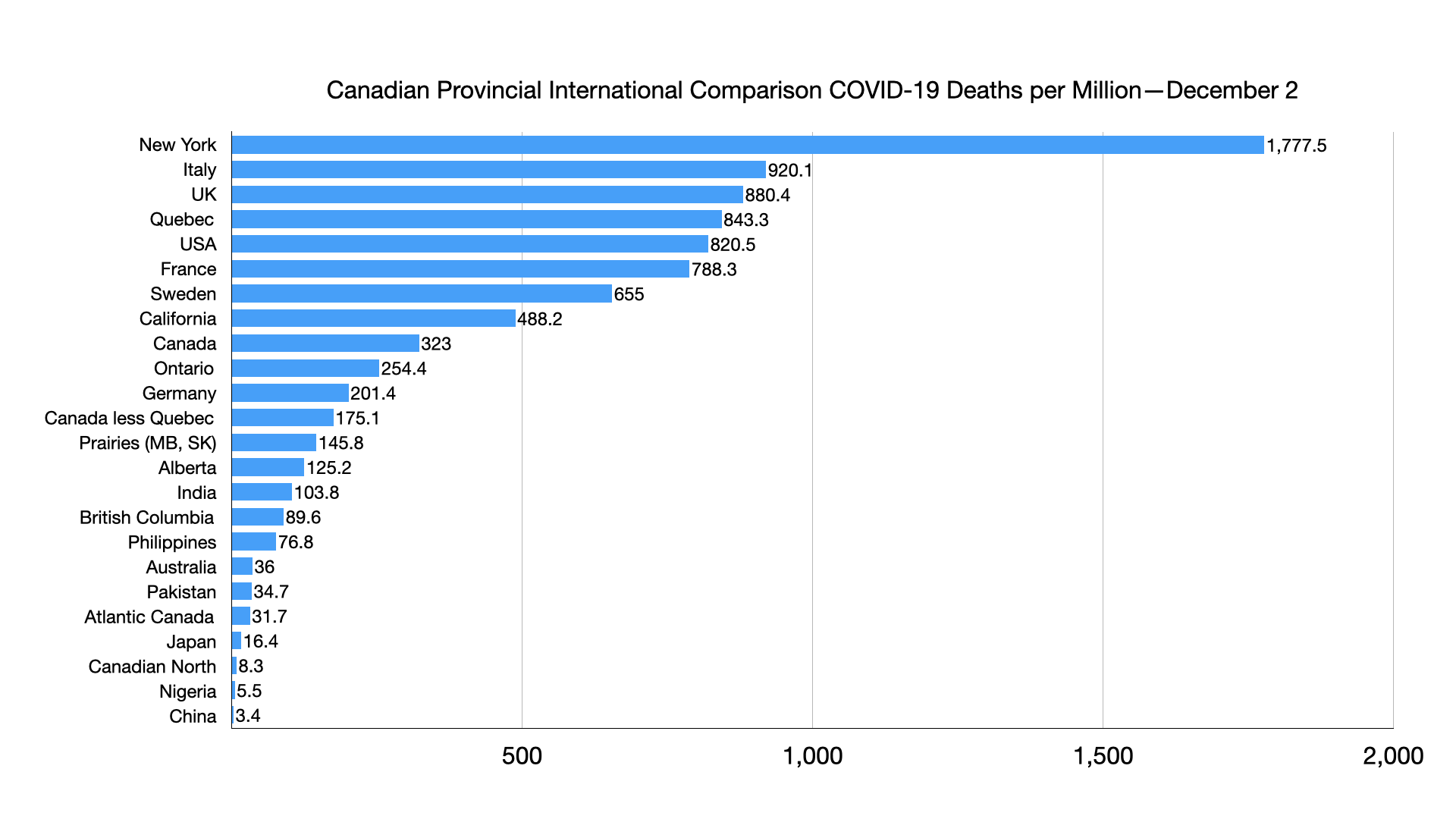
#COVID-19: Comparing provinces with other countries 2 December Update

Main news continues to be with respect ongoing sharp spike in infections along with death rate increases:
 
Weekly:
 
Infections per million: Alberta ahead of Germany, Japan ahead of Australia
 
Deaths per million: British Columbia ahead of Philippines, Canadian North ahead of Japan
 
COVID Comparison Chart.002COVID Comparison Chart.003
 

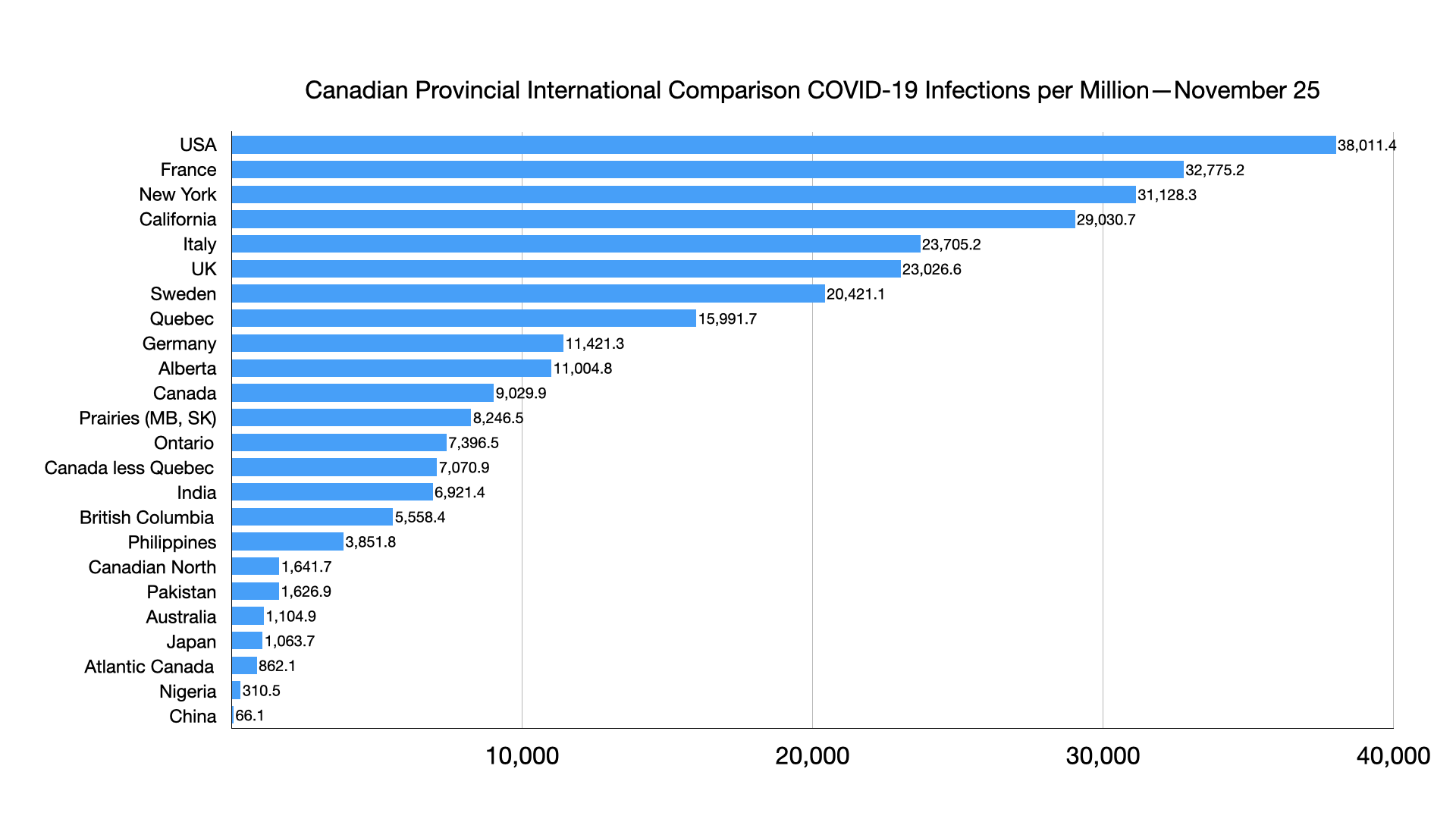
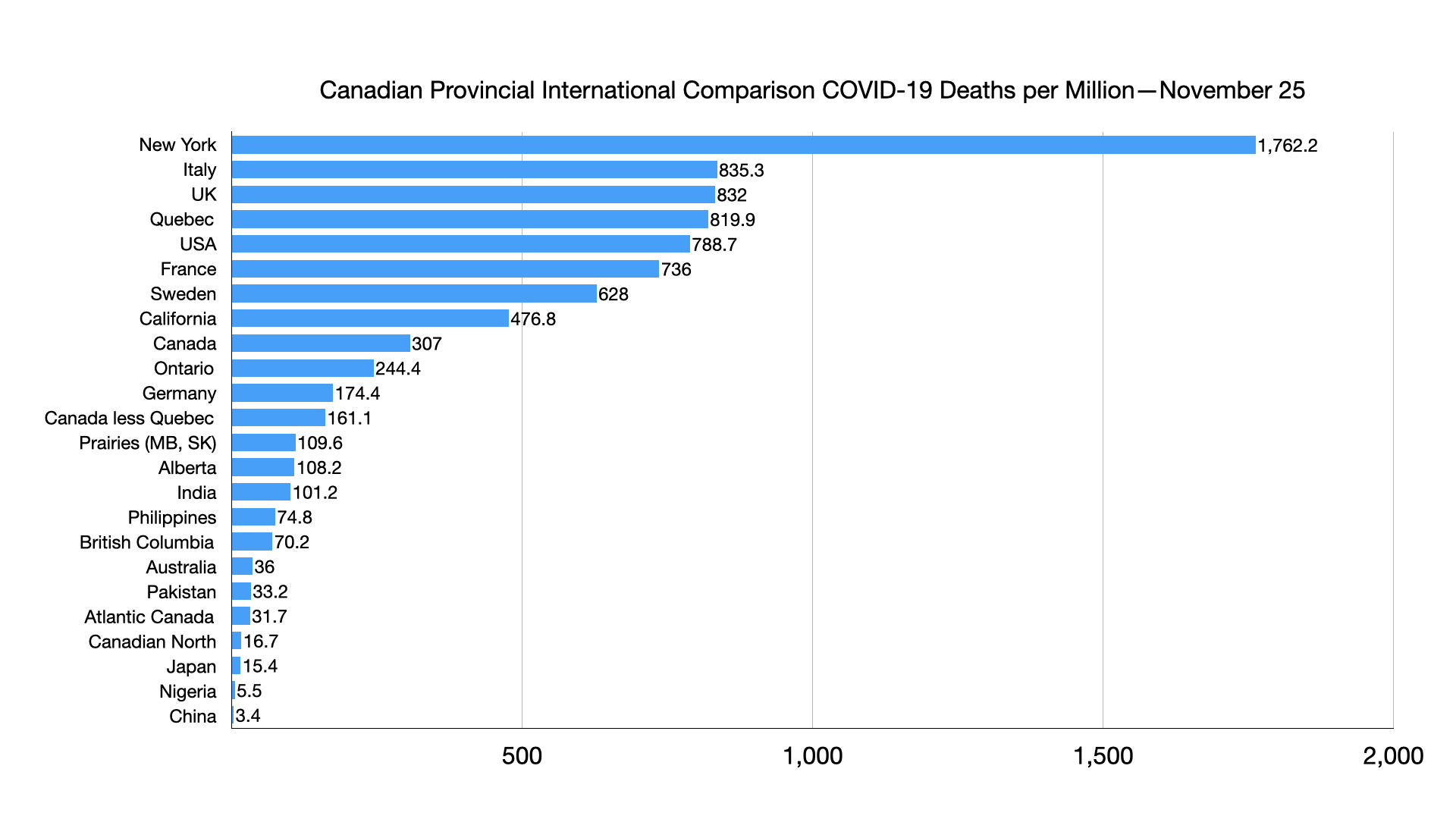
#COVID-19: Comparing provinces with other countries 25 November Update, Picard on Alberta

Main news continues to be with respect ongoing sharp spike in infections along with death rate increases:
 
Weekly:
 
Infections per million: Italy ahead of UK, Prairies ahead of Ontario, Canada less Quebec ahead of India, Canadian North ahead of Pakistan
 
Deaths per million: Italy and UK now ahead of Quebec, Prairies and Alberta ahead of India, Pakistan ahead of Atlantic Canada, Canadian North ahead of Japan
 
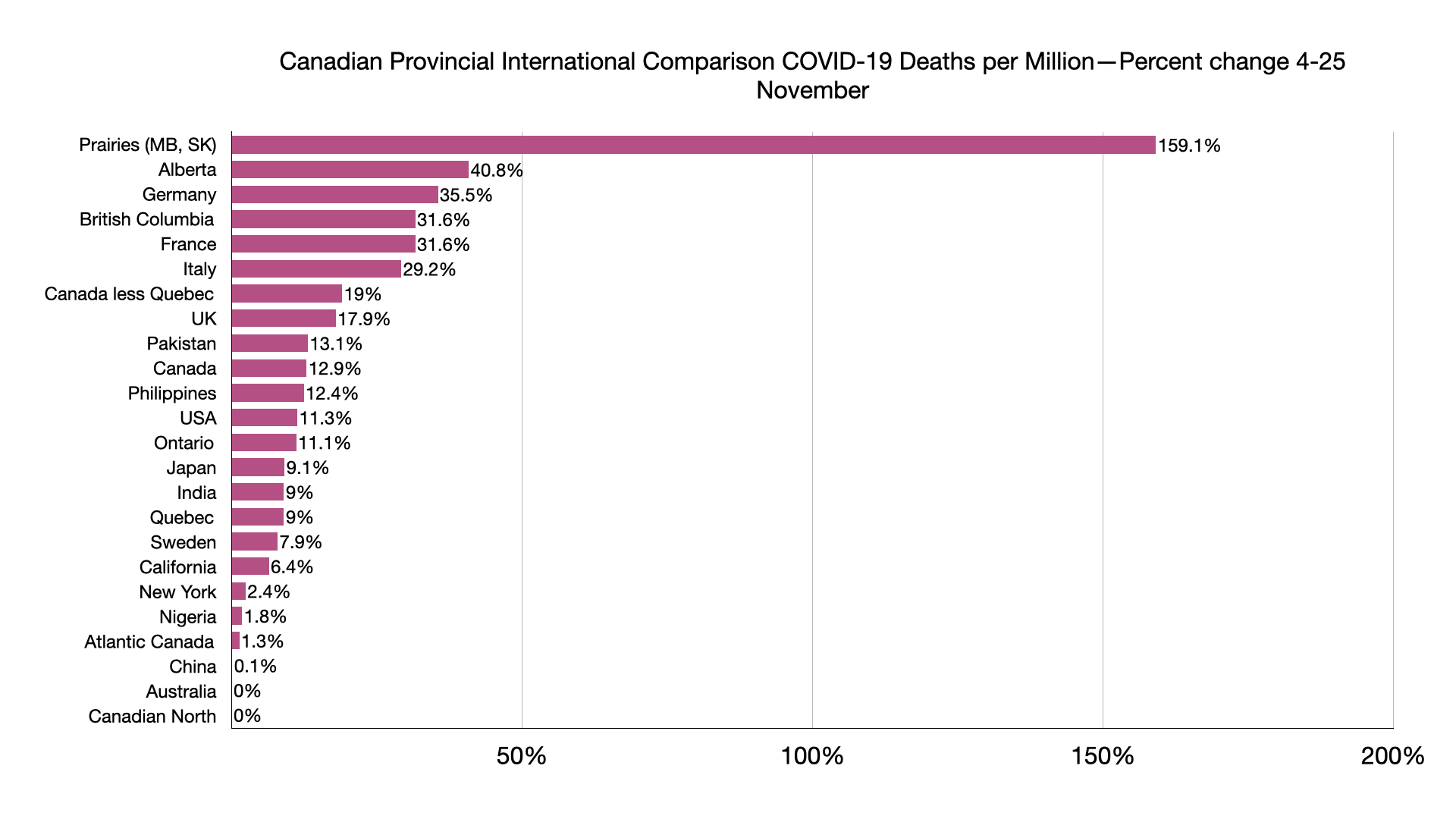
November 4-25 increase:
 
Infections per million: Greatest increase in Canadian North and Western provinces, moving ahead of many European countries
 
Deaths per million: Similar pattern with respect to deaths


André Picard’s critique of Premier Kenney and his government’s response to the pandemic:

Feckless.

That’s the only way to describe Alberta’s “tough” new measures.

In response to the soaring number of COVID-19 cases in the province, Premier Jason Kenney declared a “state of public health emergency” on Tuesday.

He started out with a little muscle flex, saying “no indoor social gatherings will be permitted, period.” Outdoor gatherings will be limited to 10 people.

But then we learned that restaurants will be open for in-person dining, bars will remain open, and so will casinos, gyms, stores, primary schools (Grades 7-12 are going to remote learning).

Heck you would be hard-pressed to find anything that will be closed.

Places of worship are allowed to hold services with one-third of capacity, just as they are now but “we are moving from recommendations to rules.”

Mr. Kenney also earnestly announced that masks would now be mandatory in the province’s two big cities, Calgary and Edmonton. But they already are mandatory because municipal governments have been a lot more pro-active and sensible than the province.

What we saw Tuesday was inaction posing as action, a quasi-libertarian Premier bending over backward to do nothing while pretending otherwise.

But Mr. Kenney’s true nature was revealed when he began prattling on about how he has resisted a lockdown because it would be an “unprecedented violation of constitutional rights.” He once again heralded the importance of “personal responsibility” while, at the same time, announcing rules that clearly suggest people don’t have to be very responsible.

Acting forcefully to protect citizens from the ravages of a global pandemic is not a violation of their rights. Quite the opposite.

Just hours before Mr. Kenney spoke, Nova Scotia Premier Stephen McNeil announced the closing of all restaurants, fitness and recreational facilities, libraries, museums, casinos and more for at least two weeks.

Why? Because the province had a “surge” of 37 cases. Thirty-seven. Business owners actually demanded the lockdown, saying severe rules are the only way to retain consumer confidence.

Alberta recorded 1,115 coronavirus cases on Tuesday, along with 16 deaths. And that was the lowest rate in a while, because testing is way down. In recent days, Alberta has had more cases than Ontario, which has more than three times the population.

The testing system is overwhelmed. The contact tracing system has collapsed. Hospital beds, and all-important intensive care beds in particular, are filling up fast. There are dozens of outbreaks in hospitals and care homes and schools.

Alberta’s pandemic response was great for many months – the Premier was right to underline that fact. But the harsh reality today is that public health and hospitals alike are dangerously close to losing control of the situation.

Mr. Kenney said it himself: “If we don’t slow the ER and ICU admissions, it will threaten our health system.”

But then, in the next breath, he was back to talking about how it’s essential to keep businesses open.

Who knows what the public will make of this Jekyll and Hyde discourse? The between-the-line message seems to be: It’s business as usual.

Yes, the pandemic is a blow to the economy; yes, it’s taking a toll on our mental health; yes, there is a lot of collateral damage.

But if there’s one thing we have learned – or should have learned – is that all that will continue, along with the harm of COVID-19, unless you go all-in to slow the spread of the virus.

Mr. Kenney said the “balanced approach” he has chosen will ensure that the spread of the coronavirus is interrupted while allowing businesses to remain open. But you can’t have it both ways.

The evidence from around the world is crystal clear: This approach is a fast-track to failure. Not only will the virus continue to spread, but the economy won’t flourish because people will still be scared.

Quebec has been in lockdown for more than two months – with rules that are way more strict that what Alberta is imposing – and it’s barely able to keep its COVID-19 numbers static, never mind lower them.

Does anyone seriously believe Alberta will be able to do better by essentially doing nothing?

Albertans should brace themselves because they’re in for a world of hurt in the coming weeks.

Source: https://www.theglobeandmail.com/canada/article-jason-kenneys-balanced-approach-is-a-fast-track-to-failure/

Religious minorities say Quebec’s Christmas gathering plan shows a double standard

Valid critique. I remember when Ontario’s Sunday closing laws (Lord’s Day Act, the Retail Business Holidays Act) were repealed or amended given this discriminatory impact on other religions along with general public pressure in the early 1990s:

Members of religious minority groups in Quebec are decrying the provincial government’s plan to allow Christmas-time gatherings in the midst of the COVID-19 pandemic, calling the move a sign of a double standard.

The condemnations came days after Premier Francois Legault offered Quebecers what he dubbed a “moral contract” through an offer to raise gathering limits over a four-day period starting on Christmas Eve.

“It’s disappointing,” said Yusuf Faqiri, a representative of the National Council of Canadian Muslims. “The Muslim community, the Jewish community, the Sikh community, when we had our respective holidays, we were not able to gather.”

Legault announced the terms of the Christmas repreive on Thursday, saying groups of up to 10 could gather between Dec. 24 and Dec. 27. The short-term move marks a sharp reversal from rules currently in place in much of the province, where all indoor gatherings are banned in regions classified as red zones under the province’s pandemic response plan.

Faqiri said his objections to the move aren’t rooted solely in the pandemic. His organization is one of several that is currently challenging Quebec’s secularism law in court. That law bans some public servants, including teachers, from wearing religious symbols while working, on the grounds that the state must be religiously neutral.

He said it’s “a contradiction” to defend that bill while allowing Christmas gatherings.

“All Quebecers, from all faith groups, from all respective traditions, we’re all proud participants in the society,” he said. “But in order for us to do that, we should all be treated the same and that’s where the fundamental issue lies.”

Rabbi Lisa Grushcow, of Temple Emanu-El-Beth Sholom in Montreal, said Jewish people have been left out.

“But we’ve been left out of something I wouldn’t want to be included in,” she quipped.

Grushcow said she’s worried that the allowance for gatherings will put vulnerable people and teachers at risk.

“I don’t know that the government’s following the science and the medical wisdom,” she said. “That’s the piece that worries me.”

She said she doesn’t want the government to allow people to gather for Hanukkah, noting that her congregation has already made it through more important Jewish holidays in the midst of the pandemic.

“We made it through Passover, we made it through Rosh Hashanah, we made it through Yom Kippur,” she said. “So if anything, I would hope that our experience can show that it’s possible to be creative and still be connected, even while keeping each other safe.”

Grushcow said there is an inconsistency when it comes to the Quebec government’s approach to secularism.

“You’re saying that you can rearrange the whole school calendar and put a society at risk so folks can celebrate Christmas, but you’re not going to let it teacher wear a hijab or a kippah,” she said. “It is a bit of a challenge.”

When asked about people who don’t celebrate Christmas at press conference on Thursday evening, Legault said he believes allowing for gatherings around Christmas is what most Quebecers want.

Other rabbis echoed Grushcow’s concerns.

“While we appreciate the intent of the Quebec government’s decision to accommodate families and allow them to gather for Christmas, it is unfortunate and disturbing that it does not apply to all faith communities,” Rabbi Reuben Poupko, the co-chair of Centre for Israel and Jewish Affairs-Quebec and the rabbi of the Beth Israel Beth Aaron Congregation in Montreal, said in a statement. “The elevating of one faith community over another is inappropriate, and all faith communities should be treated in an equitable manner.”

At a technical briefing on Friday morning, public health officials said they didn’t specifically choose to centre the moral contract around Christmas but selected the dates because they fell in the middle of the winter school break.

Source: https://www.nationalnewswatch.com/2020/11/22/religious-minorities-say-quebecs-christmas-gathering-plan-shows-a-double-standard/#.X7uWei3b23g

Paradkar: Covidiots come in all colours. Using race-based data to demonize South Asians is a cruel twisting of the evidence

The politically correct response to the thoughtful discussion of the cultural aspects by South Asian doctors (South Asians play a part in COVID-19 transmission and we need to acknowledge it).

More interesting analysis and commentary would contrast the low COVID-19 rates in Richmond, largely Chinese Canadians, with the high rates in Surrey, largely Indo-Canadians to assess the relative importance of socioeconomic and cultural factors.

Average household size is largely comparable: 2.6 in Richmond Centre and 2.7 in Steveston-Richmond, 2.7 in Surrey Centre but 3.4 in Surrey-Newton.

Participation rates are slightly higher in Surrey while male unemployment rates are comparable. However, female unemployment rates are higher in Surrey. Median incomes for both men and women are largely comparable although Steveston-Richmond median incomes are slightly higher.

Both socioeconomic and cultural factors play a role, it is not one or the other:

From the barbaric East Asians and their bat-eating habits to the villainous South Asians and their dangerous socializing habits, the COVID-19 narrative has traced an interesting if richly racist trajectory in the eight months since it has afflicted us.

Across the U.K., Canada, the U.S. and other nations, the pandemic is unveiling what health experts have always known: structures birthed in bias and driven by principles of profit have gone on to exacerbate the suffering of people living in the margins.

In June, a study by Public Health England said Black and Asian people in England are up to 50 per cent more likely to die after being infected with COVID-19. 

In the U.S., analysis by the APM research lab shows Black, Indigenous and Latino Americans experience a death rate triple or more that of white Americans from COVID-19, adjusted for age.

And in Canada a StatsCan report last month found people in large visible minority neighbourhoods in B.C, Quebec and Ontario had a much higher likelihood of dying than mostly white neighbourhoods. 

There is a growing discussion, in particular, on the role of South Asians who account for nearly half the cases of COVID-19 in the GTA’s Peel region, although they populate about a third of it. Of the 1,417 new cases of COVID-19 Ontario reported Wednesday, about a third, or 463, came from Peel.

All this data. 

Data is important to pinpoint where weaknesses lie and where solutions are needed. But of what use data if the collection itself is seen as action against those inequities? Of what use data if the analysis is used to blame communities for cultural deficiencies and individuals for systemic failures?

As the Peel example shows, layer that data with anecdotes and personal experiences of irresponsible socializing and snap, a simplistic narrative is born.

In an essay published last week in the Royal Society of Canada, University of Toronto professor Rinaldo Walcott slammed the gap between calls for race-based data collection and claims it leads to better policy making.

“Race-based data can quite frankly slow down reform,” he wrote. “ ‘Doing the research’ when a problem is already identified and its solutions known, means the collection of race-based data does not actually add much to policymaking. In fact, in some cases, it can do more harm than good.” 

Toronto Public Health data has consistently shown disproportionate impacts of COVID in the city’s northwest. Sané Dube, a manager of Community and Policy with Social Medicine at the University Health Network, often takes the 29 Dufferin bus that goes through some of the worst-affected areas. “The 29 often looks like there’s no pandemic. The bus is so full. And people who are going to work are on that bus. Same with the 35 on Jane.” 

Public health could ask the TTC to provide more buses on those routes, she says, so that people — many of whom are essential workers, “you know, the people we need to work to be able to survive the pandemic” — don’t have to be on crowded buses. 

That is one example of evidence-based action. 

If Black people have long been treated as having a cultural abnormality with their broken families — think of the single-mom and absent-father tropes — without a thought to why those families have been ripped apart, now it’s the turn of South Asians to be demonized for the opposite, their multi-generation family homes and their socializing habits. 

That there is an affordable housing crisis is well-known. Earlier this month Brampton Mayor Patrick Brown announced Peel was getting an isolation hotel, a place for people with precarious employment or living in crowded housing to isolate safely. This is another example of evidence-based action. But why the delay?

“That Peel is getting this now — we are in Month 8 of the pandemic. Why are we just getting this now?” Dube asks. 

“There is complexity behind this data that goes far deeper than South Asian “culture” or “values,”” Seher Shafiq wrote in First Policy Response, a new project by Ryerson Leadership Lab and other institutions that publishes policy ideas, where she is a managing editor. 

“South Asians, like their other racialized peers on the frontlines of this pandemic, are disproportionately employed in precarious jobs in the service industry and gig economy – brewing Tim Hortons coffee, bagging groceries and delivering UberEats orders. This means they are exposed to the virus in their day-to-day lives.”

This “model minority” was hardest hit by the pandemic recession in October, according to StatsCan. 

It’s easier to pathologize communities than implement evidence-based action. Easier to berate people for parties and “multi-day weddings” than to examine if there are adequate testing sites, if they are easily accessible by public transit and if there are adequate supports for those who do test positive.

I have little doubt there are brown covidiots out there, in large homes and small, who think they are impervious to the virus and socialize irresponsibly. I have seen no evidence yet that they are disproportionately more so than any other racial or ethnic group. If there is a blip in numbers after Diwali this past weekend, will it be solidly more than the blip after Thanksgiving? More than after Christmas? 

Covidiocy may be unrelated to race but this much is clear: race and culture are very much related to who gets scrutiny and who escapes it. 

As East Asians — ironically among the least impacted by the virus — will testify, it doesn’t take long for the blame game to spill over to people and their cultures.

Source: https://www.thestar.com/opinion/star-columnists/2020/11/18/covidiots-come-in-all-colours-using-race-based-data-to-demonize-south-asians-is-a-cruel-twisting-of-the-evidence.html

COVID-19 mortality rate higher in neighbourhoods with more visible minorities: StatsCan

Yet more evidence of correlation between visible minorities, lower income and poorer housing:

Residents of communities home to more visible minorities had a higher likelihood of dying from COVID-19 in Canada’s three largest provinces, according to Statistics Canada, in a trend health experts say underscores the need for provinces such as B.C. and Quebec to improve their data collection on race and mortality.

report issued by StatsCan late last month looking into COVID-19 mortality rates in “ethno-cultural neighbourhoods” found communities in B.C. that were home to more than 25 per cent visible minorities had an age-adjusted COVID-19 mortality rate that was 10 times higher than neighbourhoods that were less than one per cent visible minority.

In Ontario and Quebec, neighbourhoods with large visible minority populations had age-adjusted mortality rates three times higher than the general public.

That COVID-19 deaths in B.C.’s ethno-cultural neighbourhoods are ten times higher than comparable rates for Canada’s broader population could be partially linked to a lower general death rate in the province.

As of Monday, 299 people with the virus had died in B.C., out of more than 11,000 deaths across Canada.

The Statistics Canada analysis was compiled when B.C. had fewer than 200 coronavirus deaths. But the analysis is part of a growing body of literature showing that visible minority communities in Canada have been hit harder by the virus than the general population.

Dr. Andrew Boozary, the executive director of Social Medicine and Population Health at the University Health Network in Toronto, said it’s important to have specific, reliable data so affected populations can be protected.

“We’ve not been a leader on that front and it has been awfully expensive in not allowing our response to be as precise as we hoped, but also not allowing us to galvanize the response as quickly as we should have.”

‘Extremely important to be collecting that data’

Unlike Ontario, Quebec and B.C. are still not collecting the data that would identify which communities are most at risk, or why they are at risk, despite repeated calls to do so.

Source: COVID-19 mortality rate higher in neighbourhoods with more visible minorities: StatsCan