Nili Kaplan-Myrth: Vaccination nation – or, a word with the prime minister

From our family doctor:
As a family doctor, I never dreamed I’d speak to the prime minister about a life and death issue for Canadians. But this afternoon (Thursday), joined by my RN colleague Amie Varley, I am moderating a panel of health-care workers and community advocates across the country. We’ve been called “front-line heroes” throughout the COVID-19 pandemic, but our voices are often excluded from decision-making tables. I put together this panel to have a national conversation about COVID-19 vaccination strategies. Many of the issues that keep me up at night are similar to the issues that keep my colleagues, patients, friends and family awake.
What it is that we are all worrying about? Geographic disparities. My friend is a doctor in Kenora. She told me that in a 700-km corridor, from Winnipeg to Thunder Bay, none of the doctors and nurses in intensive care units (ICUs) and emergency departments, staff in LTC, health workers in any setting – has received the vaccine. She told me how fragile their hospital is in a remote area, where their entire system could collapse if anyone on their team gets sick.
We’re worried about systemic inequalities in our health-care system. First Nations, Inuit and Metis patients, and racialized Canadians, occupy a disproportionate number of the beds in our ICUs, and make up a disproportionate number of deaths from COVID-19. People who live in poverty, or are homeless, are far less likely to access the vaccine than affluent people are. Registration for vaccination may be entirely online, reliant on individuals to act as if they are buying tickets to a rock concert. How will my patients who are in their 80s, or my patients who do not own computers, who have already struggled to book COVID-19 tests, ensure that they get their shots?
There are so many issues of equity and diversity. In the process of putting together our panel, I was approached by people who wanted to know if we would talk about the vulnerability of seniors who live in the community, people with disabilities, caregivers outside of institutional settings. I spoke with people who were concerned we’d forget about Canadians who live or work in shelters, in jails. I was also approached by women’s health experts, discussing the need for national standards to support pregnant and lactating women as recipients of the COVID-19 vaccine.
I couldn’t include every advocate or every subject in our conversation with the prime minister, let alone every province and territory. How does one cover issues of racism, ableism, ageism, sexism, language barriers, socioeconomic barriers, discrimination faced by LGBTQ patients, and all the ways in which our health care fundamentally disadvantages members of our society, all in a one-hour conversation about access to COVID-19 vaccine across the country?
I also wanted to address the idea that we are “in this together,” when in fact we tend to work in silos. Our panel brings us together: Nurses, doctors, midwives, pharmacists, personal support workers, health policy researchers, patient advocates, essential caregivers. We end the panel by talking about how we can collaborate to get the COVID-19 vaccine into the arms of Canadians.
While I am still pinching myself, amazed that this is possible – I’ve told my children to speak up for what matters, but who’d have thought I’d speak directly to the prime minister? – our panel is an example of the diverse voices that should be at every decision-making table. This is only the beginning of a collaborative conversation that I hope will continue.
Dr. Nili Kaplan-Myrth, MD, CCFP, PhD, is a family doctor and anthropologist who writes about health policy and politics. She also co-hosts the podcast Rx:Advocacy.ca

Source: Nili Kaplan-Myrth: Vaccination nation – or, a word with the prime minister

What Canada can learn from Australia’s COVID response

While an Australian strict travel restrictions much harder to do in Canada given our long land border with the USA and the high level of economic integration, it is striking that Canadian governments have been unable and late in responding to COVID-19, with the results we are familiar with:

This temporary Saskatchewan expat is loving Melbourne this summer, for the reason many of the locals aren’t. It’s cool – not cool as in hip, but low-20s temperature cool. Great for running and biking and walking. Not so great for the beach or dining on restaurant patios and decks.

Those patios and decks are nonetheless open and full (maximum density of one person per two square metres), spilling out onto busy streets full of shoppers. The Australian economy is now projected to grow by 3.2 per cent in 2021, a major turnaround from last July’s estimate of minus 4.1 per cent for this year. Whence this miracle?

Maybe pandemic control has something to do with it. Here, “pandemic control” is not an oxymoron. Australia isn’t an orderly, fastidious society like Japan or hospitable to healthy doses of authoritarian rule like Singapore. It is a raucous democracy with its politics evenly divided between conservative and progressive camps. Last November saw a big anti-lockdown demonstration in Melbourne convened to protest the measures that drove the case count down to zero.

You cannot attribute Australia’s success to logistical genius or Delphic foresight. There were some legendary missteps. The Ruby Princess cruise ship debacle that disgorged a boatload of infected passengers onto the streets of Sydney a year ago. The slapstick hotel quarantine theatre in Melbourne that created the second wave of cases last June. The multi-million-dollar inquiry never did get to the bottom of exactly how, and by whom, quarantine security was contracted out to a company with no experience and ill-trained staff. The State of Victoria cabinet secretary, a cabinet minister,  and a secretary (deputy minister) lost their jobs, while others were shunted aside.

But as of Feb. 5, Australia has had 35 COVID deaths-per-million since the beginning of the pandemic. By comparison, Canada has had 543.

So, what accounts for the difference? Some is luck and circumstance. Australia is an island off the world’s heavily beaten paths. But at the beginning, its numbers were similar to Canada’s. As of March 31, 2020, Australia had 4,763 cumulative cases and Canada had 8,612 (about 20 per cent more per capita). By early February 2021, Canada had 19 times as many cumulative cases per capita.

Early in the pandemic, no one knew with certainty how contagious or lethal it was and which measures were essential to containing it. Different jurisdictions tried different policies and practices. The results of the global experiment are in. What can we learn from Australia?

First, testing is important but is powerless without good policy. Over the past year, there were periods where Australia’s testing rate was about double Canada’s, but since last summer overall rates have converged and at times Canada’s rate has exceeded Australia’s. Testing tells you what you’re dealing with. It doesn’t tell you how to deal with it.

Second, both external and internal travel restrictions are effective. Australian states – over the objections of the national government – are quick to close their borders to each other as well as the outside world. Since last September, the highest daily count of new cases nationally has been 44. Yet even after five months of stable, low numbers, people still had to quarantine for 14 days to go to Western Australia (rescinded as of Feb. 5, 2021).

On Jan. 31, a single case popped up in Perth, in Western Australia: a guard working in the hotel quarantine program. His flatmates tested negative, as have others of his reported contacts. Yet Victoria has closed its border to most populated areas of Western Australia and will fine people up to the equivalent of $4,900 if they enter without a permit.

Third, people are more likely to follow rules if you enforce them. Victoria levied the equivalent of about $29.5 million in fines last year. People were upset. Many resulted from minor infractions and/or confusion about what was permitted. Most weren’t paid and all but the most brazen violators can get the fine rescinded if they go to court and promise to behave. But the government took the heat to make a point. Pandemic control measures carry the force of law. Four hundred people were arrested at the November anti-lockdown rally.

Fourth, decisions are swift and decisive. Australia doesn’t wait for a prolonged spike in numbers. As soon as there is a small outbreak – a single case in Perth, a few cases in the Northern Beaches area of  Sydney – the system springs into action. The hot zones are mapped. Activities are suspended. Contact tracing and testing intensify. Perth and the surrounding region are locked down for an initial five-day period – the vaunted circuit-breaker approach that gives the testing-and-tracing system time to nip the contagion in the bud before the numbers get out of hand.

But the most important lesson is that Australia learned and applied the lessons. It gave up on selective restrictions when the modelling and the epidemiology suggested they couldn’t keep numbers stable and low.

The world knew from the beginning that travel was a major risk factor. Australia took that knowledge to heart. Leaders took a whole-of-pandemic perspective, reasoning that in the case of Victoria, which had most of the country’s cases for months, a severe 112-day lockdown would be less damaging to health and the economy than attempts to finesse the risks with more selective policies. The state premiers became pandemic hawks, determined to do whatever it took to avoid greater and more prolonged misery.

I don’t know how closely Australian officials have observed Canada’s pandemic performance. I suspect they would use it as an object lesson in what not to do. There is, of course, no pan-Canadian strategy – that is part of the problem – but too many provinces have catered to special-interest group pleading, played to their political bases, left bars open, made mask-wearing optional, did little enforcement and responded belatedly to emerging threats. They gave the virus a huge headstart before they chased it in earnest.

Policy and practice have to be grounded in an understanding of the citizenry. Fascinating new research reported in The Lancet shows that countries with “loose” cultures of adherence to social norms (like Canada, the U.S., most of Europe) have had infection rates five times higher, and death rates nine times higher, than those with “tight” cultures (such as Singapore, China and South Korea). Australia and New Zealand are in the loose culture camp, but they have succeeded nonetheless. They did not bank on voluntary, universal adherence to sensible guidelines. They did not make suggestions or request adherence. They raised the stakes, communicated unambiguously, came down hard and showed force where force was needed.

For once, the resolve appears to have achieved consensus among governments of different political stripes. New Zealand Prime Minister Jacinda Ardern is a social democrat, as are three Australian premiers. The other three state premiers are conservatives, as is Australian Prime Minister Scott Morrison. Despite their political differences, they’ve all sung largely from the same pandemic-control hymn book.

Now that more virulent mutations are on the scene. Canada needs to steepen its learning curve. The material is not difficult to master. The lessons are clear. The learning from failure has gone on too long. If Canada wants to succeed, emulate success.

Australia’s strategy is worth a close look not because the country is a paragon of hyper-efficiency and extraordinary governance, but because it is not. You don’t have to be perfect to do well. You simply have to say what you mean; mean what you say; pay attention to the science; and accept that while you may be vilified in some quarters for overreach, you invite catastrophe if you underestimate the strength and agility of the virus.

Source: What Canada can learn from Australia’s COVID response

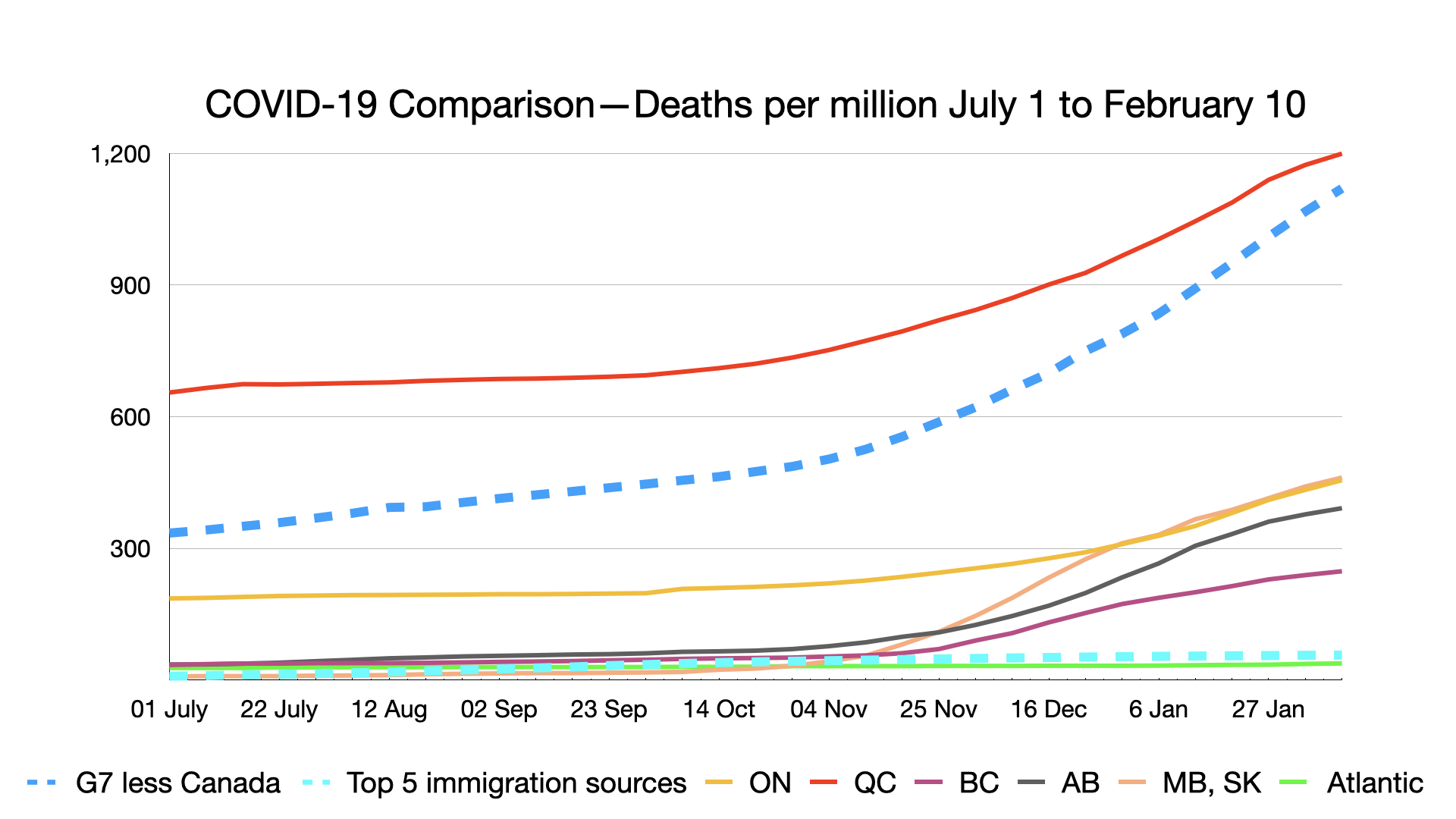
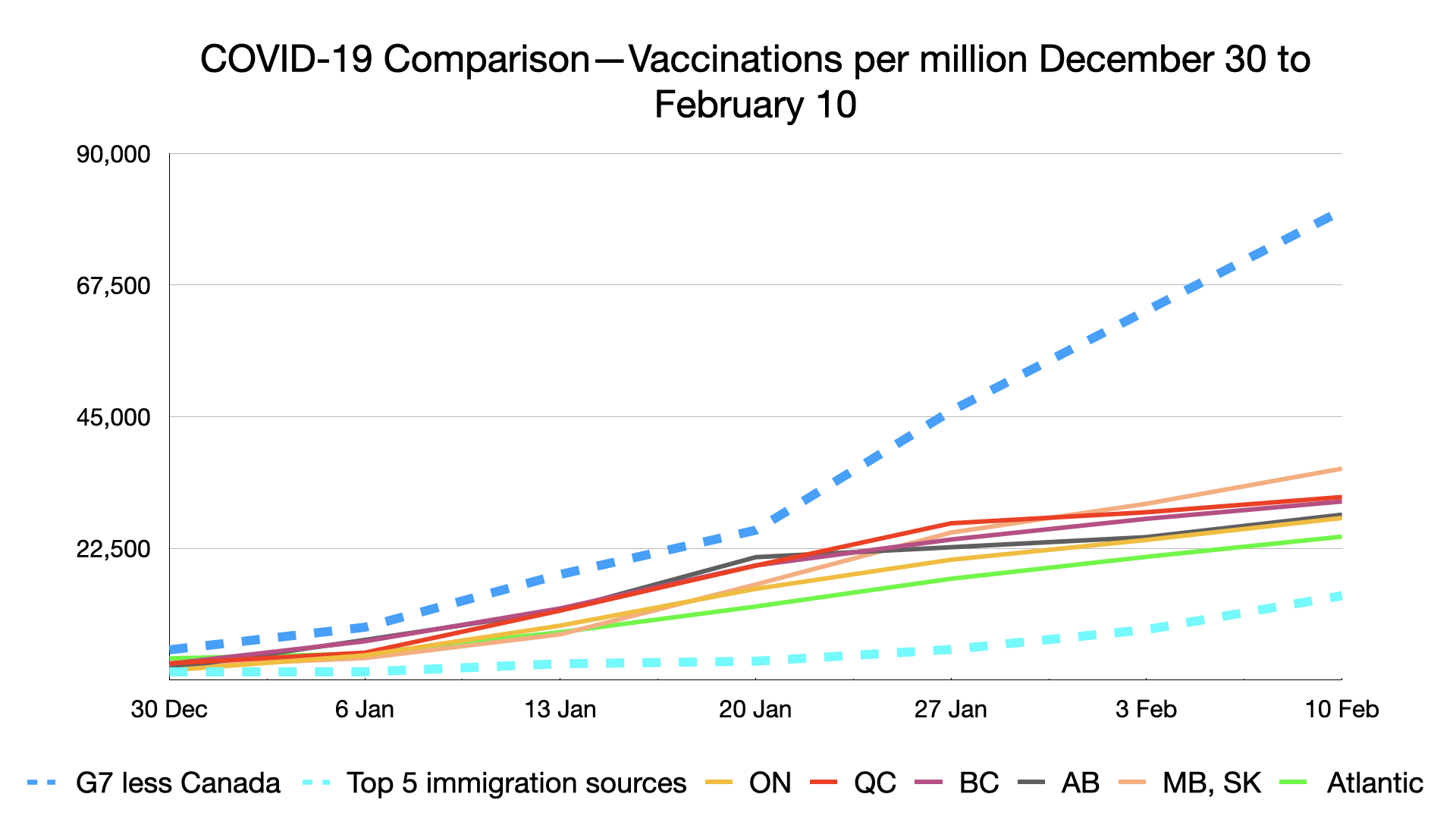
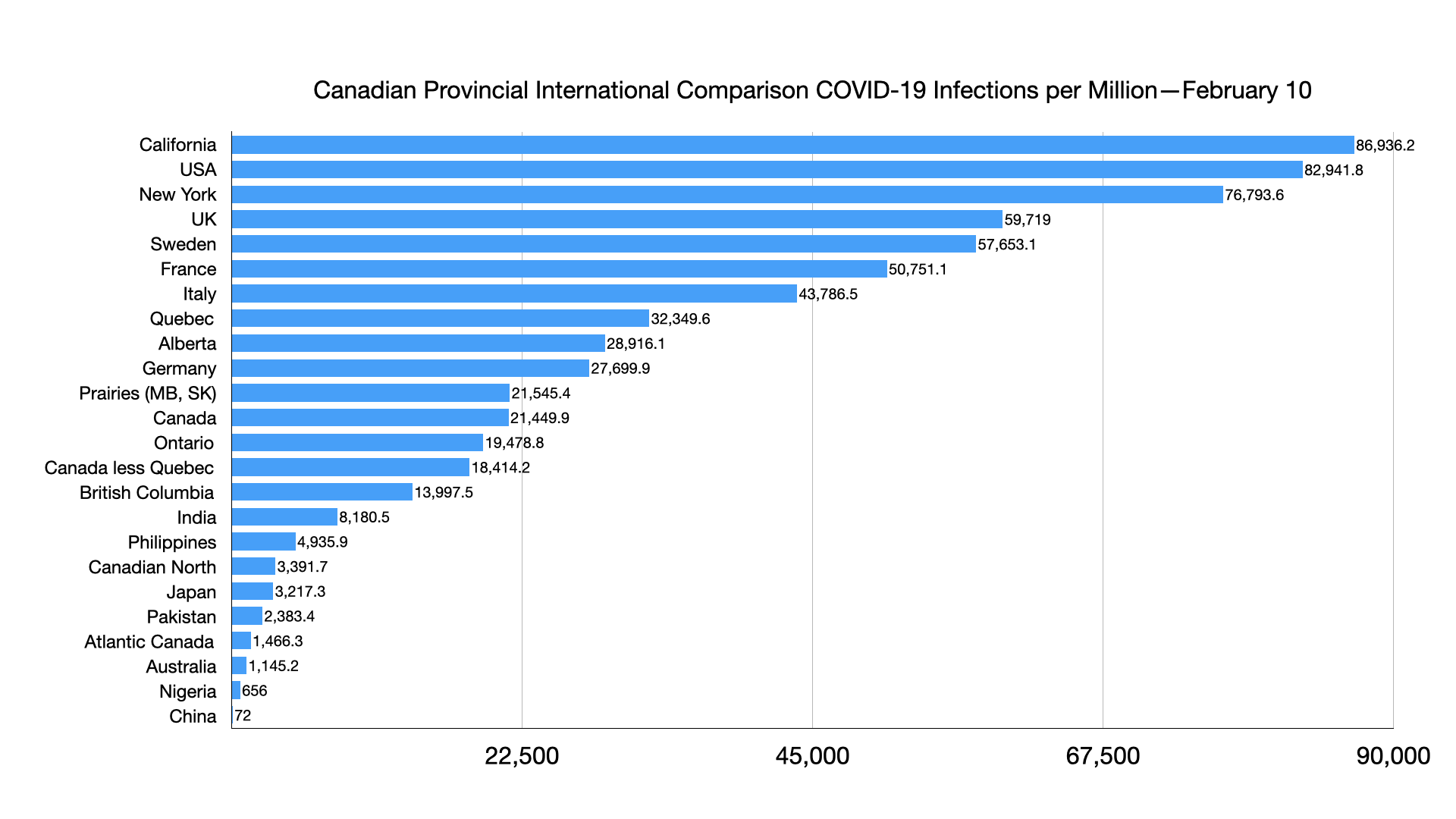
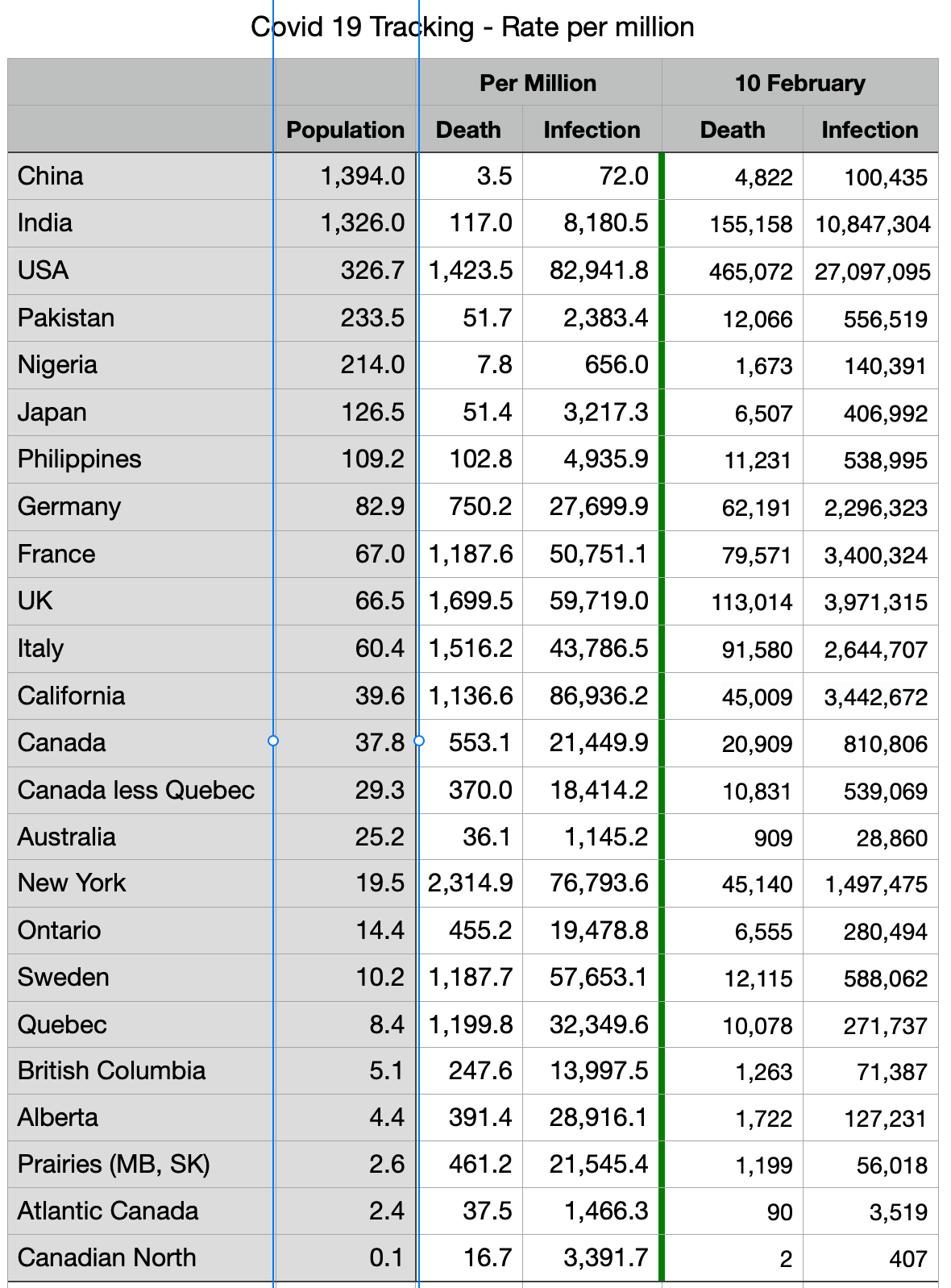
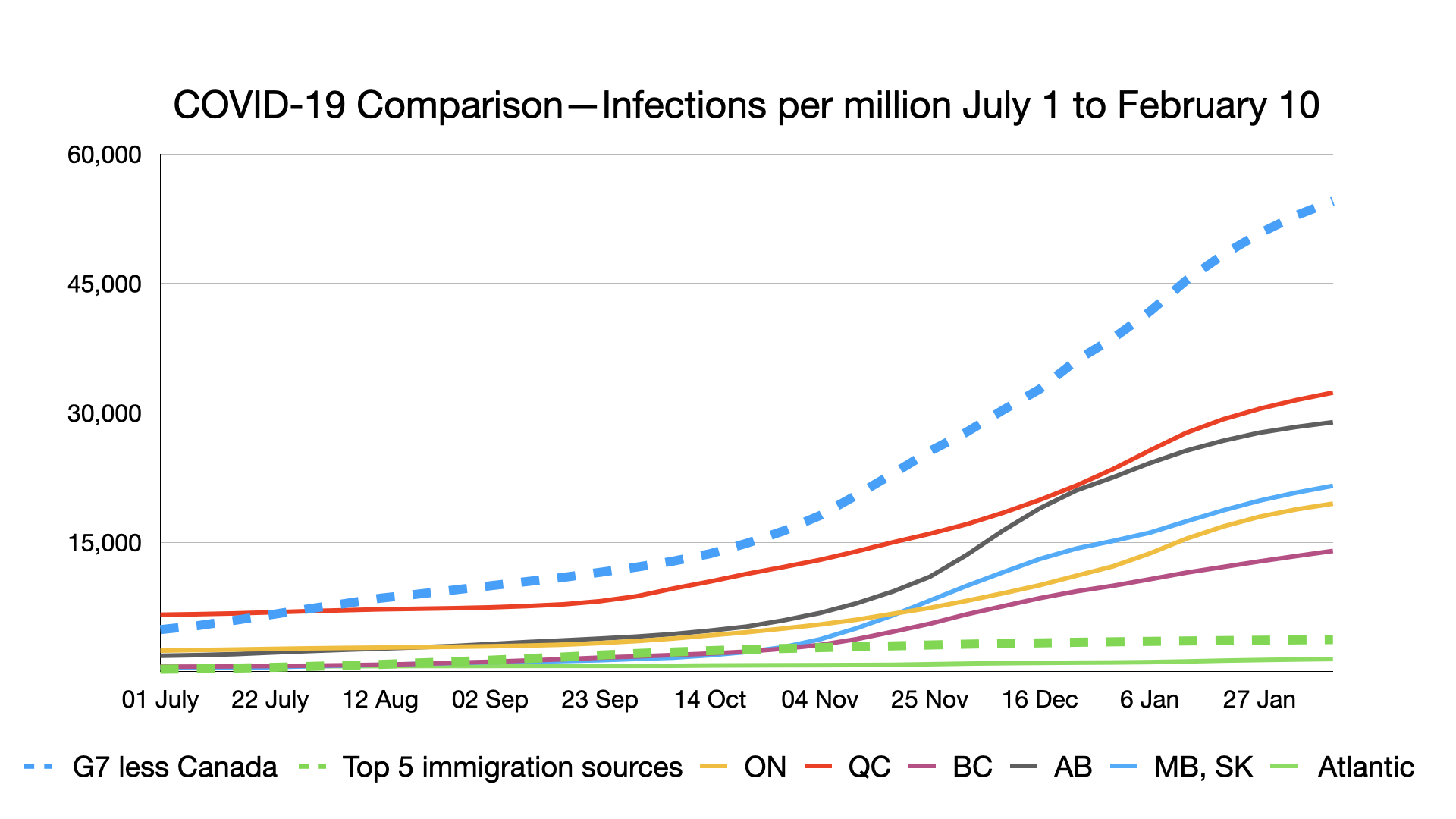
#COVID-19: Comparing provinces with other countries 10 February Update

The latest charts, compiled 10 February.

Vaccinations: The gap between the leading G7 countries (UK, USA) and other EU countries continues to grow given the pause in deliveries to Canada, with the notable exception of the Canadian North and the Prairies behind slightly ahead of France.

Trendline charts

Infections per million: Alberta continues to be controlling the virus better than Quebec.

Deaths per million: G7 continues to close in on Quebec, Prairies continue to have similar rates to Ontario with Alberta death rates tapering off compared to Ontario and Prairies.

Vaccinations per million: Gap between G7 and Canada, driven by UK and USA, continues to widen. While not on the chart, Canadian North (NWT, Yukon and Nunavut) have the highest vaccination rates overall.

Weekly

Infections per million: Prairies move ahead of Canada total

Deaths per million: France marginally ahead of Sweden.

Heather Scoffield: Waiting for COVID-19 vaccinations is no way to help jobless Canadians

Good overview with some breakdowns by visible minority groups and women:

It was never going to be “happy Friday” with new unemployment numbers for January on deck, but there were plenty of signs it was going to at least be “silver-lining Friday.”

Alas, it’s neither of those. The labour market in January was the bleak mid-winter we feared, especially if you’re young, or a person of colour, or female, or a part-timer — or, God forbid, all of those at once. And policy-makers seem poorly equipped to do much about it for now, except to counsel patience.

About 213,000 jobs disappeared in January as some of most populated areas in Canada — namely Ontario and Quebec — tightened up pandemic restrictions. It means that the second wave is taking a serious toll, eroding the employment gains of the summer and fall and making a quick recovery more elusive.

At our worst point last April, when a firm lockdown was in place, about 5.5 million people were without work or dealing with reduced hours because of the pandemic. Summer allowed many people to return to work or find new jobs, but we’ve lost ground in December and January. And now, there are still 1.4 million affected workers, many of them in the same groups of people who were hit by the first wave.

Canada’s unemployment rate rose to 9.4 per cent in January, up from 8.8 per cent in December.

Digging a bit deeper, Southeast Asians saw their unemployment rate rise by 7.6 percentage points in January to 20.1 per cent — one in five. Black Canadians are at 16.4 per cent unemployment, up 5.5 percentage points from a month earlier.

Of Black women who are holding onto their jobs, almost a third were working in the health-care sector, and a third of those were in low-paid positions such as orderlies or nurses’ aides. In other words, they are holding onto pandemic employment by taking on poorly paid and often dangerous positions.

Unemployment among young people rose 1.9 percentage points to 19.7 per cent, and the job losses were particularly striking among part-timers and working-age teenagers.

Women lost twice as many jobs as men in January, especially mothers of young children.

We’ve been here before. The first wave showed us the same disturbing patterns, as the pandemic restraints shut down businesses involved in accommodation, tourism, travel, arts and culture, and food services.

But there were some signs that maybe the second wave would be kinder, and that employers were learning how to roll with lockdowns and constantly changing constraints. More than 5.4 million people are working from home, the highest number ever. High-income jobs have stayed protected. Capital markets are surging, creating a wealth effect. Housing prices are up. Commodity prices are up. And the federal government has spent hundreds of billions of dollars trying to keep the economy afloat. Job postings, according to Indeed Canada, are looking a lot like they did a year ago, before the pandemic.

But solutions for workers in public-facing industries are few and far between.

“To state the obvious, we didn’t figure it out,” said Leah Nord, senior director of workforce strategies and inclusive growth at the Canadian Chamber of Commerce.

The Conservatives called the job losses “devastating,” and Leader Erin O’Toole committed to “charting a new course” that sees Canadians put to work by “reshoring” the manufacturing of our own essential goods, rather than importing them from China.

Prime Minister Justin Trudeau said the jobs report was “difficult” and, urging patience, pointed to all the income and business supports the federal government has provided to tide people over.

“We are there to support Canadians and we will continue to be until get through this, with income supports, with vaccines, with health measures, with the supports that people need,” he said.

But actual jobs while we continue to wait for the pandemic to be conquered? Not so much.

Business groups are pushing for the widespread adoption of rapid testing and contact tracing, so that public-facing firms can open up safely and bring their workforces back.

“We need to keep Canadians safe and working,” Nord says.

There’s no doubt that’s easier said than done. Contact tracing becomes cumbersome when case levels are high. And rapid tests can be clumsy and imprecise, leaving many provinces reluctant to deploy them widely. Nord also suggests more aggressive efforts to match job-seekers with job vacancies, and intense retraining programs for long-term unemployed people.

It’s clear that full-fledged recovery efforts can’t start until the pandemic is under control, and that’s certainly not imminent. In the meantime, we owe it to those same groups of unemployed people who are repeatedly pummelled by the pandemic to brainstorm some better answers.

Biding our time in the face of on-again-off-again vaccination schedules and new variants is not an answer.

Source: Heather Scoffield: Waiting for COVID-19 vaccinations is no way to help jobless Canadians

Across The South, COVID-19 Vaccine Sites Missing From Black And Hispanic Neighborhoods

Not surprising. Hope someone will do a similar analysis for Canada (once we have a full supply of vaccines):

Georgia Washington, 79, can’t drive. Whenever she needs to go somewhere, she asks her daughter or her friends to pick her up.

She has lived in the northern part of Baton Rouge, a predominantly Black area of Louisiana’s capital, since 1973. There aren’t many resources there, including medical facilities. So when Washington fell ill with COVID-19 last March, she had to get a ride 20 minutes south to get medical attention.

Washington doesn’t want to fall sick again, so she was eager to get vaccinated, which is in line with federal health recommendations. But she faced the same challenge she did last year: finding a local provider, this time for a vaccine. She tried for weeks, checking at pharmacies in the area. And she was put on a waiting list.

Georgia Washington has lived in Southern Heights, a predominantly Black neighborhood in the northern part of Baton Rouge, La., since 1973. After falling ill with COVID-19 last year, Washington was eager to get vaccinated, which is in line with federal health recommendations. But Washington again had difficulty finding a local provider, this time to get a vaccine.

“I’ve got lots of patience,” Washington said. “I just want to get it over with.”

Communities of color have been disproportionately harmed by the COVID-19 pandemic. Now they’re at risk of being left behind in the vaccine rollout.

Using data from several states that have published their own maps and lists of where vaccination sites are located, NPR identified disparities in the locations of vaccination sites in major cities across the Southern U.S. — with most sites placed in whiter neighborhoods.

NPR found this disparity by looking at Census Bureau statistics of non-Hispanic white residents and mapping where the vaccine sites were. NPR identified counties where vaccine sites tended to be in census tracts — roughly equivalent to neighborhoods — that had a higher percentage of white residents, compared with the census-tract average in that county. Reporters attempted to confirm the findings with health officials in nine counties across six states where the differences were most dramatic: Travis and Bastrop counties, Texas; East Baton Rouge Parish, La.; Hinds County, Miss.; Mobile County, Ala.; Chatham County, Ga.; DeKalb County, Ga.; Fulton County, Ga.; and Richland County, South Carolina.

The reasons are both unique to each place and common across the region: The health care locations that are logical places to distribute a vaccine tend to be located in the more affluent and whiter parts of town where medical infrastructure already exists. That presents a challenge for public health officials who are relying on what’s already in place to mount a quick vaccination campaign.

It’s a problem that exists not just in the South but across the country. A team of researchers at the West Health Policy Center and the University of Pittsburgh found nearly two dozen urban counties where Black residents would need to travel farther than white residents to a potential vaccination site — unless health officials act to narrow the disparities.

“We’re hopeful there will be new facilities that are stood up,” says Dr. Utibe Essien, an assistant professor of medicine at the University of Pittsburgh who studies health disparities and worked on the research team. “But what we saw play out with COVID testing was there were new facilities that came up, but they relied on existing infrastructure.”

“This is structural and foundational to the racial disparities in our country.”

Troubles getting vaccinated in Black neighborhoods

In the part of Baton Rouge where Georgia Washington lives, there is just one Walgreens where COVID-19 vaccines can be found.

Ever since an interstate was built through Baton Rouge in the 1960s, the population in the northern part of the city has struggled with housing, food insecurity, poverty and crime. These inequities have always fueled disparities in health care in Baton Rouge. The vaccine rollout is just the latest example.

“When you go to north Baton Rouge, there are very few [health care] choices. And then how many of those are participating in the vaccine program?” said Tasha Clark-Amar, CEO of the East Baton Rouge Council on Aging.

Clark-Amar runs about two dozen senior centers around the city, and her organization stepped up to fill the pharmacy gap by obtaining and providing vaccines. Clark-Amar’s group organized a pop-up clinic in mid-January, giving out around 1,000 doses that it secured from the grocery chain Albertsons. But another time, a community health clinic planned to give Clark-Amar around 150 doses for seniors — except the clinic couldn’t deliver on that promise and she had to cancel the pop-up event at the last minute.

“I was livid. I was so angry and frustrated,” she said. “Thirty-five of the people we had registered are between the ages of 80 and 99. Now you tell me, how am I supposed to pick?”

Clark-Amar has been able to schedule other pop-up events. In fact, that’s how Washington was finally able to get a vaccine. She went to one of the council’s pop-up events at a local community center in late January.

Clark-Amar says this patchwork of resources is part of life in many underresourced Black communities.

In the next state over, people are facing similar challenges. In Hinds County, Miss., where the state capital of Jackson sits, there’s only one major drive-through site, which is where the state is sending the vast majority of doses. The state added the site in late January, weeks after it had already put two drive-throughs in the wealthier, whiter suburbs just outside the city.

“It took us a little bit of time to get it logistically set up to make sure we had a Hinds County site,” Mississippi’s state epidemiologist, Dr. Paul Byers, acknowledged at a recent news conference. “But we were always planning to do that. And we are glad that we have that now.”

There’s still a problem for the residents of Hinds County, nearly three-quarters of whom are Black: The vaccination site is north of downtown Jackson in a neighborhood that is 89% white and already has more medical facilities. It’s close to a 30-minute drive from the more rural parts of the county, where many Black residents live.

In Alabama, the state has consistently ranked near the bottom in vaccine distribution since the rollout began.

But in terms of where the vaccine is available, NPR’s analysis found a disparity in one of the state’s largest counties. In Mobile County, 18 vaccination sites are listed on the Alabama Department of Public Health webpage. Fourteen are located in the whiter half of neighborhoods in the county.

Rendi Murphree, director of the Bureau of Disease Surveillance and Environmental Services at the Mobile County Health Department, said it has been hard for the county to get any vaccines at all. She also said distribution is based on which sites have the capacity to store vaccines at very low temperatures.

Joe Womack, a native of a historically Black neighborhood known locally as Africatown, said Black communities in the northern part of Mobile have always dealt with poverty, pollution and health disparities.

“It’s been a struggle ever since the ’70s,” said Womack, president of the Africatown community group C.H.E.S.S.

Beyond the South

Because of the need for a quick rollout, vaccination sites are largely dependent on the health care infrastructure already in place. Places such as pharmacies, clinics and hospitals make convenient sites for vaccines to be administered.

But the locations of those facilities can be inconvenient for millions of Americans. Those are the findings from a team of researchers at the nonpartisan West Health Policy Center and the University of Pittsburgh who analyzed the distance that Americans live from these types of places.

In 23 of the nation’s urban counties, the researchers found, Black residents were less likely than white residents to be within a mile of a site that could potentially distribute vaccines. In just these counties, they estimated 2.4 million Black residents were farther than a mile.

“We worry this is going to exacerbate disparities in outcomes even more now,” says Inmaculada Hernandez, an assistant professor of pharmacy and therapeutics at the University of Pittsburgh who analyzed the data. “The limitations of existing infrastructure in counties are very different.”

And it’s not just in urban areas. In more than 250 other U.S. counties, the researchers found, Black residents were less likely than white residents to live within 10 miles driving distance of a site. Hernandez estimates the true number of places with this disparity to be higher, since the researchers only estimated based on a sample of county residents. Georgia and Virginia top the list of states with the most counties that have this disparity.

The Georgia Department of Public Health declined to comment on the University of Pittsburgh study. The Virginia Department of Health pointed to plans to deploy the National Guard to assist with vaccinations, as well as mass vaccination sites it set up at places like a convention center, a raceway complex and a vacated department store.

“A long history of racism”

The effects of this gap, coupled with historical trust issues between Black Americans and health care providers, are already reflected in the nationwide data showing who’s getting vaccinated. According to a Centers for Disease Control and Prevention analysis published this week — which included race data on half of those who were vaccinated in the first month of the vaccination campaign — Blacks are lagging behind in vaccination rates, even when accounting for the demographics of health care workers and others who were in top priority groups.

Thomas LaVeist, a dean and health care equity researcher at Tulane University in New Orleans, says medical deserts go back into the early evolution of health care.

“But I do think that the South is perhaps more of a problem than some other parts of the country,” says LaVeist, who is also co-chair of the Louisiana COVID-19 Health Equity Task Force. “Part of that is a long history of racism, Jim Crow and, in some cases, intentional actions that were taken to ensure that some communities did not have access to health care and other resources, while others did.”

And it’s not just Black neighborhoods having trouble getting access. In Texas, with its large population of recent immigrants, the problem of location and convenience is interwoven with a lack of trust.

Texas health officials recently designated several vaccination “hubs” around the state after advocates and local officials raised concerns about the state’s initial plan to rely heavily on chain grocery stores and pharmacies to distribute the vaccine. The hubs will make their own decisions about where to distribute the vaccines they are allocated.

But as the Texas Tribune reported, when Dallas County tried to take it a step further by prioritizing ZIP codes where mostly Blacks and Hispanics live, state officials threatened to withhold doses.

The way that hubs allocate their vaccines is an especially important issue in smaller counties like Bastrop County, east of Austin.

The state’s list of providers in the county shows they are almost all clustered around State Highway 71 — mostly in the city of Bastrop — which is far from the rural county’s outskirts, where many Latinos live.

Edie Clark, a leader with a local faith-based nonprofit, said her group is worried for neighborhoods like Stony Point, which is a small immigrant community in the county.

Clark said members of the Stony Point community are still reeling from events a few years ago when the Sheriff’s Department turned over roughly a dozen residents to Immigration and Customs Enforcement for deportation. Many of those arrested were pulled over for minor traffic violations, like a broken taillight.

“They have a lot of distrust and fear of giving their information out without knowing it’s not going to be used against them,” she said.

Clark said it’s tough to imagine that a lot of people in Stony Point will drive to get vaccinated in the city of Bastrop when they won’t even drive there to get groceries. The U.S. Department of Homeland Security announced this week that immigration agencies will not make immigration enforcement arrests at vaccination sites.

Fast or fair

Reaching long-neglected communities takes time — and in the race to get vaccines to as many people as possible, time is in short supply.

Still, when the CDC outlined four ethical principles for the allocation of vaccines, two of them included equitable and fair distribution. CDC spokesperson Kristen Nordlund said, “Vaccine allocation strategies should aim to both reduce existing disparities and to not create new disparities.”

But the pressure to get the vaccine out quickly means not everyone follows those principles. In South Carolina, the board of the state’s Department of Health and Environmental Control shunned a proposal last week that would have factored age and “social vulnerability” metrics into its vaccine allocations. It opted instead to distribute solely by county population, citing a need for speed.

“I think when you look at speed, certainly, it’s probably a lot easier and faster and quicker to do those calculations when it’s just based on per capita,” said Nick Davidson, the South Carolina health department’s senior deputy for public health.

In Georgia, the high demand for COVID-19 vaccinations has left little opportunity for providers to build up new infrastructure to supplement what already exists or to work with members of historically marginalized communities on any hesitations they might have about getting vaccinated.

That’s why the Good Samaritan Health Center in Atlanta has been saving a handful of its vaccination appointments for people who might want to meet with a health care provider at the clinic to ask questions before rolling up their sleeves.

“And at the end of most of those conversations, the person says, ‘You know what? That was what I really needed. And now I’m ready to be vaccinated,’ ” said Breanna Lathrop, the clinic’s chief operating officer.

Even for those eager to get the vaccine, it’s hard to find in certain parts of the city. Only one of Atlanta’s five large-scale county vaccination sites falls in the Black neighborhoods south of Interstate 20 — and that outlier sits in a shopping mall directly adjacent to the interstate on the outskirts of the city. Many of the smaller vaccination sites that are in those Black neighborhoods are grocery store pharmacies, which receive a much lower number of doses than what can be found at hospitals and the county sites.

A few hours away in Savannah, Ga., NPR’s analysis shows just one of Chatham County’s half-dozen vaccination sites is located in a majority-Black neighborhood. That didn’t surprise Nichele Hoskins. She’s assistant director of a local YMCA-led coalition called Healthy Savannah and works to flatten out health disparities among people of color.

“In order to get people vaccinated, you’re going to have to have that kind of trust,” Hoskins said, noting it can seem a tedious process. “If you’ve ever done retail, it’s going to take a little bit of hand-selling.”

The Coastal Health District in Savannah, of course, can’t take each patient by the hand. The health director, Dr. Lawton Davis, says it’s tough to formalize a plan targeting Black residents, who make up about 42% of Chatham County’s population. So far, the Coastal Health District has reached out to two Black churches and a community health center in a predominantly Black neighborhood to arrange mobile vaccination clinics. It’s also using an existing hurricane evacuation registry of people with disabilities and health issues to help identify neglected neighborhoods around Savannah.

“There simply is not enough vaccine to go around,” Davis says. “I don’t have a formal document that says this is, you know, step A, B, C and D, but we have had reasonably in-depth discussions and we have, shall we say, a game plan on how we think this will go.”

There are other options in a public health game plan.

“Alternative facilities come to mind,” Jeni Hebert-Beirne, who leads the Collaboratory for Health Justice at the University of Illinois at Chicago’s School of Public Health, wrote in an email to NPR. “Public libraries (an important source of free wifi), community centers/park districts, faith-based organizations, barber/beauty shops. These are places that people regularly convene/gather and places where people are more likely to feel they belong.”

Shivani Patel, a researcher tracking COVID-19 health equity issues at Emory University in Atlanta, is quick to acknowledge that the problem is too large for a state’s public health system to solve on its own. Like many across the country, Georgia’s public health system has seen funding cuts in recent years that have reduced its capacity to respond to the pandemic.

Washington is also promising new support for states: A million more doses weekly are on their way to pharmacies, and the White House’s COVID-19 czar said, “[Pharmacy] sites are selected based on their ability to reach some of the populations most at risk.” The new sites are expected to start receiving the doses next week.

“Every day is potentially more lives lost,” Patel said. “This is extremely urgent.”

WWNO’s Shalina Chatlani is a health care reporter for NPR’s Gulf States Newsroom; she reported from Baton Rouge, Louisiana. KUT reporter Ashley Lopez reported from Bastrop, Texas. WABE reporter Sam Whitehead reported from Atlanta.

Methodology: NPR gathered addresses of permanent vaccination sites from state websites. NPR verified these sites by contacting county and state health officials in the nine counties mentioned in this report. Officials were offered the opportunity to review the findings and point to additional testing sites. What counts as a vaccination site varies by state. NPR geocoded vaccination site locations using the Google Geocoding API joined with Census Bureau shapefiles to determine what census tracts they were within. For each county, the analysis included only census tracts within the county’s official boundaries. The Census Bureau provided demographic data per census tract. The main demographic measure referenced in this story was the percentage of the population that identifies as “white alone,” not Hispanic or Latino. For percent white, NPR calculated the number of sites for tracts above and below the median county’s percentage of white residents. Medians referenced are medians of census tracts and are not population totals, and may therefore differ slightly from population totals.

Source: Across The South, COVID-19 Vaccine Sites Missing From Black And Hispanic Neighborhoods

Toughing out Covid: how Australia’s social fabric held together during a once-in-a-century crisis

Interesting take. Generally, the Scanlon Foundations public opinion research is similar to that carried out in Canada by Environics, and thus tends to highlight some of the similarities that are lost in political discourse and debate:

Politics, and media coverage of politics, is powered by conflict and spectacle. But the social scientist Andrew Markus wants to focus on something quieter: the resilience and optimism of Australians during a crisis; a country under duress that chose not to fracture.

Markus is the principal researcher on the Scanlon Foundation’s annual Social Cohesion report – a project that has mapped a migrant nation since 2007. The report published on Thursday is a snapshot of a country managing a once-in-a-century crisis.

The research (sample size 3,090 respondents) is normally conducted in July. Given Australia was at that time about to tip into a second wave of coronavirus infections in Victoria, and had slipped into the first recession for 30 years, the Monash University emeritus professor was puzzled when many of the snapshots of community sentiment were positive.

That seemed counterintuitive.

To be certain of the findings, a second survey of 2,793 respondents was conducted in November. “In November, we again got very positive data,” he says. By positive data, this is what Markus means. Stepping through his findings, a supermajority was on board with Scott Morrison’s response to the crisis, and the level of trust in government in Australia hit the highest point in the history of the survey.

People had confidence in the public health response. More than 90% of respondents in the five mainland states said lockdowns to suppress transmission were definitely or probably required. While the Victorian premier, Daniel Andrews, endured a period of being flogged by the Murdoch media for locking down the state, 78% of respondents backed Andrews, and when they were asked whether the lockdown was required, 87% said yes.

While America and Britain battled resurgent nativism, the inward turn triggered by the global financial crisis of a decade ago, Australians, walled in behind a preemptive international border closure, and marooned periodically behind hard state borders, continued to look to the world.

Source: Toughing out Covid: how Australia’s social fabric held together during a once-in-a-century crisis

Quebec: Un manque de diversité flagrant dans une publicité gouvernementale

Not surprising, but not acceptable, given that COVID-19 has a disproportionate affect on visible minorities given their overall lower socioeconomic status and more exposed work environments:

Où sont les Siméus, Touré, Obomsawin, Reyes, Saddiqi, Mansourian, Torres, Farhat, Tran, Kpadé?

Samedi dernier, le premier ministre François Legault et son gouvernement étaient fiers de nous présenter une nouvelle publicité réalisée en partenariat avec le Canadien de Montréal. « On est tous dans la même équipe contre la COVID-19 », peut-on y lire. « Fortin, Tremblay, Joseph, Sioui, Lévesque, Bergeron, Toulouse, Sauvé, Caron, Murphy, Boucher et Vaillancourt », peut-on y entendre. Le gouvernement caquiste nous présentait un lineup qui sonnait faux aux oreilles de plusieurs Québécoises et Québécois en raison de son manque de diversité flagrant. Et non, on ne leur donnera pas une tape sur l’épaule parce qu’un Joseph a été inclus comme un bon token noir.

Ceci n’est pas un caprice de « gauchistes », que les détracteurs des mouvements anti-racistes et anti-oppressifs de ce monde aiment dépeindre comme des pleurnichards. Les médias, le divertissement et le sport, en particulier le hockey, marquent les esprits et laissent leur empreinte dans l’imaginaire collectif. Le message pas-si-subliminal que fait passer cette publicité, c’est que l’on n’est pas dans la même équipe. Ce manque de diversité est un manque de respect envers les travailleurs de la santé racisés et issus de l’immigration. En juin dernier, un rapport de Statistique Canada révélait que, lors du plus récent recensement, réalisé en 2016, 36 % des aides-infirmiers, aides-soignants et préposés aux bénéficiaires au Canada n’étaient pas des Fortin-Tremblay-Sauvé-Caron, mais bel et bien des immigrants aux noms trop exotiques pour les oreilles de certains. Il va sans dire que, depuis le début de la crise de la COVID-19, les travailleurs racisés, parfois surqualifiés, ont été au front dans les CHSLD et les services essentiels, avec peu de reconnaissance outre les encouragements du type « J’peux pas t’aider, mais tiens bon ! ».

C’est aussi dans les quartiers les plus défavorisés de Montréal et dans ceux qui accueillent un grand nombre d’immigrants que la COVID-19 a fait le plus de dégâts. Alors que l’opinion publique fait le procès des groupes minoritaires pour les éclosions dans leurs communautés, on se voile les yeux devant les déterminants socioéconomiques qui les rendent inévitables. Des inégalités systémiques font que 21 % des Noirs canadiens connaissent une personne décédée de la COVID-19, contre 8 % pour les non-Noirs, selon une étude du Boston Consulting Group. Augmentation du taux de chômage, plus grandes chances d’attraper le virus — les personnes racisées souffrent davantage des effets de la crise sanitaire, selon l’Observatoire québécois des inégalités, et ce, sans compter l’augmentation des comportements discriminatoires et du racisme anti-asiatique. Vingt-et-un pour cent des personnes issues des minorités visibles vivent et ressentent cette exacerbation des incidents de harcèlement et d’attaques racistes.

Un coup de pub qui aurait interpellé toutes les personnes concernées aurait été bien plus efficace pour rallier nos troupes et atteindre nos objectifs de santé publique, mais le gouvernement Legault a choisi de faire autrement. Il reste à voir si cette erreur, quoique très gênante, n’était que de la maladresse ou le reflet du racisme systémique nié par le gouvernement. Quoi qu’il en soit, ne nous laissons pas distraire et continuons à revendiquer l’élargissement des critères pour les anges demandeurs d’asile. Une reconnaissance et un plan d’action concret contre le racisme systémique, dont cette publicité est un exemple, s’imposent.

Source: Un manque de diversité flagrant dans une publicité gouvernementale

To Understand This Era, You Need to Think in Systems

Good interview and insights by Tufekci that applies in so many areas, including racism and discrimination:

As a million media theorists have argued, in a few short decades (or, at most, centuries) we’ve moved from information scarcity, the problem that defined most of human history, to information abundance, the problem that defines our present. We know too much, and it’s paralyzing. The people worth following right now are those who seem able to find the signal in the noise. Few have a better track record of that in recent years than Zeynep Tufekci.

As my colleague Ben Smith wrote in an August profile, Tufekci has “made a habit of being right on the big things.” She saw the threat of the coronavirus early and clearly. She saw that the public health community was ignoring the evidence on masking, and raised the alarm persuasively enough that she tipped the Centers for Disease Control and Prevention toward new, lifesaving guidance. Before Tufekci was being prescient about the coronavirus, she was being prescient about disinformation online, about the way social media was changing political organizing, about the rising threat of authoritarianism in America.

So I asked Tufekci — who is a sociologist at the University of North Carolina, as well as a columnist at The Atlantic and a contributor to New York Times Opinion — to come on “The Ezra Klein Show” for a conversation about how she thinks, and what the rest of us can learn from it.

Tufekci describes herself as a “systems thinker.” She tries to learn about systems, and think about how they interact with one another. For instance, she studied authoritarian systems, and one rule for understanding them is that “you want to look at what they do and not what they say,” she said. So when China, after downplaying the severity of the virus early on, locked down Wuhan, she took it seriously.

“If a country like China is closing down a city of 11 million,” she told me, “this is a big deal. It is spreading, it is deadly, and we’re going to get hit.” Even then, many public health experts in the United States thought the Chinese were wrong, or lying, when they warned that the virus was spreading through asymptomatic transmission. But Tufekci knew that authoritarian systems tend to hide internal problems from the rest of the world. Only a true emergency would force them to change their public messaging. “There’s a principle called the principle of embarrassment,” she explained. “If a story is really embarrassing to the teller, they might be telling the truth.”

Here are a few other frameworks Tufekci told me she finds helpful:

  • Herding effects. Public health experts — including figures like Dr. Anthony Fauci who are lauded today — were slow to change guidance on disruptive measures like masking and travel bans. That led to a cascade of media failures that reflected what journalists were hearing from expert sources. One reason Tufekci was willing to challenge that consensus was she saw experts as reflecting social pressure, not just empirical data. “The players in the institution look at each other to decide what the norm is,” she said. The problem is social frameworks “have a lot of inertia to them,” because everyone is waiting for others to break the norm. That cost precious time in this crisis.
  • Thinking in exponents. The difficulty of exponential growth, as in the fable of the chessboard and the wheat, is that early phases of growth are modest and manageable, and then, seemingly all of a sudden, tip into numbers that are shocking in size — or, in this case, viral spread that is catastrophic in its scale. “My original area of study is social media,” Tufekci said, and that’s another area where the math tends to be exponential. This was, she said, a reason some in Silicon Valley were quick to see the danger of the virus. “A lot of venture capitalism, the VC world and the software people, they’re looking for that next exponential effect … so they had some intuition because of the field they were in.”
  • Population versus individual. In clinical medicine, Tufekci said, “we tend to really think about individual outcomes rather than public health and what we need at the population level.” But thinking at the population level changes the situation dramatically. For instance, a test with a high rate of false positives may be a terrible diagnostic tool for a doctor’s office. But if it could be done cheaply, and repeatedly, and at home, it could be a very useful tool for a population because it would give people a bit more information at a mass scale. Thinking in individual terms versus public health terms is, Tufekci said, why the Food and Drug Administration has been so resistant to approving rapid at-home antigen testing (though that is, at last, beginning to change).

There’s much more in our full conversation, of course, including Tufekci’s systems-level view of the Republican Party, why she thinks media coverage of the vaccines is too pessimistic, why Asian countries so decisively outperformed Western Europe and the United States in containing the coronavirus, and her favorite vegetarian Turkish food. You can listen by subscribing to “The Ezra Klein Show” wherever you get your podcasts, or pressing play at the top of this post.

Source: https://www.nytimes.com/2021/02/02/opinion/ezra-klein-podcast-zeynep-tufecki.html?showTranscript=1

The impact of COVID may make it difficult to attract immigrants compared to other G7 countries, making it difficult to meet the targets set for 2024.

Howard Ramos, Dan Hiebert and I have been looking at COVID-19 impact on immigration (my last monthly update can be found here: https://multiculturalmeanderings.com/wp-content/uploads/2021/01/covid-19-immigration-effects-key-slides-november-2020-draft-1.pdf).

One of the research questions we have is whether or not a country’s ability to manage or control COVID-19 will impact on its relative impact to potential immigrants. Out initial analysis is below, published in Policy Options (the updated slides can be found in the previous post):

Statistics tracking infections and deaths during the COVID pandemic show that Canada is faring better than all its G7 allies, save for Japan. Yet, it is doing far worse than the top five immigration source countries that it draws newcomers from. Canada cannot assume that it looks as attractive as it once did to newcomers, suggesting that it may be time to act proactively to meet ambitious immigration targets.

In October, Refugees and Citizenship Minister Marco Mendicino made an ambitious announcement to bring 1.2 million newcomers to the Canada over the next three years. If it the country has a shot at meeting those targets, it cannot not sit back and simply expect those numbers to happen.

Immigration is driven by a complex set of push and pull factors that incentivises migration. Put simply, source countries have attributes that make life look more attractive abroad and host countries have features that attract newcomers. For instance, a weak economy or poorer quality of life at home compared to good jobs and good health abroad.

The lingering impact of the COVID-induced downturn is flipping traditional push and pull factors on their head. In past economic downturns and recessions, for example, recent immigrants suffer the most and this means we need to consider the inequalities that might get triggered by returning to recent levels (340,000 in 2019) too quickly, which the federal government’s plan largely ignores. This is not to mention how Canada’s health care system looks compared to other countries in addressing the pandemic.

The statistics may weaken the perceptions of potential immigrants of Western public health, social welfare programs and quality of life advantages. Take for instance COVID-19 infections-per-million from July to January 2021 as an example. If you look at the top-five immigrant-source countries to Canada (India, China, Philippines, Nigeria and Pakistan) all have far lower rates of infection than the G7 which are among the countries that compete with Canada for newcomers.

Although there may be undercounting of COVID infections and deaths in non-Western countries, rates would have to be five or more times higher to change the trends we report here. We do not believe such issues are significant enough to change the overall picture that rates in G7 countries are among the highest in the world.

Rates of infection can be taken as a proxy of a number of factors. They reflect the strength of a country’s social welfare system, its healthcare system and the quality of life it can offer newcomers. Polling of immigrants to Canada time and time again show that quality of life is a reason people move to the country and it is also seen in polling on specific regions, such as Nova Scotia. Rates of infection put this all into question.

The situation is even more stark when looking at deaths-per-million over the same period in 2020. Again Canada’s top immigrant source countries all have lower rates of death compared to the G7. On this front, again, Canada tends to look better than its G7 allies. But when regions of the country are examined in more depth, Quebec has worse outcomes than other immigrant destinations and has some of the highest death rates in the world.

https://e.infogram.com/3bb049d7-ee59-4cde-b209-ed8f1edbacce?parent_url=https%3A%2F%2Fpolicyoptions.irpp.org%2Fmagazines%2Ffebruary-2021%2Fwill-the-pandemic-make-canada-less-attractive-to-newcomers-2%2F&src=embed#async_embed

The degree to which Canada is to vaccinate may also become a factor, given its sluggish start compared to the UK and U.S. but higher than immigration source countries. Such statistics put into question whether traditional immigration destinations can offer the quality-of-life immigrants seek and this may change mix of the push and pull factors that drove migration before the pandemic.

https://e.infogram.com/7176996e-d1b1-406e-b337-d32fd0bf9c85?parent_url=https%3A%2F%2Fpolicyoptions.irpp.org%2Fmagazines%2Ffebruary-2021%2Fwill-the-pandemic-make-canada-less-attractive-to-newcomers-2%2F&src=embed#async_embed

The statistics put into question the ability of the West to offer strong public health and social welfare safety nets. Dampened perceptions of the West’s advantage will likely impact the speed at which countries recover from the pandemic, the pace at which they can get their economies back to speed and thus their relative attractiveness to immigrants.

In this context, the federal and provincial governments may well need to revise immigration targets downward, at least in 2021. The mix may also need to be revisited given that the economic immigration streams prioritize the higher skilled where one lesson from the pandemic is the essential nature of lower-skilled service jobs. At the same time, Canada’s attractiveness compared to the U.S. will likely decline under the Biden administration, which is of particular importance to the tech sector.

The government cannot take for granted that the push and pull factors that drove migration before COVID will remain the same in the new normal. Instead, Canada needs to act boldly and proactively if it has a chance to returning to being a key player in attracting newcomers.

Source: https://policyoptions.irpp.org/magazines/february-2021/will-the-pandemic-make-canada-less-attractive-to-newcomers-2/

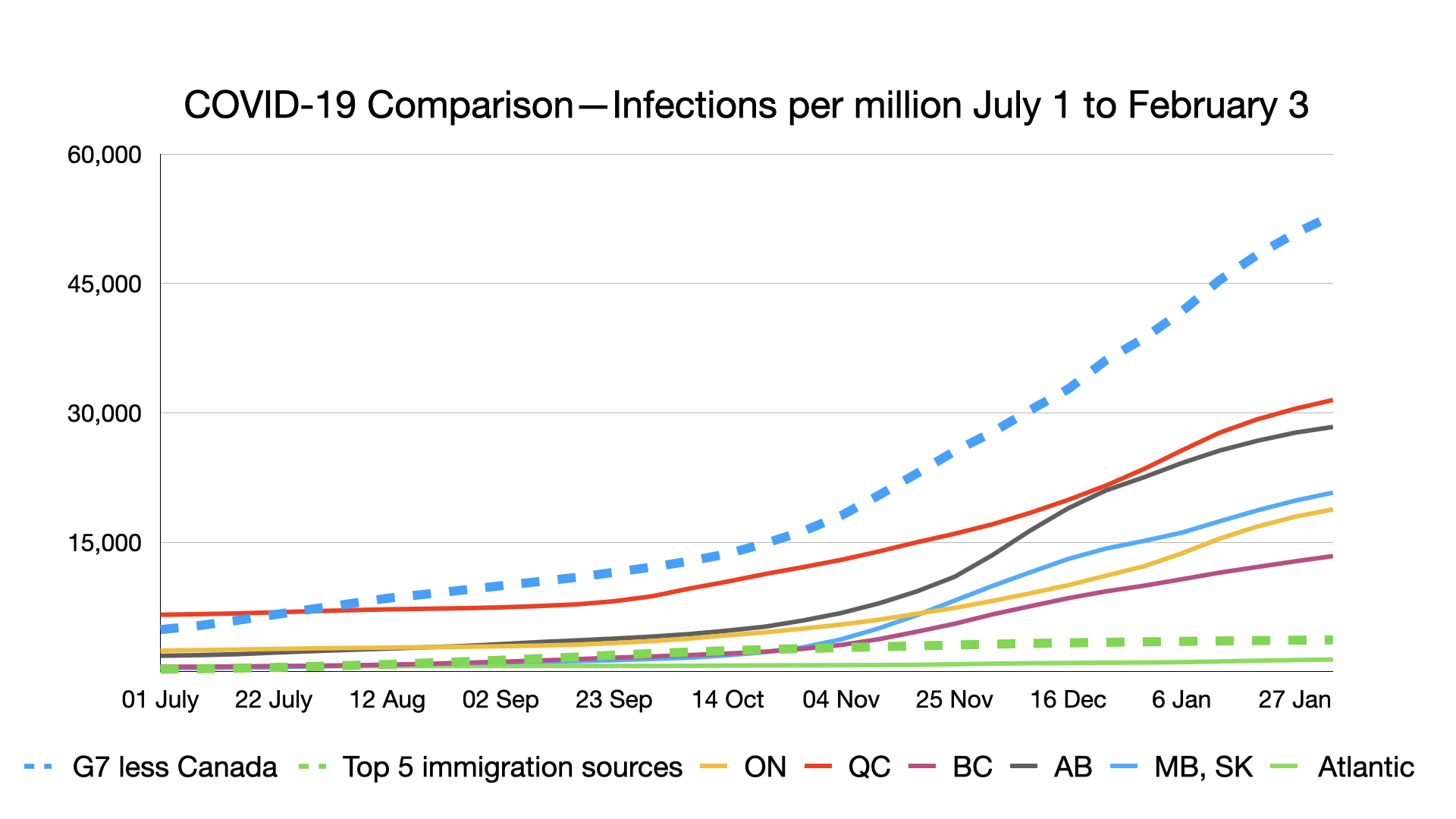
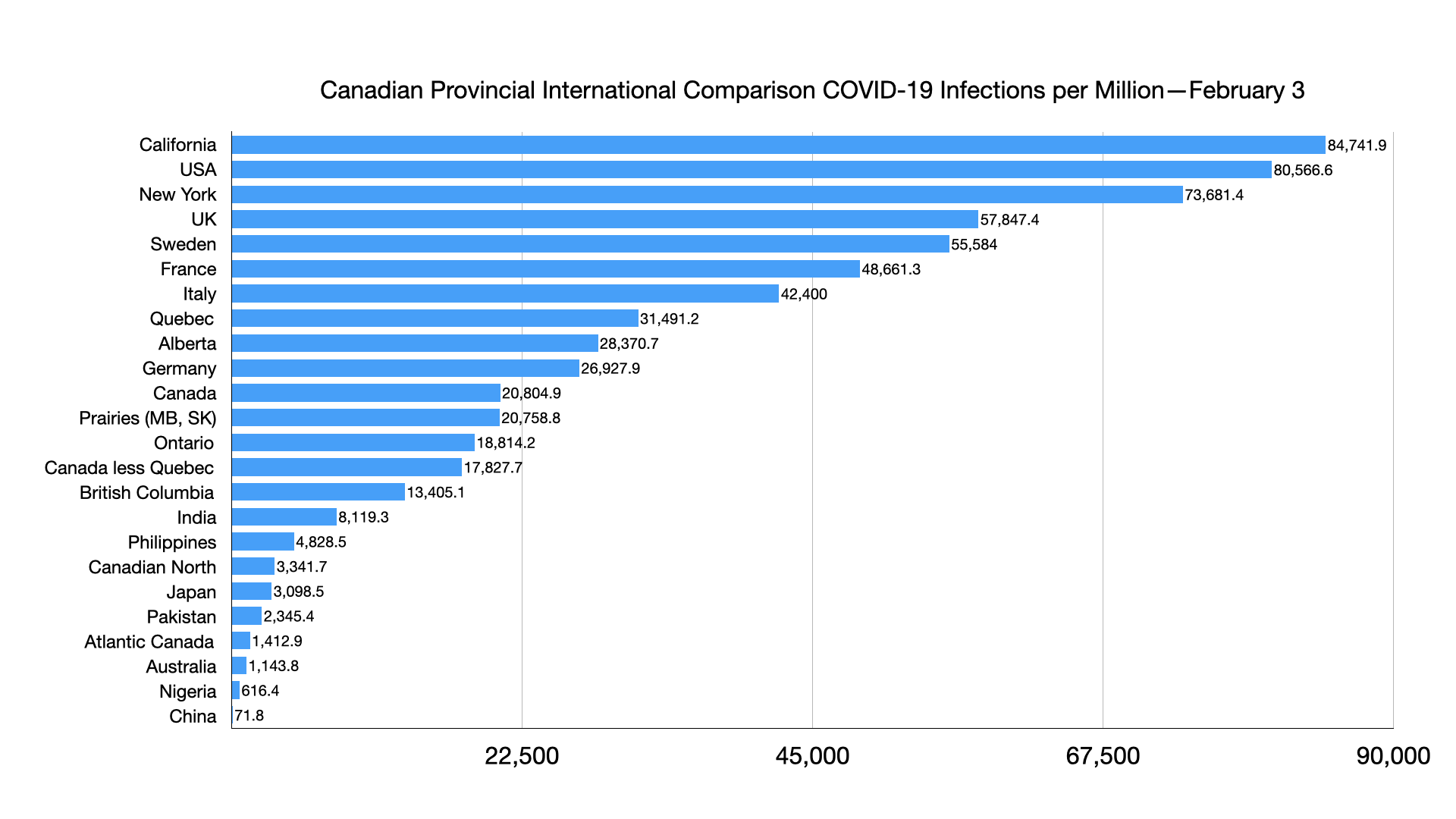
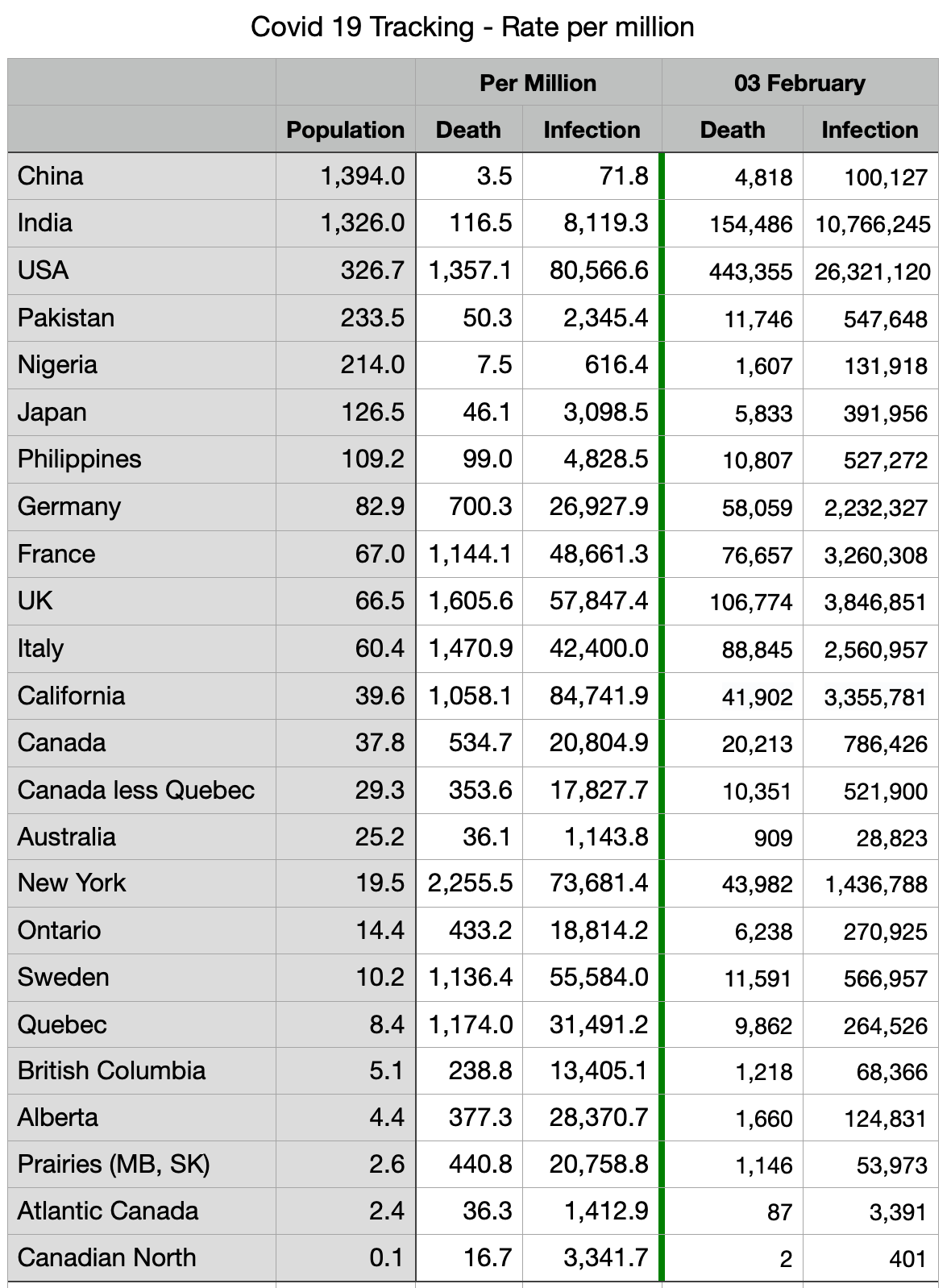
#COVID-19: Comparing provinces with other countries 3 February Update

The latest charts, compiled 3 February.

Vaccinations: The gap between the leading G7 countries (UK, USA) and other EU countries continues to grow given the pause in deliveries to Canada, with the exception of France and Sweden.

Trendline charts

Infections per million: Alberta appears too be controlling the virus better than Quebec.

Deaths per million: G7 continues to close in on Quebec, Prairies continue to have similar rates to Ontario.

Vaccinations per million: Gap between G7 and Canada, driven by UK and USA, continues to widen.

Weekly

Infections per million: No change in relative ranking from last week.

Deaths per million: Atlantic Canada now ahead of Australia.