An Early Look at Express Entry Candidate Selection

__An_Early_Look_at_Express_Entry_Candidate_SelectionGood summary of experience to date with Express Entry by the Conference Board:

A new report by Citizenship and Immigration Canada (CIC) provides a mid-year update on Express Entry, CIC’s new, two-step application management system.1 Launched on January 1, 2015, Express Entry seeks to be more responsive to Canada’s economic needs while processing immigration applications more efficiently.2 In step one, candidates complete online profiles and are awarded up to 1,200 points based on various criteria. In step two, CIC draws the highest scorers from the pool of candidates, who then become eligible to submit applications for permanent residence in Canada.

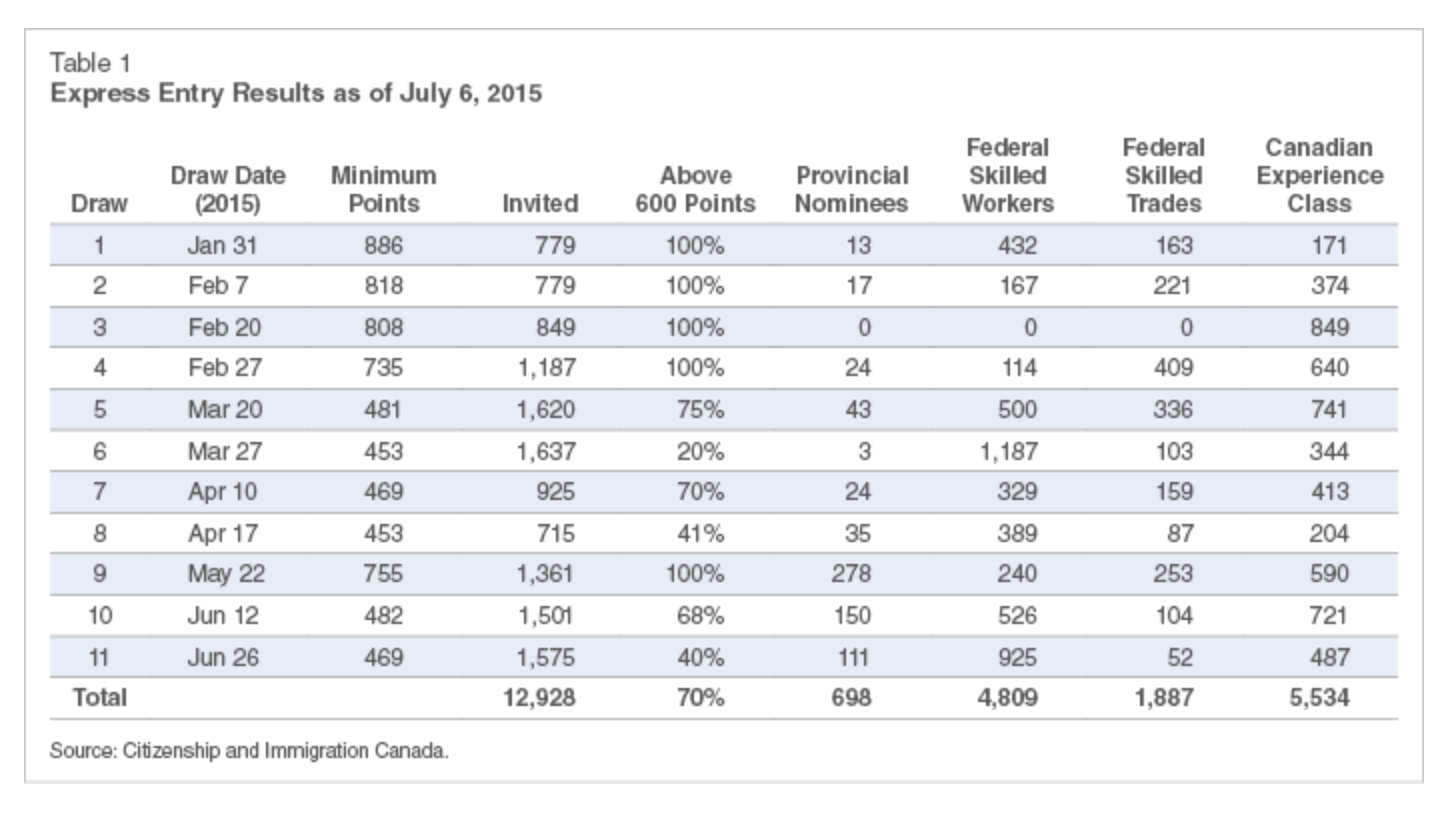
As of July 6, 2015, 112,701 Express Entry profiles had been submitted. Of these profiles, 48,723 candidates (43 per cent) were found ineligible since they did not meet Express Entry criteria. Of the remainder, 12,928 received invitations to apply for permanent resident status (in eleven draws which took place January 1–July 6: See Table 1). Among the invited candidates, 70 per cent scored above 600 points, meaning that the majority either obtained a job offer backed by a Labour Market Impact Assessment (LMIA),3 or a Provincial Nomination Program (PNP) certificate.4 Scoring over 600 points was a prerequisite to receiving an invitation to apply in Express Entry’s first four draws. Since then, point requirements have declined, though never below 453 points.

The overwhelming majority of invited candidates resided in Canada at the time of their Express Entry application (85.5 per cent), followed by India (3.2 per cent), and the United States (1.8 per cent). The top five source countries of invited candidates were India (20.8 per cent), the Philippines (19.4 per cent), the United Kingdom (7.4 per cent), Ireland (5.3 per cent), and China (4.1 per cent).

An Early Look at Express Entry Candidate Selection.

Conference Board Summit Encourages National Dialogue on Immigration

CBoC Immigration SummitWill be interesting what new approaches this summit comes up with, as well as next year’s on the more social focus of next year’s summit:

NCM: The summit is heavily focused on business and economic growth. What about the more social aspects of immigration integration?

Bloom: In total, a set of events will cover the whole range of issues in immigration. As an organization we have a lot of experience in working on economic issues in particular. But I expect to see more on social issues at the second summit next year. This year, we want to flesh out our understanding of such issues and bring that to the next event. The action plan will definitely be covering social issues as we do more research.

We recognize that security is important for Canada and Canadians, but we need to do more research on how to frame this in the context of immigration.

NCM: How do you see current events like the Syrian refugee crisis and emerging security concerns as shaping Canada’s immigration policy?

Bloom: We still have some work to do on this. We have substantial experience on working on security issues at the Conference Board. We recognize that security is important for Canada and Canadians, but we need to do more research on how to frame this in the context of immigration. We have not yet done enough work at the intersection point of these issues.

We know the security issue is not going away, but we need to understand this more clearly and do more research before we can address it. Once we have done our due diligence on this, we can expect to address this next year as well with all the right questions. The multi-year approach of the action plan will help us with this as we develop our research plan further over the coming years.

NCM: What will be your next steps after this summit?

Bloom: We hope to take what we learn from the summit and use it to enrich our research plan. We will be starting a major project to update a study we did in 2001 on brain gain. We will do a big piece on the credential issue starting June 1. This summit is also bringing together over 100 people and we hope that we can engage them in our actual centre.

We hope to be doing more regional meetings; in the year ahead we will convene out East, in Toronto, Quebec and out West. We will also be starting to plan for next year’s summit and ramp up our communication efforts. Speaking to the media is an important part of getting the message out for us and we will be doing more webinars and online outreach to try and engage and inform a broader audience.

Summit Encourages National Dialogue on Immigration – New Canadian Media – NCM.

Mother of fallen Canadian jihadi launches de-radicalization effort – Canada – CBC News

Good grassroots initiative led by Christianne Boudreau, mother of Damian Clairmont, and Dominique Bons, mother of Nicholas and Jean-Daniel Bons, all of whom were Western converts and were killed while fighting in Syria.

No universal strategy but the more grassroots and community level “soft” initiatives, the better, to complement the “hard” security measures. Sheema Khan also advocates a strong role for mothers (Partner with Muslims to root out extremism).

And for the mothers themselves, likely part of the grieving and healing process regarding their sons:

After sitting for hours and sharing lovingly built photo albums of their sons as little boys, parsing their lives and deaths and constantly replaying the questions about signs they saw or missed, they got to work.

Canadian-born Muslim convert Damian Clairmont left Calgary in 2012 for Syria, where he was killed in during battle against a faction of the Free Syrian Army.

The pair decided to form an international mothers group, determined that there must be a way to intervene and stop the radicalization process before it’s too late. They are sharing best practices as they find them and are both poking at their respective governments to step up.

Boudreau has also set her sights on establishing the Canadian chapter of a German group called Hayat. That means “life” in Arabic, and its aim is to work with families to help de-radicalize young men and women.

Hayat is an offshoot of a German organization called “Exit,” which has had good success in deprogramming neo-Nazis; as if plucking them from a cult. Hayat adopts similar methodology and applies it to dealing with militant Islamists.

After meeting with its organizers in Berlin, Boudreau came away convinced that with the right funding and staff, a Hayat chapter could make a difference in Canada.

“Its a sense of reining them [radicals] back in so they are closer to the family again,” she said. “They work with them closely after theyve taken a step back and decided maybe this is not for me, and help them get reintegrated within the community, finding a job, so they focus on the normalities.”

Mother of fallen Canadian jihadi launches de-radicalization effort – Canada – CBC News.

Satyamoorthy Kabilan of the Conference Board has a somewhat naive view of government and social media and its potential to reduce radicalization:

Despite the risk of individual mistakes and the required change in mindset for bureaucracy, I would also argue that the risk of not being a core part of the conversation and simply remaining mute, is far more dangerous. The benefits simply outweigh the risks.

We have recently seen successful uses of social media by authorities in emergency situations such as the 2013 Calgary flood and the tragic shootings in Moncton. Organizations like the Toronto Police Service TPS have had policies in place for some time that allow members of the force to represent the organization on social media. TPS has also been very vocal in sharing experiences. Learning from these and continuing to build a social media presence can help combat the threat of violent extremism in the virtual world. We simply cannot afford to have the extremists leading the conversation on social media.

By quickly occupying the public space around social media before someone else does, we can prevent others from setting the agenda and grant ourselves the opportunity to tell our own story first.

Hard to imagine any federal government taking such risks, let alone the current one, given the need to control messaging. One thing for local issues like the Calgary flood, another for issues related to radicalization where government will be very risk averse.

Better at the community level where there is likely more credibility than government.

To beat terrorists online, let’s raise our social media game – The Globe and Mail.