HESA: New Statscan Data on Students and Academic Staff

Of interest. College sector and business programs were the main abusers:

The student data is the slightly more interesting of the two, because it (finally) shows the system essentially at the height of the international student boom in the late fall of 2023 (Statscan student data is based on an October/November snapshot and therefore does not quite capture the full craziness of what went on in Ontario colleges, where most all international students were on an 8-month schedule with starts happening every four months and so therefore did not necessarily show up on Statscan scans). 

Unsurprisingly, total enrolments in Canadian postsecondary went up. A lot. 140,000 or so, which in absolute terms is the biggest single-year increase in post-secondary enrolments in Canadian history. But as figure 1 shows, that increase was a) highly concentrated in the college sector and b) largely due to international students.

Figure 1: Increase in Post-Secondary Enrolments by Sector and Source, Canada, 2023-24

Figure 2 breaks down the college increase by field of study.  Again, not a huge surprise: the biggest source of increase was business programs (cheap to deliver, required level of English not all that high); if anything, though I am surprised that so many programs saw an increase in enrolments: this result is actually substantially less business-centric than I would have expected.

Figure 2: Increase in College Enrolments by Field of Study, 2023-24

Source: New Statscan Data on Students and Academic Staff

HESA: Credulous Nonsense on Colleges from the CBC

Good analysis and critique. Shameful that the CBC declined to interview Usher as part of their reporting:

…So why did the CBC react as if it did?

This was the question I asked them when a CBC producer tried to get me to comment on the story on December 27th. Why would you do a story on so little evidence? I said I didn’t think the evidence merited a story but agreed to speak to them if they wanted someone to explain exactly why the evidence was so thin. You will no doubt be shocked to learn that CBC then declined to interview me.

Upon reading the story, it’s not hard to understand why. With zero evidence, they got a bunch of experts to repeat talking points about the awfulness of student visas that they’ve been repeating for months now.

Raj Sharma, a Calgary-based immigration lawyer, told said “If the allegations are true, it reveals shocking gaps in our integrity protocols.… This is deeply, deeply concerning and problematic,” adding that the allegations suggest “wide-scale human smuggling.”

(The “if” in that sentence is doing a hell of a lot of work – AU)

Kelly Sundberg, a former Canada Border Services Agency officer who is a professor of criminology at Mount Royal University, said the system has no oversight and is “being exploited” by transnational criminals. “This type of fraud, of gaming our immigration system has been going on for quite some time actually,” he said, noting that the volume of those potentially involved “is staggering.”

Ken Zaifman, a Winnipeg-based immigration lawyer, says that from his experience, the responsibility of oversight should lie with the educational institutions, but that they did not do so because “they were addicted to international students to fund their programs.”

Ok, so, these comments about fraud and oversight are worth examining. I’m trying to imagine how either the government of Canada or an educational institution could legitimately “prevent fraud” or “exercise oversight” in a case like this one. Are colleges and universities supposed to be like the pre-cogs in the movie Minority Report, able to spot criminals before they commit a crime? I mean, there is a case to be made that in the past Canada made such cross-border runs more tempting by allowing students’ entire families to join them in Canada while studying (as was the case in the Dingucha affair), but that loophole was largely closed ten months ago when the feds basically stopped giving open work permits to partners of students unless they were enrolled in a graduate degree.

Anyways, this is where we are now: our national broadcaster sees no problem running evidence-free stories simply as a platform to beat up on public colleges because that’s a great way to get clicks. Crappy journalism? Sure. But it’s also evidence of the disdain with which Canadian PSE institutions are now viewed by the broader public: CBC wouldn’t run such a thin story unless it thought the target was “soft.” And there’s no solution to our funding woes until this gets sorted out.

Source: HESA: Credulous Nonsense on Colleges from the CBC

Permit processing setback for Indian students in Canada

Of note, primarily colleges (where the excesses and abuses largely occurred:

…Introduced in 2018, SDS enabled students from select countries, including India, to fast-track their applications if they fulfilled certain requirements, including securing a Canadian Guaranteed Investment Certificate (GIC) valued at CA$20,635 (US$14,731) and submitting English or French language test scores. 

It notably shortened the waiting time for permits, allowing successful applicants to obtain visas within weeks, in contrast to the average processing time of eight weeks for Indian applicants under the standard application process.

The changes came into effect on 8 November, but students who submitted applications before that date will still be processed through the expedited stream. Indian students will now have to apply for study permits through Canada’s standard study permit stream. 

Originally accessible to applicants from China, India, and the Philippines, the programme subsequently broadened its scope to include additional countries, including Antigua and Barbuda, Brazil, Colombia, and Morocco, among others.

Canadian immigration authorities state the discontinuation of the SDS and NSE programmes is aimed at “strengthening programme integrity”, and is designed to create “a more equitable process” for international students, ensuring fair treatment for applicants from all countries.

Prioritising university applicants

Students from Punjab are more likely to be impacted as they enrol in Canada’s community colleges, while Canadian universities attract more students from large cities elsewhere in India, education agents said. 

“With Canada’s new cap of 437,000 study permits for 2025, I think this signals a clear shift toward prioritising degree-seeking students over diploma programmes,” said Maria Mathai, director of New Delhi-based education consultancy MM Advisory Services.

Mathai told University World News that the most immediate impact will be felt in the college sector, which accounted for 75% of SDS applications post-pandemic. She noted it could lead to an overall drop in approval rates.

In 2023, 60% of the 400,000 Indian students seeking to study in Canada applied through the SDS programme, which had a significantly higher approval rate – over 70% of applicants from India received study permits. 

In contrast, those applying through the regular study permit stream experienced much lower approval rates, at just 10%.

“Students pursuing diploma programmes, particularly from Punjab, will indeed face processing times which will increase from 1-3 weeks to 4-8 weeks,” said Mathai, adding it was to be expected as the original programme was launched to promote college applications….

Source: Permit processing setback for Indian students in Canada

Ontario colleges are fuelling unprecedented growth in international students

Good analysis by there Globe with focus on Ontario and the impact of the Ford government policies in bringing us to this mess:

… There are currently two federal government reviews of the international student program under way, one by Immigration, Refugees and Citizenship Canada and one by Global Affairs. But attempts to curtail the program will have to reckon with its impact on the schools, because international funding has become crucial to Canadian higher education.

Many of the Ontario colleges that have a large proportion of international students have expanded via branch campuses in the Greater Toronto Area or partnerships with private educational providers. The partner schools teach curricula from the colleges and the students receive Ontario college degrees and postgraduate work rights. Both Conservative and Liberal provincial governments have made attempts to limit the size of these lucrative public-private operations. The latest policy imposes a per-college cap of 7,500 students.

Cambrian College, which has a partnership with a private college in the GTA, said its home campus enrolment still has a domestic majority. It said it takes a measured approach because it doesn’t want to bring in more international students than the college or the Sudbury community can accommodate.

The schools have been encouraged on the international path by both provincial and federal governments. The federal government, which aims to attract half a million immigrants a year by 2025, is hoping to build a talent pipeline already equipped with Canadian educational credentials. The provincial governments benefit by placing a growing share of the postsecondary funding burden on prospective immigrants.

According to a report from Ontario Auditor-General Bonnie Lysyk, Queen’s Parkprovided by far the lowest level of government support to colleges of any province in 2018-19. The funding gap that colleges face has been exacerbated by the Doug Ford government’s decision to cut domestic tuition fees by 10 per cent in 2019 and freeze them at that level.

McMaster University economist Arthur Sweetman, an expert on immigration and public policy, said the growth in international students is an example of what happens when policy makers misunderstand the incentives they create.

The federal government has placed no limits on student visas, he said, and the provinces are happy not to increase their grants to postsecondary institutions. The result is that some schools have pushed the envelope.

“I think it’s a regulatory failure,” Prof. Sweetman said. “If you tell people to go make money and here are the rules, people are going to make money and go right up to the edge of the rules.”

Conestoga said in a statement that the well-being of its students is a priority and that it works with them to find affordable housing options. This year, it signed onto a sector-wide set of standards on how best to support international students.

Revenue generated through increased enrolment has helped the college boost hiring, invest in new facilities as well as in new programs and student services, the statement added, including supports for students seeking employment. It has expanded its Kitchener campus, opened one in downtown Guelph and will open two new locations in Milton next year.

David Agnew, president of Seneca, said international students are now the majority at his Toronto college, and that they enrich the learning environment and college experience for everyone on campus. Domestic students aren’t displaced by the international students, as schools are required to offer places in high-demand programs to Ontario applicants first and Canadians second. The school is, however, able to offer more programs for domestic students thanks to the funding that international students provide.

“We haven’t had a grant increase in more than a decade and now we have frozen tuition. We [wouldn’t] have enough money to operate anything close to the high-quality educational institution that Ontarians should expect,” Mr. Agnew said.

Seneca recently crossed the international majority threshold among full-time students, but the ratio drops to 39 per cent when continuing education students are included. Mr. Agnew admits that the concentration of international students at some Ontario colleges could be perceived as a concern by some people. But he says it’s wrong to lay the blame for housing shortages at the feet of international students.

He said housing affordability is an issue that cuts across society. Seneca has about 1,350 residence spaces and more than 28,000 students. The college would like to work with governments and the private sector to build more, Mr. Agnew said.

“Let’s not demonize international students,” Mr. Agnew said. “Let’s work on solutions to the affordable housing issue rather than trying to blame people.”

In a presentation to Hamilton City Council this year, Steve Pomeroy, an industry professor at McMaster’s Canadian Housing Evidence Collaborative, said the biggest added pressure in the housing market is the rapid increase in non-permanent residents, a large chunk of whom are international students or former students. He places the inflection point at 2016, when international enrolments began to jump.

“When these folks come into the housing system they’re trying to find relatively affordable housing and they’re also displacing other folks who are trying to find relatively affordable rental housing,” Prof. Pomeroy said. The competition heats up and international students, who are nearly all renters, often outbid low-income Canadians in the bottom quartile of the rental market.

With as many as 900,000 students expected in the country this year, Prof. Pomeroy said in an interview it’s reasonable to assume they’re adding demand equal to somewhere between 5 per cent to 10 per cent of the national rental housing market of 4.5 million homes.

Economist Mike Moffatt was surprised when he first noticed the close links between the real estate crunch and higher education in London, Ont., where he teaches at the University of Western Ontario’s Ivey Business School. The share of the impact on rent prices attributable to international students hasn’t been quantified, Prof. Moffatt said, but rent increases are happening at the start of term and appear to be rising faster in locations near campus.

London, Kitchener, Windsor – mid-sized Ontario cities that have both university and college campuses and high numbers of international students – have seen record rent increases and the lowest vacancy rates in 20 years, according to a January report from Canada Mortgage and Housing Corp.

The international students do not deserve any blame, Prof. Moffatt said.

“Enrolment growth is not being fed into housing policy and it’s causing all kinds of local tensions,” he said…

Source: Ontario colleges are fuelling unprecedented growth in international students

Canada’s exploitation of Punjabi international students is history repeating itself

Governments should crack down on private college student international student recruitment given a number of articles and investigations highlighting the exploitation and abuse, and the minimum benefit to the economy and society:

Canada has a decades-old tradition of exploiting Punjab’s working class. The latest example of this comes by way of international students.

Canadian schools, partnering with a shady recruitment industry, allure youth from working-class farming families. Demand has been cultivated by urban centres and television littered with advertisements to go abroad via a study visa.

As a community volunteer, I have seen the result of such perverse marketing where many come to Canada with no understanding of what awaits and hope it will work out. Sadly, many face grave hardships and encounter shameless people aiming to exploit their vulnerability.

The problems include an unscrupulous and untrustworthy private college industry swindling foreign students across Canada. Rampant labour exploitation of international students. Sex traffickers preying on female international students aware they are financially vulnerable. A concerning number of international student suicides with deaths occurring monthly. Finally, a Statistics Canada studyfound international student graduates have relatively worse economic outcomes.

While volunteers try to help as much as possible, we cannot match the volume of students being churned through the system.

We receive messages from students stating they don’t want to live anymore, and while we feel compelled to take action, it is discouraging that politicians feel no such obligation.

In fact, politicians like MP Sukh Dhaliwal and minister Marco Mendicino do not seem to think anything is wrong with the international student program.

Politicians do not feel compelled to fix this mess because international education is very lucrative. International students are charged nearly five times higher tuition, bring in over $20 billion, and have allowed provincial governments to decreasetheir proportion of higher education funding.

In one honest conversation, an elected official acknowledged to me the unwillingness to fix this problem is because the economy and many jobs are dependent on the status quo.

What does this say about those in power? I interpret inaction to mean that in order to generate wealth for Canada, politicians tacitly accept migrant suicides and Punjabi migrant women being trafficked.

Adding to my frustration is this exploitation follows a similar pattern from over a century ago.

After British colonization of Punjab in 1858, Punjab’s fertile lands were used to produce cash crops for export. In the succeeding decades, British management of agriculture to increase production also led to land values, prices of basic goods, and taxes all increasing. It also resulted in repeated famines and many modest Punjabi farmers accumulating debt.

For many struggling farmers emigration was the best option to improve economic fortunes.

At the same time, newspapers were filled with job ads from Canadian companies and labour contractors who were recruiting in Punjab.

In the 1900s Punjabi migrant workers started arriving in Canada and would experience significant hardships. They were paid less for equal work and often victims of abuse and discrimination. This easy to exploit labour was lucrative for the lumber industry.

Fast forward to the 1960s green revolution, which was initiated to boost global agricultural production. Decades later, many found the green revolution benefitted multinational corporations pushing chemical pesticides more than farmers in places like Punjab.

In Punjab, long-term pesticide use has led to environmental degradation resulting in stagnating agricultural production. This disproportionately affects modest farmers who are accumulating debt to stay afloat. For these struggling families emigration is the best option to improve economic fortunes, and a student visa is the best path to emigrate.

Sadly, like their predecessors, this generation of Punjabi migrants also face serious hardships and exploitation in Canada.

Throughout the last century Punjabi Canadians have mobilized and began a tradition of activism. Prominent fights include advocating for equal pay in the 1940s and farm workers advocating for better work conditions in the 1980s. And today, community advocates and students are fighting against the economic exploitation of international students.

Ironically, Canadian politicians will celebrate Punjabi migrants who struggled for equality and dignity in the past, but neglect the indignity Punjabi migrants experience today.

Municipal, provincial, and federal politicians showed concern for farmers during India’s farmer protest, but they have no concern for the children of these farmers suffering in Canada.

It seems that in politics the profits made off the vulnerable count, while the pain experienced by them does not.

Balraj S. Kahlon is a member of One Voice Canada and the author of The Realities of International Students: Evidenced Challenges.

Source: Canada’s exploitation of Punjabi international students is history repeating itself

Colleges, universities expecting large financial losses from drop in international students

We shall see over the next month or so when IRCC study permit data for July and August becomes available (July data should be out sometime next week):

Colleges and universities say they’re anticipating financial losses possibly in the billions of dollars due to a drop in international enrolments caused by the global pandemic.

The government of Canada last week took additional steps to make it easier for students to study online from abroad, but the national associations that represent universities and colleges say the losses are still likely to be significant. The associations are lobbying the federal government to make money available for postsecondary institutions.

Denise Amyot, president of Colleges and Institutes Canada, said a mid-June survey showed colleges expected their new international enrolments to fall by two-thirds this term, from about 90,000 to 30,000. It’s still unclear whether those fears will be realized, as data are not yet available, but colleges are hoping the impact will be less than expected, Ms. Amyot said.

“Administrators are worried right now. They’re worried about the financial impact. They’re worried they’ll have fewer programs to offer domestic students,” she said. “Every student counts right now. I can’t think of a better way to put it.”

International students are crucial to university finances because they represent half of all tuition revenue. The impact of the pandemic may be more pronounced for colleges, though, as they tend to offer shorter programs that result in more frequent student turnover.

International students contribute nearly $22-billion a year to the Canadian economy, according to federal government estimates, with billions flowing from postsecondary tuition fees alone. Ms. Amyot said an analysis conducted on behalf of the colleges estimates between $1.8-billion and $3.5-billion in lost revenue, depending on the length and severity of the pandemic.

Universities Canada said it does not yet know the extent of losses across the sector. Some universities, including the University of British Columbia and the University of Alberta, said international acceptances are in line with previous years, but numbers aren’t firm as students still have a month to withdraw. And the picture may be quite different from one institution to another.

“We are in active discussions with federal government departments about how we can work together to stabilize from the potential loss of international students,” said Cindy McIntyre, assistant director, international relations at Universities Canada.

Education is primarily a provincial responsibility. Ontario provided an additional $25-million to postsecondary institutions early in the pandemic to cope with some of the additional associated costs. Quebec gave $75-million to institutions and made more money available in student assistance. But the national postsecondary associations are aiming to persuade the federal government to contribute some pandemic-specific funds to the sector, as they did with the $2-billion recently announced for elementary and high schools.

Innovation, Science and Economic Development Canada (ISEDC) said Wednesday that Ottawa is having conversations with the provinces and territories regarding the types of supports that are needed. And Ottawa has since taken steps to ease some of the concerns of institutions, including a two-step process to speed approval for those who want to start their studies online. It has also allowed U.S. students to cross the border as long as they quarantine for 14 days on arrival and increased federal student financial aid.

At the moment only those with permits issued before mid-March whose travel is deemed essential and those from the U.S. are allowed to enter Canada.

Last week, Immigration, Refugees and Citizenship Canada (IRCC) announced measures that will allow students to complete one-year programs online without being penalized on the length of their postgraduate work permit. But the decision many institutions are waiting on is whether other international students with visas processed after mid-March will be allowed to enter the country. At the moment provincial and federal health officials are assessing plans submitted by institutions for the safe isolation of arriving students.

“It’s now too late to get international students here for the start of the fall semester, but many of our institutions still have an interest in seeing international students arrive over the course of the fall,” Ms. McIntyre said.

When asked whether Ottawa would step in with more funding to address the shortfall, ISEDC did not answer the question directly, but pointed to changes the government has already brought in, including $450-million in funding for academic research. IRCC also cited previous measures to help international students.

“Recently, changes were brought forward to give international students more certainty about their ability to enter Canada once travel restrictions are eased in Canada and their home countries,” said Mike Jones, a spokesman for Immigration Minister Marco Mendicino. “Students who have submitted a complete application will receive priority processing to make sure they can begin their classes while outside Canada, and complete up to 50 per cent of their program from abroad if they can’t travel sooner.”

There were more than 700,000 international students at all levels in 2018, a number that has grown rapidly over the past decade. Normally tens of thousands of new students would be arriving in September, but not this year. At the moment only those with permits issued before mid-March are allowed to enter Canada.

Gautham Kolluri, who runs an international student recruitment company, said students and families are apprehensive about starting an expensive degree at a time when it’s unclear when they will be able to travel to Canada. Many international students pay tuition fees of $20,000 or more, which many plan to partly fund by working part-time while studying.

Mr. Kolluri said he has a few hundred clients who have been accepted by Canadian institutions but he believes a majority will either defer admission or drop those programs in the next month. He thinks only a quarter will pursue their programs online from their home countries.

“They will lose networking opportunities and they will lose the Canadian experience they want, so they will delay and wait and see,” Mr. Kolluri said. “Investing $30,000 without knowing what will happen is a big gamble.”

He said Canada remains a top destination country, as political developments in the U.S. have made it a less desirable option.

Source: https://www.theglobeandmail.com/canada/article-colleges-universities-expecting-large-financial-losses-from-drop-in/?utm_medium=email&utm_source=Morning%20Update&utm_content=2020-9-3_6&utm_term=Morning%20Update:%20U.S.%20cable%20company%20Altice%20and%20Rogers%20table%20$10.3-billion%20bid%20for%20Cogeco&utm_campaign=newsletter&cu_id=%2BTx9qGuxCF9REU6kNldjGJtpVUGIVB3Y

New to Canada, struggling to find work: Integration programs

Role of the community colleges in integration:

It is no coincidence that Canadian colleges go to great lengths to welcome and prepare immigrant students for school and work.

Immigration is key in helping soften the effects on the labour force of the aging population, an important element of long-term economic growth, according to the Conference Board of Canada’s report, A long-term view of Canada’s demographics, released in October, 2016.

Bridging, pre-arrival, and other programs and services are particularly important for immigrant students, who, compared with international students (those in the country on study permits but who also may apply to immigrate to Canada), tend to be older, have more extensive education and work backgrounds, and are also permanent residents, notes Alex Irwin, director of George Brown’s School of Immigrant and Transitional Education (SITE).

Along with the one-year college teachers training program that Ms. Shokry and Mr. Kabir have completed, SITE offers bridging programs in nursing and construction management.

Among other Canadian colleges with prominent immigrant programs and services is Red River College, which has campuses in Winnipeg and other areas of Manitoba, and this year has nearly 1,360 immigrant students who are permanent residents.

“Our goal is to support immigrants to Manitoba with a holistic approach throughout their entire student life cycle, and we have a large suite of programs and services across different departments and areas to work toward this goal,” Nora Sobel, manager of diversity and intercultural services at Red River, said in an e-mail interview.

Red River recruits students from other countries to aid in boosting Manitoba’s skilled labour shortages, the school’s website says. In the spring, for instance, the college launched a pathway program to construction skills, starting with 20 students from countries such as Syria, Sudan and the Democratic Republic of Congo. Also on campus, Red River’s Diversity and Intercultural Services department helps organize the annual welcome party for immigrant and international students, and offers services, including financial aid information sessions.

Many programs don’t just delve into the fine points of the jobs themselves; they also give immigrant students insight into the “cultural norms and social cues in the workplace,” notes Mr. Irwin.

He gives this example: “The Canadian workplace can be seen as more casual, but there are a lot of social clues we take for granted that have to be learned if you’re new to the country, like what to call your boss. Calling someone ‘sir’ may not be appropriate in Canada.”

Prominent among pre-arrival programs is a one-day orientation and information session called Planning for Canada, which is offered free, both online and in person, in countries including India, China and the Philippines.

The federally funded program was launched in October, 2015, and is jointly run by the Canadian Immigrant Integration Program (CIIP, a program of Colleges and Institutes Canada) and Canadian Orientation Abroad (a program of the International Organization for Migration).

Planning for Canada has teamed with dozens of organizations (including the YMCA, the Immigrant Access Fund, and employment, tourism and nursing interests) as well as colleges that help students to plan their journeys to Canada.

Partner colleges include Red River, George Brown, Bow Valley College in Calgary, Vancouver Community College, and Parkland College, with campuses in Saskatchewan.

One goal of Planning for Canada is to “dispel any misunderstanding or misconceptions earlier in the [immigration] process,” says CIIP director Holly Skelton.

She says a bulk of immigrants are chosen to come to Canada based on their high levels of academic achievement, yet one common misunderstanding is that credentials earned in another country will be recognized fully in Canada.

“We’re there to provide a reality check and provide information they need to take action right away, before they come, so they can hit the ground running and don’t waste time,” says Ms. Skelton.

Source: New to Canada, struggling to find work – The Globe and Mail

BC college faculty feel pressure to ‘pass’ students with poor English | Vancouver Sun

Conflict between universities and colleges as a business versus maintaining standards?

Veteran college English instructors are routinely receiving passionate, imploring pleas for passing grades from the international students who increasingly fill their classes.

The foreign students’ emotion-filled emails and in-office appeals, often issued in jumbled English, invariably aim to cajole faculty at Langara College and other institutions into giving them a break, so they will be able to move on from their mandatory courses in English literature.

The foreign students often maintain their entire future depends on passing the English course.

Langara College has experienced a five-fold rise in foreign students since 2014, but two English literature and composition instructors say the college’s over-reliance on international fees is not working for many high-stressed foreign students, their anxious offshore parents or for shortchanged domestic students.

Langara College English instructors Peter Babiak and Anne Moriarty are among a small number of Canadian higher education officials who are ending their silence to raise concerns about the expanding business of international education, which now brings 130,000 foreign students to B.C., mostly Metro Vancouver.

“I do feel sorry for the (international) students, of course, but that’s not really the point. When I assign grades, presumably I need to be objective and not let emotions get in the way,” says Babiak, who has been teaching at Langara since 2002.

Like many faculty at universities and colleges, Babiak and Moriarty feel pressure to wave through the full-fee-paying foreign students, especially in mandatory first-year English literature courses, even if they lack fluency in English.

“There is a booming industry dedicated to helping students jump through English-language hoops, which teachers like me everywhere work hard to defend. Being part of this is weighing heavily on my conscience,” said Moriarty.

Langara Provost Ian Humphreys, however, said Tuesday “there is no pressure on faculty to pass students who are not yet achieving learning outcomes.”

Humphreys said he is proud that Langara “is an open access institution that serves a diverse student population – both domestic and international – that has a high proportion of English language learners.” He says the college’s grads have a strong success rate when they transfer to other institutions or the job market.

Moriarty, however, said that even though many of the foreign students work hard in their technical, business and computer courses, many also leave their mandatory English literature course to the end of their multi-year programs, knowing their English is weak.

Both Babiak and Moriarty also agonize over how classroom discussions in English literature courses are often severely restricted because of language barriers. It means, he said, students who seriously want to study novels, linguistics and composition don’t get as much high-level interaction as they could.

Source: BC college faculty feel pressure to ‘pass’ students with poor English | Vancouver Sun

ICYMI: Some Colleges Have More Students From the Top 1 Percent Than the Bottom 60. Find Yours. – The New York Times


Students at elite colleges are even richer than experts realized, according to a new study based on millions of anonymous tax filings and tuition records.

At 38 colleges in America, including five in the Ivy League – Dartmouth, Princeton, Yale, Penn and Brown – more students came from the top 1 percent of the income scale than from the entire bottom 60 percent.

38 colleges had more students from the top 1 percent than the bottom 60 percent

STUDENTS FROM … THE TOP 1%
($630K+)
BOTTOM 60%
(<$65K)
1. Washington University in St. Louis 21.7 6.1
2. Colorado College 24.2 10.5
3. Washington and Lee University 19.1 8.4
4. Colby College 20.4 11.1
5. Trinity College (Conn.) 26.2 14.3
6. Bucknell University 20.4 12.2
7. Colgate University 22.6 13.6
8. Kenyon College 19.8 12.2
9. Middlebury College 22.8 14.2
10. Tufts University 18.6 11.8
These estimates are for the 1991 cohort (approximately the class of 2013). Rankings are shown for colleges with at least 200 students in this cohort, sorted here by the ratio between the two income groups.

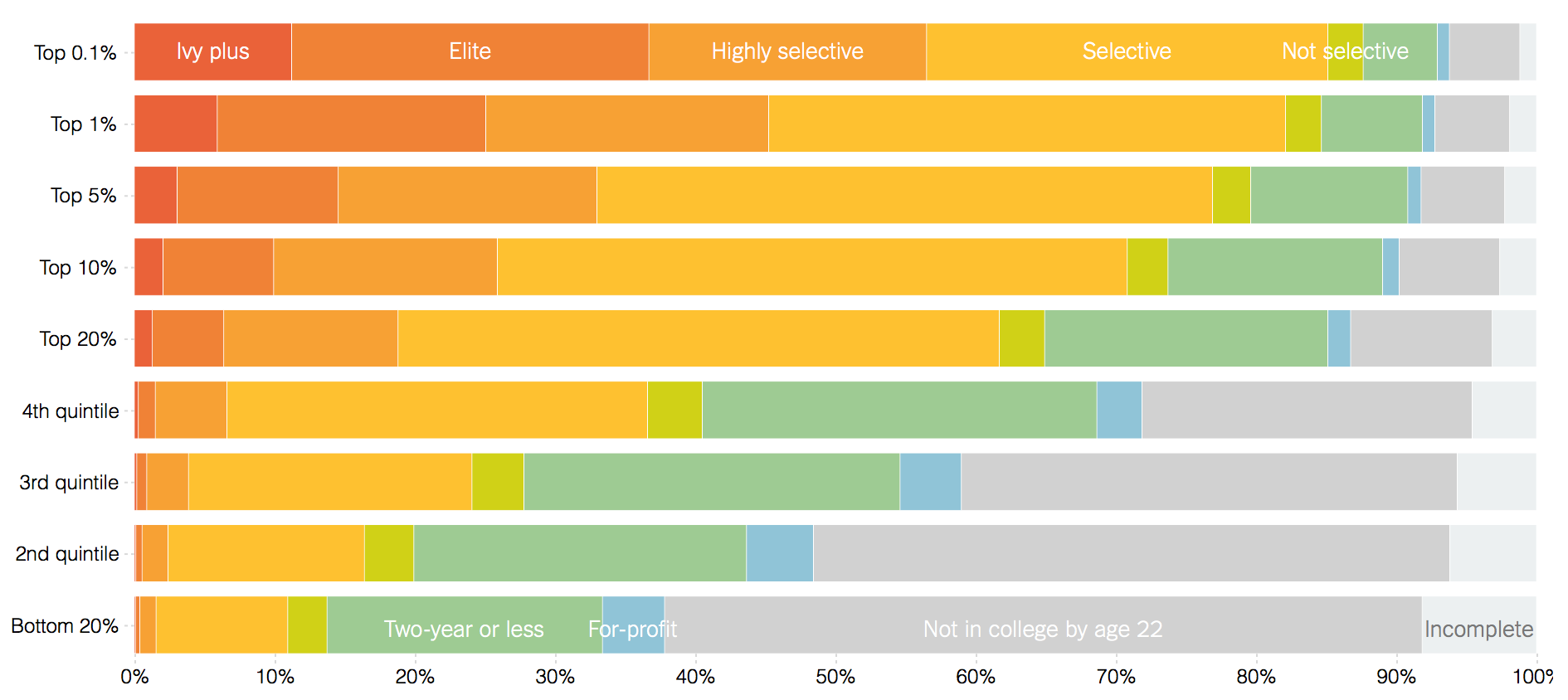
Roughly one in four of the richest students attend an elite college – universities that typically cluster toward the top of annual rankings (you can find more on our definition of “elite” at the bottom).

In contrast, less than one-half of 1 percent of children from the bottom fifth of American families attend an elite college; less than half attend any college at all.

Where today’s 25-year-olds went to college, grouped by their parents’ income

About four in 10 students from the top 0.1 percent attend an Ivy League or elite university, roughly equivalent to the share of students from poor families who attend any two- or four-year college.

Colleges often promote their role in helping poorer students rise in life, and their commitments to affordability. But some elite colleges have focused more on being affordable to low-income families than on expanding access. “Free tuition only helps if you can get in,” said Danny Yagan, an assistant professor of economics at the University of California, Berkeley, and one of the authors of the study.

The study – by Raj Chetty, John Friedman, Emmanuel Saez, Nicholas Turner and Mr. Yagan – provides the most comprehensive look at how well or how poorly colleges have built an economically diverse student body. The researchers tracked about 30 million students born between 1980 and 1991, linking anonymized tax returns to attendance records from nearly every college in the country.

We’re offering detailed information on each of more than 2,000 American colleges on separate pages. See how your college compares – by clicking any college name like Harvard, U.C.L.A., Penn State, Texas A&M or Northern Virginia Community College – or search for schools that interest you.

At elite colleges, the share of students from the bottom 40 percent has remained mostly flat for a decade. Access to top colleges has not changed much, at least when measured in quintiles. (The poor have gotten poorer over that time, and the very rich have gotten richer.)