Looming Fee Increase Could Thwart Many U.S. Citizenship Applications

Yet another Trump administration anti-immigration initiative. Cost matters, and fees need not to pose an excessive financial burden on immigrants:

When Guadalupe Rubio, 41, contracted the coronavirus in July, she struggled to make the few steps to the bathroom in the mobile home that she shared with her teenage daughter in Kent, Wash.

The pandemic had already shuttered her small construction business, which also provided for her parents and three children in Sinaloa, Mexico. Now, the virus left her struggling to breathe, trapped inside without any means to support the six family members who depended on her.

Around the time the pandemic hit Washington State, Ms. Rubio became eligible to apply for United States citizenship. She made a bit too much money to qualify for a reduction in the application fee, currently $640, and the economic effects of the pandemic and her illness sapped away her savings. She applied for food stamps, a benefit that could also provide a break on the fee, but has so far been unable to reach the overwhelmed social services agency that could help her.

If she cannot save the money or obtain a fee waiver before the fall, Ms. Rubio’s prospects of becoming a citizen will become more remote. The Trump administration moved late last month to raise the cost of naturalization applications by more than 80 percent and to substantially tighten eligibility requirements for a subsidized application.

The price for naturalization will jump to $1,160 or $1,170 for online applications. The rule will also lower the income threshold to qualify for a fee waiver and eliminate the partial subsidy for the application.

Almost all other exceptions that allowed immigrants to waive the fee will be eliminated, including extenuating financial hardship and means-tested public benefits, like food stamps. Only some protected immigrants, including victims of domestic violence and human trafficking, will remain eligible.

Ms. Rubio is one of many who would no longer be eligible for a waiver. Immigration lawyers across the country are rushing to submit their clients’ applications to the already backlogged agency before the fee increases are introduced on Oct. 2.

“It’s a low blow during a pandemic,” Ms. Rubio said through a translator. “I have worked a lot for this country, and if I’m a citizen, I can — not just contribute more — but I can also better reap the benefits of all of my hard work in this country.”

Advocates for immigrants say the fee increase is intended to stymie legal immigration and deprive immigrants of their right to vote before the election in November.
Liberal Platform: Commitment to abolish citizenship fees

I am still wading through to Liberal campaign platform, and will do a comparative analysis of the immigration, citizenship, multiculturalism and diversity commitments of all parties.

As someone who has long advocated for lowering citizenship fees, it was a pleasant surprise to see the Liberals addressing the excessive fee increases imposed by the previous Conservative government in 2014-15 (from $100 to $530 for adults, plus $100 “right of citizenship” fee of $100).

The net result has been a decline in the number of people applying for and obtaining citizenship, although the decline also reflected policy changes under the Conservatives, since reversed by the Liberals (residency back to 3 of 5 years, language and knowledge testing ages back to 18-54).

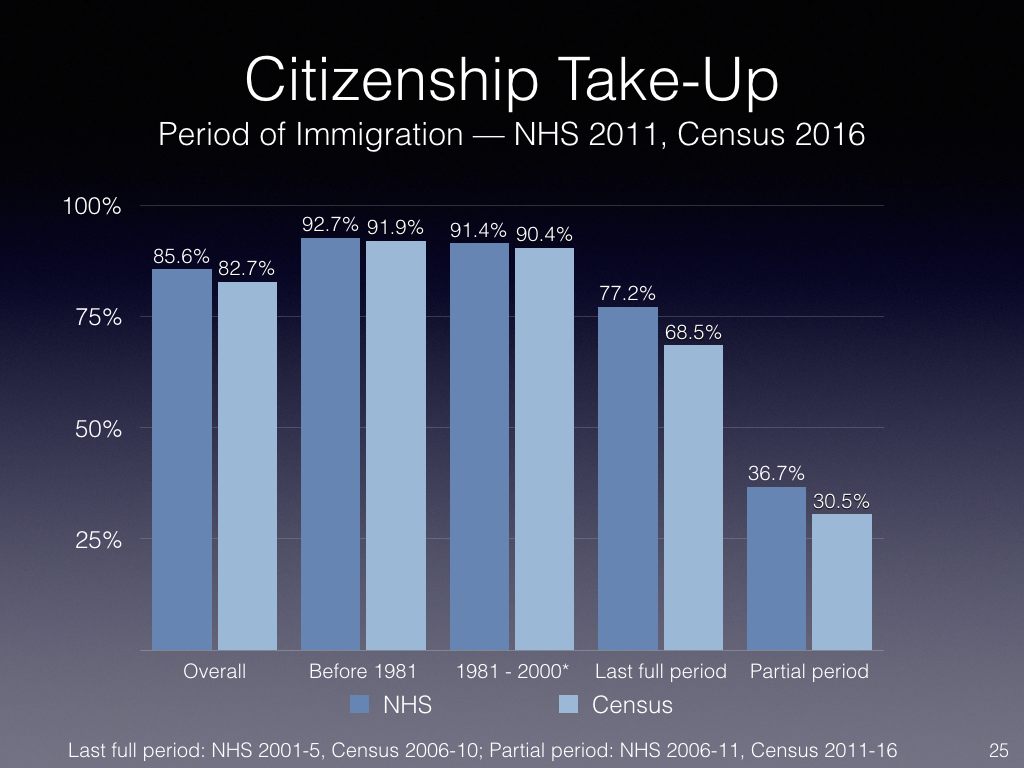
The chart below best captures the decline, comparing the last full census period citizenship take up, showing a decline from 77.2 to 68.5 percent.

My analysis of census data did show a positive correlation between income and citizenship take up (What the census tells us about citizenship)

However, while some will welcome the complete elimination of the fees, I always advocated for a reasonable balance between the societal benefits (political integration and participation) and private benefits (right to enter Canada and voting rights). Given IRCC data showing a processing cost of around $530 (2010-11), an adult total fee of $300 would have represented an appropriate balance between public and private benefits.

By eliminating the fees, the platform will most likely be perceived as political positioning with immigrant voters.

“A More Affordable Path to Citizenship

We will make applying for Canadian citizenship free for permanent residents.

With the right supports, immigrants are able to get to work, help build up our communities, and grow our local economies in short order. But arriving in Canada is just the first step on a long journey to citizenship.

Becoming a citizen allows new immigrants to fully participate in Canadian society, and the process of granting citizenship is a government service, not something that should be paid for with a user fee. To make citizenship more affordable, we will make the application process free for those who have fulfilled the requirements needed to obtain it.

Costing:”

Making applying for Canadian citizenship free for permanent residence (sic)

75

101

105

110

Note: IRCC Departmental plan 2019-20shows “Citizenship funding from 2019–2020 to 2021–2022 ranges between $61.4 million and $63.9 million.” This suggests  the Liberals are anticipating a significant increase in the citizenship take-up rate, not just one reflecting the increase in the number of immigrants.

Citizenship Applications: Third Quarter Continues to Show Decline

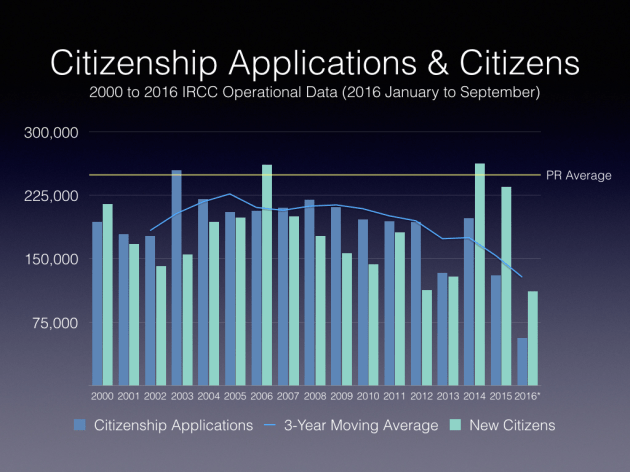
citizenship-data-slides-010Further to my earlier analysis of the half-year numbers showing a dramatic decline (The impact of citizenship fees on naturalization – Policy Options), the third quarter numbers issued this week confirm the overall trend: only some 56,000 applications were received, compared to 112,000 for the same period in 2015, just about half.

This quarter is the first quarter one year after minimum residency requirements were changed to four years from three and so one might have expected some increase. Indeed, the July-September numbers show an increase for the quarter from 12,000 in 2015 to 20,000 in 2016. But this does not change the overall picture: the total number of applications this year is likely to be around 75,000 compared to 130,000 in 2015, a drop of over 40 percent.

Nor does it change my overall argument that the likely major factor responsible for this decline was the steep increase in adult citizenship processing fees in 2015 to $530.

Of course, the one bright spot in this decline is that the backlog has been reduced: the current inventory is just over 55,000 compared to about 250,000 at the beginning of 2015. Processing time has also declined, from 21 months for the same period in 2015 to 16 months currently.

The most recent approval rate is 91 percent, slightly down from 93 percent.

But reducing the backlog and reducing processing times by reducing demand for citizenship through higher fees and other barriers runs against the government’s overall diversity and inclusion agenda.


Citizenship applications plummet as fees soar

 citizenship-data-slides-2015-009My article in IRPP on the drop in citizenship applications following the steep increase of adult citizenship processing fees to $530 and the related Toronto Star article:

The impact of citizenship fees on naturalization 

Citizenship applications plummet as fees soar: The number of immigrants applying for citizenship has dropped significantly for the second year in a row after fees went up from $100 to $530.

USA/New York: Costs of applying for #citizenship soaring

A local illustration of the impact of costly citizenship fees (Canada not immune given the increase in fees from $100 to $530 in 2014, along with the cost of language assessment around $200, a definite contributing factor in the decline of citizenship applications from an earlier average of some 200,000 a year to a more recent 130,000 per year):

Nearly 670,000 New Yorkers are eligible to apply for citizenship, but the costs have spiked so high that immigrants may no longer be able to afford becoming full-fledged Americans, the city comptroller has warned.

The citizen application fees have soared nearly 500 percent since 1989, after adjusting for inflation, from $68 to $680 [CAD 940] today, according to Comptroller Scott Stringer. In addition, the city recently cut back on adult literacy programs and now provide only limited access to affordable legal services.

These barriers to citizenship are among the findings in a new report from Stringer released last week.

“With costs that can reach into the thousands of dollars, our citizenship process has become too expensive for hundreds of thousands of New Yorkers,” Stringer said. “High fees and diminished access to English instruction and affordable legal services are throwing up roadblocks to naturalization for this generation of immigrants. Becoming a citizen is an integral part of the American experience. Every New Yorker deserves a fair and fighting chance to make it in this city and it’s the job of government to break down barriers to help those who have lived and worked here to make citizenship an attainable goal.”

Low-income immigrants are currently offered free waivers for the paperwork costs, but the waiver process is “plagued by problems,” according to Stringer. In 2011, only 23,000 fee waivers for naturalization were granted out of a total of 756,000 applications, just over 3 percent.

Applicants must pass a language-proficiency test, but English language classes cost around $400 per week for group lessons. Although the New York Public Library expanded seats for free English classes by 300 percent over the last three years, the report said, several branches have reported having to turn away applicants, unable to meet the high demand.

Source: Costs of applying for citizenship soaring: Stringer • TimesLedger

Ottawa hiking citizenship fees for second time in a year | various

Naturalization rateWhenever governments have bad news to convey, they either cloak it up with good news, or try to bury it before a long weekend or holiday.

In this case, raising citizenship fees, the Government has done both: burying the announcement in a press release announce success in addressing the backlog (some 260,000) new Canadian citizens, and issuing the press release just before Christmas.

One has to ask whether this further increase was already planned but, for a political management perspective, the Government decided better to increase fees in a two-step process.

Or was it simply incompetence in that the earlier calculations of citizenship processing costs underestimated the true costs, and over-estimated the savings from the revisions to the Citizenship Act?

My normal preference is to assume incompetence (having seen it in myself) rather than more Machiavellian interpretations.

But in any case, the increase makes Canada significantly more expensive than Australia ($AU 300 or CAD $282). Moreover, comparison to the USA ignores the fact that the US Citizenship and Immigration Service retains any fees for operations (hence the Republican frustration with President Obama’s immigration initiative as they have no funding levers available to counter them), whereas in Canada the $60 million the increase generates would normally go to the consolidated revenue fund and not to CIC to cover additional costs).

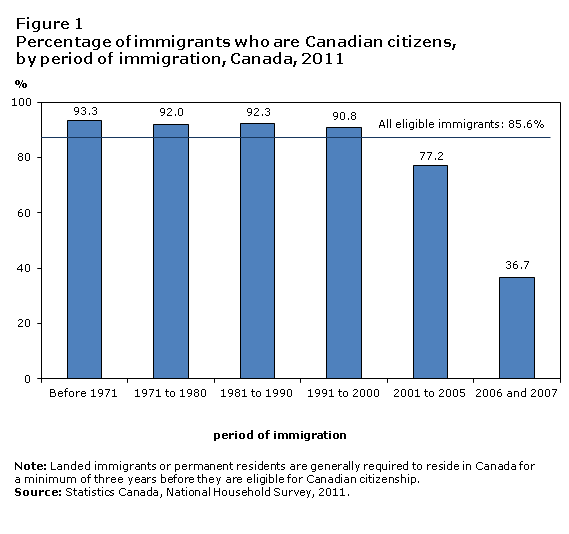
More substantively, this and other changes will continue to erode the Canadian model of immigration as a pathway to citizenship. As indicated in the StatsCan chart above, the 85.6 percent naturalization rate trumpeted by many a CIC Minister only applies to previous waves of immigration, with more recent waves having much lower rates (37 percent).

An area of concern and one to monitor, given that it moves us towards more disenfranchised residents who cannot participate in the political and democratic processes:

In February, Citizenship and Immigration Canada already increased the fee from $100 to $300 in order to recover its administrative costs. The upcoming raise means it will now cost applicants five times the money for their citizenship applications within a year. Successful candidates must also pay another $100 rights of citizenship fee to become citizens.

Officials said the fee changes are necessary to pay for the more stringent citizenship process introduced by the government to clear a backlog it created with the “residence questionnaire,” which is used to scrutinize if applicants have physically spent enough time in Canada to qualify for citizenship.

In August, Immigration Minister Chris Alexander also announced a new streamlined decision-making process to cut the backlog, which has since been reduced by 17 per cent. In total, Canada welcomed more than 260,000 new citizens this year.

“With a record number of new Canadians this year, it is clear that our government’s changes to the Citizenship Act are having a real impact,” Alexander said in a statement.

“We are fulfilling our commitment to reducing backlogs and improving processing times.”

Based on citizenship projections from 2014, the fee raise could bring in an additional $60 million to the federal coffers in 2015.

Hard not to think of this as more of a “cash grab,” given that the changes were partially sold on efficiency grounds and that CIC received an influx of $44 million in Budget 2013 to address the backlog.

Ottawa hiking citizenship fees for second time in a year | Toronto Star.

Record number of new citizens welcomed in 2014

Graphic – Changes to Canada’s Citizenship Fees: A Comparative View – Relieving the Burden on Canadian Taxpayers (6 February 2014 press backgrounder).

And the latest article complaining about citizenship processing times:

Want-to-be Canadians frustrated by citizenship processing delays

And the public statement regarding the results of CIC’s analysis of the further increase:

In its analysis, the department said the fee jump may impose additional financial pressures on some people or families.

“While the analysis assumes that there will not be a reduction in overall demand for citizenship as a result of the fee increase, it is acknowledged that some may be required to delay their application as they will need more time to save for the new fee,” the analysis says.

“Overall, in the long-term, this will likely not have a significant impact on the uptake for citizenship.”

No acknowledgement that naturalization rates have dropped from the public – and obsolete – 85.6 percent rate often quoted.

And it would be interesting to see the assumptions behind the analysis that this will not reduce overall demand for citizenship.

Conservatives Hike Citizenship Fees.. Again