Immigration committee study highlighting coronavirus impact on Canadian immigrants

Will be interesting to follow, particularly with respect to backlogs and processing (hopefully citizenship as well):

Separated family members, approved permanent residents unable to travel to Canada, and others are speaking up in the House of Commons as witnesses in a study on Canadian immigration.

Canada’s Standing Committee on Citizenship and Immigration is conducting a study that will examine the impact of COVID-19 on the Canadian immigration system over the course of no more than eight sessions. Once the study is complete, the committee will report its findings to the House. The government then has 120 days to table a comprehensive response, however, they are not obligated to make any change in policy.

This particular study will look into the following issues relevant to the coronavirus impact on Canadian immigration:

  • Application backlogs and processing times for the different streams of family reunification and the barriers preventing the timely reunification of loved ones, such as denials of Temporary Resident Visas (TRVs) because of section 179(b) of the Immigration and Refugees Protection Regulations, and the ongoing closures of Visa Application Centres;
  • Examine the government’s decision to reintroduce a lottery system for the reunification of parents and grandparents; to compare it to previous iterations of application processes for this stream of family reunification, including a review of processing time and the criteria required for the successful sponsorship;
  • TRV processing delays faced by international students in securing TRVs, particularly in francophone Africa, authorization to travel to Canada by individuals with an expired confirmation of permanent residency, use of expired security, medical, and background checks for permanent immigration.

While House is in session, the committee is meeting at 3:30 p.m. on Mondays and Wednesdays. The next meetings are scheduled for November 16, and 18. Immigration minister, Marco Mendicino, has been invited to appear before the committee on November 25 and December 2.

How travel restrictions are affecting immigrants’ mental health

Among other early findings, the mental health of immigrants and their Canadian family members was examined in two scenarios relating to family separation.

Faces of Advocacy is a grassroots organization established to reunite families in Canada during COVID-19 travel restrictions. They say they are directly responsible for the exemption on extended family members, which was announced on October 2.

The group indexed the mental health of 1,200 members at the end of August. They used validated mental health rating scales for depression, anxiety, and post-traumatic stress in civilians. The results are not diagnostic, but offer a glimpse into the mental health effects that have resulted from travel restrictions.

Despite 49 per cent of respondents reporting they have never been diagnosed with mental illness, just over 69 per cent would screen positive for symptoms of clinical depression. In addition, 16 per cent of respondents had a history of self harm or suicidal thoughts prior to the travel restrictions, but after family separation this nearly doubled to 30 per cent.

Spousal Sponsorship Advocates was established during the pandemic. It is as another grassroots movement, created to advocate for the accelerated reunification of families with ongoing spousal sponsorship applications in Canada.

Their survey took a mental health snapshot of 548 respondents, who had been separated from family for months or even years at a time. Of these, a reported:

  • 18 per cent have suicidal thoughts;
  • 22 per cent had to stop working;
  • 70 per cent have anxiety and 44 per cent generalized anxiety;
  • 35 per cent started having panic attacks;
  • 78 per cent have periods of severe depression;
  • 76 per cent have severe energy loss;
  • 57 per cent now have physical pain;
  • 52 per cent gained or lost weight abnormally;
  • 85 per cent have sleep problems.

The mental state of expired confirmation of permanent residence, or COPR, holders was also mentioned. These are people who were approved for permanent residence, but were not able to travel to Canada before their documents expired. As a result, many are unable to come to Canada without an authorization letter from Immigration, Refugees, and Citizenship Canada, and they have already upended their lives in their home country. The evidence includes a series of tweets that are intended to show the “pains, agony, [and] mental torture” experienced by COPR holders.

Source: Immigration committee study highlighting coronavirus impact on Canadian immigrants

Citizenship Act C-6 Changes: Witnesses 14 April Meeting

At the first set of hearings with witnesses, the majority were supportive of the main changes in C-6 given their concerns regarding Charter rights, due process, and removing barriers for the more vulnerable.

There were a few committee procedural disputes, with the Conservatives challenging the Chair’s discretion in asking questions and asking for use two meetings to discuss issues related to live-in-caregivers, likely both strategies to delay passage of the Bill. The Government side voted down both motions.

The first hour was dedicated to legal and related issues, with Legal Aid Ontario (Andrew Brouwer), Audrey Macklin of UofT Law School, and the Canadian Bar Association Immigration Law Section (Christopher Veeman) testifying. Their presentations and answers to questions reinforced each other. All supported removal of revocation for dual citizens convicted of terror or treason. I will post written briefs as received (they will likely be posted on the CIMM site).

Legal Aid Ontario emphasized their broader mandate to ensure equal access to charter rights, noting the rights of the mentally ill and children in particular. It shares Macklin’s point on the need to ensure that revocation for fraud and misrepresentation has comparable procedural safeguards to other areas, including recourse to the Federal Court. Refugees should get pre-decision time 50 percent credit for permanent residency time to qualify for citizenship. Brouwer made a number of recommendations to improve protections for stateless persons, both those who are legally as well as de facto, and that statelessness should be considered a factor in granting citizenship.

Macklin focused on revocation for fraud and misrepresentation, explaining the protections that existed prior to C-24, with the general principle that the more secure one’s status, and the more important the consequences of losing it, meant the greater the protections needed. The changes made by the previous government meant that those accused of fraud or misrepresentation would have less protection than permanent residents similarly accused, or even those facing a speeding ticket. Procedural protections were needed. First level decision-making should be delegated, with provision for appeal to an independent quasi-judicial body such as the Immigration Appeal Division. There should be various remedial options for the Federal Court to appeal or review.

The CBA noted that it welcomed some of the changes in C-24 that provided greater clarity on residency, streamlined decision-making and the increased resources to address the processing backlog. It agreed with Macklin, calling C-24’s misrepresentation revocation provisions ‘Kafkaesque.’ The CBA also questioned IRCC’s authority to suspend processing of incomplete applications essentially indefinitely. Loss of citizenship should mean reversion to permanent resident status. Some discretion should be provided with respect to physical presence for those whose work takes them overseas but who are based in Canada, citing pilots as an example.

Questions:

Government side:

Q: Would the risk of giving citizenship judges greater flexibility not mean less consistent decisions?

A (CBA): Possible, but that type of discretionary decision-making exists and this provides flexibility to address those with strong cases.

Q: To address statelessness, what provisions would be recommended, and would these be best dealt with in C-6 or separate stand alone legislation?

A: LAO): Within C-6, including a definition would be particularly helpful. Larger issues include ratification of the 1954 statelessness convention, an improved process to determine status similar to other countries like the UK, and amendments to humanitarian and compassionate (H&C) guidelines and the grounds for invoking statelessness.

Q: Why is revocation like banishment and how would the previous revocation provisions of C-24 been incompatible with the Charter?

A (Macklin): Explained mainly with respect to s 7 of the Charter as being cruel and unusual punishment. The normal Ministerial powers do not include punishment, with revocation being a double punishment in addition to jail time. Earlier SCC jurisprudence on the right of prisoners to vote provided a precedent for this reasoning.

Q: For those whose families are in Canada but who work abroad (example from Gulf), physical presence means they may never meet these and not become Canadian.  What suggestions do you have to address these kinds of situations?

A (CBA): During C-24 hearings, our submission recommended IRCC discretion the tests in the previous IRCC policy manual 5, pages 6-7 for a nuanced assessment of connection to Canada. This should be delegated to officials.

Physical presence is black and white, easier to apply, and thus improves processing speed. Trade-off between speed and allowing exceptions. Macklin noted that one can have both clear rules with allowable exceptions.

Q: What is the logic of the CBA in not wanting to require tax returns?

A (CBA): There are already provisions in the Income Tax Act so no need. Risk of misrepresentation revocation in case someone did not file.

Opposition questions:

Q (C): With respect to revocation, people want to feel safe. Three jurisdictions have introduced or passed similar legislation: UK, France (still in Senate) and Australia. Any reaction to the fact that other countries had adopted a similar approach to C-24? Tilson went on at some length to make his points.

A (CBA): From a practical point of view, not sure how revocation makes us safer. Better to keep them in a jail; expelling them means they may come back later. (MP Tilson noted that revocation and expulsion would happen after jail time).

A (Macklin):  France had abandoned its proposed bill. Australia had no entrenched bill of rights. There was ongoing litigation in the UK over revocation practices. More interesting, many countries had not implemented such measures, including the USA. As to question whether revocation made us safer, her understanding was that terrorism was a global problem, one that we should not export elsewhere. She cited the absurd example of a dual Canadian-British citizen, convicted of terrorism, and a ‘race’ to see which country would revoke first.

Q (NDP): What are the implications of the provisions on foreign criminality as a bar to citizenship? On language testing, is not the requirement to do the knowledge test in an official language a form of double testing?

A (LAO): There are justifiable concerns that someone who comes from a repressive regime, that the regime could lay a charge to prevent that person from becoming a Canadian citizen.

A (CBA): CBA advocates a return to the previous system where the knowledge test could take place before a judge with an interpreter.

Q (NDP): Does the steep increase in citizenship fees  result in hardship, and would you recommend the government entertain measure to reduce this hardship.

A (LAO and Macklin): Obvious barriers particularly on refugees. Refugees need citizenship and government should be mindful not to erect barriers.

Q (NDP): What should be the considerations for invoking H&C? At what stages?

A (Macklin): Crucial throughout given no law or regulation can cover all situations. Factors need to be specified.

Q (C) : Under what conditions should citizenship be revoked? Fraud, lying?

A (CBA/Macklin): Yes, for misrepresentation. There could be consideration for long-term residents. Macklin added that the misrepresentation should be material, that citizenship would not have been granted if known. A statute of limitations could be introduced. MP Saroya questioned having a statute of limitations, asking what about war crimes? Macklin noted there was no statute of limitations for war crimes or crimes against humanity. She added, in response to a further question, that citizenship is a limited tool to address safety and security, the criminal justice system and enforcement were more effective.

Second Hour

This was a broader discussion, featuring former Ambassador James Bissett, Debbie Douglas of OCASI, and Ihsaan Gardee of NCCM.

Bissett indicated his opposition to C-6, reiterated his well-known belief that five-year residency was needed. He talked about citizens of convenience, citing the Lebanese evacuation of 2006 and eventual return to Lebanon. His prime argument is that there are two classes of citizenship: natural born (by accident) and choice (naturalization). He then added to that dual citizens (which either can be).  Canada was not the only country to revoke citizenship, citing the UK. He mentioned the CSIS analysis of some 130 radicalized Canadian fighters abroad.

Douglas supported C-6 but argued for greater flexibility in the physical presence requirement with citizenship judge discretion. She noted the difficulty older applicants may have in passing the test; while she believed in its importance, it should not be a condition. Moreover, older applicants should be allowed interpreters in the knowledge test. Up-front language testing was an issue, particularly the cost, and should be eliminated for those who have met all other criteria. There should be greater clarity on the disability exemptions beyond vision and hearing.

Gardee focussed his intervention of the revocation for terror or treason, welcoming the proposed repeal of this provision in C-24. He noted that this had created considerable unease among Canadian Muslims as it created two classes of citizens. Repeal was urgent and he reminded MPs of the Maher Arar case. He mentioned C-51 as another measure that disproportionately singled out Canadian Muslims and should be repealed.

Questions

Government-side:

Q: Asked whether Bissett wanted to comment with the previous witnesses raising the issue of Charter consistency of C-24’s revocation provision.

A (Bissett): While aware of his concerns, as far as he knew it did comply with the Charter as the Dept of Justice would have reviewed the Bill and not let it go forward if not compatible (Note: bit naive given previous government’s record before the courts). C-24 had not been challenged and  there was one case of revocation. The CBA speaks for lawyers but “many other lawyers perhaps disagree or have some doubt.”

Q: Asked about the number of different categories of citizen and whether further categories were not possible, and should the criminal system have different rules for different categories.

A (Bissett): System inherently set up for three classes of citizen: natural-born (accident), naturalized (choice), dual nationals. If one chooses and takes the oath, revocation appropriate for terror or treason. More symbolic than anything else but worthy of penalty.

Q: Cited earlier Bissett article arguing that all Muslim immigrants should be interviewed and that Charter undermines Canadian security.

A (Bissett): Replied that he believes all immigrants should be interviewed and that electronic review of applications not adequate to detect fraud. Went on to say that interviews should apply to countries where terrorists come from, which are mainly Muslim, and that no one hires an employee with an interview. He noted the extent of fraudulent documents in Bangladesh and that the current system of no interviews was both ‘dangerous and silly’.

Opposition:

Q (C) : Importance of language to new Canadians, integration, inclusion, overcome barriers? What about proposed Quebec legislation and emphasis on learning French to overcome inclusion issues? What about their proposed transitory certificate to be evaluated after three years before being fully granted immigration status? What about the requirement to sign a statement of adherence to Quebec values?

A (Douglas): Language is important to function and many can and do. Has not read the Quebec proposals but is doubtful about the idea of a requirement to sign a statement on Quebec values.

Q (C) : There has been no quantitative research by IRCC on the impact of no longer requiring language assessment for 14-17 and 55-64 year olds yet there is large percentage affected. What are the implications and issues around language training”

A (Douglas): We have a robust system but resources are always an issue. The C-24 changes were not evidence-based and were ‘arbitrary.’ (Note: What goes around comes around …) C-6 goes back to a proven system. For refugees and particularly women refugees, it is often hard to pass the knowledge test. For many, coming from situations of violence and war, spending a generation in a refugee camp, some may not be able to pass the language assessment.

Q (NDP): Noted that her mother, who only had a grade 6 education, would have failed language and knowledge requirements. She asked about the barriers posed by these requirements, and the associated costs.

A (Douglas): The 14-17 years olds have spent time in Canadian schools and never understood why language assessment was required. For older women, they ‘pick up what it means to be Canadian’ and an interview with a judge can determine that. Refugee women should have interpretation where required. There are also disability issues like those who are hard of hearing where waivers may be appropriate.

Q (NDP):  Any suggestions to reduce these financial barriers and improve language training?

A (Douglas): Eliminate up-front language fees. Ensure language training available on weekends and evenings. Invest in childcare and transportation to language classes.

Q (C) : Asked about the problems faced by caregivers.

A (Douglas): Settlement agencies deal with many caregivers, with the main issues being long waiting periods for permanent residency status and associated residency issues.
#Citizenship Act C-6 Changes: Hearings Start April 12

The first Citizenship and Immigration Standing Committee hearing took place April 12. The Minister made a summary introduction to allow more time for questions (and given he was somewhat late).

The Minister did indicate in his responses to questions that while his focus was on implementing platform and mandate letter commitments, he made the general point that he was open to considering amendments in response to the NDP’s question regarding the lack of judicial hearings in cases of revocation for misrepresentation.

Government-side questions were a mix of softball (e.g., time for C-6 to be implemented) and those that likely reflected constituent concerns with respect to knowledge and language testing, along with some that probed the rationale for certain policy choices (e.g., 3 year minimum residency rather than 2). Some MPs were better at having internalized their questions, others stuck more closely to their written material.

Surprisingly, the proposed repeal of citizenship revocation for terror or treason received comparatively little attention from the Conservatives, with the Conservative immigration critic (Michelle Rempel) focussing on the elimination of language assessment for 55-64 year olds and the possible impact on the economy, leaving it to another Conservative to question the proposed repeal, mentioning the restoration of citizenship to the convicted terrorist Zakaria Amara,  (“a terrorist is a terrorist is a terrorist”).

The Minister made his standard reply: all Canadians, whether sole or dual nationals, should be treated the same (“a Canadian is a Canadian is a Canadian”), and that the Canadian legal and penal systems were more appropriate ways to deal with terrorists.

My summary notes:

Language: No disagreement among all parties on the importance of language competency to integration and citizenship. The Conservatives focussed on the reduced age requirements to 18-54 from 14-64 and the possible impact that would have on labour market participation and outcomes. They suggested a better approach was more emphasis on language training.

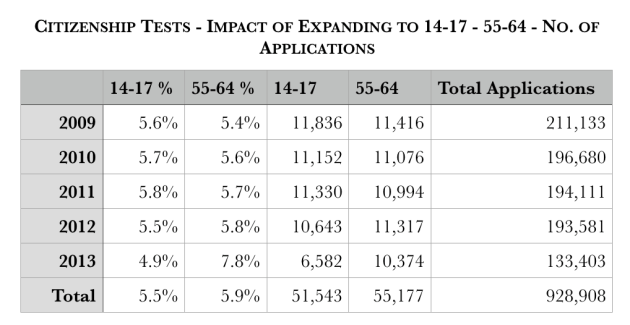
The Conservatives also asked whether any economic analysis had been done on the impact of this change for 55-64 year olds and the answer was no, the Minister retorting that none was carried out when the Conservative government increased the requirement. The Minister also responded that the number of 55-64 year olds was 8 percent of the number of applicants  (data provided to me by IRCC for earlier years shows a smaller number but they may have used 2014-15):

Citizenship Test Age Change ImpactSurprisingly, the Conservatives spent some time on the younger cohort affected (14-17 year olds) despite the fact that they would have all (or virtually all) been in school for 3-5 years and thus be competent in English or French (I always suspected this was a ‘backdoor’ way to ensure civics education).

The NDP focused more on the level of resources for language training, citing examples of reduced funding and wait times. The response was to emphasize the current high levels of funding for language training and additional funding for Syrian refugees. They also asked a number of technical questions regarding the level of language required (CLB-4 – basic).

Some Liberals noted that some constituents worried about the citizenship test, particularly the 55-64 year olds and asked how many people are likely to apply without the test and these worried. Officials replied that it is difficult to isolate factors, there were a number of reasons, including some dual citizens may not want Canadian citizens, but referred to the historic 85 percent naturalization rate (recent rate is significantly lower).

Knowledge test: There were a number of questions regarding the knowledge test and what happened when an applicant failed. The Minister and officials noted that the first time pass rate was 87 percent. Those who failed could write the test a second time, boosting the overall pass rate to slightly above 90 percent. Those who failed a second time could have a hearing before a judge, leading to another few percent to the overall rate. Subsequently, officials noted that typically the time to retake the test is between 2-4 weeks.

The NDP also noted some of the difficult and ‘tricky’ wording of the knowledge questions. The Minister acknowledged the point and stated that the revised citizenship guide would be written in a manner to be more comprehensible to more people.

Citizenship guide: Liberal side asked questions of planned revising of citizenship guide and degree to which the Charter would be emphasized and questions regarding religious rights. Officials noted that much of the content of the guide is prescribed by regulations (history, society, rights and responsibilities).

Physical presence requirement: Raised by Liberal MPs for cases of those working overseas with families in Canada, the Minister reiterated that citizenship required physical presence, that we did not want ‘citizens of convenience’ acknowledging that there were some hardships but nevertheless maintaining the requirement.

Fees: The NDP raised the issue of the steep increase of fees in 2014/15: from $100 to $530. Minister responded by saying that neither the platform nor mandate letter referred to fees but that he did not preclude looking at fees in the future.

Revocation (misrepresentation): The NDP raised the removal of judicial review as noted by the CBA, leaving revocation at the discretion of  the Minister. The Minister responded by stating that the Committee would hear from the CBA and that he was open to amendments in this area.

Processing times/Service standards: Liberal members raised the issue of processing times. The Minister gave credit to the previous government for a number of measures that have allowed IRCC to meet a processing time of 12 months (later officials indicated this was with respect to 80 percent of complete applications as of 1 April 2015 – incomplete ones are not counted).

International students pre-permanent residency credit: Minister reiterated measure to restore 50 percent credit for pre-permanent residency time for international students and also review possible improvements to Express Entry to make it easier for students, something that he intended to do that was not in his mandate letter. Some government members asked whether consideration would be given to more than 50 percent with the response being that 50 percent was deemed to be reasonable.

Refugee pre-permanent residency time: Chair asked whether consideration would be given to granting pre-permanent residency time to refugees or humanitarian cases. Officials noted that credit was only provided once refugees had been confirmed as protected persons and Minister added as general principle, government should not credit illegal time in Canada, only legal.

Lost Canadians: NDP raised that there were remaining cases and that the first generation limit remained an issue. IRCC officials explained the provisions of prior legislation (C-37 and C-24), that avenues were available for particular cases not addressed along with stateless persons.

Seizure of documents in cases of fraud. Conservatives asked for examples and officials indicated passports with entry and exit information. There were questions regarding the degree to which officials would have discretion with officials replying that this would be based on ‘reasonable grounds,’ with the details to be spelled out in regulations.

There was a long side discussion on the legitimate issue raised by the Conservatives regarding changes in the way that MP citizenship (and immigration) enquiries were going to be handled compared to the earlier direct channel of the Ministerial Enquiries group, leading to a Conservative motion, supported by the NDP, that officials brief the Committee prior to C-6 moving forward. Defeated on party lines although the request for a briefing (if not the timing, holding C-6 hearings in abeyance) appeared reasonable.

Citizenship bill flies under the radar, it shouldn’t | hilltimes.com

My take in the Hill Times on the Committee hearings on Bill C-24, changes to the Citizenship Act:

One month ago, Parliamentary hearings started on Bill C-24, the Strengthening the Value of Canadian Citizenship Act. Witnesses ranged from those who support the bill unreservedly, to those who oppose without qualification.

It was more Kabuki theatre than debate, given the government mainly probed supporting witnesses and the opposition opposing witnesses. However, many had significant nuances, particularly on due process questions, which may prove significant when the bill proceeds to more formal review.

Apart from the Canadian Jewish community, represented by CIJA, B’nai Brith and J-RAN, there is relatively little testimony from the larger ethnic community organizations. There has also been relatively little press coverage that I have seen in the ethnic media. This is somewhat surprising, given the impact that this bill will have on their communities.

Secondly, lawyers testified strongly against the bill, noting major concerns regarding Charter compliance, particularly with respect to revocation, notwithstanding Immigration Minister Chris Alexander’s assertion that the bill “is fully compliant with the requirements of our Constitution.” Additional concerns were expressed regarding the increased discretion for officials and the minister. Given the track record of the government before the courts, the minister’s confidence will likely be tested as cases emerge.

Thirdly, opinion is highly polarized between those who support the government’s approach of making citizenship “harder to get and easier to lose,” and those who believe the current approach is largely successful and believe in a more facilitative and flexible approach. Overall, more witnesses were opposed to the overall direction of the government.

This article aims to provide the general state-of-play on testimony to date.

Residency: There is no clear consensus and positions are split down the middle. However, some of those supporting the increased residency time and physical presence expressed the need for more flexibility, primarily for those with business reasons for travel. There was general opposition to removal of half-time credit for temporary residence (e.g., foreign students, temporary foreign workers, refugees and live-in caregivers) towards meeting residency requirements. The “intent to reside” provision was opposed by most witnesses, with some fearing that determination by citizenship officers of an applicant’s “intent” could be arbitrary, in addition to the broader question treating naturalized Canadians differently from born Canadians.

Knowledge and language testing: More organizations opposed increased coverage (from 18-year-olds to 54-year-old and 14-year-olds to 64-year-olds), particularly, refugee and settlement organizations. A number of witnesses also opposed the imposition of up-front language testing (introduced to streamline processing), as this effectively increased the language barrier. While some of the concerns regarding older applicants are valid, the 14-year-olds to 17-year-olds automatically will meet language requirements, as they will have been educated in a Canadian school.

Fee increases: Refugee advocates strongly opposed these increases, given that for many the cost could be prohibitive. Citizenship is particularly important for refugees given that many have had to sever connections with their country of origin.

Criminal convictions abroad: While not subject to much testimony, both those supporting and opposing expressed concern regarding the equivalence between Canadian and foreign courts, which needed greater clarity in the bill.

Revocation for fraud: All supported the principle for revocation of fraud or misrepresentation, but the vast majority opposed this being at ministerial discretion with no appeal to the Federal Court. There was support, however, for the streamlined process that removes the Cabinet role and consolidates revocation and removal proceedings.

Revocation for terrorism, high treason, or who take up arms against Canada: Not surprisingly, this formed the bulk of testimony on both sides of the issue, evenly divided. For many, such crimes break the “fundamental social contract of Canada” given that they are acts against Canadian values. For others, the fundamental issue is treating dual nationals, whether by birth or naturalization, differently from Canadian-only nationals, changing Canada’s long-standing policy since Diefenbaker.

Most of those who supported revocation noted the need to add to the existing test, “was the offence equivalent to Canadian law,” a second test, “was the judicial process also equivalent.”

Others opposed the reverse burden of proof on citizens to demonstrate that they did not have dual citizenship. It is unclear whether this includes only the right to another citizenship (e.g., Israel’s Law of Return which has parallels in a number of countries), or actually formally having exercised that right. Retroactive revocation was also criticized (the Omar Khadr provision?).

Less discussed issues included the reduced role for citizenship judges, the requirement to provide tax returns, providing preference to applicants having served in the Canadian Forces (very small numbers), Crown servant first generation exception, and the regulation of citizenship consultants.

A number of witnesses supported the expansion of “lost Canadians” to those born before 1947 (date of the first Canadian Citizenship Act) as well as their first generation born abroad. However, the government suppressed the testimony of long-standing activists Melynda Jarratt and Don Chapman who remain concerned that the bill only fixed war brides and their children, not posthumously recognizing Canadian citizenship of those who died before 1947, including Canadian war dead.

One of my favourite comments, from the Canadian Bar Association, is that the bill should be completely redrafted, with less cross-referencing, in plain language.

After the initial flurry of interest and commentary, the hearings are largely happening under the radar. Mainstream media are not covering it and ethnic communities and media are largely absent. Neither opposition party appears, at this stage, to be making this a major issue, in sharp contrast with C-23, the Fair Elections Act, and controversy over Temporary Foreign Workers. Alexander is lucky indeed.

There are some obvious areas where the government could respond to some of the testimony without changing the fundamentals. There seems no sound policy or political rationale not to count pre-permanent residency time towards citizenship. The intent to reside provision needs further clarification on how citizenship officers will decide whether it is genuine or not. It seems pointless to extend language assessment to 14-year-olds to 17-year-olds given that they have been in Canadian schools for six years before applying. There should be some flexibility for fees for low-income refugees. Greater clarity on Canadian equivalency on foreign criminality convictions will improve fairness. Revocation for terrorism and treason should similarly also test for equivalence to Canadian judicial processes, and have greater clearer criteria and language (e.g., “act” rather than “offence”).

None of this will address the philosophical differences between the government and its supporters, and those of its critics. The overall tightening of citizenship will likely reduce the number of permanent residents taking up citizenship. Increased residency and related requirements may make Canada less attractive to the “best and brightest,” and most mobile immigrants Canada wishes to attract. Revocation for terror and treason changes long-standing policy of treating all Canadians equally, whether born in Canada or naturalized.

As Bill C-24 moves to more formal parliamentary debate, we shall see if the political dynamics change and Canadians start pay more attention to this tougher approach to Canadian citizenship, and the likely effects over time, on Canada.

Immigration bill flies under the radar, it shouldn’t | hilltimes.com.