Chris Alexander: Fixing immigration and fixing the economy are two sides of the same coin

Number of suggestions by former immigration minister Alexander. First set, government already moving in that direction. Others are more difficult and or controversial to implement. While the government is committed to a Ukrainian victory (but our role minor compared to USA), not clear what other sanctions against Iran remain to be implemented, or which ones he proposes for Pakistan (Alexander has been consistent, and rightly so, on Pakistan’s counterproductive role in Afghanistan).

While we can all agree on the need to increase unity and trust, the devil is in the details and there are no easy solutions apart from better and clearer messaging by political and other leaders:

First, set immigration levels between 300,000 and 400,000—targeting the lower end so long as our economy struggles and apportioning economic immigrants roughly equally among Skilled Worker, Canadian Experience, and Provincial Nominee programmes. In future, immigration levels should be driven by our prospects for economic growth and the availability of basic services like health care and housing. But there is no substitute for decent, clear-eyed political judgement on these issues.

Second, end access for low-skilled temporary foreign workers, a subsidy for uncompetitive businesses and, as the prime minister recently put it, “big chain corporations.” Skilled workers may still be needed in selected fields, but the system needs to be tight and well-managed, not a morass of abuse and ad-hockery.

Third, process 260,000 asylum claims fast. The law requires hearings within 60 days; currently, they take over three years. The Immigration and Refugee Board needs to staff up and burn the midnight oil to take this backlog back below 10,000, where it was in 2015. To prevent new backlogs, our visa requirements should be de-politicized: citizens of countries that do not meet our existing criteria for lifting visa requirements should be required to have them. Our current government undermined these criteria, notably in the case of Mexico, with predictable consequences.

We also need to come to grips with the number of people now in Canada without any immigration status, which has ballooned, and ensure such cases are resolved via existing programmes, including the humanitarian and compassionate stream, or through the asylum system. People should not be left in limbo or the shadows.

Fourth, lift current caps for international students so our best institutions of higher education are not punished for our current government’s missteps and implement a hard-edged strategy to end fraud and “fake colleges” and restore Canada’s merit-based reputation.

Fifth, a new government should think creatively about the world’s refugee crises. By April 2024, about 120 million persons were forcibly displaced worldwide—nearly twice the 2014 figure. About 43 million are refugees. Our generous refugee programmes failed to reverse these horrendous trends. Why? Because the dictators responsible for wars, genocides and repression in the Sahel, Middle East, South Asia, and Ukraine have gone unpunished.

Russia alone launched migration crises in Europe, Turkey, and Africa; genocide in Syria and Ukraine; coups and repression on four continents; and Europe’s largest postwar invasion. Iran armed terrorists. Pakistan put the Taliban back in power. China and North Korea help them.

These aggressors are behind this spike in displacement. To prevent the number of refugees from doubling again, Canada should commit to Ukraine’s victory, sanction Iran and Pakistan, and focus our refugee programmes on victims we failed over the past decade.

Sixth, we need to restore our sense of unity and trust. The Chrétien government had a cabinet committee on social union; we need something similar now. Canada should be free of violent extremism, hate speech and antisemitism. Our borders should be respected and our laws enforced. New citizens should be equipped to resist disinformation and polarization.

Far from being “post-national,” Canada’s strong, dynamic culture and identity attract millions who want to work hard, support families, communities, and businesses, live under the rule of law, participate in good government, and help those less fortunate than themselves.

By fixing the economy and taking six additional steps, we can turn a corner on immigration. Asylum backlogs, abuses by “big chain corporations” and “fake colleges” did not spring out of the ether. They are by-products of too many years of poor administration. With competent management, Canada’s economic promise can be restored and our immigration programmes will see better days.

Source: Chris Alexander: Fixing immigration and fixing the economy are two sides of the same coin

‘Our current government hasn’t been heeding national security advice’: Former immigration minister Chris Alexander on how Canada vets immigrants—and how ISIS operatives may have slipped through the cracks 

Worth reading, both as an explainer as well as the political commentary:

Significant questions are being asked of Canada’s security and immigrant vetting processes following the arrests last month of Ahmed Fouad Mostafa Eldidi, 62, and Mostafa Eldidi, 26, a father and son facing charges that include conspiracy to commit murder for the benefit or at the direction of a terrorist group—in this case, ISIS.

Reports have emerged that the pair were able to immigrate to Canada despite the elder Eldidi having participated in violence, including torture and dismemberment, against an ISIS prisoner. The assault was recorded on video and released by ISIS prior to the pair’s immigration to Canada.

Ahmed Fouad Mostafa Eldidi is a Canadian citizen while his son, Mostafa, is not.

Police claimed the father and son were “in the advanced stages of planning a serious, violent attack in Toronto,” before their arrest.

To better understand Canada’s immigration vetting process, Sean Speer, The Hub’s editor-at-large, exchanged with Chris Alexander, Canada’s minister of Citizenship and Immigration from 2013 to 2015, who offered his expert insight on how the pair may have slipped through the cracks without raising alarm.

SEAN SPEER: How does the Department of Immigration, Refugees and Citizenship draw on intelligence and national security analysis when judging the admissibility of an immigration applicant? Does the department have its own capacity or does it draw on the capacity concentrated in CSIS and other national security agencies? If the latter, what’s the mechanism or process for such analysis to be pulled into the department’s decision-making?

CHRIS ALEXANDER: The Department of Immigration, Refugees and Citizenship uses national security-related information to make decisions, but this information invariably originates with CSIS, the RCMP, or our trusted allies and partners that share such information with us. When an applicant has never before been flagged for national security-related concerns, then IRCC is relying on CSIS, relevant police services, and their international partners to ensure nothing new has come to light. Timelines are often short; resources are invariably stretched; and matching applicants to data generated by national security review across languages, alphabets, and administrative systems can pose challenges.

SEAN SPEER: What type of national security review is typically used for immigration applicants compared to more extraordinary cases? What’s the triage process for determining the level of national security review?

CHRIS ALEXANDER: Applicants for permanent residence receive a more thorough review than say, international students or temporary workers. Anyone with a background in police, the military, or security services will receive additional vetting, especially if they come from a country with a less-than-stellar human rights record. The country of origin and any other places where the applicant lived, studied, or worked are also taken into account: if any of these countries are theatres where significant terrorist or extremist groups operate, where wars, civil wars or other armed conflicts are underway, or where hostile intelligence services may be recruiting assets, then there will be additional vetting as well. The parameters for Canada’s national security vetting are always shifting as the threat environment evolves, and our assessments catch up (or fail to catch up) to fast-changing realities on the ground around the world.

SEAN SPEER: Based on what we know about this particular case, what might have happened such that this individual’s participation in an ISIS-related execution was not factored into his admissibility?

CHRIS ALEXANDER: The information on the file might have been incomplete. For sound operational reasons, those monitoring ISIS comms and participants in ISIS war crimes may not have made their information fully available to national security databases. Stove-piping still happens; delays happen. Names also get garbled: “credible” sources may have claimed this was not the same person. Mistakes are human nature. In addition, our national security machinery has shifted gears in recent years away from terrorist threats to focus more on China, Russia, and homegrown extremism—the flames of which are often fanned online by state actors that engage in large-scale disinformation and active measures, such as Russia.i

SEAN SPEER: Is this a widespread problem in your view? To what extent does it suggest that there are others—perhaps many others—in the country with broadly similar backgrounds or past actions?

CHRIS ALEXANDER: Our system is not prone to widespread, systemic failures—it’s quite solid. But over the decades we have failed on several fronts. One example is the number of Iranian and Syrian regime officials—some with allegations of having committed terrible crimes in those countries—who somehow slipped through our vetting system. But the main challenge today is that the number of threats—from terrorist and criminal groups, as well as hostile foreign states—has grown significantly while our national security capabilities have failed to keep pace.

Add to this tension the unprecedented numbers of immigrants, temporary workers, international students, asylum claimants, and other visitors flowing into Canada over the past two years—roughly double the usual levels, with asylum backlogs rising rapidly—and you have a recipe for more frequent failures. For instance, over the period when Mexicans were coming to Canada visa-free, how many drug cartel operatives eager to open new routes into the U.S. came to Canada? We may never know. The same may be true for ISIS, representatives of China’s United Front Work Department, Iran’s Revolutionary Guards (IRGC) or Ministry of Intelligence and Security (MOIS), and even Hamas or Hezbollah, which have historically had quite robust networks in Canada.

As we have all observed to our dismay, our current government has not been heeding national security advice and, to put it very mildly, has not been vigilant on these issues over the past nine years. Our allies (particularly in the Five Eyes intelligence-sharing community) have noticed, and our reputation has been tarnished as a result.

SEAN SPEER: What, if any reforms, do you think should be undertaken to strengthen the process for assessing immigration applicants through an intelligence and national security lens?

CHRIS ALEXANDER: The key to successful national security review is rapid, continuous, skillful integration of available information. The right insights are out there, but they only shape immigration outcomes in the right ways when the data is well-organized, easily accessible, and properly brought to bear on decision-making. My guess is that those responsible for these issues have been run ragged in recent years: they need backup, a full review of our procedures, and (where necessary) modernization and integration of the relevant secure communication systems and databases.

We need to put sound national security practices back at the centre of our immigration policy—as well as our policy across government. In a world where all categories of threat actors are looking for the line of least resistance worldwide to launder money, move operatives, recruit new supporters, and disrupt democracy, Canada has become an easy mark in recent years. We need to restore our reputation for a best-in-class immigration and refugee programmes rooted in sound, reliable national security vetting. We also need to harden our defences, increase our military spending, and upgrade and broaden our national security capabilities to protect Canadians in general as well as the integrity of our immigration and refugee determination system at a time when hostile state and non-state actors have become more hostile almost across the board.

Source: ‘Our current government hasn’t been heeding national security advice’: Former immigration minister Chris Alexander on how Canada vets immigrants—and how ISIS operatives may have slipped through the cracks 


Chris Alexander: I am a former immigration minister. Unsustainable population increases won’t solve Canada’s underlying issues

Late to the various debates and discussions given his recent focus on Russia and Ukraine. More descriptive than prescriptive, with few concrete suggestions or recommendations:

In March, the Globe and Mail reported that Canada’s population had grown by 1.3 million in 2023—the largest annual increase on record.

This surge was driven by higher numbers of immigrants, international students, temporary foreign workers, and asylum claimants.

Given that the 2021 census showed that 8.3 million Canadians, or 23 percent of our population, had an immigrant background, this latest increase means that, in a Canada of over 40 million people, one in four of us is a temporary or permanent resident, or was born abroad. This proportion of newcomers is the highest since Confederation, beating the previous record of 22.3 percent set in 1921. By comparison, the immigrant share of the U.S. population is today about 14 percent.

So what is driving these trends? Given that in recent decades immigration has been virtually the sole driver of Canada’s population growth, what overarching federal and provincial policy goals and real-world pressures are behind this recent surge?

Every year Canada’s minister of immigration, refugees, and citizenship tables what is called a “levels plan” in the House of Commons. This is a set of targets for how many permanent residents and refugees should be admitted to Canada in a given year, with projections for the two following years.

Under Canada’s Immigration and Refugee Protection Act (IRPA), as adopted in 2001 and amended and updated regularly by successive governments ever since, the federal government must consult with its provincial counterparts on three issues: the number of permanent residents to be admitted in a given year; their “distribution in Canada taking into account regional economic and demographic requirements”; and what we call settlement issues, namely “the measures to be undertaken to facilitate their integration into Canadian society.”

In concrete terms, this means federal and provincial officials are in touch constantly, with the minister meeting his or her provincial and territorial counterparts regularly, as well as many other groups with an abiding interest in immigration.

The minister also has the option to consult provinces on policies and programmes. For instance, how do we get more digital artists, welders, hairdressers, workers for fish or meat-packing plants, or harvesters in the autumn when Canadians do not fill the jobs? Quebec implements its own immigration programmes, which have become more restrictive in recent years, but consults the federal government on its own levels’ plan: every Quebec immigrant still receives a Canadian visa. All other provinces also have their own programmes—including the Provincial Nominee Programme and Atlantic Immigration Programme—accounting for 40 percent of economic immigrants this year, or one-quarter of our total permanent intake in 2024.

Canadian context

So far, so good. But how have these levels evolved in recent years? For the first fifteen years of this century, Canada’s annual immigration intake ranged from 220,000 to 260,000, though in 2010 we had 281,000, and in 2015, 272,000. From 2016 to 2019, between 286,000 and 341,000 newcomers arrived yearly. With the pandemic in 2020, this number fell to 184,000. From 2021 to 2024, it rose to between 405,000 and 485,000. In 2025 and 2026, our goal will be 500,000 new immigrants per year.

In other words, the number of immigrants coming to Canada in a given year is now double what it was, on average, between 2000 and 2015. 

To put this in context, we now have the highest annual immigration levelssince we admitted 400,900 newcomers in 1913 under Prime Minister Sir Robert Borden. While today’s annual immigration represents more than 1 percent of Canada’s population, in 1913 it was over 5 percent.

But what else has been happening? In just three years, the number of non-permanent residents in Canada has quietly doubled. In the third quarter of 2021, there were about 1.3 million non-permanent residents in Canada: about 560,000 workers, half a million international students, and 166,000 asylum claimants. By the first quarter of 2024, there were 2.7 million non-permanent residents—with all three categories (temporary workers, international students, and asylum seekers) each more or less doubling in only three years.  

By March of this year, there were 329,000 asylum claimants in Canada, with 187,000 refugee protection claims pending before the Immigration and Refugee Board (IRB). (By way of comparison, in late 2015, at the end of my time as minister of citizenship and immigration, this backlog of pending claims was under 10,000.)

This bottleneck means ordinary refugee claims, which are supposed to be heard by law within 60 days, now take up to three years. As a result, the government has recently brought in new rules and additional resources for the IRB that are meant to speed decisions and processing of cases.

Global context

So what is driving upward trends in permanent immigration, temporary workers, international students, and asylum claims?

Let’s start with refugees and asylum seekers. In 2009, just over 40 million people had been forcibly displaced. In my time as minister, this number was rising fast due to genocide in Syria, civil breakdown in Venezuela, and other conflicts.

By June of 2023, serious wars in Ukraine, Sudan, and elsewhere in Africa, meant that over 110 million people were, as the UN High Commissioner for Refugees puts it, “forcibly displaced from their homes due to persecution, conflict, violence, human rights violations and events seriously disturbing public order.” In only fifteen years, the number of displaced people worldwide has almost tripled.

Since President Biden entered office, the number of migrants apprehended by patrols at the U.S.-Mexico border has oscillated between 100,000 and 250,000 per month, with 2.5 million encountered by U.S. border patrols in 2023.

By contrast, in 2013 U.S. Customs and Border Protection apprehended only421,000 “illegal aliens”; in 2019, they apprehended 860,000. 

In the febrile landscape of U.S. politics, this human drama on the Rio Grande makes for sensational headlines and salacious conspiracy theories. There is even hard evidence that state actors such as Russia are, via large-scale information warfare and other forms of influence, fanning the flames of this crisis in order to aid the Trump campaign and generally make U.S. politics even more grid-locked and chaotic.

This should come as no surprise since Russia, with the support of allies of convenience such as Turkey, actively “weaponised” Europe’s Syria-related migration crisis over 2014-16 in order to marginalize moderate voices and create fertile ground for xenophobic groups, though European politics have polarized less dramatically than other parts of the world, including the U.S.

Quite apart from conflicts and interference now triggering unprecedented forced displacement, including now from North Africa as well, Canada’s peer democracies have seen recent immigration figures jump. Australia saw a net inflow in 2022-23 of 518,000 people; over the same period, the U.K. had a net gain of 672,000, with 1.2 million newcomers arriving over 2022-23. Many attribute this recent spike to pent-up demand following the pandemic, when travel was restricted or postponed.

Indeed, all English- and French-speaking countries, as well as increasingly the European Union as a whole, are competing to attract more international students. Canada’s unique combination of strong institutions of higher education, work permits, and pathways to permanent residency have lifted our international student population from 330,000 in 2014 to over one million today. 

The challenge with such large net inflows of immigrants, students, workers, and asylum seekers has not been to find them work or places to study. The main pressure points are increasingly over infrastructure needs—housing, transport, health care, and other basic services—as well as affordability. How can so many newcomers find an affordable place to live in Canada without inflating rents or house prices, or creating hardships for the population at large?

While the impacts of these larger flows on the housing market are complex, it is fairly clear that large numbers of international students have driven rents upward in many cities, while new construction of single-family, multi-family, or student rental units has not nearly kept pace with demand due to the pandemic-related slowdowns, higher interest rates, and prohibitive zoning in many municipalities. 

At the same time, a growing student presence has brought enormous benefits to Canada, shaping a younger, larger, more dynamic, and innovative population, which on current trends (according to Statistics Canada) may reach 47 million by 2041.

Canada’s economic issues

In my view, the greatest overriding challenge Canada now faces—also a major disincentive for immigrants—is that for ten years incomes have stagnated. At the end of 2014, Canada’s inflation-adjusted per capita GDPwas $58,162; by the third quarter of 2023, it was $58,111—a loss of $51 over nine years.

In comparative terms, Canada’s poor performance is even more striking: for two years (2011 and 2012), Canada’s per capita nominal GDP was higher than the U.S.: according to IMF figures, in 2012 a Canadian earned USD $52,745 per year, while an American earned USD $51,737 per year.

Now fast forward to this year, when the IMF projects our nominal per capita GDP to be USD $54,866 compared to $85,373 for the U.S.—meaning that after twelve years the average American earns 56 percent more, while Canadian incomes have stood still.

The greatest overriding challenge Canada now faces is that for ten years incomes have stagnated.”

To add insult to injury, other advanced, high-income OECD economies where per capita GDP was lower than in Canada in 2012—such as Belgium, Finland, Germany, Ireland, Israel, and the Netherlands—now have higher per capita GDP.

What has created this growing discrepancy? This is a much longer story. The short answer is that business investment, productivity and the scale and value of our exports have, to put it mildly, not kept pace with the U.S. or many other peer economies over the past decade.

In a very short time, we have gone from being a country that was praised for low debt levels, a competitive tax system, innovative firms, prosperous cities, an educated workforce, and leadership on issues from energy to immigration to one that is considered to be heavily indebted, less affluent, less attractive to investors and falling behind—to the point where a leading Financial Times columnist has branded us the leading “breakdown nation.”

Immigration cannot solve these problems. Indeed, if such trends continue, the most qualified immigrants are unlikely to choose Canada. Moreover, the combination of record newcomer arrivals and stagnant incomes is souring Canadians themselves: after supporting immigration for many years by two to one, recent polls show disaffection growing, with Canadians now closer to evenly divided.

Immigration and the future of Canada

The bottom line is that immigrants, students, and workers chose Canada over centuries because we sustained high levels of growth and high standards of living. Canada’s declining affluence over the past decade undermines this pull factor—and is thus a major threat to our future ability to welcome newcomers.

By introducing caps both for international students and temporary residents as a whole—for the first time ever in Canada—our current government appears to agree that runaway inflows are unsustainable, particularly amid the slow expansion of our housing stock and lacklustre economic performance generally.

The most obvious areas for focused attention are asylum seekers, where the current backlog needs to be drastically reduced to ensure hearings are once again held within 60 days. This will allow Canada to sustain higher levels of refugee resettlement, which under our latest levels’ plan is now slated to decline slightly in 2025 and 2026.

Canada could easily have resettled 100,000 Syrian refugees since 2014 and 100,000 Afghans since 2021. After all, these are conflicts where people put their lives on the line for democracy, free speech, the rule of law, and women’s rights, often with Canadian support, but now face persecution in its most horrendous forms. Instead, we have so far resettled only 43,000 Afghans and 44,620 Syrians. This is a far cry from what Canada did for 120,000 Vietnamese refugees, otherwise adrift in small boats, when we welcomed them en masse starting in 1979.

Canada’s citizenship, immigration, study, and refugee programmes give our country a vital lifeline and a crucial advantage. But we cannot afford to be complacent. To meet the expectations of a next generation of newcomers, we need to become once again a leading destination for business investment and commercial success—a country where new firms, innovative products, and emerging sectors take root, find growing markets, and drive a new era of prosperity.

Chris Alexander was Canada’s Minister of Citizenship and Immigration (2013-15) and MP for Ajax-Pickering (2011-15). He is a distinguished fellow of the Macdonald-Laurier Institute and the Canadian international Council.

Source: Chris Alexander: I am a former immigration minister. Unsustainable population increases won’t solve Canada’s underlying issues
As Tories review election loss, weak support in immigrant communities a crucial issue

Article over-dramatises even if there is a need for a review.
Margins in many of these ridings were relatively small. Moreover, in Ontario, the provincial conservatives swept most of the same seats and, as the article notes, active outreach by Conservatives allowed them to make inroads.
But beyond the 41 ridings, there are an additional 93 ridings with between 20 and 50 percent visible minorities which should also be looked at:
The Conservative Party is only beginning to sift through the data from the 2021 election, but there is at least one warning light flashing red on the dashboard: the party has been nearly wiped out in Canadian ridings where visible minorities form the majority.

Of the 41 ridings in Canada where more than half the population is racialized, the Conservatives won just one in the 2021 election — Calgary Forest Lawn — despite winning 119 seats overall.

Source: As Tories review election loss, weak support in immigrant communities a crucial issue

Chris Alexander: China Against the Rule of Law

More on Senators Woo, Harder and Boehm. Again, given the release of the two Michaels, time for them to take a tougher line on Chinese government actions such as extensive arbitrary detention, crushing democracy in Hong Kong, and the ongoing repression of Uighurs:

On the same day Michael Kovrig and Michael Spavor arrived home, the Honourable Yuen Pau Woo, an independent senator appointed by Prime Minister Justin Trudeau in 2016, tweeted an invitation to Canadians to savour the happy moment. He also congratulated Canada’s ambassador Dominic Barton, and suggested there was “an opportunity to reflect on lessons learned.”

Without offering any didactic points of his own, the honourable senator provided a link to an opinion piece from the Toronto Star whose core message was that “the United States, assisted by Canada, took Meng hostage in the first place as part of its trade-and-technology war with China (…).” “Should Ottawa have arrested Meng in the first place?” asked author Wenran Jiang, an advisory board member of the Toronto-based Institute for Peace & Diplomacy. “Why did this final package deal take so long if a ‘hostage exchange’ is the result?” 

This senator’s choice of lessons was unsurprising. In June of this year, he was instrumental in defeating a Senate motion to recognize China’s genocide against the Uighurs and other Turkic Muslims — contradicting the elected House of Commons, which passed a similar measure in February by a vote of 266 to zero. Senator Woo then side-stepped discussion of a proposed boycott of the 2022 Winter Olympics in China, arguing politics should not influence sporting events. Again, this went against a unanimous motion of Canada’s House of Commons on February 22, 2021 calling “upon the International Olympic Committee to move the 2022 Olympic Games” in light of the continuing genocide against Uighurs and others.

Yuen Pau Woo was joined in these arguments by senators Peter Boehm and Peter Harder, both seasoned diplomats, who also urged Canada to suspend its judgement with regard to China’s persecution of the Uighurs. This includes the use of concentration camps and forced labour, as well as the repression of language, culture and religion. These are all blatant acts committed with the “intent to destroy, in whole or in part, a national, ethnical, racial or religious group,” as the 1951 Genocide Convention defines this “odious scourge.”

Throughout this unfortunate saga, Beijing has had a Greek chorus of supporters across Canada — mostly from people with well-remunerated corporate or political backgrounds — for the preposterous notion of a “prisoner exchange” that would get relations with China back to “normal.”

In the end, the Senate’s genocide motion failed by a vote of 29 in favour to 33 opposed, with 13 abstentions. China’s Foreign Ministry praised Woo, Boehm and Harder as “people of vision” who had seen through the “despicable schemes of a few anti-China forces.” The “clumsy trick of attacking China for selfish political gains” and “the hype of ‘genocide’ in Xinjiang is unpopular and doomed to fail,” the Foreign Ministry spokesperson crowed.

Had Woo, a former president and CEO of the Asia Pacific Foundation of Canada, and the “two Peters,” both former deputy ministers of foreign affairs, voted in favour, the Senate’s genocide motion would have passed. Instead all three chose, on an issue directly threatening the identity and lives of millions, to take the position of the Communist Party of China over one unanimously endorsed by Canada’s elected House of Commons — all in the empty hope of getting back to “normal” with Beijing.

The truth is that “normal” in the People’s Republic of China, at least since 1959, has never included the rule of law. From China’s ferocious and brutal invasion of Tibet that same year, through the murderous Great Leap Forward ending in 1962, to the decade-long Cultural Revolution up to Mao’s death in 1976 (and beyond), China has been a legal void. Serious judicial reforms never featured in Deng Xiaoping’s economic relaunch. On the contrary, basic rights were decimated, as Tibetan, Mongolian, Uighur and other refugees attest.

According to Freedom House, the current General Secretary of the Chinese Communist Party Xi Jinping’s relentless push for all-encompassing surveillance and censorship has made China the worst environment in the world for internet freedomfor the seventh year running. Compliance with such global gag orders is enforced by the CCP’s Orwellian digital panopticon, the notorious United Front Work Department, which seeks to browbeat, buy, corrupt, blackmail, extort or otherwise leverage people and firms with connections to China in support of Xi’s agenda.

Thanks to United Front subterfuge, some prominent Canadians still take China’s side, even as Beijing’s favourability score in Canadian public opinion plummeted to 14 per cent, mirroring a worldwide nosedive for China’s image driven by the two Michaels’ ordeal and Beijing’s “wolf warrior” belligerence.

Canada has a decidedly mixed record of confronting outrages by Beijing’s Communist rulers. On the one hand, we fought in Korea. But on the other hand, Norman Bethune and Pierre Trudeau remain bywords for indifference to the brutality of Chinese Communists under Mao.

Self-indulgent aloofness has cost us. Huawei’s rise was reportedly fuelled by massive theft of intellectual property from Nortel, once the darling of Canada’s tech industry. Canadians were among the first to be disenfranchised by the demise of democracy and the rule of law in Hong Kong. Meanwhile, China’s merchandise exports to Canada remain nearly triple what we export to them, even as 115 Canadians languish in Chinese jails, including Uighur activist Huseyin Celil and four others who are on death row

Today’s China under Xi uses strong-arm tactics straight out of Soviet Cold War playbooks. From Cambodia to the Czech Republic, it is corrupting democratic politicsand tilting cyber-space to boost United Front agitprop. (Though ironically, China’s level of global ambition is rising just as its growth path starts to look unsustainable.)

The Meng Wanzhou saga should remind us that the rule of law, which China lacks, remains a crucial “distinction with a difference” between us. In a tweet back in April, Senator Woo urged Canada and China to “recognize the legitimacy of each other’s judicial system.” Yet of eight principles constituting the rule of law identified by a former Lord Chief Justice of the United Kingdom, China today fulfills barely two.

Despite all the speculation about political interference and “diplomatic triangulation,” it was Canada’s rule of law that ultimately prevailed in the cases of Meng Wanzhou, Michael Spavor and Michael Kovrig. The deferred prosecution agreement Meng ultimately accepted had been on the table for years: she reportedly elected to take it when her legal team learned the B.C. court was likely to make a ruling in October clearing the way for her extradition.

Rather than face a full U.S. trial, Meng exercised an option that had been available since early 2019. This leaves Meng free, but Huawei still in legal jeopardy. Meanwhile, the costs to China’s reputation worldwide and Huawei’s global business have been asymmetrical, astronomical and devastating. Any illusions about progress towards independent Chinese justice institutions have been shattered, as the reality of genocide and repression across China come into ever sharper focus.

Democratic politics glories in disagreement. But democratic politicians that parrot the propaganda of dictators do unnecessary discredit to our institutions. Meng Wanzhou enjoyed every benefit of the rule of law in confessing to having misled U.S. authorities about Huawei’s attempts to skirt Iran-related sanctions. The two Michaels did not.

Canada’s answer to their ordeal should be to relocate or boycott the 2022 Beijing Olympics: the ghastly legacy of Hitler’s 1936 horror show requires that states committing genocide never host Olympic Games.

This is the least we can do for repressed Uighur Muslims, Tibetans, Mongolians and others still facing erasure by genocide, as well as Hong King’s brave democratic activists, many of whom who are now in jail or in exile. These persecuted people revere the rule of law in Canada as the real hero in this drama. Indeed, in the face of China’s drum roll of threats, our institutions held up remarkably well, despite the best efforts of a number of prominent Canadians to undermine them.

Our principled commitment to upholding the rule of law in China starts now — by fulfilling the commitment our democratically-elected representatives made to ensure Olympic Games are not held in a country now perpetrating genocide.

Chris Alexander was Canada’s Minister of Citizenship and Immigration (2013-15) and Parliamentary Secretary for National Defence (2011-13). He served for 12 years in Canadian embassies in Russia and Afghanistan, wrote The Long Way Back: Afghanistan’s Quest for Peace (2011) and recently released Ending Pakistan’s Proxy War in Afghanistan. He is a Distinguished Fellow for the Canadian International Council.

Source: https://email.mg1.substack.com/c/eJxVUk2P4jAM_TX01iof_aCHHGany0yZLWg1wA5cqjRJaSAkVZtSyq_fDOxlpTi2nu1nyc-MWnE03URa01vv-yvt1AqixdgrYa3ovKEXXSk5gSCBaQQSjxOQIJZUnuzLuhPiQqUiXjtUSjJqpdHf1QkAGHkNiWGF4phDkEY0SVg6D2PG0TyCUYzqOU-fM-nApdBMEKPVVLZUck-Rxtq2n-GXGVq4ZxuhpBZBP1S9pewcMHNxcOuMNZ3sfarEjWouOp81UlOfHqnUvfVd4wwvrDkLPcOZmJaQod30hdQ5P5lbkbHberMdV9Mo2Vt654u0Pbzm8SrLXS4fi_vPPr-ohjus2Ozvxb2ARbYf15-jpF-ru-OQ7H0nf23YWGTFlEvHg3fygX_zvcLp8Gdx4m_qWsllGmz9KL9uPny2iq757-vwsa7BarecXn40Z4pND9X7jR62m8zuPUkQQBACEEKEAYgDFIQpCgGoBWJ0XoEYBSkzp7kZq1kILkf433q8jriFdGJUx07WtbSNK5JMmYE_0k6y0vnLoKWdSqFppQQnthuEZ58H8dC2PAotOncovKSWwBhjHIEYAhc91XNyhwgCBDD03HxuXJcm_wT7C6NFzsw

Ex-Harper immigration minister calls out Scheer over ‘factually incorrect’ statements on UN migration pact

Yes another pleasant surprise. And funny how the CPC seems to be using more and more anti-UN language on migration (see Immigration critic Michelle Rempel’s earlier Conservative immigration critique of the levels plan where she singled out UNHCR role in selecting refugees):
Conservative Leader Andrew Scheer is being called out by a former immigration minister in Stephen Harper’s government for factual inaccuracies in a public statement Scheer made Tuesday in which he called on the Liberals to reject a UN agreement on migration.

Speaking in the foyer of the House of Commons Tuesday afternoon, Scheer said his party strongly opposes Prime Minister Justin Trudeau’s “plan to sign Canada on to the UN Global Compact on Migration.”

Scheer said that by signing the compact, Canada would open the door to foreign bureaucrats directing its immigration policy.

“It gives influence over Canada’s immigration system to foreign entities. It attempts to influence how our free and independent media report on immigration issues and it could open the door to foreign bureaucrats telling Canada how to manage our borders,” Scheer said.

“Canadians, and Canadians alone, should make decisions on who comes in our country and under what circumstances.”

Chris Alexander, who once held the post of immigration minister under Harper, pushed back against Scheer’s claim on social media.

“Scheer’s statement is factually incorrect: This Compact is a political declaration, not a legally binding treaty. It has no impact on our sovereignty,” he wrote on Twitter.

According to the text of the agreement, the compact is not a treaty but an agreement charting out how countries around the world can work together to mitigate the impact and stresses of increased global migration.

“The Global Compact is a non-legally binding cooperative framework that recognizes that no state can address migration on its own due to the inherently transnational nature of the phenomenon,” the compact says.

The document goes on to say in the very next section that it “reaffirms the sovereign right of states to determine their national migration policy and their prerogative to govern migration within their jurisdiction in conformity with international law.”

The part of the agreement that deals with how the media report on migration issues is referred to under objective 17 of the compact.

That section calls for an effort to eliminate “all forms of discrimination” in public discourse about migration issues.

The compact calls for the promotion of independent, objective reporting on the issue through the passage of anti-hate speech legislation and the withdrawal of public funding from media organizations that promote intolerance, xenophobia, racism and other forms of discrimination against migrants.

The agreement notes that any actions should always be “in full respect for the freedom of the media.”

Immigration Minister Ahmed Hussen will sign the agreement on Canada’s behalf next week in Marrakech, Morocco.

“We are proud of the leadership role that our government has played to bring countries together to collaborate in order to protect our robust immigration system,” Hussen’s press secretary, Mathieu Genest, told CBC News in an email.

“We recognize that Canada is not alone in facing these issues and believe that a compact to promote safe, orderly and regular migration is an important step in the right direction.”

“Today’s press conference demonstrated to which lengths the Conservatives are willing to go to win over supporters of the Peoples Party of Canada,” he added, referencing break-away former Conservative Maxime Bernier’s new political party.

Source: Ex-Harper immigration minister calls out Scheer over ‘factually incorrect’ statements on UN migration pact

Transition from temporary foreign workers to permanent residents

Former Minister Alexander’s asserted before CIMM during its study of C-24 that:

…it’s very important to distinguish between the two different broad categories of status that non-Canadian citizens can have here. One is temporary resident status and the other is permanent resident status. We are saying that the time that will count toward citizenship is permanent resident status. We don’t want those lines to be blurred. (28 April 2014)

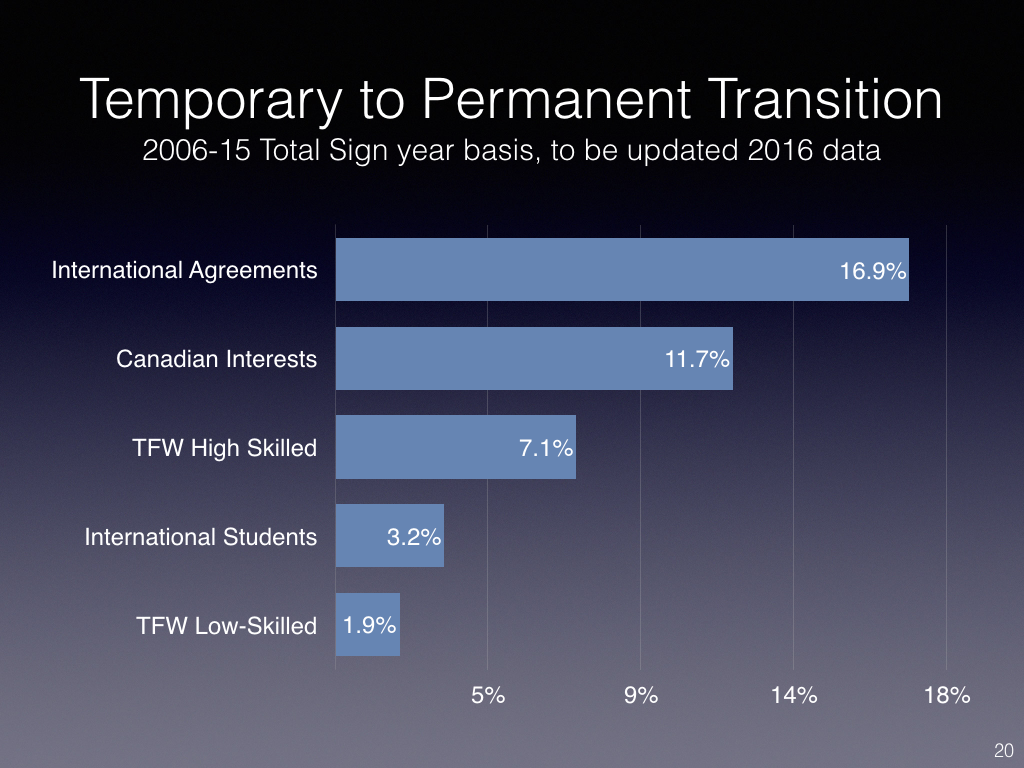
This latest Statistics Canada belies that dichotomy, as do IRCC’s Open Data data sets (my chart below based upon this series – Transition from Temporary Resident to Permanent Resident Status.

There were 310,000 temporary work permit holders on December 31, 2015, accounting for 1.7% of the national employed workforce. The number of TFWs has more than quadrupled since 2000 (Immigration, Refugees and Citizenship Canada 2017).

Over the 2000s, immigration to Canada was increasingly drawn from TFWs. For instance, the proportion of newly landed adult immigrant men already holding a job in Canada rose from 16.3% in 1999 to 28.9% in 2010. Most of this increase consisted of immigrants who had high-paying jobs in Canada before attaining permanent resident status.

About 9% of TFWs who came to Canada between 1995 and 1999 became permanent residents within five years of receiving their first work permit. This was the case for 13% of those who came to Canada between 2000 and 2004, and for 21% of those who came between 2005 and 2009.

Most transitions from TFW status to permanent resident status occurred within the five years following receipt of the first work permit. The rate rises another 1 to 3 percentage points by the 10th year, with little increase observed thereafter.

Transition rates

The rate of transition to permanent residence varied by type of work permit. Among those who came to Canada between 2005 and 2009, the five-year transition rate was highest among those in the Live-in Caregiver Program (LICP), at 56%, and the Spouse or Common-law Partner category, at 50%. The lowest rates for transition to permanent residence were among those in the Seasonal Agricultural Workers Program (SAWP), at 2%, and the Reciprocal Employment category, at 9%.

A large difference in the transition rate by type of work permit is a result of government policy. For example, while all those in the LICP are allowed to apply for permanent residence after two years of full-time work as domestic workers, SAWP workers have no dedicated stream for transition, and may only be employed for a maximum of eight months per year. Their SAWP permits, however, can be renewed over many years.

Source: Transition from temporary foreign workers to permanent residents

Tory leadership hopeful Chris Alexander mentions Rachel Notley at speech and crowd chants ‘lock her up

His political and personal judgement is in question.

Sharp contrast between John McCain showing leadership in 2008 when responding to a similar angry crowd by saying “I have to tell you. Sen. Obama is a decent person and a person you don’t have to be scared of as president of the United States.”

And the sheer hypocrisy, given his complaints about being subject to hateful tweets in last week’s CBC At Issue panel:

Federal Conservative leadership hopeful Chris Alexander says he didn’t stop a crowd calling for Alberta Premier Rachel Notley to be locked up because politicians need to listen to constituents.

The former immigration minister was speaking at a rally against the provincial NDPs’ planned carbon tax Saturday when protesters began the “Lock her up” chant popularized during president-elect Donald Trump’s campaign.

“I totally disapprove of that particular chant. I don’t think it’s fair. I don’t think it’s the right thing to say at a rally or elsewhere, and that’s why I didn’t join it,” Alexander said Sunday.

The Edmonton rally was organized by Rebel Media, an online news and right-wing opinion outlet, and video of the incident was posted on Twitter by the website’s Alberta bureau chief Sheila Gunn Reid.

The video shows the ralliers start by chanting “Vote her out,” but as they grow louder, the message changes.
As they chant “Lock her up,” Alexander smiles and appears to gesture in time with the chant, nodding along.

Someone can be heard shouting, “That’s enough! That’s enough!” in the background, and as Alexander smiles and nods, the camera turns to face the crowd.

At no point in the video does Alexander stop the protesters or say anything about their chant.

“You don’t pick it up in the video, but I started to say the words in time with them, ’Vote her out,’ and then the next point I made was about the ballot box,” he said. “I expressed my disapproval by talking about something completely different: voting. I think that was pretty clear.”

Source: Tory leadership hopeful Chris Alexander mentions Rachel Notley at speech and crowd chants ‘lock her up’ | National Post

Chris Alexander announces Tory leadership bid, wants Canada to boost immigration to 400,000 a year

Field is getting crowded and not sure the base will welcome such a large increase in immigration – or whether, given his record as former Minister of Citizenship and Immigration, he will have much credibility beyond:

Former immigration minister Chris Alexander has confirmed he plans to run for the Conservative leadership and that a key plank of his campaign will be a proposal to sharply increase the intake of immigrants to 400,000 every year, including 40,000 refugees, because “this is a core value for me and for Canada.”

Although not yet officially a candidate, the McGill and Oxford graduate said the paperwork would be completed within the next week or two. After that he intends to undertake a cross-country journey by car to the West Coast, “stopping in every place we can where we have an invitation, to speak with groups, large and small, of Conservatives and potential Conservatives.”

Alexander expressed concern about leadership hopeful Kelly Leitch’s controversial proposal to vet prospective immigrants and reject them if they did not share “Canadian values.”

“My question is,” Alexander said, “how does she propose to screen immigrants for Canadian values before they get here in a way that, A, we are not already doing, B, that is cost-effective and C, does not lead to more fraud and abuse? I don’t think any of those questions have been answered.”

The best way to safeguard the integrity of the system — which is expected to process about 300,000 immigrants this year — is to maintain the reforms undertaken by the Harper government, he said. They produced what he called “the best in class immigration system in the world. We are getting the most educated, the most proficient in English and French, and in terms of skills, the best immigrants we have ever gotten because we select on the basis of merit.”

Alexander and Leitch were both criticized during the 2015 election campaign for their part in announcing the creation of a barbaric practices tipline, widely denounced as an indication of intolerance in the Conservative party.

Alexander has since called the announcement “the wrong one for that time.” But he rejects the idea that the party is anti-immigrant.

“I think we are still a very pro-immigration party.” He reasoned that Canada needs more immigrants to replace retiring baby boomers and because immigrants are essential if the economy is to grow.

The Tories need to recapture “the middle ground” from Prime Minister Justin Trudeau to regain power, Alexander said during an interview from his home in Ajax, Ont.

Source: Chris Alexander announces Tory leadership bid, wants Canada to boost immigration to 400,000 a year

Chris Alexander on ‘barbaric cultural practices’: ‘It’s why we lost’ | CTV News

Without the ‘crocodile tears’ of Kellie Leitch, former Minister Alexander also disavows the ‘barbaric cultural practices’ tipline:

The Conservative proposal to set up a barbaric cultural practices tipline is one of the reasons the party lost the 2015 election, former immigration minister Chris Alexander says.

“I regret very much several issues that we blew up to a scale they should never have reached in the last campaign. It’s why we lost,” Alexander said in an interview with Evan Solomon, host of CTV’s Question Period.

“It was a terrible campaign. That announcement was the wrong one for that time.”

Alexander is now considering a run for the Conservative Party leadership. He says he’s finalizing the paperwork and will make a formal announcement in the coming weeks.

He’ll be facing off against Conservative MP Kellie Leitch, who appeared with Alexander last fall to promise the creation of the tipline, which was widely denounced and mocked on social media by people pointing out those in need of a tipline to report a crime could call 911. Leitch has distanced herself from the announcement, but says she stands by the message. She’s also since promoted the idea of a Canadian values test for immigrants, which other Conservative leadership candidates have roundly criticized.

Despite disavowing the tipline, Alexander – like Leitch – said the underlying value behind the announcement is important.

“I’m not going to back away from my commitment to women and girls who are facing the horror of forced marriage. It happens in Canada, it happens to 15 million girls and young women around the world every year, and young men as well,” Alexander said.

“I think Canadians get it. But we allowed ourselves to be portrayed in the last election as unwelcoming. That was a huge mistake.”

‘Not my policy’

While Conservative leadership candidate Michael Chong has been strongly critical of Leitch’s proposal to apply a values test to new Canadians, calling it dog-whistle politics, Alexander took a gentler approach.

“It’s certainly not my policy. It does make a lot of immigrants … nervous,” he said.

“It makes them feel unwelcome and it’s not workable in immigration terms. I can tell you that as someone who was very committed to defending Canadian values as minister of citizenship and immigration for two and a half years.”

Alexander also faced criticism as immigration minister over the slow pace of Syrian refugee approvals and lack of information made available under his leadership. The Conservatives pledged in January, 2015, to accept 10,000 Syrian refugees. When the haunting photo of Alan Kurdi, a toddler who drowned while fleeing and who drew an emotional reaction from Canadians in the middle of the election, Alexander says the Conservative campaign didn’t react quickly enough.

“I very much regret that after Alan Kurdi’s body was photographed on that beach, and we all mourned his loss and what was happening in the Mediterranean and across Europe, we didn’t respond as fast as we could have with a much stronger commitment to Syrian refugees,” Alexander said.

“I wanted us to respond quickly after that day. It took us two weeks. I think that was a mistake as well.”

Source: Chris Alexander on ‘barbaric cultural practices’: ‘It’s why we lost’ | CTV News