New report details Beijing’s foreign influence operations in Canada

Of note:

China has set up a sophisticated network in this country to harass people of Chinese ethnicity and Uyghur- and Tibetan-Canadians, distort information in the media, influence politicians and form partnerships with universities to secure intellectual property, a new study says.

A report by Alliance Canada Hong Kong (ACHK) that was tabled on Monday evening at the special House of Commons committee on Canada-China relations warns that the influence operations by the People’s Republic of China (PRC) are widespread, but have gone largely unnoticed. Alliance Canada Hong Kong is an umbrella group for Hong Kong pro-democracy advocates in this country.

“In Canada, individuals and groups are targeted by [Chinese] party state actors and Chinese nationalists, both directly and indirectly,” said the report titled In Plain Sight: Beijing’s Unrestricted Network of Foreign Influence in Canada. “Chinese authorities co-ordinate intimidation operations and use families who are in PRC-controlled regions as bargaining chips.”

Cherie Wong, executive director of ACHK, said the human-rights group is trying to draw attention to Chinese Communist Party (CCP) surveillance and intimidation without fanning the flames of xenophobia.

The report details how the United Front Work Department – the agency responsible for co-ordinating Beijing’s overseas influence operations – guides and controls an elaborate network of proxies and front organizations to intimidate and co-opt Chinese-Canadians as well as politicians, academics and business leaders.

“The United Front has created and mobilized shell groups, registered [non-governmental organizations] and civil societies in Canada. These groups are designed to mimic legitimate community programs …while aggressively spreading pro-Beijing messages and party lines, whether in praising Hong Kong’s national security law or condemning dissent against the Beijing Olympics.”

Harassment and intimidation campaigns are organized by United Front-affiliated community groups, and misinformation is directed from WeChat and Chinese-language media against Uyghurs, Tibetans, Taiwanese, pro-democracy Hong Kongers and dissidents from mainland China, the report said.

“WeChat is among the top news sources for Chinese-Canadians, and social media apps may be the single most effective and concerning factor in the CCP’s arsenal over Canadian-Chinese language media, simply for the PRC’s direct ability to censor and monitor WeChat, Weibo, Youku, TikTok [Douyin] and other Chinese media entities.”

The report said Canadian universities and research institutions are especially vulnerable to foreign influence, citing Chinese-funded Confucius Institutes that spout Beijing propaganda, and partnerships with Canadian academics to obtain intellectual property.

“Various Canadian universities are known to collaborate with potentially compromising entities like the People’s Liberation Army,” the report said, noting that many academics don’t understand China’s efforts to blur the line between civilian and military research.

Alberta recently ordered its four major universities to suspend the pursuit of partnerships with people or organizations linked to Beijing or the Chinese Communist Party, citing concerns over national security and the risk the research could be used to facilitate human-rights abuses. The order came after The Globe and Mail reported on the University of Alberta’s extensive scientific collaboration with China that involves sharing and transferring research in strategically important areas such as nanotechnology, biotechnology and artificial intelligence.

The report by Ms. Wong’s group also warned about Chinese foreign influence operations that attempt to win over politicians and business leaders through all-expense-paid trips and lucrative investment projects. WeChat is often used to mobilize volunteers and donations for politicians who are sympathetic to Beijing’s interests, the report added.

“Though the majority of these operations are not considered criminal or direct threats to national security, these patterns of behaviour are inappropriate and should be disclosed to the public,” the report said.

Ms. Wong told the committee these influence operations will continue until the federal government takes the kind of actions to limit them that the United States and Australia have adopted, and stops worrying about angering Beijing.

She called for an Australian-style law that requires people and organizations acting on behalf of a foreign state to register as foreign agents. A government agency on foreign influence should be established with powers to investigate and enforce the law as well as initiate public inquiries and collect data on foreign influence.

Ms. Wong said Ottawa should also ban Canadian innovative research from being shared with the military and security apparatus of hostile states, such as China. Restrictions should also be placed on sharing Canadian data and private information that could be exploited by China.

Source: https://www.theglobeandmail.com/politics/article-new-report-details-beijings-foreign-influence-operations-in-canada/

AI emotion-detection software tested on Uyghurs

The police state becomes even more sophisticated:

A camera system that uses AI and facial recognition intended to reveal states of emotion has been tested on Uyghurs in Xinjiang, the BBC has been told.

A software engineer claimed to have installed such systems in police stations in the province.

A human rights advocate who was shown the evidence described it as shocking.

The Chinese embassy in London has not responded directly to the claims but says political and social rights in all ethnic groups are guaranteed.

Xinjiang is home to 12 million ethnic minority Uyghurs, most of whom are Muslim.

Citizens in the province are under daily surveillance. The area is also home to highly controversial “re-education centres”, called high security detention camps by human rights groups, where it is estimated that more than a million people have been held. 

Beijing has always argued that surveillance is necessary in the region because it says separatists who want to set up their own state have killed hundreds of people in terror attacks.

The software engineer agreed to talk to the BBC’s Panorama programme under condition of anonymity, because he fears for his safety. The company he worked for is also not being revealed. 

But he showed Panorama five photographs of Uyghur detainees who he claimed had had the emotion recognition system tested on them.

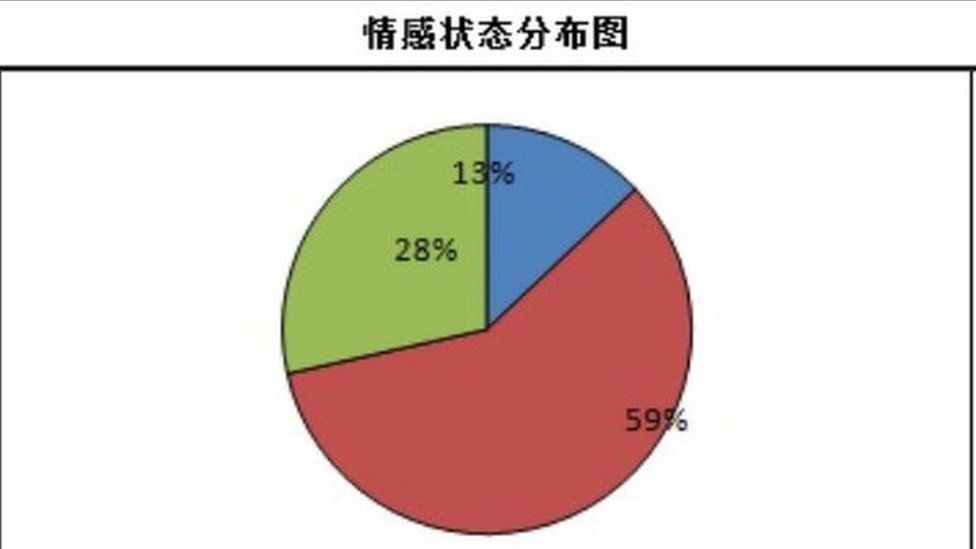
Pie-chart
image captionData from the system purports to indicate a person’s state of mind, with red suggesting a negative or anxious state of mind

“The Chinese government use Uyghurs as test subjects for various experiments just like rats are used in laboratories,” he said.

And he outlined his role in installing the cameras in police stations in the province: “We placed the emotion detection camera 3m from the subject. It is similar to a lie detector but far more advanced technology.”

He said officers used “restraint chairs” which are widely installed in police stations across China.

“Your wrists are locked in place by metal restraints, and [the] same applies to your ankles.”

He provided evidence of how the AI system is trained to detect and analyse even minute changes in facial expressions and skin pores.

According to his claims, the software creates a pie chart, with the red segment representing a negative or anxious state of mind.

He claimed the software was intended for “pre-judgement without any credible evidence”.

The Chinese embassy in London did not respond to questions about the use of emotional recognition software in the province but said: “The political, economic, and social rights and freedom of religious belief in all ethnic groups in Xinjiang are fully guaranteed.

“People live in harmony regardless of their ethnic backgrounds and enjoy a stable and peaceful life with no restriction to personal freedom.”

The evidence was shown to Sophie Richardson, China director of Human Rights Watch.

“It is shocking material. It’s not just that people are being reduced to a pie chart, it’s people who are in highly coercive circumstances, under enormous pressure, being understandably nervous and that’s taken as an indication of guilt, and I think, that’s deeply problematic.”

Suspicious behaviour

According to Darren Byler, from the University of Colorado, Uyghurs routinely have to provide DNA samples to local officials, undergo digital scans and most have to download a government phone app, which gathers data including contact lists and text messages.

“Uyghur life is now about generating data,” he said.

“Everyone knows that the smartphone is something you have to carry with you, and if you don’t carry it you can be detained, they know that you’re being tracked by it. And they feel like there’s no escape,” he said.

Most of the data is fed into a computer system called the Integrated Joint Operations Platform, which Human Rights Watch claims flags up supposedly suspicious behaviour.

“The system is gathering information about dozens of different kinds of perfectly legal behaviours including things like whether people were going out the back door instead of the front door, whether they were putting gas in a car that didn’t belong to them,” said Ms Richardson.

“Authorities now place QR codes outside the doors of people’s homes so that they can easily know who’s supposed to be there and who’s not.”

Orwellian?

There has long been debate about how closely tied Chinese technology firms are to the state. US-based research group IPVM claims to have uncovered evidence in patents filed by such companies that suggest facial recognition products were specifically designed to identify Uyghur people.

A patent filed in July 2018 by Huawei and the China Academy of Sciences describes a face recognition product that is capable of identifying people on the basis of their ethnicity.

Huawei said in response that it did “not condone the use of technology to discriminate or oppress members of any community” and that it was “independent of government” wherever it operated.

The group has also found a document which appears to suggest the firm was developing technology for a so-called One Person, One File system.

“For each person the government would store their personal information, their political activities, relationships… anything that might give you insight into how that person would behave and what kind of a threat they might pose,” said IPVM’s Conor Healy.

“It makes any kind of dissidence potentially impossible and creates true predictability for the government in the behaviour of their citizens. I don’t think that [George] Orwell would ever have imagined that a government could be capable of this kind of analysis.”

Huawei did not specifically address questions about its involvement in developing technology for the One Person, One File system but said: “Huawei opposes discrimination of all types, including the use of technology to carry out ethnic discrimination. 

“As a privately-held company, Huawei is independent of government wherever we operate. We do not condone the use of technology to discriminate against or oppress members of any community.”

The Chinese embassy in London said it had “no knowledge” of these programmes.

IPVM also claimed to have found marketing material from Chinese firm Hikvision advertising a Uyghur-detecting AI camera, and a patent for software developed by Dahua, another tech giant, which could also identify Uyghurs.

Dahua said its patent referred to all 56 recognised ethnicities in China and did not deliberately target any one of them.

It added that it provided “products and services that aim to help keep people safe” and complied “with the laws and regulations of every market” in which it operates, including the UK.

Hikvision said the details on its website were incorrect and “uploaded online without appropriate review”, adding that it did not sell or have in its product range “a minority recognition function or analytics technology”.

Dr Lan Xue, chairman of China’s National committee on AI governance, said he was not aware of the patents.

“Outside China there are a lot of those sorts of charges. Many are not accurate and not true,” he told the BBC.

“I think that the Xinjiang local government had the responsibility to really protect the Xinjiang people… if technology is used in those contexts, that’s quite understandable,” he said.

The UK’s Chinese embassy had a more robust defence, telling the BBC: “There is no so-called facial recognition technology featuring Uyghur analytics whatsoever.”

Daily surveillance

China is estimated to be home to half of the world’s almost 800 million surveillance cameras.

It also has a large number of smart cities, such as Chongqing, where AI is built into the foundations of the urban environment.

Chongqing-based investigative journalist Hu Liu told Panorama of his own experience: “Once you leave home and step into the lift, you are captured by a camera. There are cameras everywhere.”

“When I leave home to go somewhere, I call a taxi, the taxi company uploads the data to the government. I may then go to a cafe to meet a few friends and the authorities know my location through the camera in the cafe.

“There have been occasions when I have met some friends and soon after someone from the government contacts me. They warned me, ‘Don’t see that person, don’t do this and that.’

“With artificial intelligence we have nowhere to hide,” he said.

Source: http://click.revue.email/ss/c/XN2t88CAhalHja1RClwc6qsMgajWENlC9NZ1PWkAxfUzsgvZ2xjHTcAWJ2cLn-CdGZ0w_l7nnLcmMcVvmrkgMPKVaGyxQ7qZd71KSFybXPcUwFWKhwn0TtRR5hrfXMiGHmYN4Eb9iUB3URfKHjAcvp13foBYRb9l4moXoJKWITWllHNy8OXBOqTw4hzOVQ2FIU2CUmVhsxPu4XO74CTZz6IKyaJMYsCaauAXVlq0oZRL_b8NE62A-QYF2YbBNLbZZfopy2X10K3tSngIuQL5-ttL1jFJoCUfFfhj8u3XdxY/3ca/RUjBl06WSoimqdFfA2J_Bw/h41/p167_E3Thw2-rkj2w7e66SMP4kkoUGB6qZwW0QaBUXU

Burton: Time for transparency in China’s dealings with Canadian universities

Indeed:

Canada’s free society is based on cultural expectations of reciprocal fairness and goodwill in our dealings with fellow citizens. This is what makes Canada a great place to live, and so attractive to immigrants. But our trusting nature is also vulnerable to being exploited by foreign actors with agendas that threaten our security and sovereignty.

In the case of China, its intricate manipulation practices have had enormous success in transferring research data from Canadian universities in strategically sensitive areas that serve PRC purposes. According to former CSIS director Richard Fadden, these areas include avionics, space technology, nuclear science and high-level optics research.

The fact is, China’s interference and espionage activities are hiding in plain sight in our open institutions. We need transparency about what these activities comprise, which Canadians are receiving benefits from agents of foreign states, and what form these benefits take.

Recent and troubling media reports reveal that, in 2018, the China Institute at the University of Alberta accepted a major donation from Hong Kong-based billionaire Jonathan Koon-Shum Choi, but refuses to disclose the size of Mr. Choi’s gift, the purposes to which the money has been allocated, and who are the de facto beneficiaries of this largesse.

Choi is a member of the Standing Committee of the Chinese People’s Political Consultative Conference (CPPCC), part of the Chinese Communist Party’s United Front Work Department (UFWD), whose main mission is to gain outside support for Beijing’s political agenda.

As the U of A is a public institution, surely Alberta taxpayers deserve transparency regarding any money that supports or influences the university’s research.

Under an agreement with China’s Minister of Science and Technology, U of A researchers have had access to at least 50 state labs in China since 2005, while upward of 60 professors have received funding for more than 90 joint projects with state and national labs in China. Likewise, at the University of British Columbia, more than 300 professors have significant professional interest in China, and faculty have partnerships with over 100 Chinese institutions.

But agreements through China’s Ministry of Science and Technology are not like those with partners in democratic societies. These are not simply benign, mutually beneficial collaborations between autonomous scholars seeking to expand the frontiers of science and human understanding, as much as the UFWD would have us believe.

In China, professors are cadre-ranked state employees, their research dictated by the state ministries to which their universities and labs are subordinate. Their ultimate goal is to advance the Chinese Communist Party’s five-year plans for domestic development and global geo-strategic advantage.

China would not be funding Canadian researchers if there were no ability to access the data which the professors generate. This is about obtaining information or intellectual property that could serve the PRC’s economic and military objectives. Indeed, some Canadian participants over the long term appear to derive significant Chinese income streams beyond their university salaries, through lucrative PRC-associated board appointments and commercial inducements.

The money is an effective device. Chinese grants help Canadians pursue research projects that might not have been so well funded by Canada’s Natural Sciences and Engineering Research Council. The profs gain prestige from undertaking work in important and sensitive areas, enjoy wonderful hospitality in China, and benefit from considerable talented Chinese research assistance — providing they hand over their work to the Chinese state to develop. The strategy spends years cultivating a Canadian target, with the recipients often not fully aware of what they’re getting themselves into.

It is reassuring that Alberta government officials have promised to protect Canada’s national interest by curtailing U of A collaborations with China in strategically sensitive science and technology, but will Ottawa initiate federal legislation such as requiring transparency in reporting of foreign sources of income? There is a powerful pro-PRC lobby in Ottawa, mostly retired politicians who are on China-related boards, including Canadian companies and law firms that benefit from the PRC. In taking China’s money, they are expected to support the interests of the PRC in Canada in return.

Beijing seems confident that, once Canadian public outrage fades over the latest reports of China’s shameless flouting of the norms of international relations, the Canadians on the PRC gravy train will resume quietly lobbying for Ottawa’s restraint in any new measures. This United Front work is a sophisticated engagement of Canada, and the PRC always seems to end up on top.

Charles Burton is a senior fellow at the Macdonald-Laurier Institute in Ottawa, and non-resident senior fellow of the European Values Center for Security Policy in Prague. He is a former professor of political science at Brock University, and served as a diplomat at Canada’s embassy in Beijing.

Source: https://ottawacitizen.com/opinion/columnists/opinion-time-for-transparency-in-chinas-dealings-with-canadian-universities/wcm/d6768c22-f35e-4eea-849c-8b41e2bf4191

Kheiriddin: Boycotting Beijing 2022 may not change China, but it will spoil its glory

Of note and agree:

As the countdown continues to the 2022 Olympic Winter Games in Beijing, human rights groups called this week for a full-blown boycott, given accusations of China committing genocide against its minority Uyghur Muslim population and its recent suppression of basic freedoms in Hong Kong.

According to a coalition that includes Uyghurs, Tibetans and Hong Kong residents, “The time for talking with the IOC (International Olympic Committee) is over.” The statement comes the same week that the U.S. Congress is holding hearings on the issue, and days after the United States Olympic and Paralympic Committee said boycotts are ineffective and only hurt athletes.

Source: Boycotting Beijing 2022 may not change China, but it will spoil its glory

China Targets Muslim Women in Push to Suppress Births in Xinjiang

Good long and disturbing read. But given all the accounts of Chinese government repression, not all that surprising. Time for more public shaming of the Chinese government, no longer extending speaking invitations to Chinese diplomats and boycotting the 2022 Beijing winter Olympics:

When the government ordered women in her mostly Muslim community to be fitted with contraceptive devices, Qelbinur Sedik pleaded for an exemption. She was nearly 50 years old, she told officials in Xinjiang. She had obeyed the government’s birth limits and had only one child.

It was no use. The workers threatened to take her to the police if she continued resisting, she said. She gave in and went to a government clinic where a doctor, using metal forceps, inserted an intrauterine device to prevent pregnancy. She wept through the procedure.

“I felt like I was no longer a normal woman,” Ms. Sedik said, choking up as she described the 2017 ordeal. “Like I was missing something.”

Across much of China, the authorities are encouraging women to have more children, as they try to stave off a demographic crisisfrom a declining birthrate. But in the far western region of Xinjiang, they are forcing them to have fewer, as they tighten their grip on Muslim ethnic minorities.

It is part of a vast and repressive social re-engineering campaign by a Communist Party determined to eliminate any perceived challenge to its rule, in this case, ethnic separatism. Over the past few years, the party, under its top leader, Xi Jinping, has moved aggressively to subdue Uyghurs and other Central Asian minorities in Xinjiang, putting hundreds of thousands into internment camps and prisons. The authorities have placed the region under tight surveillance, sent residents to work in factoriesand placed children in boarding schools.

By targeting Muslim women, the authorities are going even further, attempting to orchestrate a demographic shift that will affect the population for generations. Birthrates in the region have already plunged in recent years, as the use of invasive birth control procedures has risen, findings that were previously documented by a researcher, Adrian Zenz, with The Associated Press.

While the authorities have said the procedures are voluntary, interviews with more than a dozen Uyghurs, Kazakhs and other Muslim women and men from Xinjiang, as well as a review of official statistics, government notices and reports in the state-run media, depict a coercive effort by the Chinese Communist Party to control the community’s reproductive rights. The authorities pressured women to use IUDs or get sterilized. As they recuperated at home, government officials were sent to live with them to watch for signs of discontent; one woman described having to endure her minder’s groping.

If they had too many children or refused contraceptive procedures, they faced steep fines or, worse, detention in an internment camp. In the camps, the women were at risk of even more abuse. Some former detainees say they were made to take drugs that stopped their menstrual cycles. One woman said she had been raped in a camp.

To rights advocates and Western officials, the government’s repression in Xinjiang is tantamount to crimes against humanityand genocide, in large part because of the efforts to stem the population growth of Muslim minorities. The Trump administration in January was the first government to declare the crackdown a genocide, with reproductive oppression as a leading reason; the Biden administration affirmed the label in March.

Ms. Sedik’s experience, reported in The Guardian and elsewhere, helped form the basis for the decision by the United States government. “It was one of the most detailed and compelling first-person accounts we had,” said Kelley E. Currie, a former United States ambassador who was involved in the government’s discussions. “It helped to put a face on the horrifying statistics we were seeing.”

Beijing has accused its critics of pushing an anti-China agenda. 

The recent declines in the region’s birthrates, the government has said, were the result of the authorities’ fully enforcing longstanding birth restrictions. The sterilizations and contraceptive procedures, it said, freed women from backward attitudes about procreation and religion.

“Whether to have birth control or what contraceptive method they choose are completely their own wishes,” Xu Guixiang, a Xinjiang government spokesman, said at a news conference in March. “No one nor any agency shall interfere.”

To women in Xinjiang, the orders from the government were clear: They didn’t have a choice.

Last year, a community worker in Urumqi, the regional capital, where Ms. Sedik had lived, sent messages saying women between 18 and 59 had to submit to pregnancy and birth control inspections.

“If you fight with us at the door and if you refuse to cooperate with us, you will be taken to the police station,” the worker wrote, according to screenshots of the WeChat messages that Ms. Sedik shared with The Times.

“Do not gamble with your life,” one message read, “don’t even try.”

All her life, Ms. Sedik, an ethnic Uzbek, had thought of herself as a model citizen.

After she graduated from college, she married and threw herself into her work, teaching Chinese to Uyghur elementary school students. Mindful of the rules, Ms. Sedik didn’t get pregnant until she had gotten approval from her employer. She had only one child, a daughter, in 1993.

Ms. Sedik could have had two children. The rules at the time allowed ethnic minorities to have slightly bigger families than those of the majority Han Chinese ethnic group, particularly in the countryside. The government even awarded Ms. Sedik a certificate of honor for staying within the limits.

Then, in 2017, everything changed.

As the government corralled Uyghurs and Kazakhs into mass internment camps, it moved in tandem to ramp up enforcement of birth controls. Sterilization rates in Xinjiang surged by almost sixfold from 2015 to 2018, to just over 60,000 procedures, even as they plummeted around the country, according to calculations by Mr. Zenz.

The campaign in Xinjiang is at odds with a broader push by the government since 2015 to encourage births, including by providing tax subsidies and free IUD removals. But from 2015 to 2018, Xinjiang’s share of the country’s total new IUD insertions increased, even as use of the devices fell nationwide.

The contraception campaign appeared to work.

Birthrates in minority-dominated counties in the region plummeted from 2015 to 2018, based on Mr. Zenz’s calculations. Several of these counties have stopped publishing population data, but Mr. Zenz calculated that the birthrates in minority areas probably continued to fall in 2019 by just over 50 percent from 2018, based on figures from other counties.

The sharp drop in birthrates in the region was “shocking” and clearly in part a result of the campaign to tighten enforcement of birth control policies, said Wang Feng, a professor of sociology and expert in Chinese population policies at University of California, Irvine. But other factors could include a fall in the number of women of childbearing age, later marriages and postponed births, he said.

As the government pushes back against growing criticism, it has withheld some key statistics, including annually published county-level data on birthrates and birth control use for 2019. Other official data for the region as a whole showed a steep drop in IUD insertions and sterilizations that year, though the number of sterilizations was still mostly higher than before the campaign began.

In Beijing’s depiction, the campaign is a victory for the region’s Muslim women.

“In the process of deradicalization, some women’s minds have also been liberated,” a January report by a Xinjiang government research center read. “They have avoided the pain of being trapped by extremism and being turned into reproductive tools.”

Women like Ms. Sedik, who had obeyed the rules, were not spared. After the IUD procedure, Ms. Sedik suffered from heavy bleeding and headaches. She later had the device secretly removed, then reinserted. In 2019, she decided to be sterilized.

“The government had become so strict, and I could no longer take the IUD,’” said Ms. Sedik, who now lives in the Netherlands after fleeing China in 2019. “I lost all hope in myself.”

The penalties for not obeying the government were steep. A Han Chinese woman who violated the birth regulations would face a fine, while a Uyghur or Kazakh woman wouldface possible detention.

When Gulnar Omirzakh had her third child in 2015, officials in her northern village registered the birth. But three years later, they said she had violated birth limits and owed $2,700 in fines.

Officials said they would detain Ms. Omirzakh and her two daughters if she did not pay.

She borrowed money from her relatives. Later, she fled to Kazakhstan.

“The women of Xinjiang are in danger,” Ms. Omirzakh said in a telephone interview. “The government wants to replace our people.”

The threat of detention was real.

Three women told The Times they had met other detainees in internment camps who had been locked up for violating birth restrictions.

Dina Nurdybay, a Kazakh woman, said she helped one woman write a letter to the authorities in which she blamed herself for being ignorant and having too many children.

Such accounts are corroborated by a 137-page government document leaked last year from Karakax County, in southwestern Xinjiang, which revealed that one of the most common reasons cited for detention was violating birth planning policies.

Those who refused to terminate illegal pregnancies or pay fines would be referred to the internment camps, according to one government notice from a county in Ili, unearthed by Mr. Zenz, the researcher.

Once women disappeared into the region’s internment camps — facilities operated under secrecy — many were subjected to interrogations. For some, the ordeal was worse.

Tursunay Ziyawudun was detained in a camp in Ili Prefecture for 10 months for traveling to Kazakhstan. She said that on three occasions, she was taken to a dark cell where two to three masked men raped her and used electric batons to forcibly penetrate her. 

“You become their toy,” Ms. Ziyawudun said in a telephone interview from the United States, where she now lives, as she broke down sobbing. “You just want to die at the time, but unfortunately you don’t.”

Gulbahar Jalilova, the third former detainee, said in an interview that she had been beaten in a camp and that a guard exposed himself during an interrogation and wanted her to perform oral sex.

The three former detainees, along with two others who spoke to The Times, also described being regularly forced to take unidentified pills or receive injections of medication that caused nausea and fatigue. Eventually, a few of them said, they stopped menstruating.

The former detainees’ accounts could not be independently verified because tight restrictions in Xinjiang make unfettered access to the camps impossible. The Chinese government has forcefully denied all allegations of abuse in the facilities.

“The sexual assault and torture cannot exist,” said Mr. Xu, the regional spokesman, at a news briefing in February.

Beijing has sought to undermine the credibility of the women who have spoken out, accusing them of lying and of poor morals, all while claiming to be a champion of women’s rights.

Even in their homes, the women did not feel safe. Uninvited Chinese Communist Party cadres would show up and had to be let in. 

The party sends out more than a million workers to regularly visit, and sometimes stay in, the homes of Muslims, as part of a campaign called “Pair Up and Become Family.” To many Uyghurs, the cadres were little different from spies.

The cadres were tasked with reporting on whether the families they visited showed signs of “extremist behavior.” For women, this included any resentment they might have felt about state-mandated contraceptive procedures.

When the party cadres came to stay in 2018, Zumret Dawut had just been forcibly sterilized.

Four Han cadres visited her in Urumqi, bringing yogurt and eggs to help with the recovery, she recalled. They were also armed with questions: Did she have any issues with the sterilization operation? Was she dissatisfied with the government’s policy?

“I was so scared that if I said the wrong thing they would send me back to the camps,” said Ms. Dawut, a mother of three. “So I just told them, ‘We are all Chinese people and we have to do what the Chinese law says.’”

But the officials’ unwelcome gaze settled also on Ms. Dawut’s 11-year-old daughter, she said. One cadre, a 19-year-old man who was assigned to watch the child, would sometimes call Ms. Dawut and suggest taking her daughter to his home. She was able to rebuff him with excuses that the child was sick, she said.

Other women reported having to fend off advances even in the company of their husbands.

Ms. Sedik, the Uzbek teacher, was still recovering from a sterilization procedure when her “relative” — her husband’s boss — showed up.

She was expected to cook, clean and entertain him even though she was in pain from the operation. Worse, he would ask to hold her hand or to kiss and hug her, she said.

Mostly, Ms. Sedik agreed to his requests, terrified that if she refused, he would tell the government that she was an extremist. She rejected him only once: when he asked to sleep with her.

It went on like this every month or so for two years — until she left the country.

“He would say, ‘Don’t you like me? Don’t you love me?’” she recalled. “‘If you refuse me, you are refusing the government.’”

“I felt so humiliated, oppressed and angry,” she said. “But there was nothing I could do.”

Source: https://www.nytimes.com/2021/05/10/world/asia/china-xinjiang-women-births.html?action=click&module=Top%20Stories&pgtype=Homepage
Ibbitson: China’s population decline poses challenges and opportunities

We need to broaden thinking beyond “more immigration is the solution” to how Canada could adapt to a world of population decline, where fewer higher-skilled Chinese and other groups may wish to come here:

China is reportedly holding back census data because it shows the country’s population has started to decline, years ahead of even the most aggressive predictions.

If so, every game changes: global warming projections, global population projections, geopolitical and economic projections.

The world’s most populous nation is now a nation on the wane.

The Financial Times reported Tuesday that China has delayed the release of its 2020 census, which was expected earlier this month, because the data reveals that China’s population has declined from a peak of more than 1.4 billion in 2019 to less than 1.4 billion now.

If true, this is one of the most momentous events of our time. Many analyses of the geopolitical rivalry between China and the United States are predicated on the assumption of continued Chinese growth and relative American decline.

But it now appears United Nations population projections, which had China’s population peaking in the 2030s before levelling off and gradually starting to decline, were off by more than a decade.

The reason, according to a report this month by the Bank of China, is steadily falling fertility. Even after the ban on more than one child per family was lifted in 2015, China’s fertility continued to fall, to a level well below that needed to sustain the population.

For that reason, Darrell Bricker and I, in our book Empty Planet, predicted that population decline would hit China sooner and harder than expected. The question was how soon and how hard. If the answer to the first question is right now, then China could lose nearly half its population by the end of the century – more if fertility continues to fall.

The decline could have been accelerated by the COVID-19 pandemic, which has suppressed birth rates across much of the world, as couples put off having a child during this period of economic insecurity. A post-pandemic baby boom is unlikely: Past experience shows that once couples put off having a child, they don’t make up for it later on. Instead, they settle for having fewer children than they’d planned.

Population decline will present both opportunities and challenges for China. Environmentally, the news is encouraging: There will be fewer new coal-fired generating stations needed, as the number of people on the grid goes down instead of up.

The problem of labour shortages could be addressed by bringing in temporary foreign workers and improving productivity through automation.

But preserving economic growth becomes difficult when there are fewer young people every year buying their first refrigerator, their first car, their first baby stroller. Fewer young consumers also means fewer taxpayers to sustain the pensions and health care costs of older people, and fewer adult children to look after the needs of aging parents.

Countries that lose population every year stagnate economically: Italy, Spain, Japan. China is the new Japan. And that could lead to problems containing the discontent of an overtaxed, overworked, increasingly frustrated population. China announced this week that it planned to gradually raise the age of mandatory retirement, which is currently 60 for most men.

This delivers a huge competitive advantage to the United States. That country’s fertility rate has also reached record lows. But despite the effort of former president Donald Trump to seal the country’s borders, the U.S. continues to let in immigrants, both legal and illegal.

The U.S. needs to return, as quickly as possible, to its former practice of welcoming a million new permanent residents each year. That may be difficult, given rising nativism among conservatives, but if Americans want to stay ahead in the race for economic and political power, immigration is the not-so-secret weapon.

In any event, as my colleague Doug Saunders noted Tuesday on Twitter, the news about the Chinese census “will help make immigration a seller’s market.” As fertility rates decline in China and other source countries, such as Philippines and India, and as labour shortages grow in China, Japan and elsewhere, the question for immigrant-friendly countries such as Canada will shift from “how many should we let in?” to “how many can we convince to come?”

That is another reasons why former prime minister Brian Mulroney and others are right to maintain that Canada should greatly increase its immigration intake. We need to get them while we still can.

Source: https://www.theglobeandmail.com/politics/article-chinas-population-decline-poses-challenges-and-opportunities/

Senator [Woo] warns China might not free Spavor and Kovrig in Meng deal if Canada not part of effort

Sigh… Not wise or helpful:

An expert in Canada-Asian relations is warning a future U.S. deal to set free Huawei executive Meng Wanzhou may not lead to the immediate release of two Canadians locked up in China – particularly if Ottawa is not seen as having played a significant role in her release.

Senator Yuen Pau Woo, as facilitator of the Independent Senators Group in the Red Chamber, is the leader of the largest bloc in the Senate. Prior to his appointment to the Senate, he served as president and CEO of the Asia Pacific Foundation of Canada in Vancouver.

Canadian diplomat Michael Kovrig and entrepreneur Michael Spavor were seized and locked up by Beijing in 2018 shortly after Ms. Meng was arrested at Vancouver airport on a U.S. extradition request – apparently in retaliation for the detention of the Huawei Technologies executive.

Ms. Meng is fighting extradition to the United States in court and Prime Minister Justin Trudeau has rejected calls from Beijing to intervene and send her home, saying there will be no political interference in Canada’s independent judicial system. In late 2020, however, the U.S. Justice Department was reportedly in discussions on a plea agreement that would allow Ms Meng to return to China.

Mr. Woo has previously played a role in back-channel diplomacy between Canada and China and says he wants to do what he can do help bring about the release of Mr. Kovrig and Mr. Spavor. “I am plugged into the discussions around these issues.”

He said there is a risk a future U.S. deal to free Ms. Meng could be “misinterpreted on the Chinese side as a problem that was resolved purely by D.C. and Beijing” without Canada.

“The resolution of the Meng Wanzhou issue may not, I am really sad to say, may not facilitate a resolution of the Spavor-Kovrig issue,” Mr. Woo told a Carleton University webinar last week.

“For the simple reason that if the political resolution is a bilateral one between the U.S. and China, that will effectively take Canada out of the equation and reduce our degrees of freedom to encourage the release of our two compatriots.”

Elaborating on this in a later interview, Mr. Woo said it’s very important that Canada be seen by Beijing as actively trying to bring about a resolution that would free Ms. Meng and if a U.S.-brokered deal is ever reached, that “Canada’s fingerprints will be all over” that arrangement.

“Right now the Canadian position for Meng Wanzhou is there is legal process and she has to go through it …. Give it your best shot – in terms of Madam Meng’s lawyers – and whatever happens, happens,” he said.

But, he noted, the United States has reportedly been trying to broker a solution.

“If we say that we are relying on the normal process of legal discussion to solve the Meng issue, why would the Chinese then subvert their legal process … to free the Michaels?”

Mr. Woo also said Canada, which has criticized the arrest of the two Michaels as “arbitrary detention,” must also recognize the Chinese justice system as legitimate.

“I don’t see that there can be any resolution of the dual problem of Meng Wanzhou and the two Michaels without some recognition and acknowledgment, on the part of the two governments, of the legitimacy of the justice systems of the other side,” he told the Carleton webinar.

“I am not saying we have to agree with the Chinese justice system but it would be extremely difficult for the Chinese to suddenly spring free Michael Spavor and Michael Kovrig if we essentially say that … your system is totally illegitimate.”

Added Mr. Woo: That’s “going to be very difficult for the Chinese to spring them free because it would be basically recognizing that the Canadian side was right.”

Conservative Senator Leo Housakos said he was appalled by the suggestion that Canada should recognize China’s judicial system as legitimate.

He said it’s impossible to consider China’s justice system legitimate “when it can imprison you without charges, [when it’s] a system that doesn’t disclose what the charges are to you or to your attorney and is a judicial system that is done in closed-door privacy.”

Added Mr. Housakos: “It’s laughable.”

The Conservative senator said it’s important to remember that Ms. Meng is being accused of serious charges of bank fraud and the Canadian courts must deal impartially with the extradition proceedings, regardless of whether the U.S. grants a deferred prosecution agreement.

The American charge for which she was arrested in Canada is fraud – lying to a bank – which is a crime in both this country and the United States.

The U.S. alleges that Ms. Meng deceived banks including HSBC about the true nature of the relationship between Huawei and a subsidiary based in Iran, called Skycom, and that this fraud led bankers to clear hundreds of millions of dollars of transactions in violation of U.S. sanctions.

The Conservative senator noted that Mr. Woo recently refused to grant leave for his motion that would have imposed wide-ranging sanctions on Chinese officials over its brutal treatment of China’s Muslim Uyghur minority.

He noted that Mr. Woo advocated a prisoner exchange with Ms. Meng and the two Michaels as did prominent Liberals from the Jean Chrétien era, such as former justice minister Allan Rock, former foreign affairs minister Lloyd Axworthy and Eddie Goldenberg, a senior Chrétien adviser.

Source: https://www.theglobeandmail.com/politics/article-senator-warns-china-might-not-free-spavor-and-kovrig-in-meng-deal-if/

China Poised to Top US Economy Without More Immigration, FWD.us Says

Similar to Canadian calls by the Century Initiative, Business Council of Canada and others, highlighting that if most immigration destination countries pursue the same policies, the net relative effect among countries will likely be minimal. The Canadian dependency ratio of seniors is expected to increase to 42.7 per 100 in 2065 compared to 27.4 currently:

The U.S. risks losing its status as the world’s largest economy to China by the end of the decade if it doesn’t increase legal immigration, according to a study released Wednesday by a tech group [fwd.us] that favors admitting more foreign workers.

The report projects that the American economy will be three-quarters the size of China’s by 2050 under current U.S. population trends and immigration levels. FWD.us, an immigration advocacy group founded by tech industry leaders, conducted the study in conjunction with George Mason University.

The situation at the border has also emboldened those who support cutting immigration levels. They argue that allowing more migrants could displace American-born workers as the U.S. economy recovers from the pandemic.

“Immigration has basically become the fulcrum of nativist and nationalist politics, which is really about a concern for putting America first,” said Justin Gest, the study’s co-author and associate professor at George Mason University. “If you look at the numbers here, the best way that we can put America first is by welcoming newcomers.”

The report argues that without more immigrants, the U.S. population will become older in the coming years as the number of elderly rises at a faster rate than working-age adults. The expense of entitlements for those older Americans, such as Social Security and Medicare, risks outpacing taxes paid by younger workers, the report argues.

The report says that while higher levels of immigration alone would not ensure solvency for the Social Security trust fund, it would help delay its depletion, now anticipated in 2034, by a year or more depending on how many more visas are issued annually.

If legal immigration levels were doubled, an estimated 31 seniors would live in the U.S. in 2050 for every 100 working-age people compared to 37 under current immigration levels, the study shows. Under that scenario, U.S. gross domestic product is projected to rise to $46.8 trillion in 2050 compared to $49.9 trillion for China. China’s economy wouldn’t overtake the U.S. until closer to 2035.

Biden’s plan isn’t that expansive. It would raise the annual number of green cards the U.S. issues by about 35%.

The report says that increasing immigration while keeping the current mix of visas, which are mostly family-based, would result in a larger GDP increase than if the U.S. allowed in most immigrants through work visas. That’s because immigrants who come to reunite with spouses or relatives are more likely to put down roots in the U.S. than those who come for work.

Groups that favor lower levels of immigration argue that granting a pathway to citizenship to immigrants already here illegally, as Biden’s plan does, would strain programs like Social Security and Medicare by making those immigrants eligible for benefits.

President Joe Biden is pushing to overhaul the nation’s immigration laws to make them more “humane.” A proposal he sent to Congress would increase the number of people allowed to gain legal permanent residence each year by almost 375,000, according to a separate study by the immigration services group Boundless Immigration Inc.

Republicans have rejected Biden’s approach and have blamed a recent spike in irregular migration at the U.S. southwest border on the president’s rhetoric and policies.

Source: China Poised to Top US Economy Without More Immigration, FWD.us Says

Claims of Uyghur genocide in China are ‘lies,’ adviser to B.C. premier says

Sigh. Needs to go:

A member of a committee that advises B.C. Premier John Horgan is under fire for referring to accusations of Uyghur genocide in China as “lies.”

Bill Yee, a retired provincial court judge and a member of B.C.’s Chinese-Canadian Advisory Committee, made the comments during an interview on the Toronto-based Chinese-language radio station A-1.

Those statements have a Canadian organization that advocates for democracy in Hong Kong calling on Horgan to dismiss Yee from his advisory role.

During the March 31 interview, Yee dismissed allegations that a genocide is being conducted against Uyghurs by the Chinese government.

“They use these lies, and those politicians, but what kind of legal basis do they have to prove China has committed genocide?” he said. “That doesn’t make sense.”

In the past year, the Chinese government has faced accusations of genocide from think tanks, non-governmental organizations and journalists who have documented human rights abuses in the country’s Xinjiang Uyghur Autonomous Region. Those stories include allegations of systematic rape, forced birth control, forced labour and internment camps targeting Muslim Uyghurs and other Turkic minorities.

On Feb. 22 Canada’s House of Commons passed a motion to formally recognize that a genocide is taking place in the region. The motion passed by a vote of 266-0, with most members of Prime Minister Justin Trudeau’s cabinet abstaining.

Last summer, witnesses who included victims of human rights abuses in the region testified before the House foreign affairs subcommittee on international human rights. The subcommittee subsequently declared that a genocide is happening in the region, and was recently sanctioned by the Chinese government, along with MP Michael Chong.

Pressed during the radio interview by host Andrea Chun, Yee said the allegations about events in Xinjiang are “made up” and “lies.”

Yee, who is a past president of the Chinese Benevolent Association in Vancouver, accused Canadian politicians of having “ulterior motives,” according to a translation of the interview done by the Star.

“The so-called evidence from some people, does that mean they’re fact? It needs to be objective,” Yee said. “Many people have ulterior motives, so have you thought about that?”

The Star requested an interview with Yee through Horgan’s director of communications, as well as through the Chinese Canadian Museum, which lists him as a member of its board of directors, and was told the messages would be passed on to him.

He did not reply to the requests.

The radio interview did not mark the first time Yee has made controversial comments about China’s human rights record.

In 1993, the Vancouver Sun reported that Yee had said there may be another “perspective” to the Tiananmen Square massacre, and that Vancouver’s pro-democracy activists may have a “hidden agenda” regarding the 1989 event.

“It’s very clear that this man is repeating the same talking points that the Chinese Communist Party has been broadcasting,” said Cherie Wong, executive director of the pro-democracy group Alliance Canada Hong Kong. “What’s worrisome is this is happening on a provincial level of politics.”

She said Yee should be dismissed from the committee, calling it a “choice John Horgan must make.”

The Star reached out to Horgan’s office about Yee’s comments last week and received a response back from Minister of State for Trade George Chow’s office that said Yee had been expressing “personal opinions” during the radio interview.

“The mandate of the advisory committee was set up to provide inputs to the government on domestic community issues and does not include foreign affairs,” the statement from Chow’s office said. “Therefore, Mr. Bill Yee has been asked to not identify himself as a member of the advisory committee when expressing personal opinions.”

The statement also said the B.C. government supports Ottawa’s stance on the issue.

But Wong said the response isn’t good enough.

“Why is it that the B.C. NDP party has an adviser who is blatantly not only echoing propaganda but also actively dismissing the lived experience of Uyghur Canadians?” Wong said. “He is not representative of what Chinese Canadians in Canada are asking for.”

She said it’s “ridiculous” to even discuss whether Yee still has a place on the committee.

Douglas Chiang, a past president of the Canadian Taiwanese Association, said he’s concerned Yee serves Horgan in an advisory role, given his comments on Xinjiang.

“It is not good news for Taiwanese people, not good news for Canadian people” he said. “I don’t know why he is an adviser for the premier.”

Chiang said all Canadian leaders should be concerned about human rights and freedoms.

Source: Claims of Uyghur genocide in China are ‘lies,’ adviser to B.C. premier says

US weighs joint approach to Beijing Olympics with allies

Of note and needed. Hopefully, enough countries will have the sense to boycott and not provide a propaganda triumph for the Chinese regime:

The State Department said Tuesday the Biden administration is consulting with allies about a joint approach to China and its human rights record, including how to handle the upcoming Beijing Winter Olympics.

The department initially suggested that an Olympic boycott to protest China’s rights abuses was among the possibilities but a senior official said later that a boycott has not yet been discussed.

The official said the U.S. position on the 2022 Games had not changed but that the administration is in frequent contact with allies and partners about their common concerns about China. Department spokesman Ned Price said earlier the consultations were being held in order to present a united front.

“Part of our review of those Olympics and our thinking will involve close consultations with partners and allies around the world,” Price told reporters.

Human rights groups are protesting China’s hosting of the Games, which are set to start in February 2022. They have urged a diplomatic or straight-up boycott of the event to call attention to alleged Chinese abuses against Uyghurs, Tibetans, and residents of Hong Kong.

Price declined to say when a decision pm the Olympics might be made, but noted there is still almost a year until the Games are set to begin.

“These Games remain some time away. I wouldn’t want to put a timeframe on it, but these discussions are underway,” he said. “It is something that we certainly wish to discuss and it is certainly something that we understand that a approach will be not only in our interest, but also in the interest of our allies and partners. So this is one of the issues that is on the agenda, both now and going forward.”

The Beijing Winter Olympics open on Feb. 4, 2022 and China has denied all charges of human rights abuses. It says “political motives” underlie the boycott effort.

Rights groups have met with the International Olympic Committee and have been told the Olympic body must stay politically “neutral.” They have been told by the IOC that China has given “assurances” about human rights conditions.

Both the IOC and the U.S. Olympic and Paralympic Committee have said in the past they oppose boycotts.

In March, IOC president Thomas Bach said history shows that boycotts never achieve anything. “It also has no logic,” he said. “Why would you punish the athletes from your own country if you have a dispute with a government from another country? This just makes no real sense.”

The USOPC has questioned the effectiveness of boycotts. “We oppose Games boycotts because they have been shown to negatively impact athletes while not effectively addressing global issues,” it said. “We believe the more effective course of action is for the governments of the world and China to engage directly on human rights and geopolitical issues.”

Source: US weighs joint approach to Beijing Olympics with allies