Ottawa should establish a standard of six months to reunite newcomers to Canada with their children, as many refugee and immigrant families now wait years, says a national advocacy group.
The long wait is unacceptable, especially for children who are separated from both parents, said Janet Dench, executive director of the Canadian Council for Refugees.
She said parents who have been forced to flee as refugees end up in many cases leaving their children with a grandparent, another family member or even a neighbour in their home countries.
“That is a very vulnerable situation,” Dench said in an interview.
“Sometimes, they’re staying with their grandparents, who, we often hear … they’re not necessarily in the best of health. They don’t necessarily have the means to support the kids.”
Dench said many children don’t get the care they need and in some cases become subject to physical and sexual abuse.
Canada is legally obliged under the United Nations Convention on the Rights of the Child to deal with family reunification applications in a positive, humane and expeditious manner, she said.
Jennifer Wan, an immigration lawyer in Toronto, said parents who come to Canada as refugees usually flee persecution in their home countries.
She cites the case of two refugee parents who have been waiting for years to see their children who are still living in unsafe conditions in India.
The parents were granted refugee status in Canada in July 2019 and applied for their children to join them that October but they are still waiting.
“The father was attacked. His business was destroyed. The wife was also separately attacked,” she said.
“Knowing what they went through, they fear for their children.”
Wan said the parents left their children in the care of an elderly relative hoping that they would be safe.
“(Their teenage child) has been really frightened to even leave his house,” she said. “He was being followed. The house was being watched.”
Wan said the government should prioritize family reunification cases that involve children, especially when the young people are in danger or don’t have anyone to care for them.
Global migration has been upended by the COVID-19 pandemic and the entire processing system has been operating at reduced capacity, said Alexander Cohen, a spokesman for Immigration Minister Marco Mendicino.
Refugees face travel restrictions and difficulties obtaining documents including evidence of a familial relationship, Cohen said.
“Since the onset of the pandemic, we have prioritized processing of vulnerable persons, family members and those in essential services,” he said.
“We’re prioritizing applications from refugees sponsoring their dependants … and are also assessing the results of two pilot programs to improve processing for protected persons with dependants abroad.”
Wan said the Immigration Department has not been responsive to her requests to expedite processing of the children waiting in India to join family in Canada.
“Sometimes, I feel quite helpless,” she said. “When we send a letter to an immigration office, we don’t really get a response to know that it has an impact.”
Dench said about 35 families have contacted the refugee council for help in speeding up their children’s immigration applications and there are many more struggling with the same issue.
Many children are suffering psychologically due to separation from their parents, she said. “Some of them have clinical diagnoses.”
Dench said she has heard heartbreaking stories of children crying out to their parents and thinking that they are to blame for the fact that they’re still separated.
The psychological distress of parents in Canada is “absolutely agonizing,” she added.
“Many, many medical professionals in Canada have also written expert opinions on what they’re seeing: the physical and psychological impacts of the stress of separation.”
Three years on, the individual tales of Windrush injustice still have the power to catch my breath. Men and women who moved to Britain as children decades ago, who found themselves banished from the UK for the remainder of their life after a holiday abroad, wrongfully arrested, detained and threatened with deportation, and denied life-saving care on the NHS. So many stories of the British state ruining black lives, but one stands out for its exquisite cruelty: that of Jay, the son of a Windrush immigrant.
Jay was born in the UK and taken into care as a baby. When he applied for a passport as a teenager he was told he did not have enough information about the status of his estranged mother. After his third unsuccessful application, the Home Office threatened to deport him to Jamaica and forced him to declare himself stateless. He was only able to secure a passport years later, after the Windrush scandal broke and his case received significant media attention.
It is so extraordinary, I struggle to get my head round it. A baby is so vulnerable that the state assumes parental responsibility for him soon after his birth. That same state refuses him a passport again, and again, and again, then, as a young man, it threatens to forcibly deport him to a country he has never set foot in. There can be no greater symbol of the sick rot that Conservative prime ministers have introduced into our immigration system through the “hostile environment”.
And yet not only have ministers declined to fix this, they are putting thousands more children in care at risk of this fate as a consequence of Brexit.
The deadline for EU citizens living in the UK, including children, to apply to the EU settlement scheme for the right to remain is less than three months away. Local authorities have to do this for children in care. No one knows exactly how many are affected; many local authorities did not keep nationality data for children in their care. But the Children’s Society has established through Freedom of Information requests that, so far, fewer than 40% of the 3,700 or so eligible children in care and care leavers we know about have applications in; the true number could be much higher. It is unclear what will happen to them if they fall through the net, only to discover their unlawful status when they are older and can’t get a job, open a bank account or rent a flat and are at risk of deportation.
By opting for an EU scheme where people have to actively apply for what should be an automatic legal right, the government has created an anomaly that could leave children in care in a similar situation to Jay. It has batted away efforts from MPs and peers to try to fast track all children in care through that process. And it is deeply worrying that the government is encouraging local authorities to register these children for settlement status, putting them on an immigration track that offers nowhere near the same guarantees as a passport, even though most, or even all, could have rights to citizenship, according to Solange Valdez-Symonds, a lawyer who specialises in citizenship.
Children born here to parents settled in the UK, or who have lived the first 10 years of their life here, have the right to register for British citizenship. If a child was born in the UK to parents who settle before they turn 18, they also have that right, but it expires when they turn 18. The home secretary also has a discretionary power to grant any child citizenship if it is clear their future lies here, for example if they are taken into care, but again they must apply before they turn 18.
But knowledge of the full extent of children’s rights to citizenship law is poor. Not only that, local authorities have to pay extortionate fees of more than £1,000 to register a child in their care for citizenship and too often nobody even knows the required information about parents’ immigration status. Some of these children will lose their rights to citizenship forever when they turn 18. All children over 10 are subject to a good character test, which many children in care are at risk of failing; the Home Office has turned down children born in the UK because of a minor police caution or a referral order following a school fight.
All this creates a system where too many children in care are likely to be dumped on a conveyor belt to the hostile environment and possible deportation. It takes young people starting from scratch, who may have no memory of living anywhere else, four applications costing more than £8,000 in fees and charges over 10 years to apply for indefinite leave to remain. The applications are fiendishly complex and require specialist legal advice; the Home Office rejects applications with the tiniest of mistakes, even as its own processes are ridden with errors and there is no right to appeal if you get rejected. If young people miss a deadline for one of the applications, or can’t afford the fees, they become undocumented, vulnerable to exploitation without the legal right to work or rent, and go back to the start of the decade-long process. It is a system designed to catch out people who grew up in the UK, to make it as difficult as possible for them to earn the right to stay here.
Even as the government apologises for Windrush, it is planting the seeds for a future injustice no less profound that will affect some of the most vulnerable children in society. The only way to resolve this is to give all children, including children in care, who grow up in Britain the lifelong right to register for citizenship for free, without a test that fails them if they get into a fight at school. The government was warned again and again about the consequences of its policies for the Windrush generation, to no avail. Will they listen this time?
Encouraging analysis showing good economic outcomes for children of immigrants (those who arrived under 15 years of age). Would be interesting to have a breakdown by visible minority group as well:
The most recent 2018 data from the Longitudinal Immigration Database (IMDB) indicate that immigrant children make a significant contribution to Canadian society and the Canadian economy over time. Although immigrant children (32.2%) are more than twice as likely as non-immigrant children (15.4%) to live in low-income households, factors such as the opportunity to be educated in the Canadian system and an increased proficiency in the official languages help immigrant children attain wages in adulthood similar to those of their Canadian-born peers.
This analysis connects the characteristics of immigrants who came to Canada as children with their adulthood socioeconomic outcomes in 2018, such as participation in postsecondary education and median wages. The IMDB provides a long-term perspective on immigrants and their socioeconomic outcomes in Canada, offering details on how immigration is shaping Canada’s future. In addition, these data from 2018 contribute to baseline estimates in preparation for future research on the impact of the COVID-19 pandemic on immigrant children, including immigrant children admitted during the pandemic, their adjustment period and their long-term socioeconomic outcomes in adulthood.
Immigrants who came to Canada as children are more likely to participate in postsecondary education than the overall population
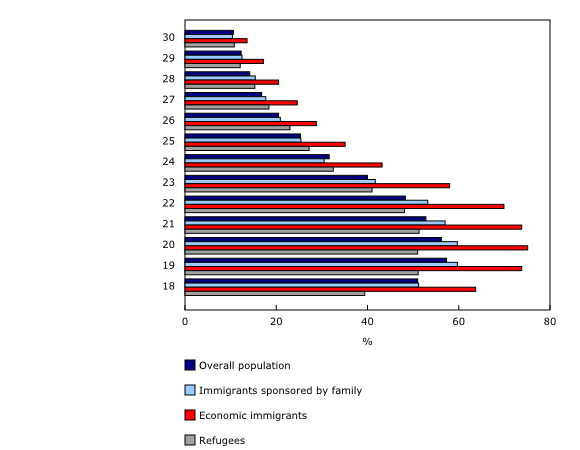
In 2018, 70% of 20-year-old immigrants who were admitted to Canada before the age of 15 participated in postsecondary education, according to tax data. This compares with 56% of the overall population of 20-year-olds in the same year.
Similar to the overall Canadian population, the median wage of immigrants who were admitted as children increased with age. In 2018, 25-year-olds in the overall population had a median wage of $29,710, compared with $30,300 for 25-year-old immigrants admitted as children. For 30-year-olds, the median wage was $41,810, compared with $47,400 for 30-year-old immigrants admitted as children. This represents a 13.4% difference in the median wage between the 30-year-olds in the total population and 30-year-old immigrants admitted as children.
Children admitted to Canada with economic immigrant families report higher postsecondary education participation than Canadians overall or immigrants admitted under other categories
Many factors influence the socioeconomic outcomes of immigrant children in adulthood, including the conditions under which they were admitted to Canada. Economic immigrants, selected for their potential to contribute to Canada’s economy, tend to have a higher median wage than refugees, who are fleeing persecution or conflict, or immigrants sponsored by family already living in Canada.
Immigrant children who were admitted as dependants of economic immigrants are likely to benefit from the higher median wage of the principal applicant in the economic immigrant category. Among children admitted in economic immigrant families, 75% of those who were 20 years old in 2018 reported postsecondary education participation. This compares with 60% for children admitted in sponsored families, 51% for refugees and 56% for the overall population of the same age, in the same year.
Chart 1 Postsecondary participation of immigrants admitted to Canada as children and of the overall population, by age and admission category, 2018
At age 30, immigrants who were admitted to Canada before the age of 15 with economic immigrant families report the highest wages compared with those admitted under other categories
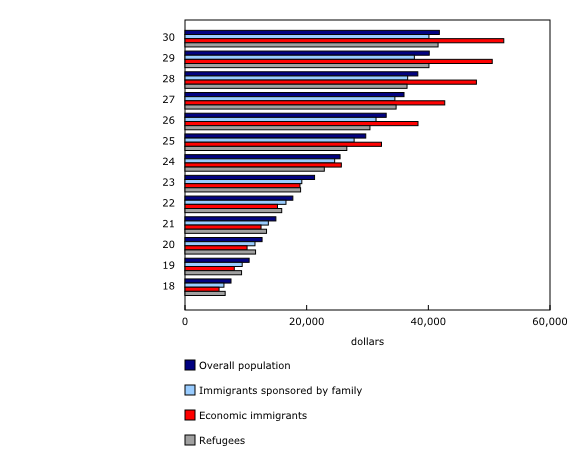
Lower participation in postsecondary education can lead to earlier labour market entry. Until the age of 23, people admitted as children in sponsored families, refugees and the overall population had higher wages than their economic immigrant counterparts. At this age, immigrants admitted as children in sponsored families had median wages of $19,200, compared with $19,000 for immigrants admitted as children in refugee families, $21,300 for the overall population, and $18,900 for people admitted as children in economic immigrant families.
However, beginning at the age of 24, a time when many have completed their postsecondary studies, the wages of people admitted as children in economic immigrant families began to surpass those of their counterparts in other admission categories and the overall population, and they continued to increase at a steeper rate over time compared with the other categories.
At the age of 30, in 2018, people admitted as children in economic immigrant families had median wages of $52,400. This compares with $41,600 for immigrants admitted as children in refugee families, $40,100 for immigrants admitted as children in sponsored families, and $41,810 for the overall population.
Chart 2 Median wages of immigrants admitted to Canada as children and of the overall population, by age and admission category, 2018
Immigrant women admitted to Canada as children have higher postsecondary education participation than men
In 2018, 74% of 20-year-old immigrant women admitted as children reported participating in postsecondary education. In comparison, participation rates were lower among immigrant men (65%) who also came to Canada as children. At 74%, the participation rate of immigrant women who came as children was also higher than the rate of the overall female population (62%) and the overall male population (50%) of the same age.
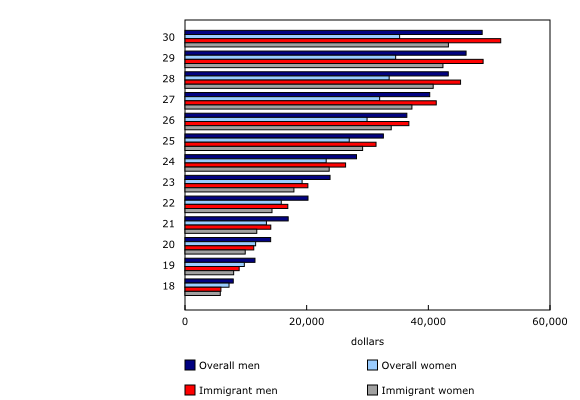
With regard to wages, 30-year-old immigrant women admitted to Canada as children had median wages of $43,300, 48% more than those of 25-year-old immigrant women admitted as children ($29,200). However, their median wages were lower than those of immigrant men who also came as children ($51,900) and of the overall male population ($48,850) of the same age. These gender income differences are in line with those in previous studies that found that women with a similar level of education as men report lower income.
Nonetheless, the median wages of 30-year-old immigrant women admitted as children were higher than those of the overall female population ($35,280), who earned the lowest median wages.
Chart 3 Median wages of immigrants admitted to Canada as children and of the overall population, by age and sex, 2018
These new data will facilitate further analysis of other factors that can affect the future adulthood socioeconomic outcomes of immigrants admitted as children, such as their age at immigration, year of immigration and their incidence of living in a low-income household during childhood.
In addition to the table about the economic outcomes of immigrants admitted to Canada as children used in the analysis above, tables on the income and mobility of immigrants by census metropolitan area are now available. These tables use data from the IMDB.
Thousands of unaccompanied immigrant children are attempting to flee to the United States amid the coronavirus pandemic, propelled by devastating natural disasters, chronic violence, and severe economic hardship at home.
US Customs and Border Protection encountered 5,871 kids at the south-west border without a parent or legal guardian last month, the largest influx yet since the start of the public health crisis in early 2020.
That sudden spike is still relatively modest compared to huge figures from fiscal year 2019, when Border Patrol apprehended more than 76,000 unaccompanied children, a trend that reached its zenith that spring.
But unlike in past years, the Office of Refugee Resettlement – which cares for those kids – has had to slash its housing capacity nearly in half in light of Covid-19. And, with nearly 5,700 of 7,100 total beds already accounted for, ORR is preparing to resurrect a controversial influx facility to create space.
“Even though the numbers of children in custody are still relatively low by historical standards,” the lack of available shelter beds is cause for concern, warned Mark Greenberg, director of the Human Services Initiative at the Migration Policy Institute.
Greenberg added: “If we return to the levels that had been experienced in all recent years except 2020, it will pose a significant challenge because of Covid.”
As more migrants attempt the arduous journey across the US-Mexico border, CBP officials are citing push factors such as “underlying crime and instability” in their countries of origin and “inaccurate perceptions of shifts in immigration and border security policies”.
Before taking office, Joe Biden’s administrationwarned that its comparatively pro-immigrant agenda would not translate to an immediate shift at the border. On Wednesday, White House press secretary Jen Psaki reiterated that, despite rare exceptions, the vast majority of migrants are still being turned away.
“Now is not the time to come,” she said.
Since 2014, a flood of immigrant children and families largely from Central America’s Northern Triangle have made their way to the US, many in search of refuge from a crush of gang-related violence, poverty and persecution. Between fiscal year 2013 and 2014, CBP apprehensions of unaccompanied children at the south-west border surged by 77%, while apprehensions for families more than quadrupled.
That significant change heralded a new era in US border migration, defined by asylum seekers and other vulnerable populations. In response to the humanitarian crisis, former president Donald Trump devised hard-line tactics to try to deter Central Americans and others from seeking protection in the US, then used Covid-19 as a rationale to effectively shutter the border altogether to defenseless migrants.
A federal judge eventually blocked the US government from applying that policy to unaccompanied minors, and Biden has said he will not resume expulsions for kids who show up without a parent or guardian, according to CBS News.
But amid the border closure, children unable to safely enter US custody have turned to perilous border crossings, said Erika Pinheiro, policy and litigation director at Al Otro Lado.
“They suffer so much,” she said. “And the fact that the US government forces them to suffer more is really hurtful to think about.”
In an elaborate game of telephone, news articles about immigration enforcement in the US and Mexico have gotten distorted in the foreign press, then exploited by smugglers, who have every incentive to spread rumors encouraging people to cross the border.
“There’s sort of like one message that comes out of the news. It gets repeated down here, maybe not completely accurately, and then the smugglers really capitalize on that, too. So it sort of builds on itself,” Pinheiro said.
As the number of unaccompanied children encountered by border enforcement increases to levels not seen since the summer of 2019, ORR is preparing to reactivate a temporary influx care facility in Carrizo Springs, Texas, that will initially be able to house about 700 kids.
The remote Carrizo Springs facility was opened in July, 2019, but closed in a few short weeks.
ORR said officials anticipate “the need to start placing children at Carrizo Springs in 15 days or soon after”, a move that has alarmed some advocates.
“There’s no reason to warehouse these children in these potentially dangerous facilities,” Linda Brandmiller, an immigration attorney in San Antonio, told USA Today.
“In a substantial number of cases, they are fleeing for their lives,” Greenberg said. “But whether that will allow them to qualify for asylum will depend upon how asylum policies are now changed.”
The United Arab Emirates (UAE) recently announced a plan to extend citizenship opportunities to highly-educated, skilled, or wealthy foreign nationals and their families. Unfortunately, the country’s citizenship law still leaves out other groups, including children born to Emirati women and foreign fathers, and stateless people.
Increasing pathways to citizenship is good investment for a country whose population consists of nearly 90 percent foreign nationals, most of whom are part of the UAE’s low-paid workforce. However, the government’s new citizenship mechanism is designed to attract an elite set of foreign nationals. It allows for UAE officials to nominate foreign nationals for citizenship using criteria mostly related to academic, entrepreneurial, or financial status.
People in the UAE have taken to social media to pointpoint out the glaring hypocrisy of the new plan and demandcitizenship for all children of Emirati mothers.
Emirati women continue to face discrimination in passing nationality to their children compared to Emirati men. The UAE’s nationality law provides that children of Emirati men are automatically entitled to UAE citizenship; however, children born to Emirati mothers and foreign fathers are not.
Emirati mothers can apply for citizenship for their children provided their child has lived in the UAE for six years. However, according to some mothers, the application process can be confusing and it can sometimes take yearsto receive a response. When the child turns 18, they can apply themselves. But even then, they can wait years with no answer.
Others on social media have raised the plight of the country’s bidun (stateless) population, who, without UAE citizenship, face serious obstacles to accessing health care, employment, and university scholarships. Children of stateless couples have no path to citizenship, regardless of how long their parents have lived in the UAE. Many bidun individuals in the UAE trace their origins to nomadic communities or immigrants living there before the country was formed in 1971, and who failed to register for nationality at the time.
The UAE is free to attract foreign investment into the country by offering the prospect of Emirati citizenship, but it should also end gross discrimination regarding citizenship for children of Emirati women and stateless groups. It is time to recognize them as Emirati nationals on an equal basis.
One of the notable features of the new coronavirus, evident early in the pandemic, was that it largely spared children. Some become severely ill, but deaths have been few, compared to adults.
They are infected at higher rates than white children, and hospitalized at rates five to eight times that of white children. Children of color make up the overwhelming majority of those who develop a life-threatening complication called multisystem inflammatory syndrome, or MIS-C.
Of more than 180,000 Americans who have died of Covid-19, fewer than 100 are children, according to the Centers for Disease Control and Prevention. But children of color comprise the majority of those who have died of Covid-19.
The deaths include 41 Hispanic children, 24 Black children, 19 white children, three Asian-American children, three American Indian/Alaska Native children, and two multiracial children.
The unique vulnerabilities of these youngsters are coming to light even as the number of infections in children is rising and schools and parents around the country are grappling with nettlesome decisions about reopening safely.
The susceptibility of minority children to the disease is not unique to the United States. Black children hospitalized in the United Kingdom were more likely than whites to be transferred to critical care and to develop MIS-C, according to a study published last week in the journal BMJ.
“Children don’t exist in a vacuum,” said Dr. Monika K. Goyal, a pediatric emergency medicine specialist at Children’s National Hospital in Washington.
Among 1,000 children tested for Covid-19 at a site in Washington in March and April, nearly half of the Hispanic children and nearly one-third of the Black children were positive for the coronavirus, Dr. Goyal found in a recent study.
Another example of racial disparities. While the study did not include socioeconomic factors, these likely explain part of the differences:
While most children who catch the coronavirus have either no symptoms or mild ones, they are still at risk of developing “severe” symptoms requiring admission to an intensive care unit, the Centers for Disease Control and Prevention said in a new report released Friday.
Hispanic and Black children in particular were much more likely to require hospitalization for COVID-19, with Hispanic children about eight times as likely as white children to be hospitalized, while Black children were five times as likely.
Despite persistent rumors that children are “almost immune” from the virus, the analysis of 576 children hospitalized for the virus across 14 states found that one out of three was admitted to the ICU — similar to the rate among adults. Almost 1 in 5 of those were infants younger than 3 months. The most common symptoms included fever and chills, inability to eat, nausea and vomiting.
The findings come as school districts across the country are figuring out how to educate the nation’s children while still protecting kids, teachers and family members from the ravages of the virus. The American Federation of Teachers has said it considers in-person schooling to be safe only when fewer than 5% of coronavirus tests in an area are positive.
Researchers don’t fully understand why some racial groups are hospitalized at higher rates than others. But the CDC’s findings are consistent with other studies, the authors of the report said, citing a recent analysis from the Baltimore-District of Columbia region that found that Hispanics had more COVID-19 infections than other groups.
“It has been hypothesized that Hispanic adults might be at increased risk for SARS-CoV-2 infection because they are overrepresented in frontline (e.g., essential and direct-service) occupations with decreased opportunities for social distancing, which might also affect children living in those households,” the CDC researchers wrote.
Underlying medical conditions might have contributed to the children’s hospitalization, researchers wrote, noting that Hispanic and Black children are more likely to suffer from conditions like obesity.
If there’s any good news, it’s that even among children hospitalized with severe COVID-19 complications, the fatality rate remains low, researchers said.
A separate study in the journal Pediatrics also found racial and socioeconomic disparities in children and young adults tested for COVID-19 in Washington, D.C. Hispanic children were more than six times as likely as white children to test positive for the virus; Black children were over four times as likely.
Ultimately, the CDC concluded, it’s crucial to continue prevention efforts wherever children gather, specifically citing schools and child care centers.
Disparities in surgical outcomes between Black and white patients have been well established, with researchers attributing some of the difference to higher rates of chronic conditions among Black people. But this study, which looked at data on 172,549 children, highlights the racial disparities in health outcomes even when comparing healthy children.
Researchers found that Black children were 3.4 times as likely to die within a month after surgery and were 1.2 times as likely to develop postoperative complications. The authors performed a retrospective study based on data on children who underwent surgery from 2012 through 2017.
Olubukola Nafiu, the lead author of the study and a pediatric anesthesiologist at Nationwide Children’s Hospital in Columbus, Ohio, said the authors were not surprised to find that healthy children, across the board, had extremely low rates of mortality and rates of complications after surgery. But what surprised them was the magnitude of the difference in mortality and complication rates by race.
“The hypothesis we had when we started was that if you studied a relatively healthy cohort of patients, there shouldn’t be any difference in outcomes,” Dr. Nafiu said.
The authors, in their paper, acknowledged limitations of the study: They did not explore the site of care where patients received their treatments or the insurance status of patients, which can be used as a proxy for socioeconomic status. This meant they could not account for differences in the quality of care that patients received or the economic backgrounds of the patients.
Another limitation was that because mortality and postoperative complications are so uncommon among healthy children, it is possible that most of the cases came from a few hospitals, Dr. Nafiu said.
But while Black people are more likely to receive care in low-performing hospitals, that may not be the main factor driving the gap this study found, Dr. Nafiu said. The hospitals examined in the study were all part of the National Surgical Quality Improvement Program, a voluntary program, meaning they had the resources to be part of the program and the belief that quality improvement is important.
Adil Haider, dean of the medical college at Aga Khan University, who was not involved with the study, said that it told a key piece of the story about racial disparities in surgical outcomes, but that there were still many questions about what drives disparities.
You might not have noticed it (there’s a lot going on) but there was some good news last week in a study in JAMA that suggested that racial disparities in extremely premature infants were shrinking. The study looked at more than 20,000 extremely preterm infants (22 to 27 weeks gestation) born from 2002 to 2016. Mortality rates dropped over the course of the study, and though serious infections were more frequent in black and Hispanic infants early on, the rates converged with those of white infants as time went on.
This is striking because the racial disparities around maternal mortality, premature birth and infant mortality have been so persistent. Black women and American Indian and Alaskan Native women are two to three times more likely than white women to die of pregnancy-related causes — about a third of these deaths take place during pregnancy, a third are specifically related to delivery, and a third happen in the year after delivery, but from causes related to pregnancy.
This came up last week, when I wrote about late preterm infants, and Dr. Wanda Barfield, the director of the division of reproductive health at the Centers for Disease Control and Prevention, pointed to rising rates of premature birth, which disproportionately affect black and Hispanic women.
These stark disparities at the very beginning of life have received a fair amount of public health attention, as have the racial and ethnic disparities in infant mortality: In the United States in 2017, 5.8 of every 1,000 infants born alive died before reaching their first birthday. Black infants died at more than twice the rate of white infants (11.9 versus 4.9 per 1,000). And this in turn is tied closely to those issues of maternal health and length of gestation; two of the leading causes of deaths before the first birthday are prematurity and the complications of pregnancy.
Often the public discussion of health disparities then jumps to adult health, where we track inequities in chronic diseases, in heart disease, cancer, diabetes and, of course, in life expectancy.
But the disparities in how children grow, how they get sick and how they get taken care of may all play into those chronic diseases, and are essential to understand.
“We focus on these chronic diseases of older age as results of racism, continuing discrimination,” said Dr. Nia Heard-Garris, a pediatrician and researcher at Lurie Children’s Hospital in Chicago, and the chair of the American Academy of Pediatrics Section on Minority Health, Equity and Inclusion.
“We do see the impact of racism on health in childhood, though it’s harder to see physical health changes immediately.”
Eating habits and behavioral patterns, which contribute to the health disparities in adults, have roots in childhood, Dr. Heard-Garris said, as does distrust of the health care system that can lead to gaps in care.
Despite Trump, officials are doing their job to increase participation:
In the last week, the United States Census Bureau has rolled out six ads in different Asian languages with pretty much the same storyline: cute little girl tells her dad all she knows about the census.
The ads’ backdrops vary — a Chinese bakery, a Korean grocery, a Filipino family’s home office — but in each one the daughter sweetly nudges dad into filling out census forms.
“We definitely wanted to hone in on that family connection and filial piety,” said Tim Wang, whose agency TDW+Co made the ads in and around Los Angeles.
The Census Bureau says that language barriers make Asian immigrants some of the hardest people to count, and it’s spending millions more on culturally-relevant advertising to reach them than it did 10 years ago.
Still, community advocates in Los Angeles, home to some of the world’s largest Asian diasporas, worry that large swaths of people could be missed in a national headcount that decides political representation and how government resources are distributed.
One concern: Census officials have dropped eight of 14 languages spoken by Asians that it used for advertising in its 2010 campaign, including those for Cambodians, Thai, Pakistanis and Laotians.
“(Asians’) numbers might increase, but we’re not going to know because they’re not responding,” said An Le of Asian Americans Advancing Justice-Asian Law Caucus, who is coordinating census outreach to Asian Californians with other non-profit groups.
A Census Bureau official cited cost as the reason it cut back on the number of languages the bureau is using in TV, radio and digital ads.
But program manager Kendall Johnson said the Census Bureau values reaching people in their native languages and has more than doubled the number of outreach workers it’s hired in 2020 to 1,500-plus, many of them bilingual. More than 100 languages are spoken among these “partnership specialists,” who go to community events and exhibit at conferences, Johnson said.
Johnson added that the Census Bureau sees community-based groups as important partners and has placed all of its English language materials online for them to translate should they want.
“We’re just one of many voices out there,” Johnson said. “We may have the largest campaign. But that doesn’t mean there aren’t other campaigns out there.”
Le said that Asian American organizations in California and beyond have indeed been busy compiling translated resources in as many languages as possible.
Still, Le fears that many Asians with limited English will fall through the cracks — and not just because the public awareness campaign is in fewer languages.
The Census Bureau is making a push for respondents to fill out the questionnaire online which Le said will be a problem for Asian immigrants who lack internet literacy or access.
Those who can navigate the web will be able to answer questions in a limited number of Asian languages: Chinese, Japanese, Tagalog, Korean and Vietnamese.
Paper forms which will only be offered in English and Spanish.
The language barriers posed by the census is just one of the challenges of getting Asian immigrants counted. The White House also had planned to ask 2020 Census respondents whether they were U.S. citizens until the Supreme Court blocked the question.
“We were just terrified that the citizenship question was going to be on, right?” Le said. “There were like many fights that we were trying to be prepared for.”
Asians are the fastest growing racial demographic in the country, but the Census Bureau is still devoting roughly the same proportion of its budget to that audience: 9% or $20.4 million.
But Johnson predicted the bureau’s media campaign to do better than in 2010, in large part due to increased use of digital ads on platforms such as Facebook and Instagram.
“The ability to much more precisely target the media is what is allowing us to get the most bang for our buck,” Johnson said.
The Census Bureau projects that its media outreach will reach 99% of the 18-plus population of all races and ethnicities.
TDW+Co principal Wang saw from focus groups and survey findings that reaching Asians in particular would be challenging.
“Asian American audiences had the lowest level of familiarity on what the census is, and why it’s important,” Wang said.
That’s why, Wang said, the messaging they developed is “very educational, motivational, and very uplifting in tone and nature.”
TDW+Co will keep introducing ads through June, including those that remind people to respond to the census, and also to “humanize” the census takers who may come knocking on their doors if they don’t, Wang said.

 Multicultural Meanderings