Muslims have marched, even if the west hasn’t noticed – Caplin

Gerry Caplan’s rant regarding the hypocrisy of many world leaders and their participation in the Charlie Hebdo march:

Too bad, because by any measure it was one of the great demonstrations of hypocrisy and double standards of our time. Most of the world has seen the historic photo of world leaders marching with linked arms. Charlie Hebdo’s satirists might have had a grand old-time mocking these peace-loving, justice-loving, free-press-loving presidents, prime ministers and the like. The World Press Freedom Index and Reporters Without Borders accuse well over a dozen of their governments as guilty of serious attacks on press freedom and journalists. But their own suppression of press freedom at home was of course different from the attacks on Charlie Hebdo’s journalists in Paris, as everyone except me seems to understand.

And the prominent world leaders in that splendid photo also have much to teach us about democracy, human rights, peace and free expression. Think the U.S., Britain, France, Turkey, Israel, Russia, Egypt, Saudi Arabia, Jordan, the Palestinian Authority. In fact, it’s startling how many of the world’s ills can be traced directly back to these countries. Among a multitude of possible examples:

America’s initial supply of cash and arms to the Mujahedeen in Afghanistan, enabling the Taliban. America’s post-9/11 invasion of Afghanistan. The U.S.-Britain invasion of Iraq. The coalition that overthrew Gadhafi in Libya, a country now in turmoil. France’s complicity in the Rwandan genocide, still unacknowledged and unapologized for. Saudi Arabia’s lavish funding of madrassas and jihadis and the enabling of the Islamic State. Russia’s aggression in Ukraine. Israel’s occupation of the West Bank. Egypt’s deep-sixing of the Arab Spring. Turkey’s authoritarianism.

What titillated most observers, naturally, was the presence – at opposite ends of the line, to be sure – of the Prime Minister of Israel and the President of the Palestinian Authority. I know it sounds unhinged even to say these words, but in a sane world they would have marched arm-in-arm. For in a real sense, whoever suffers directly from acts of terror, the ultimate victims in our time are Jews and Muslims. What’s worse, instead of demonstrating the solidarity of victims, as would happen in a sane world, the two are ferocious, lethal enemies. Twisted men who are Muslim go out and murder Jews in the name of the Prophet. While invoking the Holocaust, twisted men in Israel scream “death to Arabs.” This is not only insanity. It’s a recipe for permanent war.

What we need is a multi-million person march of Muslims and Jews together, joined by all those around the world who truly love justice and peace. WE ARE JEWS AND MUSLIMS. It’s a crazy idea, but not as crazy as the alternative.

Muslims have marched, even if the west hasn’t noticed – The Globe and Mail.
Charlie Hebdo just meeting demand for Islamophobia | NCCM

Not convinced that Abbas Kassam NCCM has done its homework and actually looked at Charlie Hebdo seriously, beyond a simplistic “no depiction” of the Prophet perspective:

Yet, the magazine and its supporters are just meeting the market demand for Islamophobia. It is now popular in our discourse to pitch western values against radical Islamists (no matter how empty these terms are). Charlie Hebdo met this demand in the worst possible way.

It is questionable whether the cartoons were even satirical. Satire is a classical tool of those without power to shed light on the weaknesses of the powerful. Satire is not about perpetuating negative stereotypes about a disenfranchised minority. Ultimately, Charlie Hebdo was promoting the very stereotypes it was supposedly trying to satirize. This might work as a business model, but it is detrimental for society.

…. It is essential that we also collectively reject the demand for Islamophobic material because it harms our valued social cohesion. As Canadians, we are living in a society that promotes tolerance and cohesion, not discrimination. However, Islamophobia stigmatizes Muslim communities, disenfranchises and isolates them from the mainstream. This creates conditions ripe for extremist radicalization, which has proven to be a danger to all of us, including Muslims themselves. And violence then creates demand for a response. This reaction can sometimes lead to the erosion of civil liberties and decreased freedoms for everyone.

Much of Canadian media should be lauded for their principled stand in declining to print the magazine’s incendiary cartoons. We can take a cue from their decision. As democratic societies we need to demand mutual respect and understanding, and reject the purveyors of intolerance. This may not sound as interesting or exciting as the clash of civilizations framework, but it is a long-term investment in our shared future.

After all, satire on the activities of fundamentalists and their political views is not necessarily Islamophobic, just as criticism of fundamentalist advocates of greater Israel is not necessarily antisemitic.

Charlie Hebdo just meeting demand for Islamophobia | TorontoStar.

For a more serious look at Charlie Hebdo, see Arun with a View for a range of commentary:

Understanding Charlie Hebdo

Douglas Todd: Defending the right to offend

Douglas Todd’s reflections on Charlie Hebdo and the ensuring debates over freedom of speech and religion:

The process of secularization is now thoroughly ensconced in the West; in effect, it declares there is no consensus over what is sacred.

As philosophers such as Canada’s Charles Taylor have pointed out, secularization has elevated the value of doubt so that it’s at least equal to values about what is sacred.

Taylor believes secularism is imperfect, but that it’s a cultural advance.

Not all religious leaders agree.

Even the most staunch defenders of Canadian multiculturalism, such as scholar Will Kymlicka, recognize that’s a problem.

Kymlicka admits religion provides the toughest test of multiculturalism. Canadians, Kymlicka says, have become accustomed to tolerating, and even welcoming, people of diverse ethnic backgrounds.

But religion is not about skin colour; it’s about belief systems. And belief systems make decisions about what is of ultimate value, which can sometimes form into rigid ideology.

That can lead to beliefs that some things are absolutely taboo, such as visual images of Muhammad.

Taking the secularization argument further, some religion scholars say the modern emphasis on doubt, paradoxically, creates healthier religions.

That’s because secularization, at its best, respects the past, but is willing to question it.

In that way, the Protestant Reformation and Enlightenment were secularizing movements.

Some go so far to say Jesus and Buddha were secularizers: Reformers who upset the religious status quo, sometimes joking about it.

I’ve never heard anyone maintain Muhammad was a secularizer, but the case could be made, since he was also a reformer, who challenged the degrading tribal customs of seventh-century Arabia.

One Charlie Hebdo cartoon that appeared in recent years featured Muhammad crying, lamenting how he had come to be loved by violent and “idiotic” fundamentalists.

I have no need to publicly mock someone’s religious (or atheistic) beliefs. But that doesn’t mean I won’t be accused of it: Some people are extremely easy to offend.

Do we walk on eggshells around such people, religious and otherwise, who believe they have a kind of sacred right to be hyper-sensitive? Or do we engage in honest exchange to defend the values of a democratic society?

Even though I dislike some of the cruder forms of satire, I dearly hope the genre has a robust future.

Douglas Todd: Defending the right to offend.

Chérif and Saïd Kouachi’s Path to Paris Attack at Charlie Hebdo – NYTimes.com

A good in-depth piece on the radicalization journey of the Paris killers and the challenge for police forces, suggesting that it may be more a matter of resources than expanded powers:

The 10-year evolution from easily spooked amateur to hardened killer is a story of steadily deepening radicalism that occurred virtually under the noses of French authorities, who twice had Chérif in their grasp. After the arrest of Chérif in 2005, when he was no more than a fledgling jihadist, he spent 20 months in prison. There, he met and became an acolyte of Al Qaeda’s top operative in France, Djamel Beghal, who had been dispatched to Paris to set up a cell aimed at attacking United States interests here, French counterterrorism officials said.

He also befriended a convicted robber, Amedy Coulibaly, who would later synchronize his own terrorist attack with the Kouachi brothers, killing a police officer and staging a siege inside a kosher supermarket in the days after the Charlie Hebdo carnage, bringing the death toll to 17.

Much remains unclear about their lives. But thousands of pages of legal documents obtained by The New York Times, including minutes of interrogations, summaries of phone taps, intercepted jailhouse letters and a catalog of images and religious texts found on the laptops of Chérif Kouachi and Mr. Coulibaly, reveal an arc of radicalization that saw them become steadily more professional and more discreet.

They shaved regularly, eschewing the conspicuous beards worn by many Islamists. They dressed in jeans and basketball sneakers, offering no outward hint of their plans or jihadist beliefs.

After at least one of the Kouachis traveled to Yemen in 2011, the United States alerted French authorities. But three years of tailing the brothers yielded nothing, and an oversight commission ruled that the surveillance was no longer productive, said Louis Caprioli, the deputy head of France’s domestic antiterrorism unit from 1998 to 2004.

The brothers appeared so nonthreatening that surveillance was dropped in the middle of last year, he said, as hundreds of young Muslims cycled back and forth to Syria for jihad and French authorities shifted priorities.

“The system is overwhelmed,” said Jean-Charles Brisard, a terrorism expert who is a former counsel to France’s chief antiterrorism prosecutor.

Chérif and Saïd Kouachi’s Path to Paris Attack at Charlie Hebdo – NYTimes.com.

Paris policeman’s brother: ‘Islam is a religion of love. My brother was killed by terrorists, by false Muslims’

From the brother of the slain police officer, Ahmed Merabet:

“My brother was Muslim and he was killed by two terrorists, by two false Muslims,” he said. “Islam is a religion of peace and love. As far as my brother’s death is concerned it was a waste. He was very proud of the name Ahmed Merabet, proud to represent the police and of defending the values of the Republic – liberty, equality, fraternity.”

Malek reminded France that the country faced a battle against extremism, not against its Muslim citizens. “I address myself now to all the racists, Islamophobes and antisemites. One must not confuse extremists with Muslims. Mad people have neither colour or religion,” he said.

“I want to make another point: don’t tar everybody with the same brush, don’t burn mosques – or synagogues. You are attacking people. It won’t bring our dead back and it won’t appease the families.”

Paris policeman’s brother: ‘Islam is a religion of love. My brother was killed by terrorists, by false Muslims’ | World news | The Observer.

Charlie Hebdo harsher with Christianity than Islam

Martin Patriquin on Charlie Hebdo:

My point here isn’t only that Charlie Hebdo is an equal opportunity offender of religions, a fact repeatedly borne out in the magazine’s archives. It’s also this: over the years, Charlie Hebdo has been far harsher with Christianity than it has with Islam. Catholic organizations have sued the magazine 13 times, and only once by Muslim groups. That the magazine was both firebombed (in 2011) and its staff attacked and killed (2015) by apparent adherents of Islam only speaks to Charlie Hebdo’s central point: it’s not the religion that’s the problem—though there’s that too—but its  most extreme adherents. “French Muslims are sick of Islamism,” read the first cover sell in one issue.

French society might well be anti-Islam. Muslims, who make up 12 per cent of the country’s population, account for about 60 per cent of its prison population. Many of Paris’s infamous banlieues are petri dishes of relative poverty and exclusion. French politicians, eager to curry to the public’s favour, have been far too quick in appealing to its baser fears; Nicolas Sarkozy’s outright burqua ban is but one example of this.

But Charlie Hebdo is hardly a reflection of this hate. In fact, when it wasn’t pillorying him for being an image-obsessed, pro-American patsy, Charlie Hebdo was at its best when it pointed out in brilliant and profane Technicolor how Sarkozy was guilty of scapegoating Muslims and the Roma for the sake of an election. Here is one example.

There’s a sad irony for you: far from being anti-Islam, Charlie Hebdo was perhaps the loudest defender of those who practice it.

Charlie Hebdo harsher with Christianity than Islam.

And in the same vein, on Arun with a View, commentary on the content of Charlie Hebdo by someone who has read it on and off over the years:

… The fact is, CH is on the left, targets all religions—but not their believers—in equal measure, and aims its main fire at politicians, and particularly the right (and, above all, the Front National). CH comes out once a week, i.e. 52 times a year. A handful of its issues—less than a dozen—over the past decade have had cover cartoons mocking radical Islamism (not Islam or Muslims). A drop in the bucket in terms of what CH has published. And most of these cartoons have been pretty good actually. Witty and on target.

A few in the inside pages—which could only be seen if one purchased the issue, as CH puts almost nothing on its website—were in poor taste (and the cover cartoon from last October on the girls kidnapped by Boko Haram—which was situated in the context of the then French debate on family allowances—was definitely in very poor taste), but, taken as a whole, could in no way be taken as denigrating to Muslims qua Muslims. And then there’s the actual content of CH’s columns and articles, which absolutely no CH detractor mentions (as they have most certainly never read any). I will defy anyone to find any of these—published at any point over the years—that could in any way be considered racist or Islamophobic.

On Charlie Hebdo, bigotry, and racism

Charlie Hebdo shooting: Debate over publishing the Muhammad cartoons

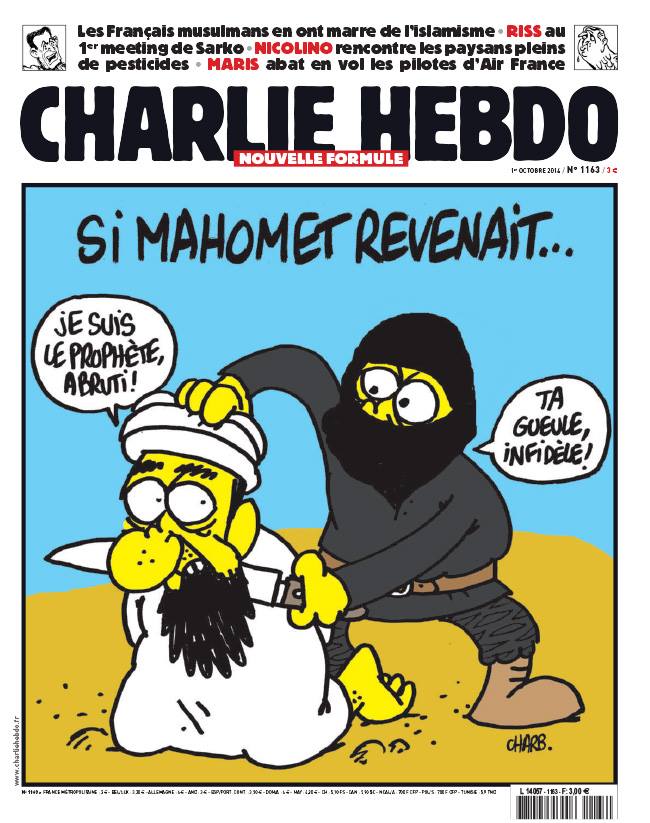
charlie hebdo no1163 011014While it is a legitimate debate to have over whether or not to publish the cartoons given fear of giving offence or further stirring things up, my sense is that editors have made a blanket decision rather than looking at the cartoons and selecting some that are not gratuitous but make valid points.

My example would be the one above:

Studer said the CBC decided against running the cartoons, arguing that to show those depictions of Muhammad would needlessly offend Muslims, who consider such depictions sacrilege.

And he wasn’t alone in putting forward that argument. The New York Times executive editor Dean Baquet told the paper’s public editor he spent about half of the day deciding whether or not to publish the cartoons, changing his mind twice before ultimately deciding not to run the images.

“We have a standard that is long held and that serves us well: that there is a line between gratuitous insult and satire. Most of these are gratuitous insult,” Baquet said.

The Washington Post ran one image on its editorial pages while the main U.S. networks, including ABC News, CNN and Fox backed off from publishing the cartoons. The Associated Press also declined to make them available.

In Canada, of the Toronto-based newspapers, only the National Post ran the controversial cartoons. Almost none of the U.K. papers ran the cartoons, nor did the BBC and the Paris-based papers Le Monde or Le Figaro.

Charlie Hebdo shooting: Debate over publishing the Muhammad cartoons – World – CBC News.

And in Quebec media, which apart from the Montreal Gazette, widely published some of the cartoons:

Publier les caricatures ou pas?

Paris attacks illustrate the power of mockery – Saunders

Nice piece by Doug Saunders on the power of satire:

Mockery travels faster than news or analysis. While Charlie Chaplin’s Interview-style mockery of Adolf Hitler in The Great Dictator was not considered a major part of the arsenal against the Fuhrer in that predigital era (and certainly didn’t provoke violence), the instant spread of disrespectful imagery is capable of threatening entire edifices of authority overnight.

What Charlie Hebdo offended was not any broad community or religion or political tendency, but rather those militant few who are driven to revenge and violence at the prospect of disrespect. Its unsubtle, schoolyard style of humour, much like Mr. Rogen’s, turned off a lot of people and groups, but that’s a fully acceptable response to bad taste and not at all related to vengeful violence.

A century and a half ago, what the police called “respect crimes” were part of the political mainstream in countries such as Canada, where wounded honour was the cause for duels and vengeance. Gauntlet-throwing died out, in most places, for generations. But something has happened in the online age to make mockery, once again, into a potent instrument. The only reasonable response is to deploy it as often, and as mercilessly, as possible.

I remember reading Satanic Verses during the time of the fatwa and some of the passages took my breath away in the sharpness and humour of Rushdie’s use of satire to make his points.

Paris attacks illustrate the power of mockery – The Globe and Mail.