USA: There Are 11,073 Muslims In Federal Prisons But Just 13 Chaplains To Minister To Them

The previous conservative government largely cancelled the chaplain program with respect to non-Christian chaplains in 2012 (Non-Christian prison chaplains chopped by Ottawa). Not sure what the current situation is:

Abdul Muhaymin al-Salim converted to Islam during his incarceration on drug charges at a federal prison in South Carolina from 2004 to 2014. In his first year there, the 49-year-old remembers a Muslim volunteer coming to the prison a couple of times a month to lead religious services.

Then, in the second year, during Ramadan, a holy month for Muslims, the volunteer was no longer allowed in the prison. Al-Salim never found out why.

“There were instances where we could have been denied or not received the proper representation or resources that we needed,” he said.

Muslims, the third-largest faith group in federal prisons, are significantly underrepresented among the chaplaincy, according to a Department of Justice inspector general report released last week. Currently, 6% of federal prison chaplains are Muslim, while 9.4% of inmates identified as Muslim.

As of March 2020, 199 of the 236 federal prison chaplains, or 84%, were Protestant Christian, even though that faith group makes up only 34% of inmates. There were no more than 13 Muslim chaplains in the past six years working at federal prisons — and that number remains today, even though the number of Muslim inmates has grown during that time, to 11,073.
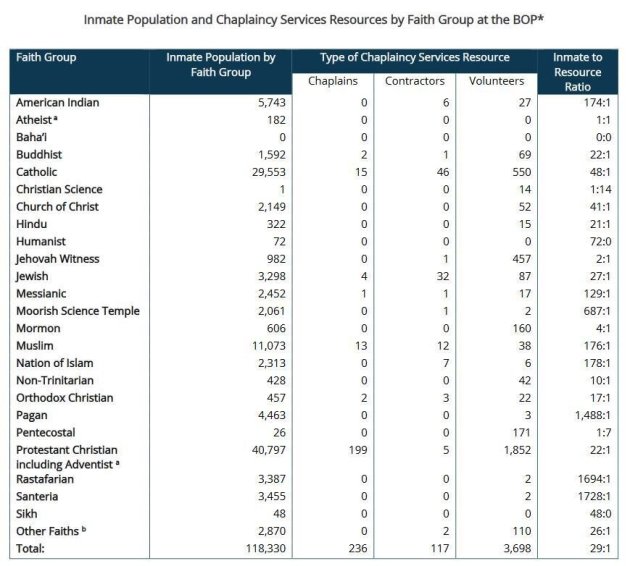
Table showing federal inmates by religion

The challenges in recruiting Muslim chaplains have persisted within the Federal Bureau of Prisons for years, the report says. In response to a 2004 inspector general report that highlighted a significant shortage in Muslim chaplains, the bureau said it tried to attract a greater number through an on-site program that allowed prison employees to acquire the necessary skills to become a chaplain. But those efforts were unsuccessful, resulting in only one Muslim chaplain trained since 2006. And the number of Muslim inmates has more than doubled since then.

“Oftentimes, this will have a negative effect because you’re left to the whims of whoever is in charge of the chaplain’s department,” said al-Salim, who now works at the Tayba Foundation, where he mentors incarcerated Muslims. “There’s nobody there to help them gain that grounding that they need.”

The needs of the federal prisons’ Muslim population are underserved without chaplains, Muslim leaders say. Because most religious services have to be led by a chaplain, not having Muslim clergy means the services get canceled. When Muslim chaplains are employed, they also make sure Muslim inmates have access to books, prayer rugs and halal meals and that they can freely practice their faith.

Why prospective prison chaplains have been discouraged from applying

“The Bureau of Prisons is committed to ensuring that inmates of all faiths can practice their religion and participate in religious services while also maintaining appropriate safety and security measures,” spokesperson Donald Murphy told NPR in a statement.

Based on recommendations from the inspector general’s office, the bureau is “making changes to improve management and oversight over its chaplaincy program,” Murphy added.

To recruit additional Muslim chaplains, the bureau said it is working with current prison chaplains and seminaries to find candidates.

The bureau is also considering waiving requirements that chaplains must be a certain age, have a graduate-level theological degree and have completed coursework in interfaith study. That would make it easier for religious leaders like Imam Sami Shamma. A chaplain at the Connecticut Department of Corrections for over eight years, Shamma said he hasn’t been eligible for a federal position because he is 65 — over the 37-year age limit for appointment. Neither could Imam Abu Qadir al-Amin, who wanted to be a chaplain at a federal prison in Dublin, Calif., where he volunteered. But he couldn’t qualify because he didn’t have access to higher education.

“Some of the more effective leaders are not necessarily people who went to school for what they’re doing now,” al-Amin said. “They’re more inspired leaders that can make a real contribution to people’s lives who are in that restricted environment and need someone who understands their lifestyle, what led them to be there in the first place, and then can more appropriately develop strategies that address the needs of them returning.”

There’s another reason it’s difficult to recruit Muslim chaplains: Ordination is required by the bureau, but Muslims do not formally ordain religious leaders. And often Muslim communities live far from the prisons, requiring the chaplains and their families to relocate. In addition, Muslim chaplains in correctional facilities often face criticism by people claiming that they are spreading an extremist interpretation of Islam to the prisoners, according to a Harvard University report.

In the meantime, the prisons are filling the gap through contracted religious services providers and trained chapel volunteers. But even with volunteers and contractors, who don’t work full time, there is only one Muslim chaplain per 176 inmates, according to the latest inspector general report.

“If they’re actively recruiting Muslim chaplains and they want to employ Muslim chaplains in the federal system, then they should maybe sit down with Muslim leaders in the community and discuss a strategy for filling that vacuum,” al-Amin said.

Despite the chaplain shortage, the bureau has made incremental progress in accommodating Muslims’ religious practices. In 2019, for instance, it changed its guidelines to allow Muslim inmates to pray in groups.

State prisons face a similar shortage of Muslim chaplains

There’s also a shortage of Muslim chaplains at state prisons, Shamma says. While he used to rely on volunteers to help, they have not been allowed to do so during the pandemic. That has sometimes meant canceled services for the almost 200 inmates he serves.

Some state prisons, with larger Muslim populations, have better resources.

Tariq MaQbool, a 44-year-old Muslim incarcerated at the New Jersey State Prison, told NPR through the Prison Journalism Project that the Muslim chaplain there is a “blessing.” He regularly attends Friday prayers and Islamic talks led by the chaplain.

But MaQbool is still advocating for other ways to practice his faith, including access to halal meals and Islamic literature.

Source: There Are 11,073 Muslims In Federal Prisons But Just 13 Chaplains To Minister To Them

Muslims Over-Represented In US State Prisons, Report Finds

Unfortunately, we do not have comparable data for Canada although I suspect we are better at accommodation (however, it does not appear that the Liberal government restored the Conservative cuts in 2012 to non-Christian chaplaincy services, or at least couldn’t find any evidence they had):

Muslims make up about 9% of state prisoners, though they are only about 1% of the U.S. population, a new report from the civil rights organization Muslim Advocates finds. The report, released Thursday, is the most comprehensive count of Muslims in state prisons so far.

The report also sheds light on the obstacles some incarcerated Muslims face in prison while practicing their faith.

“Getting a picture of the religious preference of state prisoners is, we think, really important and unique,” said Yusuf Saei, the author of the report.

Muslim Advocates requested religious preference data from every state, and based its report on the records it received from 34 states and Washington D.C. Previous data on the religious preference of federal prisoners show that Muslims make up about 12% of that population, but that’s just a small slice of a much bigger picture.

“There are roughly 200,000 federal prisoners and more than 1.3 million state prisoners,” Saei said. “We can say with a high degree of confidence this is one of the most comprehensive looks at religious preference data.” The report only focused on the Muslim population in state prisons.

Knowing how many Muslims are in state prisons, Saei said, helps prison officials understand the importance of respecting religious practice for a significant and growing portion of people in prison. The report also compiled 163 lawsuits between October 2017 and January 2019 in which Muslims alleged their right to practice was being violated.

“Incarcerated Muslims are asking for very basic things: religiously compliant food, books, prayer mats. But they’re not receiving them in many states,” Saei said. “This idea of religious liberty is baked into the U.S. Constitution and federal law specifically protects the religious liberty of prisoners. But our report shows that many state prisons are arbitrarily and illegally preventing incarcerated Muslims from practicing their faith.”

The report compared state policies and found they were inconsistent. Some are very accommodating; others are not accommodating at all. For example, the report finds that only 17 states specifically allow religious head coverings. It also finds that more and more states are fully accommodating Muslim dietary requirements–halal-certified meals. But there are states that still make access to alternative meals difficult or impossible.

“Many state policies do provide for full accommodation of Muslim diet requests. Others, however, provide diminished diet substitutes or no substitutes at all,” the report said. “And in some cases, the paucity of diet accommodations may coerce individuals into violating their dietary beliefs.”

The report provides examples of the inconsistent and in some cases burdensome state policies for Muslim prisoners. In Nevada, for example, to get a meat-substitute diet a prisoner has to pass a diet accommodation interview. In North Dakota, there is a “60-day sincerity test” for anyone who changes religions and has a new religious dietary requirement as part of the practice.

The report recommends some straightforward policies for prisons to facilitate Muslim religious practices such as permitting individual and group prayers for Muslims and training officers on how to make that happen. It also recommends giving prisoners with works assignments days off on their religious holidays, creating clear policies on burial practices that allow for Muslims to be buried within their faith traditions and allowing religious head coverings for men and women.

Prisoners’ religious practice is legally protected by the Religious Land Use and Institutionalized Persons Act, passed by Congress in 2000. That law states the government can’t impede a prisoner’s free exercise of religion without a compelling reason.

“Things that I want to do or congregate activities that I might want to engage in with other prisoners, if they’re done in the name of religion have a higher degree of protection than those same activities such as gathering together or studying together if they’re not done in the name of religion,” said Martin Horn. He teaches at the John Jay College of Criminal Justice and is the former secretary of the Pennsylvania Department of Corrections.

He said for the most part, state prisons respect federal law that protects religious practice for prisoners. And when prisoners sue over violations of religious practice, it’s difficult for the state to win.

“The state has a very high burden to overcome to avoid allowing them to practice their faith at all and that means not allowing the prayer books, not allowing them to gather for prayer, not allowing access to services of an Imam,” Horn said. “Once something is considered a religious practice, it has to be allowed unless there is a substantial burden on the state and there is no other way to mitigate that burden.”

But advocates point to cases like the recent execution of a Muslim prisonerin Alabama earlier this year. His request for an Imam to be present when he was put to death was denied by the Supreme Court in a 5-4 decision. The majority opinion said the prisoner had waited too long to make the request. In the dissenting opinion, Justice Elena Kagan wrote that the decision was “profoundly wrong.”

And Muslim prison chaplains say the current political climate affects the treatment of Muslim prisoners. That’s problematic for people with so little control over their lives.

Tariq Aquil, the Muslim chaplain credited with developing the halal meal program in California’s state prisons, said he saw that play out before he retired in 2017. Like when a Muslim prisoner’s prayer time coincided with the inmate count.

“The guard sees that he’s literally praying and he sees that he’s actually in his cell so he could literally count him right there, ‘I can see you, you’re praying so I know you haven’t escaped,” Aquil said. “But they would stop, they would yell at him and they would curse him.”

Because he was praying rather than responding to the roll call.

Some decisions made by the prisons that are obstacles to Muslims practicing their faith come out of ignorance, concerns about costs, like meal plans, or real security concerns like an emergency in the middle of Friday prayer, Aquil said.

But corrections officers live in the real world, he said, and the anti-immigrant, racist and anti-Muslim rhetoric spouted by the current administration has an impact.

“Those of us who’ve worked in an environment where we’re trained are told that we should leave our political and any other attitudes that we have at the front gate when we come to work and that we should treat everyone equal,” Aquil said. “Very few human beings that I know of have this on and off switch where they simply can disengage from hearing last night ‘lock her up’ or ‘send her back’ and then come into the prison and see the people who are attired in the same way or have the same face or something like that. So sometimes it’s subtle and sometimes it’s much more overt.”

Also, Aquil said it’s important to note that over-representation of Muslims in prison isn’t indicative of a lot of Muslims being arrested and convicted.

“About 90 percent of incarcerated Muslims in the United States become Muslims during their incarceration,” he said. “Most of the people that are in prison tend to be repeat offenders and so at some point in time they seem to become aware that they have run the gambit and maybe it’s time for a change.”

Source: Muslims Over-Represented In State Prisons, Report Finds

Prisons pay more for native spiritual services than all other faiths combined

While the issue may be more underfunding of chaplain services for other religions than overfunding of Indigenous spiritual services, it is nevertheless an interesting disparity, particularly given that relatively few Indigenous peoples according the 2011 NHS practice Aboriginal spirituality (less than 5 percent).

The previous government’s cut to chaplaincy services and subsequent restoration may also have played a part (Corrections Canada reverses course on chaplains | Toronto Star):

Canada’s federal prisons are paying significantly more each year for indigenous spiritual services than for all other religions combined.

Indigenous populations are grossly overrepresented in the prison population, a systemic issue. But statistics show that only five per cent of offenders identify as having “native spirituality.”

Still, the Correctional Service of Canada (CSC) is spending $8 million annually on sustaining spiritual services for those offenders — versus its $6.75 million ceiling for other religions.

Spokesperson Avely Serin said Elder services help offenders follow a “traditional healing path” and provide advice to the heads of institutions about “access to ceremonial objects and traditional medicines within the institution.”

As of last October, 85 per cent of indigenous offenders in custody, or 3,156, had undergone an “Elder review,” which requires multiple meetings, according to Serin.

Meanwhile, in the 2015-16 year, chaplaincy services registered 407,639 individual contacts with offenders. That number includes attendance at religious services and faith-based educational sessions, along with individual counselling.

The correctional service takes “a lot of criticism for the overrepresentation of First Nations people in the prison system,” said Catherine Latimer, executive director at the John Howard Society. She suggested that could be one reason for the extra funding.

Indigenous people make up a quarter of the prison population versus 4.3 per cent of the general population, according to Canada’s Correctional Investigator. And 31 per cent of female prisoners are indigenous.

Latimer questioned the fairness of offering different amounts of spiritual support based on ethnicity.

Indigenous offenders do have better outcomes when “reconnected with their spiritual and cultural traditions,” said the Correctional Investigator of Canada’s annual report for 2014-15.

But spiritual services help offenders of other religions, too, said Kate Johnson, a former chaplain at Joyceville Institution in Kingston, Ont.

Almost half of offenders are Christian, a majority of those Catholic, and just over five per cent are Muslim. About 15 per cent report having no religion.

“Chaplains generally are the people who provide that kind of bridge from institution to community,” said Johnson, now chaplain at Queen’s University after leaving corrections three years ago. “The better care we provide for somebody, the less likely they are to reoffend.”

Source: Prisons pay more for native spiritual services than all other faiths combined | National Post

Corrections Canada reverses course on chaplains

Good. And trust that a mix of religions, reflecting the diversity of the prisoner population, will be the result:

After three years of cuts, the Correctional Service of Canada says it is now looking for new community chaplains to work with former inmates.

The department told the Star this week it will be hiring 27 part-time positions in 21 cities across Canada. The one-year contract positions have the option of being renewed until 2020.

The surprise decision comes a week after the Star wrote about how federal government cuts to community chaplains resulted in the loss of dozens of part-time positions, with many chaplains opting to work for free so that they could continue helping parolees who needed guidance.

In explaining the hires, CSC spokesperson Sharon Pieris said in an email that chaplains contribute to “spiritual and religious growth and provide an essential link between the re-integrating offender and their community.”

Corrections Canada reverses course on chaplains | Toronto Star.

Radicalization a growing risk in Canadian prisons, experts warn

Not an easy issue to address. Comments by former prison chaplam Imam Dwyer worth noting:

Imam Yasin Dwyer worked as a chaplain in federal prisons for 11 years, but left his formal role after CSC moved to a privatized model for chaplaincy services. Dwyer says the chaplains had proven successful in building trust relationships with inmates, and the change severed critical ties to community.

“If the community is not speaking with authority about what religion is, in our case about what Islam is — especially in a correctional context — if the community doesn’t have that authority, then perhaps that authority may fall to voices that have not been granted that authority by the faith community,” he warned.

While most Muslims behind bars use faith to find meaning and guide them through incarceration, some are dealing with issues that make them vulnerable to radicalization.

Dwyer, who provided pastoral services to six of the Toronto 18 terror cell members, says he had success despite a lack of government support.

“It’s not even a matter of doing enough — it’s are we doing anything at all?” he says. “As the Muslim chaplain, I was looked upon to deal with these particular offenders, minus the resources to do it effectively.”

Dwyer says he does not want to contribute to fear-mongering, but wants to raise a red flag.

“Prisoners are in a very adversarial environment. It is a potentially violent environment where people are quite jaded and there is a real absence of consistent light. So in that situation, in that state of anger and isolation, you may have the potential of those falling into some sort of alternative dysfunctional narrative of what Islam is. That’s the flag that I would put out.”

Last month, CSC hosted an international roundtable and symposium on managing radical offenders that brought in experts from the U.S., the U.K., New Zealand, Israel, France, Spain and the Netherlands.

While there are publicly available statistics on aboriginal prisoners, have not seen statistics broken down by visible minority or religion.

Radicalization a growing risk in Canadian prisons, experts warn – Politics – CBC News.

Radicalization of prisoners discussed at Canadian roundtable

Interesting to see whether the CSC will revisit the earlier decision to cancel the chaplain program in 2013 (Is Canada doing enough to ‘de-radicalize’ convicted terrorists?):

Don Head, commissioner of the Correctional Service of Canada (CSC), got approval from Public Safety Minister Steven Blaney to fly in participants from other parts of Canada and from the United States, the United Kingdom, New Zealand, Israel, France, Spain and the Netherlands at a cost of about $63,000, according to a briefing note obtained by CBC News through Access to Information.

“Violent extremist or radicalized offender populations may pose a threat to the safety and security of institutions and communities, necessitating an examination of evidence-based assessments, interventions and management practices for this group of offenders,” the document reads.

CSC confirmed the three-day event took place Dec. 2-4, bringing together international experts who discussed ways to manage extremist offenders.

Amedy Coulibaly, seen in an undated video posted online Sunday by militants, shot a policewoman and four hostages at a kosher grocery in Paris before he was killed by police on Friday. Coulibaly is said to have been radicalized in prison, where he met one of the Kouachi brothers responsible for last week’s Charlie Hebdo killings. (Associated Press)

The issue of radicalization behind bars is on the global radar after revelations that two gunmen involved in last week’s attacks in France are believed to have been radicalized in prison.

French authorities are struggling to contain the threat from what is now considered fertile ground for extremism.

….Rioux said CSC’s initiatives to prevent radicalization include comprehensive intake and screening procedures and training for front-line staff on security threat group identification.

Radicalization of prisoners discussed at Canadian roundtable – Politics – CBC News.