Anger as wait times for Australian #citizenship blow out during coronavirus pandemic

Looks like Australia has been able to ramp up virtual citizenship ceremonies dramatically to about 750 per day, showing it can be done although less meaningful than in person:

More than 16,800 people have received Australian citizenship via virtual ceremonies during the pandemic but many more are still waiting.

The migration sector has voiced concern as the processing times for Australian citizenship applications have blown out amid the COVID-19 pandemic.

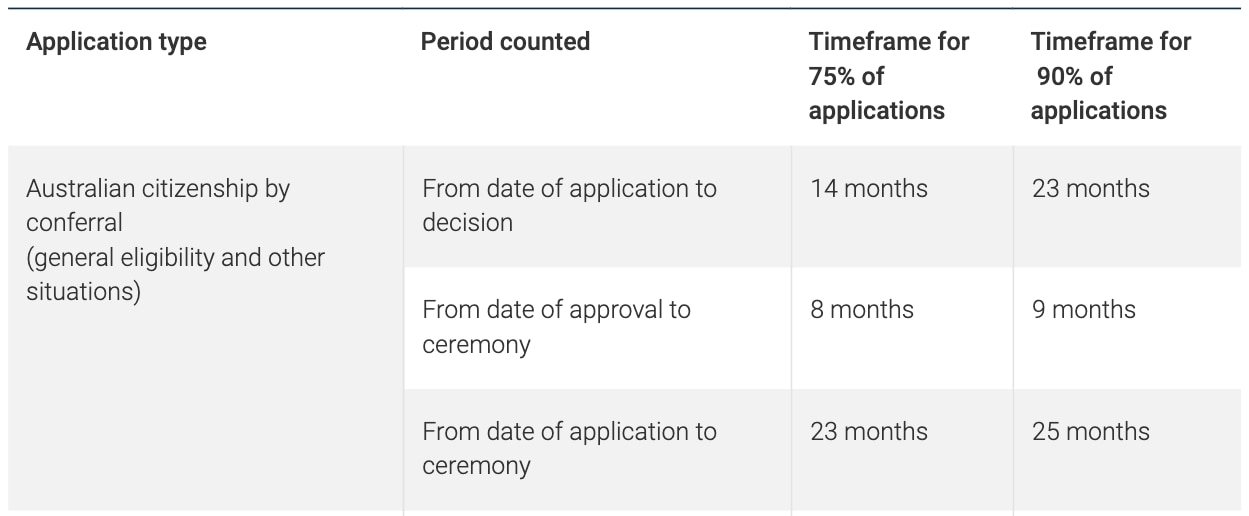
Figures from the Department of Home Affairs show 75 per cent of applications for citizenship by conferral now take 23 months – up from 16 months last June.

Ninety per cent of these applications are completed in 25 months compared to 20 months a year ago.

“Due to the COVID-19 pandemic, all face-to-face citizenship appointments, such as interviews and citizenship tests, have been placed on hold. This has meant an increase in overall processing times,” the spokesperson said.

“The department will recommence in-person interviews and citizenship tests when it is safe to do so,” they said, adding that new applications are still being accepted.

How long it is currently taking to process Australian citizenship by conferral.

How long it is currently taking to process Australian citizenship by conferral.
The Department of Home Affairs

But Carla Wilshire, CEO of the Migration Council Australia, said these numbers needed to be addressed.

“Once people go down the pathway of citizenship, a lot of decisions are put on hold until that citizenship comes through … It’s important we give them certainty as quickly as possible,” she said.

“Getting those waiting times down is critical in terms of really managing people’s sense that their lives are progressing and they are able to make decisions going forward around their commitment towards Australia.”

“Particularly during COVID, where people have a lot of generalised anxiety and feel a sense of insecurity, I think it’s really important that we take measures to … ensure resources are put to use to give citizenship as quickly as possible.”

It is a point echoed by Melbourne-based migration agent Kirk Yan.

“I haven’t seen the government offer a reasonable or acceptable explanation for the long processing times … They can’t explain why it takes two years,” he said.

“For citizenship, as long as you meet the requirements of a permanent resident, you are supposed to get it granted if you pass the citizenship test and the character or identity checks … I don’t know why it takes such a long time for the department.”

He said the latest rise in wait times left many of his clients anxious.

“The current situation has meant lots of people are waiting, just to get information or a response,” he said.

The sector has also pointed to climbing wait times as one reason why the demand for Australian citizenship is dropping.

Clearing the backlog

But even as wait times have gone up, the government has managed to address the backlog of citizenship applications this financial year.

The department spokesperson said during the year 2019-20, up to 22 May this year, 175,304 people were granted Australian citizenship – up 56 per cent on the same period last year.

Over recent months, it has been done via virtual citizenship ceremonies.

More than 750 people have received citizenship through online ceremonies each day since they began, and up to 22 May, more than 16,800 people received citizenship this way.

The latest backlog figure is now 123,727 applications, compared to 221,695 a year ago.

But Migration Council Australia’s Ms Wilshire said this number was “still significant by historical standards”.

“During COVID, there is so much insecurity as people are losing that sense of being able to visit their country of origin and connect with family as global movement is decreasing,” she said.

“I think that affirmation of being part of the Australian community is psychologically quite important for our migrant communities.”
Source: Anger as wait times for Australian citizenship blow out during coronavirus pandemic

The Coronavirus Has Derailed The Citizenship Oath For Thousands Of Immigrants Who Are Anxious To Vote

As in Canada. Need to look at ceremonies by video conferencing as in Australia.

Of course, for the Trump administration and those Republicans wishing to discourage voting, this is more a feature than a problem:

Luis Molina had waited months to complete the final step in his decadeslong journey to become an American citizen: repeating the oath of allegiance to the United States along with hundreds of other would-be citizens on March 19.

Molina, a 51-year-old who left El Salvador as a young man, had planned to hold a celebratory dinner at his favorite restaurant in Pasadena, California — President Thai — after the naturalization ceremony in Los Angeles.

To become a US citizen, immigrants must go through a long, and at times arduous, process that includes an interview with an immigration officer and a test on American civics and the English language. The final step, however, is the easiest of them all: repeating 140 words in a celebratory event that’s often held in American theaters, convention centers, and courthouses.

This simple, but legally necessary step, is all that stands in the way of Molina being granted citizenship.

But that opportunity has been on hold: In March, naturalization ceremonies across the country were canceled due to the rapid spread of the coronavirus, and the agency that administers immigration benefits, US Citizenship and Immigration Services, closed its offices to the public. The ceremonies are supposed to be rescheduled, but like many other parts of American life, the timing is uncertain.

In the wake of the cancellations, immigrants like Molina fear that they not only won’t get the chance to call themselves Americans anytime soon, but that they won’t be able to vote in the upcoming presidential election. Experts warn that the delayed naturalizations could have an impact on the number of eligible voters in November, as many states require registration by October.

“I’m kind of nervous,” Molina said. He’s watched how the Trump administration has enforced the public charge rule, which penalizes green card applicants for using public benefits, and other restrictive immigration policies. “I’ve been thinking about how they change the rules and the laws and maybe I won’t be able to get citizenship. I feel intimidated.”

A USCIS spokesperson said field offices will send notices with instructions to applicants with scheduled interviews or naturalization ceremony appointments, which will automatically be rescheduled once normal operations resume.

Some ceremonies in Los Angeles that had been scheduled for later in May have yet to be canceled, but California officials have indicated that strict social distancing measures could last beyond that.

Under normal conditions, USCIS is able to naturalize 66,000 immigrants on average every month, according to Sarah Pierce, an analyst at Migration Policy Institute. The agency generally relies on in-person oaths at its office or in larger ceremonies outside of its own facilities.

“So far, because of COVID-19, there are already tens of thousands of immigrants who have had their naturalizations delayed, and these numbers will easily exceed 100,000 as this crisis drags on,” she said.

The agency regularly hosts ceremonies that pack more than 1,000 soon-to-be Americans in one place to conduct the oath altogether. If USCIS offices are able to open as planned on May 3, the agency will still face an inherent challenge: How will large groups of people be quickly naturalized?

“Unless USCIS implements an ambitious series of naturalization ceremonies once they are able to reopen in-person services, there will be tens of thousands of immigrants who will not be able to vote in this fall’s election, despite having completed nearly all the legal requirements to receive citizenship,” Pierce said. “Because naturalization ceremonies entail gatherings of large groups of people, there are a lot of outstanding questions about when USCIS will be able to restart these and what exactly they will look like. If the ceremonies are limited by public health concerns, unless USCIS comes up with innovative solutions, these delays could reverberate for years to come.”

Former senior USCIS leaders told BuzzFeed News the cancellations will inevitably have an impact on the number of people who are able to obtain citizenship this year.

“Field offices are 100% closed, meaning not just no naturalization ceremonies, but no naturalization interviews and also no green card interviews,” said Leon Rodriguez, former director of the agency under the Obama administration. “All of this was already severely backlogged before, so the problem will become much worse depending on the length of the closure.”

As of September 2019, there were already more than 600,000 naturalization applications pending.

The naturalization oath has been a long-held American tradition, spanning back to the late 1700s. Before the early 1900s, courts from across the country administered the oath in various ways, and it wasn’t until 1929 that a standardized oath was created. Later, the Immigration Act of 1950 added language to the oath that made immigrants promise to bear arms for the US and perform “noncombatant service in the armed forces of the United States when required by the law.”

There are waivers for the requirement to recite the oath, like if an individual does not agree to bear arms for the US because of religious circumstances or has a developmental disability that prevents them from understanding the oath, but in most circumstances it is required.

“It’s like being on the 1-yard line and suddenly there’s a timeout that may last for months. If you can’t take the oath of allegiance — a pro forma final step but a moving one — then you can’t become a US citizen,” said Doug Rand, who worked on immigration policy in the Obama White House and is now the cofounder of Boundless Immigration, a technology company that helps immigrants obtain green cards and citizenship. “That means you can’t vote, of course. It also means you can’t count on being safe from deportation or on protecting your family by sponsoring them for US citizenship.”

Rand has advocated for the agency to skip the live event altogether in light of the pandemic, while others have called for oaths to be administered via televideo.

Duncan Williams, a professor of religion at the University of Southern California, had also been scheduled to recite the oath of citizenship in Los Angeles on March 19. Williams, 50, came to the country as a 17-year-old from Japan for college. The Trump administration’s restrictive immigration policies — such as the travel ban and the policy that led to families being separated at the border — created a sense of urgency for Williams to obtain his citizenship.

“What is more unsettling is the uncertainty about the future implicated in the inability to complete the naturalization process,” he said.

Williams had expected to get his US passport and vote in the upcoming elections, confident in his status as an American.

“As a Japanese national,” he said, “I’ve been observing the rising anti-Asian sentiment in the US with some trepidation, with some regret that the protections afforded to citizens is not something I can secure at the present time.”

Source: The Coronavirus Has Derailed The Citizenship Oath For Thousands Of Immigrants Who Are Anxious To Vote

Australian citizenship ceremonies to go ahead via video link during coronavirus crisis

Further to my earlier post (Thousands now face indefinite wait for Australian citizenship as ceremonies cancelled), an initiative that Canada would do well to consider:

Australian citizenship ceremonies will be conducted online via video secure video link, with the prospect of up to 750 people conferred each day, acting Immigration Minister Alan Tudge announced Monday.

The Department of Home Affairs has commenced trialling the one-on-one ceremonies for those already approved, with alternative arrangements to be made for those who can not access the internet.

“Australian citizenship is an immense privilege, and fundamental to our national identity,” Mr Tudge said in a statement.

There had been fears that tens of thousands of migrants waiting to become citizens were going to face an indefinite wait for the process to be finalised, after ceremonies across the country were cancelled because of social distancing measures brought on by the coronavirus.

After an application for citizenship is approved, migrants are required under the Australian Citizenship Act to make a pledge of commitment to Australia before a presiding officer, which normally occurs at a ceremony organised by their local council.

Current restrictions on public gatherings forced these to be put on hold.

“The Morrison Government recognises the importance of Australian citizenship for migrants and for the wider Australia community,” Mr Tudge said.

The Federal Government said there are currently 85,000 people awaiting a ceremony and those already scheduled for a citizenship event will be notified.

The Chambers family, who arrived in Perth from Wales ten years ago, are seen after becoming citizens during an Australia Day citizenship ceremony
AAP

While future applications are still being accepted, the Federal Government has put a halt on interviews and testing.

More resources will be deployed to work through the backlog once social distancing measures ease.

Source: Australian citizenship ceremonies to go ahead via video link during coronavirus crisis

Denver’s government doesn’t hold citizenship ceremonies anymore because the federal government won’t share

Petty and counterproductive:

Taking an oath to America is the last step of a complex journey to naturalization — one that Denver has been happy to show off at public libraries and other government buildings in the past during so-called naturalization ceremonies.But several months ago, the federal government blacklisted the city government from holding the feel-good ceremonies that showcase new citizens of the United States in Denver. The U.S. Citizenship and Immigration Services stopped working with the city on the ceremonies after June of 2019, about two years after the city council made it illegal for Denver government employees to share information with federal immigration authorities.

New citizens don’t need a public ceremony to become citizens. They can take oaths at federal offices, which still occurs every day. But naturalization ceremonies are symbolic shows of patriotism as well as bows on a bureaucratic process, and local governments cannot hold the events without citizenship status and other information from federal immigration officials — information that they’ve stopped sharing with the Hancock administration.

“The mission of USCIS is to both celebrate American citizenship through naturalization ceremonies as well as protect the homeland by ensuring the integrity of our immigration system. Unfortunately, the City and County of Denver chooses not to work with USCIS on investigations of potential fraud, which negatively impacts USCIS’ ability to fairly and accurately adjudicate cases involving national security concerns and fraud,” said Jessica Collins, USCIS spokesperson. “Given the situation, USCIS will not be able to collaborate with the City and County of Denver to hold naturalization ceremonies until the City and County of Denver cooperates on the overall USCIS’ mission.”

City Councilwoman Jaime Torres, who formerly headed the Denver Office of Immigrant & Refugee Affairs before taking office, called the decision by USCIS “deeply disappointing.”

“We had been so intentional about celebrating naturalization and citizenship,” she told Denverite.

The blackout has so far gone unannounced.

“If we complain every single time (the Trump) administration did something that is contrary to what this city’s values are, you guys would get sick of us,” said Rowena Alegría, the city’s chief storyteller (that’s her real title).

July 6, 2019 marks the last time USCIS partnered with Denver on a ceremony, a spokeswoman for the federal immigration department said. However at least one ceremony has been held in the city on private property since then. Suburbs around Denver are still hosting the ceremonies.

Denver has partnered with USCIS on these ceremonies for years, developing cross-governmental relationships along the way, Alegría said. And then one day, they had to cut ties. She said the city continues to support and celebrate immigrants in different ways, like My Civic Academy, a leadership program to teach new citizens about Denver.

Source: Denver’s government doesn’t hold citizenship ceremonies anymore because the federal government won’t share

‘Bizarre, heavy-handed: Councils push back on changes to Australia Day citizenship ceremonies

Ongoing Australian debates, political positioning and virtue signalling continue to amaze me. That being said, we are seeing some similar pressures from Indigenous peoples here in Canada (Canada celebrates 150 but indigenous groups say history is being ‘skated over’):

The federal government has revised the citizenship code to make it compulsory for all councils to hold citizenship ceremonies on Australia Day – but some councils say the Morrison government should have consulted rather than applying a “heavy-handed and odd” approach.

Under changes to the Australian Citizenship Ceremonies Code to be introduced in 2020, councils will also have to hold a second citizenship ceremony on September 17 – Australian Citizenship Day – and new citizens will have to abide by a strict dress code that bans boardshorts and thongs.

The revised code will be sent to councils this week, Immigration, Citizenship and Multicultural Affairs Minister David Coleman announced.

“Australian citizenship is an immense privilege and fundamental to our national identity,” Mr Coleman said.

“As part of this update, the government will require that citizenship ceremonies be held on Australia Day across the nation.

“New citizens should be given the opportunity to become an Australian on our national day – Australia Day is an incredibly important part of our national calendar.”

On Sunday, Prime Minister Scott Morrison said the government will “protect our national day and ensure it is respected”.

“We believe all councils who are granted the privilege of conducting citizenship ceremonies should be required to conduct a ceremony on Australia Day,” he told the Sunday Telegraph newspaper.

In 2017, two Melbourne councils were stripped of the right to hold citizenship ceremonies after scrapping all Australia Day celebrations to recognise Indigenous sensitivities. Yarra City Council and neighbouring Darebin Council cited a groundswell of popular support for the move but were slapped down by the government.

Amid a growing push from some corners to change Australia’s national from January 26, several councils have already made plans to move or cancel traditional celebrations this year.

Victoria’s Darebin, Yarra and Moreland, Western Australia’s Fremantle and NSW’s Byron have already flagged a change of date, because January 26 is considered a day of mourning by many Indigenous and non-Indigenous people.

City of Sydney Labor Councillor Linda Scott said councils had an obligation to listen to community sentiment.

“The job of local governments is to listen to their communities and represent their views,” she told SBS News.

“Councils should be able to set the day of their citizenship ceremonies in line with the views of their community.”

She said other councils had shifted citizenship ceremonies from January 26 because of extreme heat, a lack of new citizenship applications or because of cultural sensitivity.

Australian Local Government Association president Mayor David O’Loughlin said most councils likely won’t be opposed to the government’s proposed changes to the Australian Citizenship Ceremonies Code but councils will have valid concerns.

“Most councils hold more than one citizenship ceremony a year, some as often as monthly – the Federal Government’s strong focus on drawing a link between Australia Day and citizenship ceremonies is bizarre,” he said.

“We do acknowledge that a small number of councils are in discussions with their communities about whether the 26th of January is the appropriate day to celebrate Australia Day.

“However, councils cannot move Australia Day – this is ultimately up to the Federal government – but it is our job to be responsive to our communities, including to their calls for prudence and advocacy.”

He said if the Morrison government had “bothered to consult” with council it would have found many Local Government Areas forgo citizenship ceremonies on Australia Day because of the heat.

“In some locations, it’s simply too hot for councils to hold ceremonies during the day, so they do it the evening before, just as the Federal Government does with its Australian of the Year Ceremony,” he said.

“Interestingly, the federal government has made no mention of any financial contribution towards the additional costs involved in running these ceremonies.”

More than 73,000 people have become Australian citizens on Australia Day in the past five years, according to government figures – despite there being no specific requirement for councils to hold ceremonies on January 26.

City of Darebin’s Mayor Susan Rennie told SBS News her council “will not be marking January 26 by holding any events on that day or surrounding days” for a second year running.

Ms Rennie said Darebin is “opposed to Australia’s national celebration being held on January 26 out of respect for local Aboriginal and Torres Strait Islander peoples, who have told us that they experience a day of sadness, pain and disconnection”.

Source: ‘Bizarre, heavy-handed: Councils push back on changes to Australia Day citizenship ceremonies

Mandatory handshake will make Danish citizenship three times as expensive

Hard to believe that this change would increase the cost of the ceremonies (handshake is a standard feature of Canadian citizenship ceremonies unless the new citizen prefers an alternate sign of respect):
A much-discussed proposal that would require new Danish citizenships to shake hands with their local mayor would also come with a tripling of the fee new Danes have to pay to receive their citizenship.
Forcing all citizenship applicants to participate in a ceremony in which they would have to shake hands with their mayor or another elected official would add so much administrative work that the citizenship fee would increase threefold, according to the wording of the proposal.
The fee would increase from the current 1,200 kroner to 3,600 kroner [USD 186 to USD 558, another high fee that IRCC can use to justify the high Canadian citizenship fee].
The anti-immigration Danish People’s Party, a driving force behind the handshake requirement, said it is perfectly reasonable to demand that people pay three times as much to become a Dane.
“When you consider that you are receiving the gift of Danish citizenship, I actually don’t think it’s that expensive. I think it is a tremendously large and valuable gift,” party spokesman Christian Langballe told news agency Ritzau.
As part of the government’s new rules on citizenship, participants at citizenship ceremonies will be required to shake hands with their local official. The proposal is largely seen as targeting Muslim who refuse to shake hands with members of the opposite sex.
“A handshake is how we greet each other in Denmark. It is the way we show respect for each other in this country. Therefore it is a completely natural part of such a ceremony,” Immigration Minister Inger Støjberg said last month.
Participants at the citizenship ceremonies are also required to sign a document promising to respect Danish values.
The proposed handshake is not necessarily a done deal, as the Social Democrats, who typically go along with the government’s immigration rules, have indicated that they do not support the mandatory handshake.
Party leader Mette Frederiksen said she believes that a handshake is important and “completely natural” but expressed concerns about writing it into law.
“The ceremony is what is important to me. If it turns out that there are problems with the handshake, then we should discuss legislation at that point,” she told broadcaster DR, adding that “we make too many laws in Denmark.”
Frederiksen said her party would not take a stance on the proposal until it makes it to parliament in its final form.
A number of mayors, including some from the ruling Venstre (Liberals) party, have spoken out against the proposal and indicated that they will not force new Danes to shake hands if they don’t want to.

Source: Mandatory handshake will make Danish citizenship three times as expensive