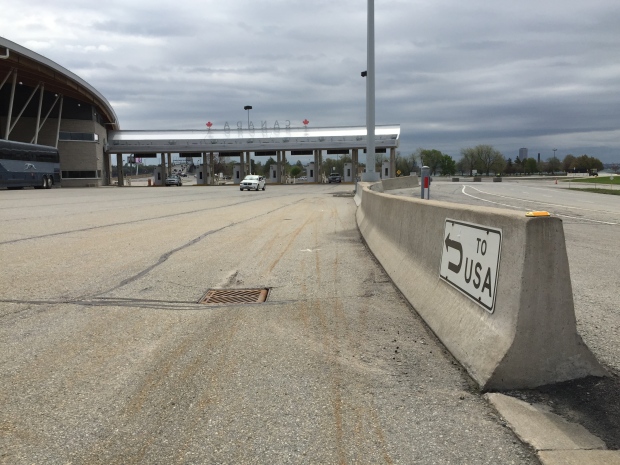
Thousands of alleged fugitives nabbed at Canadian borders in wake of CBC Toronto investigation

Hard to understand why this took so long:

Canada’s borders have become less porous in the wake of a CBC News investigation that revealed a major security gap in the way passengers were being screened before being allowed into Canada.

In the past 12 months since new screening measures came into effect on Nov. 21, 2015, the Canada Border Services Agency (CBSA) apprehended 3,067 people with outstanding criminal arrest warrants at border crossings.

In the previous 12 months, before the changes came into effect, the CBSA caught just 556 alleged fugitives.

The almost fivefold increase is in large part due to the efforts of a southwestern Ontario woman who demanded answers after being sexually assaulted — allegedly by a Nigerian man who was able to get back into Canada despite having warrants out for his arrest.

“Knowing that potentially some other person’s rapist has been caught at the border, or somebody that’s done something terrible to someone else, gives me some comfort,” she said.

CBC News is not identifying her because she is a victim of sexual assault.

The changes to national border security came last November after CBC News looked into her case and discovered front-line border agents at primary inspection points did not have access to the Canadian Police Information Centre.

CPIC is a database detailing criminal records, individuals with outstanding arrest warrants and other information outlining who might be a risk to Canadians. Only travellers deemed suspicious and sent for more secondary checks were being screened through CPIC at border crossings. Now CBSA agents at all inspection points screen every passenger arriving in Canada through CPIC.

Jean Pierre Fortin, the head of the union representing Canada’s border and immigration agents, says the changes have boosted national security.

Border picture

Canadian governments had quietly been aware of the loophole in border security since at least 2002. Yet giving all front-line CBSA agents access to a database was considered too costly. (Sarah Bridge/CBC)

“It’s sad that this only came because of a terrible situation … but we got a better tool through CPIC to our front-line officers to be able to intervene right away.”

Source: Thousands of alleged fugitives nabbed at Canadian borders in wake of CBC Toronto investigation – Toronto – CBC News

Canada’s immigration detention program to get $138M makeover

Another shift compared to the previous government:

The Canadian government is committing millions to upgrade immigration detention centres across Canada.

Immigration detention facilities in Vancouver and Laval, Que., are also set to be replaced.

Canada’s Public Safety Minister Ralph Goodale made the $138-million announcement Monday morning at the Laval Immigration Holding Centre. He said the objective is to make detention a last resort.

“In my first few months as minister responsible for Canada Border Services Agency, I have certainly heard the concerns about immigration detention, and I’ve studied those concerns with great care,” Goodale said.

“The government is anxious to address the weaknesses that exist and to do better.”

Samer Muscati, the director of the University of Toronto’s International Human Rights Program, said it was reassuring to hear Goodale address concerns about excessive use of detention in his remarks today.

“He’s saying the right things and it’s a positive development that he’s saying these things, but of course we’ll need to see what happens in terms of actions that follow,” he said. “The proof will be in the pudding.”

The government will soon begin consultations with stakeholders with the aim of finding alternatives and ways to minimize the number of minors in detention.

According to the Canada Border Services Agency, there are, on average, 450 to 500 people who are detained at any given time under the Immigration and Refugee Protection Act.

The End Immigration Detention Network says 15 people have died in detention while in CBSA custody since 2000. It says reforms are welcome, but the system is inherently unfair.

“Immigration detention including in immigration holding centres is imprisonment without charges or trial. It should end, not be expanded by throwing over a hundred million dollars at it,” said the Network’s spokesperson Tings Chak.

A Red Cross investigation in 2014 found numerous shortcomings at facilities for immigrant detainees, including overcrowding and inadequate mental health care.

Newcomers are often held in provincial jails or police facilities alongside suspected gang members and violent offenders.

The government’s reform objectives include:

  • Increasing the availability of alternatives to detention.
  • Reducing the use of provincial jails for immigration detention to prevent the interaction of immigration and criminal detainees.
  • Avoiding the detention of minors in the facilities as much as possible.
  • Improving physical and mental health care offered to those detained.
  • Maintaining ready access to facilities for agencies such as the Red Cross, United Nations High Commissioner for Refugees as well as legal and spiritual advisers.
  • Increasing transparency.

Source: Canada’s immigration detention program to get $138M makeover – Montreal – CBC News

A selection of more critical views, largely focusing on the need for oversight:

Migrants advocates welcome Ottawa’s reforms of the immigration detention system, but say the government is falling short on creating proper oversight of the agency responsible for the enforcement operations.

“It is encouraging the federal government is promising actions and reforms to the immigration detention system. Detention of immigrants needs to be absolutely the last resort and the government recognizes that,” said Josh Paterson of the British Colombia Civil Liberties Association.

“The thing is we need to put an end to housing migrants in criminal population. The money dedicated to the immigration infrastructure must not become the reason to detain more migrants and for longer period of time.”

….Anthony Navaneelan of the Canadian Association for Refugee Lawyers said what was missing in Goodale’s announcement was creating an independent oversight of the Canada Border Services Agency, which is responsible for enforcement of immigration laws including immigration detention.

“Building more detention beds is not enough. We need to keep people out of detention,” said Navaneelan.

 New Democrats immigration critic Jenny Kwan agreed.

“We need a complete and strong oversight to ensure these issues are addressed and the agency is accountable to the public. So many lives are in jeopardy,” said Kwan.

In July, more than 50 immigration detainees in Ontario held a hunger strike to protest prison conditions that include increasing lockdowns and the use of solitary confinement. They demanded to meet with Goodale — a request that was denied.

“We need an overhaul of the laws and policies governing detentions, including placing a limit of 90 days on detentions, not build new prisons,” said Tings Chak of the End Immigration Detention Network.

“Immigration detention is imprisonment without charges or trial. It should end, not be expanded by throwing over a hundred million dollars at it.”

Ontario Human Rights Commission chief commissioner Renu Mandhane said the federal government should be applauded for recognizing the need to provide adequate services to immigration detainees with mental health disabilities.

“We need to make detention more humane. Some detainees are caught in legal limbo for years,” Mandhane said. “They are faceless and hidden from the public, but their human rights should be respected.”

Conservative public security critic Erin O’Toole said there was no money in the federal budget earmarked for the immigration detention reforms and he felt the Liberal government was rushed to make the announcement without a plan.

“The devil is always in the details. This is a considerable amount of money,” said O’Toole. “A community supervision program has not been developed. Are we going to detain only the high-risk detainees? Are we going to stop using the provincial jails? These are the details I want before we decide if we need to build the new facilities.”

Immigration detention reforms fall short on oversight, critics say

‘Barbaric cultural practices’ tip line dead, but other snitch lines have continued

Interesting. More smoke than fire in terms of the number of leads followed up and acted upon:

A small team in a secretive government office in the nation’s capital stands ready, 24/7, to hear from Canadians who want to squeal on their neighbours.

Working in 12-hour shifts, between two and four Canada Border Service Agency employees are assigned every day to monitor the agency’s Border Watch Tip Line, a creation of the Paul Martin Liberal government that gives Canadians a chance to report “suspicious immigration activity” to the government around the clock, in either official language.

“No information, however trivial it may seem, is too small,” according to the CBSA webpage for the tip line.

Most of those tips end up being deleted or filed away in government archives, as do those made to two of the government’s other immigration-related tip lines, according to statistics provided to The Hill Times by the federal government.

Many of the communications via the tip lines have actually been questions about how to file paperwork for visas or other routine and unrelated matters. Some are reports of illegal activity that falls outside of the CBSA’s jurisdiction—for example, financial fraud. Others simply don’t include enough information, or do include information “not substantiated” by database searches of CBSA officials, the agency says.

Many of the tips come from members of the public who suspect a business is employing illegal workers, a neighbour may be in Canada with an expired visa, or someone they know might be perpetrating marriage fraud, according to records from earlier this year obtained by The Hill Times.

Others read like the plot from an immigration-themed soap opera.

“Tipster called to report that her friends [sic] husband has sponsored another woman,” reads the summary of one tip received by the Border Watch Tip Line in January.

“Subject is legally divorced in Canada…but she believes that she is still married to her husband [censored] and would like to know if that is legal and if divorce in Canada also means divorce in the original country of marriage.”

That tipster was “advised that [the Border Watch Line] does not offer advice or information” on such matters and told to contact the federal Immigration Department.

Round-the-clock monitoring

Calls to the Border Watch Tip Line—1-888-502-9060—are fielded by officials at the CBSA’s Warrant Response Centre, a “24/7 operation” of 34 full-time CBSA employees who help officers from the CBSA’s regional offices and other law enforcement partners “throughout North America” to execute immigration warrants or look for previously deported persons, according to CBSA spokesperson Line Guibert-Wolff.

The Warrant Response Centre is located on the first floor of a CBSA building in the southeastern corner of Ottawa, but is not open to the public and does not receive tips in-person. The CBSA only confirmed the location of the centre, which it originally declined to disclose and which draws a $2.6-million annual budget, when it was identified by The Hill Times.

The Border Watch Tip Line yielded about 12,000 tips in 2015, though the CBSA took no action in response to about 65 per cent of those tips, according to information obtained through an access-to-information request.

When asked why the agency did not take action on those tips, Ms. Guibert-Wolff wrote that the tip line receives calls “that do not contain sufficient information, calls which are not substantiated by database queries, calls that contain duplicate information that were already referred to the appropriate section, and calls not pertaining to legislation enforced by the CBSA.”

Useful tips are forwarded to regional Immigration Department or CBSA offices for further action, and the CBSA does not track the results, wrote Ms. Guibert-Wolff.

Those regional offices determine the best course of action, which can include further checks of government databases, or referral to other authorities for investigation, in which case “it may be several years” before any results are achieved, wrote Ms. Guibert-Wolff.

Different lines, same tips

Immigration, Refugees, and Citizenship Canada and Employment and Social Development Canada each operate their own online tip-reporting systems; one is intended for suspected citizenship fraud and the other for misuse of the Temporary Foreign Worker Program.

Of 457 tips emailed to IRCC’s citizenship fraud email address during the month of January 2016, 37 were forwarded to the CBSA or Immigration Department offices for further action, while 59 that were classified as spam or duplicates were deleted, and 355 were filed away with no action taken. The six remaining were still pending review as of May, according to information obtained through an access-to-information request. An access-to-information official did not respond to a follow-up question seeking information on why no action was taken on many of the emails.

The 37 tips that were forwarded for further action were split between the 18 government offices or departments, including the CBSA, immigration case processing centres and visa offices everywhere from Lima, Peru to Islamabad, Pakistan.

Subject lines of those emails—the only portion the department disclosed—suggested that tips to the citizenship fraud email address were very similar to those made through the Border Watch Tip Line, including suspicion of people working in Canada illegally, living in Canada illegally, marriage fraud, as well as a handful of emails unrelated to the purpose of the tip line.

“Person currently harbouring an alien immigrant/illegal temporary foreign worker,” reads one; “victim of fraud after marriage,” reads another.

Employment and Social Development Canada also operates a tip line and online fraud reporting tool for people who want to report suspected abuses of the Temporary Foreign Worker Program.

A July, 2015 press release from ESDC said the department had received “thousands of complaints” at that point since the tip line and online reporting tool were launched in April and June 2014 respectively.

A sample of the TFWP tips received online during the months of October and November of 2015, acquired through an access-to-information request, shows that ESDC was acting on about 23 per cent of the tips it had received.

Source: ‘Barbaric cultural practices’ tip line dead, but other snitch lines have continued

Rights groups call for oversight of Canada border agency

Another due process pressure point on the Government:

Civil society groups proposed a model Thursday for independent oversight of the Canada Border Services Agency, following the deaths of two immigration detainees in March.

Recent revelations that the CBSA had fully implemented just one of the 19 recommendations from a coroner’s inquest examining the 2013 death of Lucia Vega Jimenez at the Vancouver airport are another indication that the border agency is in need of oversight, said Josh Paterson of the B.C. Civil Liberties Association.

The CBSA is the only law enforcement agency in Canada that has no independent oversight body, noted Canadian Association of Refugee Lawyers president Mitch Goldberg, even though officers generally have more power and less training than police.

An oversight body for the CBSA would need to be independent of political influence and have legal power to both investigate and monitor CBSA activities, said Canadian Council for Refugees president Loly Rico. The council has proposed a model for a CBSA oversight body, recommending that it have the ability to receive and review complaints from citizens and non-citizens about their interactions with the CBSA, compel CBSA to share information, and make recommendations to the Public Safety Minister.

Canada has been criticized by three United Nations agencies in the last four years over its treatment of immigration detainees, said Alex Neve, secretary-general of Amnesty International Canada. Some of the practices criticized by the United Nations included the practice of keeping children in detention, the lack of a limit under Canadian law on the amount of time an individual can be detained, and the country’s extensive use of immigration detention, when it should be a last resort, Neve said.

“That is a very strong signal that Canada’s immigration detention system is broken,” he said, adding that it is “unconscionable” that there is no independent oversight of CBSA.

Source: Rights groups call for oversight of Canada border agency

New airline passenger vetting could amount to racial profiling: [privacy] watchdog

Always a thorny issue, how to use big data and other tools to focus on where the risk is the greatest. Our family joke whenever I was subjected to enhanced screening (always politely) was that I was the token white person to demonstrate no profiling.

While some of the big data used includes this kind of racial or ethnic data, some likely also includes information regarding travel patterns and other behavioural data (e.g., paying for tickets with cash):

The federal border agency’s new system for scrutinizing incoming air passengers could open the door to profiling based on race or other personal factors, warns Canada’s privacy czar.

Privacy Commissioner Daniel Therrien is pressing the Canada Border Services Agency to explain the program’s rationale and build in safeguards to protect civil liberties.

Canadian law requires commercial airlines to provide the border agency with specific information about passengers flying to Canada, including name, birthdate, citizenship, seat number and other data.

For years the border agency has used the information to try to zero in on terrorists or other serious international criminals. Travellers are assessed for risk, allowing the agency to single out those with high-risk scores for closer examination at the airport.

The border agency is moving to a system known as scenario-based targeting, already used by the United States, as part of Canada’s commitment to work closely with Washington under a perimeter security pact forged in 2011.

The border agency says the new scheme will be more efficient, effective and accurate, directing the focus to a smaller segment of the travelling population who represent a potential high risk.

The new scenario-based method uses Big Data analytics — extensive number-crunching to identify patterns — to evaluate all data collected from air carriers, says Therrien’s office, which reviewed the border agency’s privacy impact assessment of the project.

“Designed to harmonize with the system used by the U.S., it could allow the operator to, for example, search for all males aged between the ages of 18-20 who are Egyptian nationals and who have visited both Paris and New York,” Therrien says in his recently released annual report.

The privacy commissioner is concerned travellers may now be targeted for increased scrutiny if they fit the general attributes of a group — “subjected to recurring and unnecessary attention at the border because of characteristics they cannot change,” such as age, gender, nationality, birthplace, or racial or ethnic origin.

Therrien’s office recommended the border agency:

— Demonstrate the necessity of scenario-based targeting, beyond the general purpose of aligning Canada’s system with that of the U.S.;

— Be more transparent by fleshing out the privacy impact assessment with general descriptions of the types of scenarios that might be used to identify potentially high-risk travellers;

— Conduct regular reviews of the “effectiveness and proportionality of scenarios,” including an examination of impacts on civil liberties and human rights;

— Prepare a broader privacy assessment of the overall program used to collect passenger information from airlines.

The border agency “responded positively” to all of the recommendations, Therrien’s office says in the annual report.

Source: New airline passenger vetting could amount to racial profiling: watchdog – The Globe and Mail

Bipolar man on verge of deportation to a country he left as a baby — 57 years ago

The ongoing reach of the previous government’s legislation and approach:

57-year-old man who immigrated to Canada as a baby is on the verge of being deported from the only country he’s known because of a string of crimes triggered by severe mental illness.

Len Van Heest — diagnosed with bipolar disorder in British Columbia at age 16 — is just the latest, dramatic example of a growing trend, say some immigration lawyers.

Increasing numbers of adult immigrants who came here as small children and developed psychiatric or neurological conditions now face removal after the previous government toughened the law on non-citizen criminals, they say.

The Canada Border Services Agency detained Len Van Heest last Wednesday and plans to send him to the Netherlands, though he doesn’t speak Dutch and has not lived there since he was in diapers.

We’re just dumping someone in another country

The Vancouver Island man neglected to become a Canadian citizen, so falls under legislation that lets the government expel immigrants who commit serious crimes.

A Federal Court judge has just upheld the denial of Van Heest’s application to remain on humanitarian and compassionate grounds — and rejected his claim that deportation to the Netherlands would be cruel and unusual punishment.

“I don’t think it’s fair at all,” said Peter Golden, his Victoria-based lawyer. “I don’t think we can treat someone who has these vulnerabilities just like we treat everybody else …We’re just dumping someone in another country.”

Golden said he is worried that his client will end up on the streets in Holland, without his required drug treatment. “In all probability, it’s a death sentence for him.”

Van Heest is now planning a last-ditch application to the new Immigration minister, John McCallum, for a permanent stay of deportation, said his lawyer.

But a spokesman for the Canada Border Services Agency said the decision to remove someone from Canada “is not taken lightly,” and that various avenues of appeal are open to those facing deportation.

Van Heest was twice given a reprieve from removal, only to relapse into criminal activity, noted another immigration lawyer.

“I think in this particular case, as the court notes, there were just too many strikes against this fellow,” said Sergio Karas, vice-chair of the Ontario Bar Association’s immigration section. What’s more, “in the Netherlands, you’re going to get perhaps even better (mental-health) support than here.”

Source: Bipolar man on verge of deportation to a country he left as a baby — 57 years ago

Federal report warns ‘marriages of convenience’ a threat to immigration system

More anecdotal than hard evidence, but anecdotes generally signal issues:

More than a third of the applications to bring new spouses to Canada from India may involve bogus marriages, according to internal government documents made public on Tuesday.

“Marriages of convenience” in India “have become a threat to the integrity of Canada’s immigration program,” states the 2013 report from the Canada Border Services Agency’s enforcement and intelligence operations directorate.

Applications involving Indian nationals engaged in phoney marriages “are constantly evolving and creatively testing the bounds of the Canadian immigration system.”

The report, which cited statistics up to 2012, said it is “presumed” that there is a link between organized crime and the arrangement of phoney marriages.

The broader problem of marriage fraud primarily involves applicants from 10 to 15 countries. The report identifies China, India, Pakistan, Sri Lanka, Vietnam, Cambodia, Nigeria, Ghana, Ethiopia, Guyana and Haiti as the “high risk” countries involving Canadian permanent residents sponsoring bogus spouses under the immigration system’s family-class section, according to Border Services.

But the report said the problem appears to be “most prevalent” in India and it makes an unsubstantiated assertion that “it has been estimated that as much as 36 per cent of the spousal caseload” involving that country “may be fraudulent.”

The report offers suggestions to Border Services and Citizenship and Immigration Canada officials to detect fraud, but that advice was not released under provisions of the Access to Information Act protecting sensitive information.

Nationally, the document shows that the refusal rate on spousal applications from all countries had been around 14 per cent from 2008 to 2011, but jumped to 17 per cent in 2012 when there were a little over 4,500 applications.

…The report, obtained by Vancouver-based immigration lawyer Richard Kurland, properly points out a legitimate concern about marriage fraud, according to Manpreet Grewal, director of multicultural and immigrant integration services at Abbotsford Community Services.

But she said that trend is likely to drop over the long-term due to growing government vigilance, combined with the government’s increased preference for economic immigrants rather than the family-class applicants who can sponsor relatives.

There is also less interest among second-generation Indo-Canadians to be involved in arranged marriages involving Indian nationals, she said.

Border Services, she said, is making a “far-fetched” link between marriage fraud trends and the decline in the relative number of marriage-age Indian women due to sex-selection abortion practices.

“I have never seen the two things connected. It seems to be a bit of a stretch,” she said.

Federal report warns ‘marriages of convenience’ a threat to immigration system.

Paying failed refugee claimants to leave Canada didn’t work: Review

Classic case of anecdote driving assumptions, assumptions not validated prior to launch. It would be interesting to know what was CBSA and CIC advice to the political level on the design of this program: was it ‘fearless’ or going along with the flow?

And an interesting reference to “like many aspects of the refugee reform,” suggesting other aspects were similarly driven more by anecdote than evidence:

But an evaluation by Canada Border Services Agency found that’s not what happened.

“The need for the AVRR as currently designed is questionable in that removals take longer and cost more compared to other low-risk removals since the refugee reform came into effect,” the evaluation found.

The controversial program was part of the Conservative government’s overhaul of the refugee system, launched in a bid to crack down on people making unfounded refugee claims and tying up government resources.

Critics said the changes were made without considering the implications, a point echoed by the government’s own evaluation of the return project.

“Like many aspects of the refugee reform, the pilot program was designed based on a set of assumptions that could not be validated prior to launch, some of which proved not to be accurate,” the evaluation said.

Among them: the idea that giving people money to help them resettle in their home countries would convince them to stop trying to appeal negative decisions.

“Since the assistance received decreases with each additional appeal made, it was expected that more failed refugee claimants would choose to leave instead of filing an appeal,” the evaluation report said.

“The assistance paid so far shows this was not the case as more participants made two appeals in 2013-2014 than in 2012-2013.”

Those making claims from so-called safe countries, known as DCOs, were offered $500 and those from elsewhere were eligible for up to $2,000.

That didn’t work as planned either.

“The Immigration and Refugee Board databases did not initially include a marker to indicate which failed refugee claimants were from a DCO,” the report said.

However, the evaluation process worked, and it was a pilot program. Sometimes you have to try things to see if they will work, but better testing and challenge of assumptions would help reduce risk of failure.

Paying failed refugee claimants to leave Canada didn’t work: Review.

Link to evaluation here.

CBSA faces obstacles in fight against crooked immigration consultants

The challenge of implementation from CBSA President Luc Portelance:

Over the last six years, the Public Prosecution Service of Canada has accepted 22 cases, with 13 resulting in guilty convictions and several others still making their way through the courts, the memo adds.

In 2013-14, the border agency opened 40 investigations into consultant fraud — the highest number in the last six years.

“Most of these cases are still under active investigation,” the memo says.

However, consultant fraud cases are among the most time-consuming and resource-intensive investigations, Portelance notes.

In August the border agency laid four charges against an Edmonton consultant who allegedly provided her clients with forged documents — charges that came three years after the agency received a complaint against her.

Obtaining evidence to prove intent of a crime often includes several search warrants, production orders, interviews and surveillance operations, Portelance says in the memo.

“The focus on complex cases creates a significant pressure on (border agency) time and resources, and statistical reporting often does not truly demonstrate the significant amount of work being undertaken at a given time,” it says.

“Additionally, obtaining evidence of consultant fraud continues to be a challenge.”Immigration applicants are “often hesitant” to report consultants, as they were either complicit in the misrepresentations or they remain convinced their consultant can help them gain status in Canada, Portelance says.

“Many applicants fear removal from Canada as they did not acknowledge using a representative for a fee or consideration.”

CBSA faces obstacles in fight against crooked immigration consultants (pay wall)

With number of immigrant detainees growing, border agency explored holding them in prisons

Officials doing their job to find possible solutions to one of the consequences of a change in policy:

In a letter to Correctional Service commissioner Don Head, Portelance noted the border agency was assessing options for “increasing its capacity” and wanted to explore the prison service’s “expertise and facilities to hold immigration detainees.”

The border agency holds people who are considered a flight risk or a danger to the public, and those whose identities cannot be confirmed.

It has also become easier to detain newcomers. Federal changes to the Immigration and Refugee Protection Act allow officials to hold people 16 or older who enter Canada as part of an “irregular arrival” — a group whose origins are unclear or a case where criminal human smuggling is suspected.

An internal border agency background memo notes the organization has three immigration holding centres across Canada, but relies on provincial jails in other locations to house higher-risk detainees.

“In some cases, the provinces have indicated their intention to cease holding detainees in the long-term or limit how many individuals can be held within their facilities,” the memo says.

It adds that the federal government’s “current legislative agenda concerning immigration matters and the potential for an increase in the daily detained population” make discussions with the prison service necessary.

The documents, prepared in early 2012, were recently released under the Access to Information Act.

Neither the border agency nor the prison service would make anyone available for an interview. However, in emailed answers to questions, the agencies confirmed that discussions about use of federal prisons took place.

The border agency did an internal review of options for the detention program that was presented to the organization’s executive for approval early this year, said agency spokeswoman Line Guibert-Wolff.

“As a result of this process, in February 2014, the CBSA decided that federal correctional facilities would not be used to hold immigration detainees.”

With number of immigrant detainees growing, border agency explored holding them in prisons