Wise counsel for first-time refugee sponsors: Goar

Carol Goar on the messages coming from a meeting on “Faith Groups and Syrian Refugees” hosted by the Intercultural Dialogue Institute, in partnership with the Canadian Association of Jews and Muslims:

Most of them [attendees] were first-time refugee sponsors. They looked to Mary Jo Leddy, who has been welcoming asylum-seekers at Romero House for 25 years, for guidance, tips and suggestions.

But she surprised them. Instead of providing an inventory of “dos” and “don’ts,” pre-arrival preparations and cultural pointers, she told them not to plan so hard; worry so much; or focus so intently on what lies down the road. “As you take the first step, the second step will become clearer.”

She urged them to celebrate the “remarkable moment we’re living through” and rejoice in the rare willingness of Canadians to make time in their harried lives to care for desperate strangers. “I’ve never experienced anything like this. We’re drowning in a sea of kindness at Romero House.”

She congratulated them on leading by example. “As members of faith communities you can encourage others to act even though they don’t think they’re ready. These refugees are summoning us to act together for the sake of others.”

And she told them not to be cowed by presumed experts. “For many refugees therapy is useless. What they need to heal is an opportunity to contribute, get involved in a parents’ group or play in a band. One day the universe will turn upside down and they’ll say: I could really like it here.”

Source: Wise counsel for first-time refugee sponsors: Goar | Toronto Star
Tony Clement hatches open government plan: Goar | Toronto Star

Evidence vs. rhetoric, or Government irony at play:

Here is the oddest part: this is the second phase of Clement’s open government project. Phase 1 ended in 2012. According to Clement it succeeded in enhancing accessibility and transparency. The evidence suggests otherwise:

Complaints to Canada’s information commissioner were up 30 per cent last year. Suzanne Legault warned parliamentarians that the public’s right to know is worryingly fragile.

Parliamentary committees attempting to scrutinize government spending were denied access to essential facts and figures. When MPs persisted in delving into federal expenditures, the Tories adjourned the hearings.

The parliamentary budget officer was also stymied. Ministers withheld departmental documents and bureaucrats ignored his requests. At wits’ end, Kevin Page threatened to take the government to court.

Members of the media, who act as the public’s eyes and ears in Ottawa, were barred from speaking to cabinet ministers. They had to settle for anodyne statements approved by the Prime Minister’s Office PMO tweeted or emailed by Tory aides.

In Clement’s defence, he did download 172,000 government documents on a new Open Data Portal . An additional 100,000 have been now been posted.

Tony Clement hatches open government plan: Goar | Toronto Star.

Toronto’s diverse population requires multilingual health care: Goar | Toronto Star

Good overview by Carol Goar on an initiative to provide interpretation services in healthcare:

Patients using the service no longer have to bring a relative or friend to medical appointments. They don’t have to disclose sensitive information domestic abuse, mental health issues, sexual problems to their families to get help. They don’t have to impose the burden of being a go-between on young children. And according the Centre for Inner City Health, they believe the quality of the care is better when they can communicate without fear of being misinterpreted by their health-care provider.

Health-care providers have more confidence in the information they are getting from patients. They don’t have to deal with difficult family dynamics. They can involve patients in their own treatment. And they can be sure their instructions are being conveyed to the patient accurately. “It has fundamentally changed who we are able to offer services to,” one health-care provider said.

The researchers did find a few gaps and weaknesses:

  • Elderly patients often don’t like — and won’t use — the technology. The special dial-in code and the delays patching everybody into the conversation frustrate them.
  • The service is inappropriate for people with dementia or paranoia. For them, disembodied voices can be confusing or threatening.
  • It is obviously unsuitable for hard-of-hearing patients.
  • The interpreter’s gender can make some conversations difficult.
  • The cost is a barrier for certain community agencies.
  • And some patients prefer the old method.

On balance, however, the evaluation team gives the program high marks and recommends expansion with a few adjustments.

With the face of urban Canada rapidly changing, it is heartening to see Toronto take the lead in keeping medicare open and equitable.

Toronto’s diverse population requires multilingual health care: Goar | Toronto Star.

Jonathan Kay: Stop calling people ‘racialized minorities.’ It’s silly and cynical

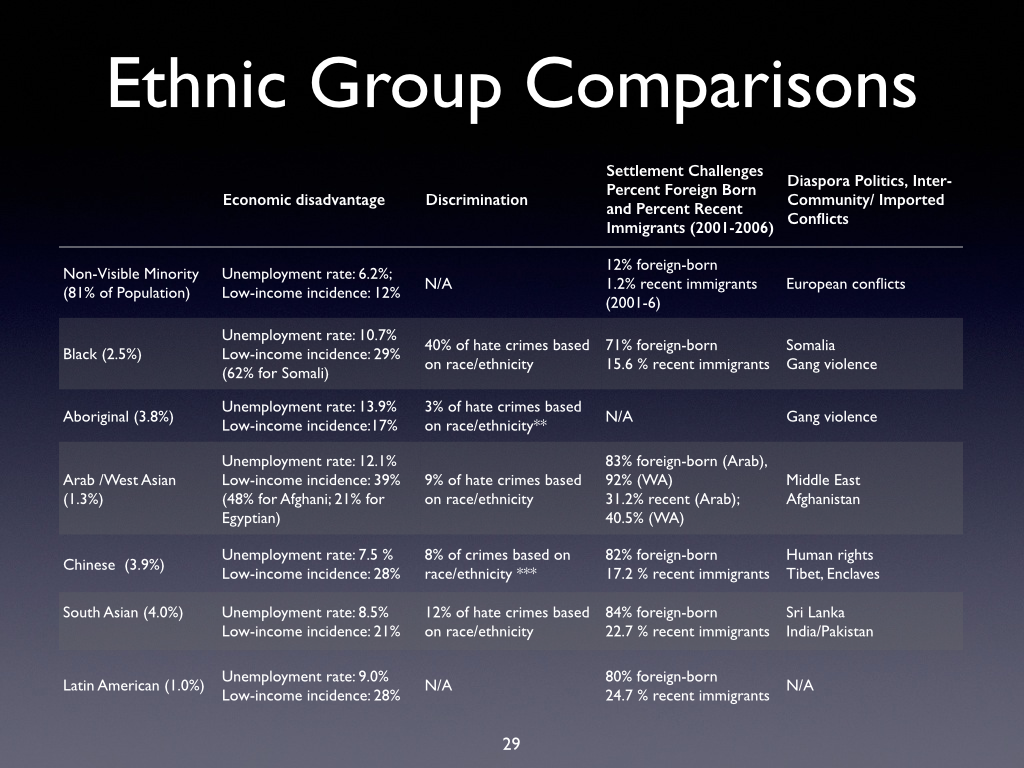
Ethnic Community Comparisons

From Policy Arrogance or Innocent Bias: Resetting Citizenship and Multiculturalism

Jon Kay takes the easy route out on faulting Carol Goar on her terminology, “racialized,” but ignores the broader, and more uncomfortable question she raised regarding inclusiveness and participation (Toronto is diverse but not as inclusive as it could be):

“Racialized Torontonians” as they call themselves?

Here’s a question for readers who live in Toronto: Do you know a single ordinary person — someone who is not either an activist, or enrolled in feminist film studies at Ryerson, or a “diversity consultant” hired by governments and big companies — who routinely refers to herself or anyone as a “racialized” person?

To be more specific, have these words ever escaped anyone’s lips within the 7,124 square kilometers of the Greater Toronto Area: “As a racialized Torontonian, I’m supporting Argentina over Germany in the World Cup final.” “As a racialized Torontonian, that shade of eye shadow really doesn’t go with my skin tone.” “As a racialized Torontonian, I’m having trouble finding a restaurant that serves authentic soul food.”

I suspect that most ordinary Torontonians would be utterly confused if Ms. Goar insisted on addressing them as a “racialized” person in a restaurant or store. They might assume she was taking some kind of ethnic census. If pressed to describe themselves through the lens of race-obsession, they might more simply respond: “If you really want to know, I’m half-black.” Or, “I’m Sephardic Jewish with a quarter Latino.” Or “I was both in The Philippines.” Or perhaps many might just avoid eye contact and say, “I’m a Canadian who lives in Toronto.”

Jason Kenney questioned the use of the term “racialized” along with “white power” and “oppression.” Grant and contribution proposals that included these terms, or websites of applicants with these terms, were routinely rejected.

While the underlying policy rationale was overdue – given Canada’s increased diversity, integration challenges within and among communities were equally significant – this change downplayed equity aspects of multiculturalism.

Jonathan Kay: Stop calling people ‘racialized minorities.’ It’s silly and cynical | National Post.

Toronto is diverse but not as inclusive as it could be: Goar

Carol Goar on diversity and inclusion, using the United Way keynote speech by Zabeen Hirji to frame her piece:

“Having diversity is interesting,” said Zabeen Hirji, chief human resources officer for the Royal Bank non-commitally. “It’s when you do something with it that it becomes powerful.”

She had put her finger on one of the biggest challenges facing this city: moving from diversity to inclusion.

As a woman, an Ismaili Muslim and an immigrant from Tanzania, Hirji is acutely aware of the difference. Many Torontonians are not.

Speaking at the annual meeting of the United Way of Toronto, Hirji was careful not to offend the business leaders in the room. Eighty per cent of the charity’s funds come from the corporate sector in direct donations and employee payroll contributions. But she made it clear that diversity — which Toronto has in abundance — is simply a description of the city’s talent pool. Inclusion is the act of tapping into the whole pool — not just the top layer — and mixing people from disparate cultures, backgrounds and generations together in a way that allows them to combine their strengths.

On that score, Toronto doesn’t do as well. Very few immigrants — who make up 46 per cent of the city’s population — hold senior positions in business, politics or civil society. Racialized Torontonians — as they call themselves — are disproportionately poor, underemployed and socially isolated.

Many influential Torontonians who could reach out — corporate CEOs, political leaders and heads of major public institutions — don’t; or don’t do it effectively. Many immigrants and their descendents in turn, live in ethnic enclaves, work for employers from their country of origin and socialize among themselves.

Hirji wasn’t there to preach. Her primary message was that harnessing the talent and energy of young people, newcomers, members of First Nations, gays and lesbians and other minorities is good for business and good for the city. She offered three tips, drawn from her 13 years spearheading RBC’s drive to make its workforce a better reflection of the population: Start with a clear commitment from the top, develop an explicit plan and get buy-in from all employees.

It was the right approach for a breakfast speech to the United Way. But it will take more than an upbeat sales pitch to identify and dismantle the barriers that hold non-white Torontonians back.

Toronto is diverse but not as inclusive as it could be: Goar | Toronto Star.