With the Mandate letters now public, two good pieces by Susan Delacourt (You’ll be judged by how you treat others, Trudeau cabinet warned) and Paul Wells (Justin Trudeau repeats himself) on the template used to guide Ministers on the government-wide priorities and the expected and broad code of conduct.
Delacourt notes:
Working well with others — including people in the media — is now officially part of the job description for Canadian cabinet ministers.
The “mandate letters” given to every minister are setting a new bar for co-operation in Justin Trudeau’s government, according to one letter obtained in advance of the expected public release.
In fact, if the sheer word volume in these letters is any indication, co-operation seems to be the top item on the to-do list of Trudeau’s team.
Ministers are being warned that they will be judged by how well they treat a whole raft of people — everyone from business to labour, stakeholders and citizens, and yes, the opposition and the media too.
“Members of the Parliamentary Press Gallery, indeed all journalists in Canada and abroad, are professionals who, by asking necessary questions, contribute in an important way to the democratic process. Your professionalism and engagement with them is essential,” the letter states.
….One group of people is singled out as well in the mandate letters for special treatment from government. “No relationship is more important to me and to Canada than the one with Indigenous Peoples,” the letter states.
The notable feature of these mandate letters, as mentioned, is the amount of words devoted to culture change of the kinder, gentler sort. “Open by default” is an operating principle.
Wells analyses further:
Possible explanations for this outbreak of boilerplate include (a) a particularly wonky form of Tourette’s; (b) a desire to put most of the country to sleep before we get to the good stuff; (c) the PM and his advisers actually think the repetitive stuff is worth repeating. I’m going to go with (c). So while many colleagues will focus on what changes from letter to letter, let’s pause here to look at what doesn’t.
- “Real change—in both what we do and how we do it.” … Now, these letters come from Trudeau and his staff and appear over his signature, but it’s nearly a deadlock certainty that public servants were involved in the process, and one of them will have said: Prime Minister, if you evoke “a personal commitment” to this stuff and then tell ministers they “will be held accountable for our commitment,” you’re elevating it way beyond the realm of pious nostrum. You’re making it sound like you mean it. Repeating it 30 times in letters to 30 ministers is like tracing a line in the sand, then scraping it a yard deep.
- “Track and report on the progress of our commitments.” …., idealism and political self-interest become nearly synonymous: Trudeau wants to be able to meet voters in, probably, 2019, with a bunch of check marks next to his 2015 promises. And again, by publicly repeating that goal, he is offering up a jumbo hostage to fortune if any promise proves impossible to keep.
- “No relationship is more important to me and to Canada than the one with”— Actually, it’s interesting here to try to guess how this sentence ends. Important relationships. Hmm. The one with . . . the United States? The United Nations? Hard-working families? Nope. Again in every letter, Trudeau elevates the relationship with “Indigenous Peoples” above every other in his personal hierarchy of priorities…..
- “Observe the highest ethical standards in everything you do.” …“As noted in the Guidelines, you must uphold the highest standards of honesty and impartiality, and both the performance of your official duties and the arrangement of your private affairs should bear the closest public scrutiny. This is an obligation that is not fully discharged by simply acting within the law.”Expect opposition members to quote that last sentence back to Trudeau and his ministers any time one of them lands in hot water. “It’s legal” is not, in Justin Trudeau’s own judgment, a sufficient defence for poor conduct.
Diversity and Inclusion commitments:
Turning from the general to the specific with respect to citizenship and multiculturalism, what is striking are the two paragraphs, again to all ministers, mainstreaming the Government’s diversity and inclusion agenda with a commitment to end divisive politics and practices and renewed emphasis on employment equity for women, indigenous Canadians and minority groups in political appointments:
Canadians expect us, in our work, to reflect the values we all embrace: inclusion, honesty, hard work, fiscal prudence, and generosity of spirit. We will be a government that governs for all Canadians, and I expect you, in your work, to bring Canadians together.
You are expected to do your part to fulfill our government’s commitment to transparent, merit-based appointments, to help ensure gender parity and that Indigenous Canadians and minority groups are better reflected in positions of leadership.
The specific commitments for each Minister will, of course, be reflected in the performance management agreements of Deputy Ministers, which in turn will cascade down to all levels of management. Hence, these are the ones that will be met given their priority.
Immigration, Refugees and Citizenship Minister
The specific commitments track the party platform commitments in immigration and refugees. On citizenship, the mandate letter expands on the platform by including repealing the revocation provisions of the C-24 Citizenship Act and the ‘intent to reside’ provision.
In other words, very surgical changes rather than more sweeping changes. For example, no mention of reversing the expansion of knowledge and language requirements from 18-54 to 14-64 year olds, nor reversing the sharp increase in citizenship fees (from $100 to $530), nor improvements in due process (oral hearings in cases of misrepresentation).
While not in the list of commitments, presumably the Minister will revise and rebrand the citizenship study guide, Discover Canada, with more inclusive substance and language, given the overall priority mentioned above.
The specific commitments are below:
As Minister of Immigration, Refugees and Citizenship, your overarching goal will be to reopen Canada’s doors to welcome those who want to contribute to our country’s success. Canadians are open, accepting, and generous – qualities that should be reflected in Canada’s immigration policies and in our approach to welcoming those seeking refuge from conflict and war. Our communities are strengthened when we come together to welcome newcomers who want to build a better Canada and to help those in need.
In particular, I will expect you to work with your colleagues and through established legislative, regulatory, and Cabinet processes to deliver on your top priorities:
-
Lead government-wide efforts to resettle 25,000 refugees from Syria in the coming months.
-
As part of the Annual Immigration Levels Plan for 2016, bring forward a proposal to double the number of entry applications for parents and grandparents of immigrants to 10,000 a year.
-
Give additional points under the Entry Express system to provide more opportunities for applicants who have Canadian siblings.
-
Increase the maximum age for dependents to 22, from 19, to allow more Canadians to bring their children to Canada.
-
Bring forward a proposal regarding permanent residency for new spouses entering Canada.
-
Develop a plan to reduce application processing times for sponsorship, citizenship and other visas.
-
Fully restore the Interim Federal Health Program that provides limited and temporary health benefits to refugees and refugee claimants.
-
Establish an expert human rights panel to help you determine designated countries of origin, and provide a right to appeal refugee decisions for citizens from these countries.
-
Modify the temporary foreign workers program to eliminate the $1,000 Labour Market Impact Assessment fee to hire caregivers and work with provinces and territories to develop a system of regulated companies to hire caregivers on behalf of families.
-
Lead efforts to facilitate the temporary entry of low risk travelers, including business visitors, and lift the visa requirement for Mexico.
-
Work with the Minister of Justice and the Minister of Public Safety and Emergency Preparedness to repeal provisions in the Citizenship Act that give the government the right to strip citizenship from dual nationals.
-
Eliminate regulations that remove the credit given to international students for half of the time that they spend in Canada and regulations that require new citizens to sign a declaration that they intend to reside in Canada.
Canadian Heritage Minister
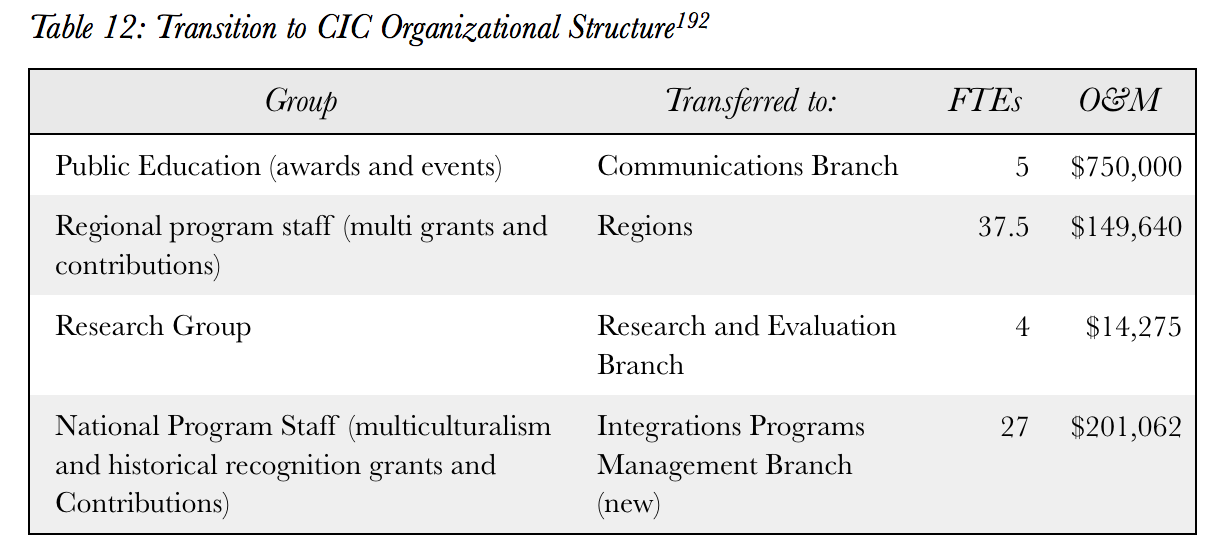
Noteworthy for what is not in the letter: any mention of multiculturalism following its transfer back to Canadian Heritage after some eight years at the former CIC.
This will give the bureaucracy time to implement the machinery changes (time-consuming at the best of times) and re-integrate and rebuild policy and related capacity that was dispersed and weakened at CIC.
For better and worse, it will give officials a freer hand in this reintegration process and the more important policy reflections on how multiculturalism can better reflect the diversity and inclusion agenda, lost somewhat at CIC under then Minister Kenney.
This would start with a review of the priorities enunciated in 2010, where language (e.g., inclusion) and substance (e.g., employment equity, racism and discrimination):
- build an integrated, socially cohesive society;
- help federal and public institutions respond to the needs of a diverse society; and
- engage in international discussions on multiculturalism.
The first opportunity to reflect this change will be the February tabling of the Annual Report on the Operation of the Canadian Multiculturalism Act, with the Ministerial message and overview (the report will cover the 2014-15 fiscal year period and thus report on the previous government’s initiatives).
However, there is a risk that the lack of political direction (and ‘supporting minister’) will undermine the ability for the multiculturalism program to play an effective policy role in the government’s overall diversity and inclusion agenda.
The overarching commitment in the mandate letter:
As Minister of Canadian Heritage, your overarching goal will be to implement our government’s plan to strengthen our cultural and creative industries. Our cultural sector is an enormous source of strength to the Canadian economy. Canada’s stories, shaped by our immense diversity, deserve to be celebrated and shared with the world. Our plan will protect our important national institutions, safeguard our official languages, promote the industries that reflect our unique identity as Canadians, and provide jobs and economic opportunities in our cultural and creative sectors.
The one commitment related to, but much broader than multiculturalism, is with respect to reinstating the court challenges program (it provided funds to groups that need funding to contest specific policies):
-
Work with the Minister of Justice to update and reinstate a Court Challenges Program.
Roles of Other Ministers
The Minister of Justice is expected to:
-
Review our litigation strategy. This should include early decisions to end appeals or positions that are not consistent with our commitments, the Charter or our values. [e.g., the citizenship niqab case, cuts to refugee healthcare]
-
Support the Minister of Canadian Heritage to restore a modern Court Challenges Program.
-
Work with the President of the Treasury Board to enhance the openness of government, including supporting his review of the Access to Information Act to ensure that Canadians have easier access to their own personal information, that the Information Commissioner is empowered to order government information to be released and that the Act applies appropriately to the Prime Minister’s and Ministers’ Offices, as well as administrative institutions that support Parliament and the courts.
The Minister of Public Safety and Emergency Preparedness has no commitment with respect to softer approaches to countering violent extremism (e.g., research, working with communities, deradicalization) although this can be implied from the overall inclusion messaging.
Link to all mandate letters:
ministerial mandate letters

 Multicultural Meanderings