With move to limit temporary residents, Ottawa is ‘attacking the demand curve now’

Good analyst by Matt Lundy of the Globe. Sensible comments by academics and economists, more self-serving ones by the business community and organizations. And interesting that the “head of inclusion and resilience economics” at Bank of Nova Scotia seems to have a contrary position to the Bank’s overall economic assessment (Raising the Bar, Not Just Lowering the Number: Canada’s Immigration Policy Confronts Critical Choices):

…“The cap on temporary-resident admissions isn’t a silver bullet since supply and demand in the housing market are currently extremely imbalanced,” Royce Mendes, head of macro strategy at Desjardins Securities, said in a note to clients. “However, by way of just slowing the upward momentum in shelter inflation, this reinforces our view that the central bank will cut rates more forcefully than” investors are predicting.

Also on Thursday, the federal government announced a partial curtailment of the Temporary Foreign Worker Program. Starting on May 1, employers in four sectors, including hospitality, will see the share of staff they can hire through the program’s low-wage stream lowered to 20 per cent from 30 per cent. (Employers in health care and construction will be exempt from the reduction.)

Most employers are subject to the 20-per-cent cap, which was raised from 10 per cent as part of a 2022 overhaul of the program. At the time, the government set a temporary 30-per-cent limit for a handful of industries with acute labour shortages.

“We are disappointed in the announcement on temporary foreign workers, as this will make it even more burdensome to fill the current 100,000 job vacancies in the food-service industry and create more red tape,” Kelly Higginson, president and CEO of lobby group Restaurants Canada, said in a statement.

“Ottawa should be careful when placing arbitrary caps on immigration,” Diana Palmerin-Velasco, senior director on the future of work at the Canadian Chamber of Commerce, said in a statement. “Temporary residents, including temporary foreign workers, can be a critical pool of talent for some sectors of our economy.”

Rebekah Young, head of inclusion and resilience economics at Bank of Nova Scotia, said Thursday’s announcements were largely “backward-looking,” in that Ottawa is trying to manage the accumulation of temporary residents.

Ms. Young said the federal government needs to articulate its objectives for economic immigration. As an example, she said those goals could be tied to gross domestic product per capita, which has tumbled to multiyear lows of late.

“That gives you a hard metric to evaluate all your programs,” she said.

In theory, the new limits on temporary residents will marginally change the relative cost of labour versus capital, Ms. Young said. However, business investment in Canada has been weak for a long time, predating the population surge.

“We need more of a productivity agenda that looks at what are the really big levers to unlock substantial business investments,” she said. This “is ultimately what will drive welfare gains.”

Source: With move to limit temporary residents, Ottawa is ‘attacking the demand curve now’
New temporary foreign worker pilot program to speed up approvals for some employers

Good critical comments by Banerjee and Skuterud regarding possible abuse and the ongoing favouring of reduced labour costs to employers. That being said, for repeat users, simplification has merit but as in so many areas of immigration policy, these change fail to address the immigration-related challenges of housing, healthcare and infrastructure:

The federal government is making it easier for businesses to bring temporary foreign workers into Canada, announcing a new “recognized employer” program aimed at speeding up the approval process for companies with a track record of using foreign labour.

The three-year pilot program is designed to reduce the amount of paperwork companies need to submit to justify bringing in outside workers.

It’s the latest expansion of the temporary foreign worker (TFW) program, whose use has exploded over the past year as the federal government has eased restrictions on short-term foreign labour. And it comes alongside a record surge in immigration, which is increasing the country’s labour supply but also adding demand to Canada’s overheated housing market and public services.

Randy Boissonnault, the new Minister of Employment, Workforce Development and Official Languages, said the change to the TFW program would “cut red tape” and help companies manage widespread labour shortages.

The move was applauded by the Canadian Chamber of Commerce, which has long lobbied for a trusted employer carveout in the TFW program.

Some labour economists, however, warned that further expansion of the program could undercut wages in Canada and make it more difficult to identify companies that are exploiting vulnerable workers.

“It could be a good thing for addressing kinds of critical labour shortages,” said Rupa Banerjee, the Canada Research Chair in economic inclusion, employment and entrepreneurship of Canada’s immigrants at Toronto Metropolitan University.

“But if this kind of a system is not really closely monitored, scrutinized, audited, it’s easy for sort of mundane and everyday examples of abuse and exploitation to kind of become even more rampant in the system,” she said.

As it stands, companies need to submit a Labour Market Impact Assessment (LMIA) before applying to hire temporary foreign workers. The purpose of the LMIA is to show that there are no Canadians or permanent residents who are able to fill the job.

Under the new system, employers who can demonstrate “a history of complying with program requirements” will be given a three-year approval to bring in temporary foreign workers, and won’t have to submit an LMIA before each application. Eligible employers will need to have had three successful LMIAs in the past five years for workers who are deemed to be “in-shortage,” and will be subject to a “more rigorous upfront assessment,” the government said in a news release.

The pilot program will be open to agriculture businesses in September and employers from all other industries starting in January.

This is the second notable change to the TFW program in just over a year. Last spring, the federal government said companies could hire up to 20 per cent of their staff through the program’s low-wage stream, up from the previous 10-per-cent cap. And in seven industries with acute labour shortages – such as restaurants, construction and hospitals – the cap was moved to 30 per cent for a year, then extended to this fall.

The TFW program is largely used as a recruitment tool for farm workers. During the first quarter of this year, employers were approved to hire more than 25,000 workers through agriculture streams, according to figures published by Employment and Social Development Canada, which decides on LMIA applications. General farm workers are easily the most sought-after role in the TFW program, with more than 22,000 approved positions in the first quarter.

But as Ottawa has eased access to foreign labour, employers have ramped up their recruitment of low-wage employees from abroad. Companies were approved to fill about 22,000 roles through the program’s low-wage stream in the first quarter, an increase of about 275 per cent from four years earlier. Cooks are the No. 2 occupation of highest demand, with nearly 3,000 positions approved from January through March. Truck drivers, food counter attendants and seafood plant workers are also in high demand.

Diana Palmerin-Velasco, senior director of the future of work at the Canadian Chamber of Commerce, welcomed the announcement and said it could improve access to the TFW program for smaller employers.

“There are whole sectors of the economy that are dependent on temporary foreign workers,” Ms. Palmerin-Velasco said. “What we have heard from our members is that it’s not that easy for employers. There is a lot of administrative burden, it can be a very complex application process. And when we think about small businesses, it’s not really accessible.”

Mikal Skuterud, an economics professor at the University of Waterloo, questioned the government’s rationale for expanding the program. The Canadian labour market has been exceptionally tight over the past year-and-a-half, as demand for workers has outstripped supply. However, in recent months, job vacancies have been trending down and the unemployment rate has risen.

“We’ve had a 25-per-cent reduction in job vacancies since May, 2022, and if you measure labour market tightness, that’s also been dropping,” Prof. Skuterud said.

He added that recent research into temporary foreign workers suggests that they tend to suppress wage growth within companies that use them. “And so we’re going through a period where real wages for low skilled workers in this country are not increasing. The most recent data looks like they’re decreasing. And so it’s all about where this government’s priorities are,” he said.

Source: New temporary foreign worker pilot program to speed up approvals for some employers

Canada’s tech startup sector wants easier access to hire top foreign talent

Yet some more expected tweaks to Express Entry:

After winning a big concession in the budget on taxing stock options, Canada’s tech startup sector is braced for its next battle: urging Ottawa to fix immigration rules that limit its ability to hire top foreign talent.

The Express Entry system brought in by the last government in 2015 “is fundamentally too rigid” and leaves employers waiting up to six months to discover if they can bring skilled foreign talent to Canada, said Tobi Lutke, CEO of Ottawa-based software firm Shopify Inc. “That puts us at a huge disadvantage for recruiting internationally.”

Under policy changes enacted by the Conservatives, employers now must validate a job offer by getting government approval for a “Labour Market Impact Assessment” – showing it couldn’t find Canadians to do the job. While that approach targeted abusers of the temporary foreign worker program, it meant fast-growing tech firms searching for the best employees globally had to submit to the same drawn-out process, only to be told in many cases by Ottawa that they should just hire a Canadian.

“It was a misguided approach,” said Sarah Anson-Cartwright, director of skills and immigration policy for the Canadian Chamber of Commerce.

Immigration Minister John McCallum wasn’t available to comment. But a department spokesman said the government plans to review the Express Entry program “to see how it can be improved for potential immigrants such as top-level foreign executives. The review will include, likely among other things, the LMIA requirement.”

Tech startup leaders say the rules not only add delays but that the process lacks transparency and consistency, imposes needless bureaucracy and lacks an appeals process. In many cases, would-be recruits choose other offers rather than waiting. Foreign students awaiting government approval for their job offers sometimes must leave Canada when their study visas expire.

Six out of 10 employers surveyed by the Canadian Employee Relocation Council (CERC) last year said the immigration changes under the Tories had hindered their strategy planning and recruiting. One out of six opted to create the jobs abroad instead.

Curious to know the relative competitiveness of Canada vis-a-vis the US, given my understanding of the problems Silicon Valley has in hiring global talent.

Source: Canada’s tech startup sector wants easier access to hire top foreign talent – The Globe and Mail

Express entry, foreign worker reforms attract ‘fewer’ skilled workers: chamber report

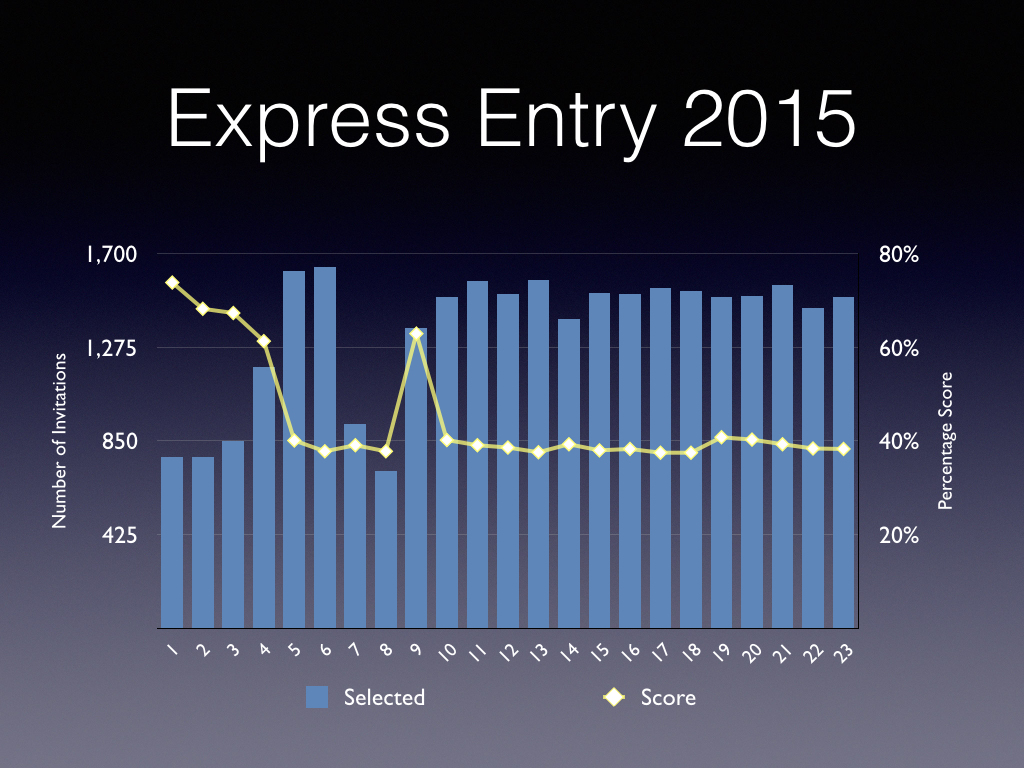
Express Entry Draws 2015.001Another item on Minister McCallum’s to do (or at least consider) list, passage below on Express Entry (the above chart shows the 23 rounds in 2015, and how the program has settled at around 1,500 invitations per draw, with a minimum score of about 40 percent of the total possible 1,200 points):

“The concept of attracting ‘the best and the brightest’ is missing in action,” says the new report, “as the competitive model of Express Entry is currently undermined by the protectionist policy embodied in the labour market impact assessment tool.”

As CBC reported in September, businesses say the labour market impact assessment (LMIA) — a new requirement borrowed from the newly reformed Temporary Foreign Worker Program — is the biggest flaw with Express Entry.

Under Canada’s new immigration system, highly-skilled foreign workers not only have to line up a job before applying to come to Canada but their job offer has to be backed by what the government calls a positive LMIA. That assessment is a document all employers now need to hire a foreign worker over a Canadian one.

The chamber calls the introduction of this new requirement a “misstep” that has made it “extremely challenging” for businesses to attract highly-skilled workers such as video game developers, top-flight researchers and workers in the trades.

Chamber calls for ‘sober, thoughtful review’

The 32-page report titled “Immigration for a Competitive Canada: Why Highly Skilled International Talent Is at Risk” lays out what Canadian businesses see as “missteps” with the immigration changes and offers 20 recommendations.

The recommendations include:

  • Removing the new requirement of a labour market impact assessment from the Express Entry system.

  • Tweak the points system under Express Entry to benefit high skilled workers applying under the International Mobility Program.

  • Reduce processing times for study permits and visas.

Source: Express entry, foreign worker reforms attract ‘fewer’ skilled workers: chamber report – Politics – CBC News

Temporary foreign workers get first dibs under express entry

More teething pains or more substantive problems? Early results or signalling a trend?

Jason Kenney, who was responsible for the Harper government’s transformation of Canada’s immigration system during his time as immigration minister, on Friday touted express entry as “a system that’s fast, that connects people to the labour market so they can realize their dreams and fulfil their potential upon arrival in Canada.”

“New economic immigrants are arriving in Canada in months rather than years,” Kenney said during a news conference in Vancouver.

“A growing percentage have jobs lined up before they get to Canada rather than being stuck in survival jobs for years following their arrival.”

While that may be the goal, express entry has opened the door to very few new economic immigrants. To date, it has favoured a large number of temporary foreign workers and other foreign nationals already in the country.

Over 85 per cent of the foreign nationals who were selected for admission under express entry in the first six months of the year — 11,047 out of 12,304 — were already in Canada, according to a report published by the Department of Citizenship and Immigration in July.

The report shows that three per cent were living in India, followed by two per cent in the U.S. and one per cent in the Philippines. Even smaller percentages resided in other countries.

As of July 6, Canada had issued 844 visas to foreign nationals and their dependents resulting in only 411 admissions being fast tracked for permanency residency.

“Implementing the express entry system was a significant undertaking and we continue to monitor it closely,” the government report said, cautioning it is only “a snapshot” intended to capture “one moment in time.”

While immigration officials are working tirelessly to iron the kinks out of the system, the report said Canada will meet its immigration quota not through express entry but by drawing from a backlog of applications submitted under the old system.

The majority of new economic immigrants to Canada will not be drawn using the new system until it’s in full flight in 2017.

‘Unusable’ for businesses

Businesses say the system’s biggest flaw is a new requirement borrowed from the newly reformed temporary foreign worker program, which Kenney and Chris Alexander announced last year following a series of stories published by CBC’s Go Public team alleging abuse of the program.

Under express entry, it isn’t enough that economic immigrants have to line up a job before applying to come to Canada — that offer must also be backed by a positive labour market impact assessment. That assessment, or LMIA, is a document all employers now need to hire a foreign worker over a Canadian one.

This is a new requirement under an economic stream that sees upwards of 250,000 new permanent residents admitted each year.

“It’s made it unusable for many employers that we hear from and for small and medium businesses,” said Sarah Anson-Cartwright, the director of skills policy at the Canadian Chamber of Commerce, the largest business association in the country representing some 200,000 employers

Members of the Chamber, she said, are disillusioned with a process that has become too “onerous.” Employers are complaining that their assessment forms are being rejected due to inadvertent omissions or typos.

Source: Temporary foreign workers get first dibs under express entry – Politics – CBC News

Express entry immigration system starts Jan. 1, leaving employers uncertain

Like any new way of doing things, it will take some time to know how well it is working, and whether there are some unforeseen side-effects or changes in behaviour:

The [Canadian Chamber of Commerce’] Anson-Cartwright said that while the government has given employers a first-hand look at the new online system, it will be some time before businesses can say how well the system works at matching skilled immigrants with open jobs.

“The reality is, until we actually have employers experiencing the process, we don’t really know — and neither does the government — how well it will work,” she said.

Employers will not have the same “privileged access” as the provinces and territories, she added.

The provinces will have the option to search the express entry pool, while employers will have to rely on the government to identify potential workers.

“Youd rather see more detail and have a chance to make your own assessment, rather than waiting on individuals to pop up through virtue of how they’ve designed the job system.

“That’s the big uncertainty is how this job-matching system will actually work,” Anson-Cartwright said.

Express entry immigration system starts Jan. 1, leaving employers uncertain – Politics – CBC News.