To mark Canada Day, former hockey icon, writer and politician Ken Dryden remarks to new citizens of note:
I wasn’t sure but I thought I had heard that someone who has received an Order of Canada is able to preside at a citizenship ceremony. I emailed the citizenship office, and asked them, and told them about Jacques. About a month later, the office confirmed a date and a place.
The ceremony was held June 26 at the Senators’ home arena. Our daughter, continuing her work with refugees, was in Botswana with her family. Until the moment I was introduced by the Clerk of the Ceremony, Jacques and his family had no idea I would be there, in part, representing Sarah. And at that moment, my wife Lynda, who had been watching Jacques, snapped a picture of him with his mouth open.
It being Canada’s 150th birthday, 150 people received their citizenship that day. As the presiding official, I spoke briefly to them and to their families. This is what I said:
“I am very happy to be here. Happy to be here with some people I know—Jacques and Sarah, Daniela, Ivan, Naomi, Steve, and Pamela, the Bwira family, whom I met first in Uganda 14 years ago through our daughter. And happy to be here with all of you, to be part of, and to share with you, this special Canada-moment.
You are quite a sight.
You are from 49 countries. 49. Almost one quarter of all the nations on Earth! Here. Together. All of us Canadians.
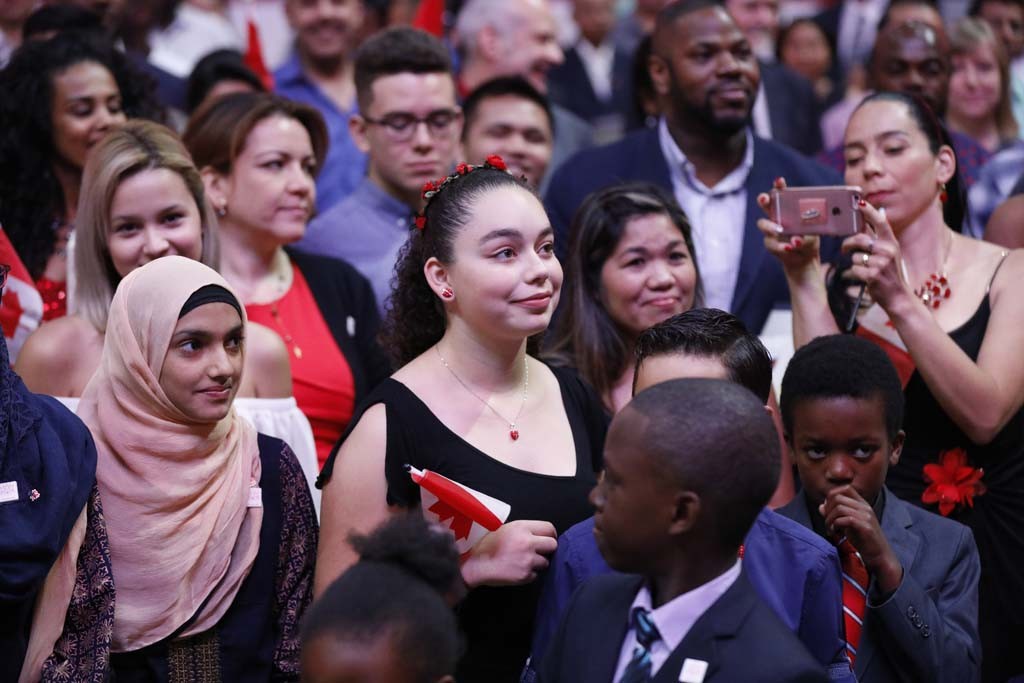
I grew up in a very different Canada. In Etobicoke, a suburb of Toronto, and the kids I went to school with, their families had come to Canada usually many generations before, and almost all of them from Europe. Mine had come from Scotland, in 1834. Then as I got older, about 20 years ago, I went back to high school for a year to write a book about education. The school was just west of Etobicoke, in Mississauga, and by this time—1995—the classrooms were like this arena—filled with people from everywhere.
One of the big questions for me in writing the book was: how could a school like this work? All the different languages, the different cultures, in many cases students whose ancestors had fought one another, sometimes for centuries. Now all in one place, inside the same four walls. In the lunch room, you could see the divisions—the students sitting in clusters, the Chinese kids here, the Jamaican kids there, the Sri Lankan kids and others somewhere else—all of them separate and apart. But in classrooms, they had to sit next to each other—not quite comfortably at first, but then not thinking about it, then just doing it, then, often without realizing it, getting to know each other a little, then, over time, even learning from each other. It was remarkable to watch and see.
Other countries have people from lots of places too—like you, I’ve been to many of those countries—but they have more divisions. More tensions. Why is it different here? Maybe because our history is shorter, maybe because we have so much space and didn’t have to live on top of each other. Maybe because we’ve always had to live with division—our many different Indigenous peoples, later our French and English settlers—we had to learn to be tolerant, accepting, patient, to “live and let live.” But maybe too because as Canadians we have never seen Canada as something already fully formed, something that long-standing Canadians created, that new Canadians could only adapt to. Where some people feel fully Canadian, and others don’t. Instead, we’ve always been willing to put Canada on the table in front of all of us, for all of us to share, so that Canada can be, and is, our focus, not what our life was and used to be.
To me, this isn’t a multicultural society we are creating in Canada. It’s a “multiculture,” something that all of us are building, and building every day. That is different all the time. A place that changes us, but that we—all of us, old and new Canadians—change too. A place, and a future, we can all feel a part of.
And something else too—it’s our message to ourselves as Canadians and to each other, an understanding we share—that in Canada, we get along. That seems pretty simple, but it’s crucial in an increasingly global world. We get along here. We ask this of each other. We expect it. And need for it to be. This understanding and way of life is now part of your legacy, your new life, your obligation to the future.
I know that as you sit here you are grateful to Canada for opening its doors to you. For giving you this gift. I know too, you are proud to be Canadian. But you also need to know that we are grateful to you. I just got back from Kazakhstan, Tajikistan and Kyrgyzstan—countries of the old Silk Road—that connected China and Mongolia through Central Asia, to the Middle East, to the Mediterranean—and eventually to North and South America. It was not just a connection of silk and other goods, but when goods move, people move, learning moves, technologies move, philosophies and religions move, ideas and cultures move. We are grateful to you because when you came here from your original home countries, you brought with you your cultures, your ideas, your learnings. You are helping to make Canada a modern Silk Road country. You are helping to make Canada a more compelling, dynamic, creative, and interesting place. And this act of creation, this is what all of us—new and old Canadians—are doing together. So that whatever Canada has been in the past, we will be so much more in the future. And what that Canada will be, what we, all of us, will be in that future, I have no idea. And that is the best part.
So congratulations! Good luck to all of you. Good luck to all of us.”
After my talk, I asked these soon-to-be Canadians to take the Oath of Citizenship, reading out one line at a time for them to repeat, giving the entire oath in English, then in French. Most of the 150 said the oath in both languages. Then these new Canadians came up on stage to receive their certificates, one by one, families coming together.
One hundred and fifty of them: 17 from the Philippines, 11 (including the Bwiras) from Congo, 10 from Haiti and the U.S., eight from Colombia and the U.K., six from Morocco and Pakistan, five from Senegal and Sri Lanka, four from China and India. There were 125 adults and 25 children, 78 males, 72 females, 102 primarily English-speakers, 48 French. Two men came up a ramp in wheelchairs, one wore a wide, bright, red-and-white Canada tie. Another man wore a Sydney 2000 Olympics tie. His son, Simon Whitfield, had won a gold medal in the triathlon and was Canada’s flag-bearer in the closing ceremonies. Originally from Australia, the father wanted to share his Canada-moment with his son. The oldest recipient was 75, the two youngest were four. There were 23 families, of two or more; three families of five. The Bwiras, with six, were the largest family present. Almost everyone came up those stairs with a smile and a look of pride. Almost everyone was dressed up in their best, whatever their best was. Each arrived at that moment in that place with their own special story, just like the Bwiras.
The formal part of the ceremony was over. Now it was time to get informal. This was a day of solemnity, and celebration. I said to these 150 new Canadians:
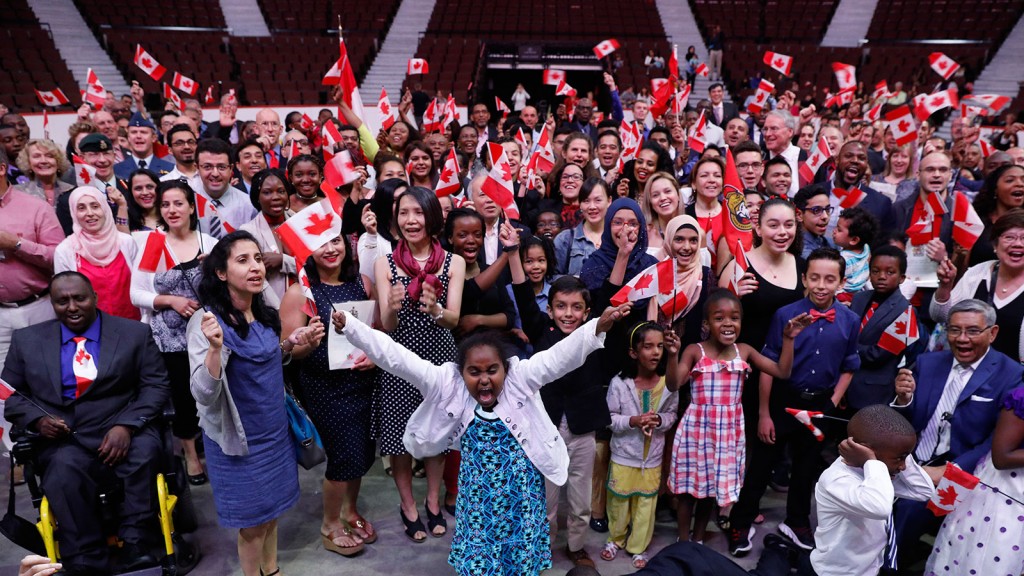
“As you know, this is a hockey arena, the home of the Ottawa Senators. And in this new home of yours, Canada, there is a tradition, that when a team wins a championship, they all gather together on the ice for a team photo. Well, today, in receiving your Canadian citizenship, I think you’ve all won the championship. So let’s everybody come up here near the stage for your team picture—Team Citizenship Canada 2017.
They jammed into the open space between the stage and the seats, the kids at the front, others stood in the rows behind them. And because this was a championship photo, some of the kids lay on their sides on the concrete floor and others kneeled around them, their “We’re Number 1” fingers raised, waving small Canadian flags.
It was time to close the ceremony. I went back up on the stage, everyone was still standing, and said, “I began this morning by saying you are an amazing sight. Why don’t you all take a moment—all of you—and look around, take your time, look at each other, look at this amazing sight you have created. And never forget what you see.”
Our 150th birthday offers Canadians a chance to pause, to see where we were and where we are, and imagine what we might be. A new immigrant’s eyes are even more acute. Immigrants have lived somewhere else, they are here each for their own very good reasons, they see Canada with fresh, deep clarity. For them, receiving their citizenship represents a great new beginning. They are here, finally. They have found solid ground. They are able, now, step by step, to build a future that is absolutely possible, for themselves, for their children, for generations of their families ahead. For me, it was a chance to see Canada, Canada at 150, through their eyes.



 Multicultural Meanderings