Contrast: Anti-Muslim bias reports skyrocket after Oct. 7 Hamas attack on Israel, Stephens: The Appalling Tactics of the ‘Free Palestine’ Movement

Starting with anti-Muslim bias complaints:

The Council on American-Islamic Relations (CAIR) released its annual Civil Rights Report today. The organization says that last year it received the highest number anti-Muslim bias complaints ever.

CAIR says it took in 8,061 bias reports in 2023 and that nearly half of them came in the final three months of the year, following the Oct. 7 Hamas attack on Israel.

“I was stunned by the sheer volume of complaints we got,” says Corey Saylor, CAIR’S Director of Research and Advocacy.

“In 2022, our numbers showed the first ever drop since we started tracking incidents,” he says. “And then to see all of that erased, it’s real insight in to how easy it is for someone to just flip the Islamophobia switch back to on.”

The report, titled “Fatal: The Resurgence of Anti-Muslim Hate,” says 15% of complaints the group received involved employment bias. 8.5% of bias reports involved schools — including colleges and universities. And 7.5% of complaints involved allegations of hate crimes, including the case of 6-year-old Palestinian American Wadea Al-Fayoume who was allegedly stabbed to death by his family’s landlord near Chicago.

“I just don’t know how much hate it takes to drive an adult to target a child,” says Saylor. “And I think it’s also fair to say that hate did not originate last October.”

Prosecutors in that case have charged suspect Joseph Czuba with first-degree murder and attempted first-degree murder for allegedly stabbing the child’s mother during the attack as well. Authorities have also charged Czuba with two counts of hate crimes.

Additionally, the CAIR report highlights a controversy highlights a controversy in Maryland’s Montgomery County Public Schools. The district allows parents to opt out of a Family Life and Human Sexuality unit, but it does not allow parents to opt out of books assigned for English classes that portray LGBTQ+ characters. A number of Muslim parents protested, saying the books were not in line with their religion’s teachings.

“The sincerely held religious beliefs of parents were completely ignored, disregarded, and even in a couple of instances criticized,” says Saylor.

The report also relays the story of how a regional airline accidentally posted to the internet part of the U.S. Government’s so-called No Fly List. CAIR’s analysis of a downloaded version of the list found that nearly all the names on it – 98.3% — were what the organization calls “identifiably Muslim.”

CAIR’s report also included mention of some bright spots. In 2023, New York City and Minneapolis permitted the call to prayer to be broadcast over loudspeakers. New Jersey and Georgia began recognizing Muslim Heritage Month. And school districts in at least 6 states added at least one Muslim holiday to academic calendars so students will have the day off from class.

Source: Anti-Muslim bias reports skyrocket after Oct. 7 Hamas attack on Israel

Brett Stephens in the NYT how many pro-Palestinian protesters have crossed the line into anti-semitism and being anti-Jewish (American examples but comparable ones in Canada):

Last week, Susanne DeWitt, an 89-year-old Holocaust survivor who later became a molecular biologist, spoke before the Berkeley, Calif., City Council to request a Holocaust Remembrance Day proclamation. After taking note of a “horrendous surge in antisemitism,” she was then heckled and shouted down by protesters at the meeting when she mentioned the massacre and rapes in Israel of Oct. 7.

At the same meeting, a woman testified that her 7-year-old Jewish son heard “a group of kids at his school say, ‘Jews are stupid.’” She, too, was heckled: “Zionists are stupider,” a protester said. At the same meeting, others yelled, “cowards, go chase the money, you money suckers” and “you are traitors to this country, you are spies for Israel.”

Protest movements have an honorable place in American history. But not all of them. Not the neo-Nazis who marched in Chicago in 1978. Not the white supremacists who chanted “Jews will not replace us” at their Unite the Right rally in Charlottesville, Va., in 2017.

And not too much of what passes for a pro-Palestinian movement but is really pro-Hamas, with its calls to get rid of the Jewish state in its entirety (“from the river to the sea …”), its open celebration of the murder of its people (“resistance is justified …”) and its efforts to mock, minimize or deny the suffering of Israelis, which so quickly descend into the antisemitism on naked display in Berkeley.

How did this happen?

It wasn’t a response to the human suffering in Gaza in recent months. A coalition of Harvard student groups issued a statementon Oct. 7 holding “the Israeli regime entirely responsible for all unfolding violence.” Pro-Hamas demonstrations broke out worldwide on Oct. 8. A Black Lives Matter chapter posted a graphic on Instagram of the Hamas paragliders who murdered hundreds of young Israelis at the Nova music festival. A Cornell professor said he found the massacre “exhilarating,” and demonstrators rallied in his support.

This is only a partial list. But it reveals the bullying mentality at the heart of the pro-Hamas movement. It isn’t enough for them to speak out; they must shut other voices down. It isn’t enough for them to make a strong or clear argument; they also aim to instill a palpable sense of fear in their opponents. American civil libertarians of the past once understood that inherent in the right to protest was the obligation to respect the right of people with differing views to protest as well. That understanding seems to be wholly absent from the people who think that, say, heckling Raskin into silence is also a form of democracy.

In this sense, critics of Israel who claim that American Jews must choose between Zionism and liberalism have it backward. The illiberals aren’t the people defending the right of an imperfect but embattled democracy to defend its territory and save its hostages. They are the people who, like the former Iranian president Mahmoud Ahmadinejad, want Israel wiped off the map and aren’t ashamed to say so. Not surprisingly, they also seem to share Ahmadinejad’s attitudes toward dealing with dissent.

It’s true that in nearly every political cause, including the most justified, there are ugly elements — the Meir Kahanes or the Louis Farrakhans of the world. But the mark of a morally serious movement lies in its determination to weed out its worst members and stamp out its worst ideas. What we’ve too often seen from the “Free Palestine” crowd is precisely the opposite.

Source: The Appalling Tactics of the ‘Free Palestine’ Movement
Trump-era antisemitism policy expected to fuel flood of student lawsuits against universities

As so often happens, lawsuits emerge, more broadly than just antisemitism:

As campuses across the country continue to erupt in protests over the Israel-Hamas war, a little-known 2019 presidential executive order is expected to fuel a flood of student legal claims against universities.

Attorneys — from a mix of white-shoe corporate firms to Jewish advocacy groups — are meeting with students who say their schools are failing to protect them from antisemitic or anti-Israel conduct.

In 2019, then-President Donald Trump signed an order instructing federal officials to expand the interpretation of Title VI of the 1964 Civil Rights Act to include “discrimination rooted in anti-Semitism” as a form of discrimination based on race, color and national origin — prohibited behavior for programs that get federal funding. Trump signed the order amid a series of violent incidents against Jews, including the 2018 killing of 11 congregants in a Pittsburgh synagogue and a 2019 attack that killed three inside a Kosher supermarket in New Jersey.

Title VI of the 1964 Civil Rights Act does not include the word “religion” as a subject of discrimination. Because the law does not list religious characteristics, legal experts say, federal officials have gradually expanded interpretations to include ethnoreligious groups.

Trump told federal agencies “to consider” using the Sweden-based International Holocaust Remembrance Alliance’s definition of antisemitism, which includes “holding Jews collectively responsible for actions of the state of Israel” and “drawing comparisons of contemporary Israeli policy to that of the Nazis.”

The alliance promotes Holocaust education and research, and has come under criticism by both Jewish and non-Jewish groups for suggesting that broad criticism of Israel can be construed as antisemitic.

In January 19, 2021, the day before Trump left office, the U.S. Department of Education, released a five-page questions and answers memo defining what constitutes antisemitism at schools.

An NBC News review of the department’s current investigations showed 15 pending cases related to race or national origin. The most recent filing listed was against Oberlin College in Ohio, dated a week before the Hamas attacks on Israel. Melissa Landa, an alumna of the college, told NBC News that she filed the letter because the school didn’t intervene after a professor taught students that “Israel is an illegitimate settler colonial apartheid regime,” according to Landa.

“I think that students need to file Title VI complaints so that universities can have federal money withheld from them, and maybe that will make them act,” Landa said. “I hope that my Title VI complaint will serve as an example for them.”

A spokesperson for the Department of Education said that since Hamas’ Oct. 7 terrorist attack on Israel, which killed more than 1,400 Israelis, “we have seen an uptick in complaints and the department is assessing them all.”

Lawyers said they have received an overwhelming number of calls from across the country from Jewish college students and their parents requesting representation in Title VI claims. Kenneth Marcus, who ran the U.S. Department of Education’s Office for Civil Rights during the Trump and George W. Bush administrations, said he is getting many calls.

“Oh, my God, I can’t tell you how many campuses we’re dealing with every single day. We have never been so inundated with cases,” said Marcus, who now runs the Brandeis Center for Human Rights, a nonprofit focused on protecting the civil rights of Jews.

In recent years, the Brandeis Center has filed Title VI complaints against the University of Vermont and the State University of New York at New Paltz on behalf of Jewish students who said their universities have allowed antisemitism to fester on campus.

In April, the Department of Education’s Office for Civil Rights said it found that the University of Vermont failed to investigate student claims of antisemitism and did not examine whether the complaints had created a hostile environment for Jewish students.

The University of Vermont signed a resolution agreement with federal officials later that month vowing to enact reforms such as expanding the school’s discrimination policy to include protections for students based on shared ancestry, including antisemitism. In June, the Office for Civil Rights opened a formal investigation into SUNY-New Paltz.

For years, Marcus has also been fighting to broaden Title VI protections to members of other ethnoreligious groups. He said prior to the Trump administration, he wrote guidance memos that said Title VI could be interpreted to include protecting members of other ethnoreligious groups such as Sikhs and Arab Muslims. But in 2019, Trump kept his executive order focused on protecting Jews.

In September, President Joe Biden issued a statement noting that Title VI also prohibits Islamophobic activities in federally funded programs. But the U.S. Department of Education has not released a detailed memo that defines Islamophobia as it has done for antisemitism.

Gadeir Abbas, a senior litigation attorney with the Council on American-Islamic Relations, said his team is preparing discrimination complaints on behalf of Muslim and pro-Palestinian students, who he says are being unfairly labeled as Hamas sympathizers or unfairly accused of providing support to terrorists.

“I think that pro-Israel groups, groups that are seeking to marginalize Palestinian voices on campus, see the Title VI claim as a way of attacking not the administration, but the other student groups,” Abbas said. “The idea is that [they’re] going to censor or penalize or punish any advocacy for equal rights of Palestinians.”

As a result, he said, Palestinian students — or students who say they support Palestinian civilians in Gaza — feel vulnerable on campus and in their communities, and some are considering filing their own Title VI claims.

NBC News has reported that bias incidents against Muslims are on the rise. CAIR said that it received 774 reports of bias incidents and requests for help from Muslims across the country from Oct. 7 through Oct. 24, nearly triple the number compared to a similar time period last year.

Abbas said that students, like all Americans, have a right to protest in the United States. “In a conflict between the First Amendment and Title VI, the First Amendment wins,” Abbas said. “Those student groups are participating in lawful activity. They’re recognized willingly by their colleges and universities.”

Three weeks before the Hamas attacks and the subsequent protests on American campuses, Palestine Legal, an advocacy organization for Palestinian rights, filed a Title VI complaint with the U.S. Department of Education. Attorneys demanded a federal investigation after the University of Illinois Chicago barred students “with Arab sounding names” from attending a January 2023 informational session on a university-sponsored Israel study-abroad program.

Legal experts said they expect the largest number of future Title VI cases to be filed against universities by Jewish students. The Anti-Defamation League recently reported that nationwide, “incidents of harassment, vandalism and assault increased by 388 percent over the same period last year.”

One of the most outspoken advocates for Jewish students’ use of Title VI since Oct. 7 has been the Lawfare Project, a nonprofit that represents Jewish clients. Lawfare staffers have met with Jewish students on campuses, posted solicitations for cases in Jewish WhatsApp groups, and used the organization’s social media accounts “End Jew Hatred” to recruit young clients.

“While we always had students reaching out to us, after Oct. 7, that became a flood,” said Lawfare senior counsel Gerard Filitti, while standing on the sidelines of a recent pro-Israel rally at Columbia University. “The phone was ringing nonstop.”

Georgetown Law student Julia Wax, 25, was also at the Columbia rally. Wax said she is in talks with Lawfare to file a Title VI lawsuit against her law school, claiming that pro-Palestinian student organizations on her campus have been publicly supporting Hamas.

“I think in a perfect world, Georgetown would create some sort of an open forum for this conflict to be discussed,” said Wax, adding that she wants Georgetown to adopt the IHRA definition of antisemitism.

In February 2020, Lawfare represented one of the first Jewish college students to file a Title VI complaint against a university after Trump’s executive order. Jonathan Karten, then 24, was a Columbia University student who said he was harassed by members of the campus group Students for Justice in Palestine. (The group did not immediately respond to a request for comment.)

Karten’s complaint said students called him “racist” and a “Zionist pig.” Tensions further escalated as professor Joseph Massad, who teaches modern Arab politics and has a history of criticizing Israel, referred to the military wing of Hamas as “armed resistance,” according to the complaint. Karten’s uncle was killed by Hamas militants in 1996 while hitchhiking in Israel.

“My professor endorsed the very same monsters,” Karten, who recently rejoined the Israeli army, said in a WhatsApp message.

The Department of Education declined to comment on the status of the case.

Karten’s younger brother, Isidore, also a Columbia alumnus, is pressuring the department to do more. Since the Hamas terrorist attacks, he has also helped organize pro-Israel events around the city and says he is frustrated by what he sees as Columbia’s muted response to antisemitism.

On Wednesday, Columbia University announced it was starting an antisemitism task force to come up with changes to academic and extracurricular programs. Columbia spokesperson Samantha Slater said in a statement that the university is beefing up security.

“Over the past few weeks, we have increased our public safety presence across all our campuses,” Slater wrote. “We are also working closely with outside security firms and are in regular contact with the New York City Police Department.”

Isidore Karten said he and other young Jewish activists continue to feel that Columbia can do more. “I don’t think they are doing enough,” he said

Source: Trump-era antisemitism policy expected to fuel flood of student … – NBC News

CAIR Announces Official Position on Hamline University Controversy, Islamophobia Debate

Somewhat tortured language trying to appease everyone but ends up IMO largely in the right place.

Bu the qualification that “encouraged schools to consider the perspective of students who argue that displaying depictions of Prophet in the classroom is harmful and also unnecessary, given they represent a small and late-stage part of the vast Muslim art history” rather than encourage students to have a broader perspective:

The Council on American-Islamic Relations (CAIR), the nation’s largest Muslim civil rights and advocacy organization, today released an official, nationwide position statement in response to a controversy at Minnesota’s Hamline University involving visual representations of Prophet Muhammad (may peace be upon him) in the classroom.

“Although CAIR’s national headquarters normally does not comment on local issues that arise in states with one of our state chapters, we must sometimes speak up to clarify where our entire organization stands on issues of national concern,” said CAIR National Executive Director Nihad Awad. “This is one of those times.”

In its statement, CAIR reaffirmed its longstanding policy of discouraging the display of images of the Prophet while also noting that the academic study of ancient paintings depicting him does not, by itself, constitute Islamophobia. CAIR also said that it has seen “no evidence” that former Hamline University professor Erika Lopez Prater had bigoted intent or engaged in Islamophobic conduct in the classroom.

READ FULL STATEMENT HEREOfficial CAIR Statement on Islamophobia and Hamline University Controversy

In the statement, CAIR said in part:

“For almost thirty years, CAIR has been…exposing, countering, and preventing incidents of Islamophobia. This pervasive form of bigotry harms countless people here in America and around the world. We never hesitate to call out Islamophobia, but we never use the word Islamophobia lightly. It is not a catch-all term for anything that we find insensitive, offensive or immoral. To determine what constitutes an act of anti-Muslim bigotry or discrimination, we always consider intent, actions and circumstances…”

“Although we strongly discourage showing visual depictions of the Prophet, we recognize that professors who analyze ancient paintings for an academic purpose are not the same as Islamophobes who show such images to cause offense. Based on what we know up to this point, we see no evidence that Professor Erika López Prater acted with Islamophobic intent or engaged in conduct that meets our definition of Islamophobia… 

“Academics should not be condemned as bigots without evidence or lose their positions without justification.”

CAIR also expressed support for Muslim students at Hamline University and encouraged schools to consider the perspective of students who argue that displaying depictions of Prophet in the classroom is harmful and also unnecessary, given they represent a small and late-stage part of the vast Muslim art history.

CAIR encouraged school officials, academics, students and others involved in the situation at the local and national level to re-examine the controversy with open minds, and pledged to do what it can to help resolve the conflict.

[NOTE: CAIR noted that its statement today represents the sole official and authorized position of the organization. Any past comments which contradict the statement do not represent CAIR’s position.]

BACKGROUND

Islamic artwork and iconography dating back to early Muslim history center largely around calligraphy and geometric designs because of ancient teachings that limited, discouraged or outright forbade the drawing of living beings, especially Prophets and other figures whose images might be subjected to idolatry. No images of the Prophet were drawn during or anywhere near his lifetime.

Many Muslims therefore consider visual depictions of Prophet Muhammad (may peace be upon him) sacrilegious and offensive. However, Muslim artists in some regions of the world did draw paintings depicting the Prophet hundreds of years after his passing, and some Muslims use certain images as part of their religious practices.

Like many other American Muslim institutions, CAIR has condemned anti-Muslim extremists who create or display images of the Prophet to cause offense. CAIR and others have also respectfully discouraged mainstream institutions from showing images of him meant to be positive.

In 1997, sixteen major American Muslim groups, including CAIR, asked the U.S. Supreme Court to respect Islamic teachings and the sentiments of most Muslims by altering or removing a frieze that depicted the Prophet in an attempt to honor him as a “great lawgiver.”

However, Muslim groups did not describe the Court as Islamophobic because its intent was not bigoted.

Source: CAIR Announces Official Position on Hamline University Controversy, Islamophobia Debate

U.S. Charities Funneled More Than $105 Million to Anti-Muslim Groups, New Report Finds

The anti-immigrant, anti-multiculturalism, anti-Muslim industry:

A new report revealed that organizations deemed Islamophobic by the nation’s largest Muslim civil rights group received more than $105 million in donations from U.S. charities between 2017 and 2019.

The Council on American-Islamic Relations (CAIR) said in a Jan. 11 report titled “Islamophobia in the Mainstream” that it studied the tax records of 50 organizations it had previously identified as the largest funders of anti-Muslim causes, and found that 35 of them were the source of a total of $105 million directed at such groups. CAIR has researched Islamophobia in the U.S. for decades and has been at the forefront of high-profile legal battles involving violations of Muslims’ religious liberties. For the purposes of its research, CAIR identifies organizations as Islamophobic if they support policies that lead to discrimination against Muslims, demean Muslims because of their religion or allege that Islam represents an existential threat to the U.S (or partner with other organizations that do).
[time-brightcove not-tgx=”true”]

“It is very important to not only track people who commit hate crimes, but the people whose money contributes to the rise in hate crimes,” says CAIR’s deputy director Edward Ahmed Mitchell. “If anti-Muslim hate groups are getting funding from mainstream foundations, that’s very concerning.

CAIR’s new report builds upon a longstanding body of research by the organization and other institutions that highlights how money is funneled toward anti-Muslim groups. A series of reports called Fear, Inc., published by the progressive think tank Center for American Progress in 2011 and 2015, were among the first to map out the issue in detail and found that eight charitable foundations spent $57 million between 2001 and 2012 to support the spread of anti-Muslim rhetoric. A 2019 report by CAIR found that the total revenue of anti-Muslim special interest groups surpassed $1.5 billion between 2014 and 2016. Mitchell notes that while 15 of the top 50 charities CAIR identified as giving to Islamophobic groups in 2014-2016 did not do so in 2017-2019, the current number is still “very significant and very concerning.”

“There absolutely is this sophisticated, orchestrated network of activists, politicians and media personalities that are working in coordination as this echo chamber to push out anti-Muslim rhetoric and policy,” says Yasmine Taeb, a human rights attorney who co-authored the 2015 Fear, Inc. report.

CAIR’s research found that the charity group Christian Advocates Serving Evangelism Inc. donated more to special interest groups CAIR identified as Islamophobic than other charities did by a significant margin—the donations were close to $20 million annually between 2017 and 2019. Christian Advocates Serving Evangelism did not respond to a request for comment.

Mitchell emphasizes that it’s possible that some donors do not know their money is being used to perpetuate Islamophobia. Of the 35 organizations CAIR identified as giving funds to anti-Muslim groups, a handful were donor-advised funds, meaning that donors can suggest how they want their money to be directed but the fund ultimately decides how donations are spent. Contributors to these funds are often anonymous, making it even more difficult to track donations. “That’s part of the reason why we do this report, so that there’s no excuse,” Mitchell says. CAIR hopes to create transparency so donors can take greater responsibility, he adds.

In its report, CAIR urged the philanthropic community to establish clear policies to ensure funds are not directed toward anti-Muslim groups and to educate their employees and boards about the extent of anti-Muslim bigotry. The ultimate goal, Mitchell says, is to reduce the threat of Islamophobia faced by American Muslims.

Source: U.S. Charities Funneled More Than $105 Million to Anti-Muslim Groups, New Report Finds

Mosque Attacks, Apparent Anti-Islam Spending Up: Report – NBC News

There does appear to be an anti-Islam, anti-Muslim industry:

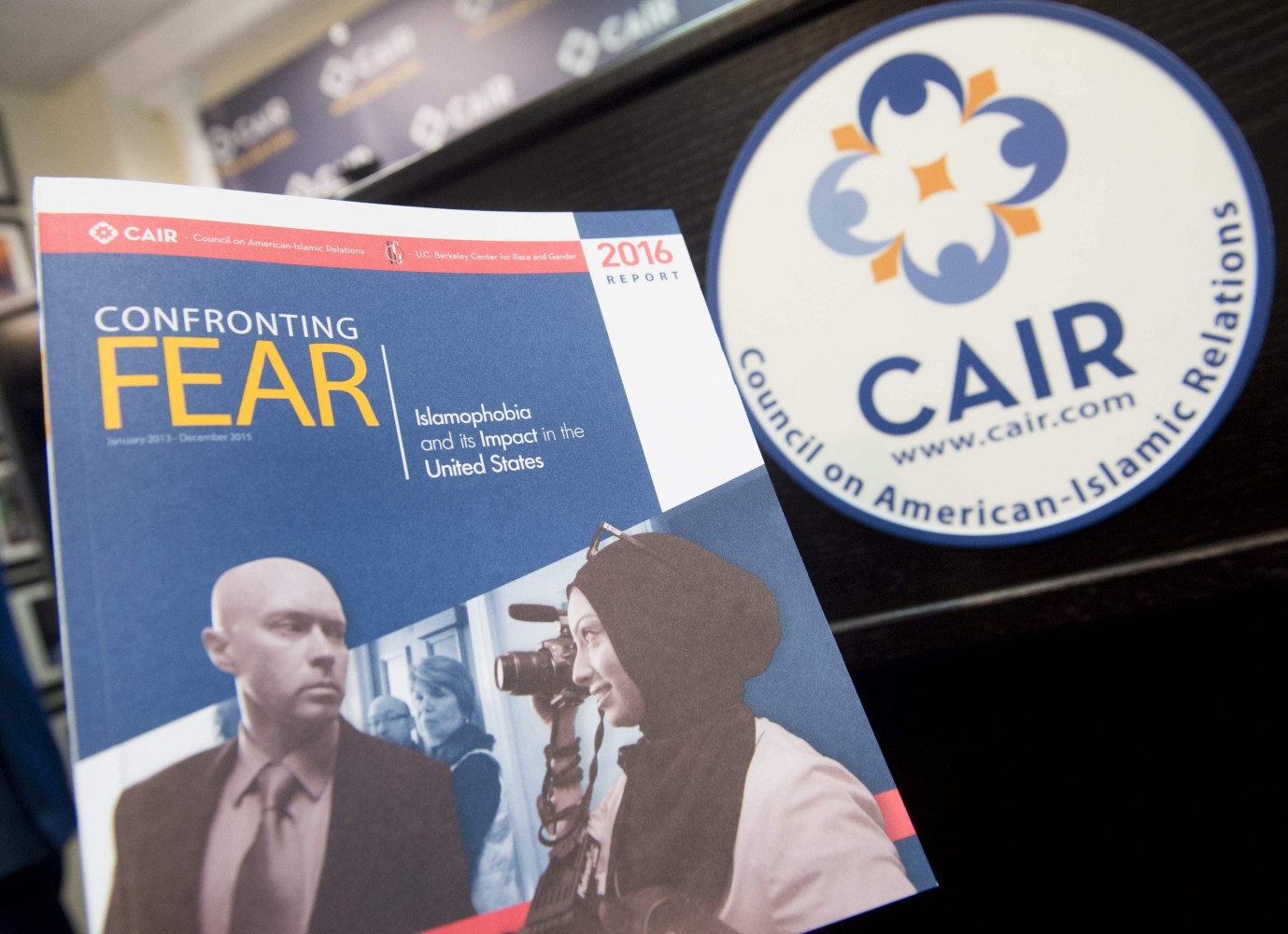
Thirty-three Islamophobic groups had access to $205 million between 2008 and 2013 to spread fear and hatred of Muslims, according to a new report by the Council on American-Islamic Relations (CAIR) and the Center for Race and Gender at the University of California, Berkeley. “Confronting Fear: Islamophobia and its Impact in the U.S. 2013-2015” documents the ways this and other funding has made Islamophobia manifest in America, as well as a new national strategy to improve American understanding and acceptance of Islam. The report also found that mosque attacks had reached an all-time high in 2015.

Image: US-POLITICS-CAIR
A report titled “Confronting Fear,” about Islamophobia in the US released by the Council on American-Islamic Relations (CAIR), is seen at their headquarters in Washington, DC, June 20, 2016. SAUL LOEB / AFP – Getty Images

“The last two months of 2015 saw 34 incidents in which mosques were targeted by vandals or those who want to intimidate worshippers,” Nihad Awad, CAIR executive director, writes in the introduction. “This is more incidents than we usually record in an entire year. This report makes a case that those who value constitutional ideals like equal protection, freedom of worship, or an absence of religious tests for those seeking public office no longer have the luxury of just opposing the U.S. Islamophobia network’s biased messaging.”

The number of Islamophobic groups in America has increased from 69 groups in 2013 to 74 groups in 2015, according to the report. Thirty-three of these groups are considered the inner core of the American Islamophobic network because their primary mission is to promote hate and prejudice against Islam and Muslims. Among the report’s other findings: Attacks on mosques have increased, with 78 recorded incidents in 2015. Ten states have passed anti-Islam laws. Two states have changed the way textbooks are approved in order to change the way Islam is taught in schools, law enforcement trainings on handling anti-Islamic crime has decreased, and a new phenomenon of “Muslim-free” businesses and armed anti-Islam demonstrations has developed.

“The 2016 presidential election has mainstreamed Islamophobia and resulted in a number of un-constitutional proposals targeting Muslims,” Corey Saylor, director of CAIR’s department to monitor and combat Islamophobia, said in a statement. “‘Confronting Fear’ offers a plan for moving anti-Muslim bias back to the fringes of society where it belongs.” 

Source: Mosque Attacks, Apparent Anti-Islam Spending Up: Report – NBC News