B.C. redesigns funding program that targets racism and hate

Small change, so likely minimal impact:

The B.C. government is redesigning the programs it uses to fight racism and intolerance, unveiling a new structure on Wednesday.

Premier John Horgan said the former Organizing Against Racism and Hate funding program has been redesigned into the new Resilience B.C. Anti-Racism Network.

The government will spend $540,000 annually offering grants and funding to communities and groups committed to cultural diversity and multiculturalism. The funding will also be used to respond to and prevent incidents of racism and hate.

The province will identify a central service provider for the program in the coming months, and estimates up to 40 local service providers will be linked into the network and funding.

“Resilience B.C. will be the beginning of increasing capacity in comms so they can do the work they need to do with the blessing and resources we can give them from the province,” said Horgan.

“Resilience B.C. Nice tag line, but it has got to be about people, it has got to be about communities.”

NDP MLA Ravi Kahlon, who served as parliamentary secretary on multiculturalism until a recent move to forestry, said the program will build upon a recent multiculturalism report he issued, as well as the restoration of the B.C. Human Rights Commission.

Source: B.C. redesigns funding program that targets racism and hate

4 B.C. sisters victorious in court after parents left them tiny share of $9M estate

Interesting case where traditional and Canadian values collide, resolved in favour of the latter. Also of interest is that the male heirs did not contest the fundamental injustice of the original will, although they argued that they still should have a greater share:

When they died three years ago, Nahar and Nihal Litt left behind an estate valued at more than $9 million. They willed 93 per cent of that to their two sons, leaving their four daughters to split what was left.

That’s despite the fact that the daughters, now in their 50s and 60s, took on most of the work of caring for their aging parents in the years before they died, according to a B.C. Supreme Court judgment. They also helped build their parents’ fortune, working on family-owned farms beginning when they were children.

And so the sisters decided to contest their parents’ will in court, arguing that their parents discriminated against them based on outdated traditional values, the judgment says.

“One of the reasons that they wanted to pursue the claim was not just out of self-interest, but so other South Asian women in the same position would also have the courage to do so,” their lawyer, Trevor Todd, told CBC News.

This week, Justice Elaine Adair agreed to redistribute the Litt estate, granting about $1.35 million to each of the sisters: Jasbinder Kaur Grewal, Mohinder Kaur Litt-Grewal, Amarjit Kaur Gottenbos and Inderjit Kaur Sidhu.

That adds up to 60 per cent of the family fortune, much higher than the $150,000 each they were initially promised.

Their two brothers, Terry Mukhtiar Singh Litt and Kasar Singh Litt, will split the remaining 40 per cent, or about $1.8 million each.

The brothers both agreed that their parents had failed to meet their “moral obligations” to their daughters, though they argued in court for larger inheritances for themselves. Terry Litt testified that he had tried to convince his mother and father that the wills were unfair, but he was unable to persuade them to make changes.

‘The hurts were deep’

Adair’s judgment lays out more than five decades of history in an immigrant family whose frugal lifestyle and hard work helped build a multi-million-dollar legacy. It reveals a network of complicated family relationships touched by resentment that led one daughter to become estranged from her parents for 20 years.

The Litts arrived in B.C. from India in 1964, when their children were between the ages of three and 14 years old, according to the judgment.

Dad Nahar found a job at a sawmill, and the family gradually began acquiring real estate, including a number of farms.

“As soon as they were old enough, the siblings were expected to work during the summers alongside their mother, picking fruit and vegetable crops,” Adair wrote.

The difference, according to the daughters, is that they were expected to take care of household chores, while their brothers were not. They testified that, as girls, they were treated as less valuable.

“There is little doubt that Nihal, over her lifetime and without justification, treated her daughters very cruelly. Jasbinder and Mohinder, the two oldest, were particular targets,” Adair wrote.

“The hurts were deep and are still keenly felt.”

Despite that cruelty, the two eldest daughters took on most of the work caring for their ailing parents in the years before they both died in the span of two months in early 2016.

‘They consider it a victory’

Today, the siblings all have their own families and are financially independent. Even before they receive their inheritance, some of them have assets valued in the millions of dollars.

But Adair wrote that the parents’ wills were not adequate to support their daughters.

B.C.’s Wills, Estates and Succession Act gives judges wide leeway to make drastic changes to a will to make sure there’s a “just and equitable” distribution to someone’s surviving spouse and children. At the same time, they’re expected to consider the “testamentary autonomy” of the dead person — in other words, a person’s right to decide who gets their money.

Todd said he believes the judge did a good job of balancing those two concerns.

“The clients are very happy with the result. They consider it a victory,” he said.

Source: 4 B.C. sisters victorious in court after parents left them tiny share of $9M estate

Douglas Todd: B.C. launches rare immigration plan for small towns

Seems like most governments are now developing comparable initiatives: the federal government with the Atlantic Immigration Pilot and the just announced Rural and Northern Immigration Pilot, the Alberta UCP’s proposed program, and Manitoba’s approach to the Provincial Nominee Program.

The numbers are small in terms of total immigration but nevertheless can be significant for rural communities:

The B.C. government is venturing out on a rare Canadian effort to lure immigrants to the struggling hinterlands.

Aware that the vast majority of immigrants to the West Coast move into hectic Metro Vancouver, the B.C. government is launching a pilot program to lure entrepreneur immigrants to cities of less than 75,000 people that are distant from major urban centres.

Bruce Ralston, the minister of jobs, trade and technology, said 30 city mayors are already on board with the pilot program, which will give preferential treatment to well-off newcomers who commit to setting up a business in and living in a rural community for at least three years.

Maintaining that B.C.’s overall fertility rates are declining, the website for the so-called entrepreneur immigration regional pilot adds that small cities “face the additional challenge that young people are leaving for larger centres to find opportunities.”

The federal government’s immigration program has never put much effort into directing immigrants to rural areas, largely because immigrants have mobility rights under Canada’s charter and can move wherever they want.

But many migration specialists have urged Canada to develop incentives to shift immigrants to small towns, since 80 per cent of immigrants end up choosing the country’s major cities. About six in 10 recent immigrants squeeze into the three biggest metropolises, Toronto, Vancouver and Montreal.

Manitoba is one of the few innovative provinces that has used its own immigration scheme to divert new workers away from Winnipeg to towns such as Winkler and Altona. And after B.C. quietly announced it’s pilot small-city program months ago, Alberta Opposition Leader Jason Kenney this week promised something similar.

“This has not been tried before in B.C.,” said Ralston, noting that B.C.’s current provincial nominee program, which is sanctioned by the federal government, brings in about 6,000 potential immigrants a year.

The majority come from Asia; choosing Metro Vancouver for the wide job variety and the cultural familiarity of living in a place that already has large populations of Chinese, South Asians, Filipinos, South Koreans and other ethnic groups.

“This pilot program is designed to get people to commit to small communities. They would have to establish a business and stay for a minimum of one year until they obtain permanent resident status, which usually takes another 18 months,” Ralston said .

“Once they have permanent residency the law says they can move wherever they want. But we think the stickiness of establishing a business in a warm community that would be enthusiastic and would wrap their arms around you would be important.”

The pilot program, which may initially accept a couple of hundred applicants, requires would-be immigrants to first visit their chosen community, invest a minimum of $100,000 in a business, have a net worth of at least $300,000 and create at least one job.

The pilot program also requires the applicant to understand English, which, controversially, has not been expected of the hundreds of newcomers welcomed in recent years through B.C.’s existing provincial immigration program for entrepreneurs.

The B.C. government intends to work closely with small-community officials to make the program work and help new arrivals connect with members of their diaspora group, said Ralston. The entrepreneur immigrants will not be allowed to start certain businesses, such as real estate development, bed and breakfasts or hobby farms.

Asked how B.C. officials will monitor whether participants actually live in the towns in which they start a business, Ralston said, “The communities have an interest in this working. The monitoring will be done by the mayors and councils and communities themselves. So if it doesn’t work, I will hear about it pretty fast.”

Simon Fraser University political scientist Sanjay Jeram is one of those who have encouraged Canadian jurisdictions to follow the lead of European nations and create incentives for immigrants and others to settle outside metropolises.

The fact most immigrants to Canada move to Toronto, Vancouver, Montreal and Calgary adds undue pressure not only to those cities’ housing costs, Jeram said, but to infrastructure, such as traffic and transit.

The inter-provincial migratory flows within B.C. travel many complex directions, however.

Even while it’s accurate to say some young people are leaving rural B.C. towns, a recent Statistics Canada report showed that Aboriginals and whites are leaving Metro Vancouver for other regions of B.C. (especially the Fraser Valley, Vancouver Island and the Okanagan).

A net total of 9,345 whites and 460 Indigenous people left Metro for other parts of the province in the one-year period ending July, 2016, according to a 2018 Statistics Canada report. The two other demographic groups that are tending to say goodbye to Metro Vancouver are those born in Canada and those between ages 55 and 65.

However, the idea that governments can encourage more immigrants, and perhaps the native-born, to make their lives in the small towns of Canada appears to be picking up steam in Canada, at least provincially.

The idea gained a boost this week when Kenney, a former federal immigration minister who now leads Alberta’s United Conservatives, announced a government led by his party would launch an immigration plan that would attract newcomer entrepreneurs to rural Alberta, in order to get “the best bang for the buck” on who settles in the province.

Meanwhile, Manitoba has been successfully focusing on attracting would-be immigrants to rural towns who are skilled workers, not wealthy business people. While Ralston said a similar small-city program for skilled newcomers has been discussed, he first wants to find out whether the two-year entrepreneur pilot program works in B.C.

dtodd

Source: Douglas Todd: B.C. launches rare immigration plan for small towns

Refugees crossing into B.C. on the rise, immigrant group says

Numbers small compared to Quebec but likely to increase:

On Nov. 18, 2017, Ribwar Omar, a 38-year-old Iraqi Kurd, arrived in Blaine, Wash., by bus. He stopped at a coffee shop, bought a hot chocolate and then, using the GPS on his phone, he made his way through a forest near the Peace Arch and crossed the border into Canada.

Omar is awaiting a refugee hearing, one of 1,277 new refugee claimants that made their way on foot from Washington state to B.C. in 2017. New numbers released by the Immigrant Services Society of B.C. (ISS) show their group has tracked a 76-per-cent increase in individuals accessing their services that have applied for refugee status, and 90 per cent of those arrive the same way Omar did: by walking across the U.S./Canada border between Blaine and Surrey through Peace Arch Park.

Chris Friesen of the ISS calls it “the underground railroad.”

“We have seen single men, families of 12, 13, people in wheelchairs, pregnant women,” said Friesen, with the majority originating from Afghanistan, Iraq, Mexico, Iran and Colombia.

Friesen and other advocates are concerned that the spike in the number of asylum seekers could increase as the weather warms-up. Last summer, over 7,000 asylum seekers entered Quebec through irregular border crossings.

The reason many asylum seekers are using irregular border crossings — through farmers fields or border parks — is because of the Safe Third Country agreement between Canada and the U.S.

Under the deal, signed during the Harper government regime, refugee claimants are required to request refugee protection in the first safe country they arrive in, unless they qualify for an exception.

“This means that a refugee claimant who came from the United States to Canada through an official border crossing could be detained and deported, or kept in the United States, forcibly impinging their ability to seek asylum in this country,” said Friesen.

Many of the refugee claimants are well-informed about their rights, and will phone the RCMP to be picked up once they arrive in Canada. “The RCMP will drive them to Hornby Street to file their refugee claim,” said Friesen.

“With the numbers that are coming in it is pushing us to the breaking point,” said Friesen, who called the situation “a bloody mess.”

Friesen said ISS is tracking two clear waves of refugee claimants. The first includes those, like Omar, who are able to obtain a legal visitor’s visa to the U.S., and use the United States as a transit point into Canada.

“This is quite new,” said Friesen.

The second stream of new asylum seekers is comprised of individuals who may have been in the U.S. for years, but are vulnerable to the Trump administration’s new policies, including accelerated deportations, the suspension of temporary protection agreements for Haitian and El Salvadoran immigrants, as well as Dreamers.

Friesen said he has been in contact with provincial officials who are planning consultations next month on contingency plans to deal with the continued influx of asylum seekers.

via Refugees crossing into B.C. on the rise, immigrant group says | Vancouver Sun

B.C.’s First Chief Judge [Begbie] haunts Law Society

The risks of hasty decisions and lack of fulsome discussion:

The ghost of pioneering B.C. justice, Sir Matthew Begbie — the Hanging Judge to some — has come back to haunt the Law Society of B.C.

The professional regulator’s benchers this spring unanimously exorcised from its lobby a statue of the legendary chief judge.

And they scrubbed references to him from the society’s image as offensive to Indigenous people.

But the colonial-era jurist who brought law-and-order to the two colonies that were the cornerstones of the province has not gone quietly into that good night.

And the decision to disown Begbie may yet prove to be just as controversial as moves in the U.S. to remove public symbols of the Confederacy or East Coast attempts to eliminate memorials of Halifax founder Edward Cornwallis, who issued a bounty on Aboriginal people.

The profession’s blue-chip journal, The Advocate, has rallied to defence of the province’s first chief justice.

In its unsigned editorial column entitled Entre Nous — Between Us, the august publication this month says that the move is “perhaps even a step in the wrong direction — than a purposeful and reasoned step toward reconciliation.”

“By removing the Begbie statue from the Law Society lobby, our governing body is now telling us that Begbie’s legacy has but a single dimension which is antithetical to truth and reconciliation,” asserts the magazine that goes to every lawyer in the province.

It added: “With great respect to the intentions of the parties, we think the recommendation to remove the Begbie statue and the acceptance of that recommendation are both misguided. … We fear that the rush to reconciliation has trampled a principled approach with one unintended consequence being estrangement rather than reconciliation of interested parties.”

Editor Michael Bain said many lawyers have already told him they want the society to revisit the issue as it was forced to do over its initial approval of a law school at Trinity Western University.

“I’ve had a lot of interesting conversations and a lot of reaction to it,” said the Vancouver lawyer. “It has definitely struck a nerve … and the impact of it happening on the profession I think has been to give people pause as to what the benchers are doing or how they are doing it.”

Published by the Vancouver Bar Association since 1943, the magazine’s masthead bears a who’s who of the profession — Christopher Harvey, Q.C. David Roberts, Q.C., Court of Appeal Justice Mary Saunders, Peter J. Roberts and Provincial Court Judge William F.M. Jackson.

The editorial acknowledged a certain amount of anxiety about wading in on the issue “but just as the first tentative steps into the ice-cold mountain lake can result in a terrified skip back up the slope, usually it is the icy plunge itself that yields the better reward.”

It then proceeds to kick the intellectual stuffing out of the society’s decision — citing the historical record to show the renowned legalist was ahead of his time and a supporter of Indigenous people.

A Cambridge-educated Chancery barrister and member of Lincoln’s Inn, Begbie arrived in what is now B.C. in 1858 at the age of 39.

“He learned a number of Indigenous dialects and even conducted trials in those languages. He had great friendships with a number of chiefs … he was clearly sympathetic when it came to trying to impose colonial law on Indigenous people. He recognized the concept of Aboriginal marriage and allowed an oath for truth-telling that recognized Aboriginal beliefs. In fact, he was surprisingly enlightened for a 19th-century Englishman when it came to understanding and interacting with Aboriginal peoples.”

Nevertheless, the Law Society indicted Begbie for presiding over four trials in which six of nine accused Tsilhqot’in warriors were convicted by juries for murdering white road-builders.

Indigenous people have long insisted the executed chiefs were freedom fighters protecting traditional territories from the encroachment of settlers.

Moreover, the chiefs surrendered only after threats to slaughter Indigenous women and children.

In 1993 the NDP Attorney General apologized for the hangings and in 2014 Liberal Premier Christy Clark confirmed the exoneration of the chiefs.

“The whole affair seems quite unseemly — indeed, Begbie’s contemporaneous writings reveal his decided unease about the outcome — but we are still trying to grasp what it is that Begbie did wrong,” the editorial maintains.

“He did not pass judgment himself but he did pronounce the mandatory sentence as the law required him to do.”

There is another Begbie icon outside the New Westminster courthouse and three mountains, two lakes, a creek, an elementary school, streets and other sites across B.C. bear his name.

The society made its decision to erase Begbie without consulting the membership, though it noted many lawyers would disagree with the move.

“I’m not sure it’s the proper road towards reconciliation in my view,” Bain said. “I would have thought more dialogue would have been helpful rather than less.”

Source: B.C.’s First Chief Judge haunts Law Society | Vancouver Sun

BC college faculty feel pressure to ‘pass’ students with poor English | Vancouver Sun

Conflict between universities and colleges as a business versus maintaining standards?

Veteran college English instructors are routinely receiving passionate, imploring pleas for passing grades from the international students who increasingly fill their classes.

The foreign students’ emotion-filled emails and in-office appeals, often issued in jumbled English, invariably aim to cajole faculty at Langara College and other institutions into giving them a break, so they will be able to move on from their mandatory courses in English literature.

The foreign students often maintain their entire future depends on passing the English course.

Langara College has experienced a five-fold rise in foreign students since 2014, but two English literature and composition instructors say the college’s over-reliance on international fees is not working for many high-stressed foreign students, their anxious offshore parents or for shortchanged domestic students.

Langara College English instructors Peter Babiak and Anne Moriarty are among a small number of Canadian higher education officials who are ending their silence to raise concerns about the expanding business of international education, which now brings 130,000 foreign students to B.C., mostly Metro Vancouver.

“I do feel sorry for the (international) students, of course, but that’s not really the point. When I assign grades, presumably I need to be objective and not let emotions get in the way,” says Babiak, who has been teaching at Langara since 2002.

Like many faculty at universities and colleges, Babiak and Moriarty feel pressure to wave through the full-fee-paying foreign students, especially in mandatory first-year English literature courses, even if they lack fluency in English.

“There is a booming industry dedicated to helping students jump through English-language hoops, which teachers like me everywhere work hard to defend. Being part of this is weighing heavily on my conscience,” said Moriarty.

Langara Provost Ian Humphreys, however, said Tuesday “there is no pressure on faculty to pass students who are not yet achieving learning outcomes.”

Humphreys said he is proud that Langara “is an open access institution that serves a diverse student population – both domestic and international – that has a high proportion of English language learners.” He says the college’s grads have a strong success rate when they transfer to other institutions or the job market.

Moriarty, however, said that even though many of the foreign students work hard in their technical, business and computer courses, many also leave their mandatory English literature course to the end of their multi-year programs, knowing their English is weak.

Both Babiak and Moriarty also agonize over how classroom discussions in English literature courses are often severely restricted because of language barriers. It means, he said, students who seriously want to study novels, linguistics and composition don’t get as much high-level interaction as they could.

Source: BC college faculty feel pressure to ‘pass’ students with poor English | Vancouver Sun

International students in B.C. could be in fake marriage schemes: Douglas Todd

The ingenuity of persons wanting to come to Canada knows no bounds. No hard numbers but widespread anecdotes indicate that there is an issue (India sends the second largest number of students to Canada after China: 77,000 in 2016):

The newspaper ads in India are the visible tip of a booming underground industry in fake marriages involving would-be international students.

The prize for the “spouse” whose family buys an instant marriage with a foreign student is back-door access to a full-time job in Canada and a fast-track to citizenship.

The matrimonial ads normally promise that the foreign students’ sham marriage, plus all travel and study expenses, will be paid for by the Indian families who are determined to have their son or daughter emigrate.

The type of Indian student the ads seek is usually a teenage girl, who must have passed an English-language test and therefore be in line to be accepted as an international student.

Media outlets in India, such as the Hindustan Times, report there is a “booming matrimony market for ‘brides’ who can earn the ‘groom’” coveted status as a migrant to a Western country.

Canada is among the most sought-after destinations for Indian foreign students, say migration specialists, because it is the most generous toward foreign students and their spouses. Australia has also been popular, but recently tightened its rules.

Here is a typical recent ad from one Punjabi-language newspaper in India, Ajit:

“Jatt Sikh, boy, 24 years old, 5 feet 10 inches, needs girl with IELTS band 7. Marriage real or fake. Boy’s side will pay all expenses.”

The ad is listed by a high-caste “Jatt” Sikh male, or more likely his parents. It seeks a contractual marriage with a young woman who has scored well (“band 7”) on an international exam called “IELTS,” the International English Language Testing System. Almost three million IELTS exams are conducted each year.

Here is another ad, from the newspaper Jagbani:

“Barbar Sikh, 24, 5 feet 8 inches. Finished Grade 12. Looking for BSc or IELTS pass girl. Boy’s side will pay all expenses to go to Canada.”

In this ad the family of a lower-caste “Barbar Sikh” is seeking to have their son marry an Indian female with a bachelors of science degree, or a passing mark on the IELTS test, so their son can be allowed into Canada as her spouse.

As these kinds of ads illustrate, the parents of the male “spouse” typically offer to cover all expenses for the international student, who often end up attending one of the scores of private colleges in Canada with low to non-existent standards.

B.C. is home to 130,000 international students, the vast majority of whom are in Metro Vancouver, which has the highest concentration of foreign students in Canada.

In exchange for financing the foreign student, the phony spouse gets to live in Canada and legally work up to 40 hours a week, plus receive medical coverage and other benefits. That puts them in a strong position to become permanent residents of Canada.

The foreign-student marriage rackets are gaining attention in newspapers in India.

Indian media are reporting angry fallout when students financed by other families either fail to get into a Western college or university, or try to break up with their spouses of convenience.

Kwantlen Polytechnic University political scientist Shinder Purewal, a former Canadian citizenship court judge, says Punjabi- and Hindi-language newspapers in India run dozens of such ads each week.

“Families are looking for matches to get their sons or daughters abroad. And the most successful route to Canada is through international-student channels. It’s an easy way to get immigration,” said Purewal.

Source: International students in B.C. could be in fake marriage schemes | Vancouver Sun

B.C.’s South Asians helped hand eight ridings to the NDP

The power of ethnic voting based upon issues that affect the community:

A range of negative factors, which some might call a perfect storm, hurt B.C. Liberal Leader Christy Clark and sharply swung South Asian voters to John Horgan’s New Democratic Party in the May 9 election.

The B.C. Liberals lost all eight Metro Vancouver ridings with large South Asian populations, with political observers saying the governing party failed to connect with voters on both regional issues and worries specific to South Asians.

South Asians felt particularly betrayed by the B.C. Liberals’ approach to the trucking and taxi industries in which South Asians are predominant, said Kwantlen Polytechnic University political scientist Shinder Purewal and prominent radio host Harjit Singh Gill.
Most of Metro Vancouver’s more than 260,000 South Asians also showed little interest in the B.C. Green party, which means that, unlike in many predominantly white urban ridings, the potential NDP vote was not siphoned off to the third-party Greens.

In north Surrey and north Delta, where South Asians often account for 50 to 80 per cent of the population in neighbourhoods, the NDP on May 9th took four ridings away from the B.C. Liberals (including the defeat of two cabinet ministers) and held on to three others.

The NDP’s George Chow also won Vancouver-Fraserview, which has a sizable South Asian population, defeating Liberal Attorney General Suzanne Anton.

In addition to issues of special concern to South Asians, Gill and Purewal made clear South Asians were miffed with the B.C. Liberals because of three key conflicts that cut across ethnic lines.

Like many others in Surrey, they said, South Asians were ticked with the B.C. Liberals for placing tolls on the Port Mann and proposed future bridges, about thousands of Surrey students making do with school portables and by the Liberals’ abandoned promise to build a second hospital in Surrey.

“South Asians felt betrayed by the people they had sent to Victoria,” said Gill, host of a popular Punjabi- and English-language radio talk show at 1550 AM.

Gill maintained his more than 100,000 listeners saw the B.C. Liberals as “becoming very arrogant” and under the influence of would-be Punjabi “kingmakers;” insiders whom he said had manoeuvred to have their favourites acclaimed as candidates, without nomination battles.

Gill focused several radio programs on the party’s failure to help thousands of Metro Vancouver truck drivers.

The United Truckers Association (UTA), whose membership is predominantly South Asian, publicly hammered the B.C. Liberals for abandoning truck drivers. “They’re going through a very hard time now,” Gill said. Many truckers had gone on strike and “are being exploited by their owners.”

Purewal, who attended UTA meetings as an observer, estimated 80 per cent of Metro Vancouver’s truck and taxi drivers are South Asians.

Surrey itself, he said, is home to more than 7,000 truck drivers.

The B.C. Liberals’ promise in March to support the arrival of Uber, the ride-hailing service, also aggravated many South Asian taxi drivers, said Gill and Purewal.

Source: B.C.’s South Asians helped hand eight ridings to the NDP | Vancouver Sun

B.C. was home to First World War internment camp for Europeans

One of the projects funded by the Canadian Historical Recognition Program endowment to the Canadian First World War Internment Recognition Fund – money well used:

Bill Doskoch was looking for work in Vancouver when he was arrested, for being Ukrainian.

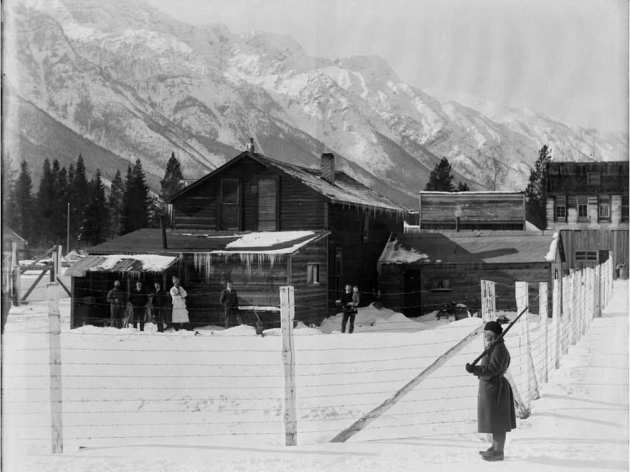
At the dawn of the First World War, the Canadian government rounded up more than 8,000 mostly single men of German, Austrian and Ukrainian ancestry, sending them to 24 concentration camps scattered across the country. One such camp was at Morrissey, not far from Fernie.

As a civilian prisoner of war, Doskoch was moved frequently, eventually incarcerated in five camps between 1914 and 1920 and only released after most others prisoners were long gone.

“He was quite a rabble-rouser apparently and refused to take internment lying down,” said Sarah Beaulieu, an archeology PhD candidate at Simon Fraser University. “He was very angry about being interned.”

Beaulieu is pursuing an excavation at the site of the Morrissey camp this summer. She has already detected an escape tunnel and recovered artifacts, including a barbed-wire crucifix.

Morrissey was regarded as a particularly barbaric experience, with abusive guards, solitary confinement and hard labour.

Bill Doskoch is one of the few prisoners from the Morrissey Internment Camp who talked about his experiences. Here, in 1918, Doskoch is in the back row, fourth from the left, with his collar turned up. FERNIE HISTORICAL SOCIETY / PNG

A report by Consul of Switzerland Samuel Gintzburger, from 1917, notes that prisoners were “absolutely destitute” and were subject to “physical coercion” at the hands of guards. Protests were frequent.

“It was notorious for mistreatment of prisoners,” Beaulieu said. “At the time it received several note verbales (diplomatic protests) from Germany threatening retaliation on Canadian and British prisoners of war should the conditions at Morrissey not improve.”

Beaulieu learned of Bill’s wartime adventures from his daughter, Anne Sadelein, who resides in Edmonton where Doskoch settled in the 1920s. He remained a union activist throughout his life.

“My father spent a lot of time in black holes for writing letters and inciting stop workages or being political,” said Sadelein.

Doskoch was often at the centre of disputes over prisoner labour in the camps.

The Canadian government misinterpreted a clause from the 1907 Hague Convention on the rules of war so that the civilian PoWs could be used as labourers building roads and parks.

Some archival records note that prisoners were paid 55 cents a day for voluntary labour, but that 30 cents a day was deducted to pay for their room and board in the camp.

When civilian internees became aware that the clause in The Hague Convention only applied to military PoWs, Doskoch copied out the entire convention by hand as a reminder of their rights, according to Sadelein.

“He knew that they had been illegally arrested and wanted to do something about it,” said Beaulieu. “Most of the prisoners were civilians with no military connections who had come to Canada to settle the Prairies.”

Morrissey had been a coal-mining camp between 1902 and 1904, but was a ghost town when the federal government converted it into a concentration camp on Sept. 28, 1915. The Canadian government would later use the term internment to avoid the association with German concentration camps after the Second World War.

“They were very badly fed: fat and potatoes,” said a female descendant of a Ukrainian Morrissey internee interviewed by Beaulieu. “No vegetables, fruit or milk and these were young men — a lot of them in their early 20s. They had to work very hard. Ten hours a day sometimes. I can’t say that it was a nice, kind camp.”

Beaulieu has the names and faces of a few prisoners. Unfortunately, in 1954, a lot of the archival material was destroyed by the Canadian government because they had no place to store it. So very little is known about the operations of these camps today.

“When I first came to do interviews people weren’t really aware of the camp at Morrissey and the few that did were under the impression that it had been a sanctuary for destitute foreigners during the First World War,” she said.

A guard watches the fence in winter at the Morrissey Internment Camp. LIBRARY AND ARCHIVES CANADA / PNG

The internees have largely stayed in the shadows, even after the government offered to pay them for their labours. Though prisoners were supposed to be paid for their labour on release, those monies were never given to them. Most were too afraid to fight at the time and were loathe to apply for it when it was available in 1929 because it would have revealed to their families that they had been prisoners.

Interviews and documents being collected by academics such as Beaulieu are being gathered and organized by the Canadian First World War Internment Recognition Fund, which is also funding her work in Morrissey.

Source: B.C. was home to First World War internment camp for Europeans | Vancouver Sun

Doug Todd: “Techno-immigrants” fuel Vancouver’s high-tech sector

Interesting study, which recalls an earlier Globe article, Microsoft reminds us that Canada is still a branch-plant economy, on how Microsoft (and likely others) strategically use Canadian immigration as a way to bring talent to their US headquarters:

In light of the political manoeuvring in B.C. over local high-tech jobs and training, the study by Froschauer and Wong quotes the president of a large B.C. high-tech association who says a key reason “Microsoft chose to open a Vancouver office was because of the easier immigration rules.”

The unidentified high-tech CEO told the researchers there’s a crucial reason Microsoft did not simply open its computer development “campus” in Redmond, Washington, which is headquarters for the global tech giant.

“It’s like two hours away, so why would they open up this campus in Vancouver?” said the CEO.

“It’s much easier to bring in (migrants from India) and others, and that’s the reason they came. And their intention is not to recruit people away from other companies in the Lower Mainland but to bring fresh people in, and that’s what the larger companies do. Small ones don’t have the means.”

High-tech companies in B.C. and Alberta also often cross the U.S. border to recruit Chinese and other foreign students, say the authors, because international students in the U.S. are generally not allowed to remain in the country after they graduate, whereas they can stay after graduation in Canada.

The sociologists do not estimate the proportion of Metro Vancouver’s high-tech sector that is made up of immigrants, international students or temporary foreign workers, but they quote the CEO in confirming migrants are “very, very useful. I don’t think we could evolve our sector without” them.

Many of the techno-migrants interviewed in the study say it’s often an advantage to be a migrant in Canada’s high-tech sector.

But others said being born outside the country can be a disadvantage, particularly because of difficulties with language.

Some people from China told the researchers that migrants from India don’t have as many problems with language, since many in the former British colony were educated in English from their childhoods.

Some high-tech executives in Metro Vancouver and Calgary favour temporary foreign workers over immigrants, add Froschauer and Wong, whose article appears in the new book, Trans-Pacific Mobilities: The Chinese and Canada(UBC Press), edited by Wong.

The sociologists learned some corporations prefer “to bring employees to British Columbia on a temporary work permit” because they can be retained longer than immigrants, who have more freedom regarding where to work.

Provincial and federal immigration programs “do not tie employees to the company, whereas the temporary work permit does,” the authors say.

The number of high-tech migrants to Canada, especially from China, is likely to continue to grow in the future, say the authors.

Source: Doug Todd: “Techno-immigrants” fuel Vancouver’s high-tech sector | Vancouver Sun