‘1984’ Hasn’t Changed, but America Has

All too true, even if there have been previous chilling periods:

…Banning books doesn’t stop at the local level.This year, after Mr. Trump signed three executive orders aimed at combating “wokeness,” the Department of Defense’s education agency removed and reviewed more than 500 titles from its school system, including, according to one report, Aldous Huxley’s “Brave New World,” which the C.I.A. had sent to the Eastern Bloc. Federal funding agencies have compiled a list of more than 350 banned words and phrases, including “women,” “diversity” and “ethnicity.”

In the Cold War, the United States chose “freedom” — democratic freedom, freedom of speech, intellectual freedom and freedom of choice — as its key point of difference with the Soviet enemy. Since the end of World War II, U.S. presidents from both parties have wrapped themselves in the rhetoric of the “free world” that they led. When Ronald Reagan — who spearheaded the Cold War “freedom” agenda and oversaw an upswing in C.I.A. literary programs — spoke to the British Parliament in 1982, he invoked “the march of freedom and democracy,” which would “leave Marxism-Leninism on the ash-heap of history.” It was no coincidence that George Minden, the leader of the C.I.A. book program, once described his operation as “an offensive of free, honest thinking.”

Mr. Trump, JD Vance, Ron DeSantis and their fellow travelers expound the virtues of the First Amendment while dismantling guardrails against disinformation and working to suppress political ideas they oppose. Book bans aren’t their only tool. They also block access for independent journalistsintimidate news organizations and defund outlets they perceive as hostile to the MAGA agenda, including NPR, Radio Free Europe/Radio Liberty, Radio Free Asia and Voice of America.

There are two lessons from the history of the C.I.A. book program that the book banners would do well to heed. One is that censorship — whether by Communists, fascists or democratic governments — tends to create demand for the works it targets. (That, and Mr. Trump’s Orwellian tactics, may explain why “1984” has been surging up the book charts in recent years.)

The other is that the totalitarians lost the Cold War, and freedom of thought won the day. The former Polish dissident Adam Michnik, whose own works were promoted by the C.I.A., presumably without his knowledge, said: “It was books that were victorious in the fight. We should build a monument to books.”

Charlie English is the author of, among other books, “The CIA Book Club: The Secret Mission to Win the Cold War with Forbidden Literature.”

Source: ‘1984’ Hasn’t Changed, but America Has

PEN: Cover to Cover – An Analysis of Titles Banned in the 23-24 School Year

Of note:

In the 2023-2024 school year, there were more than 10,000 instances of banned books in public schools, affecting more than 4,000 unique titles. These mass book bans were often the result of targeted campaigns to remove books with characters of color, LGBTQ+ identities, and sexual content from public school classrooms and libraries. As book bans reached an unprecedented high in the last school year, PEN America sought to further understand the impacts of this censorship – the identities, content areas, genres, and types of books that are being erased from America’s public schools.

In November 2024, PEN America previously reported on the content of titles that had experienced two or more bans (1,091 titles); here, we include a more comprehensive analysis of all 4,218 titles banned during the 2023-2024 school year. 

What have we found? 

Book bans are not a hoax.

How do we know?

  • Certain identities are being removed from library shelves en masse. During the 2023-2024 school year, 36% of all banned titles featured characters or people of color and a quarter (25%) included LGBTQ+ people or characters. Of titles with LGBTQ+ people or characters, over a quarter (28%) feature trans and/or genderqueer characters.
  • Erasure of identities is pervasive within banned illustrated and graphic-heavy titles. For example, 73% of all graphic and illustrated titles feature visuals with LGBTQ+ representation, of people or characters of color, or that address race/racism. More specifically, 64% of banned picture books have pictures or illustrations that depict LGBTQ+ characters or stories.
  • For all the inflammatory rhetoric about “explicit books,” only 13% of banned titles had “on the page” descriptions of sexual experiences, compared to 31% with “off the page” sexual experiences. Overall, 40% of banned titles include sexual experiences (some contained both “on” and “off the page”). 
  • Books banned during the 2023-2024 school year overwhelmingly address violence (65%), death and grief (55%), and abuse (43%); all very real human experiences.

Source: Cover to Cover

Wells: Ira Wells on book banning

Peel Region never fails to disappoint in its excesses:

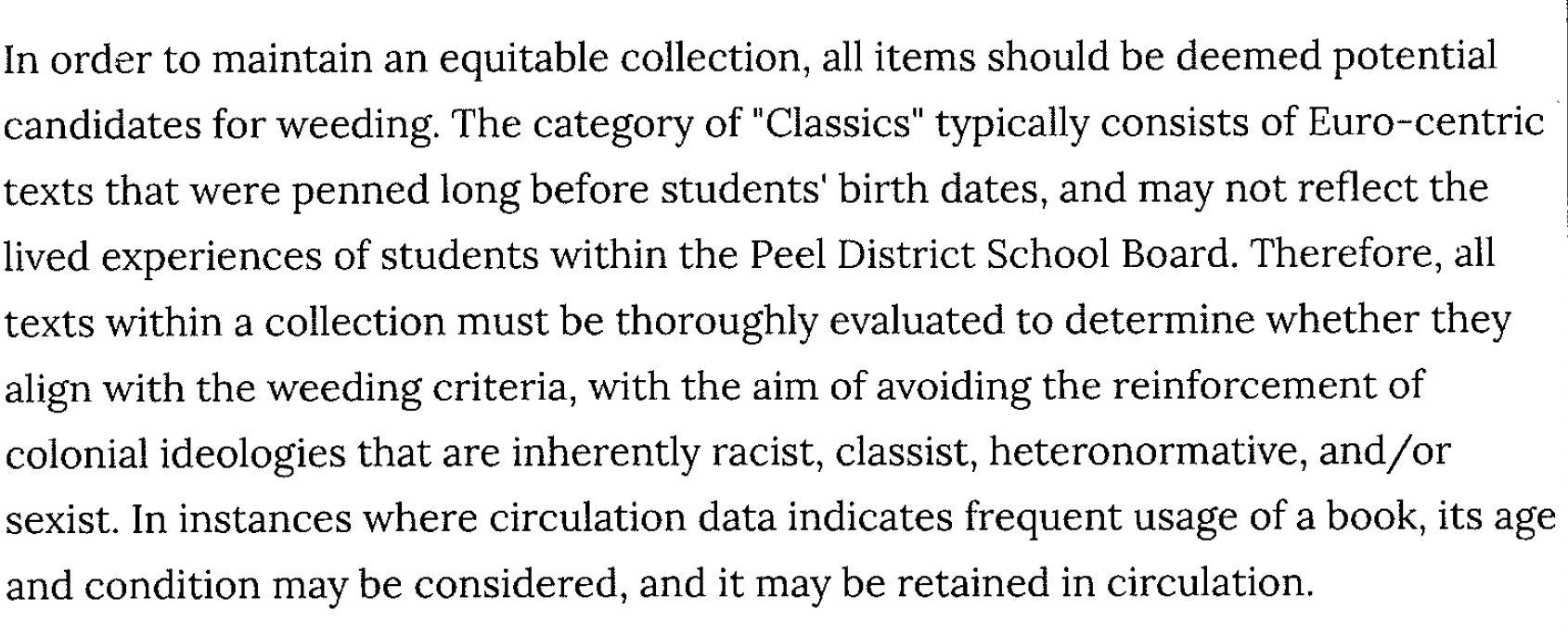
In one, [Ira] Wells was invited to take part in a “library audit” at his child’s Toronto school, led by a principle who said that if it were up to her, they’d get rid of “all the old books.” In another, all books published before 2008 were removed by the armful from Peel Region school libraries west of Toronto, on the general understanding that justice was invented in 2008 and that before that year, we were mostly just pummeling one another with rocks and other tools of oppression. I paraphrase.

Here’s a paragraph from the manual Peel Region school librarians used to guide them in this work of moral uplift. For my money, the word “therefore” is being asked to carry more than its fair comic weight:

Source: Ira Wells on book banning

Buruma: In the U.S., the left has fallen into the populist right’s culture-war trap

Of note:

The United States is in the midst of a book-banning frenzy. According to PEN America, 1,648 books were prohibited in public schools across the country between July, 2021, and June, 2022. That number is expected to increase this year as conservative politicians and organizations in Republican-controlled states such as Florida and Utah step up efforts to censor works dealing with gender, sexual and racial issues.

Today’s book bans are largely driven by right-wing populist politicians and parent groups claiming to protect wholesome, family-oriented Christian communities from the decadence of urban America. As such, a children’s book featuring LGBTQ+ characters apparently falls under their definition of pornography.

Florida Governor Ron DeSantis, a likely presidential contender, is arguably the leading advocate of state censorship and modern-day book bans. Last month, Mr. DeSantis and his allies in the state’s House of Representatives introduced a new bill that would prohibit universities and colleges from supporting campus activities that “espouse diversity, equity, and inclusion or critical race theory rhetoric.” The bill also seeks to remove critical race theory, gender studies, and intersectionality, as well as any “derivative major or minor of these belief systems,” from academic curricula.

But even though there are fewer calls from left-wing progressives to ban books, they, too, can be intolerant of literature that offends them. Such classics as To Kill a Mockingbird and The Adventures of Huckleberry Finn have been removed from some school reading lists because they contain racial slurs and might “marginalize” certain readers.

To be sure, the right-wing crackdown on academic freedom is more dangerous than the left’s literary allergies. What is interesting, however, is how much left-wing and right-wing intolerance have in common. Right-wing populists like Mr. DeSantis tend to mimic progressive rhetoric about “inclusivity” and “sensitivity” in the classroom. White students, they claim, must be shielded from learning about slavery or the role of white supremacy in American history because it might upset them and make them feel guilty.

Progressives who want to stop teaching Huckleberry Finn in schools or demand that words like “fat” be taken out of Roald Dahl’s children’s books follow the same logic. They, too, do not want children to feel offended or “unwelcome,” even if it means they don’t learn how to absorb information and think for themselves.

Right-wing mimicry of left-wing jargon can be viewed as a form of bad-faith payback. After all, the driving force behind conservative puritanism in the U.S. has always been fundamentalism, not inclusion. But religious dogmatism is intimately linked to the fear of being offended. The controversy that followed the publication of Salman Rushdie’s The Satanic Verses in 1988 is a case in point. In addition to Ayatollah Ruhollah Khomeini’s fatwa calling for the author’s death, Christian conservatives condemned Mr. Rushdie for mocking religion. Some on the left, though they did not belong to any religion, still criticized Mr. Rushdie for offending millions of Muslims.

Christian puritans do not oppose books about gay topics just because the Bible forbids homosexuality, but also (and perhaps primarily) because it violates what they believe to be the natural order. This is not so different from the sentiments of thousands of people who recently signed a letter protesting the coverage of transgender issues in the New York Times. Signatories were upset by the fact that some articles assumed that the question of gender might not be scientifically settled. The next day, another by the columnist Pamela Paul defending J.K. Rowling caused more offence; Ms. Rowling does not believe that being a woman, or a man, is simply a matter of choice.

Progressives who call for the banning of Ms. Rowling’s Harry Potterbooks (which are also denounced by right-wing zealots for promoting witchcraft) do not on the whole do so for religious reasons. Again, they talk about unwelcoming workplaces, marginalization, insensitivity, and so on. But they are often as dogmatic as religious believers; to doubt their conviction about trans identity, as Ms. Rowling does, violates their view of nature.

This is not to suggest that threats from the left to students’ access to books are as serious as those coming from the far right. Unlike extreme right-wing parties, including today’s Republican Party, left-of-centre politicians do not generally call for state-enforced legal bans. Nevertheless, some progressive rhetoric is playing into the hands of the populist right.

Bereft of a coherent economic platform, the Republicans have gone all in on the U.S. culture wars. But given that appeals by religious and social conservatives tend to gain more purchase with voters than dogmatic positions on racial and sexual identities, this is not a war the left is likely to win. Democrats, and other progressive parties in the Western world, would be well advised to concentrate less on hurt feelings and more on voters’ economic and political interests.

Source: In the U.S., the left has fallen into the populist right’s culture-war trap

Paul: There’s More Than One Way to Ban a Book

Significant and worrisome:

In the 1950s, Vladimir Nabokov’s “Lolita” was banned in France, Britain and Argentina, but not in the United States, where its publisher, Walter Minton, released the book after multiple American publishing houses rejected it.

Minton is part of a noble tradition. Over the years, American publishers have fought back against efforts to repress a wide range of works — from Charles Darwin’s “On the Origin of Species” to Maya Angelou’s “I Know Why the Caged Bird Sings.” Just last year, Simon & Schuster defended its book deal with former Vice President Mike Pence, despite a petition signed by more than 200 Simon & Schuster employees and other book professionals demanding that the publishing house cancel the deal. The publisher, Dana Canedy, and chief executive, Jonathan Karp, held firm.

The American publishing industry has long prided itself on publishing ideas and narratives that are worthy of our engagement, even if some people might consider them unsavory or dangerous, and for standing its ground on freedom of expression.

But that ground is getting shaky. Though the publishing industry would never condone book banning, a subtler form of repression is taking place in the literary world, restricting intellectual and artistic expression from behind closed doors, and often defending these restrictions with thoughtful-sounding rationales. As many top editors and publishing executives admit off the record, a real strain of self-censorship has emerged that many otherwise liberal-minded editors, agents and authors feel compelled to take part in.

Over the course of his long career, John Sargent, who was chief executive of Macmillan until last year and is widely respected in the industry for his staunch defense of freedom of expression, witnessed the growing forces of censorship — outside the industry, with overt book-banning efforts on the political right, but also within the industry, through self-censorship and fear of public outcry from those on the far left.

“It’s happening on both sides,” Sargent told me recently. “It’s just a different mechanism. On the right, it’s going through institutions and school boards, and on the left, it’s using social media as a tool of activism. It’s aggressively protesting to increase the pain threshold, until there’s censorship going the other way.”

In the face of those pressures, publishers have adopted a defensive crouch, taking pre-emptive measures to avoid controversy and criticism. Now, many books the left might object to never make it to bookshelves because a softer form of banishment happens earlier in the publishing process: scuttling a project for ideological reasons before a deal is signed, or defusing or eliminating “sensitive” material in the course of editing.

Publishers have increasingly instituted a practice of “sensitivity reads,” something that first gained traction in the young adult fiction world but has since spread to books for readers of all ages. Though it has long been a practice to lawyer many books, sensitivity readers take matters to another level, weeding out anything that might potentially offend.

Even when a potentially controversial book does find its way into print, other gatekeepers in the book world — the literary press, librarians, independent bookstores — may not review, acquire or sell it, limiting the book’s ability to succeed in the marketplace. Last year, when the American Booksellers Association included Abigail Shrier’s book, “Irreversible Damage: The Transgender Craze Seducing Our Daughters,” in a mailing to member booksellers, a number of booksellers publicly castigated the group for promoting a book they considered transphobic. The association issued a lengthy apology and subsequently promised to revise its practices. The group’s board then backed away from its traditional support of free expression, emphasizing the importance of avoiding “harmful speech.”

A recent overview in Publishers Weekly about the state of free expression in the industry noted, “Many longtime book people have said what makes the present unprecedented is a new impetus to censor — and self-censor — coming from the left.” When the reporter asked a half dozen influential figures at the largest publishing houses to comment, only one would talk — and only on condition of anonymity. “This is the censorship that, as the phrase goes, dare not speak its name,” the reporter wrote.

The caution is born of recent experience. No publisher wants another “American Dirt” imbroglio, in which a highly anticipated novel was accused of capitalizing on the migrant experience, no matter how well the book sells. No publisher wants the kind of staff walkout that took place in 2020 at Hachette Book Group when the journalist Ronan Farrow protested its plan to publish a memoir by his father, Woody Allen.

It is certainly true that not every book deserves to be published. But those decisions should be based on the quality of a book as judged by editors and publishers, not in response to a threatened, perceived or real political litmus test. The heart of publishing lies in taking risks, not avoiding them.

You can understand why the publishing world gets nervous. Consider what has happened to books that have gotten on the wrong side of illiberal scolds. On Goodreads, for example, vicious campaigns have circulated against authors for inadvertent offenses in novels that haven’t even been published yet. Sometimes the outcry doesn’t take place until after a book is in stores. Last year, a bunny in a children’s picture book got soot on his face by sticking his head into an oven to clean it — and the book was deemed racially insensitive by a single blogger. It was reprinted with the illustration redrawn. All this after the book received rave reviews and a New York Times/New York Public Library Best Illustrated Children’s Book Award.

In another instance, a white academic was denounced for cultural appropriation because trap feminism, the subject of her book “Bad and Boujee,” lay outside her own racial experience. The publisher subsequently withdrew the book. PEN America rightfully denounced the publisher’s decision, noting that it “detracts from public discourse and feeds into a climate where authors, editors and publishers are disincentivized to take risks.”

Books have always contained delicate and challenging material that rubs up against some readers’ sensitivities or deeply held beliefs. But which material upsets which people changes over time; many stories about interracial cooperation that were once hailed for their progressive values (“To Kill a Mockingbird,” “The Help”) are now criticized as “white savior” narratives. Yet these books can still be read, appreciated and debated — not only despite but also because of the offending material. Even if only to better understand where we started and how far we’ve come.

Having both worked in book publishing and covered it as an outsider, I’ve found that people in the industry are overwhelmingly smart, open-minded and well-intentioned. They aren’t involved in some kind of evil plot. Book people want to get good books out there, and to as many readers as possible.

An added challenge is that all of this is happening against the backdrop of a recent spate of shameful book bans that comes largely from the right. According to the American Library Association, of the hundreds of attempts to remove books from schools and libraries in 2021, a vast majority were made in response to content related to race and sex — red meat for red states, with Texas and Florida ranking high among those determined to quash artistic freedom and limit reader access. Republican politicians, for so long forces of intolerance, are now deep in the book-banning business.

We shouldn’t capitulate to any repressive forces, no matter where they emanate from on the political spectrum. Parents, schools and readers should demand access to all kinds of books, whether they personally approve of the content or not. For those on the illiberal left to conduct their own campaigns of censorship while bemoaning the book-burning impulses of the right is to violate the core tenets of liberalism. We’re better than this.
Source: There’s More Than One Way to Ban a Book