The ‘Ferociously Contested’ Story of How Blackness Became a Legal Identity

Interesting historical account:

How did Africans become “blacks” in the Americas?

Those who were forced into the ships of the infamous slave trade probably thought of themselves using ethnic and territorial terms that have been lost to us. But across the ocean, enslavers and local elites lumped Africans of many different backgrounds into a single category of debasement, “n—–s,” and sustained this category through laws that regulated freedom.

But the creation of racial identity through legal means took some surprising turns.

From the beginning, enslaved people and free people of African ancestry used those same laws to claim freedom and citizenship for themselves and their loved ones. They created spaces for communities where “blackness” and freedom were not only possible, but foundational.

Although free people of color were few in number compared to enslaved people, and lived on the margins of plantation societies in many ways, the contests over their identities, status, and rights were the terrain on which race was made. Legal contests over freedom determined whether and how it was possible to move from slave to free status, and whether claims of citizenship would be tied to racial identity.

By the early 18th century, Cuba, Virginia, and Louisiana (all colonies themselves, of the Spanish, British, and French Empires, respectively), had legal regimes that constituted blackness as a debased category equivalent to enslavement. But 150 years later, by the mid-19th century, the social implications of blackness in each of these regions were fundamentally different.

In Cuba in the 1850s, a free man of color could marry a white woman, attend public school, and participate in a religious association that gave him opportunities to be part of public life. But, in 1850s Louisiana or Virginia, a free man of color saw his churches and schools being shut down, faced prosecution for marrying across the color line, and ran the risk of being kidnapped, imprisoned, and even re-enslaved for remaining in the state in which he was born.

In Louisiana or Virginia, when a person sought to prove in court that he was not a person of color, he would bring evidence of civic acts, because citizenship and whiteness were so closely linked in political thought and legal doctrine that a citizen must be a white man, and only a white man could be a citizen. In Cuba, similar conduct was not necessarily incompatible with blackness.

The key to understanding these divergent trajectories lies in the law of freedom. Different approaches to freedom were rooted in various legal traditions. The right to manumission, for example, was firmly entrenched in the Spanish law of slavery, and so in Cuba manumission, or release from slavery, was not tied to race, a crucial difference from both Louisiana and Virginia.

One turning point in this story was the Age of Revolution. The populations of free people of color, who claimed freedom in rising numbers, exploded in all three jurisdictions, and the example of the Haitian Revolution inspired the enslaved as it struck fear in the hearts of enslavers.

In Cuba in the 1850s, a free man of color could marry a white woman, attend public school, and participate in a religious association that gave him opportunities to be part of public life. But, in 1850s Louisiana or Virginia, a free man of color saw his churches and schools being shut down, faced prosecution for marrying across the color line, and ran the risk of being kidnapped, imprisoned, and even re-enslaved for remaining in the state in which he was born.

But the expansion of freedom meant different things in the Spanish empire and in the U.S. republic. Communities of people of color in Cuba and Spanish Louisiana owed their existence to legal understandings and customary practices anchored in traditions of the ancien regime. Enslaved people who managed to purchase their freedom or, more rarely, obtained manumission through other means, became members of highly stratified societies. Black freedom did not imply social equality and republican rights.

By contrast, in Virginia during the Age of Revolution, the expansion of manumission, and the increase in freedom lawsuits, were tied to questions of citizenship, and of black participation in the new political order under conditions of equality. Enslaved and free people of color alike infused these questions with a sense of urgency, as they made use of every available legal loophole to purchase or make claims for their own freedom. Their actions produced dramatic results: by the early 19th century, the proportion of free people of color in Virginia had increased significantly.

Virginia’s white citizens witnessed these trends with horror and petitioned to outlaw manumissions. It was, literally, a reactionary request: to restore the colonial law of freedom. The 1806 law requiring freed slaves to leave the state fell short of that goal, but marked the first step towards a social order in which blacks could only exist as slaves.

After Nat Turner’s rebellion in 1831, whites’ political will to exclude free blacks intensified. Slaveholding states in the U.S. South responded to threats of rebellion, and to Northern abolitionists’ demands for immediate emancipation, with a defense of slavery as a positive good: the best possible condition for debased “Negroes.” To galvanize the support of non-slaveholding whites, Southerners cemented white solidarity by defining citizenship and voting rights along racial lines.

This movement created a paradox: egalitarian democracy would go hand-in-hand with the expansion of racist practices and ideologies. As slaveholders appealed to non-slaveholders with the promise of broad citizenship rights for all white men, free people of color became increasingly anomalous, and even dangerous to the polity. That is why colonization efforts that sought to remove free blacks to a distant location in Africa prospered in 19th-century Virginia and Louisiana (which changed hands to the United States in 1803), but not in Cuba.

That is also why Virginia and Louisiana acted in the 19th century, especially in the 1850s, to end the possibility of manumission, self-purchase, or freedom suits. By 1860, free people of color in Virginia and Louisiana were increasingly forced to leave the state upon emancipation or to live under threat of prosecution. A few even chose “voluntary” re-enslavement in order to remain with their families.

Free people of color continued to claim freedom in court, and fought tenaciously for the basic rights to a homeland, to remain close to friends and kin, and to live in their communities of origin. Yet they saw their militia and schools shut down, and their churches survived only under white leadership. Increasingly contested battles in court over racial identity attested to the growing anxiety over black citizenship and the need to prove whiteness in order to claim basic rights.

By 1860, Cuba had diverged significantly from Louisiana and Virginia—not in its legal regime of slavery, but rather in its regime of race. Enslaved people in Cuba took advantage of legal reforms that were not intended for their benefit to carve out greater freedoms for themselves. But in Virginia and Louisiana, where the status of communities of color was reduced to something closer to slavery. Race rather than enslavement became the true “impassable barrier,” in the words of Justice Roger B. Taney. In Cuba, where free people of color could be rights-bearing subjects, enslavement was the dividing line.

Laws regulating free people of color also served as a template for post-emancipation societies seeking ways to keep black people in their place. Slavery laws did not translate forward in the same way that regulations based on race did. When Southerners sought to restore the antebellum order after the Civil War, they could not re-impose slavery, but they passed Black Codes whose language echoed the laws regarding free people of color almost exactly. Under the Black Codes, freedmen could enter into contracts, own property, and appear in court on their own behalf. But in myriad other ways, their lives were constricted, just as they would have been if emancipated before 1861.

In the U.S., laws limiting the immigration of free people of color from one state into the other were the first immigration restrictions. These statutes echo into the 20th century—and to the present day—in limitations on the right to immigrate into the U.S. based on racial and national identity. In Cuba, on the other hand, legal racial barriers came under increasing attack even before final emancipation in 1886. In the 1880s, limitations on interracial marriages were eliminated and racial segregation in public services and education was outlawed. These changes were an imperial imperative. As the colonial state of Spain sought to retain control over its restive colony of Cuba, it had to cultivate the political support of the free black population. By 1898, the island’s short-lived political regime of “autonomy” recognized black males as voting subjects with equal rights.

The transition from black slavery to black citizenship was neither linear nor preordained. It was as contentious and ferociously contested a process in Cuba as it was in Virginia and Louisiana. But the new struggles for standing and citizenship took place against the backdrop of significantly different legal regimes of race. From being enslaved to being a citizen, the connecting tissue before and after emancipation for black people was not “from slave to citizen,” but from black to black.

Source: The ‘Ferociously Contested’ Story of How Blackness Became a Legal Identity
The crisis of anti-Black racism in schools persists across generations

One of the elements that I find most interesting is the extent of anti-Black racism in Peel, a very diverse area with many visible minorities and where about 60 percent have a mother tongue other than English. Not just a white-black issue:

Recent reports of the schooling experiences of Black students in elementary, middle and high school in Toronto tell a story of negligence and disregard. This disregard includes a lack of access to appropriate reading materials and supportive relationships with teachers and administrators.

In conversations about their school life, Black students talk about adverse treatment by their teachers and peers, including regular use of the “n-word.”

These issues contribute to alienating and problematic school days for Black students. And none of this is new: racism in Toronto and Ontario schools has been ongoing for decades.

Twenty years ago, former politician Stephen Lewis was appointed to advise the province of Ontario on race relations. The appointment came after a “stop anti-Black police violence” march turned into an uprising in Toronto. Lewis spent a month consulting with people and community groups in Toronto, Ottawa, Windsor and London and then presented a report on race relations.

He wrote:

The students [I spoke with] were fiercely articulate and often deeply moving…. They don’t understand why the schools are so slow to reflect the broader society. One bright young man in a Metro east high school said that he had reached [the end of high school] without once having a book by a Black author [assigned to him]. And when other students, in the large meeting of which he was a part, started to name books they had been given to read, the titles were Black Like Me and To Kill and Mockingbird (both, incredibly enough, by white writers!). It’s absurd in a world which has a positive cornucopia of magnificent literature by Black authors. I further recall an animated young woman from a high school in Peel, who described her school as multiracial, and then added that she and her fellow students had white teachers, white counsellors, a white principal and were taught Black history by a white teacher who didn’t like them…

More than two decades later, reports continue to show that school boards do not meet the educational needs and interests of Black students and parents.

Two years ago, I led a study to examine the schooling experiences and educational outcomes of Black students. We surveyed 324 parents, educators, school administrators and trustees. We talked to Black high school and university students in the Greater Toronto Area (GTA) who participated in the five community consultations we held in four school districts.

Participants echoed what students said 20 years ago in the Lewis report. Black students say they are “being treated differently than their non-Black peers in the classrooms and hallways of their schools.” They say there is still a lack of Black presence in schools. There are few Black teachers, the curriculum does not adequately address Black history and schools lack an equitable process to help students deal with anti-Black racism.

Students spoke about their teachers’ and administrators’ lack of attention to their concerns, interests and needs. They told of differential or “unfair” treatment, and they noted their teachers’ unwillingness to address complaints of racism.

Participants said they perceived a more punitive discipline of Black students. They also said they observed the “streaming of Black students into courses below their ability level.” They said Black students were discouraged from attending university.

Last year, I conducted another study with Black elementary, middle and high-school students in the Peel District School Board (PDSB), a multiracial district in Ontario. This study produced the same list of concerns.

Not belonging

Students reported being called the “n-word,” as they put it, by “people who are not Black.” This use of racial epithets adds to an already alienating educational climate for many Black students.

One middle school student said: “People are getting too comfortable with saying that n-word.”

A high school student shared his reaction to being called the n-word:

“I recall one time where I almost slapped this guy [for using the n-word]; but I was like: ‘Nah! I’m not going to let this happen or let him disturb me like that.”

Like Black students before them, their experiences contributed to their “sense of un-belonging” and a schooling environment that made learning problematic, tough and challenging.

Beyond Toronto, Black students and their parents are similarly complaining about the use of the n-word across Canadian public schools: Several news reports tell of parents in school boards in York, Ottawa, Montréal and Halifax.

One Montréal mother told CTV news that in an argument with his classmate, her son was called “the n-word” by a white student. The mother went on to say: “I’m at war with the systemic racism that occurs at the school.”

CBC Kids News published a story about two Black Grade 12 students in Nova Scotia who gave presentations to their peers across the province about being called the n-word. One of the presenters, Kelvin, said the word is commonly used to “hurt” and put him down.“ He said the word and its implications had not been taught by teachers in any of his classes.

Some parents and educators have connected this ongoing racism to a health and safety epidemic for Black students in Ontario schools.

That the “n-word” brings health and safety implications as well as deep consternation to Black students should be a concern that teachers take up. Teachers need to examine course materials for their content and impact on students’ learning.

Could a good reading list help?

Based on my research, I recommended the Peel District School Board evaluate their curriculum and assess the usefulness of old texts. Some of these texts repeatedly use the the racial epithet, “ni–er.” As an example, I said the 1960 American novel To Kill A Mockingbird could be re-examined as a core book taught in classrooms.

These are texts that Canadian students might find difficult to relate to their lives. These texts become especially problematic when it is the only time that the lives of Black people are mentioned in class.

All teaching material must be continuously re-assessed in relation to historical, political and social contexts. Materials must also be evaluated for their ability to pertain to the realities of Black students in today’s classrooms.

The experiences of all students must be centred and the knowledge, needs and aspirations they bring into the classroom considered.

This is the same recommendation Stephen Lewis made in 1992.

Responsive learning spaces

As Poleen Grewal, associate director of the Peel District School Board pointed out, it is not just about the texts taught. Teachers who use uncritical texts as a way into discussions about racism are unlikely to benefit Black students already aware of racism. Grewal said teaching must be accompanied by the ability to create “culturally responsive learning spaces.”

Educators need to be aware of how structures of inequities like racism, classism, homophobia, xenophobia and Islamophobia operate in educational institutions to obfuscate student interest in learning.

Recently, a number of school Boards have initiated programs that they claim address anti-Black racism, including anti-racism workshops for teachers. Will these measures help to change the inequitable and racist contexts of Canadian schools and the racism students experience?

Other places have been pro-active with curriculum. In Nova Scotia, To Kill A Mockingbird was removed from the curriculum in 1996, and replaced with the 1998 novel A Lesson Before Dying by African-American writer Ernest J. Gaines.

School boards need to value and draw upon the cultural and intellectual capital of Black students. To do so, they need to encourage the university aspirations of Black students, address racism experienced by students, and use educational materials that enable a relevant and responsive learning environment.

Source: The crisis of anti-Black racism in schools persists across generations

Black male educators sound diversity alarm | New Orleans’ Multicultural News Source

Some interesting research. If I recall correctly, there is overall under-representation of males in education, particularly at the primary level:

A diverse and inclusive education workforce can play a critical role in ensuring that students receive a robust, quality educational experience. While students of color comprise more than half of P-12 classroom populations in the United States, overcoming the shortage of educators of color has been a decades-long dilemma for U.S. schools.

The shortage is especially alarming among Black male educators, who represent less than two percent of the total teaching population. Their recruitment continues to be a critical topic in educational reform, but studies on the factors contributing to the shortage remain scarce. As a result, there has been little improvement in attracting and retaining Black male educators.

To uncover factors affecting the shortage of Black male teachers, researchers from University of Phoenix Center for Workplace Diversity and Inclusion Research (UOPX) – in partnership with the National Network of State Teachers of the Year (NNSTOY) – examined the current status of Black male educators in the nation’s classrooms.

The exploration highlighted insights of fellows of the 2018 cohort of NNSTOY Outstanding Black Male Educators. Their reflective quotes and personal narratives were published in a joint white paper titled “Having Our Say: Examining Career Trajectories of Black Male Educators in P-12 Education.”

Three areas of focus were spotlighted as potential solutions to the shortage: improved recruitment efforts, greater representation in teacher preparation programs and enriched experiences in school settings.

“With limited insight into the factors affecting Black male educators in P-12 education, the voices of the NNSTOY fellows served as the ‘coal miner’s canary’ – calling attention to the challenges experienced within the career trajectory of many Black male educators at every phase,” said Dr. Kimberly Underwood, University of Phoenix research chair and lead author of the paper.

“While this paper will help identify potential solutions, we must continue to champion efforts to create sustainable actions to diversify the teaching profession and improve recruitment and retention efforts.”

As highlighted in the paper, various studies suggest that the lack of Black male educators has negative implications for all students, both culturally and academically.

In their absence, students lose access to valuable insights and perspectives that can dramatically decrease bias and prejudice. Additionally, direct results can be seen among the benefits to students of color, which include lower dropout rates, a more positive view of schooling, fewer disciplinary issues and better test scores.

To develop a strategic approach to the issue, the UOPX and NNSTOY team will build off the voices of the fellows and conduct research to examine socialization experiences of Black male educators, including the root cause of the attrition.

Source: Black male educators sound diversity alarm | New Orleans’ Multicultural News Source

Christie Blatchford: Police and blacks in Toronto: The numbers tell a hard truth

Lot of coverage on the just released report by the Ontario Human Rights Commission but picked Blatchford given her generally more sympathetic coverage of police issues, with her column all the more devastating as a result:

There is nothing like solid data — naked, objective, hard data — even for someone like me, who struggles mightily with numbers.

Numbers are what’s at the core of an Ontario Human Rights Commission report released Monday. I don’t know that it’s the first time the commission has backed up the anecdotal with hard data, but it’s the most astonishing such marriage I can remember.

The report includes analysis of data collected from the Special Investigations Unit, the arms-length agency that probes all serious incidents where police forces in Ontario inflict serious injuries upon civilians.

For the first time, it also includes a review of the SIU director’s reports, a rich trove of heretofore unreleased detail — including descriptions of the circumstances of each incident, assessments of the civilians involved and the justification behind the SIU director’s decision to charge or not charge police.

Using that information, plus SIU investigator notes, case photographs, police documents such as officer notes and even media reports (solely when race couldn’t be otherwise determined) the analyst — University of Toronto associate criminology professor Dr. Scot Wortley — examined 244 completed SIU investigations of civilian/Toronto Police Service encounters in the four years from 2013-2017.

In those years, black people made up about 8.8 per cent of the population in Toronto. Yet, shockingly, they also made up 70 per cent of police shootings that resulted in death, 61 per cent of other sorts of lethal force encounters, almost 29 per cent of all Toronto police use of force cases and fully one quarter of all SIU TPS investigations.

As Chief Commissioner Renu Mandhane said, “This inquiry is different from past initiatives. We will examine racial disparities in how police services are provided in Toronto and will marry hard data with lived experience and case law.”

The report is called A Collective Impact, the commission’s interim report on its inquiry into racial profiling and racial discrimination of black Torontonians by police.

Even its aim is different. “The goal of the inquiry is to build trust in law enforcement and make our communities safer,” Mandhane said. That’s exactly what such an inquiry should hope to do, but not all its predecessors have been so clear.

Now, to put this in perspective, it’s important to remember that Toronto police have about 30,000 encounters a year with those it calls “in crisis,” meaning people who are emotionally or mentally disturbed. About 97 or 98 per cent of these end without the use of any sort of force. And encounters with people in crisis account for a significant chunk of those who end up in use of force clashes — almost 30 per cent.

Another troubling note: In a “significant minority” of SIU cases, the SIU director had problems with Toronto Police co-operation, though, a small mercy, such problems were no worse in cases involving black citizens.

One of these issues was delayed or improper notification to the SIU; police are supposed to notify the unit immediately whenever a civilian has been seriously injured or died. Sometimes, police notes indicate there was early awareness someone had been badly hurt, but the SIU was still not called right away.

Sometimes, the SIU director questioned the legal basis for police to have stopped or detained the black person in the first place, or for conducting searches.

And black men were significantly over-represented in SIU investigations of sexual assault complaints — six times more likely than their numbers in the population would suggest.

The data lend heft to the “lived experiences” people have been hearing about for decades and which the commission heard about in focus groups — black Torontonians being stopped because they “matched the description” of a suspect, including a young black man who was running to school, excited about a special event, and was stopped in full view of his classmates, and a black man who earlier this year who was leaving his office and searched in front of his workmates and onlookers both.

“I was feeling embarrassed,” the youth told the commission. “This is not who I am. This is not who I want to be. After that, people were looking at me different, like I was a criminal or some type of thug.”

It’s funny, but not so long ago, I was in a room full of accomplished black citizens; this was the judicial discipline hearing into the conduct of Ontario Court Judge Donald McLeod, one of a few black faces on the bench. Many of them were upset that the hearing had even been called. McLeod is a distinguished man who made it to the bench from a hard background (single mom, subsidized housing) and who in his efforts to pay it forward by founding a non-profit national black organization allegedly crossed a line judges should not cross.

McLeod had been moved to act by the shooting of a pregnant young woman, which hit close to home; he’d gone to school with the young woman’s aunt.

There was a real sense of affront in the room, that somehow, even this good and honourable man who rose so high should have been brought down like this.

It’s not quite the same thing, rather a real sense of injury and injustice, when black people end up, in such out of whack numbers, dead or hurt after encounters with police. We leave it alone to fester at our peril.

Source: Christie Blatchford: Police and blacks in Toronto: The numbers tell a hard truth

USA: Blacks Are Twice as Likely as Whites to Experience Sudden Cardiac Death

Striking. Both the fact and lack of explanations:

The rate of sudden cardiac death in African-Americans is twice as high as in whites, and no one knows why.

Sudden cardiac death is an unexpected fatality from cardiac causes that happens within an hour of the onset of symptoms, usually with no known cause.

For more than six years, researchers followed 9,416 blacks and 13,091 whites who had no history of cardiovascular disease. Over the period, 67 whites and 107 blacks died suddenly with heart symptoms. The study is in the Journal of the American College of Cardiology.

The researchers controlled for education, physical activity, depression, cholesterol and other factors. Blacks tended to have lower incomes, were less likely to be insured and had higher rates of smoking, diabetes and high blood pressure. But even after accounting for these differences, they found that the risk for sudden cardiac death was still 97 percent higher in blacks than in whites.

The lead author, Dr. Rajat Deo, an associate professor of medicine at the University of Pennsylvania Perelman School of Medicine, said that there could be variables they were unable to rule out, or unknown genetic factors that predispose blacks to heart rhythm disorders.

In any case, he said, “Over the last two decades, we’ve seen a reduction in heart attacks and stroke, but we haven’t seen the same kind of reduction in sudden cardiac death. I think more work needs to be done.”

Whites Have Huge Wealth Edge Over Blacks (but Don’t Know It) – The New York Times

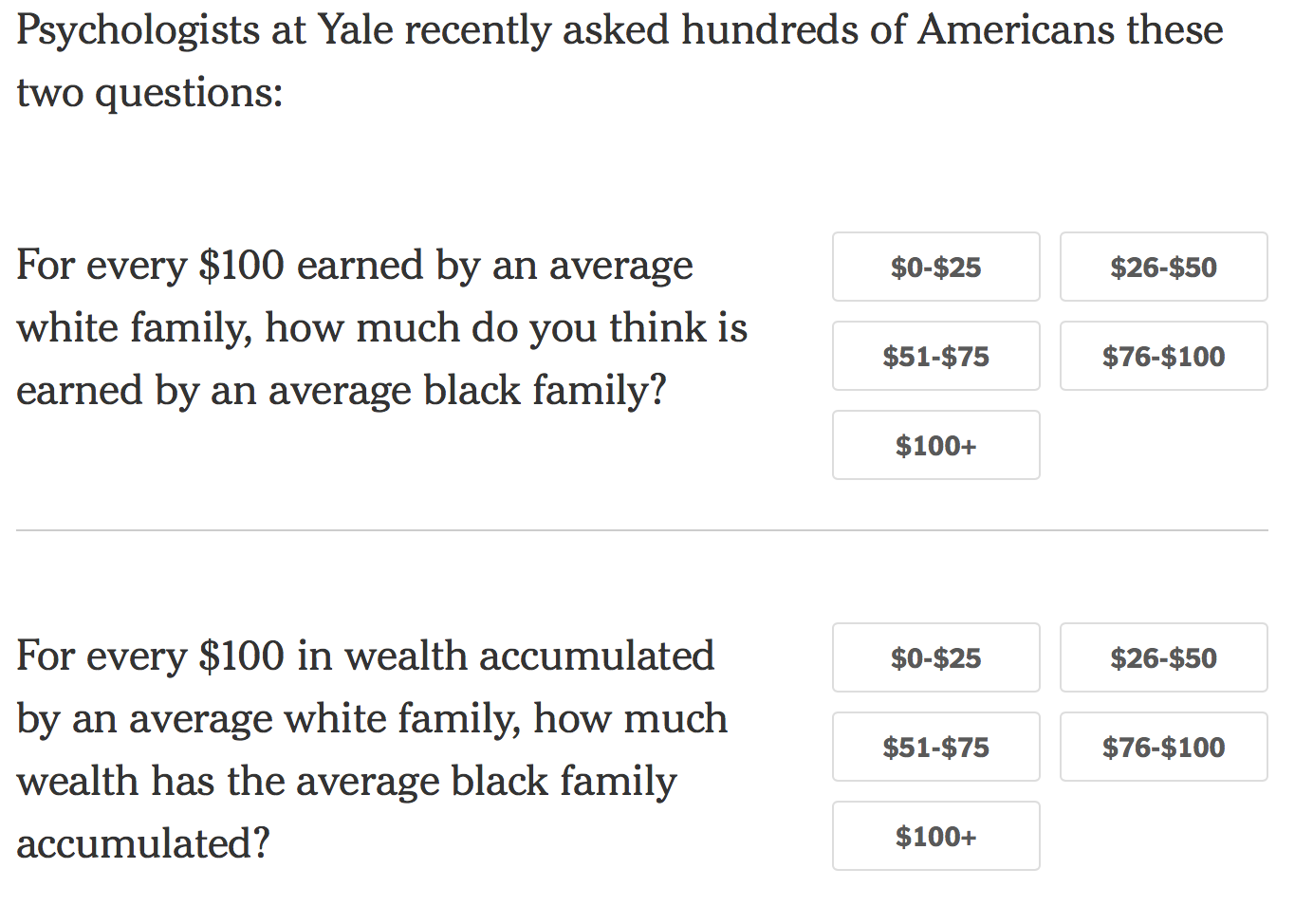
The Yale researchers suspected that many people would not get the answers right.

“I’m a person who studies inequality, who should really know how inequality looks,” said one of the psychologists, Michael Kraus, who researches the behaviors and beliefs that help perpetuate inequality. “And I look at the black-white gap, and I’m shocked at the magnitude.”

Black families in America earn just $57.30 for every $100 in income earned by white families, according to the Census Bureau’s Current Population Survey. For every $100 in white family wealth, black families hold just $5.04.

If Mr. Kraus, of all people, is taken aback by these numbers, what are the odds that most Americans have a good understanding of them? The answer, he and his colleagues fear, has broad implications for how we understand our society and what we’re willing to do to make it fairer.

Americans, and higher-income whites in particular, vastly overestimate progress toward economic equality between blacks and whites, the psychologists reported Monday in the Proceedings of the National Academy of Sciences. Americans believe that blacks and whites are more equal today than they truly are on measures of income, wealth, wages and health benefits. And they believe more historical progress has occurred than is the case, suggesting “a profound misperception of and unfounded optimism” regarding racial equality.

“It seems that we’ve convinced ourselves – and by ‘we’ I mean Americans writ large – that racial discrimination is a thing of the past,” said Jennifer Richeson, who was another of the study’s authors, along with Julian Rucker, a doctoral student. “We’ve literally overcome it, so to speak, despite blatant evidence to the contrary.”

To understand how people have perceived that progress, the researchers asked blacks and whites of varying income levels to estimate answers to the questions above in both recent years and historically. They also asked about how much black workers with a high school diploma but no college degree earn relative to whites of the same education level, and how the earnings of blacks and whites with a four-year college degree compare.

The present-day results, aggregated across several surveys used in the study, are compared here with actual government data:

The researchers suspect that the answer in part has to do with how little exposure Americans have to people who are unlike them. Given how economically and racially segregated the country remains, many Americans, and especially wealthy whites, have little direct knowledge of what life looks like for families in other demographic groups.

But the pattern this study identifies isn’t simply about lack of access to accurate information. As Mr. Kraus points out, popular videos and charts regularly circulate on social media highlighting the startling levels of inequality in America. And yet, many people who click on them forget about the severity of inequality just long enough to be surprised by it again in the future.

“Despite this information being out there, we don’t really take it in,” Mr. Kraus said. This happens “in a way that suggests that maybe we’re motivated to forget it, or motivated to distort it in our own minds.”

He and Ms. Richeson suspect that we also overgeneralize from other markers of racial progress: the election of a black president, the passage of civil rights laws, the sea change in public opinion around issues like segregation. If society has progressed in these ways, we assume there’s been great economic progress, too.

We’re inclined, as well, to believe that society is fairer than it really is. The reality that it’s not — that even college-educated black workers earn about 20 percent less than college-educated white ones, for example — is uncomfortable for both blacks who’ve been harmed by that unfairness and whites who’ve benefited from it.

“It’s very difficult to consider the possibility that some of what we’ve achieved or gained is due to forces that aren’t our own individual hard work,” Ms. Richeson said. “That’s hard to grapple with, especially in American society. We really believe in egalitarianism and meritocracy.”

These findings suggest that the motivation to see the world as fair may be even stronger in this context than stereotypes white Americans hold, for instance, equating blacks with poverty.

The researchers found in some additional surveys that whites answer these questions more accurately when they’re first asked to consider an America where discrimination persists. If we want people to have a better understanding of racial inequality, this implies that the solution isn’t simply to parrot these statistics more widely. It’s to get Americans thinking more about the forces that underlie them, like continued discrimination in hiring, or disparities in mortgage lending.

It’s a myth that racial progress is inevitable, Ms. Richeson said. “But it’s also dangerous insofar as it keeps us blind to considerable inequality in our nation that’s quite foundational,” she said. “Of course we can’t address it if we’re not even willing to acknowledge it.”

And if we’re not willing to acknowledge it, she adds, that has direct consequences for whether Americans are willing to support affirmative action policies, or continued enforcement of the Voting Rights Act, or renewed efforts at school desegregation.

Gatherings of Black people really not about whites: Paradkar

Paradkar on the recent controversies over Black only events:

Harvard’s event was one of two recent events that highlighted Western discomfort with majority-Black spaces.

The other was an event planned in France, where the mayor of Paris sought to ban the city’s first Afro-feminist festival in July because it was “forbidden to white people.” In saying that, Anne Hildalgo, the socialist mayor, co-opted the words of the far-right that had initiated the outrage.

The organizers there had said 80 per cent of the event space was open only to Black women. At Harvard, all were welcome, although not a lot of non-Black people showed up (and by the way, Stanford has had a Black graduation for 40 years).

Both these events predictably triggered accusations of reverse racism and segregation.This tweet by @lucky_american echoed views on various forums: “Are they also going to have a white commencement? If not, isn’t that kind of racist?”

Hidalgo even threatened to sue the festival’s leaders for discrimination.

“We continue to revel in the myth that our fundamental racial problems have been solved,” says Rinaldo Walcott, director of the Women and Gender Studies Institute at the University of Toronto. So these gatherings are viewed “as an affront to something they deeply believe doesn’t exist.”

If these events must be seen as separatist and divisive, then let’s at least acknowledge that one was separation as celebration, the other was separation as solidarity.

At Harvard, “the energy was electric and celebratory,” Morgan says. “It was about celebrating and recognizing that five per cent of the student population identifies as Black. It was about recognizing historically and globally this was that small fraction of people who have made it to the top university.”

The Harvard event was an ode to Black achievement in the face of historical and continued oppression. It celebrated achievements that would be lost, or not valued, in the university-wide celebration.

If Morgan’s achievements had not been acknowledged at the Black commencement, they might not have been acknowledged at all.

“In the U.S., the notion is, if you have reached the pinnacle of establishment, you are somehow outside of how poor black people are treated,” Walcott says.

That is simply not true. Studies have shown Black Ivy League graduates have about as much chance of getting a job as do white graduates from less prestigious state colleges.

For those who use the success of a Barack Obama or an Oprah Winfrey to suggest that anti-Black racism is over, the commencement was a reminder that Black success comes despite the system.

“They will try to craft our stories as examples of the benefits of personal responsibility,” Duwain Pinder, one of four speakers that day, was quoted saying in the Harvard magazine. “As proof that the American dream exists for all, rather than just a select few . . . . We are only a fraction of the Black brilliance that lies under the surface.”

In France, which prides itself on its egalité, why did a gathering of predominantly Black women threaten those who celebrate feminist gatherings of predominantly white women?

Months after its shameful ban on burkinis on beaches, the country showed once again that feminism of colour cannot escape the colonial gaze of white feminists who view other women as victims in need of rescuing from their cultures. Should those affected not be able to define their own struggle?

Mwasi-Collectif, the festival organizers, told France 24 the restricted entry was important so that Black women could have open, honest conversations without judgment from others.

Decrying that event is akin to telling feminists to allow men to set the agenda for their discussion.

Isn’t solidarity about supporting a space that allows excluded groups to think collectively and come to a resolution on how to move ahead?

Both these Black gatherings really weren’t about white people.

There was no reason to make them so.

Source: Gatherings of Black people really not about whites: Paradkar | Toronto Star