What the previous government learned about birth tourism: My article in Policy Options

Excerpt are my concluding observations:

All this being said, the number of births by foreign mothers should be monitored. Statistics Canada numbers may not present an accurate picture. The number of births to foreign women in Richmond was reported as 394 in 2016-17, greater than the 313 that Statistics Canada reported for the whole country for 2016 (see table above). The Richmond numbers showed a steady increase from 2010, compared with the flatter trend in national numbers. Statistics Canada and IRCC need to work with provincial health ministries to ensure more reliable and consistent data.

More focused measures need to be considered to reduce or contain birth tourism. Options include making it more expensive by increasing the deposit that mothers pay hospitals; making suspected birth tourism grounds for visa refusal; and banning or regulating “birth tourism hotels,” places catering to pregnant foreign women and the consultants who help make the related arrangements.

These concrete actions would be a more proportionate response to the concerns raised by politicians and their constituents, and one that should be pursued by any government to improve the integrity of the citizenship program and address public concerns about fraud and abuse.

It is also important that the motivation behind discussion and debates on birthright citizenship not be labelled as racist, xenophobic or anti-immigrant. The fundamental issue remains fraud and misrepresentation, not discrimination.

What the previous government learned about birth tourism

Richmond Hospital reports more “non-resident, self-pay” births than the provincial government reports “non-resident” births, due to birth registration discrepancy

An older article from June 29 this year that was brought to my attention following the CBC article thanks to Ian Young of the SCMP that helps explain the discrepancy between the vital statistics data collected by Statistics Canada and local reports:

The frequency by which birth tourism may be occurring in B.C. and across Canada is significantly underreported, however health officials in this province are near to closing a glaring reporting loophole.

For instance, a discrepancy between how births by non-residents are reported at Richmond Hospital and how they are reported to the B.C. Ministry of Health could soon be rectified by provincial health officials, according to a ministry spokesperson.

“In the past, the Ministry of Health has tracked non-resident births by the address listed by parents on a baby’s birth registration, which could be local or international. Hospitals will typically go by whether or not patients are paying out-of-pocket for services to determine if someone is a resident of British Columbia,” stated spokesperson Laura Heinze, via email last week, to the Richmond News.

“We are currently in the process of aligning these reporting methods in order to get a more accurate picture of non-resident births across British Columbia,” Heinze added.

The existing reporting system can create significant discrepencies in tracking because many of the non-resident women who give birth at the Richmond Hospital list their address as the “birth house” where they may be living at the time.

In Richmond, Chinese nationals are known to stay at such houses, of which there are dozens identified by the provincial government and numerous advertised online both in China and Canada. As part of advertised month-to-month accommodation packages, birth house operators typically assist women with anything from tour guides, passport applications, doctor appointments, some pre- and post-natal care as well as hospital registration.

And so, should the birth house operator list the address of their home business at the hospital’s registration desk, the ministry would not count the baby as a non-resident. Only when the true address of the mother is registered, does the birth become a non-resident in the eyes of Vital Statistics B.C., noted Heinze.

Whereas Richmond Hospital reported 299 “self-pay” births from non-resident mothers in the 2015-16 fiscal year and 379 in the 2016-2017 fiscal year, Statistics Canada only reported 99 births in B.C. in 2016 where the “Place of residence of [the] mother [is] outside Canada.”

Across Canada there were only 313 such births reported in 2016.

Statistics Canada told the News the Canadian Vital Statistics Birth Database collects demographic data annually from all provincial and territorial vital statistics registries on all live births in Canada.

“To the best of our knowledge, there is currently no government department or agency tasked with identifying and collecting data on births to non-resident mothers,” noted Statistics Canada spokesperson France Gagne.

From 2004 to 2010 the hospital helped birth, on average, 18 new Canadians per year from non-resident mothers. Numbers rose dramatically in 2014 and have risen steadily since, to the point where one in five births in Richmond are to foreign nationals.

While immigration lawyer Richard Kurland notes not all non-resident births are necessarily a result of birth tourism, Richmond may be at the epicentre of a burgeoning, and legal, birth tourism industry, whereby visiting foreign nationals seek to have “anchor babies,” who automatically become Canadian citizens under Canada’s citizenship laws.

Kurland said the key to good data is determining immigration/visitor status of the mom.

A national, public petition penned by Richmond resident Kerry Starchuk and sponsored by Steveston-Richmond East Liberal MP Joe Peschisolido aims to officially condemn birth tourism and study remedies to what Peschisolido describes as an abuse of the immigration system.

“Underground and unregulated ‘for profit’ businesses have developed both in Canada and ‘countries of origin’ to facilitate the practice of ‘Birth Tourism’; and the instances of ‘Birth Tourism’ are increasing in multiple cities across Canada,” the petition notes online.

Peschisolido disagrees with Conservative counterparts who have called for an end to birthright citizenship.

As birth tourism climbs in B.C., health authority files $312,595 lawsuit over one unpaid childbirth bill

Although the overall number of birth tourists is low compared to the total number of births in Canada (see What happened to Kenney’s cracking down on birth tourism? Feds couldn’t do it alone | hilltimes.com), appropriate to ensure that any unpaid bills are collected. “Birth houses” at a minimum need to be regulated if not banned given this is clearly an abuse, even if relatively small, of our immigration and health systems:

Record numbers of  so-called birth tourists, mainly from China, are expected at Richmond Hospital this year. Yet the Vancouver Coastal Health Authority has no plans to deter women from having their babies at the hospital to give them Canadian citizenship, despite suing a woman for nonpayment of $313,000 for her delivery.

The lawsuit filed in April relates to a birth in 2012 that involved complications and kept the lawsuit defendant, Yan Xia, and her infant, in the hospital for an extended time. Xia has not yet filed a statement of defence.

Although the hospital reserves the right to add interest charges of two per cent a month to unpaid bills, a spokeswoman said that is not the plan at this point. If such interest were to be added, the bill would exceed $1 million.

There has been a steady increase in the number of babies born to non-resident mothers at Richmond Hospital, to 384 in 2016-17 from 18 in 2010. Halfway through the 2017-18 fiscal year, there were 189 non-resident births, according to VCH spokeswoman Carrie Stefanson.

While all pregnant women are asked to register well in advance of giving birth so that hospital resources can be planned, there have been no measures taken by the hospital to deter birth tourism, which now accounts for 20 per cent of its deliveries. That is believed to be the highest proportion in the province, if not Canada. B.C. Women’s Hospital discourages birth tourism through various policies and practices. At times, Richmond Hospital has to send local women in labour to other hospitals when it is too busy.

The birth tourism phenomenon is tied to several factors, including Richmond’s demographics, a preponderance of “birth houses” for pregnant Chinese women in the city, the large number of doctors and nurses who speak Cantonese or Mandarin, and an industry fuelled by brokers who charge high fees to make the arrangements for women wanting to have so-called “anchor” babies in Canada.

Stefanson said she believes the Xia case is the only maternity lawsuit over $100,000 so far. Typically, the health authority uses other means to collect unpaid bills.

“VCH has invoiced non-residents for approximately $43 million in (all kinds of medical) services in the past year, and has collected about 80 per cent of that amount,” she said.

In the Xia case, such efforts have been unsuccessful, and with a six-year deadline for legal action approaching, the health authority decided it was time to take that action. Xia’s whereabouts are unknown.

Stefanson said the hospital exists to provide health care and will never deny urgent hospital care to anyone based on their ability to pay or where they are from.

She said the health authority expects foreigners will have travel insurance or some other means of paying. Non-resident pregnant women who go to any hospital in B.C. are expected to pay a deposit of $8,200 for a vaginal birth and $13,300 for a caesarean delivery. If they stay in the hospital for at least a night, there may be additional charges. In the past year, VCH has invoiced non-resident maternity clients $6.2 million, and 82 per cent of that amount has been recovered.

An article posted on the “Hongcouver” blog in the South China Morning Post says Richmond is at the centre of the birth tourism phenomenon. It highlighted one “birth house” called the Baoma Inn and its Instagram account showing photos of smiling expectant or post-delivery Chinese mothers enjoying touristy outings around Vancouver. Also pictured are newborns asleep, next to their new Canadian passports. In addition to pre- and post-partum accommodation, the inn is said to be able to arrange birth certificate and passport services plus getting newborns enrolled in the B.C. Medical Services Plan so they can receive publicly funded health care after they’ve resided in the province for three months.

The Baoma Inn is one of the dozens of so-called birth houses in Richmond. It is not known what birth house the defendant in the VCH case used, or even if she stayed in one.

The South China Morning Post article pointed out that Canada is one of a few countries (including the U.S.) that offers citizenship to babies born in the country, regardless of the nationality of parents. By contrast, in China, nationality is acquired upon birth only if one parent is a Chinese national, similar to policies in Australia and Britain.

David Georgetti, the Mandarin-speaking lawyer retained by VCH to litigate the case, could not be reached for comment.

Source: As birth tourism climbs in B.C., health authority files $312,595 lawsuit over one unpaid childbirth bill

Richmond woman’s petition calls for end of birth tourism in Canada

While the overall national numbers are, this has been an ongoing issue in Richmond. The call for better national data makes sense as does regulation (provincial medicare data could likely capture this – see ICYMI: Petition to Parliament calls for end to automatic citizenship to end ‘birth tourism’):

A petition by a group of Metro Vancouver residents is demanding Ottawa crack down on birth tourism in Canada.

Richmond resident Kerry Starchuk started the electronic petition. She has been campaigning on this issue for the last two years since discovering a neighbouring house was a so-called “birth house,” which caters to pregnant women who come to Canada to give birth so their child is automatically granted Canadian citizenship.

“It’s wrong. It’s jumping the queue,” said Starchuk of the practice, an increasing trend in Richmond where the majority of birth tourists hail from China.

In 2016-2017, 384 babies were born to non-residents at Richmond Hospital, said Vancouver Coastal Health — a significant jump from 18 cases in 2010. Between 2014 and 2017, 1,020 newborns were born to non-residents.

The rise in birth tourism has spawned an underground economy with unregulated agencies and brokers offering services to pregnant clients, including airport pickups, room and board, and assistance with obtaining documents such as a Canadian passport for the infant.

For Starchuk, birth tourism undermines the value of Canadian citizenship by essentially buying a lifetime’s privilege for the price of a hospital procedure, housing costs, and a return plane ticket.

“It’s not truthful, it’s deceitful and it’s short-sighted,” she said. “We don’t know what the consequences are going to be in 18 years. Are we prepared for it?”

The petition, identified as E-1527 in the House of Commons, is sponsored by Liberal Richmond MP Joe Peschisolido. It calls on the federal government to denounce birth tourism; determine the extent of the practice in Canada; and implement measures to reduce and eliminate it. It has received more than 620 signatures as of Tuesday.

Gary Liu, whose family immigrated to Taiwan when he was a teen, said most immigrants are also against birth tourism.

“Almost all of them despise this kind of practice,” said Liu, a Burnaby resident. “This is a very unfair practice to all immigrants.”

The petition is Starchuk’s second attempt to get the federal government to take action.

Her first petition in 2016, sponsored by Conservative MP Alice Wong, urged the government to end jus soli, or automatic birthright citizenship.

It received more than 8,800 signatures and was presented to the House of Commons, but went nowhere because the government felt revoking birthright citizenship would require a major overhaul of how Canadian citizenship is granted.

Liu said the rejection of that petition in 2016 was seen by some as an endorsement by the federal government of birth tourism. He hopes this second petition will gain more traction.

Starchuk said birth tourism happens across Canada, but are most prevalent in Richmond and Toronto, where the women are usually from Russia or Nigeria.

In 2016, the B.C. government said it was aware of 26 birth houses in the province.

Starchuk said more data is needed to get a grip on the extent of the practice in Canada.

“We’re hoping to have Canada-wide statistics,” she said. “We don’t know if it could be happening in West Vancouver or Langley.”

Vancouver Coastal Health spokeswoman Carrie Stefanson said figures for babies born to non-residents in other hospitals in the region are not immediately available, but said those numbers would be small.

The health authority “does not endorse or support marketing of maternity tourism and we are concerned about the impact it is having on our ability to provide quality services to every resident maternity patients,” Stefanson said.

Women who intend to use Richmond hospital to give birth are asked to pre-register six to eight weeks before their due date in order to enable to hospital to plan ahead.

Stefanson said Vancouver Coastal Health is committed to collecting payment from non-residents who use medical services, but wouldn’t deny urgent care based on a person’s ability to pay.

Peschisolido, who is in Ottawa, denounced birth tourism in a statement issued to media on Tuesday.

“Birth tourism is wrong,” he said. “Women are being exploited by organized efforts to take advantage of the system.”

Source: Richmond woman’s petition calls for end of birth tourism in Canada

Birth tourism brings Russian baby boom to Miami – NBC News

As in the case of similar debates in Canada, the conversation largely occurs based on anecdotal evidence rather than hard data (see my analysis of the push by the Conservative government against birthright citizenship and the relatively small numbers involved What happened to Kenney’s cracking down on birth tourism? Feds couldn’t do it alone).

The estimated annual numbers – 36,000 according to The Center for Immigration Studies which wants stricter limits on immigration – is small compared to the overall number of births of about four million (2015), or about 0.9 percent:

Lured by the charm of little Havana or the glamour of South Beach, some 15 million tourists visit Miami every year.

But for a growing number of Russian women, the draw isn’t sunny beaches or pulsing nightclubs. It’s U.S. citizenship for their newborn children.

In Moscow, it’s a status symbol to have a Miami-born baby, and social media is full of Russian women boasting of their little americantsy.

“It’s really common,” said Ekaterina Kuznetsova, 29. “When I was taking the plane to come here, it was not only me. It was four or five women flying here.”

Ekaterina was one of dozens of Russian birth tourists NBC News spoke to over the past four months about a round-trip journey that costs tens of thousands of dollars and takes them away from home for weeks or months.

Why do they come?

“American passport is a big plus for the baby. Why not?” Olesia Reshetova, 31, told NBC News.

“And the doctors, the level of education,” Kuznetsova added.

The weather doesn’t hurt, either.

“It’s a very comfortable place for staying in wintertime,” Oleysa Suhareva said.

It’s not just the Russians who are coming. Chinese moms-to-be have been flocking to Southern California to give birth for years.

What they are doing is completely legal, as long as they don’t lie on any immigration or insurance paperwork. In fact, it’s protected by the 14th amendment to the U.S. Constitution, which says anyone born on American soil is automatically a citizen.

The child gets a lifelong right to live and work and collect benefits in the U.S. And when they turn 21 they can sponsor their parents’ application for an American green card.

As president, Donald Trump has indicated he is opposed to so-called chain migration, which gives U.S. citizens the right to sponsor relatives, because of recent terror attacks. And as a candidate, he called for an end to birthright citizenship, declaring it in one of his first policy papers the “biggest magnet for illegal immigration.”

“You have to get rid of it,” he said on “Meet the Press” on NBC. “They’re having a baby and all of a sudden — nobody knows — the baby is here. You have no choice.”

In a twist, as the Daily Beast first reported, condo buildings that bear the Trump name are the most popular for the out-of-town obstetric patients, although the units are subleased from the individual owners and it’s not clear if building management is aware.

There is no indication that Trump or the Trump Organization is profiting directly from birth tourism; the company and the White House did not respond to requests for comment.

Roman Bokeria, the state director of the Florida Association of Realtors told NBC News that Trump- branded buildings in the Sunny Isles Beach area north of Miami are particularly popular with the Russian birth tourists and Russian immigrants.

“Sunny Isles beach has a nickname — Little Russia — because people who are moving from Russian-speaking countries to America, they want … a familiar environment.”

“They go across the street, they have Russian market, Russian doctor, Russian lawyer,” he added. “It’s very comfortable for them.”

Reshetova came to Miami to have her first child, hiring an agency to help arrange her trip. The services — which can include finding apartments and doctors and obtaining visas — don’t come cheap. She expects to pay close to $50,000, and some packages run as high as $100,000. Bokeria says some landlords ask for six months rent up front.

One firm, Miami Mama, says it brings about 100 Russian and Russian-speaking clients to the U.S. per year, 30 percent of them repeat clients. The owners are Irina and Konstantin Lubnevskiy, who bought Miami Mama after using the firm to have two American children themselves.

The couple says they counsel clients to be completely transparent with U.S. immigration officials that they’re expecting.

“We tell every client, ‘You have the documents, you have to tell the truth. This is America. They like the truth here,'” Konstantin said.

“I would like the American people to understand they don’t have to worry,” he added. “Those who come here want to become part of the American people.”

But Miami Mami has drawn scrutiny from law enforcement. In June, it was raided by the FBI, and an employee was convicted of making false statements on passport applications. The owners say they knew nothing about it, fired the worker and their business license was renewed.

Federal prosecutors declined to comment on the case, and the FBI said it could not discuss “an active investigation.”

There is no official data on birth tourism in the United States. The Center for Immigration Studies, which wants stricter limits on immigration, estimates there are 36,000 babies born in the U.S. to foreign nationals a year, though the numbers could be substantially lower. Florida says births in the state by all foreign nationals who live outside the United States have jumped 200 percent since 2000.

Customs and Border Protection says there are no laws governing whether pregnant foreign nationals can enter the country or give birth here.

“However, if a pregnant woman or anyone else uses fraud or deception to obtain a visa or gain admission to the United States, that would constitute a criminal act,” the agency said.

When federal agents raided California “maternity hotels” catering to Chinese clients in 2015, authorities said in court papers that some of the families falsely claimed they were indigent and got reduced hospital rates.

In Miami, the Jackson Health System said 72 percent of international maternity patients — who represented 8 percent of all patients giving birth last year — pay with insurance or through a pre-arranged package.
via Birth tourism brings Russian baby boom to Miami – NBC News

ICYMI: Petition to Parliament calls for end to automatic citizenship to end ‘birth tourism’

Again, the same small numbers. Again, the Conservative government considered ways to address this through working with the provinces or a separate federal system and the costs were too high relative to the small numbers (500 in their estimate) to warrant the additional costs.

Far better to continue to monitor non-resident births and prohibit consultancy services and ‘birth houses,’ and enforce the prohibition:

Thousands of Canadians have signed an electronic petition urging the government to restrict automatic citizenship rights for babies born in Canada to foreigners in an effort to stop what they call “birth tourism.”

The petition was presented in Parliament this week by B.C. Conservative MP and former cabinet minister Alice Wong.

The 8,886 signatories want to change Canada’s birthright citizenship law they say “enables an abusive and exploitative practice” where “expectant mothers who are foreign nationals with no status in Canada can gain automatic citizenship for their children born within Canada.”

Wong said the issue is “significant” in her riding of Richmond Centre, as well as other large cities like Toronto and Calgary.

She said “birth houses,” which are sometimes dubbed “maternity motels,” have sprouted up, operating as temporary lodging for pregnant women from other countries. Some are waiting to qualify for health insurance, while others pay for the hospital services, Wong said.

“Immigration and our diversity is what makes Canada unique. It is also important to protect the integrity of our immigration system and ensure that new Canadians join our country in a way that is fair,” she said in an email.

The petition notes that Canada is one of only two developed countries that have not moved to end automatic citizenship due to “widespread abuse.”

The other is the U.S., where Republican presidential nominee Donald Trump has controversially called for an end to “anchor babies.”

But the issue of “birth tourism” is flaring up in other countries as well. The U.K. does not have birthright citizenship, but British Prime Minister Theresa May recently suggested establishing passport checks on pregnant women at hospitals to crack down on the growing number travelling from other countries to take advantage of free hospital services.

‘Nothing’s right about it’

The petition says the practice of birth tourism can be costly to taxpayers for health and education and other social services. Once 18 years old, someone born in Canada can sponsor parents and other family members.

Kerry Starchuk, a resident of Richmond, B.C. who launched the petition, said Canadian citizenship should not be automatically granted when neither parent has any status or ties to the country.

She said she became aware of the issue after noticing a residence next door to her was housing a “revolving door” of pregnant women.

She believes there is a growing underground economy where commercial enterprises help bring over and accommodate women from other countries to give birth in Canada.

“Nothing’s right about it,” she said. “It needs to stop or more and more people will take advantage of the loophole.”

‘No plan to change policy’

The government has 45 days to formally respond to the petition, but Camille Edwards, spokeswoman for Immigration, Refugees and Citizenship Minister John McCallum, said no change is in the works.

“Children born in Canada to parents who are temporarily in the country (except children of diplomats, other representatives or employees in Canada of a foreign government) are automatically Canadian citizens under the Citizenship Act,” she said in an email. “There is no current plan to change this policy.”

The Immigration Ministry does not collect data related to this issue.

Statistics Canada shows the number of births in Canada to mothers of residence outside Canada climbed from 247 in 2008 to 699 in 2012, the last year figures are available. But those numbers could include some Canadians who live abroad, but return to Canada to give birth.

Lori Cascaden, media relations manager for B.C.’s Ministry of Health, said non-resident births account for approximately two per cent of the 44,000 babies born in the province each year. She said residents of other countries give birth in Canada for a variety of reasons, including premature or unexpected labour.

Maternity tourism

She said the top priority is to ensure all babies are safely welcomed to the world, no matter where they are from. But non-residents must pay all the associated costs, with revenue put back into the system.

“The ministry in no way endorses or supports the marketing of maternity tourism,” Cascaden said, adding that “Immigration Canada should be responding to allegations of someone coming to Canada for the sole purpose of giving birth.”

B.C. has an eligibility, compliance and enforcement unit that monitors this issue, she said.

Source: Petition to Parliament calls for end to automatic citizenship to end ‘birth tourism’ – Politics – CBC News

Number of babies born in U.S. to unauthorized immigrants declines | Pew Research Center

This is the most authoritative data I have seen on anchor babies (distinct from birth tourism as anchor babies generally refer to children of long-term residents rather than short-term visitors).

The numbers are significant, reflecting the large number of unauthorized immigrants in the US (and comparative lack of pathways to citizenship), and explain in part political discourse around immigration:

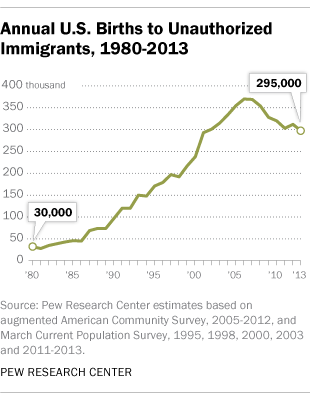
About 295,000 babies were born to unauthorized-immigrant parents in 2013, making up 8% of the 3.9 million U.S. births that year, according to a new, preliminary Pew Research Center estimate based on the latest available federal government data. This was a decline from a peak of 370,000 in 2007.

Annual U.S. Births to Unauthorized Immigrants, 1980-2013Births to unauthorized-immigrant parents rose sharply from 1980 to the mid-2000s, but dipped since then, echoing overall population trends for unauthorized immigrants. In 2007, an estimated 9% of all U.S. babies were born to unauthorized-immigrant parents, meaning that at least one parent was an unauthorized immigrant.

The 14th Amendment to the U.S. Constitution, adopted in 1868, grants an automatic right of citizenship to anyone born in the United States. But in recent years, some politicians have called for repeal of birthright citizenship, including Republican presidential candidate Donald Trump, who says that so-called anchor babies are a magnet for illegal immigration.

A Pew Research survey in February 2011 found that a majority of Americans (57%) opposed changing the Constitution to end birthright citizenship, while 39% favored such a change. That same survey found that most Americans (87%) said they were aware of the constitutional guarantee of birthright citizenship.

Number and Share of U.S. Births to Unauthorized Immigrants, 1980-2013There were an estimated 11.3 million unauthorized immigrants living in the U.S. in March 2013, according to a preliminary Pew Research estimate. They make up 4% of the population, but their share of births is higher because the immigrants include a higher share of women in their childbearing years and have higher birthrates than the U.S. population overall.

These estimates are based on data from the U.S. Census Bureau’s Current Population Survey and American Community Survey, using the widely accepted “residual methodology” employed by Pew Research for many years.

Most children of unauthorized immigrants in the U.S. are born here, and therefore are citizens. In 2012, there were 4.5 million U.S.-born children younger than 18 living with unauthorized-immigrant parents. There also were 775,000 children younger than 18 who were unauthorized immigrants themselves and lived with unauthorized-immigrant parents. These totals do not count U.S.-born children of unauthorized immigrants who do not live with their parents.

The nation’s unauthorized immigrants are more likely than in the past to be long-term residents of the U.S., and are increasingly likely to live with U.S.-born children. In 2012, there were 4 million unauthorized-immigrant adults who lived with their U.S.-born children, both minor and adult. They made up 38% of unauthorized immigrant adults. By comparison, in 2000, 2.1 million unauthorized-immigrant adults, or 30% of this group, lived with their U.S.-born children, minor and adult.

These new estimates, which include a 2008 estimate of 355,000 births to unauthorized-immigrant parents, differ slightly from a previous estimate for 2008 of 340,000 births to unauthorized parents, because they use different data sources and methodology.

Source: Number of babies born in U.S. to unauthorized immigrants declines | Pew Research Center

Is ‘birth tourism’ a problem in Canada? Doctors on frontline of debate

All the available evidence shows that the numbers are extremely small, both in absolute terms and in relation to the overall number of births in Canada.

IRCC, if it is not already doing so, should be systematically collect better quality data, working with provincial health ministries, rather than the piece meal data that we have now.

Despite the small numbers, there is a need to regulate or prohibit birth tourism consultancy services to avoid a further increase in the numbers. The CMA might also wish to take a more pro-active role.

Changing birthright citizenship, as the previous government learned, is not feasible without provincial buy-in given the various linkages between provincial vital statistics agencies and healthcare systems and any measure to restrict birthright citizenship:

Birth tourism appears to be on the rise in some parts of Canada, raising questions for doctors and hospitals, as well as debate about Canada’s practice of offering instant citizenship to infants born in the country.

“We sense there’s a growing demand in birth tourism from several countries, especially considering the instability in today’s world,” Alex Davidson, managing partner of the Toronto-based LP Group, told CTV News. “There are more and more people coming in and approaching us.”

Davidson said he typically sees two types of clients. Some are wealthy individuals, often from European countries, who want a “second passport” for their children and are able to pay anywhere between $10,000 and $20,000 to deliver a baby in Canada.

Davidson said some of his recent clients have included U.K. residents worried about the post-Brexit future once their country leaves the European Union.

Others are people from poor, crime-ridden countries who want to provide security for their children, and hope that their Canadian babies can provide an anchor in the country for the rest of the family.

“Canada has been perceived — well, it is — as a safe harbour on this planet,” Davidson said.

He said LP Group helps birth tourism clients find temporary accommodations in the country and the firm also has a list of Canadian doctors who are willing to see foreign patients.

“Elena” is a pregnant woman from Russia now awaiting to give birth in Toronto. She spoke to CTV News on condition of anonymity.

“My baby will get Canadian citizenship upon delivery and also with a Canadian passport he will get some benefits like free school and free healthcare,” she said. “It is good for the baby I think because the baby gets to choose if he wants to live in Russia, as in my case, or in Canada.”

At a recent Society of Obstetricians and Gynecologists of Canada conference, Dr. Fiona Mattatall an obstetrician in Calgary, presented figures that show an increase in the number of overseas patients who have given birth in Calgary hospitals.

She said there are now about 10 “passport babies” born each month in the city’s hospitals. Her survey also found many doctors are uncomfortable with the practice.

While many overseas patients pay to have their babies delivered in Canada, some do not, leaving hospitals on the hook for the costs.

Dr. Saul Pytka, a Calgary anesthesiologist, said he’s alarmed by the issue.

“I am frustrated — and I have to be honest, angered — by the fact that as a society we are being abused. I think we are a very generous society,” he said.

Under the Citizenship Act, all babies born on Canadian soil are automatically granted citizenship, except for children of foreign diplomats.

Canada and the United States are the only G7 countries that have birthright citizenship. Other countries like France, Germany and Australia have revoked automatic citizenship unless at least one of the parents is a national citizen.

Birth tourism is not illegal in Canada. There is no official federal data on “birth tourism,” and some say the numbers are still small. According to Statistics Canada figures from 2012, the most recent year for which numbers are available, there were only 699 babies born in Canada to foreign mothers out of more than 382,000 births across the country.

But one immigration consultant says there has “certainly” been an increase in birth tourism in Canada over the past few years with sites advertising companies that assist in getting pregnant women to Canada.

“The best gift you can give your child is a Canadian passport” says one website.

A potentially costly overhaul

In 2014, immigration officials urged the Conservative government to restrict granting citizenship by birth on Canadian soil to children with at least one parent who is a citizen or permanent resident.

But the report cited limited data and possible increased costs to provinces and territories as potential barriers to legislation reform.

Will Tao, a Vancouver-based immigration lawyer, told CTV News Channel last week that overhauling birthright citizenship rules could be extremely costly for Ottawa.

“Let’s actually look at what are the motivating factors, what are the organizations that are working abroad, perhaps without reference to Canadian law, and promoting individuals to come here,” Tao said.

Online searches turn up dozens of organizations and groups in various countries that offer advice and help facilitate travel for women who want to give birth in Canada.

“Perhaps it is not illegal right now, but perhaps it needs to be curbed or organizations that are running the services need to be stopped,” Tao said.

He also said that panic over birth tourism, especially in British Columbia, is being fuelled by a “general misunderstanding of who a foreign national is.”

Many foreign nationals have study or work permits, “and in my mind these individuals are all on the pathway to permanent residency,” Tao said.

A petition that seeks to eliminate automatic citizenship for babies born to foreign nationals in Canada is adding fire to the debate.

Kerry Starchuk, a Richmond, B.C., woman, is calling on the federal government to enact legislation that will require at least one parent to be a Canadian citizen or permanent resident in order for a baby born on Canadian soil to be granted automatic citizenship.

The petition, sponsored by Conservative MP Alice Wong, has garnered more than 6,700 signatures since June 16 and will eventually be introduced in the House of Commons.

Starchuk said she started the petition because she suspects a house next door to hers serves as a motel for pregnant foreigners who come to Canada to secure birthright citizenships for their babies.

Source: Is ‘birth tourism’ a problem in Canada? Doctors on frontline of debate | CTV News

In a related story, the Canadian Medical Protective Association highlights potential medical and liability issues:

The Canadian Medical Protective Association is cautioning doctors about providing medical services to birth tourists coming here to have babies in order to acquire Canadian citizenship for their newborns.

“Canadian physicians who provide care to non-residents are at increased risk of medical-legal difficulties arising outside of Canada,” says a notice from the CMPA. “The Association is not structured to assist when medical-legal actions are instigated by non-residents outside of Canada.”

The CMPA is the legal defence organization for doctors; it provides and pays lawyers and settlements when doctors are sued for malpractice by Canadian patients. The new bulletin to physicians regarding medical tourism is relevant and timely, given a local trend where an ever-increasing number of non-residents (from 18 in 2010 to 339 last year) are having their babies, mostly at Richmond Hospital. The Vancouver Sun and The Province have reported that the provincial government is now aware of more than two dozen “birth houses” where pregnant women stay prior to, and after, the births of their babies, before returning to China.

Birth tourism brokers marketing their services show photos of Lower Mainland hospitals and lists of Mandarin speaking doctors to deliver babies.

The CMPA statement — titled “Emerging trends and medical-legal risks in medical tourism” — warns that while there are still more Canadians travelling abroad for medical treatment than foreign visitors coming here, there are risks to think about for both patient groups. Doctors should ensure foreign patients sign agreements promising not to sue outside of Canada and they should also make sure they fully document discussions with non-residents and the care provided to them.

 The CMPA said it cannot share information about the number of doctors sued by birth tourists. But it is attuned to the broader trend of medical tourism.

“We have published guidance for physicians on the medical-legal risks associated with medical tourism and the steps they can take to mitigate risks associated with this practice,” said Dr. Doug Bell, a managing director at CMPA.

Source: Canadian birth tourism doctors cautioned on risk of liability | Vancouver Sun

Nothing illegal about birth tourism at B.C. hospitals

More on birth tourism – numbers cited still small in relation to overall live births (about 44,000 in British Columbia 2014/15 ) but the local impact on the Richmond Hospital and residents being turned away should raise some concerns (according to the reporter, Pamela Fayerman, Richmond has the highest numbers of such births).

The relatively small numbers involved do not support the elimination of birthright citizenship but it is valid to question whether governments should regulate or prohibit birth tourism agencies or brokers.

For the overall numbers, see my earlier piece, What happened to Kenney’s cracking down on birth tourism? Feds couldn’t do it alone | hilltimes.com:

Federal authorities say foreign nationals coming to Vancouver to have babies aren’t breaking any laws as long as they can show they have money to pay for their medical care.

Birth tourism is becoming increasingly popular, especially in Richmond, where non-resident births are steadily rising, from just 18 in 2010 to 339 in the past fiscal year. Women primarily from China are seeking labour and delivery services at Richmond Hospital. Canada Border Services spokeswoman Sarah Lawley-Wakelin said pregnancy is “not a reason in itself to not admit a tourist.

“But if a foreigner is seeking entry to Canada for the express purpose of undergoing medical treatment and can’t show they have the money to pay for it, then that could be deemed by a CBSA officer as a potential excessive demand on health service, thus making that individual inadmissible.”

Chinese nationals must have a temporary (tourist/visitor) resident visa (TRV) to enter Canada and must state the purpose of travelling to Canada, said Nancy Caron, spokeswoman for Immigration, Refugees and Citizenship Canada (IRCC).

“People should always be honest about the purpose of their visit when applying to come to Canada. It is a serious crime to lie or to provide false information or documents when dealing with (IRCC). Lying on an application or during in an interview with an IRCC officer is fraud and it is a crime,” Caron said.

 Asked if there have been any investigations, charges or convictions against foreigners who didn’t admit they were coming to Canada to have a baby, she said:

“Immigration, Refugees and Citizenship Canada isn’t aware of any investigations into foreigners who didn’t admit they were entering Canada solely for the purpose of giving birth to a baby.”

Vancouver immigration lawyer Steven Meurrens said the increasing popularity of birth tourism would appear to be so mothers can obtain Canadian citizenship, passports, birth certificates and other documents for their newborns. “You’ve got women who do it to help their child and those who think it will give them a leg up on their own immigration efforts. So these are so-called anchor babies, yes.”

Since 1947, the Citizenship Act has guaranteed Canadian citizenship for those born here, Meurrens said, and although the previous Conservative government under Stephen Harper explored changes to the Act, nothing was done.

Meurrens said while birth tourism may “leave a bad taste in some people’s mouths” Canada has forever been a “settler society” and birth on soil citizenship is “central to our laws.”

“Where the real problems arise is when people skip out on their medical bills,” he said.

Freedom of information documents supplied to Postmedia by the B.C. government show that half of non-resident bills related to births are paid. Meurrens said since there are agencies or birth tourism brokers running birth houses — 26 at last count that the government is aware of — it may be possible for authorities to collect funds from them.

Meanwhile, more than a dozen pregnant Richmond residents were turned away from their local hospital in the past 18 months because it was too full to accommodate them.

Source: Nothing illegal about birth tourism at B.C. hospitals | Vancouver Sun

Inside the shadowy world of birth tourism at US ‘maternity hotels’

More on birth tourism, US perspective. Still relatively light on the numbers (Canadian numbers are very small – see earlier post What happened to Kenney’s cracking down on birth tourism? Feds couldn’t do it alone | hilltimes.com):

Birth tourism companies have flourished in recent years, according to federal officials — and many of them prefer hard-to-track cash to fuel their operations.

That money, federal officials allege, is being pocketed by a group of individuals who have skirted tax law, flouted immigration laws and helped their clients defraud U.S. hospitals of tens of thousands of dollars for each baby born.

On Tuesday, federal agencies, including Immigration and Customs Enforcement and the IRS, along with the Los Angeles Police Department, conducted a massive operation to raid more than 30 California locations operated by “birth tourism businesses.” Officials collected piles of evidence that will likely be used against some of the “maternity hotel” operators in future prosecutions.

The companies advertise their services online — and no foreign language skills are necessary to guess the subtext.

…According to court documents, birth tourists were told to avoid traveling directly to Los Angeles International Airport from overseas, to avoid raising suspicion. They might even consider studying U.S. culture and booking recreational visits in order to make their travel seem more legitimate, the company advised. Alternate arrival ports such as Hawaii or Las Vegas were preferable.

You Win paid more than $60,000 a year to rent Southern California apartments that housed the women, according to court documents. Federal officials believe that StarBabyCare operated a “maternity hotel” from at least 10 units at one complex.

via Inside the shadowy world of birth tourism at ‘maternity hotels’ – The Washington Post.