Biden Made the Judiciary More Diverse—but Not More Liberal

Interesting analysis. Would be useful to have a similar systematic analysis of Canadian judicial appointments under Trudeau (may have missed one:

President Biden left his mark on the federal judiciary by installing a large number of appointees from diverse backgrounds, but he made few inroads on changing the ideological balance of courts that Donald Trump made more conservative during his first term.

Now, Trump’s return to office could ensure that the federal courts lean solidly in a conservative direction for years to come.

In terms of raw confirmation numbers, Biden edged Trump’s first term by a nose, appointing 235 judges to Trump’s 234. But the Democrat had the opportunity to appoint just one Supreme Court justice, Ketanji Brown Jackson, and he installed nine fewer judges than Trump to the powerful U.S. courts of appeals, which sit one level below the high court. 

Many of Biden’s appointees to those courts succeeded other like-minded judges, meaning that the overall ideological dynamics didn’t change much.

Where Biden made a lasting impact, however, was in appointing judges that represent a broader swath of America. About 60% of the judges he installed were people of color, according to the Leadership Conference on Civil and Human Rights. And more than 60% were women. 

Biden noted in December that he appointed more Black women to the courts of appeals than all other previous administrations combined. He also appointed the first openly LGBTQ woman to the appeals courts, as well as the first Muslim-American to a life-tenured judicial post.

Another Biden priority was selecting nominees with a broader array of professional experience, including by appointing former federal public defenders to a judiciary that has been disproportionately represented by former prosecutors. 

That focus resulted in a new batch of judges who are distinctly different “in terms of the types of clients they’ve represented and the cases they have been exposed to,” said retired federal judge Jeremy Fogel, who now directs the Berkeley Judicial Institute, a center at the UC Berkeley School of Law….

Source: Biden Made the Judiciary More Diverse—but Not More Liberal

Legal Pathways and Enforcement: What the U.S. Safe Mobility Strategy Can Teach Europe about Migration Management

Usual solid analysis from MPI, with approach and results undercover by media and not discussed by Harris campaign:

As the Biden administration comes to an end on January 20, so does one of the most ambitious migration management policy agendas in recent memory. Over the last four years, the administration initiated an innovative strategy mixing increased regional cooperation on immigration enforcement and a more orderly system for border arrivals with a significant expansion of lawful pathways and efforts to push humanitarian protection decisions away from the border. Based on the notion of “safe mobility,” this strategy eventually saw irregular migration to the U.S.-Mexico border drop to its lowest level in almost five years after a period of record arrivals. But it took a long time to implement the various elements—a period during which the U.S. public became increasingly restive over perceived chaos at the border and large numbers of irregular arrivals. Even as some key aspects of the strategy have yet to be fully implemented, the incoming Trump administration will assert its own, differing vision for migration management at U.S. borders and relations with neighboring countries.

Still, the Biden-era innovations have been watched with interest across the Atlantic, where many European governments are struggling to find an effective answer to similar mixed movements of asylum seekers and irregular migrants. While some of the U.S. measures were more developed than others, together they provide the seeds of an approach that ensures greater border control while advancing pathways for humanitarian protection.

The Biden experience makes clear, though, that sequencing matters. Many of the elements promoting protection pathways preceded the efforts for greater regional enforcement and heightened U.S. requirements to seek asylum at borders. It was not until June 2024 that many enforcement measures, including greater cooperation with the Mexican and Panamanian governments and narrowing of asylum eligibility at borders, were fully implemented, with irregular arrivals then dropping precipitously. As a result, the administration will likely be remembered more for the several million migrants who were allowed across the U.S.-Mexico border, rather than the combination of measures that finally brought irregular migration under control.

The incoming Trump administration will undoubtedly pursue a strategy based primarily on enforcement, not lawful pathways, and further reduce access to humanitarian protection. That does not mean, however, that a balanced approach that includes robust enforcement and lawful pathways is dead. Instead, for countries that want to pursue this, it points to the need for a more pragmatic approach that achieves early reductions in arrivals while also preserving pathways for protection, not delaying the enforcement-focused elements of the strategy….

Finally, the Biden administration initiatives offer a crucial lesson about managing public trust and messaging. First, it has become almost gospel that the orderliness of migration (in a planned, legal way) matters almost as much or more than the absolute numbers arriving. The CHNV and SMO programs would seem to have fulfilled this criteria—migrants arrived with authorization at airports and with a sponsor or local agency ready to receive them and support their initial reception costs. Yet there was little messaging to U.S. publics by the government about either program, leaving the door open for critics to exploit the narrative, accusing the administration of paying to fly in future voters. It also seems that numbers may, in fact, matter after all. While more than 860,000 migrants came in through CBP One appointments and another 800,000-plus through the CHNV process and similar parole processes for Ukrainians and Afghans, nearly 4.2 million other migrants were allowed in after crossing a border without authorization, in addition to others who managed to cross the border undetected. For many local communities and service providers, who received minimal support from the federal government for the costs incurred in addressing the needs of these new arrivals, the pace of change and demands placed upon them were great….

Source: Legal Pathways and Enforcement: What the U.S. Safe Mobility Strategy Can Teach Europe about Migration Management


Biden-Harris Administration Approving Citizenship Applications at Fastest Rate in a Decade

Legitimate priority to ensure more timely processing of citizenship applications beyond the politics of doing so. In Canada, both liberal and conservative governments have done the same. Should be viewed positively in terms of government service delivery:

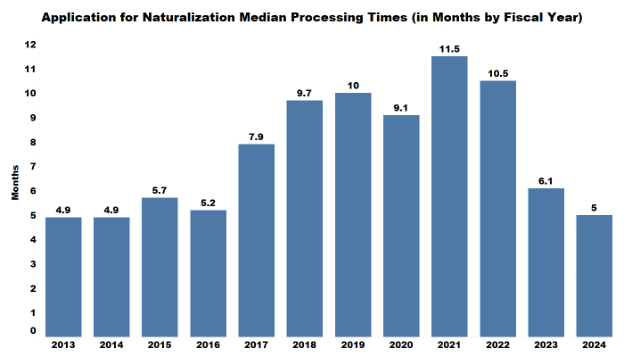
According to the Los Angeles Times, once in office, the Biden-Harris Administration immediately took steps to prioritize naturalization applications. U.S. Citizenship and Immigration Services (USCIS) hired more staff for processing applications, made it easier for immigrants to apply for free, and expanded its public relations efforts surrounding the naturalization process to reduce the flood of applications around election years.

These efforts reduced the time it takes to process naturalization applications to an average of 5 months in FY 2024—half the processing time in FY 2021, its fastest rate in a decade. Processing times increased during the Trump Administration due to a surge in citizenship applications and slowed even more during the Covid-19 pandemic. With the changes made by the Biden-Harris Administration, however, processing times have returned to their lowest level in a decade.

The Biden-Harris Administration denies that the rush to approve citizenship applications is politically motivated. When asked about the rapid approvals of citizenship applications, a spokesman for the Department of Homeland Security said, the Department “does not take actions based on electoral politics or upcoming elections. Period.”

However, a recent poll of new citizens conducted by a coalition of open-borders groups showed that new citizens disproportionately identify as Democrats (43.3. percent) rather than Republicans (30.4 percent). The same poll found that a greater share of newly naturalized citizens would vote for Vice President Kamala Harris (53.6 percent) over former President Donald Trump (38.3 percent). The remaining 8 percent said they would vote for another candidate or not vote at all.

Indeed, 3.5 million new voters have the potential to change the outcome in elections, especially if they live in swing states. In 2020, President Biden won Arizona by about 10,457 votes and Georgia by 12,670 votes. He won Wisconsin by 20,682 votes and Nevada by 33,596 votes. In 2016, former President Trump won Michigan by 10,704 votes and Wisconsin by 22,748 votes. Trump won Pennsylvania by 44,280 votes and Arizona by 91,234 votes.

Last year (FY 2023) USCIS data show that a large number of naturalizations took place in California, New York, Texas, Florida, and New York. But naturalizations occur across the country on a regular basis, and USCIS is now approving citizenship applications at about the rate of 2,500 per day. It seems Americans will just have to wait until November 6 to see what impact this wave of new citizens has had on the election.

Source: Biden-Harris Administration Approving Citizenship Applications at Fastest Rate in a Decade

The quiet technocrat who steered Biden’s effort to tighten the border

Of interest:

The lead architect of President Joe Biden’s border strategy is not Vice President Kamala Harris, despite persistent Republican claims to the contrary. That role belongs to a bookish, little-known policy adviser named Blas Nuñez-Neto.

A data-driven technocrat, Nuñez-Neto has helped engineer Biden’s pivot toward tougher border enforcement and sweeping restrictions on asylum — moves that contributed to a nearly 80 percent drop in illegal crossings since December.

The transformation is shoring up one of Democrats’ biggest vulnerabilities ahead of the Nov. 5 presidential election and potentially defusing a top-polling issue for Republican nominee Donald Trump. After three years of record crossings, the U.S.-Mexico border is quieter and more controlled today than at any point since late 2020, before Trump left office.

Nuñez-Neto pulled that off by steering the administration back to a border policy framework Democrats used to embrace more easily, according to current and former administration officials. The formula: Be generous and welcoming to immigrants seeking to come lawfully, but stingy and firm with those who don’t.

The White House declined to make Nuñez-Neto available for an interview. Biden officials said the administration’s border policy moves have been shaped by senior White House officials and Homeland Security Secretary Alejandro Mayorkas, whom Nuñez-Neto worked for before being promoted to the White House in June.

In a statement, White House spokesperson Angelo Fernández Hernández said Biden “believes it is a false choice to say we have to walk away from being an America that embraces immigration in order to secure our border.”

“We must enforce our laws at the border and deliver consequences to those who do not have a legal basis to remain in the United States, and we must expand lawful pathways,” Fernández Hernández said.

Southwest border apprehensions by month

Illegal crossings at the U.S.-Mexico border have declined in 2024, according to U.S. Customs and Border Protection data.

Nuñez-Neto’s policy approach embodies the political calculus that while most Americans remain favorably disposed toward immigrants, few things erode the welcoming spirit faster than an out-of-control border. The growing U.S. economy needs workers, too, and immigrants help offset declining U.S. birth rates. But how they arrive matters.

Relying heavily on the president’s executive powers to grant entry using an authority known as parole, the Biden administration has been allowing nearly 75,000 migrants to enter each month through legal channels.

Republican critics denounce those pathways as a “shell game,” arguing the administration is facilitating mass migration through doors that should not be opened in the first place. But the expansion — paired with the most severe restrictions on asylum eligibility at the border from a Democratic administration in decades — has corralled the disorder.

Trump has largely ignored the change, displaying at his rallies a chart that shows record illegal crossings during Biden’s first three years and cuts out data showing the 2024 decline. He continues to label Harris, his Democratic opponent in the upcoming election, as the “border czar,” though she never held such a role. Biden tasked Harris with leading the administration’s plan to reduce Central American emigration by promoting investment and job creation, not to deal with immigration enforcement at the southern border.

That task — arguably one of the least-desirable in a Democratic administration — would become Nuñez-Neto’s.

A change in direction

The Argentine-born Nuñez-Neto was working on border security issues at the Rand Corporation in early 2021 when DHS policy adviser David Shahoulian — one of the few voices in the administration urging tougher measures at the border — recommended him for a job. He became chief operating officer for U.S. Customs and Border Protection.

Trump’s rhetoric and harsh policies in the White House had galvanized immigration advocacy groups and many Democrats against enforcement and the very idea of deterrence as an element of border security. Biden loosened restrictions, fueling a perception that the border was more open even as officials — including Harris — told would-be migrants “do not come.”

Shahoulian soon left the administration in frustration. In late 2021, Nuñez-Neto took over his role shaping border policy at DHS.

More than a year later, as the administration ended the pandemic-era Title 42 border restrictions, Biden officials increasingly sought help from Mexico, Panama and other nations in the region to help contain migration and cooperate with U.S. policies. Nuñez-Neto took on a second role as DHS’s top international envoy. He became a major diplomatic asset: a bilingual U.S. official capable of explaining policy to Spanish-language media and speaking directly to Latin American officials.

Nuñez-Neto developed an especially close partnership with Roberto Velasco, the top official at Mexico’s Foreign Ministry for North American affairs, according to current and former senior officials from both nations. Mexican authorities this year have arrested record numbers of migrants traveling through the country toward the U.S. border, a crackdown that Biden officials credit with sharply curtailing illegal crossings.

Angela Kelley, a senior adviser at DHS until June 2022, said the Biden administration has worked to craft a careful balance of incentives and penalties — carrots and sticks. She had been a longtime advocate for asylum seekers, and worked to resist Trump’s policies. Nuñez-Neto was laser-focused on border crossings, checking enforcement data daily.

“He’s more of a sticks guy, given his background,” said Kelley, now chief policy adviser at the American Immigration Lawyers Association.

Nuñez-Neto was promoted to the White House as the president announced strict new emergency measures that have upended decades of asylum law, closing the border when crossings are high and essentially barring access to U.S. courts for migrants who enter the country illegally.

The restrictions were made possible by a breakthrough agreement Nuñez-Neto helped negotiate with Velasco and other senior Mexican officials. It allows the United States to return large numbers of non-Mexican migrants back across the border — a crucial tool for agencies that have struggled to send deportees to Venezuela and other nations whose relations with Washington are strained.

As the deterrence policies took shape, the number of migrants released into the United States with a pending asylum claim — the procedure decried as “catch and release” — plummeted. It was Nuñez-Neto, not someone from Harris’s team, who fielded questions about the measures from reporters and on Capitol Hill.

“Those of us who follow the inside baseball of immigration know he’s the person that has become the de facto border czar,” said one policy adviser close to the administration who spoke on the condition of anonymity to describe informal conversations with top officials.

Nuñez-Neto has done so with a quiet, disciplined manner that is the stylistic opposite of swaggering Trump-era border officials. Some immigration advocates and activists have come to view him with scorn, as a border-cop-in-sheep’s-clothing who speaks of migrants sympathetically while orchestrating the kind of crackdown immigration hard-liners have only dreamed of.

The sharp drop in illegal crossings has allowed the Harris campaign to go on offense. She blames Trump for sinking a bipartisan Senate bill last winter that would have provided billions in new funding for more border agents, detention capacity, deportation flights and other enforcement tools. She has called for Congress to pass the bill, and says she would sign it into law if she’s elected.

But several of its toughest provisions — in particular the emergency asylum restrictions — are already in place…

Source: The quiet technocrat who steered Biden’s effort to tighten the border

The U.S. Is Rebuilding a Legal Pathway for Refugees. The Election Could Change That.

Indeed:

With national attention focused on the chaos at the southern border, President Biden has been steadily rebuilding a legal pathway for immigration that was gutted during the Trump administration.

The United States has allowed more than 40,000 refugees into the country in the first five months of the fiscal year after they passed a rigorous, often yearslong, screening process that includes security and medical vetting and interviews with American officers overseas.

The figure represents a significant expansion of the refugee program, which is at the heart of U.S. laws that provide desperate people from around the world with a legal way to find safe haven in the United States.

The United States has not granted refugee status to so many people in such a short period of time in more than seven years. The Biden administration is now on target to allow in 125,000 refugees this year, the most in three decades, said Angelo Fernández Hernández, a White House spokesman.

By comparison, roughly 64,000 refugees were admitted during the last three years of the Trump administration.

“The Biden administration has been talking a big talk about resettling more refugees since Biden took office,” said Julia Gelatt, an associate director at the Migration Policy Institute, a nonpartisan research group in Washington. “Finally we are seeing the payoff in higher numbers.”

But as the presidential campaign heats up, immigration advocates fear that the gains will be wiped out if former President Donald J. Trump is elected. The former president has vowed to suspend the program if he takes office again, just as he did in 2017 for 120 days.

Mr. Trump has characterized the program as a security threat, even though refugees go through extensive background checks and screening. He reassigned officers, shuttered overseas posts and slashed the number of refugees allowed into the country every year.

The result, when Mr. Biden took office, was a system devoid of resources.

“The refugee program hangs in the balance with this election,” said Barbara L. Strack, the former lead refugee official at U.S. Citizenship and Immigration Services….

Source: The U.S. Is Rebuilding a Legal Pathway for Refugees. The Election Could Change That.

U.S. is rejecting asylum seekers at much higher rates under new Biden policy

Of note:

A new Biden administration policy has dramatically lowered the percentage of migrants at the southern border who enter the United States and are allowed to apply for asylum, according to numbers revealed in legal documents obtained by The Times. Without these new limits to asylum, border crossings could overwhelm local towns and resources, a Department of Homeland Security official warned a federal court in a filing this month.

The new asylum policy is the centerpiece of the Biden administration’s border efforts.

Under the new rules, people who cross through a third country on the way to the U.S. and fail to seek protections there are presumed ineligible for asylum. Only people who enter the U.S. without authorization are subject to this new restriction.

The number of single-adult migrants who are able to pass initial screenings at the border has dropped from 83% to 46% under the new policy, the Biden administration said in the court filing. The 83% rate refers to initial asylum screenings between 2014 and 2019; the new data cover the period from May 12, the first full day the new policywas in place, through June 13.

Since the expiration of Title 42 rules that allowed border agents to quickly turn back migrants at the border without offering them access to asylum, the administration has pointed to a drop in border crossings as proof that its policies are working.

But immigrant advocates and legal groups have blasted Biden’s new asylum policy, arguing that it is a repurposed version of a Trump-era effort that made people in similar circumstances ineligible for asylum. (Under Biden’s policy, certain migrants can overcome the presumption that they are ineligible for asylum.) The ACLU and other groups have sought to block the rule in federal court in San Francisco, in front of the same judge who stopped the Trump policy years ago.

The new filing provides the first look at how the Biden administration’s asylum policy is affecting migrants who have ignored the government’s warnings not to cross the border.

“This newly released data confirms that the new asylum restrictions are as harsh as advocates warned,” said Aaron Reichlin-Melnick, policy director at the American Immigration Council. “The data contradicts conservative attacks on the rule for being too lenient. Less than 1 in 10 people subject to the rule have been able to rebut its presumption against asylum eligibility.”

The numbers show that, thus far, 8,195 asylum-seekers who crossed the border have had the new rules applied to them and 88% had the policy limit their chance at asylum. These migrants were forced to pass a higher standard of screening reserved for different forms of protection under U.S. law. Some 46% of migrants who were forced to go through the new approach either cleared the higher standard or established an exception to the rule, like a medical emergency.

These individuals will now have the chance to seek asylum, and other protections, in immigration court.

“As intended, the rule has significantly reduced screen-in rates for noncitizens encountered along the [Southwest border],” Blas Nuñez-Neto, a senior DHS official, wrote in the filing. “The decline in encounters at the U.S. border, and entries into the Darién Gap, show that the application of consequences as a result of the rule’s implementation is disincentivizing noncitizens from pursuing irregular migration and incentivizing them to use safe and orderly pathways.”

Reichlin-Melnick said that the few who did get past the new rule probably would not succeed in getting asylum in immigration court due to the policy but could still gain the other, lesser forms of protections offered under U.S. law.

Nuñez-Neto said that without the policy, DHS expects to see an increase in border crossings that would hurt local border communities and overstretch government resources.

He explained that DHS intelligence indicates that there are an estimated 104,000 migrants in northern Mexico and that many of these migrants appear to be “waiting to see whether the strengthened consequences associated with the rule’s implementation are real.”

Nuñez-Neto said the population in northern Mexico is within eight hours of the U.S. border. He cited the increase in arrests at the border in the run-up to the end of Title 42 earlier in May, when border agents were seeing upward of 10,000 migrants cross in a single day.

“DHS anticipates that any interruption in the rule’s implementation will result in another surge in migration that will significantly disrupt and tax DHS operations. This expectation is not speculative. DHS needs only to look back to the pre-May 12 surge, which was only blunted by the application of strengthened consequences at the border and expanded access to lawful pathways and processes, in large part as a result of the rule’s implementation on May 12, to identify the repercussions of losing the rule,” he wrote.

The Trump administration barred asylum for migrants who crossed the U.S. border and did not seek protections in another country on their journey. U.S. District Judge Jon Tigar later blocked the policy. The Supreme Court stayed the order.

The Times interviewed migrants in Mexico who said they were still assessing the border changes in May — including some who were worried about the new policy and its potential consequences. The Biden administration has advertised deportations and the immigration consequences for those who cross the border without authorization on social media and in statements.

Julia Gelatt, a senior policy analyst at the Migration Policy Institute, said the data revealed the policy changes at the border were making a difference in who was able to access asylum, though she noted that families were not included in the statistics presented by Nuñez-Neto.

“These data show that a much smaller share of single adult migrants are able to get into the United States to seek protections than before Title 42,” she said. “This represents a significant narrowing of the possibility of asylum for single adults coming to the border.”

Source: U.S. is rejecting asylum seekers at much higher rates under new Biden policy

Varela: Joe Biden should be trumpeting this immigration policy victory

One take:

Given the intense focus journalists place on migrants who come to the United States, it’s disappointing that they pay such little attention to the employers on this side of the border who recruit and exploit migrants and then, if they dare complain, fire them and make them even more vulnerable to deportation. The systematic oppression of migrants doesn’t get sufficient attention, partly because journalists haven’t done their jobs but also because those who are abused and exploited don’t speak up because they’re afraid or can’t speak up because they’ve been deported.

That’s why an announcement last week from the Biden administration that it will extend some protections to migrants reporting employer abusewas so historic. In a Jan. 13 news release, the Department of Homeland Security said that “noncitizen workers who are victims of, or witnesses to, the violation of labor rights, can now access a streamlined and expedited deferred action request process. Deferred action protects noncitizen workers from threats of immigration-related retaliation from the exploitive employers.” As a result, DHS noted, the whistleblower program confirmed the current administration’s “commitment to empowering workers and improving workplace conditions by enabling all workers, including noncitizens, to assert their legal rights.”

While I and multiple immigrant rights groups have generally criticized President Joe Biden for muddled immigration policies that carry forward former President Donald Trump’s misguided policies, I stand in agreement with those groups that were quick to praise Biden for this move.

“Today opens a pathway full of hope for those of us workers who fear reporting workplace abuses, so that we can come forward to share the challenges we face every day in hostile workplaces, suffering abuses like wage theft,” Jonas Reyes, a worker leader at Arriba Las Vegas Worker Center, said in a statement published on the website for the National Day Laborer Organizing Network, or NDLON. “When we speak up and exercise our rights, we face retaliation. These protections are an important step to be able to speak up safely, and an opportunity to improve our working conditions and our lives.”

The Biden administration should have played up this announcement and drawn attention to a new policy that will further humanize one of this society’s most exploited populations. Instead, the administration conveyed the news in a press release on the Friday before the three-day Martin Luther King Jr. holiday weekend. NDLON held a virtual news conference to discuss the policy change, and while it did an excellent job of humanizing migrant voices and shining a light on their real plights, as of Thursday, that video had barely more than 150 views. By not playing up the news of the new whistleblower policy, the Biden administration missed an opportunity to transform the immigration debate by focusing on a plan that helps migrant workers instead of punishing them.

That missed PR opportunity means that when the topic is Biden and immigration, one of his progressive moves is likely to be ignored. The focus will remain on his administration’s failures to distance itself from Trump and the presidents before him who have treated immigration not as a humanitarian crisis but as a law enforcement and national security problem.

The White House statements that were released this month during Biden’s first official visit to the U.S. border with Mexico focused on “new enforcement measures to increase security at the border” meant to “reduce the number of individuals crossing unlawfully between ports of entry.” At the same time, those statements claimed that such measures “will expand and expedite legal pathways for orderly migration and result in new consequences for those who fail to use those legal pathways.” Part of these measures includes a mobile phone app that migrants can now use to apply for asylum.

New data from Syracuse University’s Transactional Records Access Clearinghouseposted Wednesday said the immigration court backlog of close to 1.6 million cases is “the largest in history.” While the Biden administration’s announcement of a phone app may have been meant to decrease the number of people making the trek here, U.S. Code still makes it very legal for individuals to physically seek asylum at the U.S. border.

Despite the relative lack of attention the Biden administration and the media have given to the new DHS rule, the announcement does demonstrate that any real positive change in immigration policy will always come from grassroots movements. Rosario Ortiz, another worker leader at Arriba Las Vegas Worker Center, said in a statementthat she and coworkers had met with U.S. Labor Secretary Marty Walsh and DHS Secretary Alejandro Mayorkas “to call for these protections.” Ortiz said, “I am proud of my coworkers and our brothers and sisters across the country who have helped open a pathway for others in our circumstances to seek the protections that we have won.”

That successful grassroots campaign is similar to the grassroots campaign that ended with Arizona voters last year granting in-state tuition to undocumented students. Like the whistleblower policy, the policy change was the result of a targeted campaign that took time to mature.

This kind of substantive change in national immigration policy that considers the rights of migrant workers has been long overdue. The groups who have been fighting for their communities know this, and there is no indication that they will slow down their efforts, no matter who’s in office — whether it’s Republicans who brag about being tough on immigrants or Democrats who are seemingly too afraid to draw attention to those fleeting moments when they’re doing right by them.

Source: Joe Biden should be trumpeting this immigration policy victory

Marshall: Biden gets real on immigration

One take:

No issue better illuminates America’s debilitating political stalemate than immigration. Everyone knows there’s a mounting humanitarian and law enforcement crisis on our southern border, but our political leaders find it safer to appease their most militant partisans than to work together to forge pragmatic solutions.

That may be changing. After ignoring an unprecedented surge of migrants for two years, President Biden has announced some modest steps toward restoring order. His reward for taking on this combustible issue is a fusillade of criticism from rightwing nativists who say he’s not serious and leftwing activists worried that he is.

Source: Biden gets real on immigration

ICYMI: Biden outpacing Trump, Obama with diverse judicial nominees

Of note.

In Canada, the Trudeau appointments 2016-22 are (2016 baseline in parentheses): 56 percent women (36 percent), 10 percent visible minorities (2 percent), and 3 percent Indigenous peoples (1 percent):

For the Biden White House, a quartet of four female judges in Colorado encapsulates its mission when it comes to the federal judiciary.

One of the judges, Charlotte Sweeney, is an openly gay woman with a background in workers’ rights. Nina Wang, an immigrant from Taiwan, is the first magistrate judge in the state to be elevated to a federal district seat. Regina Rodriguez, who is Latina and Asian American, served in a U.S. attorney’s office.

Veronica Rossman, who came from the former Soviet Union with her family as refugees, is the first former federal public defender to be a judge on the 10th U.S. Circuit Court of Appeals.

With these four women, who were confirmed during the first two years of President Joe Biden’s term, there is a breadth of personal and professional diversity that the White House and Democratic senators have promoted in their push to transform the judiciary.

“The nominations send a powerful message to the legal community that this kind of public service is open to a lot of people it wasn’t open to before,” Ron Klain, the White House chief of staff, told The Associated Press. “What it says to the public at large is that if you wind up in federal court for whatever reason, you’re much more likely to have a judge who understands where you came from, who you are, and what you’ve been through.”

The White House and Democratic senators are closing out the first two years of Biden’s presidency having installed more federal judges than Biden’s two immediate predecessors. The rapid clip reflects a zeal to offset Donald Trump’s legacy of stacking the judiciary with young conservatives who often lacked in racial diversity.

So far, 97 lifetime federal judges have been confirmed under Biden, a figure that outpaces both Trump (85) and Barack Obama (62) at this point in their presidencies, according to the White House and the office of Senate Majority Leader Chuck Schumer, D-N.Y. Among them: Supreme Court Justice Ketanji Brown Jackson, that court’s first Black woman, 28 circuit court judges and 68 district court judges.

Three out of every four judges tapped by Biden and confirmed by the Senate in the past two years were women. About two-thirds were people of color. The Biden list includes 11 Black women to the powerful circuit courts, more than those installed under all previous presidents combined.

“It’s a story of writing a new chapter for the federal judiciary,” said Paige Herwig, a senior White House counsel.

The White House prioritized judicial nominations from the start and Democratic leaders in the Senate moved quickly on them. Particular focus was placed on nominees for the appellate courts, where the vast majority of federal cases end, and those coming from states with two Democratic senators, who could find easier consensus in a process where there’s still significant deference given to home-state officials.

Democrats hope to speed up confirmations next year, a goal more easily accomplished by a 51-49 Senate that will give them a slim majority on committees. In the past two years, votes on some of Biden’s more contested judicial nominees would deadlock in committee votes.

Schumer said he also hopes to install more judges in appeals courts that shifted rightward under Trump, an effort that the majority leader described as rebalancing those courts.

“Trump loaded up the bench with hard right ‘MAGA’ type judges who are not only out of step with the American people, they were even out of step with the Republican Party,” Schumer said in an interview, using shorthand for Trump’s 2016 campaign slogan, “Make America Great Again.”

Despite their limited power to derail Biden’s judicial picks, some Republicans have fought ferociously against many of them, arguing that their views were out of the legal mainstream. The precarious 50-50 Senate meant several Biden nominees languished for months and were never confirmed before the Senate wrapped up its work this year.

Democrats also say certain judicial nominees, particularly women of color, were unfairly made into lightning rods by their GOP critics.

“The Republicans have just got a problem with this,” Sen. Dick Durbin, D-Ill., chairman of the Judiciary Committee, told the AP. “Not all of them, some do.”

Sen. Josh Hawley, R-Mo., a committee member, said Biden’s picks were “very, very left, but unapologetically so” and that his colleague’s assertions about Republicans were “absurd.”

Despite the strengthened Democratic majority. the White House could nonetheless struggle to seat some judges over the next two years.

For instance, Biden has made barely a dent in the number of vacancies for district court judges in states that have two Republican senators, confirming just one such person: Stephen Locher, now a judge in the Southern District of Iowa. Home-state senators still get virtual veto power over district picks. Advocates want Democrats to discard that tradition, arguing it only allows for Republican obstructionism.

Durbin has said he would reconsider the practice if he sees systematic abuse of it. But such roadblocks have been rare, he said, and influential Republicans give some deference to Biden on judges.

One matter Biden has not been willing to address: the structure of the Supreme Court.

Any push to reshape the high court has found little footing at the White House despite its the court’s tilt farther right under Trump.

In June, the 6-3 conservative majority overturned the landmark decision Roe v. Wade, eliminating the constitutional protections for abortion that had existed for nearly 50 years. In the same term, it also weakened gun control and curbed the U.S. Environmental Protection Agency’s ability to manage climate change.

Biden has argued the court is more of an “advocacy group these days.” But he has not embraced calls to expand the court, impose term limits or mandatory retirement, or subject justices to a code of conduct that binds other federal judges.

“I wouldn’t, in any way minimize the progress and the importance of what President Biden is doing on the lower courts,” said Chris Kang of Demand Justice, an advocacy group leading the push to expand the court. But “we need to look at the core problem, which is the Supreme Court.”

Source: Biden outpacing Trump, Obama with diverse judicial nominees
Biden administration announces asylum system overhaul: What you need to know

Useful overview:

The Biden administration announced the final version of its long-awaited U.S. asylum overhaul Thursday, aiming to speed up processing at the border and alleviate backlogs throughout the country’s immigration courts.

Fixing asylum, a process that can drag out for years, was one of President Biden’s campaign promises. The overhaul represents the most significant change to the nation’s immigration system since he took office.

The new policy is scheduled to take effect May 28, two months after it’s published in the Federal Register. The change won’t affect most asylum seekers as long as a pandemic-related rule limiting access at the border remains in force. But the new system will probably be in place once that rule is lifted and the uptick in asylum requests begins.

“The current system for handling asylum claims at our borders has long needed repair,” Department of Homeland Security Secretary Alejandro N. Mayorkas said in a news release. “Through this rule, we are building a more functional and sensible asylum system to ensure that individuals who are eligible will receive protection more swiftly, while those who are not eligible will be rapidly removed.”

Asylum seekers will now have their claims heard by an asylum officer with U.S. Citizenship and Immigration Services within several months, if the plan works as intended, instead of waiting years for a final determination from an immigration judge.

The Homeland Security and Justice departments released a draft proposal in August. After reading through 5,000 public comments about the draft, officials on a call with reporters Wednesday said they made some changes but maintained the overall framework of the proposal. The officials — from U.S. Citizenship and Immigration Services and the Executive Office for Immigration Review, which oversees immigration courts — spoke to reporters on condition that they not be named.

Under the rule, anyone denied protection by an asylum officer could request a reconsideration from Citizenship and Immigration Services within seven days. If turned down, the person could ask that an immigration judge review their application and later bring their case to the Board of Immigration Appeals and federal circuit courts. After all bids are exhausted, or if none are pursued, the person would be subject to deportation. The rule does not apply to unaccompanied children who arrive without a parent

Supporters say the policy improves what has long been considered a scary process for traumatized migrants. Instead of having to initially recount their worst experiences in an adversarial court setting as they defend themselves against deportation, migrants will now be able to make their case in an asylum office.

But many advocates worry the changes weaken constitutional due process rights for asylum seekers by essentially expanding the so-called expedited removal process, a mechanism used to quickly turn back immigrants apprehended at the border.

Richard Caldarone, who manages litigation at the Tahirih Justice Center, a national nonprofit serving immigrants who fled gender-based violence, said the new process serves no significant humanitarian purpose because it doesn’t give trauma survivors enough time to find a lawyer, gather evidence and recover.

“Survivors of trauma will not be able to recite what happened to them 72 hours after arriving in a safe place to a government official,” he said. “Given the emphasis that DHS has placed on speed for asylum seekers, this will be like the former process — designed in a way that will systematically fail to elicit people’s best asylum claims.”

A better system, Caldarone said, would give people a year before their asylum hearing to prepare and then quickly provide a decision as to whether they could stay or be deported. That would allow people to heal from trauma and lead to fewer appeals, he argued.

The backlog of pending immigration court cases has exploded in recent months, reaching nearly 1.6 million by December, according to the Transactional Records Access Clearinghouse, a nonpartisan data research center at Syracuse University. It has tripled since 2016.

Under the new system, asylum officers will grant decisions within roughly 90 days. Immigration court appeals will generally take another 90 days, officials said.

During his first year in office, Biden took roughly 300 executive actions on immigration, nearly a third of them to reverse course on Trump-era policies, according to an analysis by the Migration Policy Institute, a Washington-based think tank.

One area he did not change: For the last two years, the border has been closed to the vast majority of asylum seekers under a restrictive pandemic-era policy initiated by former President Trump. The policy, known as Title 42, invokes a 1944 public health statute to quickly expel migrants who attempt to enter the U.S. in order to curb the spread of the coronavirus.

Among more than 1.7 million people detained by U.S. Customs and Border Protection at the southwest border during fiscal year 2021, 61% were expelled under Title 42, according to agency data.

Experts say those rapid removals under Title 42 resulted in an increase in unauthorized crossings into the U.S. by people who would have otherwise requested asylum at an official port of entry. The rapid removals back to Mexico also led to repeated border crossing attempts by migrants — inflating the number of Customs and Border Protection apprehensions.

Earlier this month, the U.S. Centers for Disease Control and Prevention formally ended that policy for children traveling without a parent, saying their expulsion “is not warranted to protect the public health.” Immigrant advocates and Democratic congressional leaders have argued that the policy is illegal and have ramped up calls in recent weeks to also end its application to adults traveling alone and parents traveling with their children.

But asylum seekers will see no substantial changes, even once the updates are in place, until the CDC decides to end Title 42 entirely. In recent weeks, as the response to the pandemic has changed within the U.S., federal officials have begun planningfor the possible end of the policy.

The asylum overhaul will be implemented in phases, though officials said they have yet to decide where to roll out the initial program and whether to target any specific population, such as single adults or families.

On a call with reporters last week, Mayorkas said the phased implementation of the new asylum system is designed to avoid straining Citizenship and Immigration Services. The agency has teetered on bankruptcy, he added, and was “virtually dismantled” under the Trump administration, whose immigration approach deterred many immigrants from filing applications before the pandemic further reduced the agency’s caseload.

“We have to be mindful of the resource constraints of the asylum division in U.S. Citizenship and Immigration Services as we rebuild that agency,” he said, noting that the agency is almost entirely funded by application fees.

Under the proposed rule, the agency estimated it would need to hire 800 new employees and spend $180 million to be able to handle 75,000 cases annually.

Before the pandemic, migrants encountered near the border were screened by agency asylum officers for fear of persecution. Those who passed the initial screening would have their cases moved to the immigration courts, where a judge would decide whether they qualified for asylum or another form of protection and could stay in the U.S.

Meanwhile, they were detained or released pending a final court hearing. Immigrants facing deportation don’t have the same right to a publicly funded attorney as people in criminal proceedings, and most represent themselves.

To qualify for asylum, immigrants must prove a fear of persecution in their home country based on one of five protected categories: political opinion, race, religion, nationality, or membership in a particular social group.

Officials hope the new asylum policy will curb unauthorized migration.

“The ability to stay in the United States for years waiting for an initial decision may motivate unauthorized border crossings by individuals who otherwise would not have sought to enter the United States and who lack a meritorious protection claim,” the rule states.

The goal is also to reduce the stress for those who ultimately receive asylum or other immigration protections, according to the rule, as currently, “they are left in limbo as to whether they might still be removed, are unable to lawfully work until their asylum application has been granted or has remained pending for several months, and are unable to petition for qualified family members, some of whom may still be at risk of harm.”

Source: Biden administration announces asylum system overhaul: What you need to know