Canada increasingly dependent on low-wage migrant workers, says report

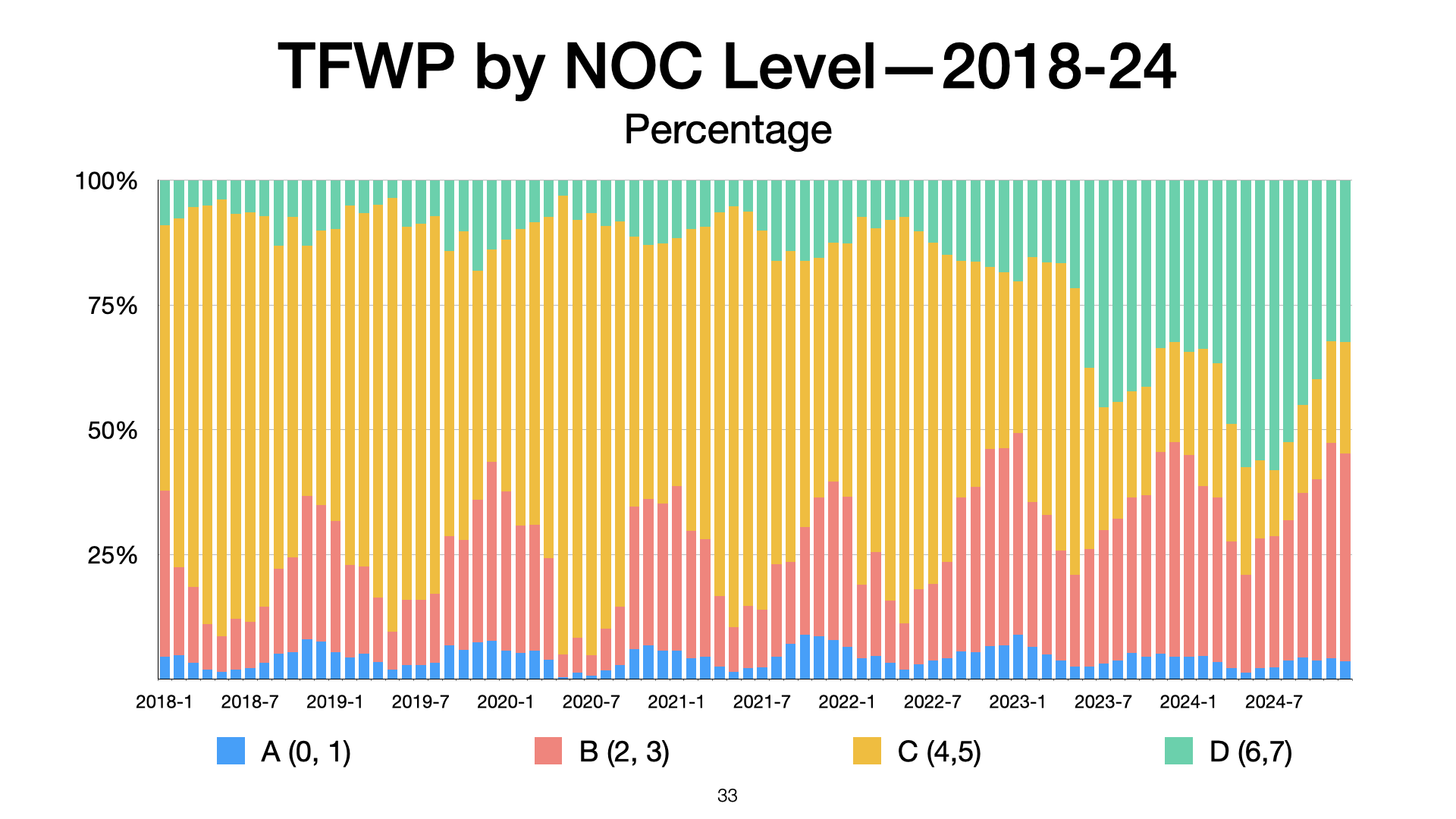
Confirmation what many have been noting (chart below highlights shift before more recent reversal_:

The share of native-born Canadians in the labour force has dropped nearly 10 percentage points since 2006, according to a new Bank of Canada report documenting how the country’s economy is becoming increasingly reliant on low-wage migrant workers.

“Not only has Canada experienced an unprecedented surge in immigration, but the composition of recent newcomers has been markedly different than in the past,” reads a discussion paper published May 9 by the bank’s Economic Analysis Department.

The paper found that, driven largely by a surge in temporary migration, the average Canadian immigrant has now become younger, lower-skilled and more likely to hail from poorer regions such as India, sub-Saharan Africa or the Middle East.

They’re also paid less. Particularly among Canada’s surging ranks of temporary migrant workers, wages have “reduced significantly relative to Canadian-born workers,” reads the paper.

Since 2015, “the average nominal wage gap between temporary and Canadian-born workers has more than doubled,” it read.

The authors calculated that the average migrant worker in Canada is now paid more than one fifth (22.6 per cent) less than a comparable Canadian-born worker. Prior to 2014, that gap was only 9.5 per cent.

The paper, entitled The Shift in Canadian Immigration Composition and its Effect on Wages, is one of the most definitive official documents as to the massive surge of migrant workers brought to Canada in the immediate wake of the COVID-19 pandemic.

Starting in 2022, Canada began accepting more than one million newcomers per year, mostly in “non-permanent” categories of immigrants ranging from international students, who are among those admitted under the international mobility program, to temporary foreign workers.

The Bank of Canada document shows that this wasn’t just unprecedented for Canada, but it went well beyond the pale of any comparable advanced economy.

Between 2019 and 2023, Canada charted population growth of more than six per cent. This was triple the rate seen in the United States, and double the rate seen in Switzerland, the only other developed economy analyzed by the paper whose demographic shift came anywhere close to those of Canada’s….

Source: Canada increasingly dependent on low-wage migrant workers, says report

Canada might struggle to rein in surge of temporary residents, Bank of Canada projects

Sobering. See Ivison’s commentary after this article:

The Bank of Canada is projecting that the federal government could fall short of its goal to shrink temporary residents’ share of Canada’s population over the next three years.

Immigration Minister Marc Miller announced in March that Ottawa would attempt to reduce their share of the population from 6.2 per cent to five per cent by 2027.

But on Wednesday, the Bank of Canada predicted that the government would miss that target. The bank’s monetary policy report — released as part of its announcement to reduce interest rates — said that non-permanent residents’ (NPRs) share of the population has actually grown since the goal was set in March.

“NPRs represented 6.8% of the population at the beginning of April — much higher than at the time of the March announcement — and the share is expected to continue rising over the near term,” the report said.

“This suggests that it will take longer for planned policies to reduce NPR inflows to achieve the 5% target.”

The central bank report does note that there is “considerable uncertainty” about its projections.

“Details on how most temporary resident permit programs will be adjusted are not expected until later this year,” it says, adding that their scenario “will be revised as further measures are announced and more details on program changes become available.”

Immigration, Refugees and Citizenship Canada (IRCC) said in a statement that the department will be including measures to address the influx of temporary residents in Canada in the upcoming immigration levels plan.

“The levels plan is expanding to include both temporary resident arrivals and permanent resident arrivals. It will be tabled in the fall following consultations with provincial and territorial counterparts and others as part of Canada’s annual levels planning,” the statement said.

Targets expected to be ironed out over summer

Miller met with his provincial and territorial counterparts earlier this spring, and the targets are expected to be ironed out over the summer.

The bank’s report comes as the government has been taking measures to temper the massive rise in people who migrate to Canada on a temporary basis to work or study.

Miller had also announced plans to scale back the number of international students by putting a two-year cap on new admissions in January.

Recent data from IRCC shows that there has been an increase in the number of student permits approved this year compared to 2023, which itself was a record year.

The government approved 216,620 student permits in the first five months of 2024, compared to 200,505 permits over the same period in 2023.

But the numbers for the cap on student visas wasn’t finalized until April, and the IRCC numbers may not yet reflect those changes.

Source: Canada might struggle to rein in surge of temporary residents, Bank of Canada projects

John Ivison: Trust the Liberals to fix immigration? The Bank of Canada doesn’t

…It is apparent that the Bank of Canada feels like it has to step in to clean up the federal government’s mess.

In its Monetary Policy Report, the bank said that NPRs will continue to rise in the near term and it will take longer than predicted to reduce inflows to achieve the five-per-cent target.

“Considerable uncertainty continues to surround the future path of net NPR flows,” it said.

If NPRs continue to leave Canada or become permanent residents at the rate observed since 2021, achieving the target would require reducing average annual gross NPR inflows by around 70 to 80 per cent across the temporary foreign worker program, the International Mobility Program and the asylum-seeker program, in addition to imposing a cap on the number of international students.

Mike Moffatt, an economist and senior director at the Smart Prosperity Institute, said the bank is clearly questioning the credibility of the federal commitment to the five-per-cent target.

“I think it’s fair. They’re basically saying the government isn’t going to do what they claim they’ll do. I don’t remember the last time I saw that from them,” he said.

It is a sign of how undisciplined immigration policy has become that the central bank feels it has to step out of its lane to admonish the government.

Source: John Ivison: Trust the Liberals to fix immigration? The Bank of Canada doesn’t

How immigration could be impacting the Bank of Canada’s efforts to bring down inflation

Of note:

Demand created from a record influx of immigrants could be one factor keeping inflation higher for longer than anticipated, some economists say, though Bank of Canada governor Tiff Macklem doesn’t appear overly worried about it.

Sticky inflation prompted the Bank of Canada on July 12 to raise interest rates by 25 basis points to five per cent — the highest level since 2001. Though the inflation rate has fallen off its peak of 8.1 per cent last summer to 3.4 per cent in May, prices of more than half the goods in the consumer price index, such as meat, bread, coffee and rent, continue to rise, Macklem said in a press conference following the decision.

The central bank now expects inflation to reach its two per cent target by the middle of 2025, instead of the end of next year as predicted in April.

But even as prices for key goods go up, the economy is proving more resilient than expected and demand momentum and consumption growth has been “surprisingly strong,” the bank said in a statement, pushing it to once again hike rates last week.

An increase in immigration could be one complicating factor keeping inflation higher for longer and stoking demand, Bank of Nova Scotia economist Rebekah Young said.

“There is more risk that inflation may be sticky in months and quarters ahead, versus it coming down faster than we thought and newcomers are a part of that story,” she said. “They are certainly adding to what could be keeping (Macklem) up at night.”

Canada welcomed more than one million immigrants in the past year as the federal government sought to address high job vacancies and labour shortages. Young said the country has traditionally used population growth through immigration as a means to increase workers and enhance supply, especially as “massive surges” of inflation haven’t been something policymakers have worried about for decades. But things have gotten more complicated.

“A lot of things are different now,” she said. “The current juncture that we are in, getting inflation back to two per cent is still fraught with uncertainty.”

Macklem last week said he expects the net-impact of immigration growth on inflation to be “roughly neutral,” though he added it is impacting some parts of the economy more than others.

He said that while newcomers filling job vacancies has been good for company margins, easing inflationary pressures, new entrants are also increasing demand for housing, helping boost rent and home prices. It’s “hard to know exactly” the net effect on the economy, he added, but the main message is that immigration is adding to both demand and supply.

“If you start an economy with excess demand (and) you add both demand and supply, you are still in excess demand,” Macklem said. “What we’re seeing is that the excess demand in the economy is more persistent than we thought and so we’ve raised rates in June and July.”

Douglas Porter, chief economist at the Bank of Montreal, said he agrees with Macklem’s assertion that high immigration adds to both demand and supply. But there’s another element the governor “didn’t talk about much,” he said, and that’s a matter of timing.

“(Strong population growth) does tend to affect things like spending and the housing demand almost instantaneously, whereas the supply side might take a little bit longer to kick in,” he said. “A new worker might enter the labour force relatively quickly, but reaching their full potential might take a little bit of time.”

In the short run, strong population growth tends to “push up the price pressures” a little bit, Porter said, but the impact in the longer run is “broadly neutral.”

Porter assessed economies of 20 nations to better understand the link between population growth and inflation and said he found a “very weak positive relationship.” Most of the impact is on the housing market, since there is a “very clear relationship between strong population growth and home prices,” he said.

Still, Porter also said Canada has fared better than most nations in terms of tackling inflation, meaning there are “larger forces at play here, beyond just population growth.”

Source: How immigration could be impacting the Bank of Canada’s efforts to bring down inflation

Worker shortage? Canada’s supply of labour is actually robust

Undercuts the case made by business organizations, governments and advocates for current immigration increases and greater flexibility for temporary workers and students:

For many years, the corporate sector in Canada has pointed to labour shortages as a persistent challenge – one that’s getting worse as the country ages and baby boomers head into retirement.

In the Bank of Canada’s latest Business Outlook Survey, published Monday, companies indicated that labour shortages were their second-most pressing concern, behind cost pressures. Small-business owners consistently say that a lack of skilled and unskilled workers is the biggest impediment to increasing sales, according to surveys from the Canadian Federation of Independent Business.

But these responses can obscure a simple fact: The supply of workers in Canada is growing quickly, and among some groups, participation in the labour market has never been higher.

As of February, that participation rate – the proportion of the population 15 or older that is working or looking for a job – was 65.7 per cent. That’s the same as in April, 2018.

To be sure, it has drifted lower from its peak levels of almost 68 per cent in the 2000s as Canada has aged.

Still, that clouds some milestones. The participation rate for Canadians 15 to 64 – what is often called the working-age population – has jumped to record levels, above 80 per cent, in recent months. In raw terms, the sum of labour market participants has surpassed 21 million, a first for the economy.

And with the unemployment rate just shy of an all-time low, it’s generally been a fruitful period for job seekers.

“Across the board – across basically all demographic groups – participation is at record highs or near record highs,” said Andrew Fields, a senior analyst at Statistics Canada.

The macroeconomic environment is certainly a draw for potential workers. Over the past three months, Canada has enjoyed a net gain of 241,000 jobs, despite higher interest rates meant to slow the economy. The Bank of Canada’s survey of consumers, also published Monday, showed that households think a recession is the most likely scenario over the next year. Even so, people are feeling upbeat about the labour market“Despite uncertainty about the economy, workers view the job market as strong. Respondents, particularly those not satisfied with their current job, are confident they can find new work,” the central bank’s report said.

Over the long term, immigration has been the main driver of population growth and, in turn, new workers. In a 2022 report, Statscan said immigrants accounted for 84 per cent of labour force growth in the 2010s.

The demographic profile of those newcomers is also helpful. According to the 2021 census, about three-quarters of immigrants who have been in Canada for 10 or fewer years were between the ages of 25 and 54 – prime years for working. Among people born in Canada, the proportion in that age bracket was 46 per cent.

This wave of newcomers is part of a deliberate plan to increase the supply of workers. The federal government is ramping up its intake of permanent residents to 500,000 annually by 2025, more than 60 per cent of whom will migrate through economic programs.

Lately, however, it’s not been solely a story of immigration. The employment rate of mothers (aged 25 to 54) with a youngest child under 6 was 76.6 per cent in January – a jump of almost four percentage points in a year.

Statscan said women with young children “are typically less likely to be employed, and these increases can reflect a tight labour market as well as a range of factors, such as the need to meet household financial requirements or changing access to childcare.”

The national child-care plan, which the federal government announced in 2021, is already delivering cost savings to parents with children in regulated daycare. Ottawa is betting that more access to affordable child care will boost female labour participation, much as it has in Quebec, which started a low-fee program in 1997.

Martha Friendly, the executive director of the Childcare Resource and Research Unit, said staff retention will be critical to creating more child-care spaces, given that industry wages can be meagre.

“It is absolutely clear that you can’t expand the supply of child care unless you actually address the work force issues. Because the people are the program,” she said.

Another theory to explain rising labour participation is that cost-of-living concerns are pushing more people to look for jobs. “If you have rising prices, some people are more likely to work,” Mr. Fields said.

Brendon Bernard, senior economist at hiring site Indeed Canada, stressed that while workers are broadly available, hiring could still be a challenge for some firms.

The situation is also a matter of perspective: Companies say there aren’t enough workers – but they’re also recruiting far more people than usual. At times last year, there were more than one million job vacancies, roughly double the number before the pandemic.

There are recent signs that the labour market is slackening. Job vacancies have tumbled about 24 per cent since last spring, although they are still elevated by historical standards. And in the Bank of Canada’s business survey, respondents said labour shortages were less intense than a year ago and it was easier to hire the workers they needed.

Despite the threat of a recession, companies have yet to implement widespread layoffs that would push up the unemployment rate, as many economists have predicted.

“Businesses are potentially waiting till the last minute, or waiting until they’re fully certain that the situation is going south, to actually start laying off workers in large numbers,” Mr. Bernard said.

“We haven’t hit that turning point.”

Source: Worker shortage? Canada’s supply of labour is actually robust

RCMP probes elaborate scam targeting Canada’s largest Muslim organization

Weird. Await results of investigation with interest:

Canada’s largest Muslim community organization has been rocked by meticulous forgeries of RCMP and Canada Revenue Agency records, which weave an elaborate fiction about federal investigators using paid informants to build a terrorist-funding case against the charity.

For more than a year, the Muslim Association of Canada has been receiving documents from an anonymous sender that suggest authorities are attempting to entrap the organization, sowing turmoil within the grassroots group. It operates 22 mosques and community centres and 30 schools in 13 cities.

A Globe and Mail investigation has found that the records mailed to MAC are fake. The trove of documents, amounting to hundreds of pages, includes printouts designed to look like internal government e-mails between criminal investigators, fake RCMP search warrants andphony records of money transfers through the SWIFT interbank system to offshore accounts supposedly associated with informants within the charity.

The Canada Revenue Agency referred the matter to the RCMP after The Globe shared some of the documents with the tax collection agency. The RCMP said in a statement that they are reviewing the documents.

Despite overwhelming evidence to the contrary, MAC is not convinced the documents are fake. The organization is calling on the federal government to launch an independent investigation aimed at determining whether someone in a government department or agency is engaging in “Islamophobic tactics against the Muslim community,” Sharaf Sharafeldin, MAC’s president responsible for strategy, said in a statement.

“The documents are quite intricate, detailed and troubling,” Mr. Sharafeldin added. “The documents or their contents must have come from a source within the federal government or its agencies as no one outside of the federal government or its agencies would have had access to such information.”

In April, 2021, the 25-year-old charity began receiving the documents in packages with no return addresses. MAC has so far received 11 deliveries of purported government files. They detail a non-existent seven-year effort by tax collectors and the RCMP to find evidence that MAC is funnelling donations to extremist groups. The last package arrived in late November.

Relations between the Muslim organization and the CRA have been fraught for years. Since 2015, the tax agency has been conducting a very real audit of MAC’s activities as a registered charity, a possible prelude to revoking its charitable status. That investigation is unrelated to any accusations of terrorist funding.

MAC has called this continuing CRA audit an “existential threat,” because losing charitable status would make it harder for the organization to raise money to run mosques and schools, as its donors would not be eligible for tax breaks. It mounted a Charter of Rights and Freedoms challenge against the CRA in April to stop the audit, arguing the agency is tainted by Islamophobia and systemic bias toward Muslim Canadians.

Canada’s Taxpayers’ Ombudsperson, François Boileau, said in an interview that he was “completely flabbergasted” to learn that someone is impersonating CRA investigators.

“Wow. Someone, somewhere is going to a lot of trouble inventing this scheme. So there is something very troubling,” he added.

The fake records sent to MAC, which were obtained by The Globe, make it seem as if the charity is riddled with informants supplying the RCMP and the CRA with details of its operations. A purported Mountie “Informant Manifest” lists six informants who are supposedly working with the National Security Joint Operations Centre, as well as 18 “secondary asset” informants.

The informant list includes what it describes as six current donors to the association, seven current members, a current board member of MAC, as well as a custodian, a banker and a food-service provider for the charity.

Perhaps the most explosive documents sent to MAC are purported records of cash payments and SWIFT wire transfers to RCMP and CRA informants who are supposedly supplying investigators with information on the organization.

The purported transfers show 13 payments into offshore bank accounts, supposedly for the benefit of three informants. All but one list the Bank of Canada as the sender. The documents show the equivalent of more than $320,000 being deposited into accounts in the British dependency of Guernsey.

But the Bank of Canada, in a statement to The Globe, said the SWIFT transfer documents bearing its name are forgeries.

“We can confirm that the documents purporting to be SWIFT transfer records are not genuine,” the bank said.

The central bank declined to say specifically what was inauthentic about the SWIFT documents, to avoid giving people tips on how to create fake wire transfers.

The fake records sent to MAC portray the Canada Revenue Agency as being under pressure from its leadership to nail the Muslim charity for wrongdoing. The documents make investigators appear willing to bend or break the rules in order to do so.

An e-mail dated March, 2022 and purportedly sent by Wayne Welch, an investigator with the CRA’s criminal investigation division in Mississauga, mentions the “urgency that the chief has placed on breaking ground on having a smoking gun on MAC.” It continues by saying: “We need to be more creative if not downright dirty in roping these bad actors in.”

One e-mail purports to show CRA leadership trying to use sex as bait. “It is agreed that scandal is the best leverage here. Please put our girl in play. He’s married. Let’s see if he bites,” the e-mail says. It’s not clear who the target at MAC is.

Another e-mail, purportedly sent in April by Shalini Shan-Hernandez, with the CRA’s criminal investigations division, paints a picture of a failing investigation. “There just isn’t the kind of material we need for a solid case,” says the message, addressed to Eric Ferron, the director general of the CRA’s criminal investigation directorate. It continues by saying: “Also, the assets have started being a little sketchy, since the larger payments have gone out.”

The records make it seem as if U.S. law enforcement is pushing the CRA for results and directing it to find an informant inside MAC’s leadership. “We on this side of the fence are concerned about the pace of your sourcing,” a June e-mail purportedly from a Federal Bureau of Investigation official named Mustafa S. appears to tell the CRA’s Mr. Ferron. “It is imperative that we are in a position by year’s end to move into the next phase of operations. To this end we need to establish a foothold in the executive of MAC.” The FBI agent is a real agent, but his e-mail address on the documents is incorrect.

Whoever sent the documents included what appear to be two RCMP search warrants – one from 2014 and another from January of this year – that purportedly show the Mounties had obtained court approval to wiretap and search MAC’s offices. While the warrants look authentic, they are missing key information, such as courthouse addresses and the locations of MAC offices. An extensive search of court records by The Globe did not turn up these warrants.

But The Globe did obtain a legitimate warrant filed in April, 2014. It focuses on another Muslim charity, and briefly mentions MAC. An affidavit that was part of an RCMP application for the warrant says that MAC provided more than $296,500 to the International Relief Fund for the Afflicted and Needy (IRFAN) between 2001 and 2010.

In 2011, IRFAN was designated a terrorist entity by the Canadian government for providing $14.6-million in resources to organizations with links to Hamas, which governs the Gaza Strip and is designated a terrorist organization by Ottawa. The CRA revoked IRFAN’s status as a Canadian charity in 2011.

RCMP Commissioner Brenda Lucki wrote to MAC in October, 2020, to assure the group it “was perfectly legal” to have made donations to IRFAN when “they were a legitimate registered charity.” Commissioner Lucki said “no charges were laid against your organization as a result of this investigation,” which was dubbed Project Sapphire.

The documents sent to MAC also describe a conflict between the RCMP and Ottawa’s Financial Transactions and Reports Analysis Centre (FinTRAC), which monitors money flows for terrorism financing.

The e-mails make it appear as if FinTRAC officials were accusing RCMP investigators of bias, and of rejecting evidence FinTRAC had gathered on MAC as part of Project Sapphire.

“Our findings, thus far, indicate no transactions that meet the criteria for intentional criminality,” says a May, 2014, e-mail purportedly from Michael Boole, a manager at FinTRAC.

In a second e-mail also dated May, 2014, Mr. Boole purportedly questions whether there is a “political aspect” to the RCMP’s conduct. In a third e-mail supposedly sent that month, he admonishes the force. “It is also not part of our mandate, either in this project or in general, to target certain groups or manipulate data to fit certain agendas,” he appears to tell the RCMP Integrated National Security Enforcement Team.

A June, 2014, e-mail purportedly shows Mr. Boole telling the RCMP to back off.

“I will put this as diplomatically as possible. This is unacceptable. We will not acquiesce to your demand for conformity to the pre-determined scenario you have formulated,” the e-mail says.

But Mr. Boole, who is now manager of the anti-money-laundering unit in FinTRAC’s intelligence sector, has sworn these e-mails are fake.

In an Oct. 3, 2022, affidavit filed in Ontario’s Superior Court of Justice, Mr. Boole said he had “not heard of the Muslim Association of Canada” until the summer of 2022, when he was contacted by federal lawyers who were analyzing an earlier batch of suspect documents sent to the charity.

He said that, during the period the e-mails cover, he did no work “on any matter related to suspected terrorist financing.”

The CRA’s Ms. Hernandez and Mr. Ferron have also sworn affidavits saying they did not author the documents sent to MAC.
Source: RCMP probes elaborate scam targeting Canada’s largest Muslim organization

Women at risk of long-term work disruption as pandemic alters jobs market, RBC warns [also visible minorities and immigrants]

More on the “she-cession” and “imm-cession:”

Women in Canada are at risk of prolonged unemployment as the COVID-19 pandemic accelerates structural changes to the job market, RBC Economics warned Thursday.

The health crisis has dealt uneven blows to the labour market – and often, to the greater detriment of women. There’s been a substantial increase in the number of women who are jobless for six-plus months, while many have dropped out of the labour force entirely.

At the same time, the pandemic is forcing many companies to adopt new technologies sooner than planned, while some consumer spending habits may have shifted permanently, the RBC report said. That could spell trouble for jobs at risk of automation, and in particular, for the women who staff the service industries most affected by health restrictions.

“As we reopen, the economy is changing,” Dawn Desjardins, deputy chief economist at Royal Bank of Canada and one of the report’s authors, said in an interview. “We need all hands on deck … in trying to get people re-engaged” in the labour market.

Using data from Statistics Canada, RBC pointed to a handful of indicators where women are lagging, and where the recovery process could prove challenging.

For instance, employment for women earning less than $800 weekly was down nearly 30 per cent from February, 2020, while for men it fell 24 per cent. Women have also sustained roughly two-thirds of the job losses in the struggling hospitality sector.

As well, nearly 100,000 women aged 20-plus have dropped out of the labour force – meaning they aren’t working or searching for a job – while fewer than 10,000 men have done so. Young and racialized women, female immigrants and mothers are among those who have suffered outsized work disruptions.

“The longer these women are out of the labour force, the greater the risk of skills erosion, which could potentially hamper their ability to get rehired or to transition to different roles as the economy evolves,” the report said.

Ms. Desjardins and economist Carrie Freestone wrote that accessible and targeted training is needed to help displaced workers, and that digital skills are crucial.

Such efforts could be unveiled in the federal government’s spring budget. Ottawa has said it will spend up to $100-billion over three years in fiscal stimulus, to help with the recovery process. And in a mandate letter sent to Employment Minister Carla Qualtrough in January, Prime Minister Justin Trudeau called for “the largest investment in Canadian history in training for workers.”

Much like RBC, the Bank of Canada has flagged concerns over structural changes to the job market. In a recent speech, Governor Tiff Macklem said automation helps companies become more productive and creates new work opportunities. But the pandemic has sped up the transformation, and that comes with collateral damage.

“Some of the jobs that have been lost during the pandemic will not return,” Mr. Macklem said. “Many low-wage jobs have a high potential of being automated. And some jobs that are disproportionally held by women and youth, such as retail salesperson and cashier, are also the kinds of jobs where the pandemic has accelerated structural change.”

The RBC report also called for “more options” in affordable child care. “But it’s no solution if [low-earning mothers] don’t have jobs to return to.”

Ultimately, Ms. Desjardins said Canada should be working toward women participating in the labour force at the same rates as men. It’s a gap that predates the pandemic, but if closed would result in a much larger and dynamic economy.

“The idea of women participating at the same level as men in the labour market, and what that can add to our economy – it just makes that pie bigger,” she said.

Source: https://www.theglobeandmail.com/business/article-women-at-risk-of-prolonged-unemployment-rbc-warns/

Bank of Canada still not committed to women on currency, petition says

A bit disingenuous for the Bank of Canada to cite public opinion research when the Government generally does not release such information, or when it does (i.e., CIC annual tracking survey) releases it in a pdf format from which one cannot extract and analyze the data tables:

The disappearance of women figures prompted scattered protests, including from Calgary city council. But Forsters campaign kicked into high gear last year after she was inspired by a British lobbying effort that was successful in getting an image of Jane Austen included on the next 10-pound notes, set for release after 2016 in the United Kingdom.

Ironically, the commitment to include the Austen image came from Mark Carney, the new Bank of England governor who years earlier in Canada had overseen the removal of images of women on Canada’s redesigned currency.

Forster began an online petition that now includes about 44,000 names, including author Margaret Atwood and actor Kim Cattrall. Some 12,000 signatures were added in the last few days, after the banks announcement.

Forster has already been rebuffed once before, after writing repeatedly to the central bank. Last year, Poloz wrote to her saying it would be premature for the Bank of Canada to commit to including images of women on any new currency issues.

“It’s clearly discrimination against women,” Forster said in an interview. “It perpetuates the myth that women are not nation builders.”

The Bank of Canada, on the other hand, says it wants to wait for the consultation process before making any commitment. The bank says previous public opinion research showed Canadians want to celebrate collective achievements, rather than individuals, and so the current series features themes such as medical advances rather than historic figures.

“These notes depict Canada’s exploits and accomplishments, endeavours in which Canadian women and men have contributed,” said spokesman Alexandre Deslongchamps.

Deslongchamps added that the current banknotes, introduced between 2011 and 2013, are expected to last for at least eight years before needing replacement so there is no immediate requirement for new designs.

Forster said she plans to continue her campaign, noting the British campaign included a threat of legal action. A court challenge in Canada might draw on Section 15 of the Charter of Rights and Freedoms, which forbids sex discrimination, she said.

She also noted that Australia, to whom the Bank of Canada looked for advice on its new plastic bills, features historic women on most denominations.

Bank of Canada still not committed to women on currency, petition says – Politics – CBC News.

Carney to include women on U.K. bank notes after women purged from Canada’s

From the fumble of over-reacting to focus group comments on a woman appearing ‘too Asian’ on the $100 bill,  formal apology as Bank of Canada Governor, to committing that similar insensitivity does not happen as UK Governor, progress.

Carney to include women on U.K. bank notes after women purged from Canada’s.

Great White North: Canadians Didn’t Want ‘Asian-Looking’ Woman on $100 Bill – Global – The Atlantic Wire

Great White North: Canadians Didn’t Want ‘Asian-Looking’ Woman on $100 Bill – Global – The Atlantic Wire.

Rachel Décoste: The $100 (Bill) Question: Is Canada’s Multiculturalism a Farce?

Rachel Décoste: The $100 (Bill) Question: Is Canada’s Multiculturalism a Farce?.