Atlantic Canada sees sharp decline in international student enrolment

As largely expected, as is the sharpest drop at Cape Breton University where the majority of all students were international:

International student enrolment is down sharply at universities in Atlantic Canada this year as the federal government’s cap on the number of study permits it will process takes a toll on the postsecondary sector.

International enrolment is down nearly 28 per cent at universities in Nova Scotia, New Brunswick, Prince Edward Island and Newfoundland, according to a preliminary survey of enrolment released Wednesday by the Association of Atlantic Universities.

The AAU said in a release that the international student numbers have been “badly eroded” by federal policies that have affected the recruitment of students. 

International student tuition became an important source of funding to universities and colleges across the country over the past decade. The reduction in international students is having a financial impact at individual schools, in some cases resulting in revenue losses of millions of dollars….

Source: Atlantic Canada sees sharp decline in international student enrolment

Immigration fuels Atlantic Canadian ‘economic renaissance,’ authors argue

Of note. In talking to friends who know Atlantic Canada, reasonably accurate picture although much of the growth is in the urban centres, not rural Atlantic Canada, who also note that governments and others have made considerable efforts to prepare the host population to understand the value of immigration:

Canada is struggling with the effects of an unprecedented immigration boom: Housing shortages, youth unemployment, overtaxed social programs and more.

But in Atlantic Canada, those irritants are largely overshadowed by a much different story: the transformation of moribund and stagnant economies that made the region Canada’s poor cousin.

The authors of a new book detail the dramatic improvements newcomers are bringing to the East Coast — and argue this is no time to swerve. They argue only for a more strategic immigration policy, one that reflects the region’s economic needs.

In Toward Prosperity, The Transformation of Atlantic Canada’s Economy, former pollster Don Mills and economist David Campbell highlight how increasing immigration in the past five years has boosted the economy of a stagnant region with the oldest population in the country.

“Provincial governments across Atlantic Canada have finally understood the implications for an aging population and the need for population growth: all four provinces in the region now have population growth strategies, with immigration as a core focus of those strategies,” they write.

Nova Scotia seeks to double its population to two million by 2060, and New Brunswick, where the population was pegged at 854,355 last year, is aiming for one million people within the decade, according to their 2025 book published by Halifax-based Nimbus.

“Most of the region’s largest municipalities now have their own population growth strategies as well,” Mills and Campbell write. “All these population strategies acknowledge the critical role of immigration to drive labour force and population growth.”

Last year, after three years of especially rapid growth in Canada’s immigration population, the Liberals under Justin Trudeau announced they were reducing the number of permanent residents admitted to the country by 21 per cent. Earlier this year, Prime Minister Mark Carney pledged to cap the total number of temporary workers and international students to less than five per cent of Canada’s population within two years.

Conservative Leader Pierre Poilievre this month called for “very hard caps” on the number of newcomers allowed into the country. He told reporters the country has struggled to integrate newcomers and he wants to see more people leaving than coming in “while we catch up.”

“We have millions of people whose permits will expire over the next couple of years, and many of them will leave,” Poilievre said. “We need more people leaving than coming for the next couple years.”

In 2022, the Canadian population rose by over a million people for the first time in history — and then kept growing faster. According to Statistics Canada, the population reached 40,769,890 on Jan. 1, 2024. That was an increase of 1,271,872 people in a single year — a 3.2 per cent jump, marking the highest annual population growth rate in Canada since 1957.

In an interview, Mills said Atlantic Canada needs smarter and targeted immigration.

“I believe in growth under control,” Mills said. “It got a little out of hand under the Trudeau Liberals. They opened the gates too quickly and it really hurt the housing market and put strains on our health-care and education systems for sure.”…

Source: Immigration fuels Atlantic Canadian ‘economic renaissance,’ authors argue

Kelly Toughill: The corrosive power of “Where are you from?”

Part of the challenges in encouraging and retaining immigration to Atlantic Canada. Not unique to Atlantic Canada: my Russian-born mother always bristled when she was asked the question in Toronto in the 50s and 60s:
Opinion: If Atlantic Canadians are serious about boosting immigration and making newcomers feel welcome, writes Kelly Toughill, we need to find a way to have real conversations about regional culture and the come-from-away phenomenon.

“Do you feel like a Nova Scotian?” I asked the woman.

We had stumbled into the topic by mistake. It is not something we talk about here: not those of us who chose Nova Scotia nor those who are tethered to the province by ancestral DNA. We were cautious, hesitant, both aware of the danger surrounding the taboo.

She is a person of significant influence with a broad social and professional network who has lived here more than 20 years. No, she said, she does not feel like a Nova Scotian and knows she never will.

Neither do I.

“I moved to Nova Scotia 21 years ago and expect to live here until I die, but I have come to terms with the fact that I will always be treated like a guest.”

There is a stereotype about the “come from away” phenomenon in Atlantic Canada, but little deep, respectful discussion of how the tendency to divide people by origin affects the region and its future. If we hope to use immigration to bolster the flagging population, we must figure out how to have that conversation right now.

Where you are from means something very different here than in the other places I have lived. In San Francisco, Rio de Janeiro, Washington, D.C. or Toronto, when asked where I was from, the question really meant, “Where do you live? Where do you choose to make your home? Where can you best relax and let down your guard?”

Here, it means something else entirely. I have never seen a place so connected to its roots. That is a joyful thing. It is one reason this province has such a strong sense of identity, a distinct culture and a tradition of caring for its own. But traditions can be exclusionary.

“When I first moved to Nova Scotia, I travelled the Atlantic region extensively for work. In other regions, an opening social line might be, “What do you do?” But here it was always, “Where are you from?””

I would answer, “Halifax,” because that’s where I live or, if asked in Halifax, would say, “Here.”

And people treated me as if I were lying.

It took me a while to realize they were asking me to name a spot of earth that defines my identity. Where are my ancestors buried? Where do people remember my malevolent uncle, my grandmother’s affection for mathematics, my mother’s brilliant, eclectic career?

There is no place like that for me. There is no place like that for hundreds of millions of people around the world. And that is incomprehensible to many of my neighbours and, now, closest friends.

It was a union activist who helped me figure out how to answer that essential East Coast question. We were sitting on a wharf in Saint Anthony, Newfoundland, when he asked where I was from. I explained that I had no idea how to answer in a way that honoured the real intent of his question. After a long talk, he suggested I name the place that I was born.

Now, when people ask, I say “Washington, D.C.” My parents were newly arrived in Washington when I was born. I left when I was eight years old and I do not have a single relative or friend in that city. It feels a little bit like a lie every time I say it, but it is the closest answer to their truth that I can offer.

A recent article in the academic journal Ethnicities describes how that specific question can be part of a system of welcoming that leaves racialized newcomers as perpetual outsiders. Speaking welcome: A discursive analysis of an immigrant mentorship event in Atlantic Canada, by Kristi A. Allain, Rory Crath and Gül Çaliskan, examined an event in Fredericton designed to welcome newly arrived economic immigrants. They considered the language and structure of the event through the lens of Jacques Derrida’s theory of conditional hospitality. They found that the event designed to welcome newcomers actually reinforced their status as foreign and other. And it all started with, “Where are you from?”

This is not just a matter of manners and personal feelings. Atlantic Canada will need tens of thousands of new immigrants to maintain its population, tax base and public services over the next few decades. There is much public debate about how to structure immigration pathways, how to improve economic outcomes and how immigrants can best be supported for long term success. But there is little discussion of local culture and how that can work for – and against – the retention of newcomers.

The woman and I were hesitant because we both know that this topic relies exclusively on personal experience as evidence, and that can very easily be misunderstood as a blanket criticism of the region. It takes trust even to talk about the phenomenon.

I sent her a draft of this column and asked if she was comfortable being named. She thought about it for a day and then declined. She said was afraid of discouraging other newcomers and also afraid of hurting the feelings of her Nova Scotian colleagues.

I know what she means. My Nova Scotian friends have been hurt or angry when I tried to describe my experience, so now I just don’t. After all, the Atlantic region is known for its tremendous hospitality. There is even a hit Broadway musical about how Newfoundland welcomed strangers stranded on 9-11. But being treated well as a guest is not the same as being included, for guests are expected to leave.

I asked the woman if she feels Canadian. The answer was instant and affirmative: of course, absolutely.

Me too. I am Canadian through-and-through. My inclusion in the body Canada does not feel conditional in any way, unlike my status in Nova Scotia.

I still wince every time I hear someone ask, “Where are you from?” It reminds me that I will always be a stranger in my own home province. I’ve come to accept my outsider status as the price of living in this magnificent place, but it is sad. If we want to draw people here, not everyone will make the same choice that I have.

So, here’s a suggestion: No matter how much it might feel right, no matter whether your intention is to welcome, or simple curiosity, don’t ask a stranger, “Where are you from?” Wait until you get to know them to probe that specific identity marker. Wait until you have forged a bond. Wait until that question will not be seen as a signal that your new friend will never really belong.

Source: The corrosive power of where are you from

Newcomers find jobs, prosperity in Atlantic Canada — if they stay

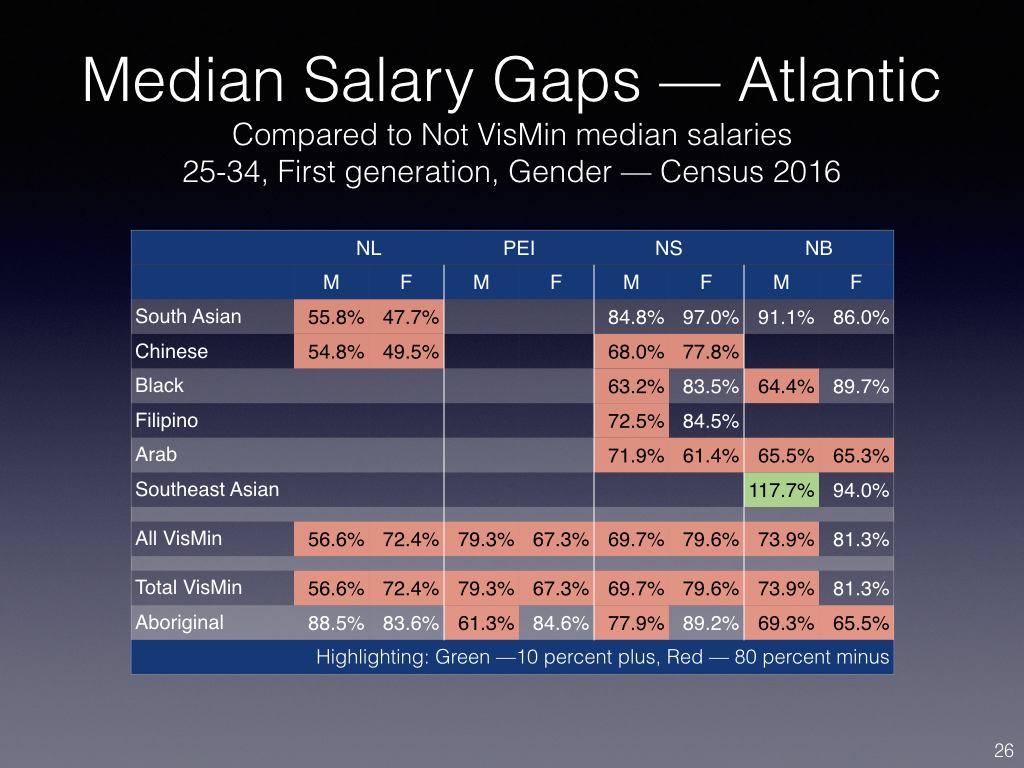
Some good data and analysis in this article, which conform with the unemployment data I have looked at but not median income(slides below):

Immigrants who stay in Atlantic Canada have higher employment levels, higher wages and face less discrimination than immigrants to other parts of Canada, yet the region struggles to attract newcomers and has the lowest retention rates in Canada.

Atlantic Canada is engaged in a radical experiment in population management that has profound implications not just for this region, but for the country as a whole. The demographic bomb that threatens Canada is set to go off here first:

— Atlantic Canada has Canada’s lowest birth rate, highest median age and often sends more residents to other parts of Canada than it takes in.

— Francis McGuire, president of the Atlantic Canada Opportunities Agency, points out that there are more than 20,000 jobs unfilled in the region.

— Across Atlantic Canada, one in every five residents is already over the age of 65. That compares to a rate of one in six across Canada.

— Newfoundland and Labrador schools have lost a third of their students since 1996; more people have died than were born in the province for each of the last three years and the average age is almost three years older than the Canadian average of 41. The Harris Centre of Regional Policy and Development at Memorial University predicts the provincial population will drop 10 per cent by 2036 and that some towns could see drops of 30 per cent or more.

— New Brunswick had an actual population decline in 2016 and has lost one fifth of its school-age children in the last two decades.

— In Nova Scotia, the resilient economy of Halifax is the only factor propping up the province’s population. Every region outside the provincial capital declined in the last census.

Immigration the solution

Many agree that a massive increase in immigration is an inescapable part of the solution. All four provincial governments have made boosting immigration a key priority and Ottawa has stepped in with Canada’s first regional immigration program: The Atlantic Immigration Pilot.

But deciding to transform your society with new blood is easier than actually doing it.

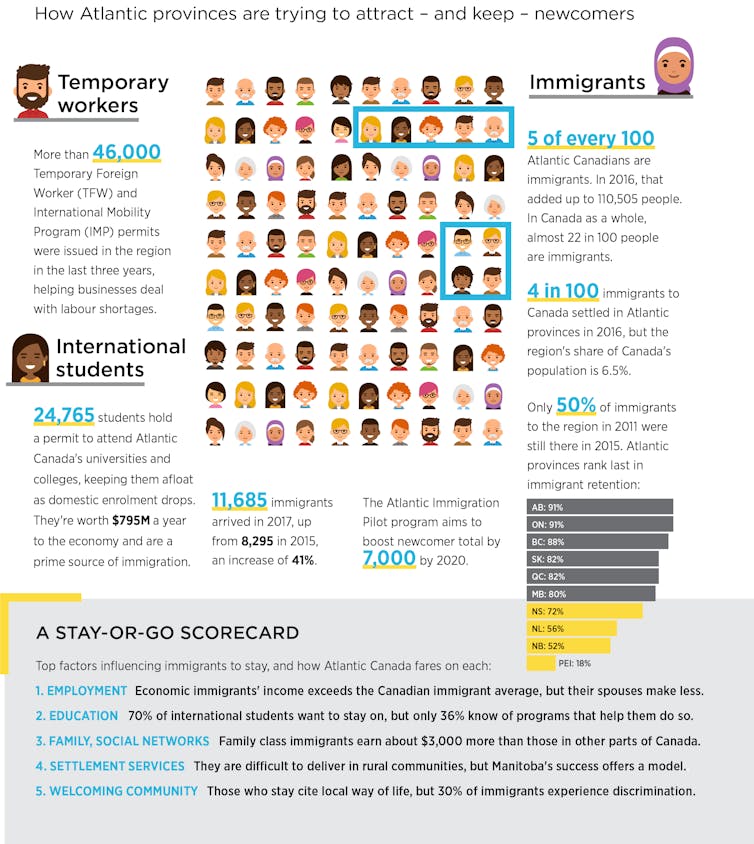
Only 18 per cent of the immigrants who landed in Prince Edward Island in 2011 were still there five years later. The rates are better in New Brunswick (52 per cent), Newfoundland and Labrador (56 per cent) and Nova Scotia (72 per cent), but they still fall far behind Ontario and Alberta, which kept 91 per cent of the immigrants who arrived in 2011, and British Columbia, which had a retention rate of 88 per cent over the same period.

Ottawa began shifting immigration responsibility to the provinces about 20 years ago.

The learning curve was steep. Initial programs in several provinces fell apart.

Now provincial recruiters target specific countries, make sure that potential newcomers know that Atlantic Canada is cold, rural and not particularly diverse, and they design immigration programs that encourage newcomers to settle.

How Canada’s Atlantic provinces are trying to attract – and keep – newcomers. Public Policy Forum, Author provided

The decision to come to Atlantic Canada and the decision to stay are two very different things.

Surveys show that immigrants leave the region in search of better jobs, but research suggests that’s not what they will find. In fact, immigrants in Atlantic Canada fare better economically than the average immigrant across Canada, and in some cases better than native-born Canadians.

Higher wages in Atlantic Canada

A profile of immigrant tax filers in Atlantic Canada published by Dalhousie University professors Yoko Yoshida and Howard Ramos found that immigrants to Nova Scotia, New Brunswick and Newfoundland were more likely to be employed and earned higher wages than the average immigrant in Canada who landed at the same time. Immigrants to P.E.I. were below the Canadian average, as were spouses of primary applicants and refugees.

Professor Ather Akbari at Saint Mary’s University found that immigrants in Atlantic Canada actually earn more than Canadian-born workers with similar skills who live in Atlantic Canada, though that wage advantage has narrowed over the last decade.

Research also disputes the familiar assumption that urban areas are more welcoming than small towns.

Dalhousie University’s Ramos recently looked at actual experiences of discrimination based on ethnicity, race and language. Overall, the incidence of discrimination was far lower in rural areas than in big cities. Atlantic Canada came out particularly well, with very low rates of discrimination compared to Ontario, the Prairies and British Columbia.

To be sure, newcomers do encounter hate and discrimination in Atlantic Canada, as in any other place.

via Newcomers find jobs, prosperity in Atlantic Canada — if they stay

Liberals’ judge selection has new bias, lawyers association says

Some valid concerns regarding diversity of experience and practice – in meeting the needs for  “identity” aspects of diversity, necessary to think also about these other aspects:

After appointing five women and no men to the bench in the Maritimes, the Liberal government is being told its commitment to diversity has a large blind spot – but not over the gender issue.

The Liberal government stressed diversity in launching a new process for appointing judges in October, 2016. For the first time, applicants are being asked about their race, gender identity, Indigenous status, sexual orientation and physical disability. Members of the committees that screen candidates are receiving training in “unconscious bias.”

Three of the five appointees in the Maritimes since then specialized in insurance law when they were lawyers, the Atlantic Provinces Trial Lawyers Association said in an open letter to federal Justice Minister Jody Wilson-Raybould on Wednesday. And all three worked for the same regional law firm, Stewart McKelvey.

“Their background is representing insurance companies in personal injury claims against the average Joe,” said Brian Hebert, president of the Atlantic lawyers association. “We’re hoping this isn’t a trend.”

In Prince Edward Island, six of the eight sitting judges on the Supreme Court and the Court of Appeal are from Stewart McKelvey. The Globe and Mail attempted to reach the managing partner of the firm’s Charlottetown office, and other managing partners, without success.

The Atlantic lawyers’ group represents plaintiffs in personal-injury cases – that is, individuals who in many cases sue insurance companies. “We represent the average person who has to fight insurance companies,” Mr. Hebert said.

“It’s a concern when we see judges being appointed from the same practice background, because we believe that as lawyers, we’re human, we’re influenced by our clients that we serve day-in, day-out, the culture of the firm that we’re in, the type of law that we practice.”

A spokesman for the Justice Minister said that only two of 12 judges appointed in Atlantic Canada since the Liberals took office in 2015 – a slightly different time-frame from the one referred to in the lawyers’ group letter – were, at the time of their appointment, with Stewart McKelvey.

“Minister Wilson-Raybould’s appointments in Atlantic Canada and throughout the country are based entirely on merit,” the spokesman, Dave Taylor, said in an e-mail.

“They respond to the needs of the courts, as identified through close consultation with Chief Justices. … The minister has been proud to appoint such outstanding candidates to the bench, as our government works toward building a judiciary that fully reflects the country it serves.”

Mr. Hebert said the appointees are highly qualified and he is not critical of the quality of appointments. Nor is his group critical of the lack of men appointed under the new process.

Christa Brothers, a former partner at Stewart McKelvey, was appointed to the Supreme Court of Nova Scotia in July; Tracey Clements, a partner at the same firm in Charlottetown, was named to the PEI Supreme Court in March; and Chantal Daigle, who chaired the recruitment office for the Saint John office of Stewart McKelvey from 2013-15, and who became a partner in 2004, was appointed last week to the Family Division of the New Brunswick Court of Queen’s Bench, after a year as case management master of that same court.

The other two appointees were not from law firms. One was a long-time provincial court judge promoted to the appeal court in Nova Scotia and the other was a lawyer from the Antigonish Legal Aid Office named to Nova Scotia’s Supreme Court.

“The reason we want women on the bench,” Mr. Hebert said, “is so that when women’s issues are before the court, or when women appear in court, there is a balancing of views. Same thing with race or other areas where we would want diversity. What we’re saying is the same considerations apply when you’re talking about the professional background of lawyers that are on the bench. There has to be a balance between the large-firm, insurance defence lawyers and other lawyers who are fighting for the rights of plaintiffs.”

In its letter, the association said a more diverse judiciary will bring “varied perspectives to the development of the law and the concept of justice itself.” 

Source: Liberals’ judge selection has new bias, lawyers association says – The Globe and Mail

Atlantic premiers, federal ministers announce new immigration initiative

A useful pilot continues to the next step:

Atlantic Canadian companies that want to hire international students and skilled workers will soon get government help.

 Atlantic Canadian premiers and several federal ministers announced a key step in an immigration pilot project, at the conclusion of their second meeting on the Atlantic Growth Strategy initiative Friday.

Federal Immigration Minister Ahmed Hussen said the provinces will now start designating employers that want to hire skilled immigrants.

Immigrants arriving in the region will have a job offer and an individualized settlement plan for them and their families.

“The idea behind this is to leverage the unique position of employers to help immigrants and their families better integrate into their new communities in Atlantic Canada and to remain here for the long-term so they can help grow the region’s economy,” Hussen said after Friday’s meeting in Wolfville, N.S.

Under the plan – part of the new Atlantic Immigration Pilot announced last July – the government will accept up to 2,000 immigrant applications this year, with increased numbers in following years depending on performance.

The pilot project is aimed at ensuring newcomers stay in the region instead of joining the stream of outmigration to other parts of the country.

Nova Scotia Premier Stephen McNeil said his province recognizes the need to capitalize on the 20,000 young people who choose his province for post-secondary education.

“About seven to eight thousand of them are from other countries,” said McNeil. “We’re aggressively going to work with our universities to grow that number even more and provide them an avenue to stay inside of our province to grow jobs and create opportunities.”

Source: Atlantic premiers, federal ministers announce new immigration initiative – Macleans.ca

More immigrants coming to Atlantic Canada, but retention rates low: report

Ongoing retention rate problem – only about half remain:

More people are immigrating to Atlantic Canada than ever before, but many do not stay, a new report says.

The Atlantic Provinces Economic Council report released Thursday said a record 8,300 immigrants arrived in 2015, and yet more the following year.

The Halifax-based council said 11,600 immigrants came to Atlantic Canada in the first nine months of 2016, due in part to an influx of Syrian refugees.

“The total numbers have tripled since 2002,” David Chaundy, author of the report, said in a phone interview Thursday.

Chaundy, the council’s research director, attributes the increase to expanded use of provincial nominee programs, which allow provinces to nominate people who wish to immigrate to their region, up to a cap.

“That’s what has really driven the growth,” said Chaundy, adding that this year the region could see closer to 19,000 immigrants, due in part to a new three-year Atlantic immigration pilot project announced by Ottawa and the four provinces last year.

But Chaundy said retention rates for Atlantic Canada are low, and lengthy processing times are a barrier for greater use of immigration in the business community.

“The challenge is on the retention of these immigrants,” said Chaundy. “Although our immigration numbers are rising, we’re still losing close to half of them over a five-year period.”

Although express entry applications are being processed within six months, provincial nominee applications are taking 16 months to be processed by the federal government, he said.

“These can be a challenge for employers looking to bring in a worker fairly quickly,” said Chaundy. “We really need to make sure we have resources to process these applications in a timely manner.”

About 80 per cent of immigrants settle in the region’s major urban centres.

The report is based on information from Statistics Canada and Immigration, Refugees and Citizenship Canada.

Source: More immigrants coming to Atlantic Canada, but retention rates low: report – Macleans.ca

An Atlantic immigration initiative? Lord knows we need bodies: Poschmann

Finn Poschmann, chief executive officer of the Atlantic Provinces Economic Council on the Atlantic Canada pilot immigration program:

Last week, it was a federal-provincial initiative involving the four Atlantic-region premiers and senior federal ministers, called the “Atlantic Growth Strategy.” It contains the necessary catchphrases, like clean growth, innovation and infrastructure, but it also contains something readily tangible: an immigration pilot program.

The scheme will operate on top of the provincially driven nominee program that fast-tracks identified individuals with job offers to permanent residency. It will allow up to 2,000 additional immigrants and their families into the Atlantic region each year for three years. If successful, the program will be continued and expanded, according to federal Immigration Minister John McCallum.

The notion that this approach might “work” comes from a plan to co-ordinate the activities of multiple levels of government, schools and employers with the aim of ensuring that immigrants land and find economic success. Strangely, this is a new idea, drawing on recent experience in landing and settling Syrian refugees.

Lord knows, the Atlantic region needs bodies. Natural population growth slowed markedly here in the early 1990s, and turned negative during the course of 2012. Since 1991, the Atlantic provinces’ annual population growth rate averaged 0 per cent, and total population growth has likewise been zero over the period. Together with demographic aging, this makes sustaining public finances, or pensions, no fun at all.

Now, the natural rate of population increase depends on the lifetime fertility rate of provincial residents. Because the Atlantic provinces’ total fertility rate is less than the Canadian average – and trends in fertility do not shift easily – immigration is tremendously more important to future population growth than it is elsewhere.

Immigration, even at levels many times higher than Canada has seen in recent decades, cannot meaningfully affect the age structure of the country’s population as a whole. But in the Atlantic area, even a comparatively small number of immigrants attracted and retained can make an important difference to population growth trends.

In 2014-15, Atlantic Canada accounted for 6.6 per cent of the Canadian population, but just 3.2 per cent of new immigrants. Were the region to have matched the Canadian average for immigrant attraction and retention relative to the resident population over any sustained period in recent decades, the region’s population and population growth rate would be trending upward, rather than flat or down.

In other words, a few thousand people goes a long way ’round these parts. The pilot program is welcome.

So what’s the catch?

First, it is not news that Atlantic economic growth has been sluggish. Among Canada’s 10 provinces, for instance, guess which four have unemployment rates above 8 per cent? And which four have the lowest employment-to-population ratios?

Many Canadians and government officials might look at those statistics and wonder where is the case for more bodies. But employers see things otherwise. They search high and low for skilled employees, and they routinely find themselves looking abroad.

Before hiring from abroad, many of these employers have to complete Labour Market Impact Assessments, which require them to prove a negative – that no Canadian is available to do the job. This pedantic exercise is something federal policy could usefully shed.

For many employers and in many communities, access to fresh bodies is the top concern. That speaks to the likely success of the immigration pilot, at least from a hiring perspective.

Then there are the self-inflicted impediments to bringing in or keeping new immigrants.

Cultural insularity is one of them, and not one that governments are well placed to deal with. Yet Treasury Board president Scott Brison’s recent proclamation that the dismissive phrase “come-from-way” should be banished from Atlantic idiom resonated widely. Attitudes within communities change slowly, with exposure to people and ideas, but they change.

What provincial governments can do, even if it will take time to fix, is address the fiscal mess that immigrants meet on arrival. Quebec wins for highest overall personal income taxes, but New Brunswick and Nova Scotia have achieved 50-per-cent-plus tax rates for professional income earners. The Atlantic region has the highest consumption taxes in the country and the four highest corporate income tax rates. Provincial per capita debt in Newfoundland and Labrador and in New Brunswick is downright ugly.

This is finely targeted foot-shooting. But at least governments have become aware of it.

And at least it is becoming widely accepted that Canada needs more immigrants, that immigrants are a new positive for our economy. It is nice to see policy reflect that reality.

Source: An Atlantic immigration initiative? Lord knows we need bodies – The Globe and Mail

Ottawa allows seasonal exemption to temporary foreign worker rules

Not surprising, given the regional politics:

The Liberal government has quietly approved changes aimed at helping Atlantic Canadian seafood processors that will allow them to bring in unlimited numbers of low-skilled temporary foreign workers to fill seasonal jobs this year.

Ottawa approved the foreign-worker exemption in response to lobbying from Atlantic seafood processors and Liberal MPs, who warned that recent restrictions to the temporary foreign worker program were hampering business. New Brunswick Fisheries Minister Rick Doucet recently said the labour shortage in his province is so bad that some lobster processing plants have had to throw lobsters in the trash.

The Liberals – who swept all 32 ridings in Atlantic Canada in last year’s federal election – are justifying the exemption as a short-term measure to buy time until a full review of the foreign worker program can be conducted later this year.

Other industry groups – such as Restaurants Canada – are questioning why exemptions are being allowed for some sectors and not others, and why they were never told of the change.

The House of Commons finance committee recently heard from a wide range of industry associations, including the Canadian Cattlemen’s Association, that requested a loosening of restrictions to the program.

The temporary exemption comes as Finance Minister Bill Morneau prepares to deliver a budget on Tuesday that will outline the federal government’s response to rising unemployment caused by the decline in Canada’s energy sector in Western Canada and Newfoundland and Labrador, which has long been a source of work for thousands of Atlantic Canadians.

Source: Ottawa allows seasonal exemption to temporary foreign worker rules – The Globe and Mail

Immigrants need a home, Atlantic Canada needs people: McKenna

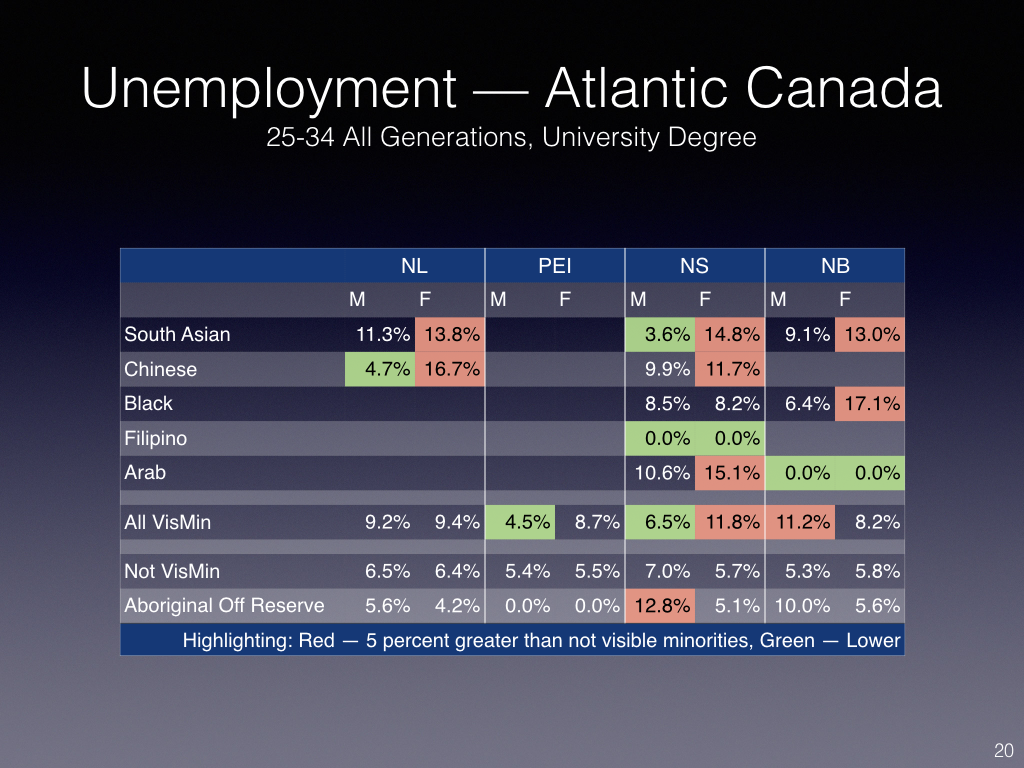
Atlantic Canada unemployment ratesFormer New Brunswick Premier McKenna advocates for an Atlantic specific immigration program. Not sure that immigration is a panacea for Atlantic Canada’s demographic problem, and retention may also be an issue as immigrants will follow opportunities.

The above table compares unemployment rates between visible minorities and non-visible minorities in the Atlantic provides (2011 NHS):

We do not need more federal programs or federal money. We need people! But the status quo immigration system won’t get the job done.

Immigrants generally go where immigrants are. More than 70 per cent of new Canadians settle in Toronto, Montreal and Vancouver. Atlantic Canada receives only about 2.5 per cent of immigrants. Without a larger base, it’s impossible to attract an immigrant population. It’s a continually reinforcing negative cycle.

The Provincial Nominee Program has had some uptake; yet, it has not moved the dial for Atlantic Canada. Again, immigrants go where immigrants are.

We need a new program dedicated to the needs of Atlantic Canada.

We do not have to reinvent the wheel. As far back as 2002, the immigration minister, Denis Coderre, floated the idea of a “social contract” whereby immigrants would be required to live in a community specified by the government for a period of at least three years, as part of the conditions for citizenship.

Allowing immigrants to convert a temporary visa into permanent status, once all conditions have been fulfilled, could pre-empt any legal arguments related to the mobility rights of individuals.

Critics will question why we should bring people to areas of high unemployment. But that is precisely where immigrants are needed. We need their entrepreneurship, their worldliness, their drive, their consumption and even their desperation. All of these attributes would be highly additive to the small communities across our region.

This model is not complicated or expensive. Ottawa could easily design a program unique for Atlantic Canada that could become a pilot for other regions depending on its success. It would be incumbent on provinces and communities to put together programs that would retain immigrants after they arrive.

Atlantic Canada is a warm and welcoming place to live. I’m confident that large numbers of immigrants would stay, refreshing our population base and providing a new energy to our economy.

My hope is the government of Canada understands it is facing a major collapse in the Atlantic region. If not this idea, what else might work? As for the Atlantic premiers, they need to make population growth their number-one priority and work together to create a new demographic destiny for Atlantic Canada.

Source: Immigrants need a home, Atlantic Canada needs people – The Globe and Mail