Scrapping Safe Third Country deal may not lead to huge influx of asylum seekers

Contrasting views by two experts: Peter Showler, former head of the IRB, and Benn Proctor of the Canada Institute of the Wilson Centre, but more a difference in degree:

The Trump administration’s crackdown on asylum seekers has renewed calls by critics to scrap or suspend the Canada-U.S. Safe Third Country Agreement (STCA); arguing that the U.S. is no longer a hospitable destination for refugee claimants.

But that raises the question about whether more asylum seekers would then come into Canada.

“The answer is that it’s speculative and no one knows,” said Peter Showler, former chair of the Immigration and Refugee Board (IRB) of Canada.

But, he adds: “I don’t think there’s a reasonable assumption that there would be a significant increase.”

Under the STCA, a person must make their refugee claim in the first, so-called “safe country” they reach. The premise of the deal was that since Canada and the U.S. share similar values, both are safe countries for those seeking refugee status.

It means those who first arrive in the U.S. and then seek entry to Canada to make a refugee claim will likely be turned back. (There are a few exceptions, for example, if the claimant has a family member in Canada.)

Legal loophole

Yet thousands of asylum seekers have recently crossed into Canada thanks to a loophole in the STCA, which applies only to those who try to enter by train, at airports or at official land border crossings. It doesn’t apply if — as so many people have in Quebec, Manitoba and elsewhere — one just walks across the border at some unofficial, unguarded spot.

Some suggest that scrapping the STCA would lead to more asylum seekers coming to Canada, because, that way, they could go to any official port of entry without the risk of being sent back to the U.S. or facing, what can be at times, a dangerous journey to cross the border, depending on the season and terrain.

Last year, more than 20,000 asylum seekers crossed illegally into Canada, according to the Canada Border Services Agency. (CBSA)

Trump has taken a hard stand against illegal immigrants, referring to them as “invaders.” His administration was slammed for the controversial policy of separating children from parents arrested for crossing illegally from Mexico. And on Monday, he said those caught crossing illegally should be immediately sent back without appearing before a judge.

His stance has sparked calls from human rights activists, refugee lawyers and Canadian politicians to scrap the STCA.

But Showler says there are approximately 11 million to 12 million illegal residents in the U.S. Many are fully aware of the relatively easy irregular or illegal ways to enter Canada, he said.

Yet despite Trump’s crackdown, there have not been huge increases of people crossing the border illegally, he said.

“That could have triggered a large movement toward Canada and it didn’t,” Showler said.

Many have established roots in the U.S., have been there for decades, have families, driver’s licences and Social Security cards and aren’t likely to come into Canada just because it would be easy, he said.

‘Moderate noticeable uptick’

In a report released last year, Fleeing to Canada on Foot: Reviewing the Canada-U.S. Safe Third Country Agreement, program associate Benn Proctor of the Canada Institute of the Wilson Centre, a global affairs think tank, ​noted that the agreement has “significantly reduced” the costs to Canada from processing claimants by dissuading applicants to come to Canada.

For example, in 2005, the year after STCA took effect, the CBSA reported that the number of claims made at the border dropped 54 per cent, from 8,904 to 4,041.

Proctor found that during the 11 years after STCA was implemented, Canada has processed an annual average of 22,839 asylum claims, 23 per cent fewer than the annual average of 29,682 claims processed between 1989 and
2004.

The OECD estimates a cost of $14,000 per asylum seeker, meaning the STCA may have reduced Canadian spending on asylum seekers by $2 billion over a 10-year period, he wrote.

(Those are first-year, or start-up costs only, he noted, and very quickly drop to near zero once refugees develop language skills and job placements.)

Since his report, however, Proctor said he has revised his thinking that there would be a huge influx of asylum seekers coming to Canada if the STCA was scrapped.

He said he now takes into account that — with the spread of information about safer places to cross the border illegally — it has become much easier to cross at these unofficial spots.

He expects a “moderate noticeable uptick” in the number of asylum claims if the STCA were scrapped.

“I would still say you expect to see more asylum claims coming from the U.S. if the Safe Third Country Agreement was disbanded or suspended. But originally I thought you would expect to see a lot more.”The increase of asylum claims would put more pressure on resources and exacerbate the problems with backlogs, he said.

Anna Pape, a spokeswoman for the IRB, said in an email that changes to the global environment have led to a “steady and significant increase in refugee claim referrals over the last few years” and resulted in a “growing backlog.”

As of April 30, 2018, there were more than 55,000 pending cases, and the projected wait time for claims for refugee protection before the board has increased to approximately 20 months, Pape said.

However, she said the IRB has improved its efficiency and that the number of refugee claims finalized has increased by approximately 40 per cent over the past year. She said the IRB projects to be able to finalize up to 2,500 refugee claims per month.

Source: Scrapping Safe Third Country deal may not lead to huge influx of asylum seekers
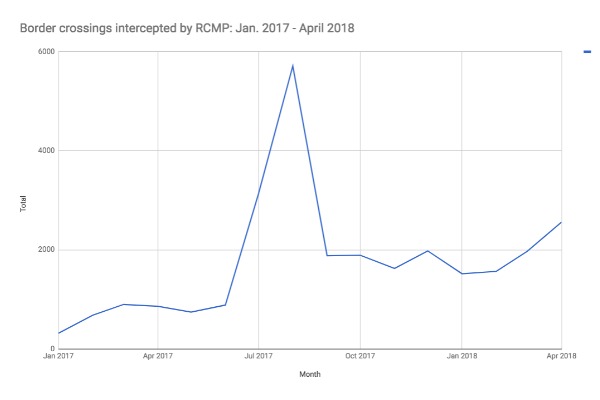
Canada’s Immigration Minister credits outreach efforts for drop in border crossers – The Globe and Mail

Encouraging, but too early to claim a trend and the relative impact of outreach versus other factors:

The Immigration Minister says a recent drop in the number of border crossers is a credit to the government’s efforts to discourage would-be asylum seekers from crossing into Canada between official border posts.

Ahmed Hussen said there was a 27-per-cent decrease in border crossers from 2,560 in April to 1,869 in May. He said unofficial figures show the decrease has continued into June.

However, Mr. Hussen said the federal government will continue its outreach efforts in the United States to discourage “irregular migration,” given the unpredictable nature of migrant flows at the border. It’s unclear what the Trump administration’s new immigration policy, which forcibly separates migrant children from their parents, will mean for Canada, which experienced a massive surge in asylum seekers along the border following an immigration crackdown in the United States last year.

“I sincerely believe that our outreach and other efforts … are having an impact in terms of the drop in numbers, but we remain vigilant. We are not letting up on our efforts and we’ll continue to do what we’ve been doing,” Mr. Hussen said in an exclusive interview with The Globe and Mail on Monday.

Last year, more than 20,000 asylum claimants – many of whom were Haitian – flooded the Canada-U.S. land border over fears they would be deported back to their home country under President Donald Trump’s plans to end their temporary protected status in the United States. In an attempt to control the surge in border crossers, Prime Minister Justin Trudeau’s government launched an outreach campaign in the United States to discourage potential asylum seekers from irregularly crossing into Canada.

However, a new group of asylum seekers started to cross the Canada-U.S. border this year: Nigerians, carrying valid U.S. visas. Mr. Hussen and his officials traveled to Nigeria in May to dispel “myths” about Canada’s asylum system and raise the visa problem with the U.S. embassy in the West African country.

While Mr. Hussen attributed the decline in border crossers to the government’s outreach program, Conservative immigration critic Michelle Rempel warned against becoming complacent about the statistics. The number of border crossers has more than doubled since May, 2017, when 742 asylum seekers entered Canada between official ports of entry.

“That’s still a significant amount of people that are coming into the country by illegally crossing the border from the United States. That number should be closer to zero,” Ms. Rempel said.

Meanwhile, questions continue to swirl over how new U.S. immigration measures could affect Canada. Mr. Trump’s “zero-tolerance policy” has forcibly separated nearly 2,000 migrant children from their detained parents, according to Homeland Security statistics obtained by the Associated Press. Outrage over the policy is mounting around the globe, and on Monday, the United Nations High Commissioner for Human Rights urged the Trump administration to stop its “unconscionable” measures.

Ms. Rempel said the troubling reports out of the United States further underscore the need for a Canadian government plan to address the global migrant crisis. She questioned the Liberal government’s position on a major asylum-seeker agreement with the United States and, if it determines that the United States is no longer a safe country for refugees, to explain what the plan is to budget for the “enormous demand” that would be placed on Canada’s asylum system by another flood of border crossers.

The Safe Third Country Agreement requires both countries to refuse entry to asylum seekers who arrive at official border crossings, as both countries are considered safe for refugees. However, since the agreement applies only to people who arrive at official ports of entry, asylum seekers can avoid being turned away by crossing between border posts.

The Immigration and Refugee Protection Act requires the government to continually review all countries designated as safe third countries, including the United States, to ensure that the conditions that led to the designation are met.

In light of the new U.S. crackdown on migrants, NDP immigration critic Jenny Kwan said the need to suspend the Safe Third Country Agreement is more evident than ever.

“I don’t think anybody with some understanding of the international laws and with a level of humanity will accept that the United States is a safe country for refugees,” she said.

via Canada’s Immigration Minister credits outreach efforts for drop in border crossers – The Globe and Mail

Liberals risk new-Canadian vote with border-crossing response, say pollsters

Some relevant polling data – will see how these numbers shift or remain stable should the trend continue or change:
Politicians and the media are to blame for using needlessly alarmist language on the rise of asylum seekers, when the system has the capacity to manage, says a former Immigration and Refugee Board chair.

The Liberals have switched to more hardline messaging around asylum seekers, say pollsters and observers, as the government’s response has left it open to attack in the face of increasing irregular border crossings and charges from the Conservatives that the Grits are soft on border security.

Politically, the challenge and vulnerability for the Liberals is especially acute among first-generation and new-Canadian communities, said Jackie Choquette, vice-president at Hill+Knowlton Strategies, which both parties have been targeting and fighting over for several elections.

“That’s traditionally been a huge area of support for the Liberal Party,” said the former provincial Liberal staffer, and an area where they could lose votes.

The issue is starting to gain traction as opinions shift within that community, she said.

“That’s a more-difficult, nuanced conversation, I think, for the government to have and that’s why I think it’s the biggest vulnerability.”

Though the Conservatives have been accusing the Liberals of being weak along the border, Summa Strategies senior consultant Kate Harrison said the attack line that’s more “acutely felt” is “on the notion of queue jumping.”

In a move many saw as a way to court new Canadian votes ahead of the 2015 election, Prime Minister Justin Trudeau (Papineau, Que.) promised to make family reunification easier for new immigrants to sponsor relatives coming to Canada.

Those “lofty promises” present a political vulnerability, Ms. Harrison said, as some families still wait for that to happen while hearing messages—accurate or not—that others get to jump the line.

“If they don’t make any progress on family reunification, a lot of those new Canadians that are already here and have family members that have been waiting to [come] here may grow very resentful,” said Ms. Harrison, a former Conservative Party staffer.

No party wants the discussion to devolve into “stoking resentment” within those communities, she said, but it has the danger of heading that way if parties aren’t careful.

All parties are “playing a careful dance” around how they frame the “tricky issue” because it “cuts to the very core of who we are as Canadians,” said Ms. Choquette, particularly as the country tends to pride itself on being welcoming.

Government shifts, sharpens message on asylum seekers

At committee and in Question Period last week, Public Safety Minister Ralph Goodale (Regina-Wascana, Sask.) responded to Conservative questions on what they’ve called “the border crossing crisis” by reiterating international obligations to refugees and stressing the government doesn’t think the situation is acceptable.

“Coming across the border in a way that tries to circumvent the law or defy proper procedure is no free ticket to Canada,” Mr. Goodale told reporters last week.

Observers saw that language from him and other officials as a very different, more stern approach. It was also a necessary shift following documents that showed Mr. Trudeau’s tweet from January 2017 welcoming “those fleeing persecution, terror [and] war,” caused confusion among officials and a flood of inquiries.

Angus Reid Institute executive director Shachi Kurl said there are a couple of outstanding questions.

“We’ve seen that message sharpened in the last little while, but is it enough? Is it enough practically and is it perceived to be enough in the minds of Canadians?” she said, adding the firm plans to poll soon on this issue again.

In a September poll following a summer spike in irregular crossings, Angus Reid found 53 per cent of respondents said the country has been “too generous” to the border crossers.

“I think there’s a narrative—which is not necessarily an accurate narrative—that Canada is an endlessly welcoming and generous country,” she said, but the polls show that’s not the case.

“As we see more individuals arriving at the border I think if anything that concern is only heightened, not lessened,” she said, adding the same goes for general awareness of the issue. “For those who are concerned, they are unlikely to have seen anything in terms of a change of approach that will have lessened or alleviate those concerns.”

‘Alarmist’ language a problem: former IRB chair

Because Canada and the United States are part of the Safe Third Country Agreement, people who cross from the U.S. at regular points of entry along the border or at airports aren’t able claim refugee status. The same does not apply at unofficial entry points, prompting the Conservatives to call on the Liberals to suspend the agreement.

Mr. Goodale has said the government broached the subject and is having “exploratory” talks with the U.S.

The latest government numbers show 2,560 such entries in April—a 30 per cent increase over the previous month. There were 20,593 irregular crossings from the United States in 2017 and have remained above 1,500 crossings a month since July 2017. The vast majority of those crossings are through Quebec, which observers note is a strategically important province politically in which the Liberals are pouring resources and where Conservative leader Andrew Scheer (Regina–Qu’Appelle, Sask.) has recently spent time courting disenchanted Bloc Québécois supporters. While the Liberals still lead the pack, a new poll showed the Tories are making gains in the province.

Source: Immigration, Refugees and Citizenship Canada

That uptick in border crossings “is only an increase compared to the unusually low numbers of claims in the past few years,” according to the Canadian Council for refugees.

The average number of refugee claims between 2013 and 2015 was 13,300 per year but between 2000 and 2009, it was an annual average of 31,400, the council said, arguing the case could be made that Canada is “returning to more usual numbers.”

Both the “loose language” and discussion around numbers from media and politicians has been “alarmist,” said Peter Showler, former chair of the Immigration and Refugee Board.

“It’s a kind of Chicken Little reporting on the numbers as though … the sky is going to fall,” he said. “The sky hasn’t fallen.”

The claims that came through in the last year “are well within the capacity of the Canadian refugee system,” he said, though agreed it requires more resources.

Part of the problem, he said, is use of the word “illegal” rather than “irregular” in discussing the kind of crossing.

The NDP has also raised this concern, that people have a right to seek protection and there are specific laws and processes in place to determine if someone falls within Canada’s definition of refugee.

The focus instead should be on protection and the legal rights of entrants, Showler said. And just because a claim is determined not to fall within Canada’s definition of refugee, that doesn’t make them fraudulent.

Most importantly, he noted the acceptance rates currently are approximately the same as those of the national average for refugee claims.

“It means that the significant majority of people who are seeking Canada’s protection, the Immigration Refugee Board has reached the conclusion that they are in need of protection,” said Mr. Showler, adding the rate is for the last two to three years is about 65 to 70 per cent—”which historically is quite high.”

Canadians should have a better understanding of the distinct refugee flows, he said, and the impact of U.S. President Donald Trump and his government’s pronouncements, including an executive order last year banning refugees and visitors from Muslim-majority countries.

Last year, many coming to Canada were from Haiti and feared deportation as Mr. Trump announced the 2019 end of the temporary residency program set up to take in those seeking refuge from the 2010 earthquake, he noted. Canada has already ended a similar program. More recently, arrivals are originally from Nigeria and head north soon after they land in the U.S., leading Immigration Minister Ahmed Hussen (York South–Weston, Ont.) to travel to Nigeria this week to meet with officials on the ground.

For the most part, pollsters say opinions on refugees are polarized along political lines, with Conservative voters more likely to say the country is being too generous to asylum seekers.

Pushing border security and painting the Liberals as soft may produce “modest gains” for the Tories but it’s not a strategy that will dramatically increase their support, said Frank Graves, president of EKOS Research Associates.

However, it can provide emotional energy for motivating their base, he said, which are “far more concerned” about the issue.

“Frankly, elections are won on emotional engagement,” he said, and the approach can bring out committed supporters, which can produce higher turnout, better fundraising, and more involvement.

Even so, Mr. Graves said he doesn’t see this issue as “a huge exposed flank” for the government while Ms. Choquette said the Liberals still need a win on the file.

“They need to make a measurable difference on one aspect of this issue, even if it’s a small aspect,” she said, though there’s no easy solution. “The potential for this issue is it hurts them with a number of key constituencies that they rely on or will need to rely on in 2019. They’re running out of time.”

via Liberals risk new-Canadian vote with border-crossing response, say pollsters – The Hill Times

Sadrehashemi/Waldman: Four myths about Canada’s border crossings

While their arguments have a sound basis, I find them somewhat disingenuous.

One could, for example, designate Roxham Road as a port of entry, given that 91 percent come through there. Some would, or course, try other places to enter, and we may get into a game of “whack a mole”, but no need to patrol the entire border as in many places, geography still makes it harder.

And one could, as Howard Anglin has suggested earlier (How Canada can restore order to its immigration system – Macleans.ca), have any increase in asylum seekers count against the total number of refugees rather than merely be additive.

Whatever the option proposed, or options being considered by the government, there are no easy solutions. But however and ultimately, as Andrew Coyne has argued, viability depends on cooperation with the US (Andrew Coyne: Asylum problem will only be fixed … – The Victoria Star).

While I agree that some of the rhetoric regarding the influx if overblown, similarly downplaying the risks to public confidence in immigration is equally unhelpful:

Michelle Rempel, Conservative immigration critic, tweeted recently that the media was finally writing about “illegal border crossings” after she had been raising it for a year. The problem is that several recurring myths are shaping much of the coverage. Here are four of them:

The first myth is that Canada could designate the entire border as a port of entry. This is not a viable option. The public safety minister cannot legally designate the entire border as a “port of entry.” Under our law, a “port of entry” is a place designated open by the minister based on a number of factors, including the anticipated frequency of persons arriving at a particular location. Border officials must examine and process people seeking to enter Canada at ports of entry.

Imagine that all 8,891 kilometres of our border with the United States were a port of entry. Even if we only had one officer every 100 meters, we would still need more than 270,000 new officers to cover the border 24/7. This is not a serious policy proposal and should not be treated as one.

The second myth is that refugee claimants who are crossing into Canada at non-official border crossings are entering illegally. Canada is a signatory to the UN Convention on Refugees. Under international law, a refugee claimant cannot be punished for the way they enter into a country to seek asylum. Our immigration law does not make it illegal to enter Canada using informal border crossings, as long as a person reports to border services without delay. There is no legal basis to insist, as some have, that those who cross at non-official border points should be summarily deported, or that their refugee claims should be expedited since they will be refused. Underlying these suggestions is the assumption that people who are entering are not “real refugees.” The problem is that you cannot tell whether someone is a “real refugee” simply by the way they enter your country. In fact, in 2017, 53 per cent of those who crossed irregularly from the United States were found to be refugees.

The third myth is that people who are crossing from the United States are taking the spots reserved for refugees Canada would bring from overseas, somehow displacing them from a “queue.” This is comparing apples and oranges. Canada has a quota for the number of refugees it brings from overseas, either through the private sponsorship program or the government assisted refugee program. The quota is not determined by the number of refugee claims that are made in Canada. A rise in the number of refugee claimants arriving at Canada’s border does not push out refugees that Canada would accept from overseas camps.

Fourth, the rush to extreme, unviable policy solutions is predicated on the most egregious myth: the federal government has lost control of the border. This is far from true. The vast majority of those crossing the border, 91 per cent, are coming through one place, Roxham Road in Quebec, and immediately declaring themselves to Canadian authorities. There is no pressure to go “under-ground”; instead, there is a fair process to ensure proper adjudication of refugee claims. Security checks are expedited for these claimants, ensuring those who enter in this fashion do not pose a security threat. The government has also increased the capacity of border officials and refugee adjudicators.

While some try to raise alarm about a “crisis” at the border, the number of refugee claimants in Canada has to be put into a broader perspective. It is true that the number of refugee claimants has risen over the last year, but we also saw similar numbers in 2001. And globally, the same number of refugee claimants who came to Canada over all of last year entered Bangladesh in a single day. This is not the time to ignore our global duties and hastily throw up new barriers. Rather, by treating those who have crossed from the United States fairly and with compassion, according to law, Canada will merely be complying with its obligations as a party to the UN Refugee Convention.

via Sadrehashemi: Four myths about Canada’s border crossings | Ottawa Citizen

It’s time to abolish the inhumane Canada-U.S. deal on asylum-seekers: Sean Rehaag

Although I am a great admirer of the work Rehaag has done with his analysis of IRB decisions and decision makers (see Refugee approval rates reflect subjectivity of decision-makers, prof says – Montreal – CBC News), his article proposing abolishing the STCA would lead to a further sharp increase in the number of asylum seekers (already controversial), further overwhelm the IRB (already overwhelmed) and undermine overall support for immigration in this country.

Evidence-based policies need to consider the operational aspects, as well as the trade-offs between overall immigration levels and classes:

The Canadian government reportedly wants the United States to close a loophole in what’s known as the Safe Third Country Agreement (STCA).

The agreement allows Canada to send asylum-seekers back to the U.S. if they come to the border. But the deal only applies at official ports-of-entry, and not when asylum-seekers cross the border elsewhere — the loophole that Canada apparently wants eliminated.

Expanding the STCA to cover irregular crossings would mean that thousands of asylum-seekers would be sent back to the U.S. after making their way to the Canadian border in the wake of worsening conditions there under President Donald Trump.

The current American administration, however, is unlikely to tweak the agreement. Trump doesn’t like refugees. He has imposed travel bans on refugees selected for resettlement; attempted to block entry to asylum-seekers arriving in a “caravan” at the southern U.S. border; he’s scorned an agreement to transfer 1,250 refugees from Australian detention facilities to the U.S. as “the worst deal ever.”

The STCA has barred thousands of asylum-seekers from Canada. Prior to its implementation, approximately 10,000 asylum-seekers entered Canada via the United States each year. Some 200 went in the other direction. In this context, Trump is unlikely to expand the STCA. If anything, he’d want to cancel it outright to decrease the number of refugees in the U.S.

The STCA’s 9-11 history

It’s worth recalling the history of the STCA. Canada had long pushed for the STCA because of the lopsided flow of asylum-seekers, but the U.S. refused for years. After the 9-11 attacks, when border security was of utmost concern, Canada essentially pulled a fast one by offering enhanced information-sharing and common border security measures in exchange for the STCA.

However, Canada would have agreed to these measures regardless because disruption to the cross-border flows of goods and services hurts Canada’s economy. In essence, Canada got the STCA for nothing.

In the Trumpian world view, this is another “worst deal ever,” and it fits into his claim that “very smooth” Canada has “taken advantage” of the U.S. for years.

If the United States isn’t likely to agree to expand the STCA, what is going on here?

Simple. This is crass political theatre.

‘Beating up on refugees’

The ruling Liberals are facing attacks by the opposition Conservatives who have returned to beating up on refugees as a show of “toughness.” In response to growing numbers of asylum-seekers irregularly crossing the Canada-U.S. border, the Liberals must be seen to be taking action, even if that action is futile.

Still, something meaningful needs to be done.

One could debate whether the agreement was ever good policy. There’s a Constitutional challenge under way about whether it’s even lawful. But, regardless, it’s clearly not working now.

The more asylum-seekers resort to irregular crossings to circumvent the STCA, the more these sites are normalized as unofficial crossings. The longer this goes on, the less effective the STCA will be at deterring future asylum-seekers from coming to Canada via the U.S.

At the same time, if specific unofficial crossings are blocked off, asylum-seekers will simply move to other, more dangerous crossings. Every country that has built barriers has seen asylum-seekers driven to increasingly desperate and dangerous measures.

Alan Kurdi — the child whose death en route to seeking asylum in the European Union sparked Canada’s most recent refugee resettlement program — and the thousands of migrants who have died trying to evade ever-increasing surveillance at the U.S.-Mexico border are stark examples of this tragic phenomenon.

In other words, if Canada blocks places like Roxham Road on the Québec/New York state border, refugees will cross remote fields in Manitoba during snowstorms. Asylum-seekers take these kinds of risks on a daily basis around the world.

If expanding the agreement is not viable, if erecting barriers is terrible policy, and if the status quo is not working — what can be done?

Also simple.

Do away with the STCA

It’s time for Canada to suspend the STCA. Asylum-seekers should be able to make refugee claims at regular ports-of-entry. At the same time, the government should calibrate funding and staffing levels for the Immigration and Refugee Board to the number of claims in the system.

This would ensure that people who meet the refugee definition are recognized in a timely manner and put on the path to successful settlement, while those who do not need Canada’s protection can quickly be removed. And it’s worth a reminder: Most are likely to meet the legal test to stay.

Suspending the STCA is not a radical proposal. Asylum-seekers made claims at the Canada-U.S. border for decades pre-STCA and the system worked fine.

Suspending the STCA will not harm Canada’s relationship with the U.S., or the ongoing NAFTA negotiations. The Americans would happily discard the STCA.

Suspending the STCA is also politically viable. It will not end Conservative opposition attacks. But rather than defending inaction on so-called “illegal” border crossings, the Liberals can instead punch back and say that they respect international refugee law.

They can ask whether the Conservatives want Canada to deport refugees — and how that squares with the lessons that Canada was supposed to have learned from the days of none is too many, when Canada had one of the worst records among Western countries of providing refuge for European Jews fleeing the Holocaust. They can ask whether the Conservatives care about the tragic deaths of Alan Kurdi and thousands of other desperate asylum-seekers around the world.

Most importantly, by suspending the STCA, Canada can show that there is an alternative to the xenophobic extreme-right policies taking parts of the world by storm.

Instead of building walls, we can adopt evidence-based policies that comply with international law and that make our country a better place for everyone. And we can show that the sky will not fall if Canada hosts a few thousand more people who face persecution, torture and even death.

If not now, when?

via It’s time to abolish the inhumane Canada-U.S. deal on asylum-seekers

Kurl: Canadians are now confronting how generous we really are

While overall support for immigration remains high, and Canadians believe in the economic benefits of immigration, valid to ask how these macro numbers will continue to hold up should the asylum seeker numbers continue to grow and the government measures, current and likely those under consideration, do not result in a decline:

This is soon to be our summer of our discontent, disagreement and discomfort, as Canadians watch increasing numbers of people claiming asylum try their luck at undesignated border crossings

Discontent over Justin Trudeau’s government’s handling of the file. Disagreement over how it should be handled, and discomfort over the realization that despite the often-proffered narrative of Canada’s endless, unconditional welcome of newcomers, we’re wary to say the least, about this phenomenon.

As they try to escape the ever fear and uncertainty of Donald Trump’s ever-tightening restrictions on immigration, and spurred on by that now infamous prime ministerial tweet, they do so by circumventing Canada’s Safe Third Country Agreement (STCA), which denies entry to those who have already claimed or obtained status in the United States, by crossing into Canada not at airports or other, staffed border crossings, but anywhere they can, along thousands of kilometers of unmonitored perimeter.

Who doesn’t remember the iconic photograph early last year, of a smiling Mountie lifting a little girl in a pink coat over the U.S.-Canada border near Hemmingford, Que? What came to national attention as something of a curiosity – and for many a representation of the “best of Canada” – has since given way to pointed questions about how officials plan to deal with the tens of thousands and counting who are seeking to make a home on this side of the 49th parallel.

When the issue again dominated headlines last fall, slightly more than half of Canadians (53 per cent) said the country has been “too generous” to the border crossers, more than eight times as many as those who said Canada hasn’t been “generous enough” (six per cent). Politics drives those opinions: past Conservative voters are overwhelmingly more likely to say this, although it should be noted that at least 40 per cent of 2015 Liberals and yes, even past New Democrat voters agree.

As to where they wanted government focusing its attention, seven-in-10 said they’d prioritize assigning more staff to monitoring and securing unguarded parts of the border. The rest (30 per cent) said they’d prioritize assisting those seeking asylum.

Little wonder then, that at the time, the majority (57 per cent) disapproved of the Liberal government’s handling of the situation, including one-third of his own party’s past voters.

Even less wonder, for reasons practical and political, the government which last year rejected calls to suspend the STCA, is now calling on the U.S. to agree to amendments that would have it apply to the entire length of the border.

How did we get here? Didn’t Trudeau proclaim that “diversity is our strength?” Wasn’t the popularity of his stance on accepting 25,000 Syrian refugees part of what convinced centre and centre-left voters to spur the Liberals to a majority?

The thing is, feel-good rhetoric is easier to accept when a complex issue isn’t staring you right in the eyeballs. Before this, incidents of irregular asylum seekers suddenly reaching our borders were largely limited to a handful of boats that managed an arduous ocean journey; Indian nationals arriving off the coast of Newfoundland and Labrador in the ’80s. Migrants from Fujian arriving in the late ’90s. Sri Lankans who made a similar trip about 10 years later.

Not until now have we had to answer uncomfortable questions about how welcoming we really are. The vast majority of people in this country (79 per cent) have said our immigration and refugee policy should give primacy to national economic and workforce needs over those in crisis abroad (21 per cent).

Given the more than 150,000 economic class immigrants who came from every corner of the world in 2016, diversity is indeed our strength. What Canadians perceive as a government weakness, however, is equating diversity with an open invitation followed by an ill-prepared response, to unchecked migration as Canada confronts its own mini-Greece moment.

via Kurl: Canadians are now confronting how generous we really are | Ottawa Citizen

Andrew Coyne: Problem with asylum seekers in Canada can only be fixed if U.S. decides to help

Coyne nails it. Any effective solution requires working with the Americans:

The frontier between the United States and Canada is often described as the “world’s longest undefended border.” This is untrue. It is defended by the United States, in both directions.

The Americans are certainly vigilant in defence of their own border, as anyone who has visited the United States lately could attest. But they are no less responsible, in a way, for defending Canada’s.

So far as the border goes undefended by Canada, it is because it is, as far as we are concerned, indefensible. We simply don’t have the resources to patrol a eight-thousand-kilometre border — still less tens of thousands of kilometres of coastline.

That a few million people, indeed, could lay claim to the entire northern half of the continent, without more than a fraction of the armed might needed to defend it, was always a bit of a con. It has relied, from the start, on our proximity to the United States.

The country exists, it is not too far to say, because the United States agrees it should. The Americans could invade any time they liked; there would be nothing we could do to stop it. They simply choose not to. So, too, we would be powerless to prevent any serious power from invading from abroad. Our security depends instead on the Americans refusing to tolerate this.

Something of the same applies to those little “invasions” by thousands of desperate individuals who, to escape persecution and privation (for most, the motives are mixed), will cross whatever international borders they must: legally if possible, illegally if necessary.

Most western countries are grappling with this. That Canada has been relatively lightly affected is because we are bounded on three sides by thousands of kilometres of water — and on the fourth by the United States. The security of our southern flank has very little to do with the policies we enact. It depends rather on what the Americans do.

The Safe Third Country Agreement between our two countries that is the subject of so much recent controversy is an example of this. Negotiated by the Chretien government in the aftermath of the Sept. 11 attacks, it was essentially a favour to us, part of a larger package of border measures; Canada had indeed been seeking such an agreement for years.

Ostensibly, the accord is reciprocal: each country agrees to turn back refugee claimants from the other, since each agrees to regard the other as “safe.” Those seeking asylum are therefore obliged to make their claims in the first country they arrive in.

But who’s kidding whom? So far as the agreement was intended to prevent “asylum shopping,” the flow of claimants was only ever likely to be in one direction.

Few, after all, would turn their back on the relatively lenient Canadian system to take their chances on the relatively strict American system. It was done at our request, to limit the number of refugee claimants entering by our southern border — and with the understanding that their claims would instead by heard by the U.S.

Even at the time, it was widely predicted to fail. If it reduced the number of legal border crossings, it could only be at the cost of creating “an incentive for people to cross the border in illegal ways,” as the executive director of the Canadian Council for Refugees, Janet Dench, noted. “They’re going to come across fields and rivers, in the backs of trucks and cars,” said the organization’s vice-president, Nick Summers. “They’re going to take risks and there are people who are going to die.” I think we can now acknowledge he was right.

Those who are demanding, in response to the latest surge in illegal crossings, that Canada “get control of its borders,” are therefore talking through their hats. It’s not something we can do on our own.

For starters, any change to the Safe Third Country Agreement — extending its reach from a small number of official ports of entry to the entire border, as the Conservatives have demanded — could only be done with the Americans’ co-operation. We can’t simply turn back refugee claimants, unless the Americans agree to take them. That’s true not only as a matter of U.S. law, but of our international obligations, under the 1951 UN Refugee Convention, not to mention Canadian law.

It seems unlikely, to say the least, that the current administration would accept such an amendment. Even if they did comply, that would still leave us with the task of policing 8,000 km of border. The more broadly we cast our net, the further afield the asylum seekers would be likely to go to evade it.

If we want to cut the flow of illegal border crossers, rather, we have to alter the incentives that encourage them to take this route. Right now they have every incentive to cross at irregular points, since that way they are guaranteed a hearing, in contrast to the official ports of entry, where they are turned back automatically.

What if we reversed that: enter by the lawful door, you get a hearing; enter anywhere else and you are sent back? But again, the U.S. would have to agree.

More broadly, we have to close the gap between Canadian and American practices, in reality or perception, that leads people to believe it is worth fleeing north. That’s not just a matter of reminding would-be claimants that acceptance is not automatic, that they may well be deported after their hearing. So long as their chances of being accepted are materially greater in Canada, the incentive will remain.

I suppose we could tighten our procedures to American designs. Or, if that’s intolerable to us, we can try to persuade the U.S. to be more liberal.

But one way or another, it is the Americans who will decide.

Source: Andrew Coyne: Problem with asylum seekers in Canada can only be fixed if U.S. decides to help

Illegal border-crossers could erode confidence in Canada’s immigration system – and in the Trudeau Liberals: @JohnIbbitson

Ongoing political management issue (real and perceived):

All three national political parties, and a majority of Canadians, support high levels of immigration, and the multicultural matrix through which these new arrivals integrate into the Canadian fabric. All of this could be at risk.

Last year, more than 20,000 people entered Canada from the United States by avoiding regular crossings, where they would have been turned back. If the first four months of 2018 are any indication, the number this year could reach 60,000, which would threaten to overwhelm existing settlement services in Ontario and Quebec.

These are not conventional refugees. Some are migrants who fear being deported from the United States. Some are arriving in the United States on visas, and then heading straight for Canada. This is wrong.

But the Liberal government is playing down a situation that could soon become a crisis.

Unless Ottawa can re-establish control over the border, the public could lose confidence in the government and, far worse, in the immigration system itself.

In recent days, we learned that the Canada Border Services Agency wants to construct temporary housing units for more than 500 irregular crossers.

The Conservatives call the housing “a refugee camp” and blasted the secretiveness of the operation.

“I’m not sure any Canadian would think that this is an acceptable response,” Conservative immigration critic Michelle Rempel declared, according to The Canadian Press.

Public Safety Minister Ralph Goodale dismissed the refugee-camp label as “misleading,” because “most irregular crossers do not spend long in custody before being released.” This will not reassure people.

Previous waves of new arrivals from the United States originated in Somalia and Haiti. This year, people appear to be arriving in the United States from Nigeria, and then heading for the Canadian border. There are also fears that Hondurans at risk of being deported from the United States might also seek shelter in Canada.

Does the Conservative proposal − that the entire border be declared a point of entry under the Safe Third Country Agreement between Canada and the United Sates − have merit? This would allow officials to apprehend and deport anyone crossing the border, regardless of where they crossed. The Liberals say such a proposal is unworkable and dangerous because migrants would seek riskier crossings to avoid detention. What else could be done? Is it within the law to expedite the claims of border-crossers, reject those claims and return them to the United States, counting on the grapevine to send the message that seeking refuge in Canada is no longer an option?

That sounds cruel, but even crueller is forcing legitimate refugee claimants to languish overseas because the system has been overwhelmed by queue-jumpers.

Cruellest of all would be to close the Canadian border to immigrants and refugees entirely, because the public loses confidence in the ability of government to control the system. Nativist populists have come to power in the United States and Europe for exactly that reason. Canada is not immune to such demagogues.

The goal here is not to keep people from coming to Canada − quite the opposite. Canada’s future depends on bringing in hundreds of thousands of people each year to fill job vacancies, to innovate and invest, to make Canada stronger and wealthier and even more tolerant and diverse.

If we lose that openness, we lose our future. This is what the people crossing into Canada in hopes of gaming the system are putting at risk. Yes, it doesn’t help that the Trump administration appears uninterested in co-operating on border security. But ultimately, this is a Canadian problem and it’s up to the Canadian government to solve it.

It feels as though the Liberal plate is overflowing with difficulties, these days. Despite many months of talks, there is still no renewed North American free-trade agreement. The May 31 deadline for persuading Kinder Morgan not to walk away from the Trans Mountain pipeline project is fast approaching. The refugee-claimant situation at the border is getting worse instead of better. If Progressive Conservative Leader Doug Ford wins the Ontario election, Canada’s largest province may pull out of the national plan to fight global warming by taxing carbon.

More than anything else, Canadians expect their government to manage the store. If voters become convinced that the Liberals can’t handle the job, they will look for someone who can.

via Illegal border-crossers could erode confidence in Canada’s immigration system – and in the Trudeau Liberals – The Globe and Mail

Canada in ‘exploratory’ talks with U.S. over border agreement on asylum seekers

Appropriate and needed given that any workable solution requires working with the US:

Canada is in high-level exploratory talks with the United States over a border agreement to manage asylum seekers, but will not say whether Ottawa wants the power to automatically turn away thousands of refugee claimants who walk across the border.

The U.S. Department of Homeland Security confirmed it is reviewing a Canadian proposal to amend the Safe Third Country Agreement (STCA), which requires Canada and the United States to refuse entry to asylum seekers who arrive at official ports of entry along the shared border, as both countries are considered safe for refugees. However, senior Canadian cabinet ministers insisted they have not entered into formal negotiations with the United States.

“It’s a discussion that we’re having with the Americans about the various techniques that could be pursued on both sides of the border to ensure security and integrity,” Public Safety Minister Ralph Goodale said on Tuesday. “If and when that conversation matures into a specific negotiation, we’ll have further things to say about it. But this is very exploratory at the moment – scoping issues and potential solutions.”

Concerns over the agreement, which was signed in 2004, surfaced last year when thousands of asylum seekers fled the United States for Canada on foot, fearing deportation under President Donald Trump’s immigration crackdown. Since the agreement applies only to those who arrive at official ports of entry, asylum seekers can avoid being immediately turned away by crossing between border posts, forcing Canada to process most of their claims.

Immigration Minister Ahmed Hussen did not confirm a Reuters report on Tuesday that the government wants the agreement to apply to the entire Canada-U.S. border. Mr. Hussen said Ottawa is in regular contact with the United States about the agreement, but declined to get into details.

“As you can appreciate, we constantly talk about all aspects of the border, including the Safe Third Country Agreement,” Mr. Hussen said. “Those are discussions that are ongoing, so I can’t take a snapshot in time and give you what was discussed on a particular day.”

The RCMP intercepted more than 20,000 asylum claimants in 2017, 91 per cent of whom crossed in Quebec. Many entered at Saint-Bernard-de-Lacolle after taking taxis along upstate New York’s Roxham Road.

The Mounties intercepted more than 5,000 asylum claimants in the first three months of 2018 – again, mostly in Quebec.

The Conservatives have urged the government to close the loophole in the Safe Third Country Agreement that allows asylum seekers to enter Canada at unofficial border crossings. Last week, the Tories tabled a motion in the House of Commons calling on the Liberals to table a plan by May 11.

“Last week, Justin Trudeau voted against taking immediate action and tabling a plan to manage our borders and immigration system,” Conservative immigration critic Michelle Rempel said in a statement on Tuesday. “Conservatives will continue to hold the Prime Minister accountable, and call for the entire Canada-U.S. border to be designated as an official port of entry.”

Mr. Goodale said the Conservative proposal is “impractical,” as it would “change the entire concept about what the border means” and “increase insecurity at the border.”

As the Liberals iron out their approach to STCA talks with the United States, they are touting their efforts to prevent more asylum seekers from crossing into Canada. For instance, Mr. Hussen said many of those crossing into Quebec earlier this year were Nigerians carrying valid U.S. visitor visas. Canadian officials raised the issue with their U.S. counterparts, and the number of U.S. visas issued to Nigerians dropped.

via Canada in ‘exploratory’ talks with U.S. over border agreement on asylum seekers – The Globe and Mail

The contrary view, to this being a crisis, can be seen in Senator Omidvar’s op-ed in The Star:

Let’s be honest. The common thread of today’s populism is anti-immigration. This populism legitimizes xenophobia and encourage the separation of people into “us” and “them”. It creates a politics that sees the other not simply as different, but as different and therefor dangerous. Adversaries become enemies.

Populism prevents an energetic engagement with diversity. It erects barriers — whether literally or figuratively — that stand at odds with the reality of an increasingly interconnected — and interdependent — world.

Populism can undermine the basic underpinnings of a democracy. If we have learned anything from south of the border it is how norms that were once considered absolute can quickly become obsolete. How things that were once unimaginable can soon become unexceptional.

So how do we respond? First, words matter. We need to watch how we talk about legitimate issues around asylum seekers and our borders. We can’t whip up fear and division.

Second, we can’t use this as political football. No party should use immigration as a wedge issue. We deserve better than that.

Finally, we need to recognize the fact that when it comes to immigration, we’ve done a lot right. We’ve devised smart policies with high levels of skilled immigrants and we help people that are fleeing some of the most wretched situations around the globe. We do a very good job of integrating them. And while we’re far from perfect, we bring a lot to the table.

However, an area that needs attention is the Immigration and Refugee Board (IRB). Although the recent budget increased funding for the IRB more is needed. Money is needed to process asylum claims efficiently as well as deal with a growing backlog. Continuing to build this “good governance” structure will go a long way to maintaining public trust in the system.

Canada still has work to do, but we have a strong foundation on which to build.

via Asylum seekers are not causing a crisis for Canada | The Star

Asylum seekers and commentary

Given the ongoing and continuing issue, this National Post basics article is helpful in understanding the trends although point 5 (government response) overstates the effectiveness of the government response even if there are no easy solutions:

The number of illegal border crossings is up significantly this year compared with the same period last year, so federal and law enforcement officials have been preparing for possibility of another spike as the weather warms up.

Departmental, RCMP and border officials provided a technical briefing this week on the plans they have developed as a result of lessons learned from pressures and concerns arising from last year’s spike in irregular migrants coming across the Canada-U.S. border.

Here’s what was learned:

1. The numbers are trending upward. Last year, RCMP intercepted a total of 20,493 people who crossed the border illegally. That means they did not present at an official port-of-entry and instead came across the border through unofficial paths to make a refugee claim in Canada. So far this year, 6,373 irregular migrants have arrived in Canada this way. That’s an increase of 128 per cent over the number who arrived in Canada between January and April 2017, which was 2,784.

2. Quebec is the hotspot. Of the 6,373 border crossers that have arrived so far in 2018, the majority — 5,609 — have done so in Quebec. However, about 40 per cent of say they are planning to settle elsewhere in Canada, mainly in Ontario. That’s why Quebec and the federal government are working on a plan to try to encourage asylum seekers away from highly saturated areas like Montreal and Toronto, in the hopes they might instead settle in outlying regions of the two provinces where labour shortages exist and migrants could find more employment opportunities.

3. Housing remains a question mark. Quebec has told the feds it will only open four temporary shelters for refugee claimants this year, with a total of 1,850 spaces. The province says it will not open Olympic Stadium or the nine other temporary shelters it operated last year for migrants because these were spaces not intended for accommodations, such as school gymnasiums. That’s why Ottawa is now working with Quebec and Ontario on processes that could be used to triage asylum seekers from the unofficial entry point in Lacolle to other shelters in those provinces.

4. Countries of origin are shifting. Last year, the majority of irregular migrants who arrived in Canada were Haitian, which is largely attributed to the Trump administration’s decision to lift the temporary protected status for immigrants from Haiti living the U.S. This year, the majority of illegal migrants in Canada are Nigerians with U.S. travel visas. Other countries of origin this year include: Columbia, the United States and Pakistan.

5. Lessons have been learned. After last summer’s unexpected influx caused some major headaches, a national strategic plan has been put in place to respond to any future spikes. It was described by a senior official as “collaborative, flexible, scalable and phased.” It allows for increased resources to be brought into an area quickly, as needed. It is designed to move asylum seekers through the system in a timely manner while also ensuring all of Canada’s rules for refugee claimants are properly followed. That being said, Ottawa continues to try to get the message out that entering Canada between ports of entry is “not a free ticket” into Canada.

Source: What you need to know about the ongoing influx of asylum seekers in Canada 

Good commentary by Ibbitson, highlighting that this is one of the three key political challenges facing the government (the other two being NAFTA and pipelines):

A third challenge is emerging, on the border. Last year, more than 20,000 people crossed from the United States into Canada by avoiding regular crossing points. Thanks to a legal loophole, by committing this illegal act, they stood a better chance of being accepted as refugees than if they showed up at a proper crossing. Mr. Trudeau may have worsened the situation when he tweeted in January, 2017: “To those fleeing persecution, terror & war, Canadians will welcome you, regardless of your faith. Diversity is our strength #WelcomeToCanada.” It seemed like an open invitation to those fleeing the deportation efforts of the Trump administration.

If the past three months are any indication, the number of illegal crossers could more than double this year, beyond 40,000, putting the entire immigration and refugee system at risk. We could have more people flooding across the border illegally than arrive legally each year from the Philippines, Canada’s largest source country of immigrants. If the Liberals can’t find a way to stem this flow, voters will punish them.

Source: Trudeau must win three fights, or he could lose to Stephen Harper 2.0  

Australia PM makes the point effectively:

“So we know what works and what doesn’t. Migration programs, a multicultural society, need to have a commitment, an understanding and the trust of the people, that the government, their government, is determining who comes to the country,” he said.

“So being in control of your borders is absolutely critical. I think that is a fundamental foundation of our success as a multicultural society, as a migration nation as people often describe us.

“You have to exert your sovereign right to control your own borders.” 

Source: Border control is key to successful multiculturalism: Malcolm Turnbull