Poll: Asian-American Discrimination Marked By Individuals’ Prejudice : NPR

Latest in NPR polling on discrimination:

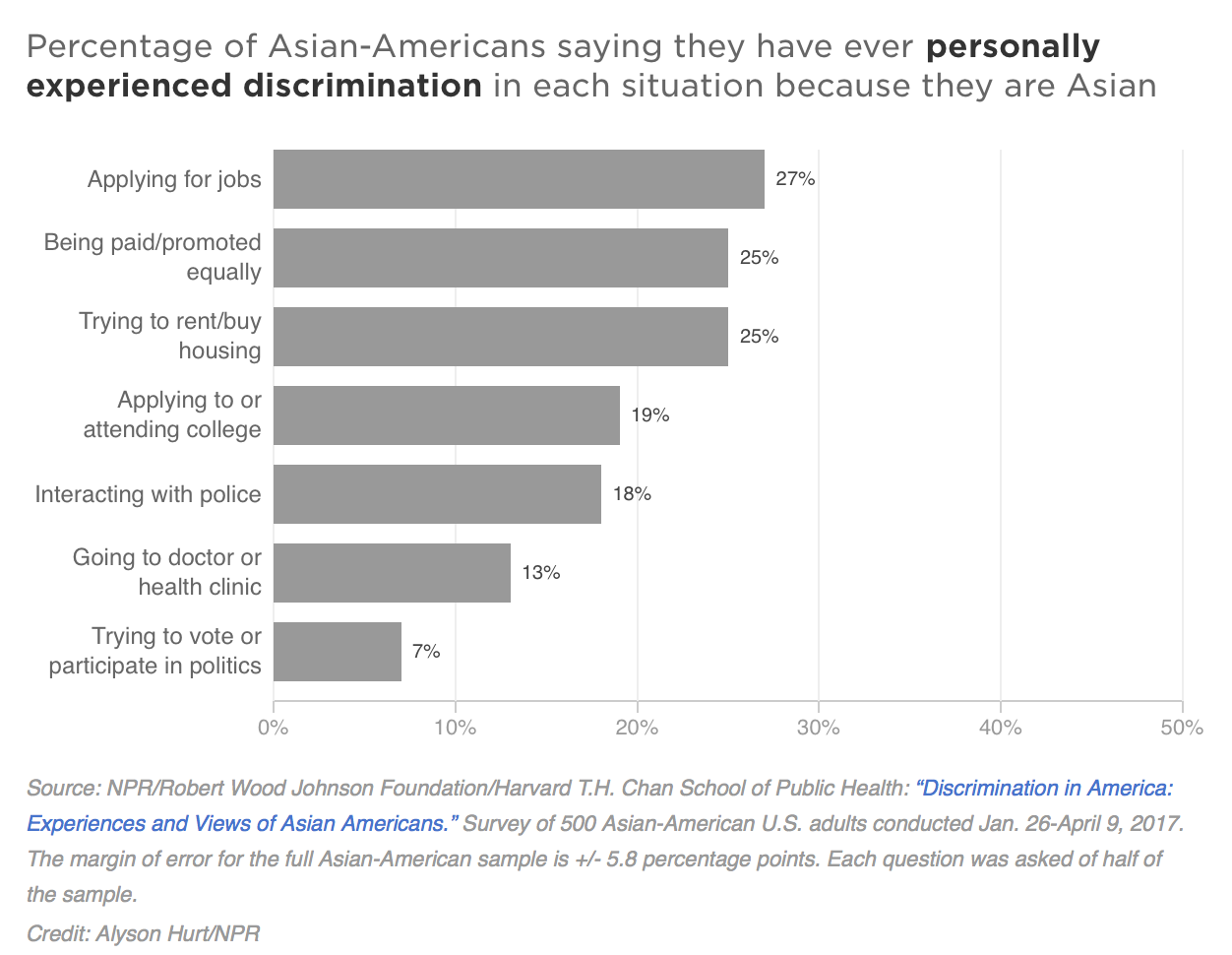
New results from an NPR survey show that large numbers of Asian-Americans experience and perceive discrimination in many areas of their daily lives. This happens despite their having average incomes that outpace other racial, ethnic and identity groups.

The poll, a collaboration among NPR, the Robert Wood Johnson Foundation and the Harvard T.H. Chan School of Public Health, also finds a wide gap between immigrant and non-immigrant Asian-Americans in reporting discrimination experiences, including violence and harassment.

“Our poll shows that Asian-American families have the highest average income among the groups we’ve surveyed, and yet the poll still finds that Asian-Americans experience persistent discrimination in housing, jobs and at college,” says Robert Blendon, professor of health policy and political analysis at the Harvard Chan School who co-directed the survey. “Over the course of our series, we are seeing again and again that income is not a shield from discrimination.”

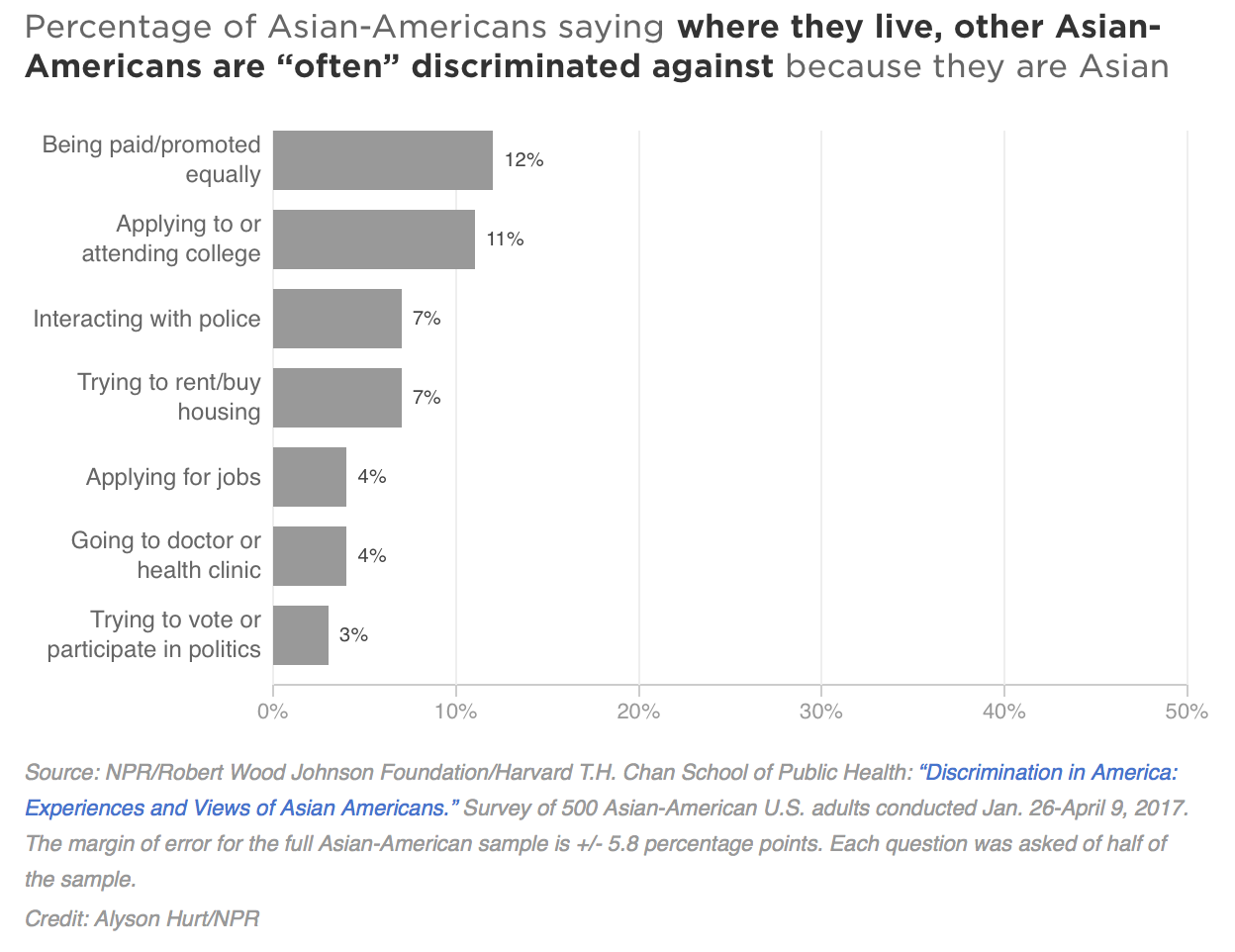
In addition to asking about personal experiences with discrimination, we also wanted to find out what people’s perceptions are of discrimination within their own neighborhoods. The numbers for Asian-Americans were lower on this measure than for personal experiences but still show that a notable level of discrimination exists in everyday life.

The survey was conducted among a nationally representative probability-based telephone (cell and landline) sample of 500 Asian-American adults. The margin of error for the total Asian-American response is 5.8 percentage points at the 95 percent confidence interval. Interviews were conducted in English, Mandarin, Cantonese and Vietnamese. Complete methodological information is in the full poll report.

Looking at the split according to immigration status, we found that nonimmigrant Asian-Americans are more than three times as likely to say they’ve experienced violence because they are Asian and more than twice as likely to say they’ve been threatened or non-sexually harassed because they are Asian.

We also saw a similar gap based on immigration status in terms of experiencing sexual harassment. But it’s important to note that our poll was done earlier this year, before the country’s widespread discussions of sexual assault and harassment in the fall. “These national conversations may have affected how people viewed or responded to their own experiences, or on their willingness to disclose these experiences in a survey,” Blendon says.

via Poll: Asian-American Discrimination Marked By Individuals’ Prejudice : NPR

What’s Keeping Asian-American Lawyers From Ascending The Legal Ranks? : NPR

Useful analysis, including breakdowns by different Asian ethnicities, and the importance of role models:

In 2015, the California Supreme Court reversed the ruling [against non-citizens joining the California Bar – Chang was unable to become a citizen given the Chinese Exclusion Act of 1882]. “Even if we cannot undo history, we can acknowledge it and, in doing so, accord a full measure of recognition to Chang’s path-breaking efforts to become the first lawyer of Chinese descent in the United States,” the judges wrote in their decision.

“That case got me thinking about the fact that Asian-Americans have been formally excluded from the legal profession as Chang was, and of course, [with] all the informal barriers,” says California Supreme Court justice Goodwin Liu, who reviewed the case. He said he realized he hadn’t seen a comprehensive study of how Asian-Americans came into the legal profession — so he took it upon himself to lead one.

In the study, Liu shows that though Asian-Americans are the fastest-growing minority group in the legal field, there’s still a stark lack of Asian-American lawyers in top positions in this country.

In 2015, 10 percent of graduates at the top-30 law schools were Asian-American, according to the study. Yet they only comprised about 6 percent of federal law clerks and 4 percent of state law clerks. Compare that to white students, and you’ll see a striking contrast: 58 percent of students from top-30 schools were white, but still landed 82 percent of all federal clerkships and 80 percent of all state clerkships.

Liu and his co-researchers also found that while Asian-Americans comprise 5 percent of lawyers in the U.S. and 7 percent of law students, only 3 percent of federal judges are Asian-American, and three out of 94 U.S. Attorneys last year were Asian-American.

The study noted that some obstacles Asian-Americans face include a lack of access to mentors, as well as stereotypes of Asians as being unable to assimilate or socially awkward.

“Whereas Asian Americans are regarded as having the ‘hard skills’ required for lawyerly competence, they are regarded as lacking many important ‘soft skills,’ ” the researchers wrote.

The study also pointed out that there’s a dearth of Asian-American lawyers in public service roles:

“It is notable that few Asian Americans appear motivated to pursue law in order to gain a pathway into government or politics. … Greater penetration into these public leadership roles is critical if the increasing number of Asian American attorneys is to translate into increasing influence of Asian Americans in the legal profession and throughout society. A major challenge is to encourage Asian American lawyers to pursue public service roles and to eliminate barriers for those who do.”

When asked to break out the data further by ethnicity, Xiaonan Hu, one of the researchers, told NPR that she noticed Filipino-American and Indian-American respondents were more likely to say they enrolled in law school to work in government or politics than, say, Japanese-American or Korean-American respondents. Two percent of respondents who were Japanese-American and 3 percent of Korean-Americans ranked the entry into government or politics as a top motivator for going to law school, compared to 11 percent of Filipino-Americans and 5 percent of Indian-Americans.

So what could account for this?

“It doesn’t seem like it’s as much about those groups [being] MORE interested in government and politics, but less averse to it,” Karthick Ramakrishnan, a professor of political science at the University of California, Riverside, wrote in an email.

“For Filipino Americans, many of them made advancements in government and local politics in California and Hawaii, where they have large populations and there were relatively long-standing Filipino communities,” Ramakrishnan, who also runs the project AAPI DATA, said.

“Indian Americans, by comparison, are much more recently arrived in the United States (with their population booming in the last 2 decades). That normally would mean that we would not expect them to be involved in politics. But, past research indicates that prior experience with democracy and high English proficiency tend to mean greater political participation.”

And while there are rampant structural issues that need to be addressed, Chris Kang, former National Director of the National Council of Asian Pacific Americans, said that emphasizing role models can sometimes be powerful.

When Kang was working with the Obama administration as Pres. Obama’s Deputy Counsel, he helped appoint federal judges. Kang said he and his team tried to highlight each new justice’s ethnicity and gender.

“It wasn’t just, ‘the first Asian-American judge in the district,’ but we really went and highlighted ‘the first Vietnamese-American, the first Filipino-American,’ ” Kang told NPR.

“If there’s someone of your particular ethnicity — or an Asian-American woman, [where there’s] only been two to the federal bench before — seeing now a dozen of them starts to make a difference,” Kang said, “and you start to think as you’re going into law school or you’re a lawyer considering what’s next for you, that a judgeship might be possible.”

Source: What’s Keeping Asian-American Lawyers From Ascending The Legal Ranks? : Code Switch : NPR

The real secret to Asian American success was not education – The Washington Post

Interesting and relevant study on how barriers affect mobility:

This claim has been with us since at least the 1960s, when it served as a popular rejoinder to the challenges issued by the civil rights movement. Many newspapers printed flattering portraits of Asian Americans to cast skepticism on the people marching for economic and social justice.

“At a time when it is being proposed that hundreds of billions be spent to uplift the Negroes and other minorities, the nation’s 300,000 Chinese-Americans are moving ahead on their own,” claimed a 1966 story in the U.S. News and World Report, which noted their “strict discipline” and “traditional virtues.”

To the extent that all myths are rooted in truth, this model minority stereotype recognizes a real pattern of Asian upward mobility. A century ago, Asian Americans were known as laborers of the lowest wage. They were ditch diggers, launderers, miners. Yet over the decades, despite poverty, racial violence and widespread discrimination, many Asians managed to clamber up the socioeconomic ladder.

Until now, the story of how that happened has been poorly understood.

“The widespread assumption is that Asian Americans came to the United States very disadvantaged, and they wound up advantaged through extraordinary investments in their children’s education,” says Brown University economist Nathaniel Hilger.

But that’s not what really happened, he says.

Hilger recently used old census records to trace the fortunes of whites, blacks and Asians who were born in California during the early- to mid-20th century. He found that educational gains had little to do with how Asian Americans managed to close the wage gap with whites by the 1970s.

Instead, his research suggests that society simply became less racist toward Asians.

Asian Americans have been part of the United States for most of its history. The first major wave of immigrants came in the 1800s, when Chinese laborers flocked to California to help build railroads. Their presence soon stirred up resentments among white Americans. The Chinese Massacre of 1871, which took place in the streets of Los Angeles, counts among the largest lynchings in U.S. history.

In 1882, Congress passed the Chinese Exclusion Act, which shut the door on the influx of low-skilled Chinese labor. By 1924, nearly all immigration from Asian nations was banned. Despite widespread discrimination, many families remained, settling mostly in California. Opinion surveys from that era show that whites expressed extreme prejudice against both Asian and African Americans. Asians also lived in segregated neighborhoods and often sent their children to segregated schools. To survive, many opened their own businesses because no one would employ them.

Hilger’s research focuses on native-born whites, blacks and Asians to rule out the effects of subsequent immigration. In 1965, changing laws ushered in a surge of high-skilled, high-earning Asian workers, who now account for most of the Asians living in the United States today.

But even before the arrival of those highly educated immigrants, the Asians already living in the United States had more or less closed the wage gap with whites.

At the time of the 1940 census, Hilger found, California-born Asian men earned less than California-born black men. By the 1970 census, they were earning about the same as white men, and by the 1980 census, the native-born Asian men were out-earning white men.

Throughout this time, many Asian American families did invest, increasingly, in their children’s education. But Hilger discovered that the improvements in educational attainment were too modest to explain how Asians’ earnings grew so fast.

The picture became much clearer when he compared people with similar levels of education. Hilger found that in the 1940s, Asian men were paid less than white men with the same amount of schooling. But by the 1980s, that gap had mostly disappeared.

“Asians used to be paid like blacks,” Hilger said. “But between 1940 and 1970, they started to get paid like whites.” The charts below shows average earnings for native-born black, white and Asian depending on how much education they had.

In 1980, for instance, even Asian high school dropouts were earning about as much as white high school dropouts, and vastly more than black high school dropouts. This dramatic shift had nothing to do with Asians accruing more education. Instead, Hilger points to the slow dismantling of discriminatory institutions after World War II, and the softening of racist prejudices. That’s the same the explanation advanced by economists Harriet Orcutt Duleep and Seth Sanders, who found that in the second half of the 20th century, Asian Americans not only started to work in more lucrative industries, but also started to get paid more for the same kind of work.

In other words, the remarkable upward mobility of California-born Asians wasn’t about superior schooling (not yet, anyway). It was the result of Asians finally receiving better opportunities — finally earning equal pay for equal skills and equal work.

Why couldn’t African Americans close the wage gap? It’s hard to say. Hilger found some evidence that there were underlying differences in skill. Between Asians and African Americans with the same amount of schooling, African Americans tended to achieve lower scores on military enlistment tests during the 1940s.

But it’s also likely that postwar racial attitudes shifted differently for Asians than for African Americans. In the 1850s, newspapers in California complained that Chinese immigrants were the dregs of the laboring class, having “most of the vices and few of the virtues of the African.” Yet by the 1960s, attitudes had completely flipped. Journalists praised Asians for being hard workers who cherished education, kept their heads down and rarely complained.

The Asian Advantage: Kristof – The New York Times

Looking at the various factors that may play a role:

Does the success of Asian-Americans suggest that the age of discrimination is behind us?

How Are Different Asian-American Groups Faring Economically? : Code Switch : NPR

Asian AmericansSome highlights from a US Department of Labour Report on Asian Americans:

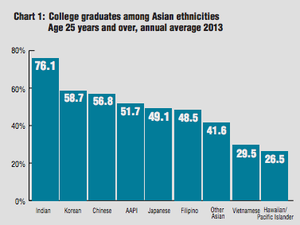
“Overall, 53.4 percent of Asians over the age of 25 have a bachelors degree or higher — the highest percentage by far among the major race groups.”

“The AAPI community has the second highest share of unemployed workers who are long-term unemployed 41.7 percent … Asian Americans who are unemployed, are without work for longer than whites and Hispanics.”

“When controlled for age, sex and educational attainment, unemployment rate for Indians is actually higher than comparable whites. This difference suggests that the Indian community as a whole tends to be more educated, but when looking at similarly situated white workers, their employment outcomes are less favorable.”

How Are Different Asian-American Groups Faring Economically? : Code Switch : NPR.