Asian-Americans Are Being Attacked. Why Are Hate Crime Charges So Rare?

Interesting analysis of some of the challenges:

On a cold evening last month, a Chinese man was walking home near Manhattan’s Chinatown neighborhood when a stranger suddenly ran up behind him and plunged a knife into his back.

For many Asian-Americans, the stabbing was horrifying, but not surprising. It was widely seen as just the latest example of racially targeted violence against Asians during the pandemic.

But the perpetrator, a 23-year-old man from Yemen, had not said a word to the victim before the attack, investigators said. Prosecutors determined they lacked enough evidence to prove a racist motive. The attacker was charged with attempted murder, but not as a hate crime.

The announcement outraged Asian-American leaders in New York City. Many of them protested outside the Manhattan district attorney’s office, demanding that the stabbing be prosecuted as a hate crime. They were tired of what they saw as racist assaults being overlooked by the authorities.

“Let’s call it what it is,” said Don Lee, a community activist who spoke at the rally. “These are not random attacks. We’re asking for recognition that these crimes are happening.”

The rally reflected the tortured public conversation over how to confront a rise in reports of violence against Asian-Americans, who have felt increasingly vulnerable with each new attack. Many incidents have either not led to arrests or have not been charged as hate crimes, making it difficult to capture with reliable data the extent to which Asian-Americans are being targeted.

That frustration erupted on a national scale this week after Robert Aaron Long, a white man, was charged with fatally shooting eight people, including six women of Asian descent, at spas in the Atlanta area on Tuesday night.

Investigators said it was too early to determine a motive. After Mr. Long’s arrest, he denied harboring a racial bias and told officials that he carried out the shootings as a form of vengeance for his “sexual addiction.”

The Atlanta shootings and other recent attacks have exposed difficult questions involved in proving a racist motive. Did the assaults just happen to involve Asian victims? Or did the attackers purposely single out Asians in an unspoken way that can never be presented as evidence in court?

Soh: Attacks on Asian-Americans reveal a strange racial double standard

While I agree that having heirarchies–ethnic, racial, religious etc–are unhelpful, my sense of Canadian media coverage is that anti-Asian attacks have received extensive and appropriate coverage as race-based attacks.

Not sure why the Globe would publish an op-ed focussed on the US without mentioning similarities and differences with Canada. :

The surveillance-camera video is horrifying to watch. In broad daylight, Vicha Ratanapakdee, an 84-year-old Thai man, was slammed to the ground while on a morning walk in San Francisco; he never regained consciousness. In Oakland, a man attacked a 91-year-old man, a 60-year-old man, and a 55-year-old woman in Chinatown. Nearly two dozen violent incidents in the area have been recorded in recent weeks.

These incidents are just part of a recent and unfortunate trend, particularly during the Lunar New Year. In a Pew Research Center study conducted last July, about 30 per cent of Asian-American adults said they have experienced discrimination because of their ethnicity or race since the pandemic began.

Former U.S. president Donald Trump’s rhetoric has been blamed for stoking anti-Chinese resentment. He repeatedly referenced the “China virus,” the “China plague” and the “Kung Flu” while in office, holding the country responsible for the pandemic.

And yet, as these crimes continue, there has been a failure to see these attacks as racially motivated. Mr. Ratanapakdee’s homicide, for instance, is not being prosecuted as a hate crime. It wasn’t until Hollywood actors spoke up that media attention was drawn to these incidents, with Daniel Wu and Daniel Dae Kim offering a US$25,000 reward for information. That led to the arrest of 28-year-old Yahya Muslim, who is not facing hate-crime charges.

Being level-headed about emotional subjects is never a bad approach, as it prevents us from jumping to conclusions about unclear events or any legal concerns. But in this case, what is the likelihood that multiple victims, targeted randomly, just happened to all be Asian? If an alarmingly high number of people belonging to another visible-minority group had been violently assaulted and murdered, would anyone doubt that the attacks were racially motivated?

It feels like a double standard. And it can feel, broadly speaking, as if racism against Asians is not taken as seriously as racism against other groups. Take, for example, a job listing posted by a Bay Area tech company recently, which explicitly sought “non-Asian” applicants. Or consider the debate on affirmative action sparked most recently by the case of Students for Fair Admissions versus Harvard; in 2019, a federal judge ruled against Asian-American applicants who believed they had been systematically discriminated against by university admissions officials, and who sought a race-neutral process.

That’s where it can feel like obsessions with race are erecting a bizarre racial hierarchy – one in which apparently only white perpetrators can commit racist or hateful acts, and one where discrimination against certain groups counts less or hurts less than discrimination against others.

Because the general economic success of Asian diasporic communities in Canada and the U.S. is dissonant with the narrative that societal white privilege limits and is hostile to visible minorities, we are too often stripped of any progressive clout afforded to “people of colour.” In the eyes of some, we are being recategorized as “white.” From this ideological view – one I disagree with – it isn’t possible to be racist toward white people.

Further complicating this lack of logic is the history of strained relationsbetween Asian and Black communities in the U.S., most notably between protesters and Korean business owners in the Rodney King riots. Asian-Americans have been long held up as an example of successful assimilation, and by doing so, they become used to dismiss the genuine concerns of Black Americans, pitting one group against another.

But protecting racial groups is not a zero-sum game; ensuring the safety of one does not need to come at the expense of another. We can identify racist acts while advocating that they should not be used to justify retaliatory harassment or prejudice against others.

Since the start of the pandemic, I’ve been asked whether I think claims of Sinophobia have been overblown to forward an agenda of race-baiting. In short: No. Because I am often mistaken as having a different Asian ethnicity, it’s been amusing and sad to see what some will say in my presence, only to furiously backpedal their opinions once I tell them that I’m a Canadian of Malaysian-Chinese descent.

For those who remain skeptical, I’d ask how they would feel if people who shared their racial ancestry were being violently targeted and terrorized, and then made to feel that their concerns weren’t legitimate, especially during a time of the year that would normally be celebratory. Acknowledging where the coronavirus originated can be done without blaming or discriminating more widely against people of Asian descent.

Source: https://www.theglobeandmail.com/opinion/article-attacks-on-asian-americans-reveal-a-strange-racial-double-standard/

Appeals Court Rules Harvard Doesn’t Discriminate Against Asian American Applicants

Of note (will be appealed to SCOTUS where, given Trump appointments, may be overturned):

A federal appeals court in Boston has ruled Harvard doesn’t intentionally discriminate against Asian American applicants in its admissions process.

The panel of judges upheld a federal district court’s decision from last year, teeing up a possible case in front of the U.S. Supreme Court.

Circuit Judge Sandra Lynch, who wrote Thursday’s decision, agreed with the lower court that “the statistical evidence did not show that Harvard intentionally discriminated against Asian Americans.”

Students for Fair Admissions, an advocacy group, first filed its lawsuit in 2014, saying that Harvard’s race-based considerations for applicants discriminated against Asian American students in process.

“Today’s decision once again finds that Harvard’s admissions policies are consistent with Supreme Court precedent, and lawfully and appropriately pursue Harvard’s efforts to create a diverse campus that promotes learning and encourages mutual respect and understanding in our community,” a spokeswoman for Harvard told NPR.”As we have said time and time again, now is not the time to turn back the clock on diversity and opportunity.”

Proponents of ending race-based considerations at U.S. universities were unfazed by Thursday’s decision and plan to bring the case to the Supreme Court, according to Edward Blum, the conservative strategist behind SFFA.

Blum said in a statement to NPR member station GBH that he plans to ask the Supreme Court to end the consideration of race in admissions at Harvard and all other universities.

The question of how much race should be a factor in college applicants is a hotly contested one. President Trump’s administration has challenged colleges on using race in admissions policies, claiming such practices violate federal law. Last month, the Department of Justice filed a lawsuit against Yale University, saying its policies violate the Civil Rights Act of 1964. Yale has said the lawsuit is “baseless.”

Wen Fa, an attorney with the Pacific Legal Foundation, which filed an amicus brief in the Harvard case, said Asian Americans are harmed by the school’s admissions rules.

“The Supreme Court’s intervention is needed so that universities comport with” federal law, Fa said.

Stella Flores, an associate professor of higher education at New York University, said she hopes the court will rely on decades of research and data that show the benefits of such policies. Race is but one factor within the broad and “holistic admissions policy” at Harvard and other schools, she said.

Flores and Fa say the new conservative majority of the Supreme Court makes predicting whether the justices will take up the case difficult.

The court has previously decided on similar questions. It upheld race-based admissions policies in the 2003 case Grutter v. Bollinger, as well as the 2013 and 2016 Fisher v. Univ. of Texas at Austin decisions.

In Grutter, the justices were asked to determine whether the University of Michigan Law School’s use of racial preferences in student admissions violates the Equal Protection Clause of the 14th Amendment or Title VI of the Civil Rights Act of 1964.

In the 5-4 Grutter opinion, Justice Sandra Day O’Connor said race-based admissions policies should be for a limited time only, Fa said.

That phrasing may be enough for the current court to take up the case, he said.

Source: Appeals Court Rules Harvard Doesn’t Discriminate Against Asian American Applicants

‘Overlooked’: Asian American Jobless Rate Surges But Few Take Notice

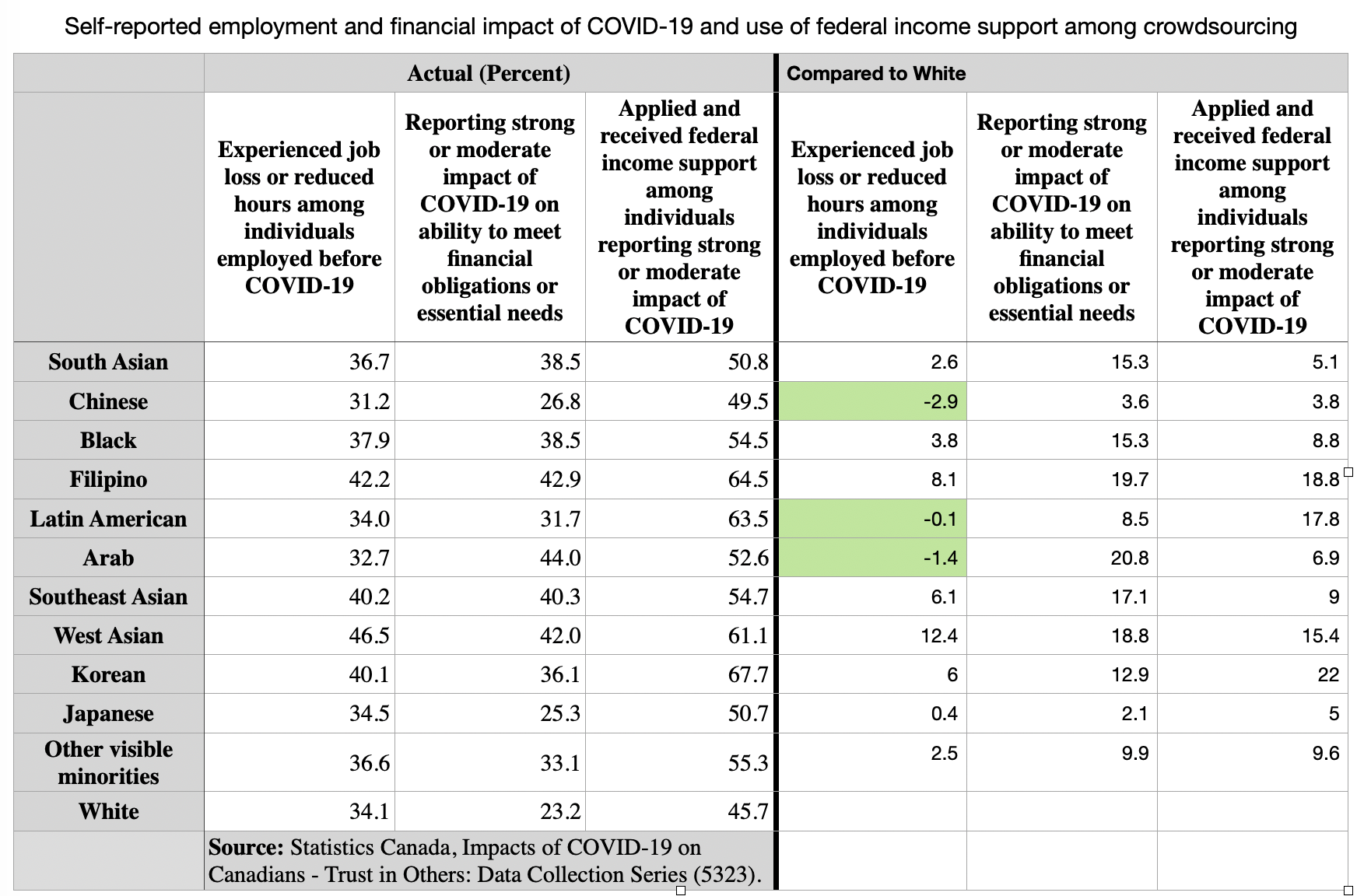
A reversal from pre-COVID. Canadian data by visible minority group shows some comparable trend with respect to income but less so for most Asian groups:

The coronavirus pandemic is taking a heavy economic toll on Asian Americans.

From Vietnamese nail salons to Cambodian donut shops, Asian-owned businesses have struggled. And Asian American workers have gone from having the lowest unemployment rate in the country to one of the highest.

Jerry Raburn lost his job at a mortgage servicing company in Southern California in March, just six months after he started.

“The business decreased dramatically, and based on seniority, I was let go,” said Raburn, who came to the U.S. from Thailand when he was 8 years old.

He now shares a single room with his mom, brother and sister in another family’s house.

“Everything just went downhill,” Raburn said. “I’m still unemployed, unfortunately, and I’ve been looking.”

David Canlas, who is from the Philippines, also lost his job consulting for software startups when the pandemic struck.

“Right now, nobody has start-up capital,” Canlas said. “Nobody has the budget to go hire a consultant. Nobody even feels comfortable for me to come into their office.”

The spike in Asian American unemployment stands out, even amidst the widespread misery of the pandemic.

A year ago, the jobless rate for Asian Americans was 2.8% — lower than that of whites, Blacks or Latinos. But Asian American unemployment soared to 15% in May, and it was still 10.7% in August — well above the rate of 7.3% for whites and the Latino rate of 10.5%. Only African Americans had a higher jobless rate of 13%.

While disparities in employment among Latinos and African Americans have garnered headlines during the pandemic, Asian American job losses have attracted less notice.

“Asian Americans are absolutely overlooked,” said Marlene Kim, an economist at the University of Massachusetts, Boston. “People have the sense that Asians are fine. That they’re a model minority. That they have good jobs and are doing OK.”

Geography explains some of the newfound challenges. Asian Americans are concentrated in places like New York and California, where the virus has taken a heavy toll.

Occupation also plays a role. Nearly a quarter of the Asian American workforce is employed in industries such as restaurants, retail, and personal services such as nail salons.

“Those industries have been hard hit by the pandemic and they traditionally employ many Asian Americans,” said economist Donald Mar of San Francisco State University.

Asian Americans also worry about discrimination, and say President Trump hasn’t helped with his provocative labeling of what he has repeatedly called the “Chinese virus.”

Paul Ong of UCLA noted that Chinatown in Los Angeles suffered an earlier and deeper drop in foot and vehicle traffic than the city’s other commercial neighborhoods.

“People are avoiding these areas in part because of this myth that somehow Asian Americans are tied in with the spread of the coronavirus,” Ong said. “Certainly that is untrue and unfair. But there’s no question that it gets reflected in the impact on the ethnic economy.”

That can be a real problem for Asian Americans who are new to the country or have limited English skills. In ordinary times, the social and economic networks of an immigrant community can open doors and provide opportunity. But Ong warned over-reliance on those networks can be a trap during a crisis like the pandemic.

“If you’re in an ethnic sector and all the restaurants are facing the same problem of being shut down, your opportunity to find work is minimal if not non-existent.”

Raburn has filed numerous online job applications since he was laid off by the mortgage servicing company, even though he finds the process soul killing.

“You don’t talk to a person,” he said. “It makes me not ever want to look for jobs again. But I have to look for a job.”

Raburn is also attending community college, and said his younger brother recently landed a job at Home Depot. Events have tested but not yet beaten his immigrant family’s hope for a brighter future.

“Life is hard in any country,” Raburn said. “I believe America will get better.”

Source: ‘Overlooked’: Asian American Jobless Rate Surges But Few Take Notice

Asian Americans Are Still Caught in the Trap of the ‘Model Minority’ Stereotype. And It Creates Inequality for All

Good long and reflective read:

The face of Tou Thao haunts me. The Hmong-American police officer stood with his back turned to Derek Chauvin, his partner, as Chauvin knelt on George Floyd’s neck for 8 minutes and 46 seconds and murdered him.

In the video that I saw, Tou Thao is in the foreground and Chauvin is partly visible in the background, George Floyd’s head pressed to the ground. Bystanders beg Tou Thao to do something, because George Floyd was not moving, and as he himself said, he could not breathe.

The face of Tou Thao is like mine and not like mine, although the face of George Floyd is like mine and not like mine too. Racism makes us focus on the differences in our faces rather than our similarities, and in the alchemical experiment of the U.S., racial difference mixes with labor exploitation to produce an explosive mix of profit and atrocity. In response to endemic American racism, those of us who have been racially stigmatized cohere around our racial difference. We take what white people hate about us, and we convert stigmata into pride, community and power. So it is that Tou Thao and I are “Asian Americans,” because we are both “Asian,” which is better than being an “Oriental” or a “gook.” If being an Oriental gets us mocked and being a gook can get us killed, being an Asian American might save us. Our strength in numbers, in solidarity across our many differences of language, ethnicity, culture, religion, national ancestry and more, is the basis of being Asian American.

Let me go back in time to a time being repeated today. Even if I no longer remember how old I was when I saw these words, I have never forgotten them: Another American driven out of business by the Vietnamese. Perhaps I was 12 or 13. It was the early 1980s, and someone had written them on a sign in a store window not far from my parents’ store. The sign confused me, for while I had been born in Vietnam, I had grown up in Pennsylvania and California, and had absorbed all kinds of Americana: the Mayflower and the Pilgrims; cowboys and Indians; Audie Murphy and John Wayne; George Washington and Betsy Ross; the Pledge of Allegiance; the Declaration of Independence; the guarantee of life, liberty and the pursuit of happiness; all the fantasy and folklore of the American Dream.

Two immigration officers interrogate Chinese immigrants suspected of being Communists or deserting seamen at Ellis Island.

Two immigration officers interrogate Chinese immigrants suspected of being Communists or deserting seamen at Ellis Island.
Bettmann Archive/Getty Images

Part of that dream was being against communism and for capitalism, which suited my parents perfectly. They had been born poor to rural families, and without much formal schooling and using only their ingenuity and hard work, had become successful merchants. They fled communist Vietnam in 1975, after losing all of their property and most of their fortune. What they carried with them–including some gold and money sewn into the hems of their clothes–they used to buy a house next to the freeway in San Jose and to open the second Vietnamese grocery store there, in 1978. In a burst of optimism and nostalgia, they named their store the New Saigon.

I am now older than my parents were when they had to begin their lives anew in this country, with only a little English. What they did looms in my memory as a nearly unimaginable feat. In the age of coronavirus, I am uncertain how to sew a mask and worry about shopping for groceries. Survivors of war, my parents fought to live again as aliens in a strange land, learning to read mortgage documents in another language, enrolling my brother and me in school, taking driver’s-license examinations. But there was no manual telling them how to buy a store that was not advertised as for sale. They called strangers and navigated bureaucracy in order to find the owners and persuade them to sell, all while suffering from the trauma of having lost their country and leaving almost all their relatives behind. By the time my parents bought the store, my mother’s mother had died in Vietnam. The news nearly broke her.

Somehow the person who wrote this sign saw people like my mother and my father as less than human, as an enemy. This is why I am not surprised by the rising tide of anti-Asian racism in this country. Sickened, yes, to hear of a woman splashed with acid on her doorstep; a man and his son slashed by a knife-wielding assailant at a Sam’s Club; numerous people being called the “Chinese virus” or the “chink virus” or told to go to China, even if they are not of Chinese descent; people being spat on for being Asian; people afraid to leave their homes, not only because of the pandemic but also out of fear of being verbally or physically assaulted, or just looked at askance. Cataloging these incidents, the poet and essayist Cathy Park Hong wrote, “We don’t have coronavirus. We are coronavirus.”

Looking back, I can remember the low-level racism of my youth, the stupid jokes told by my Catholic-school classmates, like “Is your last name Nam?” and “Did you carry an AK-47 in the war?” as well as more obscene ones. I wonder: Did Tou Thao hear these kinds of jokes in Minnesota? What did he think of Fong Lee, Hmong American, 19 years old, shot eight times, four in the back, by Minneapolis police officer Jason Anderson in 2006? Anderson was acquitted by an all-white jury.

Confronted with anti-Asian racism from white people, the Hmong who came to the U.S. as refugees in the 1970s and 1980s were often resettled in diverse urban areas, some in dominantly Black communities where they also confronted racism. “Stories abounded within our community of battery, robberies and intimidations by our Black neighbors,” Yia Vue wrote recently. “Hmong people live side by side with their African-American neighbors in poorer sections of town, with generations of misunderstanding and stereotypes still strongly entrenched on both sides.” Yet when Fong Lee was killed, Black activists rallied to his cause. “They were the loudest voices for us,” Lee’s sister Shoua said. “They didn’t ask to show up. They just showed up.”

Unlike the engineers and doctors who mostly came from Hong Kong, Taiwan, China and India–the model minority in the American imagination–many Hmong refugees arrived from a rural life in Laos devastated by war. Traumatized, they were resettled into the midst of poverty and a complicated history of racial oppression of which they had little awareness. Even the Hmong who condemn Tou Thao and argue for solidarity with Black Lives Matter insist that they should not be seen through the lens of the model-minority experience, should not be subject to liberal Asian-American guilt and hand-wringing over Tou Thao as a symbol of complicity. Christian minister Ashley Gaozong Bauer, of Hmong descent, writes, “We’ve had to share in the collective shame of the model minority, but when have Asian Americans shared in the pain and suffering of the Hmong refugee narrative and threats of deportation?”

Like the Hmong, the Vietnamese like myself suffered from war, and some are threatened by deportation now. Unlike many of the Hmong, a good number of Vietnamese refugees became, deliberately or otherwise, a part of the model minority, including myself. The low-level racism I experienced happened in elite environments. By the time I entered my mostly white, exclusive, private high school, the message was clear to me and the few of us who were of Asian descent. Most of us gathered every day in a corner of the campus and called ourselves, with a laugh, or maybe a wince, “the Asian invasion.” But if that was a joke we made at our own expense, it was also a prophecy, for when I returned to campus a couple of years ago to give a lecture on race to the assembled student body, some 1,600 young men, I realized that if we had not quite taken over, there were many more of us almost 30 years later. No longer the threat of the Asian invasion, we were, instead, the model minority: the desirable classmate, the favored neighbor, the nonthreatening kind of person of color.

Or were we? A couple of Asian-American students talked to me afterward and said they still felt it. The vibe. The feeling of being foreign, especially if they were, or were perceived to be, Muslim, or brown, or Middle Eastern. The vibe. Racism is not just the physical assault. I have never been physically assaulted because of my appearance. But I had been assaulted by the racism of the airwaves, the ching-chong jokes of radio shock jocks, the villainous or comical japs and chinks and gooks of American war movies and comedies. Like many Asian Americans, I learned to feel a sense of shame over the things that supposedly made us foreign: our food, our language, our haircuts, our fashion, our smell, our parents.

What made these sentiments worse, Hong argues, was that we told ourselves these were “minor feelings.” How could we have anything valid to feel or say about race when we, as a model minority, were supposedly accepted by American society? At the same time, anti-Asian sentiment remained a reservoir of major feeling from which Americans could always draw in a time of crisis. Asian Americans still do not wield enough political power, or have enough cultural presence, to make many of our fellow Americans hesitate in deploying a racist idea. Our unimportance and our historical status as the perpetual foreigner in the U.S. is one reason the President and many others feel they can call COVID-19 the “Chinese virus” or the “kung flu.”

The basis of anti-Asian racism is that Asians belong in Asia, no matter how many generations we have actually lived in non-Asian countries, or what we might have done to prove our belonging to non-Asian countries if we were not born there. Pointing the finger at Asians in Asia, or Asians in non-Asian countries, has been a tried and true method of racism for a long time; in the U.S., it dates from the 19th century.

It was then that the U.S. imported thousands of Chinese workers to build the transcontinental railroad. When their usefulness was over, American politicians, journalists and business leaders demonized them racially to appease white workers who felt threatened by Chinese competition. The result was white mobs lynching Chinese migrants, driving them en masse out of towns and burning down Chinatowns. The climax of anti-Chinese feeling was the passage of the 1882 Chinese Exclusion Act, the first racially discriminatory immigration law in American history, which would turn Chinese entering the U.S. into the nation’s first illegal immigrant population. The Immigration and Naturalization Service was created, policing Chinese immigration and identifying Chinese who had come into the U.S. as “paper sons,” who claimed a fictive relation to the Chinese who had already managed to come into the country. As the political scientist Janelle Wong tells me, while “European immigrants were confronted with widespread hostility, they never faced the kind of legal racial restrictions on immigration and naturalization that Asian Americans experienced.”

American history has been marked by the cycle of big businesses relying on cheap Asian labor, which threatened the white working class, whose fears were stoked by race-baiting politicians and media, leading to catastrophic events like the Chinese Exclusion Act and the internment of Japanese Americans in 1942. The person who wrote that sign I remember seeing as a child, blaming the Vietnamese for destroying American businesses, was simply telling a story about the yellow peril that was always available for fearful Americans.

The reality was that downtown San Jose in the 1970s and 1980s was shabby, a run-down place where almost no one wanted to open new businesses, except for Vietnamese refugees. Today, Americans rely on China and other Asian countries for cheap commodities that help Americans live the American Dream, then turn around and blame the Chinese for the loss of American jobs or the rise of American vulnerability to economic competition.

It is easier to blame a foreign country or a minority, or even politicians who negotiate trade agreements, than to identify the real power: corporations and economic elites who shift jobs, maximize profit at the expense of workers and care nothing for working Americans. To acknowledge this reality is far too disturbing for many Americans, who resort to blaming Asians as a simpler answer. Asian Americans have not forgotten this anti-Asian history, and yet many have hoped that it was behind them. The slur of the “Chinese virus” has revealed how fragile our acceptance and inclusion was.

In the face of renewed attacks on our American belonging, the former presidential candidate Andrew Yang offered this solution: “We Asian Americans need to embrace and show our Americanness in ways we never have before … We should show without a shadow of a doubt that we are Americans who will do our part for our country in this time of need.” Many Asian Americans took offense at his call, which seemed to apologize for our Asian-American existence. Yang’s critics pointed out that Asian Americans have literally wrapped themselves in the American flag in times of anti-Asian crisis; have donated to white neighbors and fellow citizens in emergencies; and died for this country fighting in its wars. And is there anything more American than joining the police? Did Tou Thao think he was proving his belonging by becoming a cop?

None of these efforts have prevented the stubborn persistence of anti-Asian racism. Calling for more sacrifices simply reiterates the sense that Asian Americans are not American and must constantly prove an Americanness that should not need to be proven. Japanese Americans had to prove their Americanness during World War II by fighting against Germans and Japanese while their families were incarcerated, but German and Italian Americans never had to prove their Americanness to the same extent. German and Italian Americans were selectively imprisoned for suspected or actual disloyalty, while Japanese Americans were incarcerated en masse, their race marking them as un-American.

Asian Americans are caught between the perception that we are inevitably foreign and the temptation that we can be allied with white people in a country built on white supremacy. As a result, anti-Black (and anti-brown and anti-Native) racism runs deep in Asian-American communities. Immigrants and refugees, including Asian ones, know that we usually have to start low on the ladder of American success. But no matter how low down we are, we know that America allows us to stand on the shoulders of Black, brown and Native people. Throughout Asian-American history, Asian immigrants and their descendants have been offered the opportunity by both Black people and white people to choose sides in the Black-white racial divide, and we have far too often chosen the white side. Asian Americans, while actively critical of anti-Asian racism, have not always stood up against anti-Black racism. Frequently, we have gone along with the status quo and affiliated with white people.

And yet there have been vocal Asian Americans who have called for solidarity with Black people and other people of color, from the activist Yuri Kochiyama, who cradled a dying Malcolm X, to the activist Grace Lee Boggs, who settled in Detroit and engaged in serious, radical organizing and theorizing with her Black husband James Boggs. Kochiyama and Lee Boggs were far from the only Asian Americans who argued that Asian Americans should not stand alone or stand only for themselves. The very term Asian American, coined in the 1960s by Yuji Ichioka and Emma Gee and adopted by college student activists, was brought to national consciousness by a movement that was about more than just defending Asian Americans against racism and promoting an Asian-American identity.

Asian-American activists saw their movement as also being antiwar, anti-imperialism and anticapitalism. Taking inspiration from the 1955 Bandung Conference, a gathering of nonaligned African and Asian nations, and from Mao, they located themselves in an international struggle against colonialism with other colonized peoples. Mao also inspired radical African Americans, and the late 1960s in the U.S. was a moment when radical activists of all backgrounds saw themselves as part of a Third World movement that linked the uprisings of racial minorities with a global rebellion against capitalism, racism, colonialism and war.

The legacy of the Third World and Asian-American movements continues today among Asian-American activists and scholars, who have long argued that Asian Americans, because of their history of experiencing racism and labor exploitation, offer a radical potential for contesting the worst aspects of American society. But the more than 22 million Asian Americans, over 6% of the American population, have many different national and ethnic origins and ancestries and times of immigration or settlement. As a result, we often have divergent political viewpoints. Today’s Asian Americans are being offered two paths: the radical future imagined by the Asian-American movement, and the consumer model symbolized by drinking boba tea and listening to K-pop. While Asian Americans increasingly trend Democratic, we are far from all being radical.

What usually unifies Asian Americans and enrages us is anti-Asian racism and murder, beginning with the anti-Chinese violence and virulence of the 19th century and continuing through incidents like a white gunman killing five Vietnamese and Cambodian refugee children in a Stockton, Calif., school in 1989, and another white gunman killing six members of a Sikh gurdwara in Wisconsin in 2012. The murder of Vincent Chin, killed in 1982 by white Detroit autoworkers who mistook him for Japanese, remains a rallying cry. As do the Los Angeles riots, or uprisings, of 1992, when much of Koreatown was burned down by mostly Black and brown looters while the LAPD watched. Korean-American merchants suffered about half of the economic damage. Two Asian Americans were killed in the violence.

All of this is cause for mourning, remembrance and outrage, but so is something else: the 61 other people who died were not Asian, and the majority of them were Black or brown. Most of the more than 12,000 people who were arrested were also Black or brown. In short, Korean Americans suffered economic losses, as well as emotional and psychic damage, that would continue for years afterward. But they had property to lose, and they did not pay the price of their tenuous Americanness through the same loss of life or liberty as experienced by their Black and brown customers and neighbors.

Many Korean Americans were angry because they felt the city’s law-enforcement and political leadership had sacrificed them by preventing the unrest from reaching the whiter parts of the city, making Korean Americans bear the brunt of the long-simmering rage of Black and brown Angelenos over poverty, segregation and abusive police treatment. In the aftermath, Koreatown was rebuilt, although not all of the shopkeepers recovered their livelihoods. Some of the money that rebuilt Koreatown came, ironically, from South Korea, which had enjoyed a decades-long transformation into an economic powerhouse. South Korean capital, and eventually South Korean pop culture, especially cinema and K-pop, became cooler and more fashionable than the Korean immigrants who had left South Korea for the American Dream. Even if economic struggle still defined a good deal of Korean immigrant life, it was overshadowed by the overall American perception of Asian-American success, and by the new factor of Asian capital and competition.

This is what it means to be a model minority: to be invisible in most circumstances because we are doing what we are supposed to be doing, like my parents, until we become hypervisible because we are doing what we do too well, like the Korean shopkeepers. Then the model minority becomes the Asian invasion, and the Asian-American model minority, which had served to prove the success of capitalism, bears the blame when capitalism fails.

Not to say that we bear the brunt of capitalism. Situated in the middle of America’s fraught racial relations, we receive, on the whole, more benefits from American capitalism than Black, brown or Indigenous peoples, even if many of us also experience poverty and marginalization. While some of us do die from police abuse, it does not happen on the same scale as that directed against Black, brown or Indigenous peoples. While we do experience segregation and racism and hostility, we are also more likely to live in integrated neighborhoods than Black or Indigenous people. To the extent that we experience advantage because of our race, we are also complicit in holding up a system that disadvantages Black, brown and Indigenous people because of their race.

Given our tenuous place in American society, no wonder so many Asian Americans might want to prove their Americanness, or to dream of acceptance by a white-dominated society, or condemn Tou Thao as not one of “us.” But when Asian Americans speak of their vast collective, with origins from East to West Asia and South to Southeast Asia, who is the “we” that we use? The elite multiculturalism of colored faces in high places is a genteel politics of representation that focuses on assimilation. So long excluded from American life, marked as inassimilable aliens and perpetual foreigners, asked where we come from and complimented on our English, Asian immigrants and their descendants have sought passionately to make this country our own. But from the perspective of many Black, brown and Indigenous people, this country was built on their enslavement, their dispossession, their erasure, their forced migration, their imprisonment, their segregation, their abuse, their exploited labor and their colonization.

If Hmong experiences fit more closely with the failure of the American Dream, what does it mean for some Asian Americans to still want their piece of it? If we claim America, then we must claim all of America, its hope and its hypocrisy, its profit and its pain, its liberty and its losses, its imperfect union and its ongoing segregation.

To be Asian American is therefore paradoxical, for being Asian American is both necessary and insufficient. Being Asian American is necessary, the name and identity giving us something to organize around, allowing us to have more than “minor feelings.” I vividly remember becoming an Asian American in my sophomore year, when I transferred to UC Berkeley, stepped foot on the campus and was immediately struck by intellectual and political lightning. Through my Asian-American studies courses and my fellow student activists of the Asian American Political Alliance, I was no longer a faceless part of an “Asian invasion.” I was an Asian American. I had a face, a voice, a name, a movement, a history, a consciousness, a rage. That rage is a major feeling, compelling me to refuse a submissive politics of apology, which an uncritical acceptance of the American Dream demands.

But the rage that is at the heart of the Asian-American movement–a righteous rage, a wrath for justice, acknowledgment, redemption–has not been able to overcome the transformation of the movement into a diluted if empowering identity. In its most diluted form, Asian-American identity is also open to anti-Black racism, the acceptance of colonization, and the fueling of America’s perpetual-motion war machine, which Americans from across the Democratic and Republican parties accept as a part of the U.S.

My presence here in this country, and that of my parents, and a majority of Vietnamese and Hmong, is due to the so-called Vietnam War in Southeast Asia that the U.S. helped to wage. The war in Laos was called “the Secret War” because the CIA conducted it and kept it secret from the American people. In Laos, the Hmong were a stateless minority without a country to call their own, and CIA advisers promised the Hmong that if they fought along with them, the U.S. would take care of the Hmong in both victory and defeat, perhaps even helping them gain their own homeland. About 58,000 Hmong who fought with the Americans lost their lives, fighting communists and rescuing downed American pilots flying secret bombing missions over Laos. When the war ended, the CIA abandoned most of its Hmong allies, taking only a small number out of the country to Thailand. The ones who remained behind suffered persecution at the hands of their communist enemies.

This is why Tou Thao’s face haunts me. Not just because we may look alike in some superficial way as Asian Americans, but because he and I are here because of this American history of war. The war was a tragedy for us, as it was for the Black Americans who were sent to “guarantee liberties in Southeast Asia which they had not found in southwest Georgia and East Harlem,” as Martin Luther King Jr. argued passionately in his 1967 speech “Beyond Vietnam.” In this radical speech, he condemns not just racism but capitalism, militarism, American imperialism and the American war machine, “the greatest purveyor of violence in the world today.” In another speech, he demands that we question our “whole society,” which means “ultimately coming to see that the problem of racism, the problem of economic exploitation and the problem of war are all tied together.”

Little has changed. The U.S. is still a country built on war and for war. This is why “Vietnam,” meaning the Vietnam War, continues to haunt this country, stuck in a forever war. And this is why Tou Thao’s face haunts me. It is the face of someone who shares some of my history and has done the thing I fear to do when faced with injustice–nothing. Addressing Tou Thao, the poet Mai Der Vang, also Hmong, wrote in her poem “In the Year of Permutations”: “Go live with yourself after what you didn’t do.” Thao was “complicit in adding to the/ perpetration of power on a neck … Never truly to be accepted/ always a pawn.” While the life of a Hmong-American police officer descended from refugees is different from that of a stereotypical model-minority Chinese-American engineer or a Vietnamese-American writer like me, the moral choices remain the same. Solidarity or complicity. Rise against abusive power or stand with our back turned to the abuse of power. If we as Asian Americans choose the latter, we are indeed the model minority, and we deserve both its privileges and its perils.

Our challenge is to be both Asian American and to imagine a world beyond it, one in which being Asian American isn’t necessary. This is not a problem of assimilation or multiculturalism. This is a contradiction, inherited from the fundamental contradiction that ties the American body politic together, its aspiration toward equality for all, bound with its need to exploit the land and racially marked people, beginning from the very origins of American society and its conquest of Indigenous nations and importation of African slaves. The U.S. is an example of a successful project of colonization, only we do not call colonization by that name here. Instead, we call successful colonization “the American Dream.” This is why, as Mai Der Vang says, “the American Dream will not save us.”

“Asian Americans” should not exist in a land where everyone is equal, but because of racism’s persistence, and capitalism’s need for cheap, racialized labor, “Asian Americans” do indeed exist. The end of Asian Americans only happens with the end of racism and capitalism. Faced with this problem, Asian Americans can be a model of apology, trying to prove an Americanness that cannot be proved. Or we can be a model of justice and demand greater economic and social equality for us and for all Americans.

If we are dissatisfied with our country’s failures and limitations, revealed to us in stark clarity during the time of coronavirus, then now is our time to change our country for the better. If you think America is in trouble, blame shareholders, not immigrants; look at CEOs, not foreigners; resent corporations, not minorities; yell at politicians of both parties, not the weak, who have little in the way of power or wealth to share. Many Americans of all backgrounds understand this better now than they did in 1992. Then, angry protesters burned down Koreatown. Now, they peacefully surround the White House.

Demanding that the powerful and the wealthy share their power and their wealth is what will make America great. Until then, race will continue to divide us. To locate Tou Thao in the middle of a Black-Hmong divide, or a Black-Asian divide, as if race were the only problem and the only answer, obscures a fatal statistic: the national poverty rate was 15.1% in 2015, while the rate for African Americans was about 24.1% and for Hmong Americans 28.3%.

The problem is race, and class, and war–a country almost always at war overseas that then pits its poor of all races and its exploited minorities against each other in a domestic war over scarce resources. So long as this crossbred system of white supremacy and capitalist exploitation remains in place, there will always be someone who will write that sign: Another American Driven Out of Business by [fill in the blank], because racism always offers the temptation to blame the weak rather than the powerful. The people who write these signs are engaging in the most dangerous kind of identity politics, the nationalist American kind, which, from the origins of this country, has been white and propertied. The police were created to defend the white, the propertied and their allies, and continue to do so. Black people know this all too well, many descended from people who were property.

My parents, as newcomers to America, learned this lesson most intimately. When they opened the New Saigon, they told me not to call the police if there was trouble. In Vietnam, the police were not to be trusted. The police were corrupt. But a few years later, when an armed (white) gunman burst into our house and pointed a gun in all our faces, and after my mother dashed by him and into the street and saved our lives, I called the police. The police officers who came were white and Latino. They were gentle and respectful with us. We owned property. We were the victims. And yet our status as people with property, as refugees fulfilling the American Dream, as good neighbors for white people, is always fragile, so long as that sign can always be hung.

But the people who would hang that sign misunderstand a basic fact of American life: America is built on the business of driving other businesses out of business. This is the life cycle of capitalism, one in which an (Asian) American Dream that is multicultural, transpacific and corporate fits perfectly well. My parents, natural capitalists, succeeded at this life cycle until they, in turn, were driven out of business. The city of San Jose, which had neglected downtown when my parents arrived, changed its approach with the rise of Silicon Valley. Realizing that downtown should reflect the image of a modern tech metropolis, the city used eminent domain to force my parents to sell their store. Across from where the New Saigon once stood now looms the brand-new city hall, which was supposed to face a brand-new symphony hall.

I love the idea that a symphony could have sprung from the refugee roots of the New Saigon, where my parents shed not only sweat but blood, having once been shot there on Christmas Eve. But for many years, all that stood on my parents’ property was a dismal parking lot. Eventually the city sold the property for many millions of dollars, and now a tower of expensive condominiums is being built on the site of my parents’ struggle for the American Dream. The symphony was never heard. This, too, is America.

So is this: the mother of Fong Lee, Youa Vang Lee, marching with Hmong 4 Black Lives on the Minnesota state capitol in the wake of George Floyd’s killing. “I have to be there,” she said. She spoke in Hmong, but her feelings could be understood without translation.

“The same happened to my son.”

Nguyen is a Pulitzer Prize–winning novelist and a University Professor at the University of Southern California
Source: Asian Americans Are Still Caught in the Trap of the ‘Model Minority’ Stereotype. And It Creates Inequality for All

New Site Collects Reports Of Racism Against Asian Americans Amid Coronavirus Pandemic

Of note. Similar instances in Canada:

As the coronavirus spreads and disrupts life across the country, Chinese Americans and other Asian Americans are facing a secondary threat: racism.

The virus was first detected in Wuhan, China, and some now blame the country for its global spread. In recent weeks, blame has escalated into reports of harassment and even assault in places with large communities of Asian Americans.

Last week Russell Jeung, a professor of Asian American Studies at San Francisco State University, started tracking these attacks on a new website he helped launch called Stop AAPI Hate. In the site’s first eight days, it received more than 650 reports of discrimination — largely against the Asian American community.

Jeung spoke with NPR’s Steve Inskeep about this spike in reports. Here is some of what he had to say:

On the need for the site

We recognized early on that people were experiencing a lot of bullying, a lot of shunning, a lot of avoiding when the coronavirus outbreak occurred. And we didn’t have any hard data to document what was going on, so the first thing we did was we looked at news trends, and we counted news stories that had coronavirus and discrimination or xenophobia in it.

We found hundreds of articles about policies that people thought were xenophobic, economic boycotts of Asian businesses and then later on about interactions that Asian Americans were having where people were bullying, taunting, harassing and now attacking.

We had hundreds of accounts to go to the state legislature and say, “This is happening. We need to get it documented. We need to proactively address these trends.” And since the government didn’t have the capacity in California, we started our own website as a reporting center, and it just was launched last week and we’ve been getting over 100 reports every day.

What types of reports the site is receiving

Name-calling and verbal harassment — microaggressions are the most common. It moves up to people having bottles and cans thrown at them, their homes being vandalized, and then … maybe three times a day, we have people actually being physically attacked, assaulted, being hit or punched, pushed on subways.

Are there things that have made it worse?

After [Sept. 11] people were attacking Muslim Americans and President Bush came out and said we have to not discriminate or mistreat Muslim Americans. What President Trump did was he insisted on calling it the “Chinese virus” and labeling coronavirus as a racial disease. And by othering Asians — and it’s not just Chinese, anybody who looks Chinese — it just gave people license to attack us, to blame us for the disease, to say we’re the source of it. And it’s not the people who are the source of the disease, it’s just, you know, a virus that doesn’t discriminate.

On whether President Trump helped this week when he tweeted that the virus is not the fault of the Asian American community

Yeah, we appreciate that. I think that was due to the pressure that we exerted and the complaining. But I think it’s a little too little, too late. He’s already opened the door to this racism. It was already starting even before he made the China virus remarks, and he just sort of exacerbated the situation. He still uses this us vs. them binary that argues that, “Oh, we’re really working with them” and that “We’re protecting them,” that we’re still outsiders and foreigners and not part of the American fabric.

Hear the full interview on Morning Edition here.

Source: New Site Collects Reports Of Racism Against Asian Americans Amid Coronavirus Pandemic

At Census Time, Asian Americans Again Confront the Question of Who ‘Counts’ as Asian. Here’s How the Answer Got So Complicated

Of interest. Canadian visible minority groups have three Asian groups: East Asian, South Asian and West Asian, in addition to Korean and Japanese.

With the U.S. Census online form set to go live starting March 12, Americans will soon get the once-in-a-decade opportunity to stand up and be counted. But while many of the questions on the Census may seem simple — name or date of birth — at least one is more complicated: race.

For many Asian Americans, who are the least likely among ethnic groups to fill out the Census, this can be especially true. The Census Bureau defines a person of the Asian race as “having origins in any of the original peoples of the Far East, Southeast Asia, or the Indian subcontinent including, for example, Cambodia, China, India, Japan, Korea, Malaysia, Pakistan, the Philippine Islands, Thailand, and Vietnam.”

That means, according to the Pew Research Center, that the Census definition of “Asian” — the fastest growing American population — covers more than 20 ethnicities and 20 million citizens in the United States.

But American culture tends not to think of all regions in Asia as equally Asian. A quick Google search of “Asian food nearby” is likely to call up Chinese or Japanese restaurants, but not Indian or Filipino. Years after someone posted a thread on College Confidential, a popular college admissions forum, titled “Do Indians count as Asians?” the SAT in 2016 tweaked its race categories, explaining to test-takers that “Asian” did include “Indian subcontinent and Philippines origin.”

This issue even made its way to the 2020 Presidential race: during his run for the Democratic nomination, Andrew Yang, who is of Taiwanese descent, was frequently framed by the media and his own campaign as the Asian candidate, despite his rival Kamala Harris having Indian heritage. In addition, while Tulsi Gabbard’s Samoan heritage might put her in a different category on the Census now, before 2000, the Census put “Asian” and “Pacific Islander” together in the same broader category.

“My Asian-ness is kind of obvious in a way that might not be true of Kamala or even Tulsi,” Yang said. “That’s not a choice. It’s just a fairly evident reality.”

But the history of Asian identity in the U.S. shows that what Yang asserted is self-evident today could perhaps have evolved differently — and that, as the U.S. counts its population, the result of that evolution can have serious consequences.

Inventing “Asian American”

The boundary between Asia and Europe has no official line, so the definition of “Asian” may include Central Asians, East Asians, Native Hawaiians and Pacific Islanders, Southeast Asians and South Asians, as well as West Asians — whom the Census counts as white Middle Easterners and may not self-identify as Asian. But today’s common American usage of the term is a relatively recent phenomenon, spiking in popularity in the United States after World War II.

The Corpus of Historical American English shows less than one appearance of “Asian” per million words in American texts from 1810 through the 1940s, but that number rose to nearly 15 mentions per million words in the 1950s. A similar spike can be seen in British English.

At the time of this rise, in the U.S., contact with Asian cultures was predominantly via East Asian countries. “The U.S. was at war with Japan, then Korea, then Vietnam, and has occupied other parts,” explains linguist Lynne Murphy. In addition, the Immigration and Nationality Act of 1965 made way for large-scale immigration from Asia to the U.S.

It’s easy to see how important that contact was. After all, in the U.K., where the breakup of the British Empire contributed to a wave of immigration from South Asia in the mid-20th century, “Asian” has a different meaning. In The Prodigal Tongue: The Love-Hate Relationship Between American and British English, Murphy writes about a British journalist whose use of the word “means ‘from the Indian subcontinent,’ and so when he wants to talk about people from China, Korea, or Japan, he [says] east Asians. In America, the situation is just the opposite: say Asian and people assume ‘east Asian.’ When people mean ‘south Asian,’ they’ll probably say Indian or maybe South Asian.”

As civil rights movements swept the United States in the 1960s and ‘70s, Asian populations likewise seized the moment to agitate for their rights. The term “Asian American” emerged from student activists inspired by those movements and was purposefully broad. Given that their numbers individually were much smaller than other race-based movements, “it was a moment in which Chinese American, Filipino American, Japanese American activists came together and said, ‘You know, let’s unite under this umbrella of Asian American,’” explains Anthony Ocampo, a sociologist at Cal Poly Pomona. The movement soon expanded to include South-Asian Americans, Korean Americans and Vietnamese Americans.

As Asian Americans worked for increased visibility, “Asian” and “Asian American” became more general ways of talking about people while avoiding other terms that were incorrect or problematic, like Oriental, which was prominent before the ‘50s, Murphy notes. But it wasn’t long before the term’s meaning narrowed, increasingly coming to apply only to the most visible subgroups.

Eventually, the term “Asian” came to be associated with “what you look like, how your eyes are shaped, your skin tone and your hair texture,” says Ocampo. “When people hear the word ‘Asian,’ they think of certain types of last names that are aligned with Chinese, Korean or Japanese folks.”

A 2016 study done by the National Asian American Survey found that 42% of white Americans believed that Indians are “not likely to be” Asian or Asian American, with 45% believing that Pakistanis “not likely to be” Asian or Asian American. In addition, 27% of Asian Americans believed that Pakistani people are “not likely to be” Asian or Asian American with 15% reporting that Indians are “not likely to be” either. “The question of Asian American identity is contested, with South Asian groups (Indians and Pakistanis) finding it more challenging for American society to view them as Asian American,” concluded the researchers.

A narrow vision

According to the Pew Research Center, the very first U.S. Census in 1790 only had three categories: “Free white males, Free white females,” “All other free persons,” and “Slaves.” It took nearly a century, until 1870, for a category to be added for people of Asian descent. That category was simply called “Chinese.” In 1890, the Census Bureau added “Japanese,” followed by “Other” in 1910 (which primarily referred to people of Korean, Filipino and Indian descent), and “Filipino,” “Korean,” and “Hindu” (referring to Indians regardless of religion) in 1920.

People were allowed to choose their own race from 1960 onward, and this year’s Census will have the same categories for people of Asian descent it used in 2010: “Chinese,” “Japanese,” “Filipino,” “Korean,” “Asian Indian,” “Vietnamese,” and “Other Asian.”

As straightforward as that list may sound, question of who “counts” as Asian clearly endures, and many are now speaking up about why it matters.

“The narrative defines who gets the already few limited resources and airtime that are afforded to Asian Americans,” says Ocampo. For example, discussion of Asian representation in film centers mainly on films with East Asian characters, like Parasite, The Farewell and Crazy Rich Asians. “I find that Black Asians are nearly entirely erased from the convo of being Asian. Like, I’m not even allowed to audition for Asian roles because Hollywood’s vision of ‘Asian’ is just East Asian,” tweeted actress Asia Jackson.

That feeling can be particularly relevant when it comes to checking a box on a form like the Census. Research into what’s known as “social identity threat” has shown that asking people about their identity can make them doubt their social belonging, which can make people doubt their abilities in areas that have nothing to do with race. “Anything that makes you conscious of your identity in a way that is confusing or upsetting or makes things high-stakes for you in some way can represent a problem,” explains Joshua Aronson, a professor of applied psychology at New York University.

Under-representation on the Census can lead to the misallocation of federal resources and a weak understanding of states’ needs, as the population tally plays a major role in deciding on political issues and funding nationwide. The division of seats in Congress and state legislatures is also affected by Census data.

So why are Asian Americans, even today, relatively less likely to fill out the Census?

Along with questioning the safety of offering up personal information to the government — perhaps due to the fact that the government also used Census data to round up people of Japanese descent for imprisonment in camps during World War II — language barriers, feelings of neglect and lack of familiarity with the Census all play a part in discouraging Asian Americans from participating, according to the New York Times. One study showed that Asian Americans are more likely than other groups to worry that their answers would be “used against” them.

As part of an effort to address the situation, volunteers from civic organizations are canvassing to educate Asian populations about the Census and appease any fears. And, in January, the Census Bureau began rolling out ads in Asian languages, including Chinese, Japanese, Filipino, Tagalog and Vietnamese. But last July, Representative Grace Meng of New York sent a letter to Steven Dillingham, the director of the Census Bureau, urging him to extend that outreach to the South Asian community. “I’m shocked that the Census Bureau failed to include the South Asian community in its outreach leading up to the 2020 Decennial Census,” she wrote. Dillingham wrote back, in a letter shared with TIME, saying that the Census Bureau is in fact trying to expand the campaign to include content produced in South Asian languages.

Whether that outreach made a difference — and whether it worked among allAsian Americans, or just some — won’t be known until after the Census is done.

For demographers, there is some benefit to seeing each subset of “Asian” as separate: “Good data should always be as disaggregated as possible,” says Lakshmi Sridaran, executive director at South Asian Americans Leading Together. “To understand the nuances within the Asian American community, it does matter if somebody is a Pacific Islander, Southeast Asian, East Asian, etc. In terms of how resources get allocated for diversity and hiring, it is actually very critical to meet the needs of those communities, which can be very different.”

However, as the original Asian American activists of the mid-20th century knew, there’s also power in banding together. According to Sridaran, the question for activists today should be “how we can leverage the power of coming together under that broader identity, but also uplift those who often get erased or sidelined.”

Source: At Census Time, Asian Americans Again Confront the Question of Who ‘Counts’ as Asian. Here’s How the Answer Got So Complicated

Trump’s hard-line immigration rule could disproportionately hurt Asian immigrants

Not the first article examining the likely effects on particular groups and likely not the last:

A hard-line Trump administration immigration policy that would deny immigrants residency if they are deemed likely to become a “public charge,” or need public assistance, could significantly affect the Asian American community.

The Department of Homeland Security rule, which was published in August, greatly expanded the definition of who is considered a public charge. Given the community’s use of certain social services, high rates of limited English proficiency, and heavy reliance on the family reunification system to come to the United States, immigration advocates fear that the rule would create serious barriers for Asian immigrants or those who wish to change their status.

Research from the Migration Policy Institute reveals more than 941,000 recent green card holders would have fallen under the Trump administration rule had it been in effect when they applied. Of those, 300,000 are from Asian countries.

A federal judge temporarily blocked the rule earlier this month, allowing a total of 15 days — which ends Friday — for parties to submit filings. The policy is currently enjoined and cannot be implemented by the administration, but it has already impacted many in the community who fear their use of public benefits could compromise their immigration status.

“The policy itself, the mere suggestion that the administration was considering the policy, has resulted in Asian immigrants and other immigrants pulling out of public benefits,” John C. Yang, executive director of the civil rights nonprofit Asian Americans Advancing Justice | AAJC, told NBC News.

Yang added: “This [rule], to us, is just a made-up reason to exclude certain classes of immigrants.”

The current definition of public charge is rather specific. Those who would need cash assistance or institutionalized care would fall under the category. However the Trump administration’s expanded definition would include individuals who would need food stamps, Medicaid, and Section 8 housing. The administration rationalized the rule, claiming that “self-sufficiency has long been a basic principle of U.S. immigration law.”

Roughly 70 percent to 80 percent of Asian immigrants come to the U.S. through family-based immigration, which means they would be scrutinized under the Trump administration rule. Of the more than 420,000 green cards that were granted to Asian immigrants in Fiscal Year 2017, almost 40 percent were given to immediate family members, while more than 20 percent were given to family-sponsored waiting list registrants.

In some urban areas, the Asian American community experiences particularly high rates of poverty. In New York City, Asian Americans have the highest poverty rate compared to all other racial groups. The racial group has one of the fastest growing populations in poverty. Between 2007 and 2011, the number of Asian Americans in poverty grew by 37 percent and Pacific Islander poverty ballooned by 60 percent, higher compared to any other group. The national increase was significantly lower at 27 percent.

Almost 18 percent of those who participate in government assistance programs are Asian Americans. However those in the community already underuse social services, Jo-Ann Yoo, executive director of the New York City-based social services nonprofit Asian American Federation, said. Not only would underprivileged immigrants meet challenges in obtaining permanent residency, but Yoo said that the proposed rule would further intimidate them from utilizing public services.

According to the new public charge rule, immigrants would also be assessed on English proficiency. The Asian American population already has the highest proportion of residents who speak a language other than English at home. And more than one-third of Asian American and Pacific Islanders have limited English proficiency.

“The Trump administration has a very narrow view of what types of immigrants are so-called desirable in the United States and frankly it is a racist and xenophobic view,” Yang told NBC News. “That view is that only people who are desirable are already proficient in English, already have a certain level of wealth or high skills.”

Since the rule was proposed back in 2018, roughly 13 percent of immigrant adults are reported to have withdrawn their use of public benefits out of fear of risking their future green card status, according to a report by Urban Institute. Yang added that some individuals who would not be subject to the rule have actually pulled out of public services due to misinformation.

“It does not affect refugees. It does not affect existing citizens,” he said. “We don’t want people to be fearful of using public benefits when they are entitled to use them.”

Asian Americans have long confronted restrictive immigration policies tied to the potential use of social services. The first public charge rule in U.S. history coincided with the passage of the Chinese Exclusion Act of 1882. The two separate legal rules ultimately carried the same function.

“There’s an absolute linkage between the discrimination of Asians and public charge,” Yang said. “[The first public charge rule and the Chinese Exclusion Act] were rooted in the same thing: which was this notion that Chinese immigrants were coming into the country in numbers that were too large and that they were somehow deemed to be undesirable.”

Yang pointed out that since that time, public charge has been used to exclude other immigrant communities, including Mexican immigrants and those in the Jewish community.

Source: Trump’s hard-line immigration rule could disproportionately hurt Asian immigrants

USA demographic changes and political shifts: Asians, Latinos and Orange County

Good question regarding whether or not Asian Americans will be influenced by the Trump administration’s anti-immigration rhetoric and actions:

The same sort of panic that hit California’s Latinos after the 1994 passage of the anti-illegal immigrant Proposition 187 is now hitting many of this state’s almost 6 million ethnic-Asian residents.

Latino fears in the wake of Prop. 187, which sought to keep the undocumented immigrant out of public schools, hospital emergency rooms and seemingly any place its authors could imagine, led to citizenship applications and then voter registration by more than 2.5 million Hispanics over the next three years.

They caused a political revolution in California, which morphed from a swing state equally likely to elect Republicans or Democrats into one of the most staunchly Democratic states in the Union. Only one Republican has been elected to statewide office in the last 20 years, the almost non-partisan former Gov. Arnold Schwarzenegger, who won out in the 2003 recall of ex-Gov. Gray Davis.

Now Asian immigrants are feeling fearful because of President Trump’s ban on entry to this country by residents of several Muslim-majority countries and his attempts to restrict the number of political and humanitarian refugees allowed in, plus a drive to deport Vietnamese refugees with any kind of crime on their record, no matter how old or minor.

Asians also remember the Japanese internment during World War II, in which 120,000 Japanese-Americans were held in remote camps for several years.

“You hope things like that can’t happen again, but they really can,” said one green card holder from Thailand. “So I will become a citizen.”

Like her, thousands of Asians in California, from countries as diverse as China, the Philippines and India, see citizenship as the best protection from a potential future expulsion.

If they become citizens in anything like the proportions of Latinos who felt similarly in California after passage of Prop. 187, they could spur vast political changes well beyond this state’s borders. In fact, if both they and citizenship-eligible Latino immigrants ever register in large numbers, they could turn several once-solid Republican states into battlegrounds or cause them to lean Democratic.

And Asians here are applying, although there are impediments Latinos did not face in the late 1990s. Example: Of the 220,000 immigrants in Orange County now eligible for naturalization, nearly 30 percent are Asian. Of them, about 4,500 applied for naturalization through the first three quarters of 2017. If that trend continues statewide for the remainder of Trump’s current term, more than 150,000 Asians will be added to California’s voting rolls.

Because they’re registering largely for the same reasons as Latinos once did, they probably won’t change this state’s political composition. But what about other states? Taking Texas as an example, more than 680,000 Asians are now eligible for citizenship but have not applied. That could make for big change in a state that in November almost gave a Democrats their first statewide victory in more than 20 years.

Yes, the $725 naturalization application fee is a roadblock for many. So is the required blizzard of paperwork. But Texas saw more than 20,000 citizenship applications from Asians last year. If Latinos, many even more apprehensive about Trump’s policies than Asians, register in Texas in similar percentages – and they have not yet – they could combine with Asians to turn Texas Democratic. For that state contains more than 3 million Hispanics who have not sought naturalization despite being eligible.

For sure, the numbers indicate fear among both Latinos and Asians has not reached the same levels it did among California Hispanics after Prop. 187.

But what happens when and if Trump begins serious work on his long-advertised border wall? And what if he attempts mass deportations of illegal immigrants, as former Attorney General Jeff Sessions advocated during his days in the Senate?

For sure, hate crimes against immigrants of all kinds increased during Trump’s presidential campaign and his first year in office. If that trend accelerates, it may spur the kind of fears that pushed Latinos to get naturalized here.

Isaac Newton’s third law of motion tells us that for every action, there is an equal and opposite reaction. Just as former President Obama’s policies produced the backlash that elected Trump, so Trump’s policies may already have begun producing an even stronger national backlash against him and his party.

Source: Thomas D. Elias: Will Asians spur big new political changes?

And this analysis of the shift from solidly Republican to leaning Democratic in Orange Country is revealing:

To appreciate the vast cultural and political upheaval across Orange County over the last 40 years, look no further than Bolsa Avenue. The auto body shop, the tax preparer, a church, a food market, countless restaurants — all are marked by signs written in Vietnamese.

Or head seven miles west to Santa Ana, where Vietnamese makes way for Spanish along Calle Cuatro, a bustling enclave of stores and sidewalk stands serving an overwhelming Latino clientele.

The Democratic capture of four Republican-held congressional seats in Orange County in November — more than half the seven congressional seats Democrats won from Republicans in California — toppled what had long been a fortress of conservative Republicanism. The sweep stunned party leaders, among them Paul D. Ryan, the outgoing House speaker. Even Gavin Newsom, the Democratic governor-elect of California, won the county where Richard M. Nixon was born.

But the results reflected what has been a nearly 40-year rise in the number of immigrants, nonwhite residents and college graduates that has transformed this iconic American suburb into a Democratic outpost, highlighted in a Times analysis of demographic data going back to 1980, the year Ronald Reagan was elected president.

The ideological shift signaled by the most recent election results, on the heels of Hillary Clinton beating Donald J. Trump here in 2016, is viewed by leaders in both parties as a warning sign for national Republicans, as suburban communities like this one loom as central battle grounds in the 2020 elections and beyond.

Those new swing suburban counties were one of the central factors behind the 40-seat Democratic gain in the House in November. Many of them have been changed by an increase in educated and affluent voters who have been pushed toward the Democratic column by some of Mr. Trump’s policies. That partly accounts for what is happening here in Orange County, but the political shifts can also be explained by the rapidly changing cultural, political and economic face of the region and are on display in places like Bolsa Avenue, which is known as Little Saigon.

“There are so many of us here and that is what is contributing to these changes,” said Tracy La, 23, who is Vietnamese. Ms. La helped organize a rally in Westminster in mid-December to protest an attempt by the Trump administration to deport thousands of Vietnam War refugees. It drew hundreds of people to the Asian Garden Mall, one of the largest and oldest Vietnamese-operated malls in the nation.

“This is where the future is heading,” said Mark Baldassare, the president of the Public Policy Institute of California. “I don’t see anything that took place in these elections or the demographic trends that are ongoing, to make me think this is a one-time incident.”

That said, the critical question for Democrats — and for Republicans eager to get back in the game — is how much of the November outcome, and the large turnout of younger Latino and Asian-American voters, was because of Mr. Trump.

Kyle Layman, who ran the Southern California congressional campaigns for the Democratic Congressional Campaign Committee, said this election had apparently begun to cement long-term changes in voter behavior — an assessment that is not disputed by California Republican leaders.

“I think what we have done is built a foundation that is going to be sustainable,” he said. “These seats are going to be swing seats moving forward. They are going to be very, very tight. But this is part of a long-term trend.”

Indeed, even if the dramatic shift on display in 2018 was in reaction to Mr. Trump — and particularly the immigration policies he has embraced — analysts said that he had only accelerated political movements that were well underway.

“Because it’s becoming more diverse it’s becoming more Democratic, because the Democratic Party is more inclusive,” said Gil Cisneros, a Democrat from Yorba Linda who captured a House seat held by Representative Ed Royce, a Republican. “This is no fluke at all. It’s been this way for a long time and it’s going to continue to trend this way for a long time.”

There was a steady decrease in white voters in the seven congressional districts that are in and around Orange County between 1980 and 2017, according to census data. In 1980, whites made up 75 percent of the population in the district where Mr. Cisneros won. By 2017, that number dropped to 30 percent.

The county’s immigrant population grew five times as fast as the general population between 1980 and 2000, and while the pace of immigration has slowed, the Latino and Asian populations continues to increase, driven by the children of immigrant families born in the United States.

“The Republican Party in Orange County has been traditionally all white,” said Carlos Perea, 25, who moved to Santa Ana from Mexico to join his parents 11 years ago. “The party has pushed for policies that are very harmful to those communities: 2018 was a referendum on that old Orange County.”

Source: In Orange County, a Republican Fortress Turns Democratic

In contrast, Republican support among Latinos, although low at about one-third of voters, is holding steady:

The 55-year-old Colombian immigrant is a pastor at an evangelical church in suburban Denver. Initially repelled by Trump in 2016, he’s been heartened by the president’s steps to protect religious groups and appoint judges who oppose abortion rights. More important, Gonzalez sees Trump’s presidency as part of a divine plan.

“It doesn’t matter what I think,” Gonzalez said of the president. “He was put there.”

Though Latino voters are a key part of the Democratic coalition, there is a larger bloc of reliable Republican Latinos than many think. And the GOP’s position among Latinos has not weakened during the Trump administration, despite the president’s rhetoric against immigrants and the party’s shift to the right on immigration.

In November’s elections, 32 percent of Latinos voted for Republicans, according to AP VoteCast data. The survey of more than 115,000 midterm voters — including 7,738 Latino voters — was conducted for The Associated Press by NORC at the University of Chicago.

Other surveys also found roughly one-third of Latinos supporting the GOP. Data from the Pew Research Center and from exit polls suggests that a comparable share of about 3 in 10 Latino voters supported Trump in 2016. That tracks the share of Latinos supporting Republicans for the last decade.

The stability of Republicans’ share of the Latino vote frustrates Democrats, who say actions like Trump’s family separation policy and his demonization of an immigrant caravan should drive Latinos out of the GOP.

“The question is not are Democrats winning the Hispanic vote — it’s why aren’t Democrats winning the Hispanic vote 80-20 or 90-10 the way black voters are?” said Fernand Amandi, a Miami-based Democratic pollster. He argues Democrats must invest more in winning Latino voters.

The VoteCast data shows that, like white voters, Latinos are split by gender — 61 percent of men voted Democratic in November, while 69 percent of women did. And while Republican-leaning Latinos can be found everywhere in the country, two groups stand out as especially likely to back the GOP — evangelicals and veterans.

Evangelicals comprised about one-quarter of Latino voters, and veterans were 13 percent. Both groups were about evenly split between the two parties. Mike Madrid, a Republican strategist in California, said those groups have reliably provided the GOP with many Latino votes for years.

“They stick and they do not go away,” Madrid said. Much as with Trump’s own core white voters, attacks on the president and other Republicans for being anti-immigrant “just make them dig in even more,” he added.

Sacramento-based Rev. Sam Rodriguez, one of Trump’s spiritual advisers, said evangelical Latinos have a clear reason to vote Republican. “Why do 30 percent of Latinos still support Trump? Because of the Democratic Party’s obsession with abortion,” Rodriguez said. “It’s life and religious liberty and everything else follows.”

Some conservative Latinos say their political leanings make them feel more like a minority than their ethnicity does. Irina Vilariño, 43, a Miami restauranteur and Cuban immigrant, said she had presidential bumper stickers for Sen. John McCain, Mitt Romney and Trump scratched off her car. She said she never suffered from discrimination growing up in a predominantly white south Florida community, “but I remember during the McCain campaign being discriminated against because I supported him.”

The 2018 election was good to Democrats, but Florida disappointed them. They couldn’t convince enough of the state’s often right-leaning Cuban-American voters to support Sen. Bill Nelson, who was ousted by the GOP’s Spanish-speaking Gov. Rick Scott, or rally behind Democrats’ gubernatorial candidate, Tallahassee Mayor Andrew Gillum, who lost to Republican Rep. Ron DeSantis.

Still, in the rest of the country, there were signs that pleased Democrats. Latinos voted at high rates in an election that saw record-setting turnout among all demographic groups. Latinos normally have among the worst midterm turnout rates, and while official data won’t be available for months, a number of formerly-Republican congressional districts in California and New Mexico flipped Democratic.

That’s why Republicans shouldn’t take solace from being able to consistently win about one-third of Latinos, said Madrid. They’re still losing two-thirds of an electorate that’s being goaded into the voting booth by Trump.

“That is contributing to the death spiral of the Republican Party — even if it holds at 30 percent,” Madrid said. “That’s a route to death, it’s just a slower one.”

Gonzalez, the pastor, sees the trend in Colorado. He distributed literature across Spanish-speaking congregations supporting Republican gubernatorial candidate Walker Stapleton, who was crushed by Democratic Rep. Jared Polis as the GOP lost every race for statewide office.

Gonzalez understands the anger among some Latinos at the GOP and Trump for what he says is a false impression of a solely hardline immigration stance. “In the community that is not informed, that is following the rhetoric of the media, there’s a view that Donald Trump is a bad guy,” Gonzalez said. Evangelicals “understand that he’s there to defend values.”

Gonzalez’s church is Iglesia Embajada del Reino, or Church of the Kingdom’s Embassy. On a recent Saturday night, an eight-piece band played Spanish-language Christian rock before Gonzalez walked to the podium. Wearing a blue corduroy blazer, blue shirt and grey slacks, Gonzalez, a onetime member of a Marxist group in Colombia, told his congregants that they were ambassadors of a higher power — the kingdom of God.

“It’s important that your political opinions, your social opinions,” not enter into it, Gonzalez said. “We need to represent the position of ‘The Kingdom.’ ”

Gonzalez did not mention Trump in his sermon, though he spoke about the Bible as a book of governance.

Afterward the congregation gathered for bowls of posole, a traditional Mexican soup. When politics came up, church-goers struggled to balance their enthusiasm for some of Trump’s judicial appointments with their distaste at his rhetoric and actions.

“I think the president has good, Christian principles,” said Jose Larios, a parks worker. “But we feel as Latinos that he doesn’t embrace our community, and our community is good and hard-working.”

Oscar Murillo, a 37-year-old horse trainer, is not a fan of Trump’s. But he tries to stay open-minded about Republicans. He voted for the GOP candidate for state attorney general, who visited the congregation before the election. “He’s in the same party as Trump, but he seems different,” Murillo said.

Source: Latino support for GOP steady despite Trump immigration talk


Why Trump’s Census Change Could Hit Asian-Americans Especially Hard

Some interesting analysis of how certain groups of Asian Americans will be more affected (and the corresponding groups that overall are doing well and are unlikely to be affected, which the article does not mention):

The Trump administration’s decision to add a question about citizenship to the census does not bode well for Asian-Americans and Pacific Islanders, civil rights groups fear.

Research has already shown that the minority group is significantly undercounted in the survey, with one-fifth of Asian-Americans and one-third of Native Hawaiians and Pacific Islanders living in hard-to-count census areas. This is partly due to the fact that some Asian-American and Pacific Islander, or AAPI, subgroups have relatively high rates of poverty, unemployment and educational attainment, among other factors.

Experts say the question about citizenship will significantly reduce participation in the census, and Asian-American civil rights organizations are worried about how the question could affect the growing minority group.

“Given the high number of Asian immigrants, any question regarding citizenship is likely to scare the Asian community. We are very concerned that the addition of citizenship question will disproportionately cause an undercount in the Asian community,” John C. Yang, president and executive director of the civil rights group Asian Americans Advancing Justice | AAJC, told HuffPost by email.

“The community already is fearful of the anti-immigrant rhetoric and immigration policies advanced by this administration,” Yang added. “At a minimum, the addition of this question will make it even more challenging to ensure that the community has sufficient trust in the census such that they will respond.”

Treating AAPIs as a monolith ignores how poverty and other factors contribute to undercounting in particular AAPI subgroups, according to a joint fact sheet by the Leadership Conference Education Fund and Georgetown Law’s Center On Poverty and Inequality. While it’s often assumed that AAPIs are financially well-off, reports show that Cambodian-, Hmong- and Laotian-Americans, who predominantly came to the U.S. as refugees, experience higher than average rates of poverty and lower levels of income. More than one-third of Nepalese-Americans also live in poverty.

Communities with lower educational attainment are more difficult to count, too. And Southeast Asian-Americans have some of the highest dropout rates in the country, with about 34.3 percent of Laotian-American adults lacking high school diplomas, as well as 40 percent of Hmong-American and nearly the same percentage of Cambodian-American adults. Yet about 90 percent of the general U.S. adult population finishes high school or gets a GED certificate.

Lower rates of English proficiency contribute to undercounting in the census as well. More than one-third of AAPIs have limited English proficiency, defined as a limited ability to read, speak, write or understand English. And the majority of AAPIs speak a language other than English.

What’s more, much of the AAPI community in the U.S. is made up of immigrants. In fact, almost 60 percent of AAPIs were born in another country, and an estimated 1.7 million undocumented AAPI immigrants live in U.S. The concept of a census is completely foreign for many new immigrants, Yang said, which, along with the citizenship question, would further discourage many AAPIs from participating.

Increased undercounting of AAPIs could have notable repercussions, Yang noted. A report from the GW Institute of Public Policy shows that more than $800 billion of federal funding in fiscal year 2016 relied on census data. And with census data meant to determine political representation, lower participation in the survey could mean AAPI concerns go ignored while resources for hospitals, disaster relief services, health care services and more are misallocated, Yang said.

“Undercount of the Asian American Pacific Islander community will leave the community underrepresented, under-resourced, and under-protected,” he explained. “An undercount will mean that congressional districts will be allocated and drawn without an accurate understanding [of] the Asian American community.”

Already, several AAPI organizations have spoken out against the citizenship question. The Congressional Asian Pacific American Caucus (CAPAC) chair, Rep. Judy Chu (D-Calif.), issued a statement condemning the new measure and expressing her commitment to using the legislative process to stop its implementation.

“The census is essential for ensuring fair and accurate representation and distribution of government resources,” Chu wrote. “But by including a question on citizenship, which is not required by the Constitution, the Trump Administration is exploiting the fear of immigrant communities who are already reticent to divulge personal information to the federal government.”

Social services nonprofit Asian American Federation, along with 35 partners, sent letters to both the CAPAC and the New York Congressional Delegation to advocate against the question. Citing the cost of hiring additional staff for follow-up on unanswered census questions, the question’s lack of testing, and the concerns of immigrant communities, the federation’s executive director, Jo-Ann Yoo, called on legislators to speak out.

Yang is now encouraging members of the public to fight back and make their views known once the U.S. Census Bureau seeks public comment on the questions. He also urges people to call members of Congress to show them how important the issue is to them.

via Why Trump’s Census Change Could Hit Asian-Americans Especially Hard