My latest piece in Policy Options, reporting on the Liberal government’s commitment on increasing diversity in government appointments (political, deputy minister, judges and heads of mission) – spoiler alert, it largely has.
The operative paragraph on diversity, including reporting:
To promote diversity, the new JACs will be mandated with identifying outstanding jurists from a wide range of backgrounds and practice areas, with a view to having a judiciary that reflects the diversity of Canadian society. JACs will be supported in this task by the diversity-related training provided to members noted above. The collection and publication of statistical data on judicial applicants and appointees will provide transparency and enhance accountability with respect to progress towards a more diverse bench.
With these appointments, the overall DM diversity numbers for the 39 appointments are: 43.6 percent women, 7.7 percent visible minorities:
Prime Minister Justin Trudeau shook up the senior ranks of Canada’s public service with another sweep of promotions for younger executives who are poised to take over as the leaders of the next decade.
The latest round of appointments reflects Privy Council Clerk Michael Wernick’s push to rejuvenate the top ranks of the bureaucracy with a better mix of youth and experience. The prime minister is responsible for all senior appointments but they are typically made on the advice of the clerk.
Wernick has said managing a “generational turnover” is his top priority as the last wave of baby boomers, who dominated the face and character of public service for decades, retires. In speeches, he has exhorted the baby boomers to “move on” and make way for the next generation of leaders.
Friday’s shakeup included three promotions into the ranks of deputy minster and three assistant deputy ministers into associate deputy minister jobs. All are about age 50 — either in their late 40s or early 50s — positioning them for the top posts over the decade. Last year, the average age of deputy ministers was about age 58.
As one senior bureaucrat said, “It looks like 50 is the new 60.” The public service has aged over the years, including its senior executives compared to the 1970s and ‘8os when the public service grew rapidly and it wasn’t unusual for executives to get their first deputy appointments in their 40s.
The Trudeau government has made more than 30 senior public service appointments, and a significant number have been younger appointments than in previous years or were recruited from outside the public service.
This round of promotions includes: Paul Glover, the associate deputy minister of health, becomes president of the Canadian Food Inspection Agency; Timothy Sargent, associate deputy minister of Finance, is promoted to deputy minister at International Trade; and James Meddings, assistant deputy minister at Western Economic Diversification Canada, moves to the top job at Federal Economic Development Agency for Southern Ontario.
Glover replaces CFIA president Bruce Archibald, who is retiring. Sargent is taking over from Christine Hogan, who was recently named the new World Bank Group executive director for Canada, Ireland, nine Caribbean countries, Belize and Guyana.
Similarly, Meddings replaces Nancy Horsman, who is the new International Monetary Fund executive director for Canada, Ireland, nine Caribbean countries and Belize.
Doug Nevison becomes the European Bank for Reconstruction and Development executive director for Canada, Morocco, Tunisia and Jordan.
The Trudeau government’s appointment of two women — Horsman and Hogan — to the world’s main economic boards is part of its push to ensure Canada’s representatives abroad reflect gender parity and the wide diversity of Canada. About 45 per cent of Canada’s diplomatic postings are now held by women.
Other moves in the Friday round of appointments included Chris Forbes, the associate deputy minister at Agriculture who moves to Finance as one of the department’s two associate deputy ministers. Rob Stewart, assistant deputy minister at Finance, moves up to the associate deputy minister position responsible for G7 and G20.
Nada Semaan, executive vice-president at Canada Border Services Agency (CBSA), moves to Agriculture as associate deputy minister, and Kristina Namiesniowski, an assistant deputy minister at Agriculture, takes over Semaan’s position at CBSA.
Today, more than one-third of the executive cadre are over age 55, with 400 of them over 60. About 46 per cent of all public service executives are over age 50. The average deputy minister is 58; associate deputy minister 54, assistant deputy minister 53.7 and directors and directors-general 50.
Along with the drive to infuse more young talent into the executive jobs, Treasury Board president Scott Brison is committed to making the public service more millennial-friendly to attract more youth.
Finally, the announcement of the new process for selecting federally-appointed judges. No real surprise given the ministerial mandates letters. Still nothing (yet) and regular reporting:
The Liberal government has announced a new judicial appointment process that emphasizes gender and racial diversity.
One of the key changes unveiled on Thursday specifies that governments and independent legal groups that pick the members of the committees that screen candidates “will be asked to take into account the need to ensure [the committees] are representative of the diversity of Canada,” according to a justice department backgrounder. All members of the screening committees will get training on diversity, unconscious bias and assessment of merit, the backgrounder says. A federal agency will keep track of the demographic makeup of applicants. Until now, applications have been tabulated only by gender, not race.
As part of the process, applicants will have to fill out more detailed application forms than they do now. In these forms, applicants will detail their abilities in Canada’s two official languages, and they may be tested on their proficiency.
Another set of modifications will undo changes the Harper government made to the process. The Conservatives had put a police representative on the judicial advisory committees that screen judges for federally appointed courts (such as provincial superior courts, the Federal Court and Tax Court). They had also taken away the vote of a judge on those committees, which had given the federal appointees a voting majority. And the Conservatives had taken away the judicial advisory committees’ ability to “highly recommend” applicants; they could only recommend (or not). The government will remove the police representative, return the vote to the judge and re-establish the “highly recommended” category.
Applicants who applied under the previous process will have to re-apply, but on Thursday, the government announced the appointments of 24 judges under the existing process.
The Liberals have come under fire from the legal community because they appointed just 15 judges in their first year in power, during which judicial vacancies reached 61. That’s more than at any time during Stephen Harper’s decade in power, records show. When Mr. Harper stopped appointing judges in the summer of 2015, before the federal election, there were a little more than a dozen vacancies.
Backlogs in criminal, civil and family cases have risen in some provinces, especially in Alberta and Nova Scotia.
After months of criticism for not acting fast enough to appoint much-needed judges across the country, Justice Minister Jody Wilson-Raybould announced 24 judicial appointments Thursday.
“We have moved to fill urgent judicial vacancies by drawing on existing lists of recommended candidates,” the minister said in a statement. “The government is confident in the outstanding quality of these appointees and their dedication to delivering just outcomes for Canadians.”
Justice system can’t wait for judicial appointments review, say judges
Trudeau government has backlog of more than 300 appointments
Of the 24 new appointees, 14 are women and two are Indigenous. (No visible minorities are mentioned but need to doublecheck).
Some good practical suggestions. The ones I favour include publishing the demographics of applicants and focussing efforts on improving the diversity of other judicial level appointments, where the potential pool is larger.
The easing of the official languages requirement is a non-starter, so those with judicial ambitions should make knowledge of both official languages part of their education.
So, can this missed opportunity be salvaged? Yes, if the prime minister takes four steps.
First, he should make clear that Justice Rowe was appointed because he was the best Canadian for the job, not the best Atlantic Canadian. In doing so, he would affirm that his next appointment in September 2018 does not have to be from British Columbia (since Chief Justice Beverly McLachlin, who will retire then, notionally holds that seat on the Court), leaving open the possibility of appointing an aboriginal or minority judge from outside B.C.
In particular, the current convention does not allow for the appointment of a Northern Canadian, even though the courts in the territories are some of the most diverse in Canada.
Second, the prime minister should publish demographic statistics of the applicants for this appointment. How many women applied? Self-identified minorities? Aboriginals? Non-Atlantic Canadians? How many judges? How many lawyers? The problem with promising diverse appointments is that the talent pool at the senior levels of the bar or on the trial and appeal benches may simply not be there. Demographic statistics allow the government and the legal profession to consider where more work must be done to create a pool of good, diverse candidates.
Third, the prime minister should revisit (though not necessarily reconsider) the “functional bilingualism” requirement. Potential applicants have two years to immerse themselves in French-language training. But the government should test whether the bilingualism requirement had a disproportionate impact on aboriginal and immigrant communities, where French-language education may not have been a priority for their parents.
Finally, the prime minister should disproportionally fill the 60 other judicial vacancies with qualified women, aboriginal and minority judges. A more diverse Supreme Court is, in many ways, symbolic. The real work of the justice system happens in our trial courts — that may be the only interaction many Canadians have with a judge.
After every hearing, the Court’s justices gather over lunch to discuss their views on the appeal. The appointment of Bertha Wilson in 1982 surely changed the discussion around that table about many issues, including perhaps most importantly abortion, gender rights and spousal abuse.
The appointment of an aboriginal or minority judge will have the same impact, providing a much needed perspective on novel issues facing an increasingly diverse Canada and in an age of truth and reconciliation. Our justice system is the finest the world has ever known. But, sometimes, not only must justice be done, it must also be seen to be done.
Understandable reactions but equally understandable that the government chose to give priority to regional representation and bilingualism.
However, it will be more important to assess the diversity of future appointments to the lower courts, which I expect will include visible minorities and Indigenous peoples (as did with the initial 15 appointments).
The Liberal government may have made history by nominating a Newfoundlander to Canada’s top court — but disappointed advocates say a more critical opportunity has been missed to add racial diversity to Canada’s predominantly white judiciary.
“It’s another white male . . . It’s the exact thing we’ve been doing for years,” said Koren Lightening-Earle, president of the Indigenous Bar Association, adding she would have been “borderline happy with any person of colour.”
Prime Minister Justin Trudeau announced Monday that Justice Malcolm Rowe from Newfoundland and Labrador has been nominated for the Supreme Court of Canada. If formally named to the court, it will be a historic first for the province.
However, scholars and aboriginal jurists had hoped Trudeau’s new selection process might set aside the constitutional convention of regionally based appointments, and focus on putting an aboriginal or black judge into the job.
Lightening-Earle said while Newfoundlanders and Labradorians have waited a number of decades for a representative on the court, aboriginal Canadians have deeper historic claims to a place in the judiciary.
“They (Newfoundland and Labrador residents) have been waiting a long time, but we’ve been waiting a little bit longer,” she said.
Lightening-Earle said in a telephone interview a rare opportunity has been missed, and indigenous lawyers are wondering why they bothered applying to the government’s advisory board for the position.
A report in Policy Options magazine estimated earlier this year that just one per cent of Canada’s 2,160 judges in the provincial superior and lower courts are aboriginal, while 3 per cent are racial minorities — prompting a Dalhousie University law professor to describe the Canadian bench as a “judiciary of whiteness.”
Robert Wright, a black social worker who has served on a Nova Scotia board that recommends judicial appointments, said the announcement is a disappointment given the Trudeau government’s earlier signals it might adjust the system.
“There are an increasing number of Canadians who . . . are not caught up in what I call the historical regional nature of the various Canadian identities we used to focus on,” he said in a telephone interview from Halifax.
Wright argues the principle of diversity that lies beneath appointing people from different regions needed to be shifted to recognize the increasing number of Canadians from diverse ethnic and racial backgrounds.
He said as a black Nova Scotian he would have been content to see a black person from any part of the country elevated to the bench, and he also would have been very pleased if an aboriginal judge was appointed.
Wright and Lightening-Earle say the country is losing out on the opportunity to gain from indigenous perspectives on everything from constitutional issues to sentencing to the factors that lead to crime.
Jeffery Hewitt, a legal scholar at the University of Windsor, said he doesn’t accept arguments that there may be a lack of qualified candidates.
“Tell us who applied. Give us the list. Talk to us about . . . whether there were any indigenous people in there?” said Hewitt, a Cree who has provided legal advice to First Nations.
A spokeswoman for the federal Justice Department said the independent advisory board that recommends candidates to the prime minister’s office “will be reporting on this information one month from (an) appointment.”
Hewitt said he’s hopeful that going forward, the Liberals will make more appointments to the superior courts in the provinces.
In Quebec, the Policy Options study noted three visible minority judges out of more than 500, despite bar society figures showing more than 1,800 of its roughly 25,000 lawyers identify themselves as being from visible minority groups. The province said it doesn’t keep figures.
In Ontario, one of the few provinces where the judicial advisory body keeps figures on the lower court appointments, there were 24 visible minority judges out of 334 judges, even though one quarter of the province’s overall population identifies as a visible minority.
There are no visible minorities on the bench in Newfoundland and Labrador, which by constitutional convention was the likeliest province to be tapped for the next Supreme Court of Canada appointment.
Almost a year in, one would expect more vacancies to have been filled, given the overall policy – greater diversity – is clear. But I can also see the wish to ensure that the details of the policy and its implementation are addressed first.
One of the key things to look for is the degree of transparency in political appointments, with comparable employment equity reporting to the public service and federally-regulated sectors (telecoms, banking, transport). Currently for judges, only gender is tracked. For other GiC appointments, while gender has been tracked comprehensively for 25 years (as has official languages), there has been little systemic tracking of the other groups (visible minorities, Indigenous peoples, persons with disabilities).
And in some cases, there has been backsliding: the GiC appointment index (top view) has less information than previously, requiring more looking at the individual organizations than before.
Prime Minister Justin Trudeau and his cabinet have accumulated a backlog of more than 300 appointments that are due to be filled, a CBC News investigation has found.
Almost 20 per cent of governor in council (GIC) appointments, which include roles with Crown corporations, port authorities, agencies and tribunals, are currently vacant or occupied by a Conservative appointee whose term is past its expiry date.
Overall, 170 GIC positions are listed as vacant. Another 116 are past their appointment’s expiry date but the incumbent has been allowed to remain in the role until he or she is either replaced or renewed.
Currently, 61 federally appointed judge positions are vacant, including one seat on the Supreme Court of Canada.
In the Senate, 20 per cent of the 105 seats are empty. The government has pledged to fill the 21 spots “by the end of the year.” Three more senators are due to retire in January.
Taking a toll
In some cases, incumbents have been temporarily renewed only a day or two before their appointments were set to expire because the government had not yet launched the process to find a replacement.
For example, Graham Fraser’s appointment as commissioner of official languages, which was set to expire Sunday, was extended Thursday for two months. The government has yet to issue a job posting to find his successor.
The backlog has taken a toll on the operations of some boards and government bodies.
The CRTC hasn’t been able to hold a planned hearing on French music since November because it doesn’t have the necessary three French-speaking commissioners.
The parole board, where 21 per cent of positions are currently vacant, says it’s being stretched, with its remaining part-time board members putting in additional hours to ensure the work is done.
Alberta judges warned a Senate committee in late September that the 61 vacant judge positions could affect court proceedings, saying the province’s justice system is so backlogged they are now setting trial dates for 2018. Last week, an Edmonton judge stayed a murder charge against Lance Matthew Regan, citing delays in bringing the case to trial caused in part by the backlog in Alberta’s justice system.
‘Overwhelmed’
Liberal government insiders privately point to the Prime Minister’s Office and the Privy Council Office as the source of the problem, saying “the centre” has been “overwhelmed.”
The government is confident the problem will be resolved soon. It says the backlog was caused in part by the decision to overhaul the appointments process and bring in a more open, balanced, merit-based system. The new system is now up and running and vacancies are being filled, officials say.
Sean Fine of the Globe focusses on the impact on the court system:
While Prime Minister Justin Trudeau is considering his first appointment to the Supreme Court of Canada – a vacancy became available on Sept. 1 – the shortage of lower-court judges may make it difficult for some jurisdictions to meet constitutional guarantees of timely criminal trials.
In July, the Supreme Court of Canada set a deadline of 30 months in superior courts (such as the Court of Queen’s Bench) from the time a charge is laid until the trial is completed. In Calgary, the wait is now just short of 15 months – 63 weeks – to schedule a trial of five days or more. (It can take months from the time a charge is laid until a trial is scheduled.) The situation is about the same in Nova Scotia, where the Supreme Court is now booking criminal trials of five days or more for next fall.
Civil trials, too, face long delays, which Chief Justice Wittmann said is especially hard on families seeking resolutions to legal problems. The lead time to schedule a civil or family trial of five days or more in the Court of Queen’s Bench in Calgary is now 138 weeks – bookings are being accepted for April, 2019. The Court of Queen’s Bench is Alberta’s top trial court, and it has seven vacancies and 59 full-time judges in office, according to the Office of the Commissioner for Federal Judicial Affairs. The province’s Court of Appeal has two vacancies and 12 full-time judges in office.
In Nova Scotia, the Supreme Court (the top trial court) has five vacancies and 31 full-time judges in office. The Court of Appeal has one vacancy and seven judges in office.
“On rare occasions in the past we’ve had to cancel matters. However, this is the first time we’ve had to send out multiple letters the month before suggesting that trial dates be rescheduled due to the shortage of judges,” Jennifer Stairs, the communications director for the Nova Scotia judiciary, told The Globe in an e-mail.
“That’s very difficult on the lawyers and on the litigants who are anxious to have their matters heard.”
B.C. has eight vacancies and 82 judges in office on its Supreme Court, and three open spots and 12 judges in office on its appeal court. Five-day criminal trials are available in January, 2017, while five-day civil trials, other than motor-vehicle actions, can be booked from August, 2017, onward. Dates for five-day motor-vehicle action trials are fully booked for the next 18 months, according to Superior Courts communications officer Bruce Cohen.
The Canadian Bar Association, representing the country’s legal profession, is also upset at the delays in appointing judges.
“We are very concerned. Ongoing judicial vacancies have created significant delays in the court system. These delays have a serious impact on separating families and their children, on criminal justice, on business in Canada,” CBA president René Basque said in an e-mail.
Two separate commentaries on the new Supreme Court process and the diversity aspects, starting with Emmett Mcfarlane:
Moreover, statements that the committee will canvass across Canada to fill the new appointment has been met with criticism that the government is doing away with the convention of regionally-based appointments. The upcoming vacancy is historically Atlantic Canada’s seat on the Court. There is speculation that one reason the government would look to other parts of Canada for the next appointment is the desire to appoint an Indigenous or visible minority candidate to the bench. Not appointing someone from Atlantic Canada would not conflict with anything in the constitutional text, but it would be contrary to convention. While the courts tend not to enforce conventions, the government invites significant controversy if it chooses to abandon one here.
The regional issue aside, the lack of diversity on the Court is also a serious problem, at least from the perspective of the institution’s legitimacy. Lack of representativeness in a key governing institution like the Court runs contrary to the stated objectives of the Trudeau government (because it’s 2016, after all). Since the Court’s creation in 1875, every justice has been white. The language of the committee’s mandate is no doubt intended to rectify that. Whether it will, and whether the new process will succeed in bringing greater transparency to appointments and to the Court itself, remain to be seen.
While the advisory panel has the mandate to consult widely (including with the Chief Justice of the Court, provincial representatives, and MPs and senators from all parties) it must go further in filling in what is missing – namely the lack of aboriginal and visible minority representation in the court while also achieving full gender parity on the bench.
Mr. Trudeau emphasized that the court must reflect our diverse society to bring different and valuable perspectives to the decision-making process. That is indeed what should be part of an appointment process based on merit. To achieve that, the advisory committee must perform extensive outreach activities, going into every part of our legal institutions to seek out the most competent and meritorious of such representatives of the missing diversity on the court.
Expectations of transparency and openness have been raised high by this new appointment process, but so has the expectations of a more diverse court. Because it is 2016.
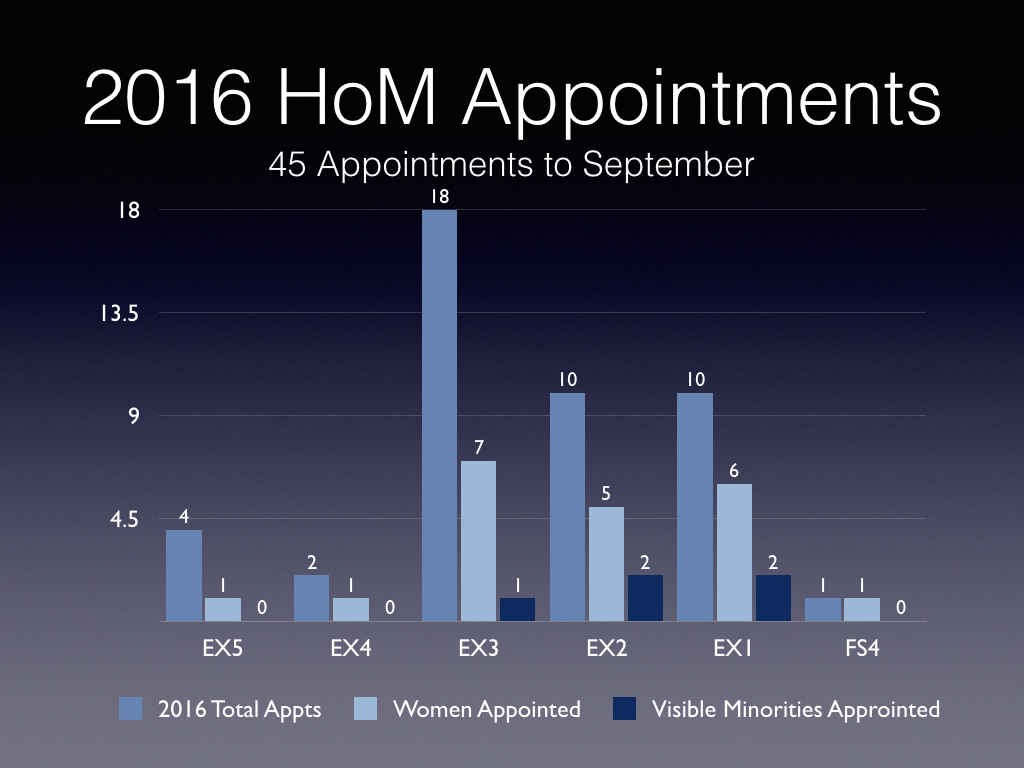
The above chart captures the diversity of all 38 Liberal government head of mission appointments in 2016 to date with respect to all appointments as well as those that are classified at the ADM level (EX4-5):
The Liberal government cleaned diplomatic house on Tuesday, announcing the appointment of 26 new ambassadors, high commissioners and consuls general from Havana to Tel Aviv. The list is heavy on foreign service experience, short on overtly political appointments and pristinely gender balanced. In a statement, Global Affairs Canada said the recalls and new postings “ensure its diplomatic leaders represent a wide diversity of Canadians.”
Ferry de Kerckhove, former high commissioner in Pakistan and ambassador to both Indonesia and Egypt over a long career in the foreign service, said the appointments signal a conscientious shift in approach for Justin Trudeau’s government. “We’re back to what I would call normalcy in diplomatic appointments,” he says. “It confirms the Prime Minister’s early statement about giving back to the foreign service its role in representing Canada abroad, and also giving back its ability to actually do their job, which is to report, comment and provide advice.”
Tuesday morning started off with a big shuffle as 26 new diplomatic appointments were announced, some replacing political appointments made under the previous Tory government.
As it did with its last shuffle, the department included a statement at the top of the list of appointments stating the government’s “commitment to ensure its diplomatic leaders represent a wide diversity of Canadians and include a greater gender representation.”
While the appointments include 13 men and 13 women, the overwhelming majority of heads of mission being replaced are men. Only four female ambassadors have been rotated out, compared to the 22 men.
A few of the new appointments are simply rotations from ambassadorial positions in other countries, while a few brand new political appointees have been added to the heads of mission team.
Patrick Martin’s astute analysis of the postings to the Mid-East:
Israel has been watching for evidence of a shift since Canada’s Liberals won the October election. Within hours of being sworn in, Foreign Affairs Minister Stéphane Dion announced that Canada will strive for a more balanced policy in the Middle East, one that includes reaching out to “other legitimate partners in the region” besides Israel.
He even described Canada’s role as being that of an “honest broker” – no words make Israeli leaders shudder more than those two.
Stephen Harper’s government was very good to Israel and Benjamin Netanyahu’s government knew it had a staunch supporter in Canadian Ambassador Vivian Bercovici. It also knew the next Canadian representative could not be so one-sided.
But in Deborah Lyons, whose name as the ambassador-designate leaked two months ago, the Israelis are being mollified by the appointment of a fair-minded career diplomat of substantial seniority. Ms. Lyons, most recently, has been Canada’s ambassador to Afghanistan, a posting that gives her credibility in conflict zones. But prior to that is where her résumé gets really interesting.
She served as deputy head of mission in Washington, as chief strategy officer of the Department of Foreign Affairs in Ottawa and as a trade counsellor for high-tech industries in Tokyo. Few words give Israelis goosebumps more quickly than “high-tech.”
Does this high-level appointment reframe Canada’s relationship with Israel and the Middle East? Perhaps, but it depends on what policy changes follow the appointment.
The departure of Bruno Saccomani as Canadian ambassador to Jordan will be welcomed by those Jordanians who care about such things. The Royal Hashemite Court grimaced at the appointment of Mr. Harper’s former head of security to lead Canada’s mission in Amman.
Mr. Saccomani lacked the experience of a foreign service officer, but also lacked the ear of the Canadian prime minister, which would have compensated for his not being a diplomat.
In Peter MacDougall, the Jordanians are getting an upgrade. Mr. MacDougall’s expertise is in refugees and in setting standards for admission to Canada – two very valuable traits in a country hosting nearly two million Syrian refugees and the place from which Canada chooses those it will allow entry.
The change of ambassadors in the United Arab Emirates is about equal in quality – both the outgoing Arif Lalani and the incoming Masud Husain are senior officials with lots of expertise and experience.
Which is a good thing, because the Gulf countries matter more than ever – with tensions over Iran, Syria and Yemen, and concern over the Islamic State and al-Qaeda.
Former Clerk and High Commissioner to London on the balance of skills that career and political backgrounds bring to appointments:
After several years watching appointments, I realized that political appointees do these jobs differently. Each person brings different strengths and skills to the job.
David MacNaughton and Gary Doer before him have a strength as Canadian Ambassador to Washington that most other ambassadors do not. They are seen as well-connected and understand politics. When they speak to American political or business leaders they know they speak with the PM’s voice. That is remarkably valuable in doing the job.
When I met political, cultural and business leaders in the U.K. and they heard I had been Secretary to Cabinet, they took me more seriously (more than I deserved to be taken). When we want to be taken seriously at the UN, or in Washington, London and Paris, then the person representing Canada may best be a career diplomat schooled in the intricacies of diplomacy, or a career public servant knowledgeable and experienced in the key issues of the portfolio, or a “political” appointee who has access to the prime minister. It depends.
However, there can be too many political appointees. To run a career foreign service we need to have senior offices available for the careerists to aspire to. However, that there are political appointees is not a bad thing.
The appointments announced Tuesday should be judged on the quality of the people and not on whether they helped get the Prime Minister elected. Every prime minister has appointed former ministers, party apparatchiks, and business people, career public servants as well as career diplomats to the rank of Ambassador or High Commissioner. They should be judged on their talents, what they bring to the job and ultimately on what they accomplish.
I like to think that because I had been a senior public servant with access, I added value to representing Canada that was more than many others could do. My predecessors each brought different strengths to the job and did it differently, not better or worse.
All those Ambassadors and High Commissioners announced Tuesday will do their best to represent Canada well. Many of them will do a very good job and accomplish great things. We should wish them all well.
A study showing a dearth of minority judges in Canada has advocates suggesting the country must seize a unique opportunity to increase racial diversity in a “judiciary of whiteness.”
“After many years of saying this is an important issue, it’s very disappointing to see how low the numbers are,” said Naiomi Metallic, a 35-year-old Mi’kmaq woman who is the chair of aboriginal law and policy at Dalhousie University.
Naiomi W. Metallic, an associate lawyer at Burchells LLP, is seen in Halifax on Tuesday, June 14, 2016. Metallic, a Mi’kmaq who is the chair of aboriginal law and policy at Dalhousie University, says both the provincial governments and Ottawa need to accelerate the process to establish a more diverse judiciary. THE CANADIAN PRESS/Andrew Vaughan
A May report in the online version of Policy Options magazine estimates just one per cent of Canada’s 2,160 judges in the provincial superior and lower courts are aboriginal, while three per cent are racial minorities.
Andrew Griffith, a former director general of Citizenship and Multiculturalism and author of the article, says he’s hopeful the Liberal government will follow up on promises of reforms, but he adds, “at the current level, there’s an obvious gap.”
His study was a laborious task of poring through hundreds of biographies to create a “reasonable picture” of judicial diversity, as neither the federal Office of the Commissioner for Federal Judicial Affairs nor most provinces keep statistics.
“It’s a judiciary of whiteness,” said Metallic, who is also a member of a Nova Scotia Bar Society committee trying to address racial issues in the profession, in an interview.
“Powerful institutions ought to reflect the societies they serve.”
Last month, the Trudeau government included an aboriginal judge and an Asian Canadian among federal 15 appointments, and Justice Minister Jody Wilson-Raybould has made a general commitment to increase diversity in the judiciary.
But Metallic — who graduated from the Indigenous Blacks and Mi’kmaq program at Dalhousie University over a decade ago — said she and other advocates will be watching carefully over the next year, with more than 41 vacancies currently open among federally appointed positions, and about 40 provincial positions open across the country. There are also openings in the country’s Federal Court and the Supreme Court of Canada.
Several provinces declined to provide estimates on the number of vacant judgeships.
Marilyn Poitras, a lawyer in Saskatoon who is Metis and a professor at the College of Law at the University of Saskatchewan, said having only two indigenous judges out of 101 judges in a province where 16 per cent of the population is aboriginal is unacceptable.
The country is losing out on the opportunity to gain from Indigenous perspectives on everything from sentencing to the factors that lead to crime, she said.
“When you start to incorporate Indigenous thinking into the justice model, you start talking a lot more about preventative measures and that’s where we should be taking things,” she said in an interview.
Both Poitras and Metallic point to a growing pool of minority graduates to draw from. For example, Dalhousie has graduated 175 black and aboriginal lawyers through a specialized program over the two decades — creating a pool of potential applicants for Nova Scotia’s five upcoming positions.
Griffith found that in the lower courts — where the bulk of the child welfare and criminal justice cases are heard — there were only 52 visible minority judges and 19 indigenous judges among the 1,132 judges.
In Quebec, Griffith noted three visible minority judges out of more than 500, despite bar society figures showing over 1,800 of its roughly 25,000 lawyers identify themselves as being from visible minority groups. The province said it doesn’t keep figures.
In Ontario, one of the few provinces where the judicial advisory body keeps figures on the lower court appointments, there were 24 visible minority judges out of 334 judges, even though one quarter of the province’s overall population identifies as a visible minority.
And in Nova Scotia, where Metallic practises, there are four non-white lawyers who made it to the bench — two blacks, one person of Sri Lankan descent and a Chinese-Canadian — and two indigenous judges, out 99 judges.
Robert Wright, a black social worker, says the figures should be higher in a province where the criminal justice sees an over representation of black and aboriginal accused, and child welfare cases frequently require sensitivity to cultural difference.
Wright, who was a civilian representative on the province’s judicial advisory committee, says black candidates were proposed in the past decade, but weren’t chosen.
Then, in 2009 the province amended guidelines on appointments, calling for 15 years of minimum practice — which dramatically reduced the potential list of applicants.
Like Metallic, Wright is hoping for change over the next year.
“The core issues of today include unrepresented litigants, an over-representation of aboriginal and black accused, a recognition of historical racial discrimination in the courts. These things must be perceived as the most pressing issues in jurisprudence in Canada today,” he said.
“Is the court we currently have tooled to address those issues? The answer that comes back is ‘No.'”
 My latest piece in Policy Options, reporting on the Liberal government’s commitment on increasing diversity in government appointments (political, deputy minister, judges and heads of mission) – spoiler alert, it largely has.


 Multicultural Meanderings