Apple’s WWDC 2016 onstage lineup was more diverse than it has ever been – Recode

Changing the public image:

Like virtually all of Silicon Valley, Apple is both extremely white and extremely male in its upper ranks. And for many years, it has been mostly white men onstage at Apple keynote events.

Last year, that began to change. And at today’s Worldwide Developers Conference, it changed some more.

Of the 10 people onstage at WWDC today, there were six men and four women, including one African-American woman. According to 2015 figures on Apple’s website, the company has a 70/30 gender split, and is 54 percent white, 18 percent Asian, 11 percent Hispanic and 8 percent black. At last year’s WWDC, there were two women onstage for the event.

The women onstage were Apple Music’s Bozoma Saint John, Apple Watch software exec Stacey Lysik, software engineering VP Cheryl Thomas and iOS software exec Bethany Bongiorno. Imran Chaudhri, on the Apple design team, was the one nonwhite guy. (Apple iTunes executive Eddy Cue — a regular presenter at Apple events, including today’s — is Cuban American.)

Apple’s Diversity Numbers Reveal Plenty of Progress To Be Made | TIME

More on diversity in hi-tech:

According to head of human resources Denise Young Smith, more than 11,000 women have been hired worldwide in the last year, a 65% increase from the year before (for some more perspective, the company employs over 110,000 people worldwide). In United States, 2,200 black employees and 2,700 Hispanic employees were hired in the same time frame, representing increases of 50% and 66%, respectively. And in the first six months of this year, nearly 50% of Apple’s U.S. hires were women, black, Hispanic or Native American.

“We feel good about what’s been accomplished in the last 12 months,” Young Smith said in a phone interview with Fortune. “Clearly this is a start, but we know that with the investments that we’re making and the work we’re doing we’ll show much more progress over time.”

CEO Tim Cook also offered a message on the company’s website Thursday afternoon, saying that Apple realizes there is a lot more work to be done. According to Cook’s statement: “Some people will read this page and see our progress. Others will recognize how much farther we have to go. We see both.”

Like many other large Silicon Valley players, Apple’s gender and racial breakdown is still far from reflecting our society. Under increasing pressure, these companies have pledged to not only disclose the demographic breakdown of their employee base, but to put money into programs that aim to increase the pipeline of women and minorities in tech and to make changes to their hiring practices. Last year, Cook said he is as committed to “being as innovative in advancing diversity as we are in developing products.” He has also said that the definition of diversity should go beyond race and gender and include age and sexual orientation, among other characteristics. (Last year CEO Cook became the first openly gay leader of a Fortune 500 company.)

… The efforts are leading to very slow progress, though it is progress nonetheless: Apple’s 2015 breakdown shows that the company’s employee base is still 69% male and 54% white; in 2014 it was 70% male and 55% white. But while one percentage point doesn’t sound impressive, it does reflect thousands of new, more diverse employees, and—as Young Smith admitted—it is just a start.

Apple’s Diversity Numbers Reveal Plenty of Progress To Be Made | TIME.

Unicode consortium looks to bring ethnic diversity to emoji by mid-2015

EmojisMulticultural emojis:

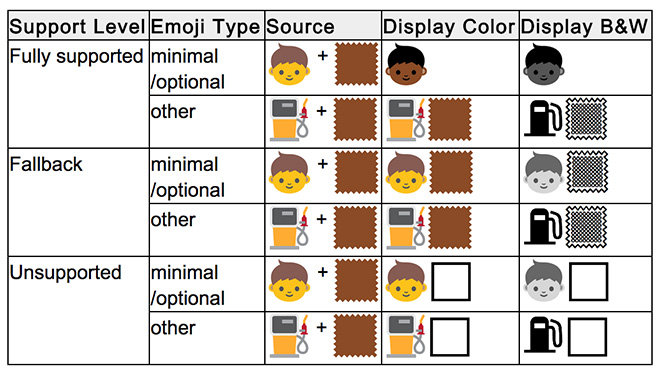
Instead of picking its own tints, Unicode proposes employing six shades from the Fitzpatrick scale, a widely recognized dermatologic standard developed to study skin tone. The initial color variations, ranging from light pink to dark brown, may change when Unicode 8.0 launches next year.

As far as implementation, users will be able to apply skin colors to a select group of characters as a font modifier, keeping the already expansive set of icons somewhat manageable. The default method displays a selected character, a color swatch and the combined result. Alternatively, a shorthand version simply displays the character and swatch glyph to be applied.

In yet another example more conducive for use with small-screened devices like smartphones, a long press on a desired emoji may bring up a preview palette showing a selected character in multiple skin tones.

Apple in March said that it was working with the Unicode Consortium to update the emoji standard with an ethnically diverse set of characters. The Cupertino, Calif., company most recently changed its emoji keyboard to include same-sex couples and families in iOS 6.

Unicode consortium looks to bring ethnic diversity to emoji by mid-2015.

Security agencies condemn use of encryption on iPhone 6

One of the unintended consequences of NSA over-reach in scooping up so much data. Another reason to buy an iPhone?

Apple declined to comment. But officials inside the intelligence agencies, while letting the FBI make the public protests, say they fear the company’s move is the first of several new technologies that are clearly designed to defeat not only the NSA, but any court orders to turn over information to intelligence agencies. They liken Apple’s move to the early days of Swiss banking, when secret accounts were set up precisely to allow national laws to be evaded.

“Terrorists will figure this out,” along with savvy criminals and paranoid dictators, one senior official predicted, and keep their data just on the iPhone 6. Another said, “It’s like taking out an ad that says, ‘Here’s how to avoid surveillance – even legal surveillance.’”

The move raises a critical issue, the intelligence officials say: Who decides what kind of data the government can access? Until now, those decisions have largely been a matter for Congress, which passed the Communications Assistance to for Law Enforcement Act in 1994, requiring telecommunications companies to build into their systems an ability to carry out a wiretap order if presented with one. But despite intense debate about whether it should be expanded to cover email and other content, it has not been updated, and it does not cover content contained in a smartphone.

Inside Apple and Google, company executives say the U.S. government brought these changes on itself. The revelations by former NSA contractor Edward J. Snowden not only killed recent efforts to expand the law, it made nations around the world suspicious that every piece of American hardware and software – from phones to servers made by Cisco Systems – have “back doors” for U.S. intelligence agencies and law enforcement.

Surviving in the global marketplace – especially in places like China, Brazil and Germany – depends on convincing consumers that their data is secure.

Security agencies condemn use of encryption on iPhone 6 – The Globe and Mail.

Apple Is Mostly White and Male, According to Its First Diversity Report

Hitech diversityNo surprise and in line with its competitors as above graphic shows (although its ads generally portray diversity well):

Apple, the latest tech company to reveal its workforce demographics, said Tuesday that its U.S. staff is 55% white, 15% Asian, 11% Hispanic and 7% black. Two percent of workers are multiracial, and another 9% did not declare their race.

In regards to gender, Apple’s global workforce is 70% male and 30% female. Within tech-related jobs specifically, the disparity is 80% male and 20% female.

Apple’s employee demographic trends are similar to those of other major tech companies, several of whom, like Google, Facebook and Twitter, have also recently released diversity reports. Like the other firms, Apple included in its report a public commitment to increase the diversity of its workforce.

“As CEO, I’m not satisfied with the numbers on this page,” Apple head Tim Cook said in a letter accompanying the figures. “We are making progress, and we’re committed to being as innovative in advancing diversity as we are in developing our products.”

In addition to race and gender, Cook said that Apple celebrates other types of diversity, such as people with disabilities as well as varying sexual orientations.

Time Magazine.

Professor goes to big data to figure out if Apple slows down old iPhones when new ones come out

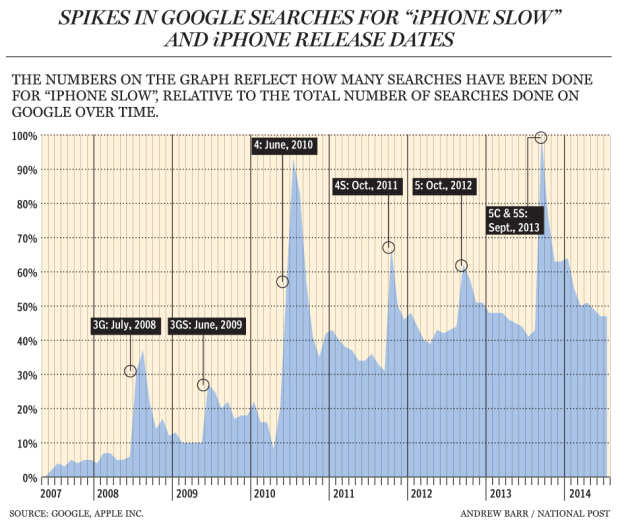
Apple Slow iphones

A good illustration of the limits of big data and the risks of confusing correlation with causation. But bid data and correlation can help us ask more informed questions:

The important distinction is of intent. In the benign explanation, a slowdown of old phones is not a specific goal, but merely a side effect of optimizing the operating system for newer hardware. Data on search frequency would not allow us to infer intent. No matter how suggestive, this data alone doesn’t allow you to determine conclusively whether my phone is actually slower and, if so, why.

In this way, the whole exercise perfectly encapsulates the advantages and limitations of “big data.” First, 20 years ago, determining whether many people experienced a slowdown would have required an expensive survey to sample just a few hundred consumers. Now, data from Google Trends, if used correctly, allows us to see what hundreds of millions of users are searching for, and, in theory, what they are feeling or thinking. Twitter, Instagram and Facebook all create what is evocatively called the “digital exhaust,” allowing us to uncover macro patterns like this one.

Second, these new kinds of data create an intimacy between the individual and the collective. Even for our most idiosyncratic feelings, such data can help us see that we aren’t alone. In minutes, I could see that many shared my frustration. Even if you’ve never gathered the data yourself, you’ve probably sensed something similar when Google’s autocomplete feature automatically suggests the next few words you are going to type: “Oh, lots of people want to know that, too?”

Finally, we see a big limitation: This data reveals only correlations, not conclusions. We are left with at least two different interpretations of the sudden spike in “iPhone slow” queries, one conspiratorial and one benign. It is tempting to say, “See, this is why big data is useless.” But that is too trite. Correlations are what motivate us to look further. If all that big data does – and it surely does more – is to point out interesting correlations whose fundamental reasons we unpack in other ways, that already has immense value.

And if those correlations allow conspiracy theorists to become that much more smug, that’s a small price to pay.

Professor goes to big data to figure out if Apple slows down old iPhones when new ones come out
Policy Arrogance or Innocent Bias: Now Also Available on iTunes

Took longer than expected but yet another option to consider (the formatting on this version on an iPad is somewhat better than Kindle or Kobo):

Policy Arrogance or Innocent Bias