Canadians doubt anti-Islamophobia motion will have any effect, even if they support it: poll

Not surprising but not particularly relevant either (see Andrew Coyne’s excellent Andrew Coyne: Politicians need to forget about polls and do the right thing):

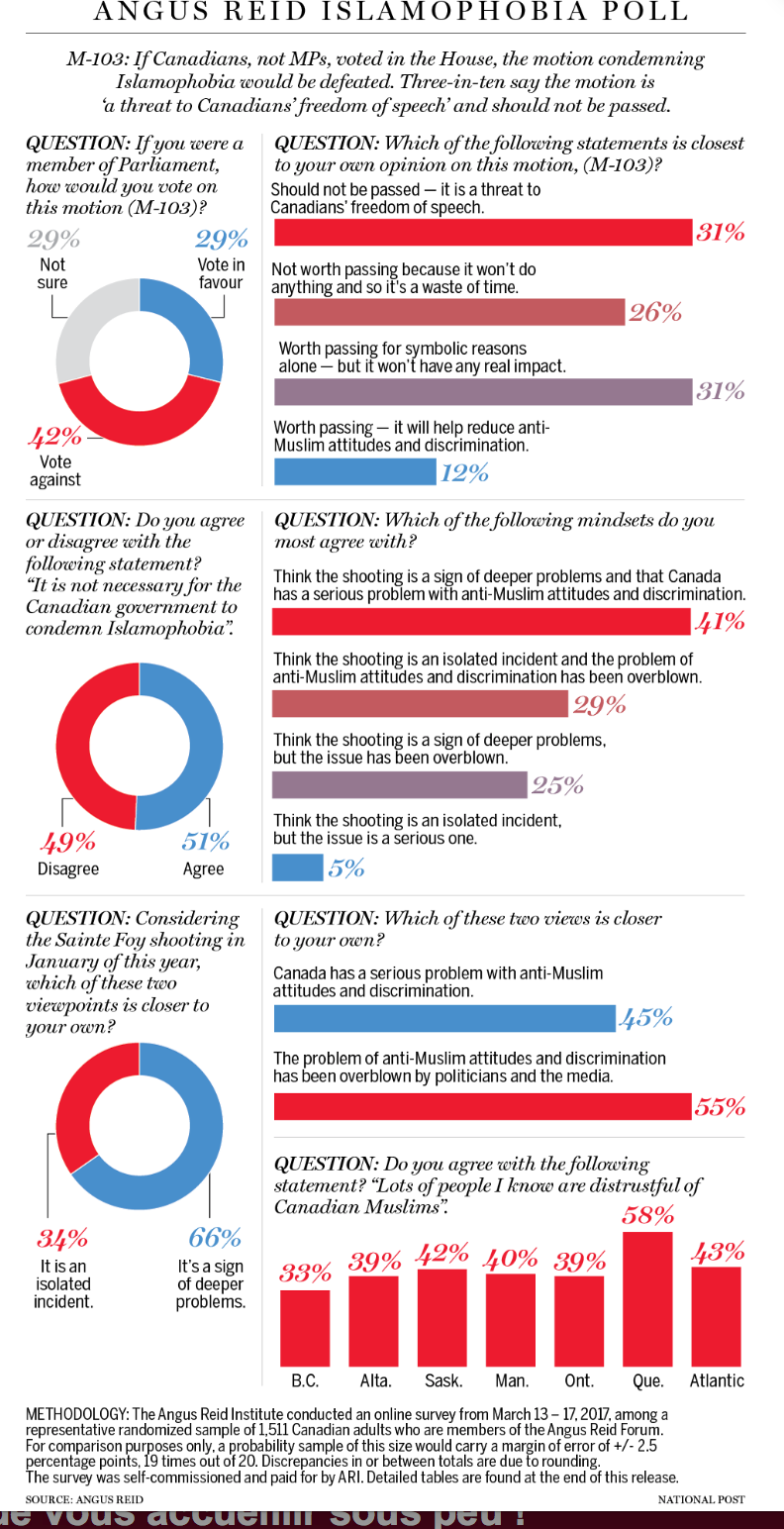
As MPs prepare to vote Thursday on a controversial anti-Islamophobia motion, Canadians — regardless of whether they support it or not — are skeptical whether the symbolic vote will have any effect, a new poll shows.

Almost nine out of 10 of Canadians have little faith M-103, a motion condemning anti-Muslim sentiment and to strike a committee to study systemic racism, will accomplish anything though they are split as to whether it’s worth passing even symbolically. According to the Angus Reid Institute poll of 1,511 Canadians, 31 per cent say the motion “should not be passed” because it’s a threat to freedom of speech, another 31 per cent say it’s work passing even for symbolic reasons “but it won’t have any real impact,” and 26 per cent say, “not worth passing because it won’t do anything and so it’s a waste of time. Only 12 per cent said they felt the motion is “worth passing” and “will help reduce anti-Muslim attitudes and discrimination.”

“Canadians are asking the question, ‘Is this the best way to be fighting Islamophobia?’” said Shachi Kurl, executive director of the Angus Reid Institute.

And, if it were up to the citizenry, M-103 would likely fail.

Source: Canadians doubt anti-Islamophobia motion will have any effect, even if they support it: poll | National Post

A quarter of Canadians want Trump-style travel ban, poll shows – Politics – CBC News

While I do not find these results all that surprising (but the headline could have been written “75 percent don’t want”) rather than focusing on the negative.

Angus Reid polling tends to be more negative on these issues than Environics and Ekos .

This does however reinforce the need for the government to be attentive to these concerns, even if they are more part of the Conservative than Liberal base (as some of the CPC leadership campaign strategies and opposition to M-103 indicate):

A significant minority of Canadians say Canada’s 2017 refugee target of 40,000 is too high and one in four Canadians wants the Liberal government to impose its own Trump-style travel ban.

Those are just two of the findings in a new Angus Reid poll that looked at Canadian’s attitudes towards the federal government’s handling of refugees.

Overall, 47 per cent of Canadians surveyed said Canada is taking in the right number of refugees. But 11 per cent say 40,000 is too low and Canada should take in more, while 41 per cent say the 2017 target is too high and that we should not be taking in anymore refugees.

Shachi Kurl, executive director of Angus Reid, told CBC News that “41 per cent is not the majority voice but it is a significant segment of the population that is actually saying our targets for 2017 are too high and that, I think, adds to a level of anxiety for those folks.”

“Certainly in terms of that ‘too many, too few’ debate, a lot more people think it’s too many than too few,” she said.

The survey also asked Canadians about the federal government’s decision not to alter its own immigration policy to match that of U.S. President Donald Trump’s after he rolled out his travel ban.

Some 57 per cent of Canadians said the federal government made the right call in not following Trump down the rabbit hole, while 18 per cent said Prime Minister Justin Trudeau’s government should have chose to take in more refugees.

But the number that is perhaps the most interesting is that 25 per cent of Canadians say Canada should have adopted its own temporary travel ban similar to the U.S. policy.

“We tend to, when we are looking a numbers, look at the majority view, but the fact that one in four Canadians are of the mind that we should be looking to our own travel ban is significant and is part of a red flag that is starting to emerge in terms of refugee policy,” said Kurl.

Working hard to fit in

When it comes to whether the government did a good job of resettling refugees, 61 per cent said they either strongly (12 per cent) or moderately (49 per cent) agree that it had. But some 39 per cent of people either moderately (22 per cent) or strongly (17 per cent) disagreed.

Kurl said those surveyed are also split over how well refugees are integrating into Canadian society, and how enthusiastically Canadians are welcoming new arrivals.

A slim majority of (54 per cent) say refugees do not make enough of an effort to fit into mainstream society, while 46 per cent say that they do try hard to fit in.

When the responses are broken down across age groups, it’s revealed that the younger the person, the more likely they are to say that refugees are working hard to fit into Canadian society.

For example, 62 per cent of those in the 18-24 age range say refugees are making enough of an effort to fit in, but in the 25-34 age range that drops to 47 per cent.

There is a slight spike among 35-44 year olds where 54 per cent of those asked said refugees are working hard to fit in, but for those who are 45 and older, only one in four said the same thing.

Source: A quarter of Canadians want Trump-style travel ban, poll shows – Politics – CBC News

How Angus Reid, CBC got it wrong about multiculturalism: Jedwab

While I don’t have polling expertise, Jack makes valid points regarding the survey and the presenting of false dichotomies:

According to respected pollster Angus Reid, Canadians aren’t as accepting of cultural difference as they think. That’s probably right.

Unfortunately, the observation is based on a misleading question from a survey that the Angus Reid Institute did in partnership with the CBC. Released during the first week of October, the Angus Reid-CBC survey revealed that “by a factor of almost two-to-one, Canadians say they would prefer that minorities do more to fit in with mainstream Canada, rather than encourage cultural diversity in which groups keep their own customs and language.”

Reid construes this finding as a barometer of support for multiculturalism, which he states was stronger when he asked a similar question some 25 years ago.

Reid’s formulation implies that by maintaining one’s customs and language, newcomers and their children won’t fit in to the undefined mainstream to which the survey question alludes. The survey creates additional confusion by referring to minorities in one proposed response and immigrants in the other.

Canadian multiculturalism doesn’t force newcomers to make the stark choice served up to respondents in the Reid survey. Indeed, the manner in which the policy and practice of multiculturalism is conveyed by the government of Canada suggests there is no contradiction between preserving one’s language and customs and fitting into society.

According to the government of Canada “multiculturalism ensures that all citizens can keep their identities, can take pride in their ancestry and have a sense of belonging … through multiculturalism, Canada recognizes the potential of all Canadians, encouraging them to integrate into their society and take an active part in its social, cultural, economic and political affairs. Multiculturalism has led to higher rates of naturalization than ever before. With no pressure to assimilate and give up their culture, immigrants freely choose their new citizenship because they want to be Canadians.”

In other words, someone can preserve their Jewish heritage or celebrate Chinese New Year or speak Arabic with friends at work and still be a full participant in the so-called Canadian mainstream. Certainly our mainstream(s) is diverse and the term is left open to quite broad interpretation. The survey creates far more confusion about newcomer adjustment to Canada that it offers meaningful insights about Canadian views on the process.

The survey results that purport to be about multiculturalism are used by Reid to construct what is referred to as an index of Canadian values. One might deduce from the results that multiculturalism is not a value to which the majority of Canadians adhere. But that conclusion simply cannot be drawn on the basis of the question.

A 2013 Statistics Canada survey of 27,000 Canadians found to a great and moderate extent, 88 per cent of respondents felt ethnic and cultural diversity was a shared Canadian value.

Other questions in the Angus Reid-CBC survey that seek to gauge Canadian values are also awkwardly formulated and thereby lead to yet other unwarranted conclusions.

When it comes to secularism, the Angus Reid-CBC survey asks Canadians whether they prefer “Keeping God and religion completely out of public life” or “publicly celebrating the role of faith in our collective lives.”

Faced with another stark choice, unsurprisingly, most respondents opt for keeping religion out of public life. There is, however, a large grey area between the two visions that Canadians are not permitted to choose.

Wearing a hijab, turban or keepa at work should not be construed as a “public celebration of faith.” By providing no concrete example of what is meant by a “public celebration of faith” Reid leaves the impression most Canadians believe there should be no room whatsoever for religion in the public space. That is certainly not the view of most Canadians.

Multiculturalism and the place of religion in society remain the object of important public debate and it is vital that underlying issues be clearly explained to the population to enable them to make informed decisions. Regrettably, the survey results provided by the Angus Reid Institute and CBC do not move us closer to this objective.

Source: How Angus Reid, CBC got it wrong about multiculturalism | Toronto Star

Angus Reid’s survey actually shows high level of support for our diverse society: Cardozo

Good analysis by Andrew Cardozo:

Much is being made of a new Angus Reid poll on the attitudes of Canadians towards minorities, coming out as it does on the heels of Kellie Leitch’s plan to test immigrants on “anti-Canadian” values. Polling people’s attitudes on diversity is always a good thing as the mood does change from time to time, depending on the issues that face us.

While Angus Reid is a hugely credible polling organization, this poll is somewhere between incomplete and not very informative.

There were two sets of questions on diversity in the poll. Interestingly, the first did not receive coverage—not even in Reid’s own article on the CBC News website—while the second, the more sensational one, garnered all the coverage. Surprising!

Respondents were asked to first comment on: “How well immigrants are integrating into society.” A full 67 per cent said they were satisfied and 33 per cent said they were dissatisfied. (The report does not reveal how many had no opinion, which seems odd. Not even one per cent? But I digress.)

This is a good news story, no? Two to one, Canadians believe immigrants are integrating well. Not many government policies or societal trends get that kind of support.

Sadly, the questions that received all the coverage, perhaps because they align more with Leitch’s narrative in some way, are actually simplistic in the extreme. And further, while the questions did not use the word “multiculturalism,” Reid’s reporting did.

Here are the statements that respondents were asked to comment on: should minorities do more to fit in with mainstream society; and should we do more to encourage cultural diversity with different groups keeping their own customs and languages.

Trouble is, that is not the conundrum that defines multiculturalism. It is perhaps the conundrum that defines segregation. Should minorities fit in or live segregated lives? One or the other. Binary. No combination, no nuance.

Multiculturalism, from its very inception as a government policy in 1971 by one Pierre Trudeau, has been about both integration and cultural retention. Check the Hansard on that. Canadian individuals, immigrants and Canadian born, can generally walk and chew gum at the same time, and they do it all the time.

Interestingly, the poll came out on October 3, during Rosh Hashanah. And you have to think of all the Canadian Jews who were marking the high holiday. Most are able to get time off work and were celebrating the new year with family and friends. Jews are among the most integrated of minority groups in Canada and they contribute in significant ways in virtually every facet of Canadian society, and yet Rosh Hashanah, is widely celebrated.

So which of Angus Reid’s two statements do they fall under: fitting in or keeping their own customs? Or did they walk and chew gum?

One is tempted, on this basis, to dismiss the poll as incomplete or sloppy. But let’s look at a few other examples and try to guess what it is pointing to.

As Reid points out, attitudes change. In the 1990s, wearing a turban in the Armed Forces was a hugely controversial issue, which the Mulroney government settled at great political cost. It is part of what gave rise to the Reform Party. And, of course, today the Defence Minister Harjit Sajjan wears a turban, and, given his mastery of his role in the Canadian Forces, his competence shone through.

Several Jewish MPs celebrated last week.

Several Muslim MPs, like Democratic Institutions Minister Maryam Monsef, celebrated Eid last month while being a federal minister as did several MPs, including Conservative Ziad Aboultaif and Liberal Ahmed Hussen. Walk and chew gum.

As the world watches the horrors of Hurricane Matthew bearing down on Haiti, former Michaëlle Jean, Canada’s former governor general and now head of La Francophonie, was helping to find aid for the victims of yet another catastrophe to hit her country of origin.

To turn back to Leitch’s issue of anti-Canadian values, one is tempted to ask, are these the anti-Canadian values we should be concerned about?

If there is a conundrum with multiculturalism, it is about the limits of cultural retention and how far we go in reasonable accommodation—a debate that rages on in Quebec. It’s a good discussion to have, but in a free and democratic society, there will rarely be unanimity about where that line exists. It’s about how we make walking and chewing gum at the same time possible. Multiculturalism works when we do both things.

When a practice restricts people’s integration that is a point of discussion like wearing a niqab. But is the solution to legislate what a woman should wear, or is it to find ways in which she will feel comfortable removing it? Or may be the rest of us just get over it?

Leitch gets some support because there is a view that immigrants bring over anti-Canadian values. Whether it was the Irish Fenian who assassinated Thomas D’Arcy McGee in 1868, or the people responsible for the Air India bombing in 1985 or the shooter who killed Corporal Nathan Cirillo in 2014, (Cirillo’s assassin was Canadian born) these people had values that were not in keeping with Canadian values of equality and justice.

It would be helpful if Leitch could be more specific. Yes, we want to root out undesirable elements and want to be clear about basic Canadian values such as gender equality and respect for diversity. At the same time we need to do all we can so we don’t import terrorism or violence.

Likewise, Angus Reid might be more specific with his questions rather than erect headline-catching false conundrum.

Perhaps the newsworthy story is that Canadians believe immigrants should integrate, that’s two to one, and that they generally like the way they are integrating, that’s two to one.

Source: Angus Reid’s survey actually shows high level of support for our diverse society – The Hill Times – The Hill Times

A less nuanced analysis is Margaret Wente’s:

Yet in liberal discourse, any resistance to immigration on any grounds makes you a racist, and any questions about immigration policy are perceived as illegitimate. People get frustrated by that. They’re also frustrated by a narrative that, in their view, only goes one way. They feel they’re constantly being harangued by their betters that it is they who must accommodate the newcomers. No one ever talks about what the newcomers should do to accommodate them.

And so they’re not thrilled when Kathleen Wynne, Ontario’s Premier, dons a head scarf to meet with the woman who insisted on her right to wear the niqab during the citizenship ceremony – and then tweets that it’s “an honour.” They are not thrilled when their Prime Minister promotes inclusivity by visiting a mosque where the women have to sit upstairs. They don’t like it when a Muslim boys’ soccer team refuses to play against girls.

Kellie Leitch taps into that sentiment. I don’t doubt for a moment that Canada has its share of racists – but if the Liberals ignore the genuine concerns of people who think accommodation should go both ways, they’re asking for a backlash.

Many progressives (including, I suspect, Mr. Trudeau) hold a romantic view of immigration as a sort of global social-justice project, which obliges us to share our good fortune with as much of the rest of the world as possible, while declaring that every other culture is just as good as ours is.

Thankfully, most Canadians don’t share this woozy notion. They pride themselves on their tolerance. But they’re also hard-headed pragmatists. They think immigration policy should serve our national interests, and that our leaders should not forget it.
 How much diversity do Canadians want? 

CBC-Angus Reid poll: Canadians want minorities to do more to ‘fit in’

The latest survey on attitudes towards integration. Questions not that nuanced, and the usual contradiction between two-thirds being satisfied “with how well immigrants are integrating” and an equal number who believe “minorities should do more to fit in better with mainstream Canadian society.”

The online survey was conducted in early September from a sample of 3,904 Canadians. The results have a 2.5 per cent margin of error 19 times out of 20.

The poll was conducted in the wake of a series of issues that dogged politicians as they contested last year’s federal election: a proposed ban on niqabs in public service; the Syrian refugee crisis; and terrorist attacks both in Europe and on Parliament Hill.

The results also hint at why Conservative leadership candidate Kellie Leitch believes she may be onto a winning issue by asking supporters their thoughts on vetting would-be immigrants and refugees for “anti-Canadian values.”

According to the poll, two-thirds of Canadians say they’re “satisfied” with how well new immigrants are integrating into their communities.

That figure seems to fly in the face of another result, because an equal number said they believe “minorities should do more to fit in better with mainstream Canadian society.”

‘Unthinking or mindless multiculturalism’

Former B.C. premier and Liberal cabinet minister Ujjal Dosanjh has written and spoken extensively about the need to address concerns about equality, race and culture in the face of blind devotion to multiculturalism.He said the poll shows Canada’s political leadership needs to pay attention.

“What you want is creative multiculturalism, generous multiculturalism, but not unthinking or mindless multiculturalism where everything anybody brings to this country is acceptable,” he said.

“Diversity is great if we can begin to live with each other in equality, in understanding … but we also understand our collective obligations to building a better society. If we can’t live together with each other properly and make concessions to each other, then this phrase that politicians use — that diversity is a strength — is nonsensical.”

http://www.cbc.ca/amp/1.3784194 

Visible minorities less likely to view police favourably: survey

Not surprising, although it would be interesting to have a breakdown by visible minority group to see if there are significant differences between their confidence in the police (my hypothesis is that Black Canadians, given the prevalence of carding and other practices, would likely have the lowest level of confidence).

The contrast with USA data, however, is striking:

The majority of Canadians view their police forces favourably, but confidence erodes when members of visible minorities are polled, according to a new survey from Angus Reid.

When asked if they have trust in the police and justice system, Canadians said “yes” about most institutions, with only the criminal courts failing to reach a majority of support. Sixty-eight per cent of white people expressed confidence in police while 58 per cent of members of visible minorities did so.

Support for the police and justice system appears to be growing, with a small increase from 2014 and a near-spike from the lows of 2012, when none of the institutions broke 40 per cent support.

Quebec led the way in all categories, with support often more than 10 percentage points higher than in other provinces. Atlantic Canada and British Columbia had the lowest levels of trust.

The survey of 1,505 residents from across the country comes at a time of greater scrutiny of policing. Most recently, Black Lives Matter Toronto staged a sit-in during the Toronto Pride Parade on July 3 to protest against what they argue are discriminatory policing practices targeting black residents in the city.

The results hinted at the frustrations: Of those surveyed, 58 per cent of members of visible minorities trusted the institutions, 10 percentage points lower than white respondents.

While there is a discrepancy between whites and members of visible minorities in Canada, the results are magnified in the United States, where the summer has seen racial tensions simmer in wake of two recent shootings of black men by police. Only 39 per cent of members of visible minorities express confidence in the police, compared with 62 per cent of white residents, a Gallup poll found.

Despite the largely positive Canadian results, the Angus Reid survey also highlighted troubling data about the challenges facing members of visible minorities in the country.

Over a 10-year period, the black inmate population in Canada has surged 60 per cent. In Toronto, where black people make up less than 10 per cent of the population, 41 per cent of youth in child welfare services are black. In Vancouver, close to 60 per cent of people in poverty are members of visible minorities; in Toronto, it’s 62 per cent.

Source: Visible minorities less likely to view police favourably: survey – The Globe and Mail

Young immigrants twice as likely to be religious than Canadian-born: Todd

Worth noting:

Young and middle-aged immigrants to Canada, most of them from Asia, are countering the trend that sees homegrown Canadians becoming more secular.

I’ll write more in the future on a revealing Angus Reid Institute poll, which has found immigrants between the ages of 18 and 34 are more than twice as likely than the average Canadian to be actively religious.Young immigrants super religious

While 21 per cent of people born in Canada attend religious services, that figure jumps to 49 per cent for young immigrants — whether they are Muslim, Christian, Buddhist or Sikh.

Here’s an excerpt from the Angus Reid Institute website:

Findings:

  • People born outside Canada are considerably more likely to attend religious services than people born in Canada (35% versus 21%).
  • Young arrivals aged 18-34 and 35-54 (increasing numbers of whom are coming from Asian and African countries) are much more likely to actively attend services than their older counterparts (49% for the young compared to 27% of those 55 and older).
  • Additional analyses shows a similar, though somewhat weaker pattern holds for the religious self-designations of younger arrivals from other countries: 42 per cent of those who are 18 to 34 say they are embracing religion.
  • Similarly, 38 per cent of 35 to 54-year-olds born elsewhere are embracing faith – also well above the level for their Canadian-born counterparts.

Interestingly enough, it looks as if the largest religious group among immigrants in recent times has been Roman Catholics.

The second largest religious group among immigrants is Muslims, who have a much lower average age.

Religions of immigrants to 2011

Source: Young immigrants twice as likely to be religious than Canadian-born | Vancouver Sun

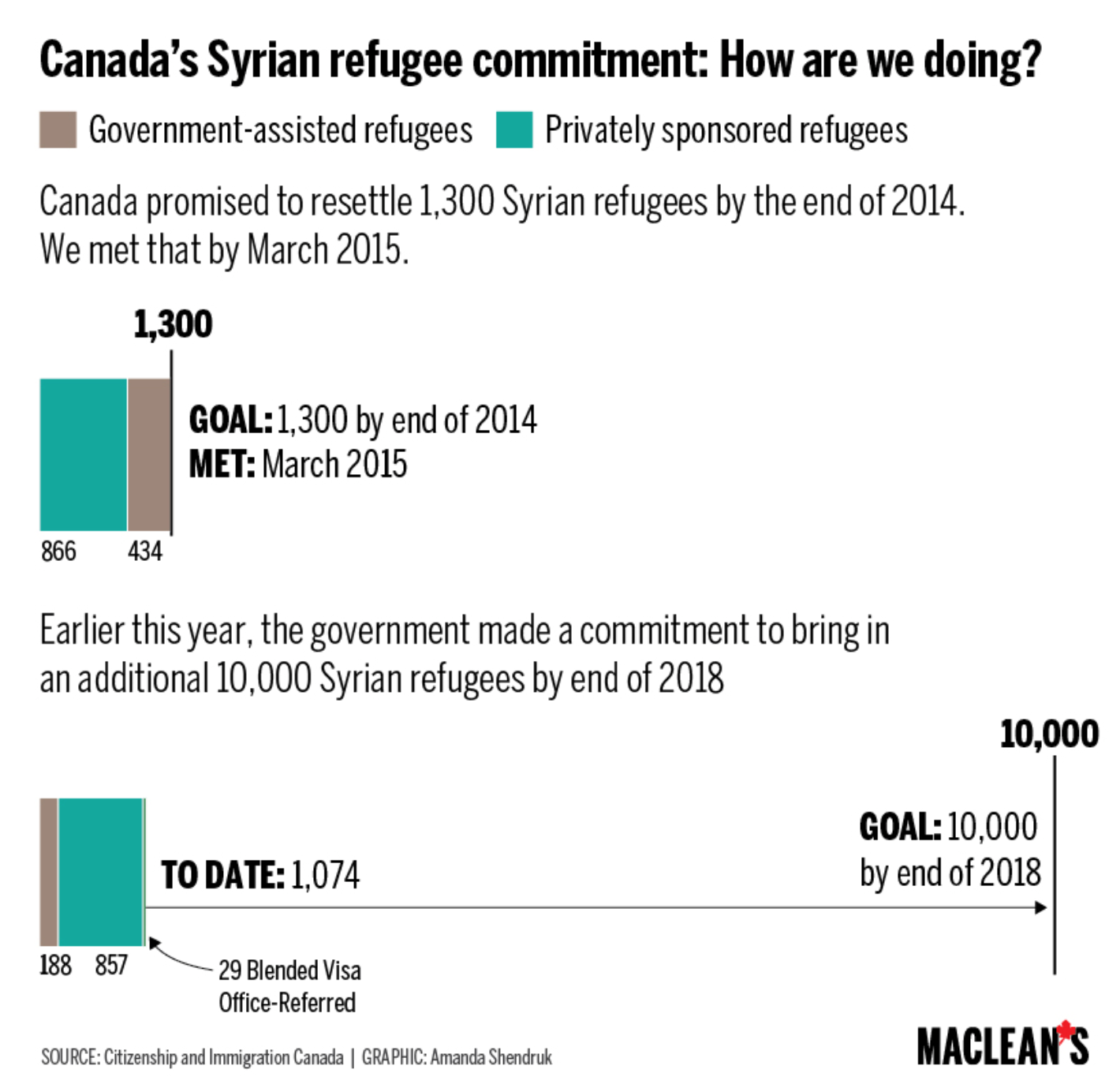
Highlights of Media Coverage of the Politics of the Syrian Refugee Crisis

Canadians_divided_along_political_lines_over_whether_to_accept_thousands_of_refugees_in_current_crisis_-_Angus_Reid_InstituteMuch of the focus has been on Minister Alexander’s handling of the crisis. Starting with Calgary Mayor Nahid Nenshi:

“Minister Alexander should have been a star. He was an incredible diplomat. By all accounts he’s a brilliant man, but he’s also the minister behind Bill C-24, which I remind you means that me — born at St. Mike’s hospital in downtown Toronto — could have my Canadian citizenship stripped,” he said.

Calgary mayor lashes out at immigration minister on refugee crisis

Both Robin Sears and Scott Reid attribute his approach to the numbing effect of the overall Conservative party approach:

As one friend put it, he must have been given a Pierre Poilievre blood replacement treatment, so thoroughly have they crushed his humanity. Since becoming minister he has spoken in a wooden, angry snarl in interview after interview. Perhaps frustrated at the nonsense he has been instructed to deliver, he repeats it in a surlier tone. Few of us are able to be smiling, convincing liars in public. It is perhaps a testament to the angst he feels about the role he has been ordered to play that he does it so woefully.
The refugee story looks as if it might now become the pivot issue of the campaign. It speaks to the deep humiliation that many Canadians have come to feel about the harsh vision of Canada the Harper government flaunts to the world. (Alexander’s TV meltdown made the BBC’s front page online.) It speaks to their ferocious defensive attack in response to any criticism from any quarter. And it underlines how far their mean-spirited response to this crisis is from the values of a majority of Canadians.

Sears: The cost of mindless, heartless message control

But it’s not the first time he’s played the part of the unthinking partisan. Watching Wednesday night’s spectacle, one had to wonder what’s gone wrong. Where did that original Chris Alexander go? Up there on the screen that might as well have been Paul Calandra or Pierre Poilievre, government spokespersons that we’ve come to associate with transparent posturing.

That’s the really troubling thing. Alexander, a knowledgeable, talented and presumably well-motivated person, someone whose history and abilities once inspired sincere hopes for great things has allowed himself to become just another one of “them.” A snapping, snarling partisan.

Not because he’s a bad person. Not because he’s taken this particular stand on this particular issue. But because that’s what politics – specifically politics as it’s currently practiced on Parliament Hill – does to people. It brings them low.

If the Conservatives lose this election, don’t underestimate how much this sort of thing contributes to their downfall. When even the likes of Chris Alexander can be so diminished people can see that something about our politics simply has to change.

Reid: Chris Alexander the latest example of how politics debases even the best of us

Both Sears and Reid’s commentary recalls an early piece by Konrad Yakabuski on the almost Faustian bargain Alexander appears to have made (Chris Alexander balances his portfolio and power).

Turning to commentary on the Government and party leaders as a whole), Andrew Coyne calls for a combined non-partisan response by the three main parties (which has been echoed by Liberal leader Trudeau):

Into the void have stepped the country’s mayors. Toronto Mayor John Tory, in particular, has been attempting to organize some sort of coordinated municipal campaign, nationwide. The emphasis, it would appear, would be on encouraging private sponsorship. “I believe we should mobilize to sponsor Syrian refugees. This is who we are as Canadians,” he said Friday. “This will not happen by itself. It will happen when Torontonians step up.” Indeed, the mayor had reportedly already personally sponsored a refugee family, even before the events of recent days.

The thought occurs: what if our national leaders were to put themselves on the line in the same way? What if they were all to get behind the same campaign? What if they were to put politics aside, even for one day, and appear together on the same stage, exhorting the whole country to “step up”? What might we do then?

Andrew Coyne : It took a photo of a dead child to capture our attention. What matters is what we do next

One of the few to defend the PM and Government (silent on Minister Alexander) was Christie Blatchford:

Harper’s view is that only a three-pronged effort has a chance in Syria: accept more refugees and do it faster; give more humanitarian aid; continue to participate in the military campaign.

As he said once, “Laureen and I had the same reaction, but it doesn’t lead to the same conclusion. Our message is (also) we need to help people who are actually there, who can’t get away, and stop the violence being directed at them. I do not know for the life of me how you can look at that picture and say ‘Yeah, I want to help that family’ and say walk away from the military coalition. … It’s incomprehensible to me to see an image like that and conclude you do more of one thing and less of another.”

It wasn’t perfect, but it was a responsible, intelligent and reasoned response to that picture, and on a day when others took an easier path, the one strewn with flowers, teddy bears, balloons and sentiment. Alan Kurdi’s story certainly should galvanize the world, not only to be stricken and weepy, but to fury.

Blatchford: Alan Kurdi’s story should galvanize the world — but Harper can’t be blamed for this tragedy

Tasha Kheiriddin explains a likely factor in the Government’s reluctance:

Harper’s words reveal the unspoken subtext of fear in the Syrian refugee crisis: this new wave of migrants and refugees come from a country where the West is not only directly involved in a war, but in a war with an organization that threatens to take the fight beyond its borders, to our own shores. The fear isn’t simply that these refugees pose a security threat because there could be terrorists among them. The fear is that they pose a social threat — by bringing with them a worldview that could be at odds with the pluralist, secular and socially-liberal societies in which they seek sanctuary.
The fear is that even though the refugees are fleeing the depredations of ISIS, they will not integrate, but seek to change the fabric of their new societies against the will of the current citizenry. It’s a fear grounded in the experiences of European nations like Great Britain, France, the Netherlands and Sweden, which have witnessed social problems ranging from demands for gender-segregated swimming pools, to Islamic “takeovers” of local public schools in Birmingham, to riots in the banlieues of Paris.
It is grounded here at home in the debate over the former PQ government’s Charter of Values in Quebec, incidents of segregation at a Toronto public school and the federal government’s opposition to the wearing of niqabs during citizenship ceremonies.
No one wants to acknowledge the elephant in the room, but if the Syrian refugees are to be saved, someone must. It would be fallacious to deny that practices such as gender segregation, the wearing of the niqab and the subordination of man-made law to that of the divine would make it difficult for any immigrant to integrate into mainstream western society. But it’s just as wrong-headed to assume that all Muslims live this way, or that other religious groups already established in our country, such as the polygamous sect members of Bountiful, B.C., don’t also hold beliefs that conflict with those of the majority.
The answer is not to turn our backs on refugees from Syria, or refugees from any Islamic country, but to impress upon them and on all immigrants that immigration is a two-way street. Newcomers have the rights to their religion, beliefs and practices — but not if those practices violate the norms of the societies to which they must adapt. Values such as equality of the sexes, equal treatment for persons of different sexual orientation, freedom of association, and separation of church and state are not up for negotiation. Any “reasonable accommodation” must be just that: reasonable.
It’s the task of a mature democracy — and compassionate leadership — to find a way forward in this and future refugee crises, and to re-establish Canada’s reputation as a haven for those who need our help.

What’s holding us back from helping the Syrians? Fear.

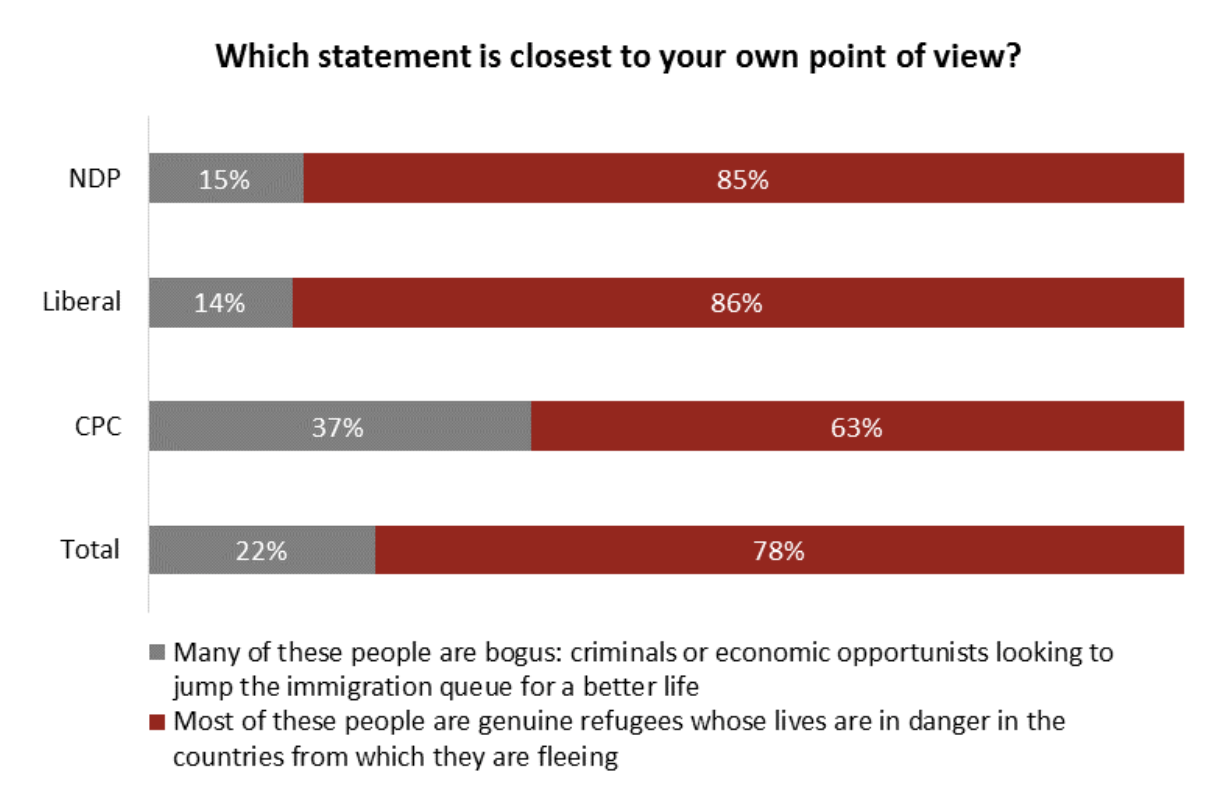
Public opinion polling helps explain the different party positions.
Bogus_refugees_or_notAngus-Reid conducted a useful poll, breaking down opinion by party affiliation, showing the Government’s position is aligned to the Conservative party base and messaging of “bogus refugees”, with the overall key findings being (all parties):

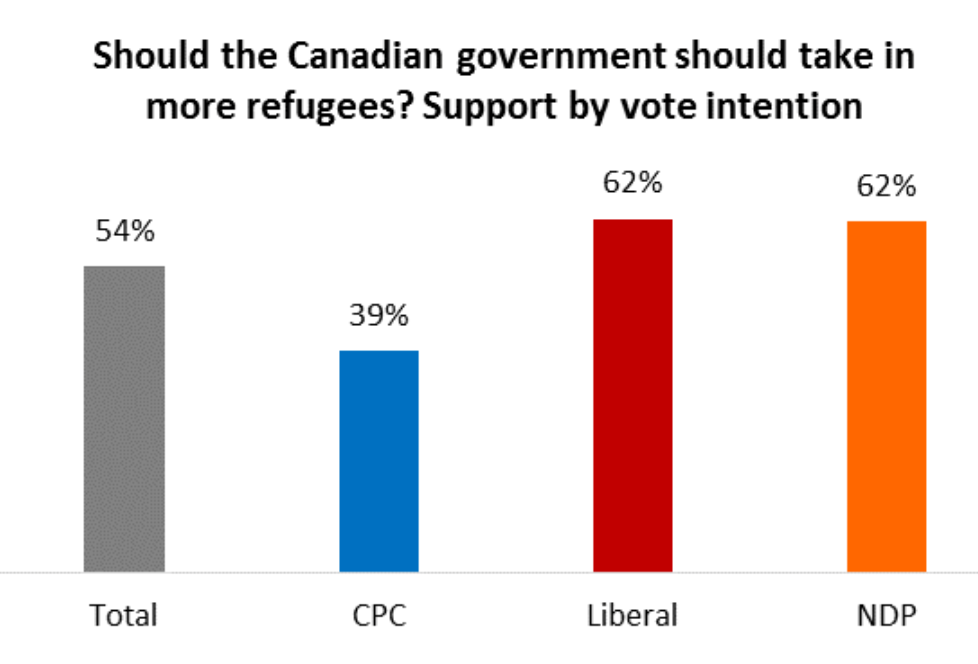
  • Overall, most Canadians (70%) say Canada has a role to play in the migrant crisis, but are divided on increasing the number of refugees the government sponsors and resettles here, and on seeing government spend more to make it happen. (54% and 51% support each, respectively)
  • A significant gender difference exists on whether the people fleeing to Europe from the Middle East are seen as “genuine”: Canadian men are twice as likely as women to say the migrants are “bogus”
  • As to what exactly this country should do, Canadians are most supportive of sending medical and armed forces professionals into the affected European countries areas to assist refugees, divided on taking more refugees and least supportive of “doing nothing”

Canadians divided along political lines over whether to accept thousands of refugees in current crisis

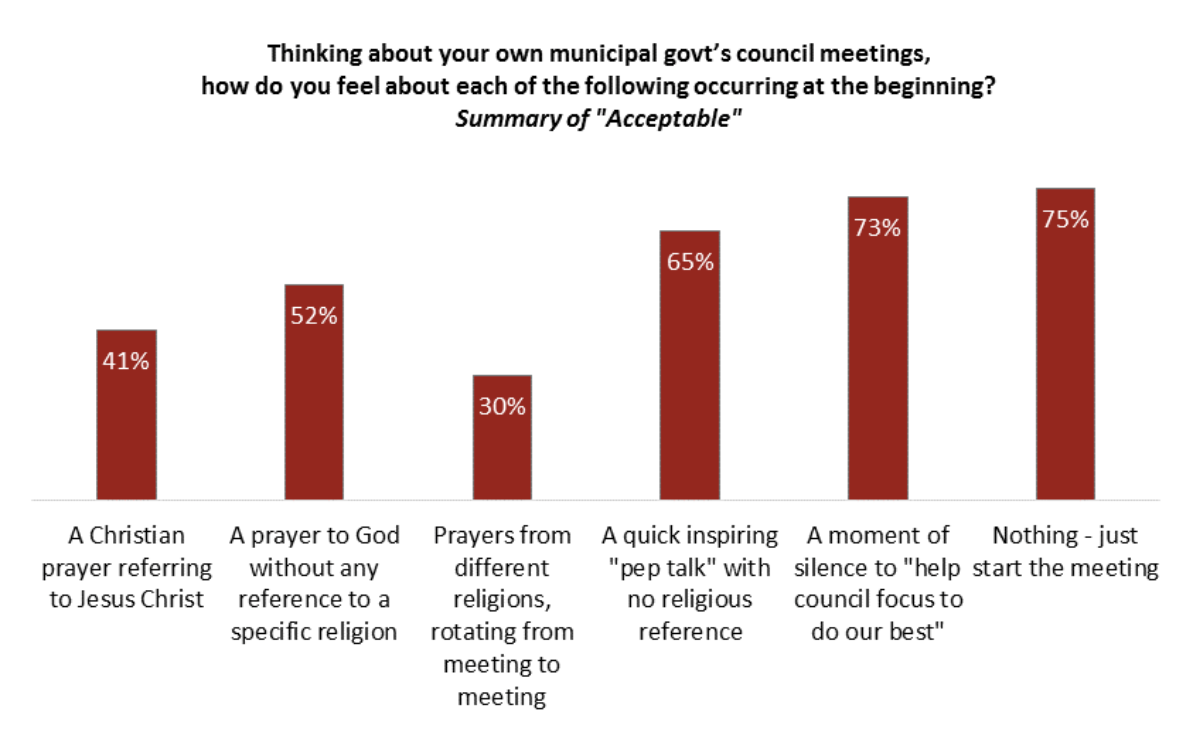
Prayer in Canadian Public Life: a Nation Divided – Angus Reid Institute

Prayer_in_Canadian_Public_Life__a_Nation_Divided_-_Angus_Reid_InstituteThe latest polling on the Supreme Court’s ruling against prayer in public meetings. Key Findings:

  • Just over half (56%) of respondents are in favour of the court’s decision while the rest (44%) are opposed.
  • That support drops to one-third (34%) among the religiously inclined, and jumps to nearly four-fifths (78%) among those who say religion isn’t important to them.
  • In spite of the secularist view on prayer at public meetings, very few (7%) of respondents want to see the lyrics to O Canada changed so that reference to God is removed.

Prayer in Canadian Public Life: a Nation Divided – Angus Reid Institute.

A God? That’s complicated. Canadians hanging on to personal faith as organized religion declines: poll | National Post

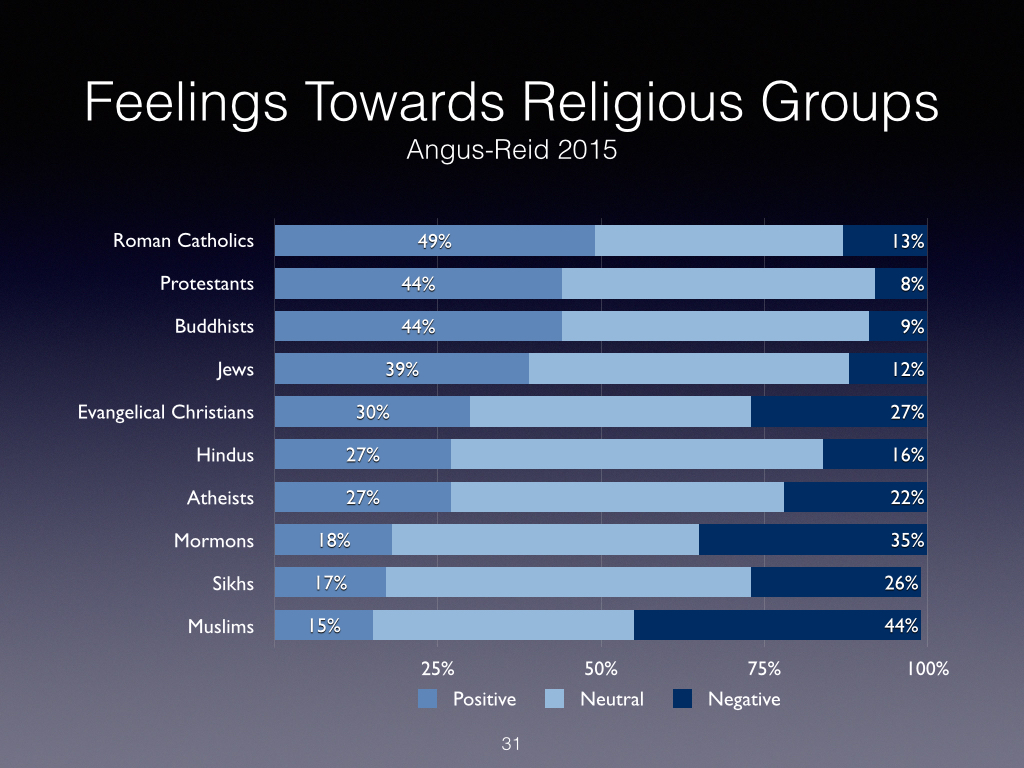
Angus Reid Religon Poll 2015 - Feelings Towards.001The National Post provides a very good infographic summarizing the findings of the recent Angus-Reid survey Religion and faith in Canada today: strong belief, ambivalence and rejection define our views which contains a wealth of information on attitudes and practices and worth reviewing.

Chart above highlights feelings towards different religions and is largely unsurprising.

The chart below provides a relatively rare view of immigration by religion between 2001-11, showing that while religious minorities are a significant share (36 percent), they are still less than Christian immigrants (42 percent). But the median age of religious minorities is younger than for Christians: 32 compared to 41.

Religious Immigration 2001-11.001

A God? That’s complicated. Canadians hanging on to personal faith as organized religion declines: poll | National Post.