Australia: A major multiculturalism review has recommended bold reforms. How far is the government prepared to go?

Jakabowicz on the review:

A year ago, the government instigated an independent review of the national multicultural framework.

As more than half of Australia’s population is either born overseas or has one parent who was, this policy is important. It underpins how multiculturalism works in almost every part of life. It aims to ensure equity and inclusion for people from minority groups, and attempts to whittle away at structural racism.

Now the review report has been released. This comes against a backdrop of growing antisemitism and Islamophobia in Australia, as well as the fallout from the failed Voice to Parliament referendum and the vicious racism many communities experienced during the COVID crisis.

The report includes 29 recommendations for improving Australia’s multicultural society. The government has committed $100 million over the next four years to implement the recommendations, though it is still working through the details and timeline. Here’s what it found.

Some of the recommendations are symbolic and have appeared in every multicultural review over the past 50 years. But other recommendations are far more concrete.

Firstly, it suggests there be a federal Multicultural Commission (a proposal the Greens have had on the parliamentary agenda without Labor support for some years). This body would be empowered to provide leadership on multicultural issues, hold opponents of human rights to account, and promote close collaboration between stakeholders at all levels.

Secondly, the panel proposes breaking up the Department of Home Affairs. This would be an attempt to reverse the surveillance and punishment approach that many believe the department to have towards migrants, refugees and some ethnic groups.

Instead, it suggests a new-look, nation-building, Cabinet-level Department of Multicultural Affairs, Immigration and Citizenship.

And from a policy perspective, the report recommends:

  • better ways to protect people’s languages
  • a citizenship process that is less about learning cricket scores and more about appreciating diversity and the importance of mutual respect
  • diversifying our media sector so it more effectively reflects and involves our minority communities
  • and ensuring the arts and sports sectors are spaces for intercultural collaboration and cooperation.

Overall, the report shows how marginal multicultural affairs have become in government – these ideas would go a long way toward refocusing the government’s attention where it is needed.

Why was this review needed?

The review was tasked with assessing how effective Australia’s institutions, laws and policy settings are at supporting a multicultural nation, particularly one that’s changing rapidly. This included looking at the challenges of refugee and immigrant settlement and integration, as well as the impact of world events on Australia’s multicultural society.

There’s also an economic element. The review looked at how we can ensure the wide-ranging talents of Australia’s residents are fully harnessed for personal and broader societal benefit.

These questions point to the need to bring together political, economic, cultural and social priorities in our government programs and policies. They also recognise the deeper challenges of racism, social marginalisation and isolation, which are often compounded by other factors, such as age, gender, class, health and disability.

These are not new questions. What is new is the recommendation for a strategy to engage in a sustained and interconnected way with the causes and consequences of our current failures. It is very unusual for a government to ask a review to do this.

The findings also bring together the perspectives and insights that many advocates in this space have long championed, but which have been swept aside and neglected for over two decades.

Importantly, the report stresses that a national commitment to multiculturalism demands bipartisanship.

I made an argument for a research strategy element in the review in 2023, and was later commissioned to develop a paper on research and data for a multicultural Australia.

The panel has now recommended that a national multicultural research agenda be developed by the new Multicultural Commission, taking account of my recommendations.

What will the government do?

There is still a long row to hoe – none of the recommendations have been publicly accepted (nor dismissed) by the government, and as yet no specific resources have been committed (despite the $100 million commitment overall). Significant action, however, is likely over the coming months and in future budgets.

While it is unlikely Home Affairs will be broken up immediately, some major moves to upgrade the capacity of the public service to deliver on the government’s commitments are likely. The courage of the government to advance these priorities in the election will depend in part on public reactions to the report and its implementation, as well as the stance of the Opposition.

Will the panel’s extensive work improve cohesion, enable better community relations, and unleash the social and economic benefits of a more collaborative society? The first test will be in how a proposed Multicultural Commission would be structured, led and resourced. We may not have long to wait.
Source: A major multiculturalism review has recommended bold reforms. How far is the government prepared to go?

As the war in Gaza rages, social cohesion in Australia is under strain — how to ensure it doesn’t break?

Good discussion of the perils of too much emphasis on intra-group dimensions compared to inter-cultural dimensions and Canada has also neglected inter-cultural dimensions and the civic integration focus of multiculturalism:

Australian multiculturalism is being shaken to its core by deepening community tensions and rising levels of hate speech and intimidation, triggered by the humanitarian catastrophes associated with the conflict in Gaza. The response to these traumas in this country, to date, has been characterised by a misplaced focus on the part of some political leaders on protests, a reluctance to build inter-cultural community relations, and the long-held but shallow emphasis on celebratory harmony, rather than meaningful collaboration and genuine community engagement.

It is worth reflecting, then, on the way sociological concepts and scholarly collaboration might help facilitate such engagement, as well as deepen mutual understanding and calm some of the trigger-point anger that government admonishment has yet to ameliorate. Perhaps more urgently, we wonder whether and under what conditions the universalist ethos expressed in multiculturalism can safeguard us against destructive forms of tribalism that do not see the humanity of others.

There has already been a great deal of public commentary about the way support for both “sides” of the Gaza conflict is threatening social cohesion and destabilising existing political allegiances. The decision of Senator Fatima Payman to defy her own party and vote instead with the Greens in their demand for immediate recognition of Palestinian statehood — a decision which led, ultimately, to Senator Payman’s defection from the Labor Party — is a particularly vivid example of this phenomenon.

We believe that social divisions such as these are, in part, a consequence of the emphasis being placed on the intra-groupdimensions of multicultural policy, however poorly enacted. This comes at the expense of cultivating and enhancing the inter-culturalpriorities and skills that are necessary for social cohesion. Too often governments have seen emotional engagement on ethno-religious issues as detrimental to building a common purpose, condemning such perspectives and haranguing their exponents.

Solidarity under threat

Against this background, we write as Australian scholars with Arab/Muslim and Jewish heritages, respectively, who have dedicated our academic careers to the study of multiculturalism, diversity governance, interfaith dialogue, and inter-cultural relations. We have pursued these academic studies from a principled commitment to universal human rights, social justice, and deep equality. We have been following with great moral concern the catastrophic war unfolding in Gaza and its serious implications for community relations and social cohesion in Australia.

As perceived representatives of the main sides in this conflict — particularly in the context of diaspora communities — Jewish and Arab Australians have faced undeniable bigotries in the form of antisemitism and Islamophobia, and have often responded to such bigotries by publicly calling out these and other forms of systemic racism. Although there is an understandable sensitivity on both sides to hate speech, it is all the more disappointing that advocacy can degenerate into their own punitive strategies and inflammatory language.

It is bitterly ironic, then, to watch certain members of these two Australian communities engage in forms of “cancel culture” through the intimidation and public shaming of those deemed adversaries in the daily commentary on the Gaza war. As some have put it, the war in Gaza may be “tearing us apart” and threatening transcultural social solidarity and the viability of respectful pluralism.

One of the more worrying effects of the local mobilisation of communities on the critical social infrastructure of our multicultural society — which has been forged with such difficulty over the past fifty years — has been the rapid decay in engagement between Jewish and Muslim/Arab community organisations. We have also witnessed a widening divide among some Australian scholars of Arab/Muslim heritage and Jewish backgrounds. Pre-existing apprehensions have been exacerbated and long-held certitudes undermined, undermining public declarations of respect for Australia’s multicultural achievement.

Principles of multiculturalism

In light of the way these tragic events overseas have revealed key weaknesses in Australia’s approach to multiculturalism over the past two decades, it is important to remind ourselves of some of the key principles of multiculturalism as a nation-building and inclusive strategy — one which respects diversity and difference, but which seeks to encourage inter-cultural collaboration and creativity.

Multiculturalism represents far more than the demographic recognition of the origins and persistence of transported diasporic cultural mores. From the very beginning, multiculturalism in Australia was understood to be a political ideal that can harness principles of equality and social justice strategies during times of upheaval, heightened social tensions, and severe emotional distress.

Importantly, the liberal ideal of the person as a free subject able to pursue their values and beliefs — upon which the normative ideal of multiculturalism is based — has also been shaped by the social justice concerns for rights and well-being. For according to this ideal, in order for anyone to have these opportunities and rights, everyone has to have them. This points to the existence of constraints on those opportunities that might impinge upon the well-being of others. Hence, when competing truths vie for dominance in a shared society, pathways to engagement must remain open and be socially facilitated.

Social scientists understand society to be constituted by overlapping realms of social capital strengthened by trust. In multicultural societies, during conflicts with outer others the social capital built within communities may be hardened, while that between groups is diluted if not almost totally dissolved. Moreover, the settlement and social integration experiences of diverse diaspora communities are likely to be affected by an absence of multigenerational social networks that would otherwise facilitate social integration, national attachment, and political affiliation — which may then lead to a sense of social marginalisation and disempowerment, in many cases breeding resentment and outright hostility. These are significant signals of a fragile trust.

In institutions like universities, it is therefore vital that we rebuild and model trust among colleagues of different intellectual persuasions and ethno-religious affiliations, using the space afforded by scholarly interaction to explore in what ways and to what end such a dialogue can be extended.

Diversity comes with obligations

Australia has not always had a great record of trying to resolve inter-ethnic conflicts and build a rights-based social sphere. But since multiculturalism was first launched fifty years ago, the recognition of diversity and opposition to racism have been widely accepted as core multicultural values — albeit not always without resistance, contestation, and even scepticism, particularly in relation to First Nations people.

Furthermore, a key concept in multiculturalism and other pro-diversity approaches relates to inter-cultural engagement. By committing to, rather than withdrawing from, dialogue premised on mutual respect and support for justice and human rights, we are committing to recognise cultural and religious differences and uphold shared values within the multicultural ethos. Only then can we hope to minimise the risk of reaching a tipping point for multiculturalism that will significantly deepen community tensions and further weaken social cohesion.

There needs now to be serious engagement between people who are committed to keeping Australia’s multicultural project on track. To this end, the federal government must no longer procrastinate over two important initiatives — the Multicultural Framework Reviewand the Anti-Racism Framework. After all, one of the keys to Labor’s victory at the last federal election was the number of culturally diverse candidates the ALP placed on the ballot in order to reflect the diverse reality of contemporary Australian society.

Yet, as Senator Payman pointed out in the wake of her resignation from the Labor Party, embracing diversity comes with obligations. Indeed, the superdiversity of our multicultural society should be reflected in the way our key institutions — including political parties and universities — operate. Senator Payman is one of those new faces who reflect the aspiration of many communities to have an equal place at the national table.

There must be space for a diversity of perspectives and positions that reflect the multilayered identities of modern Australians. This is how we ensure that multiculturalism works for everyone.

Distinguished Professor Fethi Mansouri is the founding Director of the Alfred Deakin Institute for Citizenship and Globalisation at Deakin University.

Andrew Jakubowicz is Emeritus Professor of Sociology at the University of Technology Sydney.

Source: As the war in Gaza rages, social cohesion in Australia is under strain — how to ensure it doesn’t break?

Australia: Grattan – Ethnic tensions will complicate the Albanese government’s multicultural policy reform

On the ongoing Australian multiculturalism review and similar political dynamics with Australian Muslims as in Canada:

When ASIO boss Mike Burgess delivered his annual threat assessment earlier this year, he stressed the rising danger posed by espionage and foreign interference.

“In 2024, threats to our way of life have surpassed terrorism as Australia’s principal security concern,” he said.

But ASIO also remained concerned about “lone actors” – individuals or small groups under the radar of authorities with the potential to “use readily available weapons to carry out an act of terrorism”.

It was a concern “across the spectrum of motivations – religious and ideological”.

With minor variations, Burgess might have been describing what allegedly happened at Sydney’s Wakeley Assyrian Orthodox Church on Monday night, where Bishop Mar Mari Emmanuel was attacked with a very “readily available weapon” – a knife.

Monday’s incident would have set off shock waves in ordinary times, especially given it was followed by an ugly riot as an angry crowd converged on the scene, trying to get at the alleged perpetrator, a 16-year-old boy (who has since been charged with a terrorism offence).

In this case, the fear the attack triggered was dramatically heightened by context.

Tensions, especially in western Sydney, are much elevated because of the Middle East conflict. And the Wakeley attack came just two days after the Bondi Junction shopping centre stabbings, which killed six people. While that atrocity did not fall under the definition of “terrorism”, inevitably the two incidents were conflated by an alarmed public.

The mix, further stirred by incendiary social media, increases the difficulty of keeping a sense of proportion about the church incident, which isn’t the first instance of a terrorist act in Australia and presumably won’t be the last.

We don’t know the background of the attack on the bishop. We do know that the wider pressures on our social cohesion – including dramatic rises in antisemitism and Islamophobia – are deeply troubling. Australia’s multiculturalism is enduring unprecedented strains, with all the difficulties that brings for political and community leaders.

When there are security crises, terror-related or not, the default call is, not surprisingly, for authorities to DO SOMETHING. More police (or security guards). Greater law enforcement powers. Tougher penalties. New controls on social media. (After the church incident, the eSafety commissioner ordered tech companies to take down images of the attack. These were widely available, because the church service had been live-streamed.)

Sometimes calls for action may be warranted, but often they’re little more than a knee-jerk response – and can open other debates (for example, over the justification for censoring certain images but not others).

The challenge for political leaders is not just dealing with the immediate increasing threats to cohesion, but with longer term policy.

Prime Minister Anthony Albanese recently flagged, when he met a Jewish youth group, that the government planned to appoint an envoy against antisemitism (a post existing in other countries) and a matching envoy against Islamophobia. There’s no timetable for these appointments.

Looking to the future, what’s unclear, given the present tensions, is the likely trajectory of Australia’s multiculturalism.

Will the strains worsen, seriously fracturing the society? Or will they ameliorate in the years to come? Multiculturalism is likely in transition, but what will be its pathway? And what are the political implications?

Labor is particularly worried about the erosion of its support among Muslim voters in western Sydney seats.

The cat was belled on the suburban multicultural vote in 2022, ironically not by a Muslim candidate but a Christian of Vietnamese heritage. Dai Le, whose family fled the Vietnam war, seized the previously safe Labor seat of Fowler in Sydney’s outer south-west.

It remains to be seen whether this is a one-off, or if more strong independent candidates will start to emerge as people from multicultural communities fight for a bigger direct presence in politics, or to exert more influence through strategic voting.

A recently-registered group called Muslim Votes Matter styles itself as “shaping our future through informed voting and collective influence”. It says on its website, “There are over 20 seats where the Muslim community collectively has the potential deciding vote”.

Kos Samaras, from the RedBridge Group, a political consultancy, says “the fire” has been raging for some years in multicultural communities in areas such as north-western Melbourne and western Sydney. The Israel-Hamas war has obviously fuelled it.

Samaras says the Muslim political alienation from the major parties has been strongest among members of the those communities who were born in Australia – people in their 20s, 30s and 40s.

This week, after the church attack, NSW premier Chris Minns called in faith leaders. But it is a moot point whether this consultation with predominantly older people reaches the younger, more alienated generation.

Young Australian Muslims grew up in a post-September 11 world, Samaras says, with a sense of being outsiders in the country. We saw this feeling during the pandemic, in the complaints about the different treatment of people in Sydney’s eastern and western suburbs.

Notably, Muslim community leader Jamal Rifi, speaking this week to Sky on behalf of the 16-year-old’s family, referenced the fact the Bondi Junction killings were not labelled “terrorism” by the authorities while the church incident was. “I understand there is a difference between the two but unfortunately the overwhelming feeling in the community [is] that it is, you know, Tale of Two Cities,” he said.

Andrew Jakubowicz, emeritus professor of sociology at the University of Technology Sydney, highlights the three separate elements of multiculturalism. These are

  • “Settlement policy, which deals with arrival, survival and orientation, and the emergence of bonding within the group and finding employment, housing and education
  • “Multicultural policy, which ensures that institutions in society identify and respond to needs over the life course and in changing life circumstances, and
  • “Community Relations policy, which includes building skills in intercultural relations, engagement with the power hierarchies of society and the inclusion of diversity into the fabric of decision-making in society – from politics to education to health to the arts.”

Australia has been fairly good at the first, not so good on the second and “very poor” on the third, he says.

The Albanese government last year commissioned an independent review of the present multicultural framework. The report has recommendations for the short, medium and long terms. It envisages changes to institutions as well as policies and at federal and state levels.

Although the review is not due for release until mid-year, the May budget is likely to see some initiatives.

But there are differences between ministers about how far and how fast reform should go. A febrile combination of local and international factors is making crafting a multicultural policy for the next decade a much more sensitive operation than might have been envisaged when the review was launched.

Source: Grattan on Friday: Ethnic tensions will complicate the Albanese government’s multicultural policy reform

Australia: What is the government’s multicultural policies review seeking to …

Of interest:

Fifty years after the Whitlam government released its landmark report on multiculturalism in Australia, the Albanese government has launched a major review of its policies to ensure they are serving multicultural communities in the best ways.

But will this review provide a multicultural policy “for all Australians”? Or is it just seeking to ensure, as the government put it, that “no one is left behind, and everyone feels that they truly belong”?

Multicultural policies in Australia initially aimed to benefit all Australians, not just multicultural communities. They were meant to express the broader principles of liberal democracy, such as equality, freedom and economic opportunity.

However, the past decade has been marked by “fear-mongering and division”, as Immigration Minister Andrew Giles recently reminded us.

Perhaps this is why the Albanese government review, promised during the 2022 federal election, has set a modest goal on multicultural policies. It may ultimately fall short of the broader goal of engaging with wider society.

So, what will the review actually be looking at? And what is it seeking to achieve?

How Australia has changed

The review’s terms of reference say the aim is quite simple: ensuring we have a government that works for a multicultural Australia.

It identifies discrimination, systemic barriers to services and social mobility as focal points for action.

Australia has changed significantly over the past decade. More than 50% of the population today was born overseas or has at least one parent overseas born. And nearly 30% identify with a non-Anglo culture.

Over the past decade, perhaps the biggest issue in relation to the social integration of immigrants has been the huge increase in temporary migration to Australia.

Public policy has equated “temporary” with “not requiring support”. That means these migrants have not received adequate services in housing, transport, education, employment protection and health.

They were the ones most abandoned during the pandemic, when they were told simply to “go home” or survive on the streets.

What the review will look at

There are three intertwining policy spheres that require a major rethink in the multicultural review:

  • multicultural policy (including language policy, recognition of people’s identities and support for their sense of belonging to Australian society, and employment protection policy)
  • settlement policy (focused on new arrivals of both migrants and refugees, including trauma recovery), and
  • community relations (covering discrimination, relations between different cultural groups, anti-racism efforts, social integration and the all-important relations between Indigenous and non-Indigenous Australians).

These policies were left to decay over the last generation, throughout both Labor and Coalition governments.

Another focus of the review will be on the power hierarchy in Australia and how open it is to non-European Australians.

This remains a major challenge for the country. There are few people of multicultural backgrounds in positions of power, such as

Importantly, the review will also consider the role of the government as an employer itself. Recent studies have pointed to the under-representation of culturally and linguistically diverse groups in the public sector at both the Commonwealth and state levels – especially at senior levels.

The review will consider how the Commonwealth government has been addressing all of these issues. It will make recommendations on legislation, policy settings, community relations and government services at the federal, state and local levels.

Where the review may fall short

Unfortunately, the review was not asked to examine the poor state of Australian government data collection on diversity and its appalling consequences.

We recently saw this most starkly in the lack of statistics on mortality from COVID, which hit older, multicultural Australians particularly hard.

Neither is it being asked to consider how to rebuild the depleted state of Australian research on diversity and multicultural issues. This was a central recommendation of the last Labor-led parliamentary committee review of multicultural policies in 2013.

The chair of the current panel is Dr Bulent Hass Dellal, executive director of the Australian Multicultural Foundation. He has considerable experience as a government advisor in the Abbott, Turnbull and Morrison governments. He also has the confidence of the new government.

However, there are no First Nations people on the panel, though they will be invited to contribute. The government has also not appointed any academic researchers to either the panel or reference group.

From the perspective of experts with an interest in cultural and linguistic diversity, this is disappointing.

Lastly, the review is being conducted within the Department of Home Affairs rather than the Department of the Prime Minister and Cabinet.

Multicultural policy was once thought important enough to have the support and imprimatur of the prime minister and be monitored by his staff – be it Malcolm Fraser or Bob Hawke. This is seemingly no longer the case.

Andrew Jakubowicz, Emeritus Professor of Sociology, University of Technology Sydney

Source: What is the government’s multicultural policies review seeking to …

Australia: If that is not who we are, then who are we?

Bitingly sharp critique of the phrase “This is not who we are,” written mainly but not exclusively from an Indigenous perspective. While over the top, more than a kernel of truth in terms of the various divisions and fault lines that apply more broadly than Australia and Indigenous issues:

After news of Australian war crimes in Afghanistan made headlines, it was only a matter of time before a politician uttered the words “This is not who we are”

Australia has been trying very hard for a very long time to have its cake and eat it too when it comes to the idea of ‘we’.

It has tried to create the impossible, or at least the grossly contradictory and hypocritical, by aggressively separating and dividing people across every imaginable line while simultaneously appealing to an idealised sense of ‘we’ whenever it is convenient or expedient.

We are separated across state lines, a fact which has never been clearer than when watching our Prime Minister first attack Victorians and then try to steal their achievement as his own.

We are separated across racial lines with racist dog whistling from media and politics, and more overt racism from everyday white supremacists.

We have simultaneously rejected Indigenous rights, rejected multiculturalism, and embraced assimilation in a way that allows racism to be framed as only a problem when someone complains about it and not when someone enacts it. The divisive act, separating we into usand them, is the acknowledgement of mistreatment rather than the mistreatment itself – “Why do they always have it to make it about race?” they ask, to an elusive ‘them’ who they like to imagine make everything about race.

We are separated across political lines with a renewed animosity and disdain aimed not just between our political parties, but from our politicians to the people they are meant to represent.

We work hard to separate ourselves with all sorts of real and imagined differences; AFL or NRL, Ford or Holden, devon or fritz, potato scollops or potato cakes, and while many of these are a bit of a laugh, some have still led to more than a few playground/pub punch ons over the years.

We also separate ourselves in ways that actively dehumanise those of us who are not we so that we are less concerned about about their human rights being denied (which is of course the point of dehumanising someone in the first instance); homeless, unemployed, incarcerated, lower income, asylum seekers, Indigenous peoples – if only they’d worked a little harder, not jumped the cue, not made it about ‘us and them’, not been mean to me once in primary school, then they’d be one of us, then they’d deserve dignity, respect and basic human rights.

And amongst all of that division there is a singular unified theory of ‘We’ that transcends time and space and all of reality.

The mythical ‘We’ who arrived on the First Fleet, even though it was not us who committed the massacres. That is not who we are!

And the we who were already here for thousands of years before we are not us but they, but only because they always make it about race by playing the race card, and they didn’t even invent the wheel so they should be thankful it was us who invaded and not some other them, not that it was even an invasion to begin with… and on it goes.

It is the We who wins gold medals at the Olympics, or beats India at the cricket, or New Zealand in the rugby, but it is not us if they refuse to sing the anthem, or if they take a knee, or dare to wear an Aboriginal flag, or throw an imaginary spear. That is divisive! That is not who we are!

It is the We who fought bravely in every war (except the frontier wars which never happened) so that we can celebrate our veterans, our beloved ANZACs, with alcoholism, gambling and sacred biscuits once a year. We forget they even exist outside our imagined dreams of past national glory even as we all mindlessly chant ‘Lest we forget’. And when they return different from when they left and in need of our support, we pass the buck yet again because it is not us who fail our returned service men and women just as it is not us who committed the war crimes – that is not who we are.

We is an impossible dream but still one that many feel is worth pursuing, personally I could take it or leave it, especially since that dream has been turned into a nightmare by those who exploit us by using we as a convenient scapegoat allowing them to pick and choose not just who is we, but when we are we. We push them away for not being we enough, we thin the ranks of we by declaring that all of us who do wrong in our name were never really we to begin with – they are unWe. They are not the real We. They are not who we are.

But either it is who we are, because we share a sense of collective identity, and accept collective responsibility for both the good and the bad, or if it is not then we, the collective embodiment of Australia, does not exist as anything other than a system of ever changing rules that benefit a select few, that denies Indigenous people justice, and that locks up brown people for trying to exercise our legal right to seek asylum.

We are the greatest nation on earth, because we only accept collective responsibility for all the good stuff while denying any responsibility for the bad stuff, though we will still happily keep the land and resources that were gained through doing the bad things that we didn’t do.

But here is the long and short of it for all of us.

If we want to have “Australia won a gold medal at the Olympics” then we also have to take “Australia committed war crimes”.

Of course we did not all individually do all the bad things anymore than we all collectively did the good things, for that is what being a collective is all about – collective responsibility.

And we do not need to stand for an anthem or salute a flag or be suitably proficient in English to do that, we just need to acknowledge problems where they exist and strive to make them better and never turn a blind eye or shirk our collective responsibilities to ourselves, to each other, or to our fellow human beings regardless of where we come from.

There is strength in the collective ‘we’, but there is a danger when we let them decide who weare and who we are not.

The modern incarnation of jingoistic, patriotic, racist as fuck, white ethnostate loving nationalism has its roots in the Howard/Hanson era, but of course is merely an adaption of the same white ethnostate ideal that Australia was built on. Once the idea of a Whites Only nation was put to bed, Australia was either going to embrace true multiculturalism or it was going begrudgingly accept that not everyone can be white while demanding that they damn sure do their best to act it anyway. This is where the origin of ‘One Nation’ comes from, for before it was a racist political party it was part of a strategy aimed at getting people to accept multiculturalism.

As Andrew Jakubowicz explains:

Multiculturalism may well be supported by 80% of Australians, but this level drops when anxiety about border security rises. So, multiculturalism’s opponents have much to gain from heightened public concern about “Muslim immigration”.

Hanson’s election has helped clarify the sides of the debate around how Australians have “imagined community” for more than 30 years, since Geoffrey Blainey first shaped the opposition arguments. There is one nation with many cultures, which was Bob Hawke’s 1989 definition of multiculturalism. And then there should be only one culture albeit followed by many races, which is Hanson’s conceptualisation – though wrongly labelled as “One Nation”.

The first sees Australia as a civic nation in which reciprocity and difference, supported by core commitments to democracy and equality, provide the architecture for creativity and cohesion.

The second sees Australia as an (Anglo-Christian) ethnic (multicoloured) monocultural nation in which assimilation into an imagined singular worldview drives calls for cohesion and claims of social strength.

We have never really reconciled which of the above ‘we’ we mean when we talk about ‘we’, and until we do we will be incapable of working out where we are heading because not only do we not know where we are, we apparently don’t even know who we are, even if some of us want to pretend to know who we aren’t.

Source: If that is not who we are, then who are we?

Australia’s new parliament is no more multicultural than the last one

Dramatic contrast with Canadian numbers: 56 foreign-born (44 MPs, 12 Senators, 2017), and currently 48 MPs who are visible minority:

Politicians often say Australia is the most successful multicultural country in the world – but it would seem the country’s growing diversity is failing to make its mark in the corridors of power.

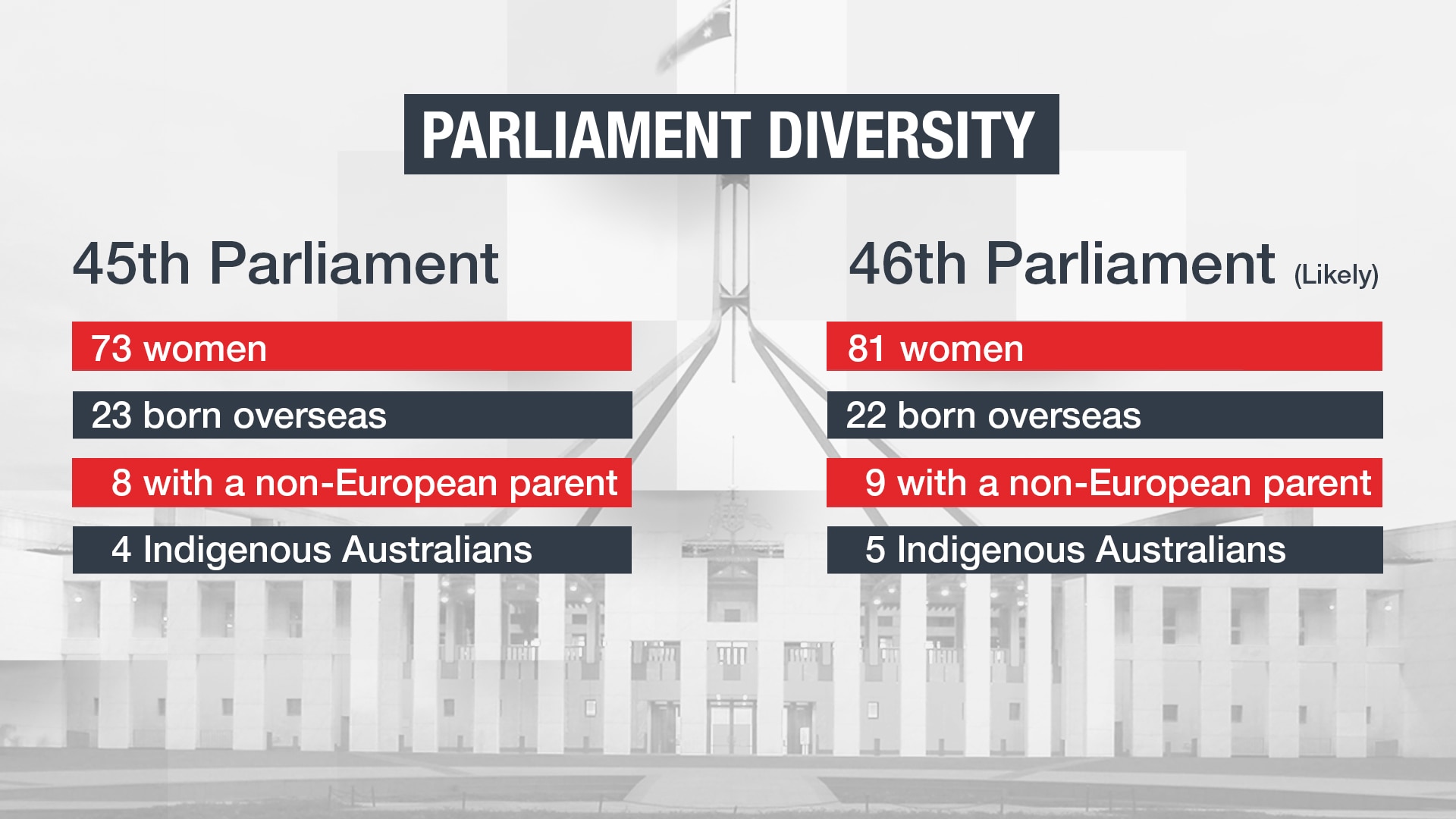
The newly elected 46th parliament will likely have little more cultural diversity than the previous one, according to figures compiled by the Parliamentary Library and SBS News.

The number of MPs born overseas in the new parliament is down from 23 in the previous parliament, to 22, across the House of Representatives and Senate. While the number of MPs with one or more parent from a non-European background rose slightly, from eight in the previous parliament to nine in the new one.

45th Parliament versus the 46th Parliament

SBS News (source Parliamentary Library and SBS News)

Some of the notable exiting MPs include the Liberal’s Tony Abbott, born in England and Lucy Gichuhi, born in Kenya. As well as Labor’s Lisa Singh whose parents were born in Fiji.

Some of the newly elected MPs from diverse backgrounds include Liberal’s Dave Sharma, born in Canada to an Indian father; the Green’s Mehreen Faruqi, born in Pakistan; and the Liberal’s Gladys Liu, born in Hong Kong, who as of Tuesday was on track to pick up the closely fought Victorian seat of Chisholm.

According to the 2016 census 28.5 per cent of Australians were born overseas. While the United Kingdom remains the largest country of origin within that, China and India are in second and third place respectively.

UTS sociology professor Andrew Jakubowicz said he wasn’t surprised parliamentary diversity hasn’t grown in the new parliament.

“Parliament is essentially a white club, it is essentially a white boys club … The dynamic of change which is sweeping through the Australian community more widely is very apparent at the state level, but the federal level it seems to have been squeezed out,” he told SBS News.

The figures on multiculturalism for the 45th Parliament come from the Parliamentary Library and were accurate as of April 2019.

Data for the new parliament is compared with the previous figures and available public biography information of all new incoming MPs on their official websites.

Parliament is essentially a white boys club.

– ANDREW JAKUBOWICZ, ACADEMIC

SBS News has reached out to both the Labor and Liberal parties to confirm the birthplace of several new members who haven’t mention their place of birth on their official websites.

The analysis is also based on the likely results, with some Senate and Lower House results still not finalised on Tuesday, following Saturday’s election win for the Coalition.

Where there has been change, is in the number of women who will take their place in parliament, with at least 81 women having confirmed to have won seats in the Senate or the House of Representatives.

This is compared to 73 female MPs in the previous parliament. There are 227 seats across both houses of parliament.

The number of Indigenous Australians in parliament will also likely increase from four to five with the return of Tasmanian Senator Jacqui Lambie.

During her first stint in Parliament, Ms Lambie used her maiden speech in 2014 to reveal her family connection to Tasmania’s Indigenous population.

According to an Essential Research poll commissioned for SBS News prior to the election, 71 per cent of Australians believed the country would benefit from a greater representation of under-represented groups in parliament.

Of those who agreed with the sentiment, 46 per cent said they would like to see more women in parliament, 32 per cent said more Indigenous Australians and 17 per cent said more Australians born overseas should be in parliament.

Professor Jakubowicz said he believed the Section 44 controversies and dual-citizenship concerns may be a barrier for multicultural Australians who are thinking about getting into politics.

“I think people from ethnically diverse communities who might want to make a run might be fairly intimidated by the sorts of hoops needed to jump through,” he said.

He also added that until the major parties change their internal processes and begin pre-selecting diverse candidates in winnable seats, little would change.

“The idea is that the parliament represents the range of the Australian people … that isn’t happening,” he said.

Source: Australia’s new parliament is no more multicultural than the last one

Australia: Foreign-born voters and their families helped elect Turnbull in 2016. Can they save ScoMo?

Interesting overview of the upcoming Australian election and ethnic votes. Some similarities to Canada but with greater polarization and more extreme views:

At the 2016 federal election, a small but significant vote cast by foreign-born Australians and their families helped elect the Liberal Party. The voters backed conservative minor parties in typically Labor-leaning electorates, and their preferences flowed to the Liberals.

Electoral pundits made little of this phenomenon at the time, and the media were not particularly interested. But in the wake of a similar voting pattern in the same-sex marriage plebiscite in 2017, the search is now on to find the elusive “ethnic vote”.

Who are these voters and where do they live?

The two largest collectives of non-English speaking groups are Chinese-Australians, and people from the Indian subcontinent including Pakistan, Bangladesh, Nepal and Sri Lanka. These “ethnic groups” are already multicultural, multilingual and politically diverse.

Pockets of Chinese-Australians concentrated in key swing seats in NSW and Victoria were mainly responsible for the surprise outcomes in 2016. That included Reid, Banks and Barton in NSW and Chisholm in Victoria. Three of the four went to the Liberals, but on demographic grounds and political trends at the time, all could have been delivered to Labor. (While Barton stayed Labor, the swing to the Liberals was significant.)

In 2019, we could see a similar pattern emerge in these seats again, as well as in Moreton in QLD, Hotham in Victoria, and Parramatta, Greenway and Bennelong in NSW.

Australia has over 300 ancestries, 100 religions and 300 languages, so invoking a category like “ethnic” does not lead in a particular direction – especially given the divisions and diversity within cultural groups and language communities.

And this population diversity has been shifting as newer groups have accelerated their presence, and older groups have passed on. The foreign-born population now have a growing number of Australian-born children, although many may not yet be able to vote.

How are the parties targeting them?

The main ethnic communities lobby group, the Federation of Ethnic Communities Councils of Australia (FECCA), has produced a policy wish-list and is seeking responses from the parties.

Among the majors, only the Greens have a clearly articulated multicultural policy, having put a proposal for a Multiculturalism Act with subsequent implementation and rights machinery to the Senate over a year ago.

The ALP still sits on its hands on the legislative option, possibly fearing that supporting such a move might trigger negative reactions from the working class and more racist voters.

Their policy now includes a “body” named Multicultural Australia, with a string of commissioners across the country. It will probably come under Tony Burke as Minister, focusing on citizenship and access issues. In this, it is a variant on the 1990s Office of Multicultural Affairs. This was once part of the Hawke/Keating prime minister’s office but was abolished by John Howard as soon as he could.

Labor has committed more funds for community language schools and criticised delays in processing citizenship applications, as well as the high level of English required to pass the test. Former Senator Sam Dastyari has argued that opening up parental reunion is a major offer to a range of ethnic groups needing older family members to do caring work. This move, as one of this author’s informants, said, would really “win the Desi’s heart”, and probably many other ethnic groups as well. The idea has prompted a hostile response from the Coalition.

While Liberal leader Scott Morrison reiterates the old Turnbull mantra of Australia being the most successful multicultural country, the government’s lacklustre Multicultural Advisory Council no longer seems to have a web presence other than one which promotes integration and Australian values.

The Liberals propose a system of aged care “navigators” to help people with limited English survive the aged care system, while also injecting funds into start-up businesses run by migrants.

Conservative think-tank the Institute for Public Affairs retains as its second policy demand of any Liberal government that Section 18C of the Racial Discrimination Act be abolished. The Liberals took this into 2013 and 2016; Morrison has said it’s not on for 2019, though the right of the party is still committed.

What role will they play in the election?

Ethnic communities are not necessarily either cohesive or unanimous in their political viewpoints unless something particularly touches on their “ethnicity”.

The recent anti-Chinese sentiment reflected in media headlines about the alleged corruption of Australian political parties by wealthy Chinese residents may be doing that among Chinese communities. Many Australian Chinese think that Labor is much more sensitive to these issues than the Coalition, and Liberal Party Chinese figures have voiced these concerns in public gatherings.

Although they can be very interested and involved in politics, Chinese Australians have tended to hold back from active political engagement in the past. Indians, by contrast, bring some knowledge of English and, coming from a Westminster democratic system, tend to be more directly engaged – as party members for example. The Greens are particularly open to south Asian members; so, it seems, is the Christian Democratic Party (CDP).

While there are many conservative and religious parties across the country, only NSW has the CDP. It’s offering a “multicultural” array of candidates and directing preferences to the Liberals. The party was key in funnelling support from East Asian intensive electorates in 2016.

After unsuccessful discussions over a number of elections as to whether a socially conservative alliance might be formed between Muslims and Christians, Hindus, Buddhists, Daoist and non-religious groups, something like the alliance appears to have been launched in Sydney. Reportedly “targeting Labor seats that had a high no vote in the same-sex marriage survey”, it could put some further some punch behind the Christian Democratic Party even though it’s not directly affiliated. The CDP is also targeting the Pacific communities in its campaign of support for Christian footballer Israel Folau.

Meanwhile, parties of the far right are competing to present their anti-multicultural agendas. In Lindsay, neo-Nazi Jim Saleam represents the Australia First Party, while across the country, right-leaning parties tussle for the xenophobic vote. That includes Rise Up Australia, Shooters Farmers and Fishers, Australian Conservatives, Australian National Conservatives, Pauline Hanson’s One Nation and United Australia Party.

Although these parties may preference the Coalition, they may prove to be one force that drives ethnic communities towards the ALP.

Election day and beyond

Election day will provide the proof for many of the claims about ethnicity, voting, influence and ideology. It’s highly likely that the senators elected from the right will run a unity ticket against multiculturalism in the new Senate.

This year may well prove the last flash of a mainly White Australian election, with its defenders doubling down on the right, while the centre takes on a multi-coloured hue, and the left is ever more rainbow. A lot of the knowledge that we may glean from the election process will only be learned in its aftermath, picking through small details and trying to form a pattern of explanation.

It has taken the Australian public sphere the best part of three years to work out what happened with cultural diversity and its complexities in 2016. We may well have just as long to wait this time around.

Source: Foreign-born voters and their families helped elect Turnbull in 2016. Can they save ScoMo?

Australia: Why multicultural policy looms as a Senate bargaining chip

Commentary on how the Australian Liberal party appears to be playing on the multiculturalism file, following the recent election of anti-multiculturalism hardliners Pauline Hanson and Eric Abetz:

[Liberal senator Zed[ Seselja [multiculturalism portfolio], in interviews with ABC Radio National and SBS, has revealed he supports multiculturalism – by which he means honouring ethnic community tradition while joining the Australian mainstream.

As he is a member of the government, and for as long as the government position is to leave Section 18C alone, he will stand by that position – though he may still push internally to change it.

Seselja said “it’s reasonable that people feel unease” about Islamic terrorism in response to TV personality Sonia Kruger calling for an end to Muslim migration. However, he did reiterate the government’s position that the immigration program does not discriminate on religious grounds.

But Seselja did not publicly voice his support for members of the Muslim community who may feel intimidated or victimised by calls for Muslim immigration to be banned – a call now echoed by right-wing Tasmanian senator Eric Abetz. Nor did he distance himself from Kruger’s endorsement of Bolt’s “understanding” of the drivers for potential vigilante attacks on the Muslim community and its institutions.

Seselja indicated that reworking “Labor’s multiculturalism policy” was on his to-do list. This is bizarre, as the current policy was taken almost unchanged by Labor from the considered policy of containment and minimisation developed during the Howard era.

Multiculturalism will clearly be one of the trading goods carried in the saddlebags of the government’s peacemakers in the Senate. How it will be shed, and for what deals, remains to be seen. That its components will be among the first sacrifices offered seems most likely, but the multicultural communities that defended Section 18C are alert to the dangers.

Source: Why multicultural policy looms as a Senate bargaining chip

Election 2016: the most exciting time to be multicultural in Australia?

Australian election platforms and multiculturalism – good overview by :

Laundry [of the governing Liberal party] does not believe in setting targets for diversity inclusion, preferring to let the market sort it out. Given the clear precedence of Australian law in all cases, as a practising Catholic, he strongly supports the freedom of communities to use religious tribunals to provide guidance for individuals in conflict. He cites Catholic Canon Law, Jewish Beth Din and Islamic Sharia as appropriate.

Laundy is opposed to extending racial vilification protection to religious vilification. He argues that religions are far stronger and don’t need it.

He is also opposed to a Multicultural Australia Act, rejecting even the option of debating it. He does not believe there is any need for a Multicultural Affairs office in the prime minister’s portfolio, nor mandated participation for cultural minorities in government advisory bodies.

Laundy accepts, however, that the Australian Multicultural Council needs serious work, with its membership changed to be far more representative.

As someone who has spoken out in defence of multiculturalism, he says:

“I know the views that vilify me are those of a small minority. Most Australians like what multiculturalism has done for the country.”

Reflecting on the past, he notes:

“Any prime minister who doesn’t support multiculturalism does so at his own peril.”

Rowland [Labour party shadow critic] shares many of Laundy’s social values. Labor, she stresses, has no policy for a Multicultural Act, though she also points to the party’s strong defence of Section 18C, especially through the shadow attorney-general, Mark Dreyfus.

Rowland agrees that perhaps an incoming government might charge a revised Australian Multicultural Council to explore legislative options for national multicultural legislation. But it is unlikely to be an election policy, and she doesn’t have a view.

The wider issues of diversity and representation have not been on Rowland’s radar. She admits she has never discussed with the shadow communications minister, Jason Clare, issues of diverse representation on either the ABC board or in its programming.

Rowland takes a diametrically opposed position to Laundy on where religious law sits. She believes religious groups should play no role in any Australian legal situation. For her, the law is and must remain secular – be it for Jews, Catholics or Muslims.

She is also wary of whether religious vilification should be part of the Racial Discrimination Act, flipping it to Dreyfus as his responsibility. She would, however, have the review of the Multicultural Council as a pressing issue, especially in terms of its ability to advise government on key areas such as employment, support for grassroots organisations, and the building of more community hubs.

Source: Election 2016: the most exciting time to be multicultural in Australia?

How national multicultural legislation would strengthen Australian society

Andrew Jakubowicz, Professor of Sociology, University of Technology Sydney on the need for an Australian multiculturalism act:

Australians in general like the idea of a culturally diverse society. This is not surprising, given the high proportion of overseas-born Australians and their immediate descendants.

They recognise the creativity that comes from the interaction of different ideas and viewpoints. They are happy with individual cultural traditions being retained so long as the consequences do not breach social harmony. They really do not like inter-group vilification, though they want to affirm a common bond of fairness and respect – words Turnbull uses repeatedly.

When multiculturalism and these principles are marginalised as they were during the Howard, Abbott and Rudd years, social cohesion unwinds. When the allocated political champion of multiculturalism of the day has no legislative lever from which to shift prejudice and encourage engagement, society suffers.

Given the sustained avoidance of legislated multicultural goals and practices by governments and the evident consequences in pockets of alienation and fragmentation, it should be time for a debate on what form of legislative framework Australians would like to see in support of their desires for a fair and multicultural public sphere.

This means an Australian Multiculturalism Act, and a ministerial remit for the whole of government.

Source: How national multicultural legislation would strengthen Australian society