The English Voice of ISIS Comes Out of the Shadows

The Canadian connection. No rush for consular assistance:

More than four years ago, the Federal Bureau of Investigation appealed to the public to help identify the narrator in one of the Islamic State’s best-known videos, showing captured Syrian soldiers digging their own graves and then being shot in the head.

Speaking fluent English with a North American accent, the man would go on to narrate countless other videos and radio broadcasts by the Islamic State, serving as the terrorist group’s faceless evangelist to Americans and other English speakers seeking to learn about its toxic ideology.

Now a 35-year-old Canadian citizen, who studied at a college in Toronto and once worked in information technology at a company contracted by IBM, says he is the anonymous narrator.

That man, Mohammed Khalifa captured in Syria last month by an American-backed militia, spoke in his first interview about being the voice of the 2014 video, known as “Flames of War.” He described himself as a rank-and-file employee of the Islamic State’s Ministry of Media, the unit responsible for publicizing such brutal footage as the beheading of the American journalist James Foley and the burning of a Jordanian pilot.

“No, I don’t regret it,” Mr. Khalifa said from a prison in northeastern Syria. “I was asked the same thing by my interrogators, and I told them the same thing.”

A thin, diminutive man who occasionally broke into a grin during the hourslong conversation with The New York Times, Mr. Khalifa said he immigrated as a child from Saudi Arabia to Toronto, where he learned to speak much like a native-born Canadian. He said he had studied computer systems technology and worked for a contracting company before leaving for Syria — drawn to the battlefield by watching YouTube.

Terrorism experts say it is hard to overstate the role his effortless English narration played in bringing the terrorist group’s propaganda to English speakers and luring some of them to its cause.

Mr. Khalifa has admitted to narrating “Flames of War,” a 2014 propaganda video showing the execution of Syrian prisoners.CreditSITE Intelligence Group

“His voice is the most recognizable English-speaking voice to have ever appeared in Islamic State propaganda,” said Charlie Winter, a senior research fellow at the International Center for the Study of Radicalization at King’s College London.

To verify Mr. Khalifa’s claim, The Times asked three audio-forensic experts to compare the anonymous voice on the “Flames of War” video with a televised statement by Mr. Khalifa aired in Syria shortly after his capture. Though such analyses are not foolproof, all three experts concluded it was highly likely that Mr. Khalifa was the narrator.

It is “134 times more likely that the unknown speaker” is Mr. Khalifa than someone else, Catalin Grigoras and Jeff M. Smith wrote in a report prepared for The Times. Both are forensic audio specialists at the University of Colorado’s National Center for Media Forensics.

Robert C. Maher, a voice recognition expert at Montana State University in Bozeman, created a spectrogram comparing the pronunciation of specific words in the two audio clips, concluding that “the speech tone, pitch, cadence and pronunciation is the same in these examples.”

Later, a U.S. official briefed on the matter confirmed to The Times that Mr. Khalifa was indeed the narrator.

The release of the “Flames of War” video on Sept. 19, 2014, marked a turning point for ISIS, coming less than three months after the founding of the group’s caliphate. Until then, the group had published shorter, less ambitious videos.

Filmed in part by an ISIS fighter equipped with a GoPro camera, the 55-minute video was the first to create an immersive experience, showing a soldier digging a trench before an operation, conducting surveillance and then engaging and overrunning the enemy. Because it was narrated in English, it became a touchstone for recruits from Australia, Britain and North America, according to Mr. Winter.

For Mr. Khalifa it was the beginning of a prolific career. The sum of his narration work — believed to include dozens of audio and video clips — serves as a sampling of the Islamic State’s most influential English-language propaganda.

“He is a symbol — the voice coming out of ISIS, speaking to the English-speaking world, for the better part of the last four to five years,” said Amarnath Amarasingam, a prominent researcher in Toronto who studies radicalization in Canada.

Mr. Khalifa is now among hundreds of ISIS fighters from approximately 50 countries who are locked in prisons in northern Syria. Thousands of their wives and children are being held in detention camps, free to move among the tents but unable to leave. Mr. Khalifa said he had married in the caliphate and had two children, though it was unclear where they were now.

Canada is one of many countries that have been reluctant to take back their citizens, worried that battlefield evidence may be deemed inadmissible in court, making it difficult to secure prosecutions.

A month after his capture, Mr. Khalifa’s future was uncertain. He said he had not received a visit from Canadian authorities or been offered consular help. The Royal Canadian Mounted Police declined to comment on his detention, as did the Canadian foreign ministry. The F.B.I. also declined to comment.

Mr. Amarasingam, the Toronto researcher, was among the first to take an interest in the unnamed narrator’s possible Canadian connection, after noticing the distinct accent of the speaker in an ISIS video boasting about the 2015 attacks in Paris. “I thought, this guy sounds like people I grew up with,” Mr. Amarasingam said.

Later, on a research trip to Syria, Mr. Amarasingam and the journalist Stewart Bell were given access to a Canadian fighter captured nine months ago. The combatant, Muhammed Ali, said he had met and befriended the narrator, describing him as a Canadian of African descent who used the nom de guerre Abu Ridwan.

In an interview with The Times, Mr. Ali agreed to listen to an audio recording of the recently captured Mr. Khalifa. “That’s him,” he exclaimed. Mr. Ali said Mr. Khalifa’s identity as the narrator was not widely known in the caliphate. “That’s not something he shares,” Mr. Ali said. “But once you speak to him, it’s obvious.”

In a two-minute televised statement after being captured by the Syrian Democratic Forces, Mr. Khalifa identified himself as an ISIS fighter and gave his name as Mohammed Abdullah Mohammed, which follows the Arab naming convention of his first name followed by his father’s and grandfather’s names. He admitted to attacking the local Kurdish militia but made no mention of his role as the narrator.

The brief statement was enough for analysts to recognize the voice as that of the narrator, though officials with the militia group said Mr. Khalifa initially denied his role.

In the interview with The Times, Mr. Khalifa spoke in the presence of two Kurdish prison officials, who recorded the exchange but did not interfere. He clarified that his legal name was Mohammed Khalifa, a detail confirmed by Mr. Amarasingam, who has been in touch with one of his childhood friends in Canada. Mr. Khalifa downplayed his significance in the Islamic State and insisted that he had not appeared in any execution videos beyond providing the voice-over narration, a claim that could not be immediately verified since most executioners wore masks.

He said he was born in Jeddah, Saudi Arabia, to parents of Ethiopian descent, earned a diploma in computer systems technology from Seneca College in Toronto and led an unremarkable work life as an information technology specialist, including for Kelly Services, an IBM contractor. IBM did not immediately respond to a request for comment.

Reached by phone, Kelly Services confirmed that a Mohammed Khalifa was contracted by the company from May 2009 to April 2010 in Markham, Ontario. Seneca College declined to comment.

By 2013, Mr. Khalifa was listening to online lectures by the Qaeda propagandist Anwar al-Awlaki. He said they convinced him of the necessity of jihad. But it was a YouTube video, not unlike the ones he would later narrate, that helped him make the leap. It showed a group of British fighters speaking English on the front line in Syria, he said, giving him the sense that he could fit in.

Mr. Khalifa said he crossed into Syria in 2013 and initially joined the Muhajireen wal Ansar Brigade led by Omar al-Shishani, a Georgian militant who would become the Islamic State’s minister of war. The brigade pledged allegiance to ISIS in late 2013, and before the caliphate was declared in 2014, Mr. Khalifa said he had already begun working for the group’s media ministry, among the most crucial organs of the terrorist state.

He said he was initially employed as a translator, helping render Arabic copy into English, before being asked to work as a narrator. Asked which videos he worked on, he initially demurred, before quietly answering, “Like ‘Flames of War.’”

The media unit, he said, was led by Abu Muhammad al-Furqan, an Iraqi confidante of the Islamic State’s leader, Abu Bakr al-Baghdadi. The media chief, killed in an airstrike in 2016, was intimately involved in vetting the group’s work, reviewing scripts and requesting edits, Mr. Khalifa said.

The chief insisted that the execution videos feature a diversity of killers, so no single participant rose in prominence above others. A camera team roamed the caliphate scouting for the ideal executioners, Mr. Khalifa said. They were especially keen to find people from different nationalities to underscore the group’s global reach.

“The intention was to not make anyone into a celebrity,” Mr. Khalifa said.

The team staged the executions, capturing the scene using still cameras, GoPros and drones, and then delivered the raw footage on an SD card to the media unit’s office, inside a villa on the Euphrates 12 miles outside Raqqa, Syria.

There, he said, an editing team pored over the footage, storyboarding the narrative arc and adding sound effects and narration.

Mr. Khalifa claimed that he had had no role in filming or carrying out the scenes he narrated, which included deploying underwater cameras to capture the staged drowning of prisoners.

“I was just the voice,” Mr. Khalifa said, insisting that his work was confined to the studio.

He said he was chosen for that role by an Australian supervisor who went by the name of Abu Abdullah.

“He would give me a text, like a script, and I would review it for mistakes, and then we would record,” he said. “He would then review it and see if there was anything that he would like me to place emphasis on.”

At first, Mr. Khalifa said, the audio was recorded in a professional studio, with walls made of foam to absorb ambient sound. They used the software Magix Samplitude to edit the sound, and the finished productions were broadcast through a portable satellite dish.

But that all changed with American airstrikes in late 2014, Mr. Khalifa said. They had to relocate to urban centers starting with Raqqa, moving from house to house, aware that the proximity to civilians helped protect them.

As the Islamic State’s territory shrank, the media team was pushed out of Raqqa, but remained active, carrying the satellite dish with them, he said. They worried that the dish might give them away, but they continued transmitting nonetheless. In the final weeks before his capture, Mr. Khalifa estimated, there were at least 20 media operatives in the group’s last pocket in Syria, which has since been reduced to a tiny patch of land.

“Guys I knew agreed to work out of their homes,” he said. “They still took the risk.”

By the time he was apprehended last month, Mr. Khalifa said he had stopped working for the media unit and had picked up a Kalashnikov rifle to defend the Islamic State. Officials with the Syrian Democratic Forces said he had tried to attack their position. Mr. Khalifa said he had approached a villa, entering from below while soldiers were on an upper floor.

After a protracted gunfight, he said, he was bleeding and alone. The videos he had narrated were full of bravado, his voice representing a group that had vowed never to give up. But after more than six defiant years in the battle zone, Mr. Khalifa said, he did something that he never thought possible.

“I was exhausted. My ammo was gone,” he said. “They kept calling on me to surrender, and so I threw down my weapon.”
ICYMI: Fringe internet culture can’t stay in the fringes

Useful and insightful commentary as usual Amarnath Amarasingam on “incel” radicalization:

Combine powerful online echo chambers, the perceived decline of the white male, a surge in online troll culture and groups of angry and alienated men, and you have a powerful cocktail for dangerous radicalization.

As of yet, we don’t have proof that these conditions led to the horrific van attack in Toronto that left 10 dead and 14 injured. But we do have a clue: a Facebook post on the page of Alek Minassian, charged in Monday’s attacks, talking about the “Incel Rebellion.”

Incels or “involuntary celibates” are those who are essentially forced into celibacy because they cannot find a sexual partner. Many of the young men who join this movement feel ignored, and the groups of which they are a part have likewise been ignored by mainstream society. That’s why many of us hadn’t heard the term “incel” until this week.

As we learn more about Minassian’s history, it might very well turn out that the incel movement was not the primary factor in his decision to get behind the wheel. But it’s worth discussing regardless, because as many of us are beginning to realize, fringe internet culture can cause real social harm.

Incels operate across the same platforms as a range of extreme right activists — platforms such as Reddit, 4chan and 8chan, and use communications channels such as Discord, the gaming chat application noted for its use by activists seeking to influence European elections in favour of far right groups.

In fact, the movement plays off of similar tropes and language as the extreme right, using terms like “cuck” and “feminazi.”

The ideological nexus that ties these groups together is the perception of (white) masculinity being under threat from external forces such as women, people of colour, refugees and the political left, combined with a hatred of social progressive values that empower previously marginalized communities.

Normies, Chads and Stacys

These incel individuals, who often suffer from a range of vulnerabilities including anxiety and autistic spectrum disorders, flourish in digital fora that provide them with the opportunity to embrace their identity as outsiders, relishing in their role as “beta male.”

In the confines of these incel echo chambers, they blame their social misfortune on their peers who have fewer issues engaging in social activities — people they label as “normies,” “Chads” and “Stacys.”

Normies, a term originating on 4Chan and referring to anything and anyone who is mainstream, includes Chads, a nickname used to describe good looking men who have no difficulty finding women who will sleep with them, and Staceys who are women who always reject incels in favour of Chads. The behaviours that the “betas” feel incapable of achieving offline — such as social confidence and intimate relationships — are projected onto these imagined boogeymen.

Many of these youth needed support, though some of them may have turned to established social institutions already for help in the past. Today, they’re increasingly finding it in these closed-off online collectives, talking with like-minded and equally alienated individuals, which ends up amplifying and reinforcing — rather than addressing and counteracting — their angst and anger.

As with all cases of radicalization, under the right set of psychological and personal conditions, individuals can be pushed to violence. Thousands of youth may feel these grievances, but only a few may ever decide that violence is a necessary way to express themselves. Even after decades of research in terrorist radicalization, the question of who might ultimately turn to violence is still beyond our grasp.

Elliot Rodger is the primary example of an incel radicalized to the point of violence. In 2014, the 22-year-old killed six people in Isla Vista, California, after posting a manifesto about his hatred of women and desire to punish them for rejecting him. His violence was later lauded on the fringes of the internet, fostering a range of distasteful memes and helping to reinforce the mythos of the group.

Academic discourse around “fragile masculinity” has long pointed out that we need to start taking these grievances more seriously, particularly among youth. Many of these online discussions are overflowing with worrisome levels of toxic masculinity and anger. In the mindset of those who occupy these spaces, they are trapped between the strong men they cannot become, and the weak men who reinforce the feminism that they see as ostracising and oppressing them.

Ultimately, these communities are providing a home to those who feel unable to find a place in mainstream society. The attitudes espoused therein must be challenged, but more importantly, these individuals must be offered an opportunity to engage with those outside of their echo chambers, through meaningful interventions and support.


Source: Fringe internet culture can’t stay in the fringes

Acknowledging that Canada’s hate groups exist

Good assessment and commentary on Canada’s right-wing hate groups by Amarnath Amarasingam and Ryan Scrivens:

The results of a three-year national study published last year — involving interviews with Canadian law enforcement officials, community activists and current and former right-wing adherents, triangulated with analyses of open source intelligence — suggested that the foundations of hatred are complex and multifaceted, grounded in both individual and social conditions that strengthen and weaken the movement. Understanding these conditions, from a policy perspective, will provide us with a starting point to counter right-wing extremism in Canada.

Some of the factors that strengthen the hate movement include: Canada’s history of racism; a political climate of intolerance that arises from time to time (for example, during Quebec’s Charter of Values debate); media (mis)representations of particular minority groups (for example, Muslims depicted as terrorists after 9/11); and a weak law enforcement response to hate groups. In many respects, it is Canada’s national political and social climate that enables bigotry and hatred to exist in the country, a climate that provides right-wing extremists with a backdrop against which they can recruit new members and spread their radical beliefs.

On the other hand, factors that weaken or destabilize this already unstable movement include a general lack of ideological commitment in hate groups and infighting and transiency within them, as well as strong and visible law enforcement response in certain localities, resilient communities and the presence of an antiracist movement. In other words, hate groups in Canada are generally unorganized and lack the ability to strategize and sustain themselves, and law enforcement officials who put pressure on these groups are generally successful at dismantling them. This is particularly the case when antiracist movements and communities work closely with law enforcement and share intelligence on hate groups or their adherents.

It is difficult to know exactly what the policy response in Canada should be to right-wing extremism, but, in general terms, we need to acknowledge that hate groups do exist in Canada and that they do pose a threat to the safety and security of our communities. Coming to terms with this is a first step in developing policy initiatives to resist the radical right. Discussions about counterterrorism or counterextremism policy cannot focus solely on jihadism. The Trump administration has rightly come under criticism for its decision to cut federal funding for organizations that are fighting right-wing violence, such as Life After Hate.

Second, we must directly exploit the strengths and weaknesses that are inherent in hate groups and their environments in order to disrupt their growth and sustainability, through an approach that includes individuals from different sectors of society. In other words, policy initiatives must include the voices of key stakeholders who have unique insight into right-wing extremism, including law enforcement officials, community activists and former right-wing extremists.

Information about Canadian hate groups is fragmented. Law enforcement officials, for example, may have one important piece of information about a particular hate group while community activists or former extremists may have another. Policy initiatives must bring these stakeholders together to develop effective responses to the threat from the radical right in Canada. We mustn’t look at the violence in Europe and the United States and complacently conclude that we are somehow immune. We are not.

Source: Acknowledging that Canada’s hate groups exist

Toronto lifts curtain on extremism prevention plan, quietly operating for more than 2 years

Part of the arsenal in combatting extremism and increasing resilience:

Police in Toronto are lifting the curtain on an extremism prevention program that has been quietly operating in the city for more than two years — but experts in the field say getting young people at risk of radicalization to use it will come down to a question of trust.

The project, which first sprouted in 2013, has been purposely kept from public view until this week.

“At this point in time we feel that we have a good service in place and we’re ready for people to participate in it,” Deputy Chief James Ramer told CBC News. Together with the City of Toronto, Ramer said, the force hoped to fine-tune the program behind the scenes through direct involvement from community groups, rather than simply present a made-by-police project.

Here’s how it works.

A person deemed at risk for extremism is referred by a police officer or a participating agency to one of four hubs, each consisting of 15 to 20 bodies, including medical professionals, faith groups, the school board and community housing.

Referrals require the consent of the person at risk and are based on a list of some 103 risk factors. Participation, said police, is entirely voluntary.

Cases are assessed at the hub, and depending on the most pressing concerns, two participating organizations are chosen to lead an intervention, which can range from spiritual counselling to mental health assistance.

Referrals anonymous

“All of this is done in complete anonymity,” said Ramer, adding that the hub process meets the privacy commissioner’s “gold standard” in terms of protection of personal information. Only cases that involve a criminal element or pose risks to public safety are formally investigated.

As for what kinds of extremism the program addresses, Sgt. Kelly Gallant said it runs the gamut from Islamist-inspired, to white supremacist to environmental extremism, to name a few. “We talk about all different kinds of extremism.… Not just what we mostly see on TV.”

It’s not the first time a deradicalization program has been floated in Toronto, but it is the city’s first police-led initiative.

Toronto police

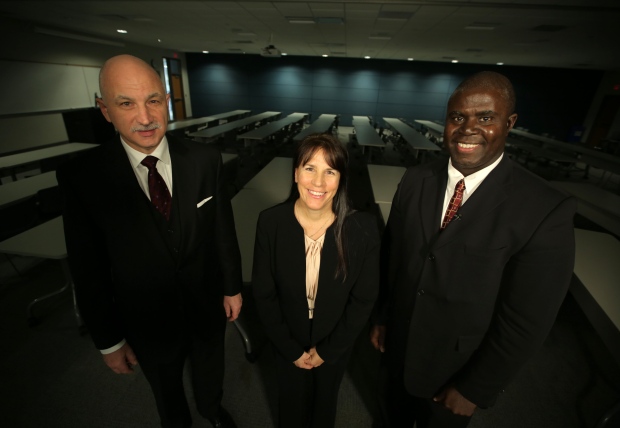
Deputy Police Chief James Ramer, Sgt. Kelly Gallant and Staff Sgt. Donovan Locke say the extremism prevention program has been quietly operating in the city for more than two years. (CBC)

Six months ago, the Canadian Council of Imams announced plans to open two to three deradicalization clinics in Toronto that would take a “holistic” approach, as early as this fall. Those clinics, Toronto imam Hamid Slimi told CBC Toronto, have not yet taken off owing to a lack of community support.

Toronto’s program is housed under the police’s existing community safety program, which also tackles gangs and drugs. Montreal also has an anti-radicalization centre, but not one led by police.

Trust ‘in shambles’ in some communities

But whether young people will consent to being involved in the program will ultimately depend on whether they feel safe engaging with police, says University of Waterloo religious studies post-doctoral fellow Amarnath Amarasingam.

“It depends much on how the police are able to gain the trust of communities. In some communities, this trust is in shambles, but in others, there is a history of working together. So, it really depends if the cops can shed some of this baggage,” Amarasingam said.

Source: Toronto lifts curtain on extremism prevention plan, quietly operating for more than 2 years – Toronto – CBC News

What motivates a Canadian jihadist?

Interesting study by credible researchers:

 A new study based on interviews conducted over social media with foreign fighters in Iraq and Syria raises doubts about the commonly held notion that young men in North America and Europe who are drawn to violent Islamic extremism must be marginalized loners looking for an alternative to their dead-end lives.

Three university researchers who contacted dozens of jihadists from abroad in Iraq and Syria, including some Canadians, say they seemed to be drawn mainly by the religious ideas—“no matter how ill-informed or unorthodox”—behind jihadism. Rather than being isolated individuals who self-radicalized in front of their computer screens, the report says they usually found mentors and, at least in the case of the Canadians, joined the fighting in “clusters.”

In the working paper entitled Talking to Foreign Fighters: Socio-Economic Push versus Existential Pull Factors, the researchers caution against assuming that radical Islam appeals only young men on the edges of society, those without good job prospects or supportive family and friends.

They suggest previous academic studies have put too much weight on those “push” factors—the problems and frustrations in the lives of young men who turn to extremist Islam and, ultimately, terrorist violence. “Based on what we are hearing in interviews with foreign fighters—more interviews than anyone has yet to report on—we think more attention and significance should be given to the repeated affirmations of the positive benefits of being jihadists,” they say.

From mid-December 2015 to Feb. 29, 2016, the researchers put questions to 40 foreign fighters, 60 family members, friends and associates, and 30 online fans, recruiters, and potential fighters. (Among the Canadians the interviewed was Aaron Driver, the would-be terrorist killed last week in a confrontation with police in Strathroy, Ont.) Those fighting in Syria and Iraq were interviewed through “extended social media dialogues.” But their working paper, posted recently on the website of the Canadian Network for Research on Terrorism, Security and Society, is based on an initial analysis of just 20 interviews with foreign fighters in Syria and Iraq.

The researchers are Lorne Dawson of University of Waterloo’s sociology and legal studies department, Amarnath Amarasingam of George Washington University’s program on extremism, and Alexandra Bain of St. Thomas University’s religious studies department. Dawson told Maclean’s by email that they plan to eventually publish a more complete paper on their research in a peer-reviewed journal, and are also “being pressed to write a book in short order.”

In the working paper, they write that the foreign fighters they contacted “run the gamut from troubled youth with personal problems to accomplished young men and women from stable backgrounds.” In the 20 interviews they analyzed, not one of their subjects suggested “directly or indirectly” that being marginalized socially or economically pushed them onto such an extreme path. “Anger and frustration have their role to play in the process, but it is the positive investment in an alternate world-saving role that matters most, no matter how strange it may appear to outsiders,” they say.

As well, the paper points to the importance of influential radical voices who carry some form of religious authority. “In most cases, we would say the help and encouragement of some other outside mentors is required to complete the process of radicalization, to turn wannabe terrorists into deployable agents or independent martyrs for the cause. The process of self-radicalization needs to be legitimated to be complete.”

To probe the views of radicalized young men directly, the researchers had to assure them that they were not seeking “operational information” that would put them at risk. The questions focused on personal and family background, their sense of identity, and how they became fighters.

Along with information about the individuals, the researchers assembled a sort of group portrait of the Canadians fighting for various terrorist and radical factions in Iraq and Syria. “It is extremely difficult to verify any of this information, however, and for the most part we are merely reporting what one or more individuals have told us,” they admit. Still, the outline they sketch is intriguing.

They say Canadians tend to be radicalized in “clusters” and travel to the conflict zone in small groups. Of those who have made the journey, at least 19 Canadian men have died fighting in Syria and Iraq, five or them converts to Islam, the rest from Muslim backgrounds. Eight were from Ontario, eight from Alberta, and three from Quebec. The researchers say they “have good reason to believe” most of the radicalized Canadians in the war-torn region have joined ISIS, but others are fighting for less well-known groups, like Jabhat al-Nusra and Ahrar as-Sham, while at least 15 have fought with Kurdish or Christian militias.

The paper estimates that between 10 and 15 women have gone from Canada to Iraq and Syria to back ISIS, often marrying terrorists. “We know that three have given birth to babies as a result of their marriages to ISIS fighters, who are usually other foreign fighters,” they say.

Throughout the report, the authors repeatedly note that they are summarizing only preliminary findings. “Things may change as more of our existing interviews are analyzed and more interviews are undertaken,” they say. Still, they assert that their interviews with actual fighters have been more extensive than those relied on for previously published scholarly studies.

Source: What motivates a Canadian jihadist? – Macleans.ca

Canadian women give birth to children of ISIS fighters

No real surprise here that Canada is not exempt from this trend of some women living in the West, hard as it is to understand why, both objectively and from their families’ perspective.

Decisions have consequences, as other accounts of women who have traveled to Iraq and Syria have found out (‘There’s no way back now’: For female ISIL members, Syria is one-way journey).

These studies are helpful to highlight this (fortunately small) trend, and more important, inform counter-extremism strategies:

Canadian women are helping to grow the so-called Islamic State.

According to researchers at the University of Waterloo, three Canadian women have given birth to children of ISIS fighters, while another two are pregnant. The new details are part of a larger study following foreign fighters who flee to Syria and Iraq. The women travelled separately over the past two years, leaving their families back home devastated.

“They’re quite worried about what is going to happen to their daughter, but also their grandchild,” said Amarnath Amarasingam, a co-lead author of the study. “For most of the parents, I think there’s kind of a double reaction. First they’re kind of happy a grandchild is involved, but at the same time, they’re quite devastated that a child was born into a war zone, to somebody they’ve never met.”

The researcher also said the challenges these women face are quite obvious. Although they have a place to live, it is difficult to find basic supplies like clothing and diapers. Some of the families back in Canada are keen to help their daughters, but are afraid of the legal consequences.

“If you were to send diapers to Syria, I don’t know if that contributes to real support of a terrorist organization, but it does rest on very shaky legal ground, in terms of what you’re allowed to send to a place like Raqqa,” said Amarasingam.

Public Safety Minister Ralph Goodale said this is “obviously a very disturbing development,” and recommitted to opening a national counter-radicalization office.

“We will be moving forward shortly, as rapidly as we can, on the creation of this new office for community outreach and counter radicalization,” said Goodale.

“I’m concerned with every dimension about this type of problem, it runs contrary to everything Canada stands for, in terms of values in the world,” he added.

The creation of a new office was part of a mandate letter from Prime Minister Justin Trudeau to the public safety minister late last year. The Liberals aren’t saying yet if funding for the office will be included in the upcoming budget, but there are signs this program will be a priority.

Amarasingam said the challenges these women face become more complex because of their age. “These girls are very young,” he added, “they don’t have much experience in how to raise children, but they’re also raising these children under circumstances many others don’t have to worry about.”

Source: Canadian women give birth to children of ISIS fighters | CTV News

Quebec needs to confront its Islamophobia problem

Quebec Second Gen Economic

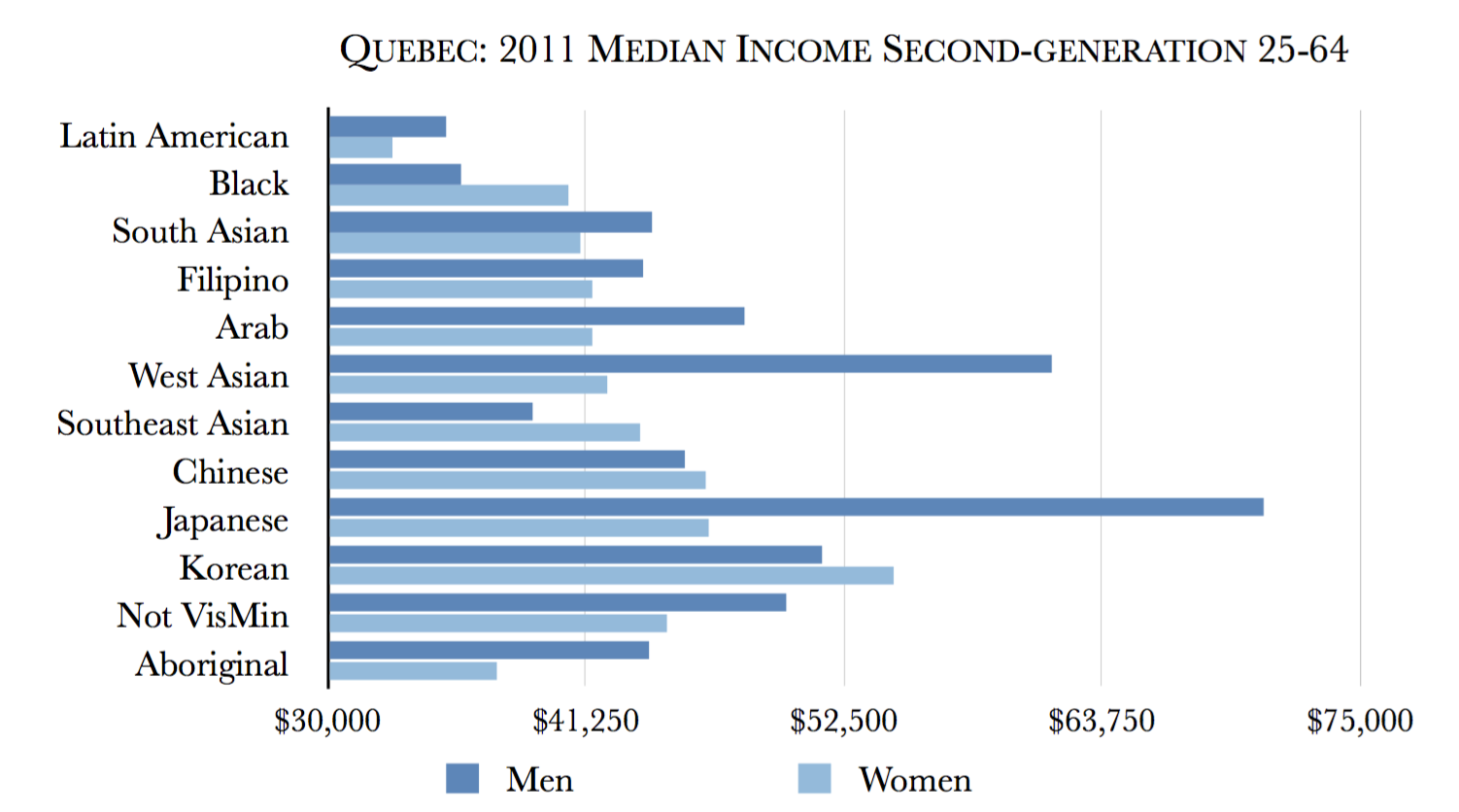
More on the challenges faced by Muslims in Quebec by Amarnath Amarasingam and Higham Tiflati. Overall, economic outcomes for immigrants and their children are lower than elsewhere in Canada:

While Islamophobia and anti-Muslim animus exists throughout Canada, the nature of it in Quebec seems to be unique, and quite worrisome. Law-enforcement officials and social workers receive calls from concerned citizens wanting to report “suspicious persons” like a man with a long beard in their neighbourhood, and calls from concerned families asking whether their relative, a new convert to Islam, could become a terrorist.

Muslim students also report that Francophone CEGEPs do not allow their students to create Muslim Students’ Associations (MSAs), a policy not even practiced by Anglophone CEGEPs in Quebec.

Polling data backs up much of what these young people are expressing. A 2015 Quebec Human Rights Commission survey found that 43 per cent of Quebecers believe we should be suspicious of anyone who openly expresses their religion, with 49 per cent expressing some uneasiness around the sight of Muslim veils.

For many Muslim youth, this kind of public scrutiny is deeply alienating. Young Canadians from other ethnic and religious backgrounds have the privilege and the freedom to wrestle with adolescent identity issues in private. These struggles, ones we have all experienced, play out quite differently for Muslim youth.

Aspects of Muslim youth identity, such as whether to wear the hijab, are quite often national debates, discussed on the nightly news, and even find their way into speeches given by the prime minister. The young girl wearing a hijab is not someone who has made a fairly harmless and rudimentary religious choice, but is seen as someone making a political statement about Western values or ways of life.

It is no surprise then that these youth express an emotional exhaustion arising from being constantly watched, scrutinized, and pitied. Fairly mundane activities such as walking down the street or riding the bus become “events,” requiring mental and psychological fortitude. It takes a deep toll on their confidence, self-esteem and sense of inclusion. As Safiya remarked, “Shayma didn’t want to feel like a stranger here any more.”

Safiya, though, is committed to changing her life in Quebec, and changing the way Quebecers see her and her community. She has dreams and goals. “My parents brought me here for a reason,” she says. “Sure, things are not perfect, but I see potential in our Muslim community here in Quebec and if everyone just left it won’t help.”

Source: Quebec needs to confront its Islamophobia problem | Toronto Star

How afraid should we be of Islamic State? 

Good piece by Mitch Potter in the Star regarding the over-blown hyping of the  threat and risks of ISIS:

Yet even here, some researchers doubt those risks match up with the warnings, given that the number of Canadians known to have joined ISIS is barely enough to mount a decent hockey game.

“The Islamic State is a threat to Canada — but it is wildly overblown,” says Amarnath Amarasingam, a Social Sciences and Humanities Research Council of Canada postdoctoral fellow who co-directs a study of Canadian foreign fighters at the University of Waterloo.

“By our count, there are about 60 Canadians who went to fight, of which 15 are already dead. And not all are with the Islamic State — some are fighting for the Kurds, some are fighting for the Free Syrian Army, for nationalist reasons, not as global jihadists who would present a threat to Canada.”

A similar low-threat assessment for Europe emerged this week in a research paper for Holland’s Clingendael Institute of International Relations, which concluded that, “although concerns have run high following the recent attacks in Paris, the threat of violence carried out by foreign fighters to Europe, while present, is largely overstated.”

Co-author Daniel Byman, a professor of security studies at Georgetown University, goes further in his assessment, emphasizing that while Europe must provide “ongoing resources to security and intelligence services to keep the threat low,” it should also “avoid reactive policies such as systematic prosecution and imprisonment of returnees.

“Some returnees must be imprisoned immediately and others monitored, but governments should also channel resources towards community-led programs emphasizing the rehabilitation and reintegration of returned fighters,” Byman writes.

In the Canadian context, it is difficult to imagine the general public embracing such a nuanced approach when the government itself, with more than a little help from the media, is sounding the direst of warnings. But that too is addressed in the Clingendael recommendations, which urge governments to “take care not to overstate the threat of foreign fighters and take steps to reassure citizens that the risk is real but limited.”

To the University of Waterloo’s Amarasingam, that’s the missing piece in Ottawa’s approach to the problem: we get all the warnings, minus the reassurance.

“I understand what the government and CSIS and the RCMP are trying to do,” says Amarasingam. “They want to ensure that in the unlikely event that Canada ever experiences an attack like 9/11, it won’t tear apart the fabric of our society and have us turn on each other.

“They want to plant the seed of possibility in our consciousness to prepare us. But when you raise those warnings — when you say ‘We’re not a multicultural haven immune from this; we are at risk’ — you also need to temper that message and provide the context that the risk of that kind of attack on the streets of Toronto is actually quite low.

“That’s a key piece that Canadians aren’t getting. And the consequence is that the fear is ramped up out of proportion to the actual risk.”

via How afraid should we be of Islamic State? | Toronto Star.

John Maguire ISIS video is silly, say radicalization experts

I think the experts have it about right. The videos may resonate with some who are already down the radicalization path but are unlikely to trigger interest in radicalization:

[Amarnath] Amarasingam says ISIS’s belief that it can win followers by throwing a few local references into its boilerplate message about Muslim grievances is ineffective.

Theyre “making an argument from deep inside the jihadi narrative,” hoping that it will resonate with westerners “who don’t believe in that narrative.”

The fact that Maguire emphasizes that he was a “bright” student with a “strong” grade-point average in university is ISIS’s attempt to counter the idea that Westerners who join the group suffer from mental problems, says Paul Bramadat, director of the Centre for Studies in Religion and Society at the University of Victoria.

Maguire appears to be challenging “the notion that only terribly alienated, dislocated, or mentally disturbed people might be attracted to this particular religious or political ideology,” says Bramadat, who is also the co-editor of the book Religious Radicalization in Canada and Beyond.

“By underlining his very ordinary upbringing – the hockey, the music – he is saying, Look, I have been a normal member of Canadian culture. I know what I am talking about. I am not an outsider.”

But any right-thinking person can see through it, says [Robert] Heft. “Who is [the message] really going to? A young, uneducated, sometimes depressed and unstable person in society.

“Theres nobody who is a balanced person who says, Wow, he’s fighting a great cause.”

John Maguire ISIS video is silly, say radicalization experts – CBC News – Latest Canada, World, Entertainment and Business News.