Donald Trump could happen in Canada. It’s already begun. – Macleans.ca

Some good analysis and questions regarding the resilience of Canadian politics to Trump-style politics, focussing on the ugliness in the Alberta PC leadership campaign and the Leitch/Blaney campaign approaches.

Starting with Charlie Gillis:

The question, say experts, is whether support for such ideas could galvanize into a Trump-style movement. Ice-breakers like Blaney and Leitch are exploiting the same rural-urban cultural divide that Trump did in the U.S., acknowledges Clark Banack, a Brock University political scientist who studies populist movements. But the kind of anti-elitist discontent that moves votes is seldom seen in Canada outside the West, Banack notes, and when it arises elsewhere, it tends to be short-lived. “We have sporadic examples of people emerging for a short time around a specific issue,” he says, citing Rob Ford’s rise to the Toronto mayoralty on the strength of working-class, suburban anger. “But overall, Canadian political culture is less susceptible to populism than American political culture.”

Another mitigating factor: the relative absence in Canada of a dispossessed working class in a mood to punish its leaders. David Green, a professor at the University of British Columbia’s Vancouver School of Economics, believes Trump’s support base of white men with no college degree would be hard to replicate in this country because the commodities boom sustained Canada’s blue-collar workers, even as the financial crisis crushed the dreams of their counterparts in other countries. Between 2003 and 2015, he notes in a forthcoming paper, mean hourly wages for Americans with a high school education or less fell by six per cent; for the same demographic in Canada, they climbed eight per cent. The effect, he says, was to slow the growth of the economic gap that has fed voter rage in the U.S., the U.K. and parts of Europe. Last year, our top 10 per cent of earners made 8.6 times on average what the bottom 10 per cent pulled in—a ratio that, while high, falls beneath the OECD average and far below the U.S. ratio of 19 to one.

But all that could change, Green warns, if oil prices remain low—especially if the housing market weakens at the same time. The country’s residential construction boom, he notes, has maintained job centres around the country’s large cities, putting more than a few displaced oil patch employees to work. “What do you do with that set of less-than-university-educated guys—the demographic that switched over to Trump?” Green asks. “That’s a potentially worrying connection.”

More so, agrees Banack, if you have a high-minded central government that overlooks their misfortune while pursuing its own pre-occupations. Running against Ottawa, he notes, is a time-tested stratagem for populist movements in Canada, and these days, few national governments are more closely identified with the globalist program of trade, labour mobility and climate-change action than Justin Trudeau’s Liberals. Something like Trudeau’s promised national carbon tax, which will be felt keenly in the West, could be enough to trigger a populist insurgency in Alberta, he says, though it’s safe to assume the federal Conservative party would do everything it could to stop such a movement, given the outcome of the Reform party experiment: “Another vote split, and you could forget about a Conservative federal government for another 10 or 15 years.”

Maybe, but experienced political players are no longer sure economic logic and conventional political calculus are in force. Carter, the Alberta strategist, notes that the online communities where so-called “alt-right” voters congregate—Facebook groups, or conspiracy-fuelled sites like Infowars—don’t traffic in that sort of information. In its place: a strain of fanaticism typified by the onslaught that ran Jansen off the PC stage, which Carter believes is sure to spread. “I don’t know if it’s Trump or social media or just belief that they’re correct that gives a sense of permission,” he says. “But this is not normal.”

Gary Mason in the Globe picks up similar themes:

The Premier and her party are now sitting at 14 per cent in the polls. The party receiving the most support in recent public opinion surveys is the Progressive Conservatives, the same entity Mr. Kenney plans to destroy if he wins the leadership. He wants to build a new political organization that Wildrose members will feel comfortable joining as part of an overarching bid to unify conservative forces in the province.

Either way, Alberta seems to be preparing to make an ideological course correction.

There’s little doubt the rise of Donald Trump has emboldened many in the province. One of those would appear to be Derek Fildebrandt, a Wildrose MLA and one of the most powerful conservative voices in Alberta.

He has little patience for the likes of Ms. Jansen and others complaining about online trolls and provocateurs. “Hypersensitive, politically correct, victim-as-virtue culture is creating a leadership class of wimps,” he wrote in a tweet that could have been sent out by The Donald himself. “People are sick of it.”

After Mr. Trump was elected, Mr. Fildebrandt tweeted: “The biggest lesson that we should learn from the election of Trump: smug, condescending political correctness will spark a backlash.”

I’m not sure what is happening in Alberta, but on almost any level it’s not good. Trump-style politics could well be making its way north of the border. At the end of the day, however, society gets the politicians it deserves.

Source: Not so progressive: Trump-style politics seep into Alberta

Can Jason Kenney throw a rope around Alberta’s unruly Right? Delacourt

Good column by Susan Delacourt on Kenney’ s move to Alberta politics and his many strengths, with a nice shout out to my books:

One of the events obliged panelists to give quick answers to provocative questions posed by the audience. “Who’s the best cabinet minister in Ottawa right now?” someone asked. I didn’t even have to pause for thought: “Jason Kenney,” I said. Many others on stage and in the audience shared that view.

It wasn’t just his reputation for hard work, although that certainly was a factor. Kenney was everywhere in the old Conservative government, building his clout on the political front (with those cultural communities and others) but also on the policy front. I was told once that Kenney had a representative at every meeting in Ottawa, keeping tabs on all kinds of decision-making processes, even those beyond his ministerial brief.

open quote 761b1bKenney does have strong views (no one’s going to mistake him for a Red Tory) but the caricatures ignore his practical side. And party mergers need practical politicians.
For a sense of what kind of minister Kenney was, I tend to urge people to take a look at books published by Andrew Griffith, a former director general in Kenney’s old department of Multiculturalism. Griffith has written revealingly of a public service coming to grips with a minister who had definite ideas about how to blend policy and politics, evidence and anecdote.

And where many ministers hewed to the PMO diktat and avoided contact with the media, Kenney was eminently approachable. I don’t think he ever said no when I asked him for comment on one thing or another. (Though he hasn’t replied to a message I sent him today as I was writing this article.)

For years he held annual Christmas parties at which reporters were not only welcome, but positively encouraged. The reward for attending was getting to hear Kenney tell funny, behind-the-scenes stories about the Harper government — nothing headline-making, just anecdotes that presented his political workplace as a little less stuffy and aloof.

And it was never hard to find opposition MPs during the Harper years willing to say that Kenney (along with John Baird) was one of the more co-operative ministers in cabinet, willing to occasionally drop the hyper-partisan posture that characterized so much of that government’s style.

This version of Jason Kenney is at odds, naturally, with the caricature painted by his critics — of a rigid, even scary, ideologue. Kenney does have strong views (no one’s going to mistake him for a Red Tory) but the caricatures ignore this high-energy politician’s practical side.

And party mergers need practical politicians. Harper was a pragmatist when he set about uniting the old federal PC party with the Canadian Alliance back in 2003.
Still, I will concede that I’m finding it hard to square the more nuanced Kenney I saw with the politician who tweeted out his support for the Brexit vote a couple of weeks ago. Given that much of Brexit’s support came from hostility towards immigrants, it seemed odd, to say the least, to see a former immigration minister — a courter of cultural communities — on that side of the question.

Interim Conservative Leader Rona Ambrose, I noticed, also seemed at a loss to explain the support for Brexit from the likes of Kenney and Tony Clement in an interview last weekend on CBC’s The House — suggesting vaguely that it might have something to do with friendships they’ve forged abroad.

Perhaps it was just Kenney keeping things interesting, blurring the tidy lines of the boxes people want to throw around him. If he is going to seek the leadership of the Alberta PCs, that in itself is a bit of a surprise; many people expected to see him seek the leadership of the federal Conservatives.

It may not be a good sign for those federal Conservatives that Kenney sees his future elsewhere right now. He became pretty adept — as his old boss would attest — at figuring out where there was room for growth in the conservative movement.

Could he pull off a merger in Alberta? I wouldn’t put it past him. Kenney has developed a knack for doing — and being — the unexpected.

Source: Can Jason Kenney throw a rope around Alberta’s unruly Right?

The black people in the Middle of Nowhere: The lost community of Amber Valley, AB

Good piece on the history of Amber Valley and its Black community:

Of course, 1909 Canada was no beacon of racial tolerance — as evidenced by the simple fact that Ottawa didn’t allow a second Amber Valley to take root.

In the era of the Chinese Head Tax and the Komogata Maru, it was clear that the government of Prime Minister Wilfrid Laurier made no bones about keeping out non-white immigrants. The only reason nobody had bothered to explicitly keep out blacks was because nobody in Ottawa could conceive of black people wanting to live in the Siberia-like climate of Alberta.

But it only took a surprise trainload of Oklahomans to spawn a nationwide flurry of petitions and letters demanding that the borders be closed to black immigration.

“This board of trade views with very serious concerns the influx of Negro settlers into Central Alberta,” read a 1911 petition by the Calgary Board of Trade.

If left unchecked, claimed the Calgarians, the tide of American blacks would have a “disastrous influence upon the welfare and development of this fair province.”

The basic objection was fear of a black Canada. The United States at the time had 10 million black citizens, and many in white America all too willing to see them disappear over the Canadian border. At the time, a Vancouver newspaper even published an interview with a Oklahoma immigration agent who was reportedly promising to “put a nigger and a team of horses on every quarter section of land I can get my hands on.”

Ottawa feared a black takeover of the plains that could overwhelm Canada’s existing 7 million population. By 1911, Canadian diplomats had effectively kiboshed any future Amber Valleys by warning would-be U.S. pioneers that “the American Negro may be barred on the ground that he could not become adapted to the rigorous northern climate.”

Tristin Hopper

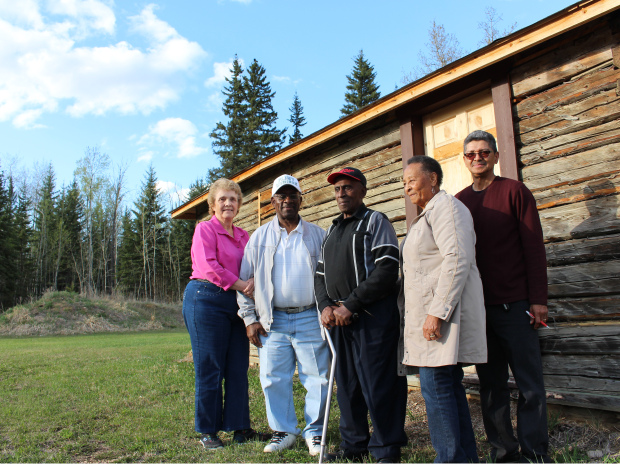
Tristin HopperThe children of Alberta’s black pioneers standing in front of the preserved Amber Valley cabin of Romeo Edwards, April 30, 2016. From left to right, Edith Edwards, brothers Elmer and Ken Edwards, Joyce Edwards and Gilbert Williams. With the exception of Edith, who grew up nearby, all four were born and raised in Amber Valley.

As with so many Western pioneer settlements, Amber Valley’s heyday was shortlived. Born-and-raised Amber Valleyans started striking out for the list of Calgary, Edmonton and Winnipeg by the 1940s, and as parents died the original homesteads were sold.

Source: The black people in the Middle of Nowhere: The lost community of Amber Valley, AB

An Alberta MLA on battling gender identity

A reminder of the value of having diversity among Parliamentarians:

The Alberta legislature has lately become a place for remarkable confessionals, courtesy of the governing New Democrats. Last month, it was a member from Lethbridge who told of the brutal abuse her ex-husband inflicted on her, to bring clarity to a debate on reforms making it easier for Albertans to escape domestic violence.

On Tuesday, an Edmonton-area New Democrat personalized transgender issues, as the legislature debated—and would unanimously support—explicitly adding gender identity and expression to the Alberta Human Rights Act. Estefania Cortes-Vargas, a former office aide to Premier Rachel Notley, had previously been public about being one of the first openly gay MLAs in Alberta history. Tuesday, Cortes-Vargas opened up about gender identity, and started with frustration that assembly Hansard traditionally records members with gender-specific honorifics like Mr. or Ms.

From the Hansard, here is the member recorded simply as Cortes-Vargas:

As I wrote my notes, Speaker, I started off by asking myself why I need to include in that your gender in order to identify you. I asked myself this question before I even came into this Legislature and was asked to identify my gender so Hansard could put that into the transcription.

I have always battled with gender identity, gender expression, and I continue to do so. A lot of the time I don’t have the answers to who I am, why I act this way, why I dress this way, but I do know this: I do know that I’m a person, that I deserve rights, and that anything less than that is unacceptable. Gender, Speaker, plays a role in everyone’s life, but for the trans community and for the gender-variant community it’s magnified to a level that creates high suicide rates, high unemployment rates, high levels of work in the sex trade because people are shunned.

People feel like they cannot be themselves without continuously having to explain to people that, hey, maybe I’m a boy and maybe I’m a girl. It shouldn’t matter. If the way I look confuses people, I love it. I will always continue to challenge that the way I look needs to define anything about me, because at the end of the day, when I look in the mirror, I say: “For the first time in my life, when I cut my hair, when I chose different wardrobes, when I challenged my cultural identity as a Hispanic woman, hey, maybe I don’t need to wear heels, and maybe I don’t need to have long hair just because that’s what is expected and that’s what’s considered beautiful. I think I’m a beautiful person.”

Source: An Alberta MLA on battling gender identity – Macleans.ca

Alberta’s politics have inevitably become more diverse: Hébert

Aberta Key Slides.001 Aberta Key Slides.002 Aberta Key Slides.003 Aberta Key Slides.004 Aberta Key Slides.005

On the eve of the Alberta election, the national media finally notices that Alberta has changed.

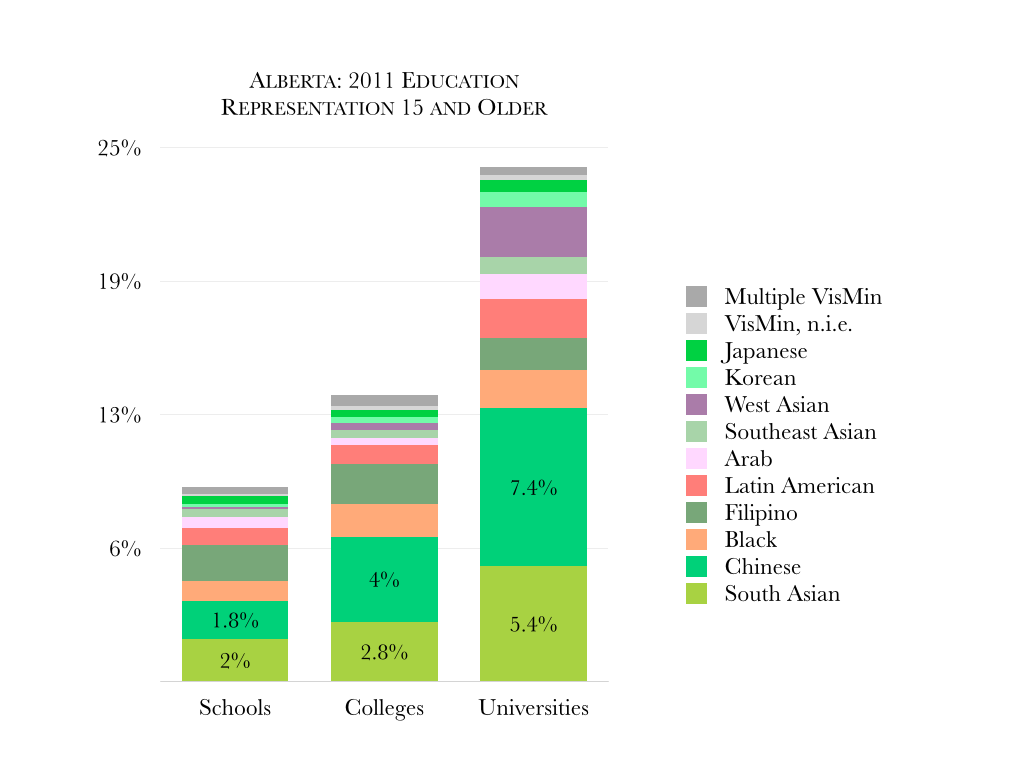
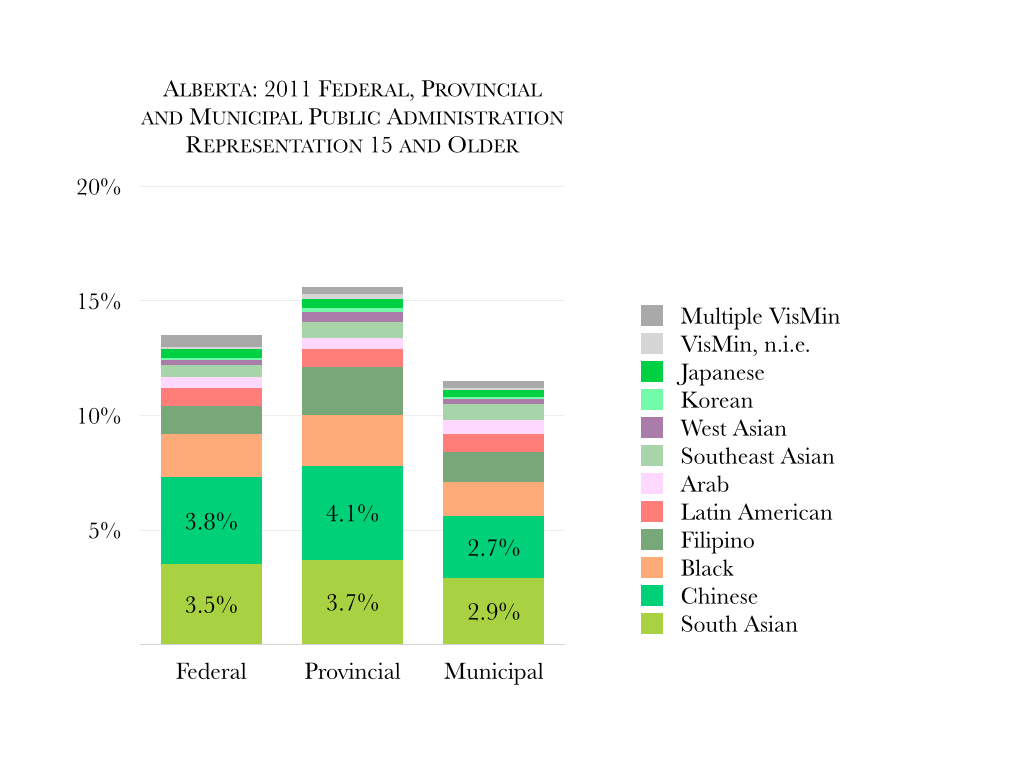
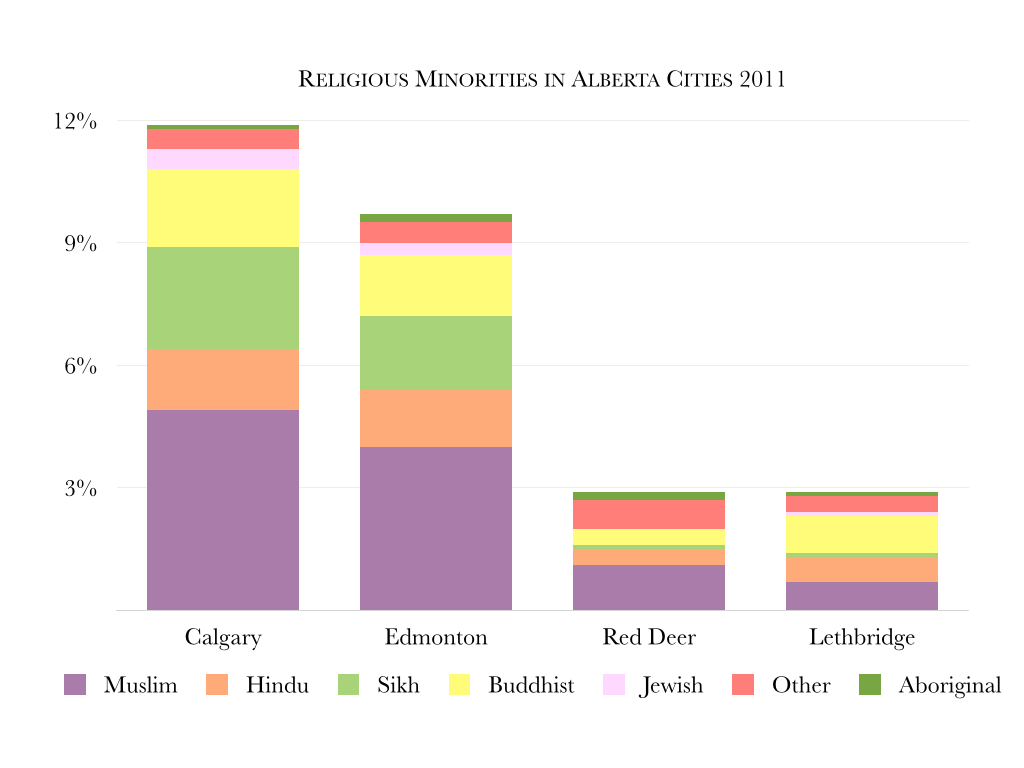
The above charts from my forthcoming book, Multiculturalism in Canada: Evidence and Anecdote, highlight this change from a diversity angle, with Alberta having overtaken Quebec as Canada’s third most diverse province, with strong visible minority representation in healthcare, social services, universities, and provincial government public administration.

Chantal Hébert on the change:

As Alberta goes provincially on Tuesday, it will not automatically go federally. The dynamics of the two back-to-back campaigns are strikingly different.

But over the longer term it would be unwise for the federal Conservatives to bet that their virtual monopoly on Canada’s fourth largest province is immune to the tectonic shift that may see the NDP in power in Edmonton after next week.

In the big picture, it was actually only a matter of time before Alberta’s politics became more diverse.

Sooner or later, the changing demographics of the province were bound to impact on its voting patterns.

Its population has been growing faster than the Canadian average. Its median age (37) is the lowest of the four big provinces.

There is not a poll that does not show that the younger the electorate the better the NDP, the Liberals and the Greens fare versus the Conservatives.

The emergence of the NDP as the leading candidate for provincial government is the biggest crack to date in the monolithic facade of Alberta, but it is not the first one.

That was preceded in 2010 by the election in Calgary in 2010 of Naheed Nenshi, a mayoral candidate who was an outsider to the city’s power circles.

Then there was the taking of an Edmonton riding a year later by NDP MP Linda Duncan with more than 50 per cent of the vote cast and, a year after that, the rise to a close second place of Justin Trudeau’s Liberals in a 2012 Calgary byelection. (In that vote the Green Party came a respectable third with 25 per cent support.)

Even more recently the Trudeau Liberals won 35 per cent of the vote in Fort McMurray — the riding that current Wildrose Leader Brian Jean used to hold during his eight years as a Harper MP.

To predict that Alberta will increasingly take on shades other than blue is not to predict the demise of the federal Conservative party but it is to foresee an ultimately healthier federal political environment.

A more diverse Alberta voice at the national level would be a positive development both for the province and for Canada’s political life.

Alberta’s politics have inevitably become more diverse: Hébert | Toronto Star.

Alberta plans document dump of freedom of information requests

The reaction is almost comical. Too much information, No opportunities for scoops. Do the critics really prefer the federal approach of not releasing, or delaying to the max, information?

But the first two concerns raised by officials strike me as valid:

Sources said the freedom of information co-ordinators were blindsided by the Prentice directive and immediately identified several problems the new policy could create, including:

The potential for privacy breaches.

An increased legal risk for the government if it discloses copyrighted material, or confidential business information.

Backlash from the media, as the new policy would effectively eliminate scoops and undermine long-term investigations.

The inability of the government to justify charging fees for documents that would soon be publicly posted.

Some freedom of information co-ordinators also privately questioned the propriety of Prentice personally ordering a change to policy while the privacy commissioner’s office is conducting an investigation into political interference in freedom of information.

Sources said these concerns were largely ignored. Co-ordinators were told they had to implement the new policy as planned, although legal research had yet to be completed.

I had initially been less sympathetic to the media concerns but listening to journalists discuss the impact on P&P helped me understand the possible implications for scoops and longer-term investigations. But all they need is a window of exclusivity (a week or two) as they should have a head start in knowing what they would be looking for in a way that most would not.

It is a more sophisticated way to manage controversies; flooding, rather than withholding, information. But to make this work, all documents released should be indexed and tagged on Google to ensure easily searchable.

Alberta plans document dump of freedom of information requests – Edmonton – CBC News.

National Post editorial board: When church and state collide

National Post on Alberta’s Bill 10 on allowing gay-straight student clubs and the broader issue of separation of church and state (no funding is the cleanest option):

Above all else, this situation is simply undesirable: Governments shouldn’t be telling churches how to worship, and churches shouldn’t be telling legislators how to govern. And the gap between acceptable religious and political opinion seems unlikely to shrink.

Eventually, Canadian governments may have to make a decision: Fund religious schools and other alternatives to the secular public system — directly or through a portable subsidy — and let them teach according to the tenets of their faith or ideology; or don’t fund them at all. It would cause serious political headaches in the short term, but save many more in the long term.

National Post editorial board: When church and state collide

And Don Braid’s harsh criticism of the Bill and the Alberta government’s handling of the issue:

Bill 10 began life by voicing support for formation of alliances, but then allowing schools or school boards to refuse them. This was “balancing” the rights of students with those of parents and elected trustees, the government said.

If the students still wanted their alliances, well, they could appeal to Court of Queen’s Bench.

From the heart of the legislature gasbag, the PCs were actually serious about making gay teenage children march into court like a pack of government lawyers.

Greeted by torrents of scorn, the government backed up — into further absurdity, unfortunately.

Kids would no longer need appeal to the courts. Instead, if a school board refused an alliance, the minister of education would simply approve it.

There was no longer any thought to the precious “right” of schools to refuse gay-straight alliances. Apparently it never meant much to begin with.

But schools could still say no, which seems absurd when the minister would then say yes. How would children feel about that? Worse, the amended bill gives no guarantee that after ministerial approval, kids would be able to meet on school property.

Further ridicule ensued. This sounded like segregation — “normal” kids are welcome to have their club meetings at school, but gay students have to go down the street.

This bill can’t be allowed to stand in modern Alberta — and the government may finally know it.

Don Braid: Alberta backs away from bullying bill that treats gay students as unequal

Employers say temporary foreign worker figures are not accurate

Never good when the numbers are wrong:

But six employers contacted by The Globe on Thursday contended the information is inaccurate, raising questions about the accuracy of some of the data the government used to support its case for sweeping reforms to the temporary foreign worker TFW program.

The federal list is set to become political fodder in Alberta on Friday, when the Alberta Federation of Labour plans to release a copy that it obtained through a separate information request.

“There are lots of employers using the program very aggressively,” said Alberta Federation of Labour president Gil McGowan. “A lot of these [TFW] jobs are some of the best in our economy and we shouldn’t be cavalier about allowing them to slip through our fingers.”

Three of the largest employers included on the list said the figures were not accurate.Shaw Cablesystems, which was listed as employing 4,354 temporary foreign workers more than 30 per cent of its work force, said it had provided incorrect figures to Employment and Social Development Canada. The correct figure is 169 TFWs, or one per cent of its work force, the company said in a statement.

…. Alberta Labour Minister Ric McIver noted Alberta has a severe labour crunch. He said business owners are inundating him with concerns about restrictions to the foreign worker program.

“Canada is a big country and sometimes one size does not fit all,” Mr. McIver said. “Our goal is to work with our partners in the federal government and look for a program that actually meets the needs of Alberta business, puts Canadians first to get jobs, but doesn’t put businesses out of business by denying them absolutely essential labour.”

Mr. Kenney doesn’t appear to be wavering. In an e-mail Thursday, he noted 110,000 Albertans are looking for work and the changes will affect about 8,000 low-paying jobs currently filled by foreign workers. “There are also still too many people capable of working who are not in the labour force,” Mr. Kenney wrote.

Employers say temporary foreign worker figures are not accurate – The Globe and Mail.

Jason Kenney faces foreign-worker fallout in own backyard – Politics – CBC News

More on the changes to the Temporary Foreign Workers program, the political repercussions:

Like most government decisions, the clampdown on temporary foreign workers has come with a political price.

Last spring, as media reports swirled about questionable use of the scheme by companies small and large, Employment Minister Jason Kenney met for days on end with his staff, hearing hours of briefs and brainstorming a solution, according to a senior government source.

Kenney knew he was walking a political tightrope, trying to maintain the program in industries and regions where employers face legitimate labour shortages, while clamping down — and crucially, being seen to clamp down — on companies that are allegedly displacing Canadians to get cheaper labour.

The minister had long been troubled by reports that included such examples as a coal mine in northern B.C. which listed fluency in Mandarin as a job requirement when requesting foreign temporary workers. The case was the subject of a union-led federal court challenge, but was dismissed.

But the final straw, according to an official who helped craft the government response, was a report that two waitresses were laid off in Estevan, Saskatchewan, only to be replaced by foreign workers.

“That was the kryptonite moment for us,” the source recalls. “This is one of the hardest places to find Canadians to work and yet, they were laying off Canadians.”

Kenney’s decision: phase in a 10 per cent cap on the number of low-wage workers coming in, ban their use in areas where unemployment is six per cent or higher, and increase processing fees and fines for those who abuse the program.

The result: applications to the program were down by 75 per cent this summer over last, Kenney told the Commons last week.

But the result is also growing anger among employers in sectors as far-flung as the fashion and film industries, to fish packing plants, to the hospitality sector and restaurant industry, to mines in remote northern regions.

…Kenney, for his part, is standing firm on the new policy.

His office has argued that businesses, small and large, need to do a labour market assessment as part of their business plan. If they have to offer higher wages to attract people, so be it.

Still, concern about the repercussions could explain the government’s haste to offer a break to small business on EI premiums announced earlier this month by Finance Minister Joe Oliver.

Some Conservatives seem to feel the pot needs sweetening, as they march into election season running on their banner theme: economic prosperity for all.

Jason Kenney faces foreign-worker fallout in own backyard – Politics – CBC News.

ICYMI: Canadians expose foreign worker mess in oilsands | CBCNews.ca Mobile

More controversy regarding Temporary Foreign Workers and alleged abuse of the program to the detriment of Canadians:

Alberta’s minister of jobs, skills, training and labour said cases like this need investigation but foreign workers are still needed in the oilsands.

“We shouldnt penalize a whole industry, a whole economy, a whole region because there are some unfortunate circumstances. What we need to do is to get better at investigating those complaints and providing remedy to them,” said Kyle Fawcett.

When CBC News asked the federal minister responsible if visas may be revoked in this case and he indicated its possible.

“Weve done it… We have sent people home when their presence here as temporary foreign workers was based on misrepresentation,” said Immigration Minister Chris Alexander.

Signs with phrases in foreign languages are up at the Husky Sunrise worksite to help workers communicate with each other.

“We are saying to all employers you will only have access to this program if there’s not a qualified Canadian to do the job.”

The union said, because of a grievance it filed, the latest crew of new arrivals was pared back from 70 to 20 workers.

“These are widespread concerns,” said Nuygen from CLAC. “Safety is definitely one of the top two issues. The other is temporary foreign workers getting jobs ahead of Canadians.”

Demosten said foreign workers are still being promoted, however, to higher paying, non-union foreman jobs over him and other certified Canadians.

“People who don’t speak English are our bosses. They are telling us what to do and they don’t have any idea what to do.”

Canadians expose foreign worker mess in oilsands | CBCNews.ca Mobile.