Perhaps I am a bit thick, but parents of foreign-born adoptees have to commit to raising their adopted child in Canada and thus would most likely meet the residency requirement of 1,095 days within a five-year period.
The direct route to citizenship for adoptees was in response to parental pressure to have a faster route than PR sponsorship. But making that choice meant the adopted child was considered the first generation born abroad, like any naturally born child born abroad.
Appears more a matter of identity and convenience rather than fundamental practicalities to me:
….Two lawyers specializing in citizenship have submitted a briefing paper to the Senate committee, which will consider Bill C-3 this week. They argue that the bill should exempt children adopted from abroad from the substantial-connection test.
The paper’s co-author, Toronto lawyer Sujit Choudhry, who filed the successful constitutional challenge to the Citizenship Act on behalf of Lost Canadian clients, said it is “deeply unfair to the families of these children to treat them differently than children adopted domestically.”
“It also violates Canada’s international treaty obligations and the Charter,” he said in an e-mail.
Its other author, immigration lawyer Maureen Silcoff, suggested that unless Immigration, Refugees and Citizenship Canada addresses the issue it could face a legal challenge.
“IRCC is fully aware of the issue. Adoptive parents and MPs have been advocating on their behalf for years. We do not understand their reluctance to address this issue at this moment, when C-3 is before Parliament. Amending C-3 would avoid unnecessary litigation.”
Don Chapman, a leading advocate for Lost Canadians, who is giving evidence to the Senate committee this week, said, “I don’t want to leave any child behind.”
But he expressed concern that amending the bill in the Senate may lead to it being held up when it returns to the Commons. …
Every year for the last four years, Maha Al-Zu’bi, a former Calgary professor, her husband Tahseen Kharaisat, a former local restaurant owner, and their five-year-old son Furat have dressed in red and white to celebrate Canada Day from the apartment they’re renting in the northwest suburbs of Amman, Jordan.
Maha says, while it’s always a celebratory day, it’s a hard one — because sometimes even the thought of looking at pictures from home brings her to tears.
“We strongly believe we’ll be back in Canada someday. But we don’t know when,” Maha told CBC News. “We love Canada, but sometimes when you love someone you close your eyes to their mistakes because you love them.”
The “mistake” Maha refers to is a federal policy with roots stretching back through the last decade. Families, their lawyers and advocates say it effectively blocks Canadians from adopting children from many Muslim-majority countries. The sticking point is a difference in terminology between how those countries, and Canada, view adoption.
CBC News spoke with two families who say their lives are on hold while they’re left waiting for the government to recognize their adoptions as legal.
‘The way I was being treated never felt like I was Canadian’
Al-Zu’bi and Kharaisat are Canadian citizens. When they moved to Calgary in 2011, Al-Zu’bi quickly got a job at the University of Calgary, where she completed a PhD in environmental design, while Kharaisat opened a shawarma restaurant.
But their family didn’t feel complete — the couple had always hoped to have a child.
After years of exhausting and expensive fertility treatments, and with Al-Zu’bi in her early 40s and Kharaisat about to enter his 50s, time felt like it was running out.
The waitlist to adopt a child in Canada was at least five years, so the couple turned to their country of origin, Jordan, to find a child in need of a home. That’s where they met Furat. The three-month-old boy was born with a cleft hand — a congenital condition where the centre of the hand is missing fingers. He was abandoned by his birth mother due to his disability.
“The first moment the lady gave him to me, I was staring into his eyes and he gave a big smile — it was a great sign that he’s as happy as we are,” Al-Zu’bi said.
They decided to welcome Furat into their family and completed the Jordanian adoption process, under a law called kafala. It never occurred to them to consult a lawyer to investigate whether Canada would treat some international adoptions as different than others — and there was nothing clearly visible on theCanadian government’s website that would indicate that adopting from an Islamic country would be prohibited.
One week after Furat was adopted, the family applied to the Canadian embassy for his visitor visa. It was promptly rejected.
“It was a surprise. And, to be honest, it was very disappointing,” Maha says. “I file taxes every year. We’ve always been good citizens. I love Canada … but [once I started being interviewed] the way I was being treated never felt like I was Canadian. It wasn’t welcoming.”
The family’s lawyer wrote to Alberta Adoption Services to request a review of the department’s policy. Alberta’s justice department instead responded, stating the federal government would need to amend its immigration regulations for the adoption to proceed.
The U.S. issued Furat a visitor visa, despite Canada’s reluctance. The CBC has blurred the photo to hide any personal information. Supplied by Maha Al-Zu’bi (Supplied by Maha Al-Zu’bi)
While adoption is provincially regulated in Canada, few provinces allow for exemptions to the policy, and advocates say the federal restriction means it’s difficult, if not impossible, for families to adopt children under a certain type of Islamic legislation.
That’s because in many Islamic countries, like Jordan, guardianship is established under kafala law, by which adoptive parents become the sponsors or guardians of a child, but not their official adoptive parents. It’s based on an interpretation of the Qur’an that encourages fostering children in need, without severing the possibility of ties to the child’s biological family.
The official reason Furat is barred from entering Canada is that Canada, as a signatory of the Hague Convention on intercountry adoption, does not recognize parent-child guardianships established in countries under Islamic law. Yet the United States, Britain and Australia, all signatories to the same convention, allow adoptions from Islamic countries.
Countries affected by the legislation include Jordan, Somalia, Pakistan, and Morocco. It’s a policy the current federal government promised to review five years ago — but questions from CBC News to the government about the status of that review went unanswered.
Immigration, Refugees and Citizenship Canada maintains these countries’ policies don’t meet Canada’s legal definition of adoption. However, critics say Canada’s policy is based on a misinterpretation of Islamic adoption law that unfairly discriminates against Muslim families.
The IRCC says that while the government is “sensitive to the emotional stress that can be caused when there are issues with cases involving children” it must take precautions to ensure international adoptions comply with laws in Canada, the Hague Convention, and the child’s country of origin.
“Once the adoption process has been completed in accordance with the laws of both countries, then the immigration or citizenship process to bring the child to Canada can proceed,” the IRCC said in an emailed statement.
The family has submitted all requested legal documents, including a letter of support and verification of legal guardianship from Jordan’s foreign affairs ministry and the minister of social development. The IRCC says, as Furat’s case is before the courts, it’s unable to comment further.
Policy’s origins date back to counter-terrorism memo
In British Columbia, unlike Alberta,provincial legislation allows an adoption agency to sign off on non-Hague-recognized adoptions in advance, before a family adopts from overseas, which has allowed some adoptions to be completed in countries like Morocco.
Delia Ramsbotham, managing director of B.C.’s Sunrise Family Services Society, says her agency has received calls from families across the country asking how to adopt from nations that don’t have an established adoption process with Canada — and that sometimes she has to break the news the adoption might not be possible, due to the country they’re trying to adopt from or where they live.
She says that one of the reasons Hague adoption rules are so restrictive is because they’re meant to ensure children are legally available for adoption, and that they’re able to legally immigrate into their adoptive parents’ country.
“It’s an attempt to try to put safeguards in place for everyone involved,” she said. “The powers that be don’t want people who live in Canada flying overseas and doing an adoption and bringing those kids back if we don’t know if those kids were trafficked, if those kids were actually in need of a family or if their parents were paid off … it’s not just protecting the children, it’s protecting the birth parents, and adoptive parents.”
She suggests that anyone preparing to adopt first contact their province or territory’s adoption agency, to get guidance on navigating the complex patchwork of laws between Canada and whichever country they’re interested in adopting from.
When asked by CBC News why Alberta doesn’t recognize guardianship adoptions, like B.C., a spokesperson for Alberta’s minister of children and family services said its legislation doesn’t “recognize guardianship orders as equivalent to adoption orders.”
They added that it’s outside the province’s legislated authority to be involved in international adoptions that only grant guardianship orders.
While Canada ratified the Hague Convention in 1995, adoptions from Islamic countries still appear to have been accepted across Canada until about 2013. That year, Canada abruptly issued a notice that it had banned all adoptions from Pakistan, stating “Pakistani law allows for guardianship of children but does not recognizeour [Canada’s] concept of adoption.”
The CBC’s Fifth Estate releasedan investigation into the policy in 2018, where it found that the restriction had quietly been extended to virtually all Islamic countries, and that emails from federal officials to provinces and territories were attempting to drum up support for the change.
It found that just days before the Pakistan adoption ban, a heavily redacted memo addressed to former foreign affairs minister John Baird, titled “Canadian programming to counter the terrorist threat from Pakistan,” raised questions of whether the decision was motivated by a national security agenda.
CBC News has filed requests under the Access to Information Act with the hope of clarifying the origins of the policy and determining whether the current federal government has endeavoured to change the policy, but has yet to receive the results of those inquiries.
The office of then-federal immigration minister Ahmed Hussen said in 2018 that it would undertake a review of the policy and determine a path forward to recognize Muslim adoptions. But the results of that review, if complete, do not appear to have been made public.
CBC News asked Immigration Minister Sean Fraser’s office for comment on the status of that review and was told that the office does not have an update to share. Any further comment was referred to the IRCC.
The federal government’s website states it can providehumanitarian exemptions to the policy. And legal decisions, like one by an Edmonton Court of Queen’s Bench Justice in 2015, have declared that kafala law does create “apermanent parent-child relationship.”
And yet, five years later, the government policy remains the same, with no clarity. And more families are left in legal limbo.
‘I was so hurt’
Farhan Abdi Omer, a Canadian citizen from Somalia who works as a security officer at the Calgary Courts Centre, is another parent confounded and, in his words, “heartbroken” by the government’s denial of his application to bring his two sons to Canada.
For three-and-a-half years, Omer, like the Al-Zu’bi family, has applied, been denied, and is now in the process of appealing Canada’s immigration system.
Fifteen years ago, Omer was working as a police officer in Somalia. One evening, while inspecting an area of Mogadishu that had seen intense violence and targeting of Somali Christians, he happened across two boys, Ayanle and Khader, on an abandoned street.
They were approximately three and five years old. Omer and his late wife took the boys in, and searched for their birth parents for over a year before deciding to formally adopt them via a secular, United Nations-recognized court in Somalia in 2009.
Later, the family fled Somalia, and became refugees in neighbouring Djibouti. Omer and his wife decided he should immigrate to Canada first, to save money and prepare for the entire family’s arrival down the line.
While in Djibouti, Omer’s wife was diagnosed with cancer, delaying their immigration process as his earnings in Canada went toward her chemotherapy treatments. She passed away in 2017, leaving the boys in the care of Omer’s mother before he began the process to bring them to Canada.
By this point, Omer’s two sons had become Christians, which he says makes them more vulnerable to discrimination in Djibouti.
In 2019, the same year Maha Al-Zu’bi and Tahseen Kharaisat applied for Furat’s temporary visa, Omer applied to sponsor his boys to come to Canada. The application was referred to the Canadian High Commission to Kenya in Nairobi. The visa office twice expressed concern that the Somali adoptions were not legally valid because Somalia is predominantly Islamic.
“I am concerned that there is no official law or legal structure that allows full adoption in Somalia,” reads one of the letters from the high commission, dated May 17, 2021, which Omer provided to CBC News.
“While issues and obligations related to guardianship, custody and care of children left without biological parents may be addressed in Islamic Sharia law as understood in Somalia, Islamic Sharia law and other bodies of law in Somalia do not allow for full adoption of a child, as generally understood in Canada.”
The letter also says the immigration program manager was concerned the arrangement may not be in the best interests of the child because there is “no competent recognized central government adoption authority or child welfare agency in Somalia” with the capacity to approve adoptions, verify the origins of the child or verify adoption documents.
In response, Omer explained, with supporting documentation, that the Somali adoption order was issued by a secular, UN-recognized court.
Further, Omer obtained an order from an Alberta Court of Queen’s Bench (now King’s Bench) justice that establishes that Omer’s Somali adoption order has the legal effect of an adoption order under Alberta law.
Despite these responses, Omer says the visa office refused the applications on the basis that adoptions are not available in Somalia as it is a majority Islamic jurisdiction.
“I was so hurt … Because I’m a Muslim?” Omer said. “I’m a citizen, a Canadian. I respect everyone, all religions. I am integrated. I mean, I can’t hear that from Canada. If I heard that from Somalia, I would say, ‘OK,’ but from Canada? I can’t hear that. It’s not acceptable.”
Last summer, Omer’s application was officially denied, with the family being told by the immigration program manager that he was not satisfied that a legal adoption had taken place.
Ramsbotham, the B.C. agency adoption director, says even if Omer had moved to B.C. and not Alberta, B.C. law likely still wouldn’t allow for him to bring his children to Canada — because it only allows for adoptions approved in advance, and Omer had taken guardianship of his children long before he immigrated.
She said she’d like to see more targeted humanitarian exemptions to the law.
“I do wish that the government would create a provision for valid placements of kids in different circumstances,” Ramsbotham said. “The human experience is too complicated to fit nicely into all the laws that are drawn out.”
A legal fight
Omer is currently in the process of appealing the decision with the support of pro bono legal counsel. In the meantime, he has been working seven shifts a week at the courthouse, sending money to the boys, who are now 18 and 20, and his mother.
Omer’s immigration agent, Tewolde Yohannes, says he has been approached by about half a dozen other Somali families in Calgary struggling to bring their adopted children into Canada, but that after his experience with Omer’s case, he will no longer take on their cases.
“It just drains you,” he says, “knowing the outcome will most likely be negative.”
Omer’s current pro bono counsel is Nick Ettinger. He says the immigration appeal process “can be virtually unnavigable without legal counsel, which may be financially out of reach for many newcomers to Canada.”
In their appeal, Omer’s counsel raised concerns that a ban on adoptions from Islamic countries is discriminatory. An appeal earlier this year argued that the denying visa officer’s blanket statement that Islamic law doesn’t allow for full adoption “lacks transparency … and constitutes an unfounded generalization.”
Omer says his sons face risks to their safety back in East Africa, due to their identity, and he is anxious to bring them to Canada as soon as possible. In the Alberta court’s endorsement of Omer’s adoption order, the presiding judge noted the particular vulnerability of the boys and the urgency with which their application should be processed.
“They need somebody to guide them to success in their life. They need somebody to help them. I need them because I need, you know, to be happy with them — because I was happy,” Omer said. “They’re really smart kids and I want them to have a better life.”
Impossible choices
Al-Zu’bi and Kharaisat are also fighting the government’s decision in Federal Court.
After four years of waiting to return to Canada, they’ve incurred enormous costs — Tahseen was forced to sell his restaurant, the couple depleted their savings, and they sold off all their furniture to pay for their legal expenses.
In one letter from the immigration office in Jordan, an immigration officer told the family that since the Canadian couple chose to adopt their child in Jordan, they might as well just stay there.
“I have considered the emotional and financial hardship to the guardians who have chosen to leave Canada … I do not find that the hardship of the situation they have chosen to pursue is undue,” the officer wrote.
Maha Al-Zu’bi says that since adopting Furat, she hasn’t spent a day away from his side. They could stay in Jordan, but it would mean selling their home in Canada, declaring non-residency, losing their careers, and starting over. Back in Canada, more than 100 friends have written letters of support on their behalf to the government.
Michael Greene, the couple’s lawyer, calls the denial “unfair, [and] grossly unjust.”
Greene says the decision to interpret the Hague Convention to exclude kafala adoption is an entirely political one — no court was involved in the change. He points to a number of changes to immigration legislation either made or considered at the time of the decision, during former federal immigration minister Jason Kenney’s tenure, such as the examination of a plan to cut off refugees withhealth issues and the passage of a law that allows the immigration minister to decide who can and can’t enter the country on the basis ofnational security concerns.
“It’s a political decision. It wasn’t like the courts came down and said, ‘You can’t recognize kafala adoptions anymore.’ I’m suspicious of how the law came about,” Greene says.
However, Kenney, who is no longer in politics, says he had not heard of Canada’s policy on kafala law until CBC News contacted him in August to ask about its origins, and says it never came up during his time as immigration minister.
He added that he does feel the IRCC needs to be rigorous when it comes to international adoptions, whether to prevent child trafficking through “failed states and deeply corrupt countries” or to avoid creating a “back door for de facto immigration for young people who are not bona fide adoptees.”
‘We encourage Furat to always be happy’
Furat, who is now four, is a bubbly and bright little kid.
In a recent Zoom interview with CBC News, he seemed unaware of his family’s plight — but eager to talk about his excitement to see Canada, and to show off his taekwondo moves. But the burden of the situation was apparent on Al-Zu’bi’s face, as she wiped away tears while speaking.
“It’s not easy. We encourage Furat to always be happy. We are trying our best to give him whatever we can for a normal child. We will keep pushing,” Al-Zu’bi said.
Meanwhile, Omer is still preparing to bring his sons to Canada. He talks to the boys and their grandmother daily, before work. He tells them the process has been delayed, but does not share the reason their applications have been rejected.
“They think Canada is very open, and there is freedom of religion here. I don’t want them to lose hope,” he says.
When asked to clarify its policy on adoptions under kafala law, the IRCC sent the following statement:
The Government of Canada’s first priority is to protect the safety and well-being of the child/children involved in international adoptions.
Immigration, Refugees and Citizenship Canada (IRCC) is sensitive to the emotional stress that can be caused when there are issues with cases involving children. Nonetheless, IRCC must take all necessary precautions to ensure that all international adoption cases involving children comply with Canadian laws, international laws, as well as the statutes and regulations of the child’s country of origin.
The Hague Convention on Protection of Children and Co-operation in Respect of Intercountry Adoption (“Hague Convention”), to which Canada is a party, covers only international adoptions that create a permanent legal parent-child relationship between the adoptive parents and the adopted child. Some countries have other systems in place, such as guardianship or Kafala, which does not sever the legal relationship between the biological parents and the child and does not create a new permanent legal parent-child relationship.
These types of systems do not meet Canada’s legal definition of adoption (see s. 3(2) of the Immigration and Refugee Protection Regulations). The Hague Convention, as well as federal, provincial and territorial legislation in Canada, state that the laws of both the country of origin and the receiving country must be complied with for all international adoptions. A key consideration under the Hague Convention is that the child’s availability for adoption must be determined by the child’s state of origin.
For all international adoptions, two separate processes must be completed:
1. The adoption process, and
2. The immigration or citizenship process.
The adoption process involves the adoption authorities in the province or territory of residence of the prospective adoptive parents and the State from which the child is being adopted. Once the adoption process has been completed in accordance with the laws of both countries, then the immigration or citizenship process to bring the child to Canada can proceed.
In Canada, adoption is the responsibility of the provinces and territories, and they all have their own legislation implementing the Hague Convention. IRCC’s role as the competent authority for immigration and citizenship is to make a determination on the right of the child to enter and reside permanently in Canada.
Backlogs within Canada’s immigration bureaucracy are creating what one observer calls an “impossible situation” for families adopting children from outside of the country, with processing delays now far outlasting their children’s visas and rendering the kids ineligible for provincial health coverage.
Last weekend, Greg Hanniman and wife Marli Nicol arrived home from Bulgaria with their newly adopted two-year-old son Aleksandar, at the end of a long and expensive process for the Arnprior, Ont. family.
While Aleksandar is adjusting well to his new home and family, Hanniman says they’re now dealing with maddening uncertainty as they wait for bureaucracy at Immigration, Refugees and Citizenship Canada (IRCC) to even begin processing Aleksandar’s application for citizenship.
Children adopted overseas are usually granted a six-month temporary residence permit, essentially a tourist visa, upon entering Canada. That used to be sufficient to allow IRCC to finish processing their citizenship applications. But delays for processing citizenship for adopted kids are now running close to two years, well past the expiry of temporary visas. That is leaving parents scrambling to get extensions and the children ineligible for basic social programs.
“The major concern we have now obviously is health care,” said Hanniman, a Canadian Armed Forces combat veteran who now works in the computer industry.
The couple began looking into adoption in 2019 and, after meeting Aleksandar in Bulgaria earlier this year and falling in love with him, they submitted their paperwork to IRCC in March.
“It’s clear that he will be granted his citizenship, there’s really no reason why he won’t, but now we have to wait years for the bureaucracy to sort itself out.”
Pavel Georgiev, intercountry adoption co-ordinator with Toronto-based Loving Heart International Adoption Agency, said adopting from out of country entails a two-step process to obtain Canadian citizenship for the child.
In the past, IRCC’s turnaround times for the first part’s approval — where the parents notify where they’re adopting from and demonstrate they are both citizens — was well within the six-month tourist-visa window, Georgiev said. But these approvals are now taking upwards of 20 months. And families are being placed in the position of their newly adopted children overstaying their visas.
“Throughout my 10-plus years of experience in the field of intercountry adoption, this is by far the longest waiting times we’ve seen,” Georgiev said.
“It’s a bit of an impossible situation for adoptive parents.”
Upon landing in Montreal on August 27, Hanniman said he managed to convince immigration officers to grant Aleksandar a two-year visitor record instead of the standard six-month visitor visa. Taking Aleksander back to Bulgaria after a visitor visa expires in six months would have been a non-starter, Hanniman said. And he wasn’t ready to wait nearly two years to bring their son home while IRCC processes his citizenship application
While the extended residency permit has solved most of the family’s short-term problems, it still leaves Aleksandar ineligible for Ontario Health Insurance Plan (OHIP) coverage until his paperwork makes its way through IRCC.
“We have his doctor appointment Tuesday and a dentist on Thursday, but once again, without OHIP, it’s going to be all coming out-of-pocket,” Hanniman said.
When he recently called IRCC to find out the next steps, he said the phone agent told him the government wouldn’t even begin to look at the file until 19 months had passed.
Parents have so far dealt with the uncertainty either by persistently hounding IRCC or their local MP to speed up the approvals, Georgiev said. But he said these are not acceptable solutions.
“Many children who are adopted through intercountry adoption will want to take the child to have a complete assessment by their family doctor,” Georgiev said. But without health coverage, parents are left to pay the medical costs.
Hanniman said he isn’t looking forward to dealing with IRCC when it finally gets around to processing Aleksandar’s paperwork.
“They were not helpful in the slightest,” he said. “They didn’t even try to help.”
IRCC spokesperson Mary Rose Sabater said that IRCC “understands the emotional and financial hardship” experienced in these situations.
She said the two-step process “may take up to six to eight months from start to finish. Depending on the child’s country of origin, it is not unusual for the process to last for two years or even longer.”
Enacting separate adoption-specific immigration streams could help alleviate backlogs, Georgiev said. Once IRCC receives confirmation that an adoption has actually been completed, he said, the government could expedite the paperwork.
“If there were a standardized process through which, once notified and shown documentation that an adoption has been finalized they expedite their review of the part one application and issuance of the approval, that would entirely resolve this problem,” he said.
Processing delays and red tape have become a common complaint for those dealing with Canada’s immigration bureaucracy.
Appears that the parents were aware of the implications when they chose the direct grant of citizenship approach, rather than the permanent residency one. And there was careful thought given to the implications of the first generation cut-off and who would be affected.
And yes, like all citizenship policy, there is a certain arbitrariness involved in the impacts but there was care taken in ensuring that all children born abroad were treated equally. All Canadians need to consider the potential impact of citizenship policy on their children:
When Kat Lanteigne’s adopted son grows up and wants to have children of his own, they won’t automatically inherit his Canadian citizenship if they are born abroad.
The Toronto-area mother and her husband Graeme Ball, both Canadian citizens, adopted their son Nathaniel when he was 15 months old from Zambia in 2017. They chose to apply for a direct grant of citizenship for him, as opposed to sponsoring him as a permanent resident and going through the long process of becoming a citizen through naturalization. Because of this decision, Nathaniel can’t pass on his citizenship to his own children if they are born outside of Canada.
“He is a Canadian citizen. He was granted his citizenship,” Lanteigne told CTVNews.ca during a telephone interview in January. “Why is our son and other children like him considered not to have that right?”
The provision that Lanteigne is referring to was added to Canada’s citizenship law by the federal government under Stephen Harper in 2009. The first-generation limit prevents foreign-born children from passing on their Canadian citizenship to their own offspring if they, too, are born abroad.
It also bars these Canadian foreign-born citizens from applying for a direct citizenship grant for their own children if they, too, are adopted or born abroad.
There are currently two routes to citizenship for foreign-born children who are adopted by Canadian parents.
In the first route, children can become citizens through a direct grant before immigrating to Canada. The second route is through a regular citizenship grant, often called naturalization, where adoptive parents sponsor their child to immigrate to Canada as a permanent resident before they apply to become a citizen later in life.
The first-generation limit that prevents adopted children, like Nathaniel, from passing on their citizenship to their own children if they are born abroad only applies to those who attain citizenship through the first route.
The only exception to the law is for the children or grandchildren of Crown servants, such as government workers or those in the military, who were born naturally or adopted abroad and would automatically inherit Canadian citizenship.
Adopted children who are sponsored first as permanent residents before they’re naturalized, on the other hand, can pass on their Canadian citizenship regardless of where their children are born.
For adoptive parents such as Lanteigne, this distinction creates a “substandard class” of Canadian citizens.
“It’s extremely disappointing,” she said. “It’s disappointing that our government would create a vulnerability for a particular group of people based on their vulnerability, which is that they were a child in need of adoption.”
Even though Lanteigne said she and her husband were aware of the first-generation limit before they adopted their son, they didn’t want to risk having him fly to Canada as a stateless citizen. Zambia, like many countries, did not recognize dual citizenship at the time of Nathaniel’s adoption.
“You have to make the choice as to whether you’re going to apply for the direct route or you’re going to apply for the naturalized route,” Lanteigne said. “We did not want to travel internationally or even have our son live his younger life without being a fully realized citizen.”
Because of that decision, Lanteigne said her son will face future barriers in life that other Canadian citizens won’t encounter.
Limiting ‘indefinite citizenship’
Beatrice Fenelon, a spokesperson for Immigration, Refugees and Citizenship Canada (IRCC), said the first-generation limit “replaced complex requirements” with a “more clear and transparent rule.”
Before it was introduced, she said those born abroad to a Canadian parent in the second and subsequent generations had to meet “certain conditions” and take steps to maintain their citizenship. If they failed to take those steps, they lost their citizenship “often without realizing it,” she said.
“The first-generation limit is applied equally to the children of Canadians born abroad, whether the child is naturally born or adopted, in order to ensure consistency in the application of the rule,” Fenelon explained.
Nastaran Roushan, an immigration lawyer based in Toronto, said the government introduced the amendment in order to limit “indefinite citizenship.”
“This feeds into, whether you believe in it or not, the rhetoric that citizenship is a right and it should be limited as a right to those who are actual Canadians,” she said. “So somewhere along the line, they believe that people are not Canadians any longer because they have enough of a disconnect from the country and therefore they shouldn’t be able to pass on that citizenship to somebody else.”
Roushan acknowledged that in some cases the limitation makes sense, such as when a Canadian and their children spend most of their lives abroad.
However, she suspects the government didn’t consider that in certain cases it puts individuals in precarious situations where they’re living in a country without status.
“It’s arbitrary,” she said.
The immigration lawyer said it’s arbitrary because there are other ways of ensuring people don’t have indefinite citizenship without forcing certain individuals to choose between being potentially stateless and not being able to pass on their citizenship by descent.
Roushan said that some people justify the statelessness issue by pointing to a provision in the act that allows individuals in certain cases to obtain citizenship. However, she said that is only available to those who applied for citizenship before they were 23 years old and they have already been in Canada for 1,095 days.
‘Being ignored’
Another Toronto-area mother, who wished to remain anonymous to protect the identity of her adopted son, shares Lanteigne’s concern about the first-generation limit in Canada’s citizenship law.
When she was in the process of adopting her young son from Ethiopia in 2008 she knew the amendment to limit citizenship by descent would be coming into effect in April 2009.
“It was a difficult situation to be in because I had to just cross my fingers that it would be done in time, that my adoption process would be completed in Ethiopia,” she said.
Like Lanteigne, the mother wanted her son to hold Canadian citizenship before he travelled.
She said she had her final successful court date in early 2009 along with all of her completed paperwork, but her adoption documents weren’t processed by the Canadian government until two weeks after the new law came into effect.
Because they missed the deadline, she said her son, who is now 12 years old, will not be able to pass on his citizenship to his own children if they’re born abroad.
“I have discussed with him that he is a second-class citizen, that he does not have the same rights as other children,” she said. “You can imagine that’s not an easy conversation to have as a parent or as a child. It’s not a good feeling.”
Lanteigne said she and her husband have been trying to have the law overturned for the past five years. In 2015, she put forth a petition with signatures from other adoptive families and supporters calling for the provision to be removed from Canada’s citizenship law, but it was rejected.
Every time she contacts politicians about the law, Lanteigne said she’s told the government has been updating immigration regulations for a long time with no explanation as to why this particular one is being kept in place.
“It’s a constant frustration because it goes on for so long, because the [immigration] minister’s office and this current administration, basically, refuses to engage,” Lanteigne said. “The sad thing about this is this is actually a really minor amendment. It doesn’t take a lot of legislative time.
An under-looked issue – the decline in the number of international options.
The previous government passed legislation granting citizenship to those adopted internationally (rather than through permanent residency) given considerable advocacy at the time by parents of internationally adopted children:
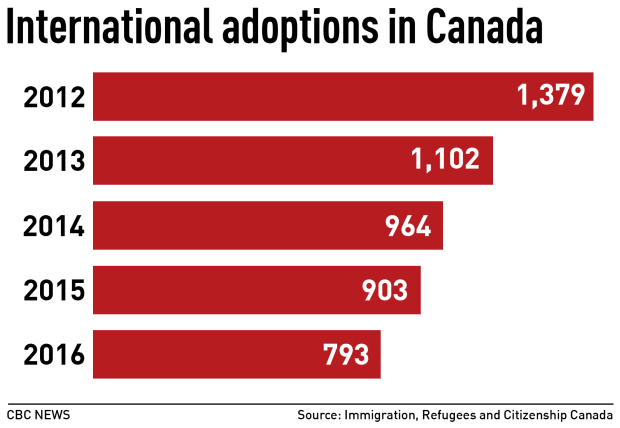
The number of international adoptions has declined dramatically in Canada in the last five years due to tighter country controls, exorbitant costs and alternative routes to parenthood.
Last year, there were only 793 international adoptions in Canada, according to data from Immigration, Refugees and Citizenship Canada (IRCC). That’s the lowest number in decades, and nearly half the total from 2012, when there were 1,379 inter-country adoptions.
Deborah Brennan, chair of the Adoption Council of Canada, points to a number of factors driving the downward trend. These include hefty costs (an international adoption can cost up to $50,000) and an increasingly onerous administrative process that can take anywhere from 18 months to several years.
A growing number of countries have imposed restrictions or all-out bans on international adoptions, and many have developed stronger systems to encourage more adoptions within their own borders.
“I think they are paying more attention to making sure they create an infrastructure within their own country where they can take care of their children themselves,” Brennan said.
She sees the trend as potentially positive for adoptee children, because remaining in their countries of origin helps ensure their family connections, culture and ethnicity are not lost.
“Our preference is that kids do stay … in their own countries of origin because it is risky for kids to come here and lose that. Many parents who adopt internationally, in my opinion, can sometimes do not a great job of maintaining those ties and those roots,” she said.
More domestic adoptions?
While Canadians are increasingly using other ways to have a family, including surrogacy and in vitro fertilization, Brennan hopes fewer international adoptions will mean more domestic adoptions in Canada.
Right now, more than 30,000 children are available for adoption around the country.
Many of them are over six years old, are in sibling groups or are have visible special needs. Brennan said a big part of the problem with matching parents with children is a lack of social workers and a huge gap in the inter-provincial adoption system.
In 1993, the Hague Convention on the Protection of Children and Co-operation in Respect of Intercountry Adoption imposed strict safeguards to make sure all adoptions were in the best interests of the child. It also adopted new measures to crack down on the abduction, sale and trafficking of children.
Some provincial and territorial authorities have imposed suspensions on certain countries of origin including:
Cambodia.
Georgia.
Guatemala.
Liberia.
Nepal.
Data shows that the number of international adoptions to Canada remained high in the aftermath of the Hague convention, with moderate fluctuations between 1999 and 2009 that ranged from 1,535 to 2,127.
Another example of people falling between the cracks through no fault of their own:
Today Adam Crapser calls Korea home, a home he hasn’t been to since he was just 3 years old. But a ruling just last month called for the Korean-born adoptee to be returned to his birth country despite having no connections or family in Korea, nor any understanding of the Korean language.
For the past year, Adam Crapser has been the poster child for the Adoptee Citizenship Act, as he has fought to stay in the United States. Adopted at age 3 by American parents, Crapser was abused by his adoptive parents who never made sure to file for Crapser’s American citizenship. Later adopted by another abusive family, no one ever took care of the paperwork necessary to get his citizenship complete, something that automatically occurs for children adopted internationally after 2000 thanks to the Child Citizenship Act. The loophole in the law has eft an estimated 30,000 adoptees vulnerable to deportation because their parents did not fill out the proper paperwork for their citizenship, according to the Adoptee Rights Campaign.
For Crapser, that meant coming under scrutiny after acquiring a criminal record, in part in an effort to retrieve belongings from his second family, who were convicted of a number of serious criminal charges due to their treatment of Crapser.
Crapser’s attorney on the case, Lori Walls, said Crapser’s story is similar to other cases she’s worked on and seen over the years. Walls began working with Crapser in 2015 after Crapser heard about the successful outcome for one of Walls’ other Korean adoptee clients caught in a similar predicament. In that case the outcome was more positive, but that adoptee’s criminal charges were also less severe than Crapser’s. Regardless, Walls said it’s a travesty that children brought to the United States and adopted by American parents should face such harsh penalty for circumstances beyond their control.
“The United States government facilitated these adoptions and it’s outrageous that the government is now deporting these people,” Walls said. “It doesn’t make sense that someone who entered as an infant or toddler is subjected to deportation proceedings as an adult.”
For that very reason, Rep. Adam Smith, D-Wash., has been working to change the loophole through the introduction of the Adoptee Citizenship Act. If passed, the act would grant citizenship to adoptees whose parents and guardians failed to go through the proper channels to ensure their child’s citizenship.
“We’re talking about people who have no connection whatsoever to their birth country,” Smith said. “They’re subject to the laws of the United States if they commit a crime, but they shouldn’t be subject to deportation.”
For that same reason the Citizenship Act of 2000 was passed to provide adoptees with immediate citizenship upon adoption. However, the law didn’t retroactively cover children adopted prior to 2000.
Seems a bit odd given that the US and UK permit adoptions from Muslim countries, and CIC’s rationale is not articulated beyond the usual process reasons:
Canada maintains that kafala does not qualify as adoption, arguing that the arrangement does not sever legal ties with a child’s biological parents.
Other Western countries, including the United States and United Kingdom, have policies allowing kafala arrangements to be legally recognized there.
Canada’s position on kafala can leave families who have received guardianship in Muslim countries caught in a bureaucratic web that appears to be unique to Canada, and unable to bring their children home.
Nusrat Munshi obtained legal guardianship of Aleeza just two months after the little girl was abandoned at a Karachi orphanage. (Submitted by Nusrat Munshi)
Citizenship and Immigration Canada spokeswoman Nancy Caron says it is not Canada’s policy to discriminate against any country when it comes to adoption.
“Eligibility of individual countries for inter-country adoption is determined on a case-by-case basis by the provinces and territories based on Canadian laws, and with respect for international laws as well as the statutes and wishes of the originating country.”
However, Amirzadeh says whether it’s an official government policy or not, the red tape effectively discriminates against Muslim families. “It’s like saying, ‘You’re born there, so you’re doomed.'”
And while a formal ban on adoptions from Muslim countries isn’t currently official policy, Canada hasn’t entirely ruled one out.
Documents obtained through access to information show that in 2013, the provinces and territories debated a ban on adoptions not only from Pakistan, but other Muslim countries, too.
At least two provinces, British Columbia and Ontario, refused the proposal, according to the documents.
“At this time, there is no intention of extending this closure to inter-country adoptions from other countries, although this does not limit such actions being taken in the future if determined to be warranted,” Citizenship and Immigration Canada wrote then.
Michael Blugerman, a Toronto-based adoption agent who was licensed to process adoptions from Pakistan for years until the 2013 ban, says while the government needs to make sure adoptions are legitimate, lumping cases from Muslim countries together isn’t the answer.
“It’s what I’d call a cultural-religious-profiling problem,” he says.
Meanwhile, Canada and Pakistan differ over the reasons for the adoption ban.
Citizenship and Immigration spokesperson Remi Lariviere says that adoptions from Pakistan were suspended through “ongoing procedural evaluations by the Government of Canada with input from the Government of Pakistan.”
But it seems Pakistan is not objecting to adoptions.
“It was a decision of the Government of Canada,” says spokesperson Nazia Khalid of Pakistan’s High Commission in Ottawa. “If they decide not to allow adoption, what can the Pakistani government say about it?”


 Multicultural Meanderings